Royals and Remembrance

Once Halloween and Guy Fawkes Night have passed, poppy season is all that remains to block Christmas from achieving total domination for the rest of the year. There are, of course, two separate dates for this occasion — Armistice Day (always 11th November, the exact anniversary of the end of the First World War) and Remembrance Sunday (second Sunday in November, a broader commemoration of war dead). Both of these events involve two-minute national silences… assuming, of course, that a silence actually falls. Due to the logistics and practicalities of the working week, some organisations have to hold subsidiary events outside the universal dates. Silences here can be hard to regulate if everyone around isn’t coordinated with it. I remember quite a few occasions from childhood when a reverent, contemplative peace was anything but. Even the highest are not immune to this: The Queen attended a service at Westminster Abbey last Thursday, but it was immediately outside rather than inside the main building. As you would expect from an open-air event in central London on a weekday, the “silence” was actually filled with a lot of traffic noise as well as two different emergency sirens. The only blessing was that at least there were no dogs barking. I’m actually a little surprised that this phenomenon hasn’t been the subject of a Family Guy cutaway by now, given that it would be an easy way to get two minutes of padding with minimal animation.

Another big event in November is the United Nations Climate Change Conference, now taking place in Belém, Brazil. The Prince of Wales flew down some days in advance to present his Earthshot Prize, which Sir Keir Starmer also attended, though neither stayed for COP30 itself. This is the latest in a long line of solo overseas engagements undertaken by the heir apparent since his wife’s cancer diagnosis last year*. William was back in time for the Sunday cenotaph service but he missed the Festival of Remembrance at the Royal Albert Hall on Saturday night. Prince George attended for the first time, in his father’s place. The festival includes the religious and patriotic music expected for a solemn occasion, but also a handful of modern entries. One of these was a cover of Avicii’s The Nights. I can’t work out whether it adds to or detracts from the spirit of the event to know that Avicii himself, err, left this world behind some years ago, his life clearly remembered but tragically brief, and predeceased his father. He was from Sweden, a country formally neutral in both world wars. The festival featured multiple performances from Sir Rod Stewart, who sported the unusual sartorial combination of a knight bachelor’s badge hung from an open shirt.

The cenotaph ceremony in Whitehall traditionally involves the laying of wreaths by senior royals, senior servicemen, cabinet ministers, diplomats, various officials representing the British Overseas Territories and Crown Dependencies, and leaders of the significant political parties in the House of Commons. This has always been a bugbear for Nigel Farage, because his parties have so far never met the threshold of six MPs needed to qualify. UKIP in 2015 got 12.6% of the popular vote but only one seat. Douglas Carswell, as the party’s sole representative in the Commons, was regarded for procedural purposes as an independent rather than a leader. Reform in 2024 got 14.3% of the vote and five seats. The cruel twist here is that since the election the Reform caucus has gained two members (one from defection, one from by-election) but also lost two of the originals, so that when November came they were back as they started. It should be noted that the six-member rule, introduced in 1984, has exceptions for the Northern Ireland parties to avoid the appearance of sectarian bias. It is also possible for two or more parties to coalesce for this purpose, as Plaid Cymru and the Scottish National Party have done since 2001**.

The Princess Royal was also absent from the London commemorations, having gone on a royal tour of Australia. She instead paid her respects at the ANZAC memorial in Sydney. It is a little extraordinary for two royal overseas visits to take place at the same time, especially when both of those away from the United Kingdom are counsellors of state. Recently I have been constructing a Wikipedia page listing all of Anne’s official overseas travel (similar to those which already exist for other senior royals) but it has quickly become a little overwhelming to see just how busy she is, with twenty such journeys listed in the Court Circular just for the last two years.

One ought probably to discuss heraldic matters now. In some of the photographs of Anne’s visit I can see her two crosses and a heart flying in various places. I didn’t see William or Camilla flying theirs in the outings aforementioned. Close-up shots of the wreaths laid and crosses planted also show royal symbols. The Queen’s monogram appeared on hers, complete with the Tudor crown. William’s, even now, still uses the pre-Carolean design (note the oak leaves and lack of arch on the coronet). The King’s wreath did not use his monogram, but instead the full royal achievement with BUCKINGHAM PALACE underneath. Once again it was the old-style illustration with St Edward’s crown.

Sir Lindsay Hoyle is something of a vexillophile and has taken to Tweeting whenever a new flag is flown from New Palace Yard. In 2021 he began making a point of raising the flags of the Overseas Territories. His most recent example was the flag of the British Indian Ocean Territory, allegedly celebrating its national day. I can’t find photographic evidence (including on Parliament.UK) of the flag actually flying in the yard, so I can only go on the image shown in the Tweet itself. The BIOT flag includes the Imperial crown, sometimes with a cap of maintenance and sometimes without, but always in the St Edward form. Hoyle’s picture had a Tudor crown. I cannot find this version on the territory’s website or any other source. Is it a custom make? The BIOT is currently the subject of a slow-moving but high-stakes political controversy as Starmer’s government intends to cede sovereignty of the landmasses to Mauritius. This would mean that the territory as a political entity ceases to exist, hence no point updating the flag. I notice that there was not a representative of the BIOT among all the other BOT representatives laying wreaths at the cenotaph. The flag of the BIOT has been widely used in the campaign against the handover, including by the displaced islanders themselves. The bill to ratify the handover passed the House of Commons and recently had its second reading in the Lords, but then there were reports that the government has paused its progress due to public resistance. In this context it is tempting to read Mr Speaker’s Tweet as a not-so-subtle dig at the Prime Minister.

Finally, a point about Flickr: The cenotaph ceremony and the Earthshot prize both produced plenty of government photographs which can be moved onto Wikimedia Commons. The former had two photographers: Simon Dawson for the Prime Minister’s Office and Gunter Hofer for the DCMS. After migrating both albums across I quickly realised that the time stamps given in the metadata were wrong. Dawson’s were one hour too late (probably not adjusted for daylight savings) while the DCMS ones were in some cases out by a whole year! This feels like an elementary mistake for a professional photographer. Sadly there are not likely to be many photographs of Anne’s excursion to Sydney for the reasons I explained last year.

FOOTNOTES

*The Princess of Wales appears not to have gone abroad on official business since 15 October 2023.
**The SNP alone has won at least six seats in every subsequent general election, so in practice the utility of this alliance is one-sided.

Depravity and Deprivation

The Prince Andrew made a statement two days ago that, following discussions with the rest of the royal family, he will “no longer use my title or the honours which have been conferred upon me”. This is a press release rather than any formal instrument of law, so does not properly remove those from him, though a complete stripping away of said title and honours may be looming anyway. It is important to be aware of the principles and procedures involved here.

Removal of the Peerages

Andrew holds three titles in the Peerage of the United Kingdom — Duke of York, Earl of Inverness and Baron Killyleagh — which were conferred on him by Queen Elizabeth II. He has committed to ceasing all use of these titles whether in public or private context and so most if not all press and official sources will no longer use them when referring to him, but legally removing them is not easy. For almost a thousand years it has been the case that the reigning monarch (nowadays always on the advice of the Prime Minister) was broad prerogatives to hand out peerages at will, but not to then take them back again.

Some media sources are misusing technical terms here: The peerages are not “dormant” (which occurs when the incumbent dies and it is not clear who, if anyone, is the heir), nor “abeyant” (which is where the peerage allows succession to heirs female but without ranking them by primogeniture as the males are, so that inheritance is split between them). They are also not “extinct” or “reverted to the crown” (when the incumbent dies there is definitely no heir), nor “merged with the crown” (when the peer ascends to the throne). Probably the most appropriate term here is disused, for while Andrew legally still is Duke of York, he and everyone else will behave as if he isn’t.*

This video by Dr Allan Barton, writer of The Antiquary, explains most of the processes of removing peerages, which I will here summarise in textual form:

Recent Legislation

The Peerage Act 1963 provided, among other measures, for a person who has inherited a peerage within the last twelve months to disclaim it for his lifetime by writing to the Lord Chancellor. This is not relevant to Andrew’s situation as he has held his titles for over thirty-nine years and they were newly-created for him rather than inherited.

The House of Lords Reform Act 2014 allows peers to retire from Parliament at will, and also allows the Lord Speaker to expel members who are absent without leave for a whole session of six months or longer, as well as those who receive criminal convictions resulting in imprisonment for more than a year. The House of Lords (Expulsion and Suspension) Act 2025 further gives the House the power to vote out members who breach the code of conduct. Notably neither of these acts say anything about removing the titles of those affected, only their membership of the legislature. These are not relevant to Andrew’s situation either because his membership of the upper house was already terminated by the House of Lords Act 1999 and he was not one of the peers elected to stay on at the time nor has he contested any of the hereditary peer by-elections since then.

The Titles Deprivation Act 1917 allowed King George V to revoke British peerages from those whom a specially-appointed committee of the Privy Council had identified as aiding or supporting an enemy country in the First World War. This is probably the closest precedent for Andrew’s situation but still is not itself applicable as his alleged offences are not of the nature described therein, plus “the present war” as specified is one that ended more than four decades before his birth.

Earlier Legislation

In medieval and early modern times, a recurrent political weapon was the Act of Attainder. This was a special Act of Parliament which convicted and sentenced its target for a serious crime without the need for a trial in court. An attainted man lost all of his civil rights and his property was all forfeit to the state. If he held a peerage this was forfeit in the same way.

This was used regularly to punish peers who were political enemies of the monarch, especially if they had led revolts against him. There is precedent for this being used against members of the monarch’s own immediate family, most notably in 1478 when George Plantagenet was attainted and then executed for treason against his brother King Edward IV. He lost the dukedom of Clarence and all subsidiary titles, which his own son Edward of Warwick was then unable to inherit.** The last use of an act of attainder against a peer of the realm was in 1745, when several dozen people were convicted for the Jacobite uprising against King George II.

The procedure for attainder was abolished in the nineteenth century and Winston Churchill was dissuaded from attempting to revive it in the twentieth. The concept of convicting a person of a crime through the legislature rather than the courts was open to abuse for political purposes and is considered incompatible with modern conceptions of Human Rights, so its future usage is highly unlikely.

If the present Duke is to be properly deprived of his peerages, a bespoke new law will need to be devised.

Removal of the Knighthoods and Other Honours

Elizabeth II appointed her son a Commander of the Royal Victorian Order in 1979, then promoted him to Knight Commander in 2003, then Knight Grand Cross in 2011. She also appointed him a Royal Knight Companion of the Order of the Garter in 2006.

Appointments to orders of chivalry are by the monarch’s letters patent, which can be cancelled and annulled by subsequent letters patent. Andrew’s knighthoods are both in orders under the monarch’s direct control rather than those subject to ministerial advice so I would logically assume that members can be removed (or, to use the technical term, degraded) at the monarch’s will as well, but this page on the Cabinet Office website is a little ambiguous.

Andrew was appointed a Grand Companion of the Order of Logohu in 2015. This order has the King of Papua New Guinea as sovereign and the Governor-General as Chancellor, but I haven’t so far found a source clarifying whether governmental advice is required for either appointment or removal.

Andrew also has a raft of military and commemorative medals, including the South Atlantic Medal for his service in the Falklands War. I haven’t looked up the rules of eligibility and forfeiture for all of these individually. His foreign awards (such as the Royal Norwegian Order of St Olav) are up to those countries to decide.

Removal of the Status of Prince

The dignity of Prince or Princess of the United Kingdom, along with the style of Royal Highness, is conferred by the sovereign either by letters patent or royal warrant and can be revoked by the same. François Velde of the website Heraldica has compiled the texts of all of these since 1864. It should be noted that, whereas the monarch himself has a distinct legal title in each of the Commonwealth Realms, the titles of the rest of the royal family only exist in the law of the United Kingdom and are recognised in the other realms by courtesy.

Removal from the Line of Succession

Per the Statute of Westminster 1931 any changes to the rules for succession to the throne must be agreed by all the Commonwealth Realms in unison. Per the Act of Settlement 1701 the Duke can remove himself from the line of succession by converting to Roman Catholicism. Perhaps that is something His Majesty can discuss with His Holiness at next week’s state visit.

Other Matters

The Order of Precedence in Scotland is determined by a royal warrant from 1905. That in England & Wales is based mainly on an ordnance by the Lord Chamberlain in 1595. These can be, and frequently are, amended in small ways by successive royal warrants to assign precedence to individuals and offices for which the original documents did not account. The King could likely revoke Andrew’s precedence as a brother of the monarch by this method.

The House of Lords Precedence Act 1539 (which per se only applies within the Lords chamber but in practice has been used as a basis for the order of precedence in England more widely) is primary legislation and would need another act of Parliament to change it.

Andrew is still eligible to be a Counsellor of State per the Regency Act 1937, as the Counsellors of State Act 2022 did not remove existing counsellors. His position as fourth adult in line to the throne will not change until Princess Charlotte has her twenty-first birthday in 2036. He could be ruled out early if he ceases to be a British subject and/or domiciled in the United Kingdom. Again, the only other way to remove him is by new primary legislation.

His precedence is largely an academic matter now that he is no longer attending even family events let alone public ones, and is fantastically unlikely to be called upon to attend a sitting of Parliament nor to sign state papers, but if there is to be a bill to remove his peerages then it would be fairly easy to tack on an extra couple of sentences dealing with these matters too.

I am a little uncertain as to the protocols around removing his naval rank, but it seems that, with the cooperation of the Admiralty Board, he can be permitted to resign his commission.

Before we get carried away with all of this, it is worth reminding ourselves of the state of limbo in which the addled prince currently lives — he has, after all, still yet to be convicted of, or even tried for, any crime, and in the future it may be considered by cooler heads that a bad precedent was set in such degradation based on the heat of public opinion.

Finally, spare a thought for Andrew Lownie, whose book is, much as I predicted, already seriously overtaken by events barely two months after publication. He’ll have to rush out a new edition next year, I suppose!


FURTHER READING

FOOTNOTES

*The closest parallel, though still quite weak, is how Queen Camilla was legally Princess of Wales from 2005 to 2022 but styled herself Duchess of Cornwall instead.

**As the attainder only applied to his father, he could still inherit the earldoms of Warwick and Salisbury from his maternal grandmother… but then in 1499 he too was attainted and executed for treason against King Henry VII. The latter title was restored in 1512 to his sister Margaret, but then she was attainted in 1539 and executed in 1541 for treason against King Henry VIII.

UPDATE (20th October)

Dr David Torrance has produced a briefing on this topic for the House of Commons Library. My FOI request to the Cabinet Office as to whether the Honours Forfeiture Committee’s remit includes those orders in the sovereign’s personal gift has been rejected.

The Queen’s Austen Faux Pas

The Queen’s Reading Room has just had its annual festival at Chatsworth House. In this video as shown on the ITN royal family YouTube channel, she makes a speech about Jane Austen (who turns 250 this year), a segment of which I will now quote:

We are provided with this magnificent backdrop that was her inspiration for Pemberley in Pride and Prejudice, and who can forget the infamous scene of Mr Darcy emerging from the lake in the BBC version?

There have been quite a few BBC adaptations, but of course she is referring to the 1995 version where Darcy is played by Colin Firth. I have not yet gotten around to reading the book or watching any of its adaptations, but immediately this line pinged something in my head. I was sure I’d read somewhere, many years ago, that this is an example of the Mandela Effect — that the infamous scene that none can forget was never actually in the episode!

Happily I didn’t need to go through the entire series on iPlayer because the Lake Scene is the subject of multiple YouTube videos, including at least two by the BBC itself.

Sure enough, we see him jumping in, then him swimming beneath the surface, then cut to Bennet in Pemberley’s garden, then to Darcy walking along the grassy hills still damp. The actual moment of his emergence from the water is not included.

Just three months ago there was a YouGov article describes this as a prime example of collective false memory: Their study showed 49% remembered the scene happening even though it didn’t. The televisual non-event is so famous that there was even a giant fibreglass statue of Firth erected in Hyde Park in 2013.

I wonder if anyone at Clarence House had to check Her Majesty’s speech in advance of the event. This is the sort of thing which should have been caught and corrected before it went public.

Trump at Windsor and Chequers

The 47th President of the United States has now completed his much-anticipated second state visit to Britain. Here are my observations on it.

Time and Place

This time the state visit was at Windsor Castle instead of Buckingham Palace. Trump himself said that this was because Windsor was better. While most (including the royals themselves) would agree that Windsor is the superior setting by most metrics, the real reason for the change of location is that Buckingham Palace is undergoing major renovations so won’t be available for these kinds of events for some time. Trump had previously visited the castle on his Official (not state) visit in 2018.

There had been some speculation about the idea of the second state visit being held in Scotland rather than England. The King’s letter to him in February even speculated he could come to Balmoral, but this did not come to pass. Trump did make a visit to Scotland this summer while the monarch was also there, but it was a private rather than a political visit and the two men did not meet.

The timing of the visit was a little tight, as it was sandwiched between the Duchess of Kent’s funeral and the Queen’s Reading Room Festival. The Duke & Duchess of Edinburgh were not present due to clashing commitments — commemorating Independence Day in Papua New Guinea, then representing Britain at a business summit in Japan.

Ceremony and Security

What made this visit a little surreal is that, due to the intense unpopularity of Donald Trump among most of the British population and the scale of protests against him, this was the paradoxical phenomenon of a state visit done almost in secret. There were no “public-facing” events, with the foreign visitor instead being flown in his own presidential helicopter directly from Stansted airport to his ambassador’s residence, then to Windsor Castle, then to Chequers, then to Stansted again, thus avoiding the public roads (although his motorcade was still driven there without him in it).

What particularly stood out here was the carriage ride: For the state visitor to be pulled by horse through the streets of Windsor (or the Mall in Westminster) is a standard part of the tradition — witness Macron two months ago, the sovereigns of Japan and Qatar last year, and even Vladimir Putin in 2003 — but the enormous additional security requirements for American leaders had previously rendered this impractical. The solution here was for the carriage ride, like everything else, to happen entirely within the castle grounds. There were still soldiers lining the route, but no cheers from adoring crowds (or, more likely, jeers from abhorring crowds instead). The emptiness of the background gave the scene a visual quality reminiscent of much of the COVID years, especially Prince Philip’s funeral.

Other Parts

The First Lady had a tour of the Windsor Castle library with Queen Camilla, followed by a Scouts Squirrels event with the Princess of Wales. Her facial expressions throughout these events are noticeably different to when she is pictured with her husband.

Attire

As the state banquet was at Windsor, naturally the royal men were wearing the Windsor uniform while everyone else wore white tie. The King & Queen wore the sash of the Order of the Garter, as did the Duke & Duchess of Gloucester, the Prince of Wales and the Princess Royal, while the Princess of Wales and Sir Tim Laurence wore that of the Royal Victorian Order. Trump’s chest was noticeable for its lack of adornment, which is a little odd as he seems exactly the sort of person who would most covet medals and sashes. There was no exchange of honours between the two heads of state, which one would normally expect to see here if it hadn’t been done already.

I also spotted that, when first meeting each other, the sovereign and the president both wore ties the same colour as the hats worn by their respective consorts, which was a nice touch.

Music

We had copious renditions of God Save The King and The Star-Spangled Banner. I was a little surprised we never heard the presidency’s own anthem Hail to the Chief. Protocol aside, it would have been more artistically-apposite to have that one paired with the royal anthem while the national anthem was paired with something like Rule, Britannia!

Progress and Politics

Having completed his Dignified stay at Windsor, the President then moved to Chequers for the Efficient part of the visit. The British and American governments produced a Memorandum of Understanding regarding cooperation on advanced information technologies and, most intriguingly, nuclear energy. That last one is something that Britain has direly needed for a while, though the other parts have yet to fully escape the realm of folly.

Photographs

One of the main perks, for me at least, of having a US Government visit to the UK is that there will be a series of official photographs released into the public domain. I was a little disappointed on this occasion to see that the White House Flickr account didn’t publish any photographs of the visit, while the State Department only published one of Marco Rubio meeting Yvette Cooper on the runway. The collection on Wikimedia Commons is mainly made up of images found on White House Twitter and Instagram feeds. The White House YouTube channel also uploaded some nice long videos of the key events (albeit with a banner over much of the screen). There is less clarity on these platforms as to the copyright status, and it may later turn out that they are commercial photographs rather than government ones, in which case they will have to be removed. The Downing Street Flickr account published three dozen photographs of the event at Chequers but the only one from Windsor was the group shot shown above. This means there are no free photographs of the state dinner itself, so these will have to be sourced from screencaps of the aforementioned videos.

The Future

Already there have been further news articles hinting that Trump intends to invite Charles & Camilla to Washington D.C. next year, on a reciprocal state visit coinciding with the 250th anniversary of the United States’ independence. That should be interesting to see!

UPDATE (22nd September)

The White House Flickr account has now released an album of the state banquet with 27 photographs at time of typing, as well as 83 of the arrival ceremony and 48 of the Chequers conference, which sure makes my life a lot easier.

The Duchess of Kent’s Funeral

The funeral took place today at Westminster Cathedral. It was not televised, but there was a press-pool camera outside which livestreamed to YouTube. Unfortunately the camera feed only covered the outside of the cathedral, and our view of the inside was limited to a handful of still images (which seem to be of guests filing in rather than the ceremony itself), and what could be seen from the outside once the doors were opened. Since it was broad daylight from the outside, it took a while for the camera’s light sensitivity to adjust so that proceedings inside were actually visible. This was briefly undone every time someone in a white cassock walked across the camera’s field of vision outside, so that the interior became a black void again. I will make here what few observations I can, mainly about flags and cars.

When viewed from the piazza, the flagpole on the left of the main door normally flies the flag of the Holy See (or Vatican City) while that on the right flies the Union Flag (or Jack). This time the Vatican flag flew full-mast throughout while the right pole flew the sovereign’s banner of arms at full-mast in his presence and the Union Flag at half-mast in his absence.

Katharine did not have the use of a banner of her own arms (the Duke of Kent impaling Sir William Worsley) so her coffin was draped in the generic royal banner with the ermine bordure. Attendees on departure could be seen clutching the printed order of service with Katharine’s royal cypher (the letter K topped by a coronet of crosses and strawberry leaves, curiously not the version shown on Wikimedia Commons). The order of service itself has not been released, but the royal family website has this article explaining events that took place. An announcement on the cathedral’s website uses Sodacan’s illustration of the late duchess’s heraldic achievement.

The doors opened as the piper was walking out, after which the national anthem was played. Two verses were sung, preceded by Gordon Jacob’s fanfare. It was played on the cathedral’s organ but I don’t think any brass players were present.

I took notes on which royals arrived in which car:

  • The Late Duchess herself was carried in the claret Jaguar hearse (no numberplate) also seen at Elizabeth II’s funeral.
  • The Duke & Duchess of Gloucester in OY20FUL (a dark red diesel Jaguar)
  • Prince & Princess Michael in a blue BMW (probably YK74MHB, electric)
  • The Duke & Duchess of York in KN74EFK (a green hybrid Range Rover)
  • Sir Tim Laurence & The Princess Anne in DK74CMV (a blue petrol Bentley Bentayga)
  • The Prince & Princess of Wales in KU25UPR (a blue hybrid Range Rover)
  • The Duke of Kent & Lady Helen Taylor in a blue Jaguar (registration not shown in footage)
  • The King and Sir Clive Alderton in the Bentley State Limousine (no numberplate needed).

The Duke of York looked a little confused on the way out, walking towards the cars, then back to the cathedral, then to the car again, as if not sure which one he was meant to be using. A short wheelbase bus was used for several other family members, including Lord & Lady Frederick Windsor.

The Duke of Kent, aged 89, understandably looked rather frail and shrivelled. His siblings Prince Michael and Princess Alexandra were both seen in wheelchairs at some points, then walking with canes at others. The Queen did not attend, having pulled out at the last minute due to a sudden bout of acute sinusitis. It is not confirmed if she will still be attending the imminent American state visit.

August Armorial Announcements

The Queen’s heraldic banner continues to be a bugbear: Late last month, Sky Sports Racing Tweeted a short video of Her Majesty arriving (by helicopter) at Ascot. The commentator pointed out that upon Her Majesty’s appearance the royal standard was flown, but I noticed that it was again the generic ermine-bordered version and not that impaled with the arms of Bruce Shand, which has been seen in official usage recently. Perhaps the venue simply didn’t have a copy of that one yet?

The slow rollout of the Tudor Crown continues — on 1st August the Australian Department of Defence announced that all three service branches had updated their logos to use the new crown, as well as making other small adjustments to the rest of the graphics.

On the same day, the British Army announced a new cap badge for The King’s Gurkha Artillery Regiment, which likewise has the Tudor Crown on in. Since this regiment did not exist until this year, there was no St Edward’s version to remove in this case.

The King himself appeared at RAF Lossiemouth on 6th August to present a new standard to 42 (Torpedo Bomber) Squadron. I would assume that the Tudor Crown appeared on it, but none of the photographs or footage of the event gave a clear view of the standard itself — which is ironic given that was the whole point of the event!

Progress in the judiciary is less clear. I should remind readers that I am only speaking here about the judiciary of England and Wales, since that in Scotland uses the other version of the royal arms with the Crown of Scotland while that in Northern Ireland is reluctant to use explicit national symbols at all. The United Kingdom Supreme Court, and the Privy Council, have already been discussed.

From the PDFs of recent judgments, it appears that both civil and criminal divisions of the Court of Appeal are still using the old and rather ugly Royal Courts of Justice logo, with the almost-triangular royal shield topped by St Edward’s Crown, as are all three divisions of the High Court. Other courts are less consistent.

I have seen the Crown Court using several different ideas:

It looks as if every different court location has its own document template.

Discovering the Small Web Movement

What happens when the mines run out?
The Captain announces a new golden age of prosperity. They just fill up again.
What, just like that?
Yeah. Well, you don’t think that’s wrong, do you?
Wrong? It’s an economic miracle. Of course it’s wrong.
Oh. Oh then, of course, the lights change.
What lights?
You know, the lights. The ones on the sky at night. Little points of light.
Do you mean the stars?

Conversation between the Doctor (Tom Baker) and Kimus (David Warwick) in The Pirate Planet (part 2) by Douglas Adams, broadcast 7th October 1978.

Anyone perusing my blog’s back-catalogue recently may recall my post about The Queen’s Reading Room, a post which I named “Reading the Room” in a very weak pun on the topic name. That post now has an update at the bottom clarifying that since I wrote it another podcast has started up which actually is called “Reading the Room”. Of course, it’s such an obvious title that, in this age of mass podcast proliferation, it was bound to be used eventually (and indeed the Substack blog carrying it needs to have “pod” at the end of its subdomain because plain “readingtheroom” was already taken), but this one seems to be rising to prominence among intellectual circles. It almost certainly gets a leg-up due to the fact that both the hosts – Felice Basbøll and Ella Dorn – are columnists for a handful of newspapers and magazines, as likely are a lot of their listeners, so its popularity is not entirely grassroots. Apart from the very broad stroke that they both talk about books, this podcast is entirely unlike the Clarence House production: There are no interviews with the authors, tours of vintage libraries or commissions of research into national literacy statistics. This podcast consists of the two hosts talking among themselves for over an hour at a time about one or more books they’ve read, their choices and the outflowing discussions focusing heavily on philosophy and contemporary socio-political matters. This is not an approach that it would be practical (or constitutionally wise) for Her Majesty to take.

Alright, that’s enough unpaid advertising. The podcast is not the real reason I’m writing this article now. In addition to their newspaper editorials, Basbøll and Dorn both also have individual Substack blogs. Most of what they write there isn’t relevant to this article either, but there was one that particularly struck me as important – Dorn’s post from 27th February this year entitled “How to Take Down Big Tech”. The main thrust was that, for the preservation of online freedom and, more broadly, of enlightened society, it would be better if we avoided large social networks as a general principle in favour of smaller forums and individual websites. She referred to this as “The Small Web Movement”. I have supported the same goals for practically the whole of my online life and have often encountered posts, articles, comments and videos from other people concurring, but only here did I discover that it was an established ideology with a tangible identity.

My history with the World Wide Web is a fought one. For most of the noughties, my family – and most households in the area – had about the connection quality you would expect from rural broadband at that time. Then again, the web itself was still quite primitive. In 2009 out ISP jacked up the price prohibitively high. For the next few years we had no home broadband at all, and internet access was only achievable through a prepaid WiFi plug-in device, which had limited utility. I think it was in 2012 that, having established HubbNet, we finally got a decent connection again. No sooner had I rejoined the online world then I became aware that it was under threat. In the good old days it appeared that, subject only to the physical limitations of their hardware, anyone could have their own website, use any number of online services and upload any number of photographs or videos. It seemed to be, quite literally, a free-for-all. The story of the past decade or so has been the realisation that this utopia was unsustainable. For a long time all of these big sites were running at a loss, heavily subsidised by very wealthy investors who supported the development of these technologies in the hope that they would somehow become massively profitable in the near future. A lot of them still haven’t. As the money dried up and investors started insisting on a tangible return, and even moreso post-pandemic as the long era of ultra-low interest rates finally ended, companies had to make drastic changes to their products to increase revenue and slash costs. Restrictions were placed on space, ads became more aggressive and harder to skip. Pages disappeared behind paywalls and old pictures/videos/files were deleted. The crusade against free riders often became in practice a war on usability. The polite term, though not the common one, for this phenomenon is “Platform Decay”. If the freedom of the web wasn’t under threat from the companies themselves, it was threatened by politicians. Leaders and legislators across many countries, parties and decades have repeatedly sought to take control of the medium that most of them don’t understand in the slightest. This is alternately done in the name of copyright, security and safety. In the New Tens we were threatened with the spectres of SOPA, PIPA, CISPA, ACTA and Article 13. thankfully the most dangerous aspects of these were killed before they could reach the statute book. In the present decade we haven’t been so lucky: I am writing this in the wake of the coming-into-force of the Online Safety Act, a multipartisan disaster passed in 2023 against the objections of everyone with half a brain. Similar laws exist in some parts of the United States and are expected to proliferate across the European Union. However virtuous may have seemed the intentions these laws claimed, they all had the potential to destroy the internet as it has been known for the past thirty years. The deliberations over these laws tend to play out as battles between sovereign states and the major tech businesses, with the common end user having plenty of reason to distrust both. With states concentrating on the most prominent large platforms, and the platform owners themselves often pre-emptively shutting messages which could offend either the government or their advertisers, the need for a decentralised network of small independent backup sites becomes pressing.

The main benefit of having an entire website of your own is that it gives you a greater degree of personal control, especially with regard to visual customisation. Twitter and similar sites give you a profile picture, a couple of sentences’ written biography and maybe a header image if you’re lucky. Long ago YouTube channels allowed you to change the button colours and set a background image, but those abilities were removed around the time they were bought out by Google. Variables, on social media profiles, tend to be restricted within a fairly narrow range. Website builders, by contrast, often allow dozens, maybe hundreds of templates, after which the client has further options for menus, logos, assorted other widgets, fonts and colour schemes. If you’re coding your own website from scratch you can have it look and work basically any way you want. For a physical analogy, imagine a street where each resident can have his own house with its own unique design and decoration, versus a barrack hall where each inmate can, at best, have a different selection of photographs on the backboard behind his pillow. The flipside of this, of course, is that increased proximity allows conversations to happen faster. Short, snappy replies can be given almost in real time, whereas with separate websites they would naturally tend to be longer and more spaced out. Most in and indeed out of the Small Web Movement would consider that a positive, perhaps even the positive, but there are others for whom this spontaneity and intimacy are extremely valuable. There are ways to approximate this, if need be – most website builders include the options for comment sections on posts and pages, as well as a “re-blog” feature. If inter-platform compatibility is an issue, you could always just include a hyperlink to the other person’s post in your own. If that’s too cumbersome… maybe email each other? In my personal experience, I’ve more often witnessed this problem occur the other way around, as Tweeters desperately crush a substantial paragraph of text into a long string of single-sentence posts, or even screenshot the block of text on another medium then upload that as an image. The latter solution has the advantage of speed but it must be monstrously inefficient in terms of accessibility, searchability and digital memory space.

The Movement’s favoured solution is the return to the dedicated online forum. Forums have been around since the earliest days of the World Wide Web, but their power and prominence has waned in latter years with the rise of the social media giants. Reddit, in particular, is designed as a sort of universal mega-forum which subsumes all the others. Forums are a halfway point between personal websites and major social networks, giving people with shared interests a common space without having to invite the whole world in, allowing customisation of design at group level but not individual. Examples of forums which still command some cultural weight are The Student Room, Digital Spy and the notorious Mumsnet. One might throw in the Army Rumour Service as well. There are also lots of smaller forums dedicated to specific hobbies, needs or franchises. Often a long-running film, book, or television series will have a quasi-official fan forum, e.g. Star Trek has Trek BBS, Doctor Who has Outpost Gallifrey and I think I’ve already mentioned Sodor Island Forums. In case I’ve not mentioned already, there are, of course, heraldry forums too.

Fairly it could be said that all of this still falls short of the intention of the Small Web Movement because they still involve using someone else’s platform. The real goal is to have each blogger hosting their own website independently. While I accept the principle of decentralisation, I think expecting everyone to keep individual servers running may be a little beyond feasibility given constraints on money, space, electricity supply and technical knowledge. Indeed, since it has been over a decade since I completed my Information Technology GCSE or had much direct involvement in HubbNet, some of the material I’ve come across from the Movement about Gopher and Gemini is stretching the limits of my own understanding a little, though I hope to get there reasonably soon. Perhaps a compromise could come about in the form of small local data centres, with hosting space rented out in a manner akin to garden allotments. More realistically, since the intention is to transition the masses away from social media accounts, builders such as this would be a relatively easy first step, from which those most determined (and whose sites are successful enough to justify it) can later move the whole way.

I remain undecided on the necessity of registering your own domain rather than using a subdomain of the website builder. I have written before about my disappointment in having to go for “HomeworkDirect.UK” because the Uncle Ben’s rice brand snapped up “HomeworkDirect.Com” just before I could claim it. I always intended this blog to be at “RobinStanleyTaylor.Net”, but did not actually get around to registering the domain until 2017, with “RobinStanleyTaylor.Wordpress.Com” sufficing for the first two years. I cannot run a proper counterfactual to see how the blog would have fared without the change, but I know I was getting at least some regular engagement on the small number of posts I’d made up until that point. I suppose the main value of a domain is on an aesthetic level – it confers an air of formality and professionalism, whereas a “.someonelse.com” looks casual and amateur. A personalised domain also tends to be shorter (what with one of the levels being removed) which makes branding easier. On a practical level, and in keeping with the general thrust of this article, having your own domain allows you to totally replace the website you use without having to give up the URL you’ve already posted everywhere. I took advantage of this in 2022 when I moved Homework Direct to WordPress because Wix put its prices up. On the other hand, renting a domain is itself an expense as well as requiring identification whereas subdomain sites can still be free and anonymous. Of the sites I frequent (on which topic more later), I notice that The Norton View is still on a WordPress subdomain after operating more than fifteen years, as did Murrey and Blue under its original ownership. Of the many Substack blogs I’ve recently encountered, the vast majority have kept it at “.substack.com”, whereas it would be difficult to imagine them all doing the same on WordPress. Perhaps one is considered more prestigious than the other in some way.

As a case study into the importance of having a website and not just a channel, I point to the example of Chuck Sonnenburg, professionally known as SF-Debris. Chuck is a film and television critic of more than seventeen years’ standing, making him one of the seniormost figures in what is now a very large “reviewtainment” industry. He got his start talking about Star Trek: Voyager, then gradually branched out to the rest of the Star Trek franchise, then to other science fiction and fantasy franchises (e.g. Doctor Who and Red Dwarf) as well as whatever miscellaneous films and series his fans suggest for him. He claims to have surpassed the ten thousand video mark some years ago. His journey has rarely been easy. His review videos take the form typical of the genre – ten to fifteen minutes of footage from the episode he’s reviewing, occasionally playing the sound but mostly as a silent montage over which he reads his commentary. Purveyors of this type of content maintain that it falls under Fair Use, but that doesn’t stop IP owners – or indeed the automated systems of the video-hosting services) from blocking videos on the grounds of copyright infringement. Chuck has been around long enough to witness several such piracy purges. For his first few years he used YouTube as his primary platform – only natural as it was and is by far the largest – with a backup channel on Blip.TV. The backup channel was mainly used for long-form videos, as YouTube back then had quite restrictive limits on running time. In 2011, having had a few too many threats from YouTube, Chuck decided to take down hundreds of his own videos before the platform inevitable purged them, then set about making Blip his main platform instead. Rather than simply reupload his old videos in their original form, Chuck decided that a lot of them needed rerecording. He did this alongside still making new reviews, so it took years before all his missing episodes were available again. Almost immediately this effort was rendered worthless because BlipTV completely shut down as a platform. Chuck therefore had to reupload everything again with yet another host. He has joked about this himself, claiming not to remember how many platforms have dropped him over the years. At the time of writing he seems to be using DailyMotion for his “full motion” videos while, ironically, going back to YouTube for lesser versions where he essentially talks over a slideshow of still images instead of moving clips. This alternative format is less engaging to watch but safer from a copyright perspective, as well as almost certainly being easier to edit. Here the point of this [my, not Dorn’s] article comes into play – originally Chuck’s videos were displayed on his YouTube channel and that was likely to be the place where people watched and commented on them. Alongside this, however, he also had a standalone website at sfdebris.com which essentially ran like a blog with each post being titled after the episode or film he was reviewing and consisting of an embed of the corresponding video followed by a short (and snarky) written description. Originally this could have struck some as pointless, but the repeated purges vindicated his approach, for links to his website remain usable long after links to his video channels are killed. When the videos are taken down, the sites pages are left with error messages or even just empty spaces where the embeds used to be, but the page titles, the descriptions and the navigation menus are intact so that the site exists as something of an empty shell. As Chuck proceeds with reuploading on a new video host, the shell is gradually filled in again with the new videos being embedded exactly where the old ones had been. When the reupload process is eventually completed, visitors will find the site looking and working much as it did before. If they notice any difference at all, it will only be that the play button on the video is a different colour – just like the citizens of Zanak noticing the new lights in the sky when the mines are refilled. Nowadays Chuck has the DailyMotion videos unlisted to they cannot be viewed from the hosting site itself, only as embedded on his blog, so that none come to think of the former as his home. Chuck also has a dedicated forum set up to take on the role normally played by the comment section. Again, this helps to maintain long-term continuity, because comments left on the videos themselves would be lost to digital history upon blocks or takedowns. It also has the advantage that the conversations themselves are easier to write and read.

If you’re as much a pessimist as I am you’ve probably already anticipated that if a critical mass of content creators adopted this strategy then the platform owners would cotton on and start forbidding embeds, or at least restricting them in some (probably financial) way to force viewers to use the host sites directly. In this scenario I would hope that creators already using said strategy would be able to vote with their feet by switching to hosts more obliging (unless of course they were to all do it at once). In the interim a simple direct link on the blog page would probably suffice for the same purpose, even if it was less elegant in looks.

Dorn’s article expressed a wish to see people exchanging URLs for websites instead of handles for profiles, so at this point I ought to share some of my own recommendations. Per her advice, I have created a link directory on this website, which can be accessed under the “About” heading in the main menu.

FURTHER READING

On Admirals and Arundells

The Queen turned seventy-eight today. That’s not traditionally considered one of the big birthdays and so commemorations have been fairly muted. The most significant announcement was her appointment as Vice-Admiral of the United Kingdom.

The Vice-Admiral is the deputy to the Lord High Admiral, and it may be prudent to recap the outline of that office first: The Lord High Admiral is the ultimate head (originally operational, but later just ceremonial) of the Royal Navy. Appointments have been made since the late fourteenth century in the Kingdoms of England and Scotland, then later Great Britain. Occasionally in Stuart times, and almost permanently from Anne’s reign onwards, the singular office was not filled and instead the post was instead put “In Commission” – i.e. delegated to the Board of Admiralty with the First Lord of the Admiralty (a cabinet minister) as its chair. The creation of the modern Ministry of Defence in 1964 saw the Board with its First Lord dissolved and the title of Lord High Admiral resumed in the person of Queen Elizabeth II. In 2011, on his ninetieth birthday, she conferred the office upon her husband Philip. The status of the office following his death in 2021 is a little ambiguous but the general assumption is that it defaulted back to the sovereign and now resides in King Charles III. I had wondered if Vice-Admiral Sir Timothy Laurence would be appointed on his seventieth birthday this March, but this did not occur. The King perhaps intends to retain the top office for himself and have his wife as runner-up.

The Queen is both the first female and the first royal holder of the office of Vice-Admiral, whose previous recipients have all been career navy men (and indeed tended to hold the actual rank Full Admiral). Her Majesty’s most recent predecessor was the Lord Boyce, who was appointed in 2021 and died in 2022.

Below the Vice-Admiral is another deputy, the Rear-Admiral. This office is currently held by Sir Gordon General, a General in the Royal Marines who was formerly Vice-Chief of the Defence Staff and also served as Lord High Constable at the 2023 coronation.

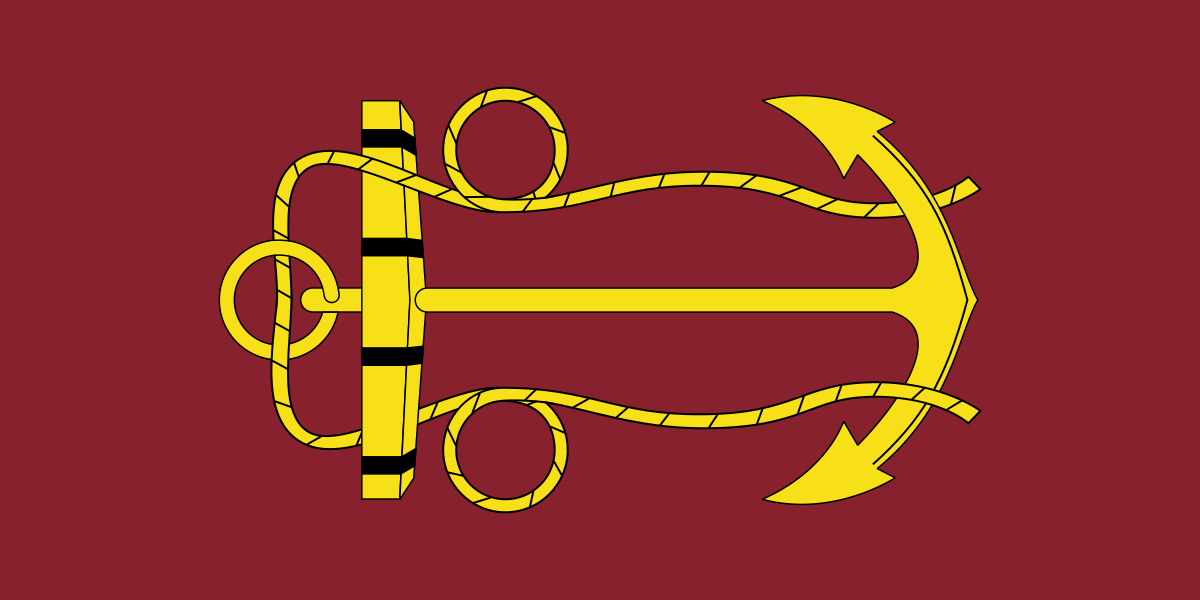
The Lord High Admiral has a flag of office – a fouled golden anchor on a crimson field. The Queen was presented with a “burgee” (pennant) with a red anchor on a white background when she visited HMNB Devonport. I just about saw Camilla’s impaled banner of arms as well.

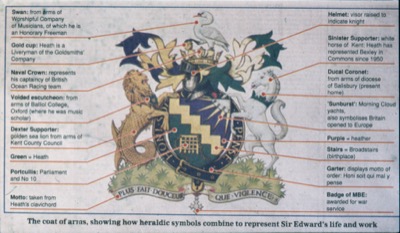
On another note, today is also the twentieth anniversary of the death of Sir Edward Heath, Prime Minister 1970-1974. His military career was on land, though he was a noted yachtsman in later life. He stayed in the House of Commons for twenty-seven years after his premiership had ended, which is considerably longer than all his successors combined. He is the most recent Father of the House to have served more than one term, as well as the most recent to have formerly been Prime Minister.* He is also the most recent example of the Order of the Garter being conferred upon an incumbent member of the House of Commons**.

Wikimedia Commons has long had a vector graphic (by Sodacan, of course) of Sir Edward’s shield of arms, but it was only recently that I discovered, through the website of the Heraldry Society, a photograph of the heralds’ illustration of the full achievement. Heath had no offspring, so the arms as a hereditament became extinct.

This anniversary means that Arundells, his house in Salisbury, will now have been his museum for longer than he actually lived there. He bequeathed the building to his namesake charitable foundation who then opened it to the public. There was a fear in 2010 that the house would need to be sold due to high running costs, which then developed into a legal battle, but as of 2025 the estate seems to be running as normal again.

It should be noted that the spelling is Arundells with two Ls, not Arundels with one. Incidentally, it was an Earl of Arundel who is listed as England’s earliest Lord High Admiral, so everything links up I suppose!

*I’m phrasing it that way because Heath is not the most recent Prime Minister to be Father of the House – that was Callaghan.

**I hesitate to say “sitting member” because St George’s Day in 1992 fell in the interlude after the general election (9th April) but before the new Parliament actually assembled (27th April).

Some Heraldic Snippets

Today the Royal Household released the Sovereign Grant Report. I will discuss the actual substance of it – especially the planned retirement of the royal train – in a later article. For now I will note that the front cover and title page of the report both continue to use the old version of the royal arms with St Edward’s Crown. This was also true of the Birthday Honours published last month in the Gazette.

The Queen opened the Ratho Library in Edinburgh today. She travelled in the newly-acquired BMW G70 (also a topic for a later article) which had her banner flying from the bonnet. It was difficult to get a good look in the footage and the press stills don’t show it at all, but I think I could make out the impalement line, with the dexter side having a yellow top half while the sinister side was white on top and blue on bottom. That would indicate it to be the English marshalling of the royal quarters, surely an armorial faux-pas for an event taking place in the Scottish capital!

The Duke of Edinburgh is in Canada visiting his namesake island and regiment. The royal website’s page on the event depicts his Canadian banner of arms flying in at least one photograph, though again I can’t find it shown in any of the stills on Getty or Alamy.

Also last month another German car manufacturer, Mercedes-Benz, was recognised as a royal warrant-holder. I presume it will be the new Tudor crown illustration that they show, but I haven’t seen any photographs of it yet.

For Gareth and the Empire!

Recently Gareth Ratcliffe, who represents Hay-on-Wye on Powys County Council, Tweeted a photograph of the royal warrant by which he was appointed an Ordinary Member of the Civil Division of the Most Excellent Order of the British Empire.

I have seen photographs and scans of similar documents before, but usually they were from a great many decades ago. I was interested to look at an up-to-date example.

The warrant begins with the sovereign’s full style (in English, of course) and concludes with the place and date. Notably it is accredited to St James’s Palace (which, rather than Buckingham, is the true headquarters of the crown), though I am quite certain that neither the monarch nor his clerks were actually in that place on New Year’s Eve signing thousands of such warrants in one go.

King Charles’s signature appears at the top of the page and Queen Camilla (in her capacity as Great Master of the Order) signs at the bottom. Six months ago I was told by the Foreign, Commonwealth & Development Office that warrants of appointment to these orders of chivalry do not depict a coat of arms, only the seal of the respective order. Embossed at the top of this warrant I can see that the seal itself actually contains the royal arms of the United Kingdom in the English arrangement, so the critical question of whether the design changes when in other realms is not necessarily resolved.

Also in the news this week was the 300th anniversary (or Tercentenary) of the Most Honourable Order of the Bath. The King (as Sovereign) and the Prince of Wales (as Great Master) attended a service in Westminster Abbey to commemorate. The cover of the Order of Service shows the seal of the order, which likewise has the British royal arms. I even found a photograph of a bound copy of the Statutes of the Order, which has the seal illustrated in full colour. There were also photographs taken of the stallplates of current and former Knights Grand Cross, including Great Masters. One hopes to see Prince William’s plate appear there too at some point, if only to get visual evidence of his full heraldic achievement as heir apparent.