Review: The Queen and Mrs Thatcher by Dean Palmer

The Queen and Mrs ThatcherOf all the post-Churchill prime ministers who have governed the United Kingdom, there is one whose personality and policy stick out particularly strongly in the national – and indeed global – consciousness. Margaret Thatcher is the longest-serving British premier in living memory, and also the one whose tenure is often considered the most transformative. Even now, twelve years after her death, her legacy remains a potent force in determining the course of British politics both inside and outside her own party. As I mentioned in my article about memoirs, a lot of MPs define their status in relation to Thatcher in a way that doesn’t happen with Macmillan, Wilson or even Blair. Perhaps, then, it is only natural that her royal audiences, more than anyone else’s, should be a source of such fascination. Palmer isn’t the only one to single out this relationship – there’s also Moira Buffini’s comedy play Handbagged. Thatcher also marks a turning point in Elizabeth II’s reign (the halfway point of which occurred about the time of her third election victory): When the monarch came to the throne her ministers were often people nearly as old as her grandparents, by the end they were people born well within her reign and sometimes younger than her grandchildren. Thatcher was only four months older – had the Princess Elizabeth gone to school they would have been in the same academic year. On top of that, there was the obvious novelty of having the heads of state and government both be female, which still hadn’t happened again when this book came out.

The theme of the book is that despite the superficial similarity in sex and age, the two protagonists (or should that be antagonists) were fundamentally poles apart in class and philosophy – Elizabeth representing the genteel, leisurely aristocracy and Margaret the ambitious middle-class strivers. The chapters on their childhoods are where this difference is laid out most starkly (and also where Palmer’s sympathies are most obvious): Alfred & Beatrice Roberts had high aspirations for their offspring, which little Maggie displayed superhuman intelligence and stamina in pursuing, even to the extent of hiring a private tutor to teach her Latin because her grammar school didn’t offer it but Oxford required it. Palmer says that in a few months she picked up what normally takes five years. Lilibet, by contrast, barely got any formal education as her mother Elizabeth Bowes-Lyon did not value it at all. Mary of Teck intervened to rectify her granddaughters’ shortcomings but even she agreed that it would be undesirable to have them be particularly studious1. That said, it was assured that the princess took seriously her status as heiress presumptive, and that this sometimes gave her an “imperious” attitude, even to the point of criticising a priest’s sermon or a guard unit’s attire (ironically that part is like Thatcher later on). The longstanding political trope of “authenticity” comes up here: Thatcher, having worked her way from middle to upper class, had taken elocution lessons and adopted other affectations which often caused sniggering from both above and below. The Queen, having been born and raised at the top, naturally avoided this. That Thatcher did not share Her Majesty’s (or really any) sense of humour was another cause of friction. It would be wrong, however, to say that such friction is inherent due to the differences in social class, or even to political differences – among the grammar school generation of prime ministers Elizabeth II got along well with Wilson, Callaghan, Major and Brown but not so well with Heath.2

I shall attempt now to go through, in no particular order, the key reasons which Palmer identifies for the disagreement between the two leading ladies. The first is the subversion of the traditional relationship between crown and government: The British constitution employs a separation of the Dignified and Efficient parts of the state so that patriotic adulation can safely be directed at a figurehead who does not exercise real executive power, while the person who does exercise it is kept in a position of symbolic subservience. Furthermore, the Prime Minister is supposed to be first-among-equals, with all the other ministers around the cabinet table deciding on policy collectively. Thatcher’s domineering personality and immaculate sense of style often got her called “Presidential”. She would insist on immediately visiting the scene after a disaster to meet survivors (whereas the royals would wait a day or two in case their presence obstructed rescue and clean-up operations), and taking military salutes in preference to the monarch – something even Churchill couldn’t have done. It was seen that she was usurping her queen’s role as the symbolic personification of the nation. She also had a tendency to ride roughshod over her political colleagues, gradually purging all but the staunchest loyalists from the front bench, then later neglecting even these in favour of a small cabal of special advisers. This, Palmer notes, is what ultimately brought about her political downfall in 1990.

The second point of contention was Thatcher’s political philosophy: Although she was the Leader of the Conservative Party, many commentaries and histories of her tenure remark that it was really the Labour Party at this time which was “small-c conservative” in so far as it sought to maintain the prevailing status quo in Britain’s economic order. Thatcher thought that the policies of the last dozen governments had led Britain into terminal stagnation and that radical reforms were needed to find prosperity again – the welfare state, the nationalised industries and the trade unions were all dead weights which throttled growth, therefore they had to be destroyed. There was to be a ruthless drive for efficiency and productivity above all else. This did not sit well with the sedate and sentimentalist approach to life favoured by the royal household and the rest of the aristocracy. Despite the outward deference of Thatcher herself, the Firm could well have feared for their own survival against the forces she sought to unleash. The traditionalist wing of the Conservative Party, many of whose members were also from aristocratic backgrounds and who supported a paternalistic approach, likewise balked at much of this. A division erupted between One-Nation/Wet and Thatcherite/Dry parliamentarians which continues to this day.

The third division was over the pair’s approach to division itself: Thatcher realised that in order to be an effective political leader she often had to make decisions which would be unpopular even if they were necessary (and ultimately beneficial). A government can survive on the support of a surprisingly-low proportion of the population (given turnout and constituency distribution) and even that need technically only be mustered once every four or five years when a general election comes around. Party leaders need to make strategic calculations about which demographics matter and which don’t, as well as what they can accomplish in the limited time available to them. Thatcher to this day is legendarily divisive, making enemies of large swathes of the country, but not really caring as long as she beat them. The Queen, by contrast, needed to be monarch for everyone, everywhere, forever, no matter their creed or their breed. The position of the crown was more comfortable in the age of consensus than when the people were polarised. This distinction is especially stark in international affairs because Thatcher was only head of government in one country whereas Elizabeth was head of the enormous Commonwealth of Nations, many of which were demographically and economically very different to the United Kingdom. At times of crisis, such as over Rhodesia and South Africa, Thatcher often found herself at odds with the majority of her overseas counterparts, leaving Her Majesty in a difficult position scrambling to hold the organisation together. The Queen greatly valued her extended Commonwealth family, whereas Thatcher saw many of them (particularly the African countries) as ungrateful leeches. This rift also continues in the Conservative Party to this day.

Finally, many pages are devoted to Thatcher’s dealings with the news empire of Rupert Murdoch. He achieved his dominance of the British press during Thatcher’s premiership thanks in no small part to her continued and determined support. Murdoch’s many papers and other outlets would ensure the widespread distribution of the Thatcherite perspective. Murdoch shared Thatcher’s hatred of trade unions and strikers. He also had a loathing of Buckingham Palace, and his reporters would go to great lengths to dig up (or indeed create) dirt on the Windsors, intruding on their private lives where the British press theretofore had restrained themselves from treading. Thatcher may not have actively approved of such practices, but she tacitly tolerated them in exchange for Murdoch’s support to her government. To this day, many on the left and right (though mostly left) identify “The Murdoch Press” as the root of a great deal of Britain’s political and social instability – his antics in the 1980s encouraged an overall lowering of the tone which has yet to rise back up.

I picked up my copy of Palmer’s book from a throw-out sale at Hull Central Library on the 1st of this month at a price of 50p. I noticed there was a more recent edition of the same title still on the shelves for lending. In mine, I spotted an alarming number of proofreading errors, some of which I will now list for your amusement:

  • Page 43: “Alfred Roberts sought to make something of himself beyond the realm of his little business by taking an active role in both his local Methodist church and by serving on the local council.” – The word “both” should immediately follow “business”.
  • Page 61: “Mothers throughout the country were astonished that a women would take free milk from children.” – That should be “a woman” not “a women”.
  • Page 93: “Not since Elizabeth I and Mary, Queen of Scots had two “queen regnants” lived in the British Isles.” – That should be “queens regnant” not “queen regnants”.
  • Page 138: “Prurient interest in the royal family’s private lives were off-limits.” – That should be either “interests” or “was off-limits”.
  • Page 165: “Scargill was a socialist hero after helping to bring down the Tory Government in 1984.” – I would assume that meant to say 1974.
  • Page 166: “It cost £44 to mine a metric ton of British coal, while the rest of the world were selling it for £32 per ton.” – That should probably be “was selling” and metric tons are more commonly called tonnes.
  • Page 192: “At Buckingham Palace, Her Majesty waited for the third time to invited Mrs Thatcher to form her government.” – That should be “to invite” not “to invited”.
  • Page 221: “embarrassment” is used twice in the same paragraph.
  • Page 271: “King William and Queen Katherine would certainly sparkle” – That should be “Catherine” not “Katherine”.

Also, throughout the book Palmer refers to “the queen” rather than “The Queen” or “the Queen” which are more usual in most style guides.

I was intrigued too by the reference on page 153 to “the first Elizabethan period”, obviously identifying 1952-2022 as the second such era. This usage has not really caught on widely in academia or among the general public. I wonder whether “New Carolean” will do so.

On that note, the political attitudes of the then-Prince of Wales are also covered. He is described as being more “Wet” than his mother, and even as being sympathetic to the Social Democratic Party under David Owen. There is mention on page 195 of a meeting between prince and premier about increasing the former’s constitutional role. Thatcher turned down planning for any regency arrangements. She said he could open parliamentary sessions in his mother’s absence if need be, but only as a Lord Commissioner on the woolsack instead of from the throne (ironically the former was made impossible in 1999 and the latter wound up happening of Elizabeth II’s own volition in 2022). The most surprising thing mentioned was the stance of Queen Elizabeth the Queen Mother – apparently (page 207) she was an ultra-Thatcherite and fully supported the prime minister’s ideology, which is a little at odds with what was said about her attitude to raising her daughters as aforementioned or what the book also said about her dealings with Charles.

A few days ago I mentioned three new royal biographies coming out. While I have yet to read any of them in full (and may never do so) I read some of the previews on Google Books. Excepting where the later books describe events too recent for the earlier ones to cover, I expected that there would be a fair bit of overlap. Sure enough I noticed a lot of the same quotations and anecdotes appearing. This book has a very lengthy endnotes section which links back repeatedly to a large number of earlier royal and political biographies. Since most members of the family rarely (and the monarchs themselves never) give tell-all interviews (and those who do are often unreliable in what they say), nearly all of the publications on this subject will be pieced together from the same handful of sources, stories and speculations, with the original part being the author’s decision on which way to arrange them, what narrative arc to infer from them, and what commentary to add. Palmer does an adequate job of that, I suppose, but I can’t see this ever being considered one of the greats.


FOOTNOTES

1The term for this was “bluestocking”, which is also the name of Helen Lewis’s blog.

2The book came out too early to learn what she thought of May, let alone Truss.

Mid-Year Reading Round-up

Having already posted some months ago a long list of all the books I’ve recently acquired, I suppose at some point I should say something about the experience of actually reading them. Here, then, are some mini-reviews of the publications I’ve finished during the period of January-June 2025, in no particular order.

The First Four Georges by Sir J. H. Plumb

Already reviewed in a different post.

The Extended Phenotype by Richard Dawkins

Although he is primarily famous for The God Delusion and maybe secondarily for The Selfish Gene, the professor himself generally regards this one as his true magnum opus. I’m not sure how famous Dawkins already was back in 1982, but this book feels as if written in his capacity as a biologist rather than as a public intellectual and activist. It is a much more academic work than his more famous ones and, having not been taught biology for just over a decade, I cannot claim full comprehension of the more terminologically-dense parts, but these aren’t really necessary for understanding the main thesis. Dawkins does not present new facts so much as a new way of interpreting facts we already possess: Normally the conception of evolution and natural selection is that they take place on the level of the individual organism, the family, the society and even the entire species. Dawkins instead looks at it in terms of the alleles of genes competing indirectly against each other with the organisms serving merely as a convenient – and disposable – host. The title of the book refers to Dawkins’s other big point that alleles affect the physical and behavioural characteristics of a species, which in turn affect the environment those species inhabit, as well as the ways in which other species evolve in response, so the phenotype of an allele in one species can be regarded as including the features observed in another species. The author also brings up a great many case studies of evolutionary adaptation and competition, including counter-intuitive examples such as between males and females of the same species, or even between parent and child! Of great interest here are his analyses of why some creatures are capable of adapting to “win” an evolutionary war while others are not. A theme which runs through the book as well is the difficulty of finding the vocabulary to comprehend these complex natural phenomena without slipping into metaphor and personification, which feels in some way prescient given the author’s later writings about religion.

The Final Curtsey by Margaret Rhodes

As with Lady Boothroyd’s autobiography, the early sections of this book felt a lot like reading my own grandmother’s childhood recollections, although from the opposite end of the class spectrum. Rhodes gives her account of her aristocratic early life, her experience of living through the war and her career as a courtier to the royal family. One thing that confused me a little was her choice of names for Britain’s senior mother and daughter after 1952 – the reigning sovereign is “The Queen” whereas George VI’s widow is “Queen Elizabeth”. Often I would get a long way into a paragraph before working out which one Rhodes meant. Despite being published in 2012, just four years before she died, Rhodes mentions a distinctly old-fashioned approach to writing. To modern eyes she appears curiously unfazed by the historical weight of her experiences, taking it in her stride that she dined nightly with the heiress presumptive while the bombs were falling, got roped into organising a faraway dynastic wedding, smuggled prisoners out of a country undergoing a violent coup and even watched a man drop dead in front of her. While the overall tone may seem a little twee at times it’s definitely worth the read and packs a lot into relatively few pages. The final days of the Princess Margaret and the Queen Mother are especially important for the record.

The Gathering Storm by Sir Winston Churchill

This is a very long book, and that’s only the first in a six-volume set amounting to more than three thousand pages in total. Churchill has written a great many well-renowned history books, but here it is a history in which he was a major protagonist so it also doubles as a memoir of sorts. The length here is justified as he writes in great detail about a multiplicity of topics, taking the reader step-by-step from the conclusion of WWI to the outbreak of WWII, with the volume ending at the point when he became Prime Minister. It’s astonishing to realise that he completed this enormous tome while he was serving as Leader of the Opposition, a feat of intellectual multitasking which feels impossible today. Given that Churchill’s reputation speaks for itself it almost feels redundant to comment further except to say that I am on the lookout for Volume 2, though given the backlog of books already accumulated it could take a while to get there.

The Glamour Boys by Sir Chris Bryant

Yet another World War II history, and also written by a sitting MP. Bryant’s behind-the-scenes account of the parliamentary machinations leading up to the war is in many ways complementary to Churchill’s own. The focus here is on the alternative, underground world that the “boys” were forced to inhabit, noting the parallels between their nonconformism, adamant against the mainstream of the time, on both personal and political levels. This book presents a major setback for anyone attempting a historical rehabilitation of Neville Chamberlain – his reputation before was of optimistic (or perhaps delusional) naivety rather than malevolence, but here he comes off as cruel and wicked in his attempts to suppress his glamorous detractors with an underhanded smear campaign. The only downside to this book is its length – at 448 pages it’s a rather weighty tome and it sometimes feels as if Bryant was padding it out to look more imposing on the shelves. Some critics have said he indulges too much in the lurid descriptions of the rebels’ relationships in the early part of the book, but I think the real waffle comes nearer the end, once the war has already gotten going, when the defining goal of the story has been completed and everything thereafter feels a bit more like generic wartime biography divorced from the specialist subject matter.

The King’s Painter by Franny Moyle

Going a bit further back this time takes us to the Tudor era. This is a biography of the portrait artist Hans Holbein the Younger, best remembered for his imposing image of Henry VIII. The biography covers the full length of Holbein’s life and career, with detailed analyses of his major works and the artistic innovations they represented. Not having studied the history of art (or art itself) much before I cannot fairly judge the quality of Moyle’s commentary here, except to note that she brought up verisimilitude so often it almost felt like a tic. Aside from the art itself, a lot of the book was dedicated to the religious and political upheavals in continental Europe which alternately expanded and restricted Holbein’s professional opportunities.

The Roman War Machine by John Peddie

Returning to the war theme but backing up even further to the ancient world, this is a book on the military structure and logistics of the Roman Empire. In some ways this felt like a throwback to my GCSE Latin course, in others like a memory of and educational field trip I might have done in primary school. This book is in English, of course, save for the heavy use of Latin military jargon. Peddie writes in detail, and with diagrams, about the ranks, formations, equipment and resources sustaining Rome’s military operations. Even here we cannot avoid World War II, for Peddie makes repeated comparisons to campaigns in the twentieth century to show the historical resilience of the Roman legacy.

The Penguin Guide to the Railways of Britain by Edgar Jones

This book was published in 1981 so a lot of the guidance here is obviously out of date now. On this note I would particularly highlight some lines from pages 36-38: “The Advanced Passenger Train represents the latest development in electric rail transport.”, “It is possible that a diesel-powered version of the APT will be developed for use on non-electrified lines.” and “At this moment 60 per cent of trains are diesel-powered. With the progressive introduction of the HST – the most advanced diesel-electric in the world – it is fair to say that this form of power has reached its apogee in Britain. Since electricity holds the key to the future, when these expresses become obsolete it is probable that the diesel, like steam, will disappear.”. The first fifty pages tell the history of locomotion in Britain from the early nineteenth century to the late twentieth, including the evolution (with diagrams) of different types of rail vehicles. The next three hundred pages take the reader around the country, region by region, explaining all the routes can be taken and all the stations that can be visited. The writing, though concise and eloquent, can be a little dry and it was difficult to keep up the momentum towards the end. From the way it’s structured, it less resembles a conventional reading book than the railway version of Burke’s and Debrett’s, so perhaps one is better off treating it that way instead of trying to finish it in a linear fashion.

Classical Literary Criticism by T. S. Dorsch

It is a little strange to realise that not only has literature itself been around for thousands of years but that literary criticism has been too. Even though the source texts may be as old as the fourth century BC and the translations into English were done in 1965, a lot of the prose still feels contemporary to one familiar with book and film reviews both amateur and professional. Indeed, a lot of the talking points would not have been out of place in a modern day “reviewtainment” video essay. There are multiple chapters on individual narrative devices, as well a the structures and purposes of different types of plays and comments on stories already performed in the writers’ memories. Most impressively, there are multiple instances when one of the writers goes into detailed analyses of the subtleties of another writer’s word choices and sentence structure. All of this, of course, has to be translated from Greek and Latin into English with the nuances intact. There are even times when one of them criticises another critic’s literary criticism, such as when (p65) Aristotle notes that “Ariphades ridiculed the tragedies for using expressions that no one would use in ordinary speech… these raise the diction above the level of the commonplace, but Ariphades failed to see this”. The introductory note by the editor explains who the sources – Aristotle, Horace and Longinus – actually were. The former belonged in the fourth century BC while the latter two belonged in the first. The gap between them is greater than between Shakespeare and Wilde, yet to us know they seem interchangeable, a good reminder of how long the ancient Greek and Roman eras really were.

Shadow State by Luke Harding

The book was just over three hundred page but I devoured it very rapidly. It tells of how the Russian Federation went from the collapse of the Soviet Union under Gorbachev to the emergence of Putin’s regime in which the military, business, the mafia and the President’s personal interests are all effectively merged into one and how this level of corruption affects not just Russia itself but also the other nations with which Russia interferes. The stories told are the ones you’d expect – Hillary Clinton’s emails, the Salisbury poisoning, and Brexit. There is some poetry in the timing: The book was published in 2020 as Trump was heading to the election he would lose. I bought it from Red Cross on 28th August 2024, as he was heading to the election which would see him restored. This also of course means that Putin’s ongoing war against Ukraine cannot be included, though there is much about the events leading up to it and Zelensky (suited and beardless) makes several appearances. The hero of the tale is Eliot Higgins, a journalist who created the Bellingcat online information exchange that allowed amateurs to monitor and scrutinise world events remotely. Harding resists the temptation to grant Russia an Orwellian omniscience, noting instead that Putin’s schemes often backfired or fell flat, that he only turned to online subterfuge because he lacked the funds for traditional spycraft, that many of his apparent successes – including Trump – were coincidence or blind luck and that the quality of Russian operatives had declined since Soviet times. The story of Salisbury assassins Chepiga and Mishkin, in particular, plays out as something of a farce. Nonetheless the death and destruction they caused is very real and, at time of writing, the threat feels as pressing as ever.

The Ricardian Century by John Saunders

This may be the newest book I’ve ever picked up from a charity shop, as I found it at RSPCA in February and the copyright notice said 2025. The book was in pristine condition and I worked very hard to keep it that way, although despite my best efforts a few bits of the corner flaked off before I’d finished it. This is the official history of the Richard III Society from its foundation in 1924 (as the Fellowship of the White Boar) to its centenary celebrations in 2024. The book is the product of a print-on-demand service rather than an established publisher and at times looks, to paraphrase Mark Corrigan, like a printout rather than a book. The cover design is especially poor: On the rear is a small square photograph of Saunders, in low resolution and squinting a bit, clearly cropped from a larger group shot, while the front has an equally-fuzzy raster of a depiction of the Society’s coat of arms from which not all of the white space has been cut out of the background. Aesthetic issues aside the contents are engaging enough, giving the reader a detailed look at all the twist and turns of both Ricardianism as a movement and the Society as an organisation. What fascinates me is that by all logic the Society ought to be a dissident fringe group. Though clearly there has been a shift in public attitudes to Richard III over the centuries (and certainly in this millennium) towards acquitting him of history’s more outlandish charges, the consensus among historians is still that he was the most likely perpetrator of the regicide of his nephews. Furthermore, as Ricardianism asserts that “the wrong side won” at Bosworth in 1485, and that sad side includes the current royal family, it is tantamount to asserting (much like the Jacobites) that the entire royal line thereafter to the present day must be illegitimate. Despite this the Society has been accepted by the wider academic community as a legitimate scholarly institution (even if they still ultimately disagree with its conclusions) and has even been accepted by the royal establishment with Prince Richard, Duke of Gloucester serving as Patron for more than half of his and its lifetime and the College of Arms hosting the book’s launch. George Awdry, Wilbert’s brother, is also mentioned a few times. One thing that really stuck out at me was the revelation (p93-4) that the Society was not formally incorporated as a legal entity until 2019, which made me wonder how they’d acquired a grant of arms in 1988, among other things.

Quite the Collection

In addition to my two library cards and my many online sources I have during the past few years – commencing mainly in 2022 – accumulated a rather large collection of used books from a handful of charity shops I have frequented, mainly in Hull but also in some other East Yorkshire towns. Over the weekend I set about cataloguing the lot, though this list excludes those which I have given away as gifts to friends or family members. The small minority which I am currently reading or have already finished are shown in bold.


FICTION (arranged by author)

Dr. Gregory’s books have proven particularly easy to find at sub-£ prices.

  • Austen, Jane: The Complete Novels
  • Blyton, Enid: The Secret Seven (books 4-6)
    • Go Ahead
    • On The Trail
    • Good Work
  • Boyne, John: The Boy in Striped Pyjamas
  • Brooks, Max: World War Z
  • Chaucer, Geoffrey & Spearing, Anthony Colin: The Knight’s Tale
  • Dickens, Charles: Little Dorrit
  • Durrell, Lawrence: Sebastian
  • Gerber, Michael: Barry Trotter
    • and the Shameless Parody
    • and the Unnecessary Sequel
  • Gregory, Philippa
    • The Boleyn Inheritance
    • The Constant Princess
    • The Favoured Child
    • The Lady of the Rivers
    • The Other Boleyn Girl
    • The Other Queen
    • The Red Queen
    • The Taming of The Queen
    • The White Princess
    • The White Queen
    • Three Sisters, Three Queens
  • Keyes, Daniel: Flowers for Algernon
  • Lawrence, David Herbert
    • Lady Chatterley’s Lover
    • Women in Love
    • Sons and Lovers
  • Mallinson, Allan: A Call to Arms
  • Mantel, Dame Hilary: Bringing Up the Bodies
  • Mitchell, Margaret: Gone With The Wind
  • Naylor, Doug: Red Dwarf, Last Human
  • Orwell, George: The Complete Novels
  • Penman, Sharon: The Sunne in Splendour
  • Sachor, Louis: Holes
  • Sansom, Christopher John: Sovereign
  • Shakespeare, William: The Complete Works
  • Thackeray, William Makepeace: Vanity Fair
  • Tolkien, Christopher: The History of Middle-earth (volumes 1-7)**
    • The Book of Lost Tales, Part 1
    • The Book of Lost Tales, Part 2
    • The Lays of Beleriand
    • The Shaping of Middle-earth
    • The Lost Road and Other Writings
    • The Return of the Shadow
    • The Treason of Isengard
  • Tolkien, John Ronald Reuel: Sir Gawain & the Green Knight, Pearl and Sir Orfeo
  • Towles, Amor: A Gentleman in Moscow
  • Townsend, Sue: Adrian Mole, The Prostate Years
  • Tsiolkas, Christos: Dead Europe

NON-FICTION (arranged by topic)

ANCIENT WORLD

  • Beard, Dame Mary
    • How Do We Look? The Eye of Faith
    • Pompeii, The Life of a Roman Town
  • Graves, Robert: The Greek Myths, Vol. 1 & 2
  • Peddie, John: The Roman War Machine
  • Potter, Timothy William: Roman Italy
  • Taggart, Caroline: A Classical Education
  • Thucydides: History of the Peloponnesian War
  • Wells, Colin: The Roman Empire

ART & ARCHITECTURE

  • Cruickshank, Dan: Adventures in Architecture
  • Devonshire, Deborah, Duchess of: The House, Chatsworth
  • National Trust:
    • Beningbrough Hall*
    • Treasures of
  • Spalding, Frances: British Art Since 1900
  • Style, Colin & O-Ian: House Histories for Beginners
  • Suh, H. Anna: Leonardo’s Notebook
  • Taylor, Richard: How to Read a Church

BIOGRAPHIES AND MEMOIRS (arranged by protagonist)

  • Cameron of Chipping Norton, David, Baron: Cameron at 10 (Sir Anthony Seldon & Peter Snowdon)
  • Churchill, Sir Winston
    • The Churchills, In Love & War (Mary Sybilla Lovell)
    • Winston & Clementine, The Triumphs & Tragedies of the Churchills (Richard Hough)
  • Clark, Alan: Into Politics (himself)
  • Cook, James: Captain James Cook (Richard Hough)
  • Devonshire, Georgiana, Duchess of (Amanda Foreman)
  • Fowlds, Derek: A Part Worth Playing (himself)
  • Hodkinson, Mark: No One Round Here Reads Tolstoy (himself)
  • Holbein, Hans: The King’s Painter, The Life & Times of (Moyle, Franny)
  • Hudson, Kerry: Lowborn (himself)
  • Ishikawa, Tetsuya: How I Caused The Credit Crunch (himself)
  • Kaufman, Sir Gerald: How to be a Minister (himself)
  • Kay, Adam: Twas The Nightshift Before Christmas (himself)
  • Macron, Emmanuel: The French Exception (Alan Plowright)
  • Mitford, Nancy: The Letters of Nancy Mitford (Charlotte Mosley)
  • Mowlam, Mo: The Biography (Julia Langdon)
  • Newcastle, William, 1st Duke of: Portrait of a Cavalier (Geoffrey Trease)
  • Palin, Sir Michael: Full Circle (himself)
  • Pilkington, Karl: The World of Karl Pilkington (Ricky Gervais)
  • Riverdale, Robert “Skips”, Baron: A Life, A Sail, A Changing Sea (himself)
  • Smith, Matt: The Biography (Emily Herbert)
  • West, Timothy: Our Great Canal Journeys (himself)
  • Whitelaw, William, Viscount: The Whitelaw Memoirs (himself)

CONTEMPORARY POLITICS

  • Abell, Stig: How Britain Really Works
  • Brooks, Richard: The Great Tax Robbery
  • Cohen, Nick: Waiting for the Etonians
  • Harding, Luke: Shadow State, Murder, Mayhem & Russia’s Remaking of the West
  • Luce, Edward: In Spite of the Gods, The Strange Rise of Modern India
  • Minton, Anna: Ground Control
  • Runciman of Doxford, David, 4th Viscount: How Democracy Ends
  • Willetts, David, Baron: A University Education
  • Wilson, Andrew: The Ukraine Crisis, What It Means For The West

HISTORY (other)

  • Belchem, John: A New History of the Isle of Man, Vol. 5 The Modern Period 1830-1999
  • Briggs, Asa, Baron: A Social History of England
  • Browne, Harry: The Rule of British Trade Unions 1825-1914
  • Churchill, Sir Winston: A History of the English-Speaking Peoples, Vol. I
  • Crosby, Alan: Preston Gould, England’s Greatest Carnival
  • Thomas, Gordon: Inside British Intelligence
  • Hibbert, Christopher: A Social History of the English 1066-1945
  • Jones, Terry: Who Murdered Chaucer?
  • Laidler, Keith: The Head of God, The Lost Treasure of the Templars
  • Morfitt, Paul & Wells, Malcolm: Hull Corporation Buses*
  • Sandbrook, Dominic: Never Had It So Good
  • Stead, Neville: Kingston-upon-Hull, Images of a Rich Transport Heritage
  • Street, Sean: A Remembered Land, Recollections of Country Life 1880-1914

LINGUISTICS

  • Burrow, John Anthony: A Book of Middle English
  • Oxford
    • Dictionary of Idioms
    • Dictionary of Quotations & Proverbs Vol. I
  • Parkinson, Judy: I Before E
  • Taggart, Caroline & Wines, J. A.: My Grammar & I

LOCOMOTION

  • Allan, Ian: Railway Liveries 1923-1947
  • Atterbury, Paul: Discovering Britain’s Lost Railways
  • Morrison, G. W. & Whiteley, J. S.: Profile of the Deltics
  • Jones, Edgar: The Penguin Guide to the Railways of Britain
  • Ross, David: The Illustrated History of British Steam Railways

ROYAL FAMILY

  • Burns, Michael: The Queen’s Flight
  • Fraser, Lady Antonia: The Warrior Queens: Boadicea’s Chariot
  • Glenconner, Anne, Baroness: Lady in Waiting
  • Green, Candida Lycett & Wales, Charles, Prince of: The Garden At Highgrove
  • Junor, Penny: The Duchess, Camilla Parker Bowles
  • Kent, Princess Michael of: Crowned in a Far Country
  • Langley, Philippa & Jones, Michael: The Search for Richard III, The King’s Grave
  • Lisle, Leanda de: Tudor, The Family Story
  • Low, Valentine: Courtiers, The Hidden Power Behind the Crown
  • Mayer, Catherine: Charles, The Heart of a King
  • Phillips, Charles: Kings & Queens of Great Britain
  • Plumb, Sir John Harold: The First Four Georges
  • Rhodes, Margaret: The Final Curtsey
  • Weir, Alison: Katherine Swynford

SCIENCE, PHILOSOPHY & IDEAS

  • Attenborough, Sir David: Life on Earth
  • Darwin, Charles & Leakey, Richard: The Illustrated Origin of Species
  • Dawkins, Richard
    • The Extended Phenotype
    • The Greatest Show On Earth
  • Freeman, Betty Jo; Ornitz, Edward M. & Tanguay, Peter E.: Autism, Diagnosis, Current Research & Management
  • Garner, Alan: The Voice That Thunders
  • Harari, Yuval Noah: Homo Deus, A Brief History of Tomorrow
  • Shennan, Stephen: Genes, Memes & Human History

SECOND WORLD WAR

Churchill manages to appear on this list twice as an author and twice as a subject.

  • Beevor, Sir Anthony
    • D-Day
    • Stalingrad
  • Bryant, Sir Arthur: Triumph in the West
  • Bryant, Sir Chris: The Glamour Boys
  • Cawthorne, Nigel: Fighting Them on the Beaches
  • Churchill, Sir Winston: The Second World War, Vol. I
  • Faulks, Sebastian: The Vintage Book of War Stories
  • Felton, Mark: Zero Night
  • Gillies, Midge: The Barbed-Wire University
  • Levine, Joshua: Dunkirk, The History Behind The Major Motion Picture
  • Lomax Eric: The Railway Man
  • Roberts of Belgravia, Andrew, Baron: The Storm of War
  • Trigg, Jonathan: D-Day Through German Eyes
  • Wilson, Kevin: Men of Air, The Doomed Youth of Bomber Command

TELEVISION

  • Jay, Sir Antony & Lynn, Jonathan: The Diaries of the Right Hon. James Hacker Vol. II (Yes, Prime Minister)
  • Lloyd, John & Mitchinson, John: The Second Book of General Ignorance (QI)
  • McCann, Graham: The Story of a Television Classic (Dad’s Army)
  • Patterson, Dan: Only Book You’ll Ever Need (Mock the Week)
  • Porter, Richard: And On That Bombshell (Top Gear)

MISCELLANEOUS

  • Automobile Association:
    • 250 Tours of Britain
    • Book of British Villages
  • Lewis, Oliver: The Orwell Tour
  • Jordison, Sam & Kieran, Dan: Crap Towns Returns
  • Marshall, Enid Ann: General Principles of Scots Law
  • Which?: Book of Tax 1985/86
  • Wood, Michael: In Search of Shakespeare

*Unfortunately I left this one for some weeks in the boot of my car and upon eventually retrieving it I discovered the floor was damp. I can’t put it back on the shelf until the mold has been treated. (UPDATE 3rd February – I found another copy of Beningbrough Hall in a different charity shop for half the price at which I bought the first one.)
**These were purchased as a set for £15. Carrying them out of the shop was a bit tricky. I also acquired Volume 9, Sauron Defeated, as a gift in 2020. These may technically belong in the non-fiction section as the series constitutes more of a literary making-of documentary than a pure immersive story.

Churchill the Activist: His Dedication to Human Rights

Another presentation by the International Churchill Society, featuring Ankit Malhotra and Zareer Masani.

I asked the final question: “Both sides of the EU referendum were keen to claim Churchill’s legacy. What is known of his views on the optimal level of European political integration?

Justin Reash, the host, joked that “keen” was an understatement.

Masani said that his references to a United States of Europe would not go down well with today’s Brexiteers who constantly go on about how the EU is trying to create just that against everyone’s national interest. He thought that Churchill would not be a typical Brexiteer – he was in favour of European unity, but would have liked to see it include the east of Europe and not just the west as actually transpired.

Malhotra added that the idea of a United States of Europe was provocative at its time and not unique to Churchill – even Gaddafi imagined a United States of Africa – but that the British have always been wary of a larger system of uniform governance which perhaps explains their attitude towards the EU. If they championed an idea they obviously believed in it wholeheartedly, which is why the Council of Europe lives on, perhaps more strongly than the European Union.

Reash said that one of the many reasons for Churchill’s initial interest in the United States of Europe was the sense of collective security, which was shown not to have been achieved at Versailles. Being able to prevent another world war is something we all really want, that legacy now of course bearing fruit in Ukraine.

Churchill’s Reputation Today

Today I attended a virtual presentation by Dominic Sandbrook to the International Churchill Society, the whole of which has been posted on their YouTube channel.

My question was “Other than Thatcher, is any later prime minister likely to receive a state or ceremonial funeral?”, and Dr. Sandbrook’s reply was “No, Tony Blair might be an obvious contender but I don’t think he would want one. It’s really interesting, the contrast between Blair and Thatcher: Thatcher was tremendously controversial in her lifetime and afterwards. People who voted for Thatcher continue to adore her whereas those who didn’t absolutely despised her. In Blair’s case it’s actually a lot of the people who voted for him who now regard him as the devil incarnate, so I don’t know who the constituency would be to support a Blair funeral – the small constituency of “centrist dads” as I believe they’re called on social media? Most prime ministers end up kind of regressing into obscurity. Harold Wilson won lots of elections and bestrode British politics in the 1960s-70s but basically was a forgotten man by the time he died.” which somehow segued into a discussion of The Crown.

A Canadian Heraldry Double-Dip

At 4pm today (or 11am for them) I attended yet another virtual lecture put on by the Toronto Branch of the Royal Heraldry Society of Canada. The speaker was Bernard Juby and the topic was heraldic bookplates – meaning a decorative label pasted into the early pages of a book, illustrating the arms of the copy’s owner. Juby told us, and showed many examples, of heraldic artists in Canada and around the world who had been commissioned to make such pieces. He said that the convention began in late fifteenth-century Germany, and that until relatively recently books of all kinds were primarily owned by the elite social classes, most of whom would be armigers.

His presentation focused on breadth rather than depth, moving at considerable speed through the portfolios of over a hundred artists. The rushing by of so many luxuriously detailed and coloured artworks was quite dazzling. It was indicated that a recording of the presentation will shortly be available on the society’s YouTube channel, so I need not attempt to describe them all again.

Towards the end of this presentation, Jason Burgoin casually mentioned that later in the same day the British Columbia & Yukon branch of the society would be holding its annual general meeting. This began at 1pm BC time, which was 4pm in Toronto or 9pm in Yorkshire.*

The meeting was chaired by Steve Cowan. He welcomed the presence of Angélique Bernard, one of the branch’s patrons, and then announced that this would probably be the last Zoom meeting for a little while. He moved swiftly and efficiently through the agenda, including a handful of financial statements and appointments of various society officers (He noted that everybody else turned their cameras off at that point. “Very wise”.). The main concern was the content of The Blazon, the branch’s newsletter, and anticipation of upcoming commemorations (Commonwealth Day, Platinum Jubilee and the branch’s own fortieth anniversary). I was pleased to be able to witness this, as practice for the NERA’s AGM in May.

After an ten-minute adjournment, another presentation followed. This was by Charles Maier, former Athabaska Herald, and concerned the armorial history of Sir Winston Churchill. Maier said that while we often talk of him as one of the great men of history, his heraldry is great in itself. Winston was born a nephew of the Duke of Marlborough. He was proud of his lineage but also wanted to secure his own accomplishments. It is a lingering curiosity that he consistently refused to differentiate his own arms from those of his uncle.

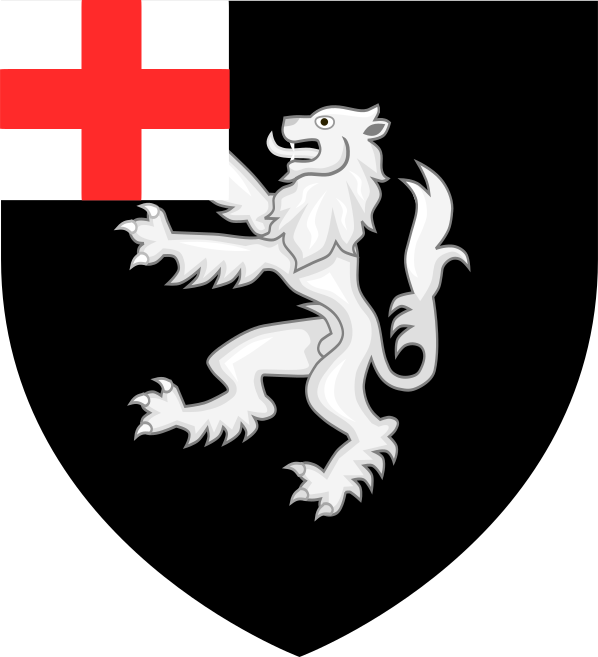
The first Sir Winston Churchill was a cavalier soldier who was stripped of his lands and wealth under the republic. It was most likely during this time that the motto “Faithful Though Disinherited” was adopted. His branch of the family had borne arms Sable a lion rampant Argent over all a bend Gules, but in Charles II’s reign the bend was removed and replaced with a canton Argent thereon a cross Gules, presumably as an augmentation in reward for his services. The crest, a lion holding a red flag, also seems to date from this time. John Churchill, 1st Duke of Marlborough, was also made a Prince of the Holy Roman Empire in 1704 and Prince of Mindelheim in 1705. This allowed him to use the Imperial Eagle as a supporter behind the shield in addition to the wyverns on either side. A further augmentation (an inescutcheon Argent a cross Gules, surmounted by another inescutcheon Azure three fleur-de-lys Or) was granted in time for his funeral in 1722, and carried on flags in his procession. A special act of Parliament allowed Churchill’s English peerages to pass to his daughters, and through them into the Spencer family. The Spencer dukes gave their own quarterings priority over his until 1817 when they swapped them around and changed their name to Spencer-Churchill. They used a griffin and a wyvern as supporters. The modern day dukes continue to use the heraldic accoutrements of their principality, despite titles of the Holy Roman Empire never being allowed to pass through the female line, and also in spite of all German monarchies having been abolished in 1918. I found it a little strange that the Churchills continue to cling to a token given by the Germans for defeating the French, given that their name is now associated with saving the French from the Germans.

The later Winston was appointed Lord Warden of the Cinque Ports in 1941, allowing him to use the arms of that office. He became a Knight of the Garter in 1953, requiring a banner and stallplate of his arms to be placed in St George’s Chapel. Churchill disliked his first banner and had another one made in “a more striking, modern style”. He also had two stall plates – the first was made by Harold Soper in 1954, but never affixed because the herald responsible was not satisfied with its artistic quality. The second was made in 1958 by George Friend. He received a state funeral in 1965. This was conducted by the Earl Marshal, who had Nelson and Wellington as his only precedents. Banners of Churchill’s own arms, and those of the Cinque Ports, were held by heralds in his procession. The funeral banner had a small blue crescent for difference, which Churchill had refused to use when alive. The coffin went from Victoria to Bladen by train, the namesake locomotive bearing a plaque of his arms on its boiler.

Maier pointed to some other examples of his heraldic legacy – HMS Churchill, HMCS Churchill, Churchill College Cambridge and the 1965 Churchill postal stamp, whose launch coincided with the introduction of the modern flag of Canada, ironically symbolic of the passing of the very age with which he was most associated. His arms were also borne, impaled, by his daughter Mary Soames, who became a Lady of the Garter in 2005. Of course, he also brought up Churchill’s time in Canada: The famous “roaring lion” portrait was taken by Yousuf Karsh in 1941, and Churchill’s expression is of anger at having his cigar taken away. William McKenzie-King, Prime Minister of Canada at the time, was desperate to be photographed with Churchill, though that picture is less well known. When Churchill was Secretary of State for the Colonies he argued with the Garter King of Arms about whether a warrant or a proclamation was needed for Canada’s new blazon.

Patrick Crocco asked if there was any particular system for assigning Garter stalls. Maier said it was simply whichever stall had been recently vacated. He also mentioned that HM Treasury covers all expenses relating to the order’s insignia.

There followed even more post-presentation chat, including a lengthy discussion between Cowan and Burgoin about women’s naval bowler hats. Sean from New Zealand was again present with his baby (whose burblings could be heard). I said that I had spent much of the past two years baby-sitting, thus becoming familiar with the heraldic banners featured in Ben & Holly among other programs. I also mentioned that I had been reading The History of the English-Speaking Peoples aloud to my mother, and trying to master Churchill’s voice.

All in all, today’s three events took up a lot of virtual time, but was well worth it. More are coming soon.

FURTHER READING

*A considerable amount of the post-presentation chat concerned the confusion that arises due to holding virtual meetings across multiple time zones. To make matters worse, different countries do daylight savings at different times – in Canada it begins tomorrow, but in Britain not for another fortnight.

Heraldic Humour – A History

Eight days ago the President of the United States gave an address at the Teen Student Action Summit of the political organisation Turning Point USA. As is often the case for such appearances, he was flanked by projections of the presidential seal. This time, however, something was wrong.

A derivative of the Great Seal, the presidential seal is known less for the rather diminutive escutcheon (Paly of thirteen Argent and Gules, a chief Azure.) than for the much larger supporter – a bald eagle displayed, holding in its dexter talon an olive branch and in the sinister thirteen arrows all Proper – and for the motto of “E Pluribus Unum”, which was considered the effective motto for the whole country until the controversial imposition of “In God We Trust” in 1956. The presidential seal in all its variants is famous worldwide. Even my own letterhead is based on it, though swapping the eagle for my namesake passerine. This very familiarity makes it all the odder for the recent substitution to have gone unnoticed until too late.

The seal which appeared beside the president last week may have looked legitimate at first glance, but on the second there are some glaring differences. The most obvious is that the bundle of arrows has been replaced with a set of golf clubs. The next is that the eagle has two heads pointing in opposite directions. Peering closely at the emblem, it can also be seen that the olive branch has been replaced by a wad of dollar bills and that the motto scroll says “45 es un títere”.

Designed by Charles Leazott, a once-loyal Republican who defected after the rise of Donald Trump, the doctored image paints the incumbent as a puppet of the Russian Federation whose primary concern is for his own wealth and leisure.

This is far from the first instance of heraldry being used for satirical purposes. During the American Civil War, H. H. Tilley produced a mock coat of arms for the Confederacy – which had not yet adopted a real state emblem. A cigar-smoking plantation owner and a hand-manacled slave support a shield of cotton, tobacco, and sugar, with three slaves hoeing the fields in base and some of their owners’ characteristic tools in chief. The motto given is “Servitudo Esto Perpetua”. Behind the crest rooster are two flags in saltire. One is clearly the battle flag used by several of the southern armies, the other is a skull and crossbones with the number 290. This latter flag could refer to the CSS Alabama, which was built in secret and known merely as “Hull No. 290” prior to launch.

Going back further to 1814, the Anglo-German publisher Rudolph Ackermann released and Explanation of the Arms of Napoleon Bonaparte. This particularly savage illustration has, for a crest, the world being set on fire and stabbed with French standards. The escutcheon, a montage of eight acts of barbarity attributed to the recently-deposed Emperor, is supported on the dexter by Death holding an hourglass and on the sinister by Satan wearing an iron crown.

Not all heraldic satire is quite so brutal: a 1909 Punch cartoon by Bernard Patridge alludes to the art by citing “an heraldic inversion”, in which the prime minister Herbert Asquith has to stand with his limbs awkwardly spread out to hold Winston Churchill (President of the Board of Trade) and David Lloyd George (Chancellor of the Exchequer) on his shoulders. The drawing was made during the crisis over the “People’s Budget”, the commentary being that Asquith’s prominent ministers were the real protagonists of the government, their nominal leader being in fact subservient.

A famous Gillray cartoon from 1797 shows William Pitt the Younger looming over the House of Commons. Notable is the suggestive positioning of the royal coat of arms (affixed to the canopy above the speaker’s chair to indicate the royal authority of the legislature) between the premier’s legs. The message is that Pitt had no passion beyond the accumulation and exercise of state power.

These armorial parodies continue into the modern day – many being found on Wikimedia Commons, though these do not see much use. A particularly memorable instance comes from 2011, showing the arms of Princess Beatrice of York, the coronets replaced by the unusual hat she wore to the wedding of her cousin the Duke of Cambridge.

FURTHER READING