A Note on the Honours Given to Prime Ministers

Cameron’s ennoblement got me thinking about the general trend of honours given to former prime ministers. Combing through Wikipedia, I have produced a list of them. To keep it from becoming overly long (and to avoid ambiguities about who counts as a prime minister), I have restricted it to honours conferred after the end of Victoria’s reign.

Although their legal status is much the same, British orders of chivalry can be politically divided into two categories: The Baronetage, Knights Bachelor, the Orders of the Bath, St Michael & St George, the Companions of Honour and the British Empire are appointed on the advice of government ministers, while the Royal Victorian Order, the Order of the Hospital of St John of Jerusalem and the Order of Merit are conferred at the monarch’s personal whim. The Orders of the Garter and Thistle fell into the former category in the early eighteenth century but were changed to the latter in 1946. Peerages both life and hereditary are presumed to be in the former category.

Here is a simplified list of who received which kind of honour and when. Honours which a person held before ascending to the premiership are not included:

HONOURS IN THE MONARCH’S GIFT

Garter (post-’46)

  • Churchill in 1953 (while still prime minister, in advance of the coronation)
  • Attlee in 1956 (resigned as Labour leader the previous year)
  • Wilson in 1976 (three weeks after leaving office)
  • Callaghan in 1987 (three weeks before stepping down from the Commons)
  • Thatcher in 1995
  • Major in 2005
  • Blair in 2021 (New Year’s Eve)

Merit

  • Balfour in 1916
  • Lloyd George in 1919 (while still prime minister)
  • Churchill in 1946 (while opposition leader)
  • Attlee in 1951 (while opposition leader, ten days after premiership’s end)
  • Macmillan in 1976
  • Thatcher in 1990 (nine days after premiership’s end)

St John

  • Thatcher in 1991 (Dame of Justice)

HONOURS ON MINISTERS’ ADVICE

Garter (pre-’46)

  • Balfour in 1922 (backbench MP) (adv. Lloyd George)
  • Asquith in 1925 (adv. Baldwin)
  • Baldwin in 1937 (adv. Chamberlain) (immediately after resignation)

Companion of Honour

  • Attlee in 1945 (adv. Churchill) (shortly after resigning as Deputy PM)
  • Major in 1998 (adv. Blair)

Hereditary peerage

  • Balfour in 1922 (adv. Lloyd George)
  • Asquith in 1925 (adv. Baldwin)
  • Baldwin in 1937 (adv. Chamberlain)
  • Lloyd George in 1945 (adv. Churchill)
  • Attlee in 1955 (adv. Churchill)
  • Eden in 1961 (adv. Macmillan)
  • Macmillan in (adv. Thatcher)

Life peerage

  • Douglas-Home in 1974 (adv. Wilson)
  • Wilson in 1983 (adv. Thatcher) (dissolution honours)
  • Callaghan in 1987 (adv. Thatcher) (dissolution honours)
  • Thatcher in 1992 (adv. Major) (dissolution honours)
  • Cameron in 2023 (adv. Sunak)

It may also be worth considering honours given to the spouses of prime ministers, whether for achievements in their own right or by right of marriage.

  • Margaret Lloyd George: GBE in 1918 (adv. her husband)
  • Lucy Baldwin: GBE and DStJ in 1937 (former adv. Chamberlain)
  • Clementine Churchill: GBE in 1946 (adv. Attlee), life peer in 1965 (adv. Wilson)
  • Dorothy Macmillan: GBE in 1964 (adv. Douglas-Home)
  • Denis Thatcher: TD in 1982, baronet in 1990 (adv. Major), CStJ in 1991.
  • Norma Major: DBE in 1999 (adv. Blair)
  • Cherie Booth/Blair: CBE in 2013 (adv. Cameron)
  • Philip May: Knight bachelor in 2020 (adv. Johnson)

Unless I’ve missed any, no current or former prime minister (or their spouse) has, from 1901 onward, been appointed to the Order of the Bath, the Order of St Michael and St George, the Order of the Thistle or the Royal Victorian Order.

Chipping off the old block

One week after the announcement of his appointment, David Cameron took his seat in the House of Lords today. Although there is still no update on the London Gazette (their website tends to be quite slow in these matters), he was shown Parliament.UK as a member of the house from Friday and today the reading clerk confirmed he had been created Baron Cameron of Chipping Norton, of Chipping Norton in the County of Oxfordshire on 17th November.

Cameron is the fifth former prime minister to be ennobled in pursuance of the Life Peerages Act 1958 – the others being the Lord Home of the Hirsel (1974), the Lord Wilson of Rievaulx (1983), the Lord Callaghan of Cardiff (1987) and the Baroness Thatcher (1992).

Of those, only Thatcher had her introduction ceremony recorded for television. Hers was the older style featuring bicorne hats, bowing, and the reading of the writ of summons after the letters patent, all of which were omitted from 1997 onwards. Cameron’s is the post-2020 version which retains some changes to the choreography meant to comply with COVID-era social distancing requirements. His supporters, the Lord True and the Baroness Williams of Trafford, are both incumbent ministers (Leader of the House and Chief Whip respectively) and both were appointed to the upper house during Cameron’s premiership. Thatcher, in her maiden speech, remarked that some 214 then-members of the house were her own appointments. I don’t know quite what the present figure is for Cameron (though I do remember the late Lady Boothroyd complaining in 2015 about it being too high).

Cameron’s choice of territorial designation is slightly surprising – most would likely have expected him to choose Witney, his old constituency, rather than Chipping Norton, a fairly small town within it. Simply being “The Lord Cameron” without further specification would not have been allowed as there are already several other life peers and a Scottish clan by that surname. The prior example of a two-word location which comes most prominently to mind (at least as far as senior ministers are concerned) is the Lord Butler of Saffron Walden – though that had been Rab’s constituency name as well.

Curiously, it is not clear yet if Cameron has been properly appointed to the office of Secretary of State for Foreign, Commonwealth & Development Affairs as the latest Privy Council minutes do not mention him.

UPDATE (23rd November)

Cameron’s peerage was Gazetted on Tuesday, and his ministerial appointment was formalised on Wednesday. He also made his maiden speech on Tuesday.

I Might Have Known

Three years ago I had a stab at designing a coat of arms for the Reverend Wilbert Vere Awdry, believing that he never had one officially granted or descended to him. Now, however, I discover that he most likely did.

When searching through the Internet Archive I found a digital copy of The Thomas The Tank Engine Man, a biography of Awdry by Brian Sibley (who also edited The Fall of Númenor and wrote several companion books about Tolkien’s legendarium and its cinematic adaptations).

The early pages recount some of the vicar’s family history, including his uncle William and grandfather Sir John. Sir John Wither Awdry spent three years as Chief Justice of the Supreme Court of Judicature at Bombay and William Awdry spent twelve as Bishop of South Tokyo. I quickly found that these two men already had their own Wikipedia biographies, both of which mentioned their kinship to Wilbert. If only there had been links in the other direction I might have discovered this information much earlier.

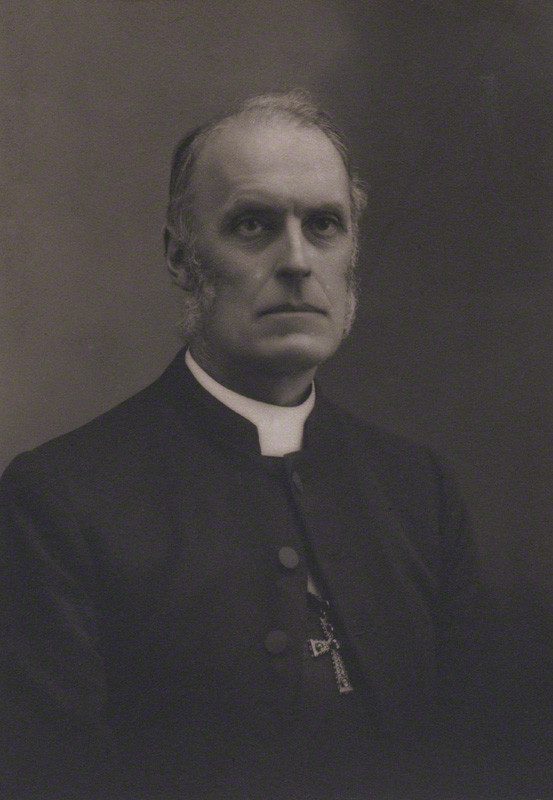
William, August 1900

Unfortunately Debrett’s Peerage would be of no use here as it tends to list only the corporate and not the personal arms of the Lords Spiritual, and even then only those diocesan bishops within the United Kingdom – Awdry meeting neither condition. Happily, Sir John did have an entry in Burke’s Landed Gentry 1862, which lists his dynastic arms of unspecified antiquity as Argent three cinquefoils Or on a bend Azure cotised of the same with crest Out of a ducal coronet a lion’s head Azure and motto Nil Sine Deo.

William and Wilbert being legitimate agnatic descendants of Sir John, it naturally follows that whatever armorial ensigns he possessed, they possessed also. It is curious, therefore, to have found so little record of him or his son Christopher actually using them. This is amplified by the fact that the fact that he and his brother George clearly had an active interest in and working knowledge of heraldic blazon, which Sibley’s book even notes:

George…was exploring matters of heraldry and coats of arms ‘A real beauty occured to me for Tidmouth,’ he wrote to his brother, ‘It ought to be rather elaborate, as it is relatively new, and the simple ones are doubtless allotted already.’ The proposed arms for Tidmouth were to feature a smith’s hammer and tongs, a lymphad (a heraldic ship), three herrings and a wheel. ‘This,’ George explained, ‘covers all Tidmouth’s titles to importance: shipping, transport, fishing, engineering…’

I did, of course, illustrate Tidmouth’s arms two years ago as well.