A Stark Vision

Amateur or professional, few students of Britain’s royal, political and constitutional history will be unaware of Dr David Starkey. With an extensive collection of literary and televisual credits, plus a famously oversized personality, he was for many years a giant among celebrity historians. His most prominent was his 2004 series Monarchy, followed by Magna Carta in 2015, but he can be traced back much earlier, appearing in The Trial of King Richard the Third in 1984. He has even been featured on the royal family’s own YouTube channel.

His career, though illustrious, has not been smooth sailing, for his character is notoriously abrasive and his reputation has been rocked by a string of ill-worded outbursts – in most notably in 2011 and 2015. His performance in directly teaching the youth was also rocky.

I was quite surprised, early in 2020, to see him interviewed on Akkad Daily. It taxed my mind to decide whether this pairing more represented Benjamin going up in the world or Starkey going down. Certainly the latter plummeted with great velocity that summer following a catastrophic episode with Darren Grimes, which resulted in many of his professional contracts being terminated and accolades withdrawn.

Given the severity of that latest offence, and given that he was seventy-five years old, one could have expected Starkey to vanish from public life altogether and slip quietly into retirement. For a few months that looked to be the case but then he began popping up again on various virtual conferences and current affairs broadcasts, suggesting there is still a place for him on the talking head circuit (well, the right-wing parts of it anyway).

A week ago he launched his own YouTube channel on which, seemingly alone, he gives lengthy speeches to his camera about his specialist subjects. Much of it recycles what he has already said in his earlier lectures and documentaries, some of which are of course no longer available. His motivation is not clear: it could simply be a charitable effort for the sake of public education (sort of a more sedate Crash Course) but then his website asks for monetary donations and boasts about the number of supporters he has in his “fight back”.

In between these was Charlie Brooker’s end of year mockumentary Death to 2020, in which Hugh Grant plays the historian Tennyson Foss. Judging by the hair, clothes, spectacles and voice I am fairly sure this is meant to be a pastiche of Starkey’s own interviews, although hints at the character’s backstory are clearly different.

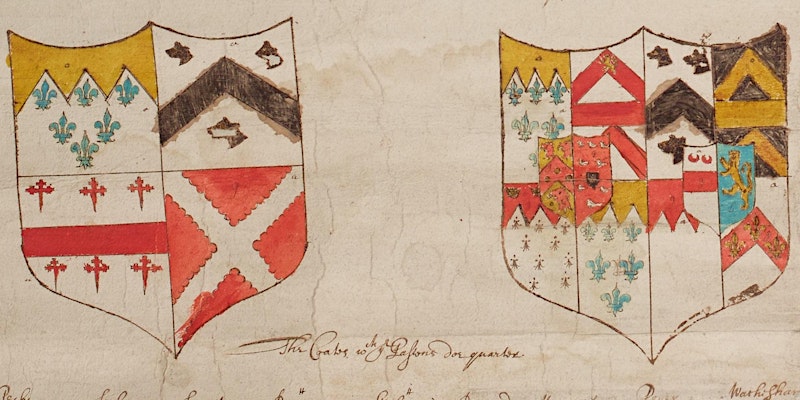
The Heraldry of the Pastons

This afternoon I attended a virtual presentation by the Norfolk Record Office concerning the heraldry of the Paston family. I knew little of these people before signing up, but the topic was as intriguing as any other heraldry lecture.

The presenter was Dr John Alban of the University of East Anglia. He apologised for not being physically present in the office – having to divide his time equally between Norfolk and South Wales – but said it didn’t matter since in a virtual lecture he was not restricted by location. That comment fell quickly into irony. The first few minutes of the lecture were plagued by technical difficulties as the audio failed completely for many in the audience, requiring us to log out of the session and then back in again. That was far from ideal, of course, since it caused us to miss the introductory sentences. At least we could see the slides, including establishing what the Paston arms were in their simplest form: Argent six fleurs-de-lis three two and one Azure a chief indented Or. He then showed us a gallery of uses of those arms in various places and by various institutions, whether alone or marshalled with others.

The main thrust of the presentation was in showing how arms mutated and evolved in the period before heraldic regulation, and how even after that armigers would be keen to manipulate the historical record for their own ends. Thus we saw a few alternate prototype versions of the Paston arms and their appearances in medieval and Tudor records. One especially interesting case study shown to us was William Cecil, 1st Baron Burghley, whose family history before Henry VII’s accession Alban reckoned to be entirely fabricated.

At the end of the presentation an attendee asked Dr Alban to recommend books on heraldry. He suggested the works of Charles Boutell and Arthury Charles Fox-Davies, and was pleased when I pointed out that older works such as these were available for free on Google Books or Archive.org for those who could not access physical copies.

In these meetings I tend to scan the list of attendees for anyone remotely famous. This time I found Elizabeth Roads, Lyon Clerk from 1986 to 2018. As per usual I attempted at the end of the session to plug this blog. I probably left it a little too late as we were being instructed to log out (and I’m fairly certain Roads already had), but there already seems to be a bit of an uptick in view count, so at least someone spotted it.

The Deputies That Weren’t

In the long-awaited cabinet reshuffle it was announced that Dominic Raab, First Secretary of State since 2019, had been appointed Deputy Prime Minister. This would appear to be the latest in a long though intermittent line of appointments to that title. On closer inspection, however, the line may not be as long as once thought. A year ago the Wikipedia page listed eight people as having held the post, with a footnote about a possible ninth. By last month, that had been revised to just three official title-holders, supplemented by alternate lists of many more unofficial ones.

The main sources for these were Vernon Bogdanor’s 1995 book The Monarchy and the Constitution, Jonathan Kirkup & Stephen Thornton’s 2015 article ‘Everyone needs a Willie’: The elusive position of deputy to the British prime minister, Rodney Brazier’s 2020 book Choosing a Prime Minister: The Transfer of Power in Britain, and the Lord Norton of Louth’s 2020 book Governing Britain: Parliament, Ministers and Our Ambiguous Constitution. The latter has been much advertised on his lordship’s blog in recent months. The differences in the lists that they give shows that there is much scholarly dispute over who can be canonically considered a deputy prime minister in this country. In addition to those who were thought to have the title but actually didn’t, there are several listed as not having the title but still performing essentially the same function.

Different authorities have different criteria for who should be counted – Bogdanor lists those who chaired the cabinet in the prime minister’s absence and chaired numerous cabinet committees, Kirkup & Thornton use a five point checklist:

  • Styled as Deputy Prime Minister in Hansard or the Gazette
  • Designated as such by the Prime Minister
  • Recognised as such by their cabinet colleagues
  • Listed second in the cabinet hierarchy
  • Answered Prime Minister’s Questions

Clement Attlee, generally considered the trope maker and codifier, was Leader of the Labour Party from 1935 to 1955, a period which included the 1940-1945 wartime coalition government. Churchill had him appointed Lord Keeper of the Privy Seal in 1940, then Secretary of State for Dominion Affairs in 1942, then Lord President of the Council in 1943. He deputised for Churchill in parliamentary questions and cabinet meetings, with many sources saying he essentially ran all domestic business of the government while Churchill focused on the war. Curiously the time period usually given for his tenure as DPM begins only in February 1942. The Lord Hennessy of Nympsfield asserts that George VI’s minute for that reshuffle just said “Secretary of State for Dominion Affairs” and that it was Churchill who wrote “Deputy Prime Minister” on a separate paper. Bogdanor also asserts that Attlee was never formally given the latter title by the King.

Herbert Morrison was Lord President of the Council and Leader of the House of Commons through most Attlee’s premiership from 1945 to 1951, switching to Secretary of State for Foreign Affairs in the last few months. He is counted by Bogdanor, Kirkup & Thornton and Norton but not by Brazier.

Sir Anthony Eden was Secretary of State for Foreign Affairs during Churchill’s peactime ministry of 1951 to 1955. He is considered by all the lists to have functioned as DPM, though the King did not formally appoint him as such.

R. A. Butler is counted by all, though there is dispute as to when he took office. Under Eden and Macmillan he held several overlapping posts: Lord Privy Seal (1955-59), Leader of the House of Commons (1955-61), Chairman of the Conservative Party (1959-61), Secretary of State for the Home Department (1957-62) and First Secretary of State (1962-63). Brazier considers him to have been DPM beginning in 1955 but Norton believes he only started in 1962. Both agree he ceased when Douglas-Home replaced Macmillan in 1963.

George Brown became Deputy Leader of the Labour Party in 1960 and remained so throughout Wilson’s first two governments, resigning after the general election of 1970. From 1964 to 1966 he was First Secretary of State and Secretary of State for Economic Affairs, then he was Secretary of State for Foreign Affairs until 1968. It could be a typo, but Brazier apparently still considered him to have been DPM after that despite him no longer being in government.

Michael Stewart was First Secretary of State from 1966 to 1968 then Secretary of State for Foreign & Commonwealth Affairs from 1968 to 1970, succeeding Brown in both offices. He is counted by Bogdanor as well as Kirkup & Thornton to have been DPM in the last two years.

Curiously none of the authors consider Barbara Castle (First Secretary of State 1968-70) to be worthy of inclusion.

Reginald Maudling had been appointed by Heath as Deputy Leader of the Conservative Party in 1965. He was appointed Secretary of State for the Home Department following the party’s election victory in 1970. He resigned both posts in 1972. Bogdanor and Brazier consider him to have been DPM for two years.

William Whitelaw was Deputy Leader of the Conservative Party from 1975 to 1991, being created Viscount Whitelaw roughly halfway through this period. He was appointed Secretary of State for the Home Department in 1979, then Lord President of the Council and Leader of the House of Lords from 1983 to 1988. All the lists include him as DPM while he was in government, but are clear that he did not actually hold the formal title.

Sir Geoffrey Howe is widely considered to have been DPM from a reshuffle in 1989 until his famous resignation in 1990. He held the posts of Lord President of the Council and Leader of the House of Commons. When I commented on Norton’s blog suggesting his inclusion the noble lord replied:

Sir Geoffrey Howe was offered the title, but as he explained in his autobiography*:
Charles Powell then contacted him to tell him that Buckingham Palace ‘had had a little difficulty in accepting the official description “Deputy Prime Minister” . They were proposing to follow the precedent of Eden with Churchill and use the form of words: “Sir Geoffrey will act as Deputy Prime Minister”.

Michael Heseltine, it seems, is the first to be definitively appointed Deputy Prime Minister. He held the title from 1995 to 1997 as well as being First Secretary of State.

John Prescott was the second canonical incumbent. He had been elected Deputy Leader of the Labour Party in 1994 and was appointed Deputy Prime Minister after the general election of 1997, resigning both posts in 2007. For his first four years in government he was Secretary of State for Environment, Transport & the Regions. Thereafter he was First Secretary of State.

It is another curiosity that none of the lists include anyone for Gordon Brown’s premiership, even though the Lord Mandelson (First Secretary of State and Lord President of the Council 2009-2010) was widely considered to be DPM for the last eleven months of New Labour.

Nick Clegg, Leader of the Liberal Democrats throughout their coalition with the Conservatives from 2010 to 2015, was the third canonical DPM. He was also appointed Lord President of the Council and Minister for Political & Constitutional Reform. He regularly stood in for David Cameron at Prime Minister’s Questions.

William Hague was First Secretary of State through the same period. He was the second Conservative in the cabinet hierarchy and answered Prime Minister’s Questions when both of his superiors were absent. He was the senior member of Cameron’s shadow cabinet and so probably would have been DPM had the party won outright in 2010.

George Osborne was First Secretary of State and second in the cabinet ranking during Cameron’s second government of 2015 to 2016. He answered Prime Minister’s Questions in Cameron’s absence.

Theresa May did not appoint a DPM or FSoS during her first ministry. Most seem to have assumed that Philip Hammond (Chancellor of the Exchequer) was deputy by default. When she missed PMQs on 7 December it was David Lidington, Leader of the House of Commons, who stood in for her.

Damian Green was appointed First Secretary of State and Minister for the Cabinet Office in June 2017 but had to resign in scandal in December. He was second in the cabinet ranking and deputised at PMQs.

David Lidington was Chancellor of the Duchy of Lancaster from January 2018 to July 2019. He was second in the cabinet ranking throughout despite not holding either of the usual titles. He again deputised at PMQs during this period.

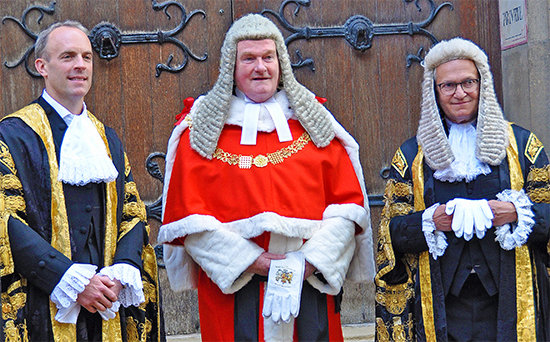
Dominic Raab was appointed First Secretary of State and Secretary of State for Foreign & Commonwealth Affairs in July 2019. He resigned both posts this month in favour of Deputy Prime Minister, Lord High Chancellor of Great Britain and Secretary of State for Justice. Bizarrely many press sources called this a demotion. He took charge of the government last year when Boris Johnson was in intensive care, and has deputised at PMQs many times, including last week. He would appear to be the fourth canonical DPM, having the title in Hansard as well as in government publications (no Gazette mention yet). Oddly the cabinet rankings until recently had him below the Chancellors of the Exchequer (Sajid Javid, then Rishi Sunak) and the most recent list of cabinet committees showed he wasn’t chairing any of them.

One might reasonably be wondering at this point as to the constitutional distinction between Deputy Prime Minister and First Secretary of State. Put simply, the latter actually exists in law. Every time a new first secretary is appointed there will be an order in council recording it, in the same way as for all the other secretaries of state. The office commands a salary in its own right and so an incumbent does not need to hold a sinecure in conjunction. This is in contrast to Deputy Prime Minister, which has no legal existence and is, in effect, simply a courtesy title given by the actual Prime Minister. Every holder of the title has simultaneously held at least one other ministerial office.

There is, though, one way in which First Secretary of State is like the Deputy Prime Minister and unlike the other secretaries of state. As I commented to Norton last year:

The main difference between the First Secretary of State and all the others is that he is a minister without a ministry. While there is an Order in Council to appoint a new First Secretary of State each time, there has never been a statutory instrument to establish a corresponding First Department. For this reason there is a little similarity with the title of Deputy Prime Minister in that leaving the position vacant has the same practical effect as abolishing it (indeed the press often don’t know which term to use), because the role cannot be proven to exist if it is not occupied.

*This is “Conflict of Loyalty”, published in 1994. The machinations of Howe’s appointment as DPM are described in pages 586-594.

UPDATE (July 2024)

Despite Norton agreeing with my above comment, this article by Robert Swetlic for the UK Constitutional Law Association highlights that there actually was a statutory instrument to give formal powers to the First Secretary of State in 2002, only for another instrument to take them away in 2008, with the latter acknowledging the corporation sole as being vacant at that time. Neither references a “First Department”, with the appropriate references being made instead to the “Office of the Deputy Prime Minister”, despite the title Deputy Prime Minister itself not being given a statutory footing in the way that First Secretary of State was, which just confuses the situation even more.

Ever to Succeed

News has broken that two days ago Her Royal Highness Princess Beatrice, Mrs Edoardo Mapelli Mozzi, gave birth for the first time. Her yet-unnamed daughter is eleventh in line to the throne. I wished to edit the relevant Wikipedia article accordingly, but that proved difficult as the list had multiple levels of indentation to reflect the generations and all the numbers had to be changed manually.

There is a challenge in deciding just how many names to include on the page. The legitimate non-Papist descendants of George I’s mother number well into the thousands nowadays and the vast majority of them are non-notable. The editors have here decided to limit the display to the descendants of the sons of George V. In practice this just means Bertie, Harry and Georgie, since David and John both died without issue. Even that restricted selection comprises sixty-three living people, of whom thirty-two have no pages of their own.

The clumsiness of editing this list brought up an idea I had some years ago for giving each member of the diaspora a numerical code to indicate their position within the succession. The electress herself, being the origin of the succession, would be 0. Her eldest son Georg Ludwig would be 1, her next son Frederick Augustus 2, Maximilian William 3 and so on. For each generation a digit is added, so Georg’s offspring George Augustus and Sophia Dorothea would be 1.1 and 1.2, while George Augustus’s children would be 1.11, 1.12, 1.13 and so forth. Under this system Princess Alexandrina Victoria of Kent & Strathearn would be 1.11141 while Princess Elizabeth Alexandra Mary of York would be 1.111411221. Prince Philip of Greece & Denmark would, I think, be 1.111416331. The beauty of this system is that the crown always goes to the living person with the lowest number, rather than each new birth or death close to the throne forcing everyone downstream to be renumbered.

There are downsides, of course. First, there is always the danger of one day discovering a missing sibling who died young and was forgotten to history. Second, until the commencement of the Perth Agreement the crown followed male-preference primogeniture, so any girl’s code was liable to change upon the arrival of a brother. Third, if any person in the line has more than nine legitimate children then the numerals would be inadequate (as in George III’s case, though perhaps there one could only number his nine sons and omit his six daughters, none of whom had surviving children of her own), and an alphabetical system might be needed instead – Elizabeth II would be AAAADAABBA and the late Prince Philip AAAADAFCCA.

On a related note, I have been keeping tabs on Judiciary UK for some months looking at new judgements as they come out. My main interest was Bell v Tavistock, but the day before that was resolved my eye was caught by the decision of Sir Andrew McFarlane (President of the Family Division) not to publish the Duke of Edinburgh’s will. Sir Andrew spoke at length about official etiquette regarding the royal family, and shed some light on that term’s definition. For Wikipedians, academics, press and others, there has always been a little confusion as to when membership of the family ends**. Is it the top X in line to the throne? Everyone descended from the current monarch? All descendants in the male line from George V? From Victoria? Everyone styled Royal Highness? Everyone on the balcony at Trooping the Colour? Then there are the gradations – often the headlines talk of “minor royals”, usually meaning the Dukes of Gloucester and Kent but sometimes including the Prince of Wales’s siblings and niblings, while mentions of “senior royals” are even more nebulous. One reason for this difficulty is that there are really three separate types of rank within group – precedence is determined by one’s relationship to the incumbent monarch, style and title by generations’ removal from any monarch and succession by primogeniture of descent from Sophia. McFarlane, in his judgement, may have given some more substance on which to build at least the latter’s definition.

From paragraph 15: This Court has been informed that in recent times the definition of the members of the Royal Family whose executors might,as a matter of course,apply to have the will sealed up has been limited to the children of the Sovereign or a former Sovereign, the Consort of the Sovereign or former Sovereign, and a member of the Royal Family who at the time of death was first or second in line of succession to the throne or the child of such a person. In addition, the wills of other, less senior, members of the Royal Family may have been sealed for specific reasons, or, as the list of names suggests, a wider definition of “Royal Family” may have been applied in this context in earlier times.

From paragraph 23: The confidential note that was disclosed and is attached to Charles J’s judgment contains an interesting account of the development of the practice of sealing Royal wills during the last century. That note provided that, in particular,the practice of applying to the Family Division applied, as a matter of course,to ‘senior members of the Royal Family’ who were defined as:

•The Consort of a Sovereign or former Sovereign;

•The child of a Sovereign or former Sovereign;and

•A member of the Royal Family who, at the time of His/or Her death, is first or second in line of succession to the throne or the child of such a person.

This means that, for judges’ purposes “senior royal” essentially means monarchs themselves, their consorts and their children (not necessarily children-in-law), as well as the first two in line to the throne and their children. Monarchs’ children are easy enough to spot from the rest, with the definitive article in their princely styles and their coronets of crosses interspersed with fleur-de-lys, but the latter category could be unstable – Princesses Elizabeth and Margaret of York would have been senior by this definition during their grandfather’s reign but would have lost that status had Edward VIII sired children of his own.

Applying it to the current situation, then, we can see that the seniors of the present royal family are:

  • HM The Queen
  • HRH The Prince Charles, Prince of Wales
  • HRH The Prince Andrew, Duke of York
  • HRH The Prince Edward, Earl of Wessex
  • HRH The Princess Anne, Princess Royal
  • HRH Prince William, Duke of Cambridge
  • HRH Prince Henry, Duke of Sussex
  • HRH Prince George of Cambridge
  • HRH Princess Charlotte of Cambridge
  • HRH Prince Louis of Cambridge

There is one part of the judgement with which I take issue – paragraph 13 says It is understood that the first member of the Royal Family whose will was sealed on the direction of the President of the Probate, Admiralty and Divorce Division was His Serene Highness Prince Francis of Teck. Prince Francis was the younger brother of Princess Mary of Teck who, upon her marriage to King George V, became Queen Mary in 1910. Later that same year, at the age of 40 years, Prince Francis died. An application was made for the will to be sealed and not published. The application was granted. This is a little misleading, as Mary married Prince George, Duke of York in 1893 and became Queen on his accession in 1910. The judge’s text implies that she didn’t marry him until he was already King.

*Some in the press have claimed that as her father is an Italian count, the baby will be a countess, but the title is not recognised by the Italian republic or by the United Kingdom. Most likely she will be Miss [[Firstname]] Mapelli Mozzi.
**Of course, any family can present this difficulty as few are consciously defined by any formal rules.

UPDATE (1st October)

Princess Beatrice’s baby is named Sienna Elizabeth Mapelli Mozzi.

In Those Circles

Five years ago I discovered a project called the Culture Concept Circle. It is run by Carolyn McDowall, an “independent cultural and social historian”. The YouTube channel comprises a long series of short documentaries about the history of art and design, a lot of them focusing on British architecture. The videos are not as polished as those you’d see on television – they are mostly just zooming or panning along stock still images (often low resolution) with a voiceover lecture – but this should not diminish their appeal for anyone already interested in the subject matter. If anything, they highlight how much of a modern TV documentary is essentially padding. The People Profiles are somewhere in between, as are History Matters and Extra History.

I’ve also recently discovered English Heritage podcasts. They cover an eclectic range of subjects from royal romances to Darwin’s gardens. The one that particularly caught me was How the railways shaped the nation. This is less because of its actual content than because it is narrated by collections curator Dr Matt Thompson, whose voice sounds remarkably similar to that of Ted Robbins.

On Ladies’ Garters

Dr Andrew Gray

Just a day after York’s presentation, I attended yet another heraldic zoom lecture, this time by Dr Andrew Gray for the Heraldry Society, concerning Ladies of the Order of the Garter. I made a post about this topic two years ago and advertised it in the chat box. Unusually the host actually drew attention to it, and my site traffic is already seeing an uptick.

The lecture began with the special statute enacted by the newly-ascendant Edward VII in 1901 to appoint his wife Alexandra to the order, followed by a similar instrument in 1910 for Queen Mary. Gray noted that this was unusual at the time but not unprecedented. In 1358, just ten years into the order’s creation, Edward III made Philippa of Hainault a lady of it. Gray mentions that the early gentlemen of the Garter had ladies in their company on ceremonial occasions, though their status – and even identity – is vague. In the period of 1358-1495 Gray identified seventy-four Ladies of the Garter in the records, most of whom were wives of the knights and/or members of the royal family. He notes that there were probably a lot more but the necessary records are missing. The ladies received robes, and wore the garter itself on the upper arm (whereas the men wore it on the leg).

There then followed an examination of the ladies appointed in that time, their arms, and their relation to the contemporary monarchs. One of those highlighted was Jacquetta, Countess Rivers, whom Gray noted had been made famous by Philippa Gregory. She was allegedly descended from the water goddess Melusine and gifted psychic powers, which the present monarch has presumably inherited.

The appointments of ladies of the order ended in 1495 with Margaret, Countess of Richmond and mother of Henry VII. Over the next few centuries there were five female sovereigns of the Garter but no female appointees until the sudden spurt in the twentieth century. There was also some discussion of the issues I raised in my aforementioned 2019 post regarding female crests and helms.

While I enjoyed the presentation it still left me a little confused – I don’t recall learning any explanation as to why the installation of ladies was discontinued in the sixteenth century, nor the precise distinction between plain “Lady” and “Lady Companion”. Still, at least I got to flog the blog rather effectively this time.

The society’s lecture series is taking a break now, and will return on 24th September.

The College of Arms in the Eighteenth Century

The early decades of the eighteenth century saw the College of Arms at its lowest point in its history, when its relevance and even its survival seemed to be in doubt. Very few grants of Arms were being made, heraldic regulation was increasingly ineffective, and the practices of its Officers were in decline. Appointments were sometimes made for the wrong reasons, so that Officers might not be there for their heraldic or genealogical skills. Could the century see a revival of the fortunes of this ancient institution? Could it find new venues for its activities, new areas of expertise, and new sources of revenue? Could heraldry adapt to the changing fashions and aesthetics of the Enlightenment and Romanticism? This talk will seek to examine and answer these questions.

So said the online invitation. Today’s virtual heraldic lecture was given by Peter O’Donoghue, York Herald since 2012. As the title implies, the lecture covered the ups and downs of life and work at the college from 1701 to 1800. As this one, unusually, has been uploaded to YouTube, I do not think it necessary in this instance to type out a long account.

Prorogation with Brenda Hale

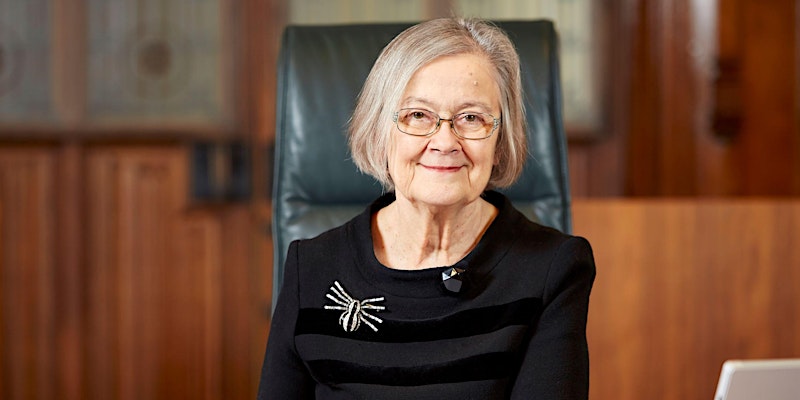
The Baroness Hale of Richmond today gave the 2021 Magna Carta Lecture for Royal Holloway, University of London, in which she recounted the events of her 2019 ruling on the lawfulness of prorogation.

The lecture was conducted on Microsoft Teams with over two hundred attendees. Paul Layzell, the college principal, made the introductory speech.

Hale told the tale of the events leading up to her court’s judgement. The prorogation ceremony had taken place on Monday 9th (technically the early hours of Tuesday 10th) September. On Wednesday 11th September three judges of the Inner House of Scotland’s Court of Session ruled that the prorogation was unlawful. On the same day the High Court of England & Wales ruled that the matter was non-justicable. One day later the High Court of Northern Ireland declined to rule on the prorogation as the other courts had already done so.

It was obvious that, there being only one UK Parliament, these contradictory rulings could only be resolved by the UK Supreme Court and that their answer had to be reached relatively quickly lest the alleged unlawful purpose (of reducing the legislature’s sitting time) would already have been achieved before the court could say that it shouldn’t. As with the first Miller case the decision was made to use a maximally-large panel of eleven justices to prevent suggestion that the panel’s composition would have changed the result. The parties were given impossibly tight deadlines to file their written submissions and other documents for the hearings between Tuesday 17th and Thursday 19th September.

Her ladyship treated us to a brief history of constitutional law, including Magna Carta itself of course but more specifically various rulings on the extent and the exercise of royal prerogative powers whether by monarchs themselves or their ministers. She referred to Sir Edward Coke, who as Chief Justice of the Common Pleas in 1607 declared that the King could not overrule courts according to his own preferences, and then in 1610 ruled that the King could not create new criminal offences by proclamation, and that the King had no prerogative but that which the law of the land allows him. Any question of who made the law in the first place was settled by the Glorious Revolution of 1688 in which William III & Mary II were elevated to the throne on the express condition that only the King-in-Parliament could make law.

Hale referred to other prerogative cases such as Entick v Carrington in 1765 which held that the Secretary of State lacked to the authority on his own to issue search warrants, and Attorney-General v De Keyser’s Royal Hotel Ltd in 1920 which held that prerogative powers could not overturn a statutory prohibition on requisitioning property without compensation. The latter, she noted, is now more famous for the dispute over how “De Keyser” should be pronounced. I recall that episode being reenacted on Have I Got News For You. A more recent case was Council of Civil Service Unions v Minister for the Civil Service in 1984, surrounding the government’s attempt to ban – via Order in Council – GCHQ staff from unionising. The Law Lords held that such prerogative powers were subject to judicial review but that national security concerns were a legitimate exception. The most recent precedent was R v Chaytor in 2010, which decided that MPs’ expenses claims were not protected by Parliamentary Privilege because, Hale told us, “Proceedings in Parliament are what MPs do when they go about the core business of the house – taking part in debates, questions committees, votes – not anything and everything that MPs may do when they’re in the Palace of Westminster.”

She then returned to the prorogation hearing, noting that counsel for the litigant from Northern Ireland “had to be reminded more than once that we were not there to decide whether Brexit could be reconciled with the Good Friday Agreement”. She acknowledged that some people were surprised by the speed with which the court was prepared to give judgement, but argued “We were already ten days into the prorogation, so time was of the essence.”. The justices worked at furious speed over the weekend to have draft judgements typed, agreed and processed in time for handing down on Tuesday.

All parties agreed that the court could determine the existence and extent of prerogative powers, but there were disputes over whether exercise thereof was justicable. The justices determined that the case was about the former: The power to prorogue could not be unlimited, for that would foul the principles of Parliamentary Sovereignty and Parliamentary Accountability. The justices concluded that “advising the monarch to prorogue Parliament would be unlawful if the prorogation had the effect of frustrating or preventing without reasonable justification the ability of Parliament to carry out its constitutional functions as a legislature and as the body responsible for supervising the government”. If the effect of this prorogation was unlawful then it would not be necessary for the Prime Minister’s intent to be reviewed. The court easily concluded that the effect was as described and that there was no reasonable justification – the government’s only explanation of any kind being a memorandum from Nikki da Costa which gave reasons for having a speech from the throne on 14th October (long set in Her Majesty’s diary), but not for closing Parliament five weeks in advance instead of the usual six days or so. It was acknowledged that those weeks included the party conference season when the legislature tended not to sit anyway, but pointed out in this instance MPs and peers might have elected to stay at work to oversee the major constitutional change looming on 31st October.

Finally the government had argued that the prorogation itself, in contrast to the ministerial advice, was a Proceeding in Parliament and thus immune to challenge by any court. There came the meat of Lady Hale’s judgement – although the prorogation ceremony took place in the Lords’ chamber with members of both houses present it was not something that the legislature had debated or decided, rather it was imposed upon them from outside. The court was therefore entitled to question it, and they decided that with the ministerial advice having been unlawful, the Order in Council to which it led must also have been unlawful. In a memorable turn of phrase “…when the royal commissioners walked into the House of Lords it was as if they walked in with a blank sheet of paper.” and so Parliament had not in fact been prorogued. The session resumed and the two speakers recalled their respective houses the next day.

After the passage of some further major legislation (further delaying Brexit to 31st January 2020*), Parliament was again prorogued, but only for the standard six days, with the speech still taking place on 14th October as planned. Hale recalled that she and the other justices “went along in our finery to hear it, knowing full well that there was likely to be a general election and another Queen’s Speech before the year was out, and so it turned out to be. I felt very sorry for Her Majesty. She could so easily have been spared it all if it had been clear from the outset that that was the plan.”

Now Hale has five reflections:

  1. If there had been no case, then the legal position would have been the same but “noone would have been any the wiser” without a court to decide it. We need people to bring forward cases when fundamental constitutional principles are involved, even if their personal motivations for doing so are less high-minded.
  2. If the Prime Minister had filed an affidavit saying that he needed a realistic threat of exiting without a deal and Parliament was determined to thwart him, therefore it was necessary to suspend legislative activity, then the case would have been more complicated as it would constitute a justification whose reasonableness the court would have to assess, clearly a more political decision.
  3. Some say it would have been better for the ruling not to have been unanimous, as the inclusion of dissenting opinions would have allowed the public to see how the government’s arguments were acknowledged but refuted. Hale regrets that due to the time pressure it was not possible to rehearse them at length, but insists it was still quite clear what they were. In her view the unanimity of all eleven justices has more power than a split decision would have.
  4. Public approval of the ruling was strongly correlated with support for remaining in the European Union, but not absolutely. She remembers widespread wearing of the spider brooches and t-shirts by people whose views on Brexit she could not know. Indeed, she does not know how her fellow justices voted in the referendum or in general elections. Public attitudes are not always irrelevant, but a question of high constitutional principle cannot be decided in accordance with public opinion on something completely different.
  5. Some say the whole effort was for nothing as the government swiftly won a large majority. Hale disagrees, citing other cases (including Miller in 2016) where a defeat of the government’s prerogative was soon followed by statutory authorisation, but insisting that they all affirmed important constitutional principles regarding the rule of law and the prevention of tyranny.

The baroness’s presentation concluded to as much applause as the software would allow. Matthew Humphreys, Head of the School of Law, then initiated a short question period. He began with the perennial question of whether a codified constitution would have made any difference. Hale replied that constitutions tend to say there will be a legislature to make laws, a judiciary to interpret them and a government to run the country. Commonwealth constitutions often say that the government may exercise the powers previously exercised by Royal Prerogative, without telling you exactly what the Royal Prerogative involves, and thus without answering the questions raised in any of the cases studied. She also believes that, whatever the merits of introducing a codified constitution may be, it is surely never going to happen. Written constitutions tend to be the product either of revolution or of decolonisation. A country with neither of those factors would have little inclination to introduce such a document, and in any case Parliament would not want to limit its own power – as tends to be the point of a codified constitution – especially by allowing the courts to strike down its acts.

I asked the next question: “Had the European Union (Withdrawal) No. 2 Act received Royal Assent at prorogation rather than separately hours earlier, would the “blank sheet of paper” ruling have annulled it in the same manner as it was deemed to have done for the Parliamentary Buildings (Restoration & Renewal) Act?”

Her response: “That would require some further research to even reach a tentative view on what the right answer is. We were not considering whether the Royal Assents given at the same time were affected by the “blank sheet of paper”. Off the top of my head it sounds quite unsurprising that they would be, but in any event it wouldn’t have made any difference because we would have had to have reached the conclusion that we did. The fact that the Withdrawal No. 2 Bill received Royal Assent by a different route obviously meant that it wasn’t affected but it wouldn’t have mattered that much if it had been affected because obviously Royal Assent could have been given when Parliament resumed, so these are technicalities which are of extreme interest to aficionados of Parliamentary procedure but they don’t actually affect the principles involved.”

The next question, by Mohammad Sabuj, was “Were there any restrictions in the jurisdiction of the Supreme Court that justices face in the judicial review as opposed to an appeal in this matter? Had an appeal been brought, would that make the decision of the Supreme Court more authoritative?”

Her response: “In both cases we were dealing with judicial review and we were hearing an appeal from a judicial review. The way to challenge the validity of governmental actions in the absence of a statutory right of appeal from that action is by judicial review, so there’s no problem with judicial review – that’s the way to do it. There are certain government actions for which there is a statutory right of appeal but prorogation of course is not one of them.”

The Lord McNally asked: “You said in your remarks about the eleven hard-working justices who made the decision “They are not as diverse as I would like.” How do we make our judiciary more diverse?” He acknowledged having previously asked her that same question back when he was the minister for judicial diversity and “failed totally in achieving anything”.

Her response: “A great deal of progress has been made during this century since we have had the Judicial Appointments Commission and an open, transparent, merit-based process for appointing judges. The gender diversity in the judiciary has improved very considerably. It’s still not as it should be but it’s doing very well. Ethnic diversity is a much more complex problem because the barriers and obstacles to success in the legal profession are different for different ethnic groups and so achieving a proper balance is going to be more complicated. Then there are other dimensions of diversity that are even more challenging, one of which is educational and socioeconomic background. I could bang on about this for quite a long time, but I’d like us to be encouraged by the fact that we do now have a system which is committed to trying to make things better and the good news is that in the tribunals judiciary the gender and ethnic balance is not far short of of what it is in the working population of the comparable age group, which is a great achievement and if it can be done for the tribunals judiciary it can in due course be done for the courts too. Don’t be too downhearted Lord McNally. You didn’t have a silver bullet, there is no silver bullet, but nevertheless progress is being made.”

A.G. Latham asked: “The requirement that the length of prorogation must be justified by adequate reason sounds rather like the proportionality requirement in other words. Would you accept that characterisation of it, and do you think this this will prove to be potentially relevant in other areas?”

She replied: “There are no doubt theses being written as we speak about whether the concept of proportionality is gradually taking over from the concept of irrationality or mens rea unreasonableness in the context of judicial review of governmental action generally, because there are one or two hints in one or two cases that we might move by inaction, but we certainly haven’t got there yet and the cases where we have addressed the problem directly – The Malayan Massacre Case – it was expressly rejected so I don’t think it’s going to happen anytime soon, but the point about the case that we had was that we didn’t really have to think very hard about what might or might not be a reasonable justification. That’s why I raised the question about what if the evidence had been different, because there was very clearly no evidence of any reasonable justification for anything other than a four or five day prorogation in preparation for the Queen’s Speech on 14th October. When you’ve not got anything you don’t have to worry about what might be justification. Somehow I doubt whether the problem’s going to arise again, but if it does of course my successors will have to wrestle with it.”

Paul Evans said: “I was provoked by your reference to the Bill of Rights earlier. You mentioned William & Mary’s acceptance of it when they took the throne and you talked about the unlikelihood of a written constitution”. His audio then failed, but Humphreys guessed that the question would have been “Could Parliament repeal the Bill of Rights?”

Hale replied: “If Parliament repealed the Bill of Rights, would it actually nevertheless retain the concept of the sovereignty of Parliament which was cemented by the Bill of Rights? In theory Parliament can unmake any law, but if they unmade the Bill of Rights I think it’s a very interesting question as to whether the courts could nevertheless say that the principle that Parliament could make or unmake any law remained extant, because that was the result of the revolutionary settlement – and it was a revolutionary settlement – in 1688. That’s another nice one for my successors, but I don’t think you’re going to have it happen so maybe you won’t have to decide it.”

FURTHER READING

*Hale repeatedly said “31st December” instead, perhaps confusing Brexit itself with the end of the transition period.

Cecily Neville by Annie Garthwaite

Host Cynthia Spencer, Chairman Keith Stenner and Writer Annie Garthwaite

The latest installment in my EventBrite saga is today’s presentation to the Gloucester Branch of the Richard III Society by Annie Garthwaite, who has written a historical fiction piece about Cecily Neville (1415-1495), Duchess of York and mother of two kings.

The meeting properly began at 14:00 but the Zoom session was opened at 13:30. Cynthia Spencer, the host, said this was both to reduce the risk of interruption due to technical errors (or people arriving late) and to replicate in some way the socialisation between attendees that would occur at physical meetings. The first few minutes were thus filled with little more than awkward “Hello, hello?”s as early arrivals tested their sound systems. Garthwaite herself had to borrow an office with a fast broadband connection, her own being unreliable. There ensued a more general discussion as to the benefits and drawbacks of conducting all such meetings virtually. The ease of attendance from across a wider geographical area without a long commute was weighed against the subscription fee for the software. I opined that a virtual event’s main weakness was the impossibility of a buffet. Garthwaite recalled having virtual dinner parties – dinner for twelve people but only washing up for two! Inevitably there was talk about not being dressed below the waist.

After many more minutes of functional chatter, Keith Stenner (Chairman of the Gloucester Branch) announced that this was their first presentation of a fiction book. Garthwaite said that she had inherited her mother’s obsession with historical fiction and that her history teacher would pass books along to her. She was particularly enthralled by We Speak No Treason and developed an infatuation with Richard III – one obviously unrequited if for no other reason than the monarch having died five centuries prior.

Likeness by unknown artist circa 1540.

Cecily, the speaker noted, was born in the year of Agincourt and died in the reign of Henry VII. She was the only main protagonist of the Wars of the Roses to personally live through the whole of the conflict period, and spent much of that time as the most powerful woman in England save the queens themselves.

Garthwaite read out an extract from her book, set in Rouen in 1531 with Cecily observing Joan of Arc’s execution.

Returning to her background, she mentioned that she had long been familiar with other important women from the period – Margaret of Anjou, Margaret Beaufort, Elizabeth Woodville – and blamed Shakespeare for Cecily’s comparative obscurity. In his plays the duchess appears old, pious and dull, with few lines and little agency. Our guest went into an explanation of her subject’s childhood and courtship, then (with some fumbling around the screen-share function) showed us a simplified* diagram of Richard of York’s ancestry to demonstrate how he came about his multiple peerages as well as his two claims to the throne. She noted that, despite Richard clearly receiving royal favour at various points, he was always under suspicion from the Lancastrians.

Cecily’s arms – Richard Duke of York impaling Ralph Earl of Westmorland.

Garthwaite said she believed Richard & Cecily to be a marriage of equals, both being highly intelligent and ambitious – Cecily was allowed to operate autonomously in her husband’s business, household and political negotiations. It was a worryingly long time before the marriage produced any children but eventually she sired eight sons and four daughters (most of whom she outlived).

Garthwaite views Cecily’s marriage as the apprenticeship to her true flourishing as a widow, noting that when her son Edward IV acceded to the throne he immediately rushed off to the Battle of Towton, leaving the duchess in charge of the royal household “effectively as regent”, with ecclesiastical and diplomatic correspondence describing her as the true leader of England.

Describing the production process, Garthwaite said she – a novelist not a historian by training – was determined to stick as closely to known facts as possible. Medieval noblewomen did not solely concern themselves with embroidery and maternity, but would be in charge of managing large and complicated household organisations. Cecily’s family conflict was examined – her marriage into the House of York pitted her against her own Beaufort cousins.

After an anecdote about Destiny’s Stone on the Hill of Tara, another extract was read – concerning the Duke & Duchess’s last day in Ireland. This ended the formal presentation. Stenner noted that the book ended in 1461 but Cecily lived to 1495, and asked if a sequel was coming. Garthwaite confirmed that there would.

Spencer then began reading out questions that had been submitted by other attendees. One was about the allegation that Edward IV was the son of Blaybourne the archer and not Richard of York. Garthwaite laughed “I knew this would come up!” and said that the possibility of an affair was gold dust for historical novelists, but she decided that the theory was too tenuous.

Another was how a writer decides which historical events to include and which to omit, given Cecily’s very long life. Garthwaite said she learned to find the junctures which enable you to tell the overall story most clearly. She also said that “Your editor always has different opinions on it than you do.”

Spencer herself then asked about the legal status of decisions made by a woman in that era, and how her household was managed during confinement. Garthwaite replied that a lady of Cecily’s rank effectively had her own household distinct from her husband’s. After her husband’s death and her son’s accession she procured for herself very substantial tracts of land. This demonstrated, in the writer’s view, that female emancipation was not strictly linear – women of Cecily’s time wielded significantly more power than their Victorian or even later counterparts.

I asked Garthwaite what she thought of Cecily’s portrayal by Caroline Goodall in The White Queen and The White Princess** – the only instance I knew of her being played on television besides adaptations of Shakespeare plays. She replied that she had not seen either series and never passed judgement on other writers, but credited Philippa Gregory with renewing public interest in that era of history. Spencer chimed in that Cecily came across as a powerful person and that “It was a weird series but there were a few outstanding performances and I thought she was very good.”. Garthwaite said that while writing her own book she could not read anyone else’s historical fiction for fear of getting their thoughts mixed up with her own. This reminded me of Daisy Goodwin, writer of ITV’s Victoria, saying she would not watch The Crown to keep her own work independent and avoid plagiarism allegations.

The congregation then began to disperse but the session was kept open for a few more minutes so that members could scribble down contact details. I plugged my blog verbally for the first time, though I wish I had got in a moment earlier as by then there were only six out of thirty-one other people still logged in.

I have read and heard about the Richard III Society before but this was my first time directly interacting with its members. I hope there may be more.

*Inevitably, for a fully-detailed family tree for the Plantagenets, Beauforts, Nevilles and Mortimers would require multiple dimensions and still look tangled.

**Notably she was the only character not to be recast, perhaps because she was already an old woman when the first series started and so did not need to be aged up.

It Mitre Be Good

Bowyer (left) and Burgoin (right)

My assault on the Eventbrite buffet continues with Crosiers, and Mitres, and Tiaras, Oh My: A Gamboling Journey Through Ecclesiastical Heraldry by David Bowyer. The session was hosted by Jason Burgoin, president of the Toronto Branch of the Royal Canadian Heraldry Society.

Logging on was difficult: I had expected the meeting to begin at 7pm as listed on the advertisement but then it became apparent that this was Toronto time, so for attendees from the British Isles it would actually be taking place from midnight. The first few minutes were a little tense as the audio quality was very poor and an unknown person let out several primal-sounding screeches that left the rest of us confused. Burgoin, pleading that “We are not IT folks.” advised us that the bandwidth would be conserved and quality improved if everybody not presenting would turn off their cameras and microphones, and indeed there was some improvement. When Bowyer began his presentation he was swiftly interrupted by a notice that the screen share feature was not on.

Bowyer’s presentation eventually got moving. There were 119 PowerPoint slides, each showing an illustration of the titular ecclesiastical objects either in real life or represented in heraldry. He explained the history and symbolism of all the different kinds of hats that could be placed above a clergyman’s arms and the other embellishments that could be placed behind.

After nearly two hours the talk concluded and Burgoin resumed the screen to announce other upcoming events. He was conscious that many overseas viewers had been forced to stay up very late and was keen to answer any questions before they started logging off en masse. There was some time left over for idle chitchat, with one Englishwoman commenting that she had never used Eventbrite before signing up to this two months ago, and that it wasn’t a problem for Brits be up past midnight but she didn’t expect it to go on until 2am. I, in my first verbal interjection to any virtual conference, remarked that one of the advantages of the virtual format was the ability to attend from in bed. Lyon then told us how annoyed he was that the College of Arms in England had granted arms to Bishop Seabury of Connecticut* even though he had been consecrated in Aberdeen. He then announced that he had recently granted arms to the Principal Presbyterian Theological College. They had requested that their supporters be “one man, one woman, one white, one black, one in one academic gown, one in another academic gown” and that “when I described it in the blazon they decided it wasn’t gender-neutral enough so I had to go back and look at new language to be able to express what the students’ aspirations were for the supporters which I managed to do.” I then asked how long the blazon ended up being, expecting that the effort to account for every demographic permutation would have consumed reams of parchment. Instead he replied “Very short, I ended up just blazoning it “two human figures one wearing X one wearing Y representative of inclusion” and they can do what they like with it after that as far as I’m concerned.” and then departed saying he had to preach in the morning. I noted after he had gone that I now had an unusual claim to fame – very few can say that they spoke to Scotland’s chief herald from in bed at 2am. Another member said “We’ll just have to invite Garter to one of these.” and indeed I have often wondered when I will get to see any representatives of the English college on Zoom.

I recognised some of the names, faces and avatars from earlier conferences – such as Liam Devlin. Alexandra Fol, David G. Scott, Richard d’Apice, Brian Abel Ragen and Douglas Anderson were also among the names, though I cannot be certain that they were the ones I have linked.

There are plenty more heraldry conferences to come, as well as plenty on other topics – such as Lady Hale of Richmond discussing her 2019 prorogation judgement. All in good time.

*It wasn’t clear from context if he meant Seabury’s personal arms or the official arms of the diocese.