The Inbetweeners: A Potential Revival

Even here I’ve managed to squeeze heraldry in. The shield of Rudge Park Comprehensive School is about as generic and uninspiring as you’d expect, but at least it conforms to the rules of heraldry unlike so many in real life. The blazon is most likely “Azure on a bend Argent three oak trees of the field”.

The Inbetweeners is a televisual franchise that can be considered, if not actually dead, then at least dormant, in as much as it’s been eleven years since the release of the second film and fifteen years since the end of the TV series. Neither the audience nor, it seems, the cast and crew, can entirely move on and yesterday there was an announcement that the four lead actors had signed up to a revival. Most of the news articles I could find were behind paywalls and those few which were readable still didn’t betray much in the way of detail despite about what form this new instalment would take. Presumably nothing of substance has been decided yet. From fans and commentators there is excitement, but also a lot of dread.

My academic cohort were a few years behind that of the character, and I think we discovered the program en mass around 2011-12* — after the series proper had ended but before we reached sixth-form ourselves. While the jokes (and indeed the catchphrases) circulated widely, I’m not sure it was ever regarded as more than fiction. Nobody saw it as a reflection of their own lives at the time, much less an aspiration for the future. A lot of cultural histories of this period refer to The Inbetweeners as the way sixth-form really worked for most people in Britain, in opposition to the fantasy version presented by Skins**, but curiously I don’t remember anyone at my school talking about Skins at all. As to whether it’s representative now, I’m obviously too old to say (and likely wasn’t qualified even back then), but I remember these articles from the end of the last decade noting how hard the format had proven to recapture.

Even so, we know we are in for some kind of comeback, and the scepticism of the long-time fans is well-founded as bringing back a property like this after such a long time always runs the risk of sullying rather than enhancing its reputation. Even this series’ own tenth anniversary special in 2018 was widely regarded as a damp squib. The problem most critical to a story of this kind is the age of the characters: Dawson Casting is routine for productions like this and right from the start the leads played characters a few years younger than themselves*** without straining credibility. Now, however, if you tried to pick up remotely close to where the second film left off they’d be about twice as old as the people they portrayed, and even with digital de-ageing it would be hard to pull off, with the added complication that the setting itself would have to be more than a decade in the past rather than contemporary^. Clearly, if the cast are to unite onscreen again, it would need to be in a “Where Are They Now?” sort of way, catching up with them at about age 35. This is tricky, as inevitably their situation in life will be very different, and that tends to cause existential problems for what is formally called situational comedy. Of course, other genres can also have this problem in their own ways, so here I will briefly change tack.

Dr Philippa Gregory has written a great many novels about English royal history, including a long string of them about the Plantagenets and Tudors. Starz has adapted some of these into TV series: The White Queen in 2013^^, The White Princess in 2017 and The Spanish Princess in 2019-20. TWQ covered the life of Elizabeth Woodville from 1461 to 1485, TWP followed her daughter Elizabeth of York until 1499. Gregory said that these parts of English history were underserved in mainstream fiction beyond Shakespeare, which may be correct. Season 1 of TSP was about the life of Catherine of Aragon from 1501-1509. This part could still qualify since Catherine’s time with Henry in their youth before their marriage broke down is also frequently neglected. When it was announced that TSP would get a second season, fans on their forums wondered just how long Starz intended to string this out, noting that the story couldn’t go much further before becoming a rehash of Showtime’s series The Tudors or myriad other productions including Gregory’s own The Other Boleyn Girl.

When it comes to this proposed revival, the comparison of which to be most wary is, of course, Peep Show, that other Channel 4 cult classic of the noughties. The exact diagetic timeline of that series is not always consistent, but the final episode has Jeremy turning 40 and the first series seems to have them both just shy of 30. The Inbetweeners, if renewed now, would land around the middle of this range. What’s more, a lot of the story ideas floated for the new script — whether by ordinary fans or by people connected with the franchise, feel very PS-esque: I saw musings about quirky flatshares, wedding disasters, failed partnerships and juxtaposed career outcomes. As I mentioned in last month’s post, PS had to end once the main characters got too old for the situation to continue, and any revival now would need to radically change its approach to adjust to the times. There might well need to be a new setting, and the characters to be written in a new way. This would also be the case for The Inbetweeners, and indeed more so given the even greater time gap both absolute and proportionate. It would not be possible to write the characters as the same personalities we remember from 2010, nearly half their lives ago. For sure, you could make arrested development an explicit feature of the story (as it also was on PS, and which would be entirely expected for at least two of the main four) but even then it would come off with a different tone.

My intention here is not to come of as overly pessimistic: I know from Futurama and Red Dwarf that an old franchise can be successfully brought back many times across several decades. It is eminently possible to get an interesting story out of a late sequel, albeit one which will need to be quite distinct from what was written the first time around and with the high risk that a large proportion of the audience will feel disgust at the outcome rather than delight. There is life here still, just not necessarily as we used to know it.


NOTES

*As the whole series ran to only eighteen episodes it was quite easy to finish the whole run on 4OD in a few days.
**I refer readers to this video essay by Stuart “Stubagful” Hardy, in particular where he says “I never got to live a life like the kids on Skins. Most of my teenage years consisted of being made to sit in a series of rooms with adults glowering at me… alright, a drama based on my teenage years probably wouldn’t have exactly made for a compelling piece of television but, in my defence, that was real! You people want real, don’t you.
and, while it’s actually reviewing a completely different Channel 4 program, Charlie Brooker’s famous line in this Guardian article: “The biggest teenage taboo is being strait-laced. It’s easy to tell a researcher you went to a house party that turned into an orgy. It’s less easy to say you like eating toast and watching QI.
***The four lead actors were born 1982-87 whereas the characters would have been born 1991-92 in order to start sixth-form in 2008.
^The second film already has this problem, being set in 2010-11 but made in 2014.
^^Co-production with the BBC.

Princes and Passports

The King and the Prince of Wales made an unusual joint appearance on Thursday night – at a “Countdown to COP30” event at the Natural History Museum. I was a little perplexed to see them both getting out of the same car, given that security protocols often require the incumbent monarch and the heir apparent to travel separately. Perhaps that was itself an environmental statement, but in that case they surely would have turned up in His Majesty’s new electric BMW instead of the petrol-powered State Bentley. The limousine was, of course, displaying the undifferenced royal shield and banner.

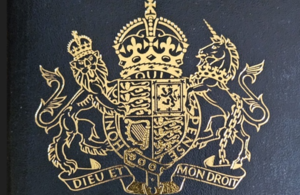
Today the Home Office announced that British passports had been updated to, among other things, display Timothy Noad’s illustration of the British royal arms, replacing the old Reynolds Stone illustration as it has in so many other contexts. Stone’s illustration, at time of writing, still appears on Acts of Parliament.

In other heraldic news, it has been five months since the last newsletter by the College of Arms and six since the last blog post by the Heraldry Society. Still, at least there’s another virtual Oxford lecture coming up in a fortnight’s time!

Francium Decay

It was announced today that Sébastien Lecornu was resigning as Prime Minister of France, having only taken up that office on 9th September. He hasn’t technically left office yet as he remains in a caretaker capacity until a successor can be found, but even if he lasts another three weeks like this his tenure will be shorter than Liz Truss’s in Britain.

Changing heads of government repeatedly in a short time is generally regarded as a symptom of a country’s political instability. I had a go at comparing France to some other countries — not all of them, obviously, nor is this sample chosen according to any particular principle — to see how bad things really are.

I think ten years is a long enough period from which to make a fair assessment, so I have listed all the people to have held the equivalent office in the period beginning 6th October 2015 and ending 6th October 2025. Dates of appointment are listed in brackets.

Nine

France

  1. Manuel Valls (31/03/2014)
  2. Bernard Cazeneuve (06/12/2016)
  3. Édouard Philippe (15/05/2017)
  4. Jean Castex (03/07/2020)
  5. Élizabeth Borne (16/05/2022)
  6. Gabriel Attal (09/01/2024)
  7. Michel Barnier (05/09/2024)
  8. François Bayrou (13/12/2024)
  9. Sébastien Lecornu (09/09/2025)

Six

Britain

  1. David Cameron (11/05/2010)
  2. Theresa May (13/07/2016)
  3. Boris Johnson (24/07/2019)
  4. Liz Truss (08/09/2022)
  5. Rishi Sunak (25/10/2022)
  6. Sir Keir Starmer (05/07/2024)

Five

Italy

  1. Matteo Renzi (22/02/2014)
  2. Paolo Gentiloni (12/12/2016)
  3. Giuseppe Conte (01/06/2018)
  4. Mario Draghi (13/02/2021)
  5. Giorgia Meloni (22/10/2022)

New Zealand

  1. John Key (19/11/2008)
  2. Bill English (15/12/2016)
  3. Jacinda Ardern (26/10/2017)
  4. Christopher Hipkins (25/01/2023)
  5. Christopher Luxon (27/11/2023)

Ukraine

  1. Arseniy Yatsenyuk (27/02/2014)
  2. Volodymyr Groysman (14/04/2016)
  3. Oleksiy Honcharuk (29/08/2019)
  4. Denys Shmyhal (04/03/2026)
  5. Yulia Svyrydenko (17/07/2025)

Four

Belgium

  1. Charles Michel (11/10/2014)
  2. Sophie Wilmès (27/10/2019)
  3. Alexander de Croo (01/10/2020)
  4. Bart de Wever (03/02/2025)

Three

Australia

  1. Malcolm Turnbull (15/09/2015)
  2. Scott Morrison (24/08/2018)
  3. Anthony Albanese (23/05/2022)

Canada

  1. Stephen Harper (06/02/2006)
  2. Justin Trudeau (04/11/2015)
  3. Mark Carney (14/03/2025)

Germany

  1. Angela Merkel (22/11/2005)
  2. Olaf Scholz (08/12/2021)
  3. Friedrich Merz (06/05/2025)

Israel

  1. Benjamin Netanyahu (31/12/2009 and 29/12/2022)
  2. Natfali Bennett (13/06/2021)
  3. Yair Lapid (01/07/2022)

Two

Luxembourg

  1. Xavier Bettel (04/12/2013)
  2. Luc Frieden (17/11/2023)

Russia

  1. Dmitry Medvedev (08/05/2012)
  2. Mikhail Mishustin (16/01/2020)

Spain

  1. Mariano Rajoy (21/12/2011)
  2. Pedro Sanchéz (02/06/2018)

The winner is Saint Vincent and the Grenadines, where Ralph Gonsalves has been Prime Minister since 29th March 2001.

As you can see, France is indeed doing rather badly in terms of minister retention. Britain isn’t exactly doing well either. I was a little surprised to see Australia, Canada and Germany all tied, given that the former is infamous for cycling its leaders and the latter respected for retaining them. Scholz has clearly let the side down by only lasting one term while Tony Abbot quit early enough to miss out on being counted here. Stephen Harper is only just barely included for Canada as the general election which would see him ousted was already ongoing.

Nova Cantaur

The process of appointing a new Archbishop of Canterbury has been a very long one. Justin Welby announced his intention to step down on 12th November 2024. The See of Canterbury formally became vacant with effect from 7th January 2025.

Today, 325 days after Welby’s announcement, it has been revealed that Dame Sarah Mullally, currently Bishop of London, is his designated successor. Of course, that’s still not the end of the process: She won’t formally assume her new office until her confirmation of election on 28th January and her enthronement is scheduled for some time in March, which could mean the whole saga ends up taking nearly 500 days. This isn’t even the worst example of episcopal appointments taking too long — the Bishopric of Durham has been vacant since 29th February last year with no replacement in sight. Currently in this respect (and, embarrassingly, many others) the Roman church is outperforming the Anglican: Only 27 days passed between the death of Francis and the inaugural mass of Leo XIV.

When Benedict XVI resigned (for reasons quite similar to Welby), there was some speculation that Francis, already 76 and with some known health issues, had been deliberately chosen by the cardinals as someone who wouldn’t serve long. That he lived and held the crozier for another twelve years took many by surprise. The Church of England took the element of surprise out of the game fifty years ago by imposing mandatory retirement at age 70 (though a maximum of one year’s extention is allowed at the monarch’s discretion). As with judges and heralds, this means there must be consideration of an informal maximum appointment age if the candidate is to have a decent time in the job before being forced out. Mullally, who was born in 1962, will be the oldest at taking office since Coggan and the second-oldest since Lang. She will have only six years, maybe seven if extended, in which to make her mark.

The “big five” diocesan posts in the Church of England, the ones always represented among the Lords Spiritual in Parliament, are Canterbury, Durham, London, Winchester and York. Looking at the other Archbishops of Canterbury who have served since the end of Victoria’s reign, we see that F. Temple and Fisher were, like Mullally, translated from London; Welby from Durham; Davidson from Winchester; Williams from Monmouth; Carey from Bath & Wells; Carey from St Albans; Lang, W. Temple, Ramsey and Coggan from York. Clearly, it is by no means mandatory to have held one of the other top posts first but it certainly helps. Since Durham is vacant, Mullally’s only rivals here were Stephen Cottrell and Philip Mountstephen, both born before 1960 and thus realistically too old.

Given the sour note on which Welby departed, and the long time taken to find a successor, some commentators were wondering if the institution was looking for someone out of left field in order to clean the slate. That turned out not to be the case (whether or not it was ever the intention) as Mullally is, by my reckoning, rather the obvious choice.

EXTERNAL LINKS

Balancing the Ball


Almost from birth I have had a strong aversion to even thinking about rugby and this was not assuaged during the few terms at secondary school when I had to learn to play it. This article is not about the sport, but about the peculiarity of a Buckingham Palace Tweet.

The text of the Tweet says:

A message from His Majesty The King to @RedRosesRugby and Women's @RugbyCanada Team following today’s #RWC2025 final.
The use of “following” here is a bit strange, since the message was put out eight hours before the game had even started. The King’s message is shown as an attached image, depicted against the backdrop of a rugby pitch with the England flag at the top and the Canadian flag at the bottom.
My wife and I send our warmest good wishes to both the
England Red Roses and Canada Women's Rugby Team as
you prepare for your World Cup final.

What a remarkable achievement for both teams to have
reached this pinnacle of the sport. I know that supporters
on both sides of the Atlantic will be cheering with equal
and tremendous pride.

May the best team win, and may you both play with the
spirit of sportsmanship, determination and true grit that
makes rugby such a wonderful game to watch. Whatever
the result, you have already done your countries proud.

Good luck to you all.

Charles R.
The message, of course, has to congratulate both teams equally for getting to the final and then be studiously neutral as to which of them will win it. I would plaintively suggest that including the Canadian coat of arms alongside the British one would have helped in this regard.
The King acted in a third capacity today when he held an audience at Balmoral Castle with Anthony Albanese, whom I think he last met in person at CHOGM in Samoa. Albanese had already been in Britain for bilateral discussions with Sir Keir Starmer at Downing Street.
Earlier this year Their Majesties made a state visit on Britain’s behalf to the Italian Republic. The trip was supposed to include a state visit to the Holy See in Vatican City as well, but things went awry when Pope Francis fell seriously ill. Eventually they managed to get a low-key private meeting on their anniversary, but anything grander was beyond His Holiness’s health. He died twelve days later. About a week ago, a few newspapers were reporting was going ahead with Leo XIV as host. Today the Palace confirmed it. The exact date has not been given yet, only “late October”. This will be the fourth British royal visit to the Vatican this year, as the Prince of Wales attended Francis’s funeral and the Duke of Edinburgh attended Leo’s inaugural mass. Those aforementioned news articles said it would be Charles III’s final overseas journey for 2025. That is very disappointing as it means there won’t be a royal tour of New Zealand this year. Given that 2026 is a general election year — in which royal tours are conventionally avoided — and that the sovereign is already expected to fly to Canada, the United States and Antigua & Barbuda at various points, it might not happen now until 2027, a full three years after it was originally planned.

Trump at Windsor and Chequers

The 47th President of the United States has now completed his much-anticipated second state visit to Britain. Here are my observations on it.

Time and Place

This time the state visit was at Windsor Castle instead of Buckingham Palace. Trump himself said that this was because Windsor was better. While most (including the royals themselves) would agree that Windsor is the superior setting by most metrics, the real reason for the change of location is that Buckingham Palace is undergoing major renovations so won’t be available for these kinds of events for some time. Trump had previously visited the castle on his Official (not state) visit in 2018.

There had been some speculation about the idea of the second state visit being held in Scotland rather than England. The King’s letter to him in February even speculated he could come to Balmoral, but this did not come to pass. Trump did make a visit to Scotland this summer while the monarch was also there, but it was a private rather than a political visit and the two men did not meet.

The timing of the visit was a little tight, as it was sandwiched between the Duchess of Kent’s funeral and the Queen’s Reading Room Festival. The Duke & Duchess of Edinburgh were not present due to clashing commitments — commemorating Independence Day in Papua New Guinea, then representing Britain at a business summit in Japan.

Ceremony and Security

What made this visit a little surreal is that, due to the intense unpopularity of Donald Trump among most of the British population and the scale of protests against him, this was the paradoxical phenomenon of a state visit done almost in secret. There were no “public-facing” events, with the foreign visitor instead being flown in his own presidential helicopter directly from Stansted airport to his ambassador’s residence, then to Windsor Castle, then to Chequers, then to Stansted again, thus avoiding the public roads (although his motorcade was still driven there without him in it).

What particularly stood out here was the carriage ride: For the state visitor to be pulled by horse through the streets of Windsor (or the Mall in Westminster) is a standard part of the tradition — witness Macron two months ago, the sovereigns of Japan and Qatar last year, and even Vladimir Putin in 2003 — but the enormous additional security requirements for American leaders had previously rendered this impractical. The solution here was for the carriage ride, like everything else, to happen entirely within the castle grounds. There were still soldiers lining the route, but no cheers from adoring crowds (or, more likely, jeers from abhorring crowds instead). The emptiness of the background gave the scene a visual quality reminiscent of much of the COVID years, especially Prince Philip’s funeral.

Other Parts

The First Lady had a tour of the Windsor Castle library with Queen Camilla, followed by a Scouts Squirrels event with the Princess of Wales. Her facial expressions throughout these events are noticeably different to when she is pictured with her husband.

Attire

As the state banquet was at Windsor, naturally the royal men were wearing the Windsor uniform while everyone else wore white tie. The King & Queen wore the sash of the Order of the Garter, as did the Duke & Duchess of Gloucester, the Prince of Wales and the Princess Royal, while the Princess of Wales and Sir Tim Laurence wore that of the Royal Victorian Order. Trump’s chest was noticeable for its lack of adornment, which is a little odd as he seems exactly the sort of person who would most covet medals and sashes. There was no exchange of honours between the two heads of state, which one would normally expect to see here if it hadn’t been done already.

I also spotted that, when first meeting each other, the sovereign and the president both wore ties the same colour as the hats worn by their respective consorts, which was a nice touch.

Music

We had copious renditions of God Save The King and The Star-Spangled Banner. I was a little surprised we never heard the presidency’s own anthem Hail to the Chief. Protocol aside, it would have been more artistically-apposite to have that one paired with the royal anthem while the national anthem was paired with something like Rule, Britannia!

Progress and Politics

Having completed his Dignified stay at Windsor, the President then moved to Chequers for the Efficient part of the visit. The British and American governments produced a Memorandum of Understanding regarding cooperation on advanced information technologies and, most intriguingly, nuclear energy. That last one is something that Britain has direly needed for a while, though the other parts have yet to fully escape the realm of folly.

Photographs

One of the main perks, for me at least, of having a US Government visit to the UK is that there will be a series of official photographs released into the public domain. I was a little disappointed on this occasion to see that the White House Flickr account didn’t publish any photographs of the visit, while the State Department only published one of Marco Rubio meeting Yvette Cooper on the runway. The collection on Wikimedia Commons is mainly made up of images found on White House Twitter and Instagram feeds. The White House YouTube channel also uploaded some nice long videos of the key events (albeit with a banner over much of the screen). There is less clarity on these platforms as to the copyright status, and it may later turn out that they are commercial photographs rather than government ones, in which case they will have to be removed. The Downing Street Flickr account published three dozen photographs of the event at Chequers but the only one from Windsor was the group shot shown above. This means there are no free photographs of the state dinner itself, so these will have to be sourced from screencaps of the aforementioned videos.

The Future

Already there have been further news articles hinting that Trump intends to invite Charles & Camilla to Washington D.C. next year, on a reciprocal state visit coinciding with the 250th anniversary of the United States’ independence. That should be interesting to see!

UPDATE (22nd September)

The White House Flickr account has now released an album of the state banquet with 27 photographs at time of typing, as well as 83 of the arrival ceremony and 48 of the Chequers conference, which sure makes my life a lot easier.

The Duchess of Kent’s Funeral

The funeral took place today at Westminster Cathedral. It was not televised, but there was a press-pool camera outside which livestreamed to YouTube. Unfortunately the camera feed only covered the outside of the cathedral, and our view of the inside was limited to a handful of still images (which seem to be of guests filing in rather than the ceremony itself), and what could be seen from the outside once the doors were opened. Since it was broad daylight from the outside, it took a while for the camera’s light sensitivity to adjust so that proceedings inside were actually visible. This was briefly undone every time someone in a white cassock walked across the camera’s field of vision outside, so that the interior became a black void again. I will make here what few observations I can, mainly about flags and cars.

When viewed from the piazza, the flagpole on the left of the main door normally flies the flag of the Holy See (or Vatican City) while that on the right flies the Union Flag (or Jack). This time the Vatican flag flew full-mast throughout while the right pole flew the sovereign’s banner of arms at full-mast in his presence and the Union Flag at half-mast in his absence.

Katharine did not have the use of a banner of her own arms (the Duke of Kent impaling Sir William Worsley) so her coffin was draped in the generic royal banner with the ermine bordure. Attendees on departure could be seen clutching the printed order of service with Katharine’s royal cypher (the letter K topped by a coronet of crosses and strawberry leaves, curiously not the version shown on Wikimedia Commons). The order of service itself has not been released, but the royal family website has this article explaining events that took place. An announcement on the cathedral’s website uses Sodacan’s illustration of the late duchess’s heraldic achievement.

The doors opened as the piper was walking out, after which the national anthem was played. Two verses were sung, preceded by Gordon Jacob’s fanfare. It was played on the cathedral’s organ but I don’t think any brass players were present.

I took notes on which royals arrived in which car:

  • The Late Duchess herself was carried in the claret Jaguar hearse (no numberplate) also seen at Elizabeth II’s funeral.
  • The Duke & Duchess of Gloucester in OY20FUL (a dark red diesel Jaguar)
  • Prince & Princess Michael in a blue BMW (probably YK74MHB, electric)
  • The Duke & Duchess of York in KN74EFK (a green hybrid Range Rover)
  • Sir Tim Laurence & The Princess Anne in DK74CMV (a blue petrol Bentley Bentayga)
  • The Prince & Princess of Wales in KU25UPR (a blue hybrid Range Rover)
  • The Duke of Kent & Lady Helen Taylor in a blue Jaguar (registration not shown in footage)
  • The King and Sir Clive Alderton in the Bentley State Limousine (no numberplate needed).

The Duke of York looked a little confused on the way out, walking towards the cars, then back to the cathedral, then to the car again, as if not sure which one he was meant to be using. A short wheelbase bus was used for several other family members, including Lord & Lady Frederick Windsor.

The Duke of Kent, aged 89, understandably looked rather frail and shrivelled. His siblings Prince Michael and Princess Alexandra were both seen in wheelchairs at some points, then walking with canes at others. The Queen did not attend, having pulled out at the last minute due to a sudden bout of acute sinusitis. It is not confirmed if she will still be attending the imminent American state visit.

Accession Day 2025

Today marks three years since the passing of Elizabeth II and thus the commencement of the fourth year of the New Carolean era. Here is a quick round-up of recent developments.

New Royal Biographies

The stream of these is continuous and too large to notice all of them, but three in particular have generated news coverage:

  • Entitled: The Rise and Fall of the House of York by Andrew Lownie (14th August, HarperCollins). The title alludes to the Wars of the Roses, but really it’s about the personal, professional and financial lives of the most recent Duke & Duchess. The book is overwhelmingly derogatory and might have been considered scandalous had not most of the topics therein been raised already some years ago (while the other claims are usually less-than-credible). Many reviewers and columnists have said words to the effect that it would be devastating to its targets’ reputations if only they had reputations left to devastate. The people who didn’t already believe the things Downie asserts here probably won’t read this book anyway so despite a few sensational headlines I doubt in the long run it will really change anyone’s position.
  • Power and the Palace: The Inside Story of the Monarchy and 10 Downing Street by Valentine Low (11th September, Headline). Low has already written Courtiers in 2022, which I have in my collection but have not gotten around to reading yet. I’m not sure I’ll ever read this one either since, as is often the case with this kind of book, the newspapers have already spent weeks running headlines explaining all the important bits. The book is about the relationship between senior members of the royal family and senior members of successive governments. The most outlandish part is the attempt to lift the lid on Schrödinger’s box regarding Elizabeth II’s political beliefs, long a source of speculation to all and sundry. Low, quite remarkably, claims that Her Late Majesty was much more candid than formerly thought and that everyone else around her was more studiously discreet. The most prominent assertion (in terms of news coverage) concerns her views on the 2016 EU referendum. Private Eye has this amusing summary:
GALLAGHER’S GALL
ORDERED by press watchdog Ipso to print a correction to his pre-referendum front-page headline “QUEEN BACKS BREXIT”, which was found to breach its accuracy rules since there was nothing in the story to show it was true, then-Sun editor Tony Gallagher was defiant.I don’t accept that we made an error at all,” he huffed to the BBC. “We made a judgement that the headline was right and that it was backed up by the story. We knew more than we put into the public domain. The sources were so impeccable that we had no choice but to run the story in the way that we did.”
Nine years on, Gallacher has been promoted to edit almost-as-respectable sister sheet the Times, which is serialising Power and the Palace, the new book by the paper’s retired royal-watcher Valentine Low. And what headline appeared on Saturday’s front page flagging the first revelations from the impeccably sourced tome? “The Queen was a Remainer.” (Eye 1657 page 7)
  • Charles III: New King. New Court. The Inside Story by Robert Hardman (Pan Macmillan). It actually made most of its headlines last year but apparently he has a new edition coming out soon. I’m not sure if this is the second edition or if there’s already been one in the interim that I’ve missed, as I found a version on Google Books which claims to have been published on 7th November 2024 yet includes photographs of events from 2025. It has three extra chapters compared to the one I borrowed from Hull Central Library, and these cover the two royal cancer crises as well as the D-Day Commemorations and the general election. This latest version is obviously too early to include Trump’s state visit or the Duchess of Kent’s funeral, so probably yet another version will be needed next year. Pan Macmillan ought to have a trade-in scheme so people who already bought the old edition can get discounts off the new one. In an interview with journalist Patricia Treble he said Charles is “just the King” now as opposed to “the new king” so perhaps the very name of the book is now redundant and it would be better in the long run to wait until he has enough extra material for a full-length sequel instead of endless retroactive add-ons.

The Tudor Crown

Yes, that old chestnut again. I note that HM Goverment is still not entirely consistent here: When Rushanara Ali resigned last month the Prime Minister’s typed response had the new Noad illustration on its letterhead but when Angela Rayner resigned last week Starmer’s handwritten reply was topped by the old image, as was the letter from the Standards Adviser. Recently Charles wrote a letter to King Mswati III of Eswatini (formerly Swaziland) congratulating his country on fifty-seven years of independence. That letter was Tweeted by the British High Commission in Mbabane, showing the new emblazonment. It uses the “lesser” version of the arms in blue instead of the greater version in red, so it perhaps it should be understood as an FCDO letterhead instead of a royal one.

State Visits

Britain has already received a state visit from France this year and is about to host one for America also. As far as outbound visits go, there doesn’t seem to be anything scheduled for the rest of this year. In 2026 Their Majesties are expected to travel to Canada again (for an extended royal tour), to the United States (for a British state visit) and to Antigua & Barbuda (for CHOGM). There is still no announcement as to when they will visit New Zealand, which must be frustrating to those who’ve been waiting well over a year now!

The Deputy & The Duchess

The Duchess’s Heraldic Achievement

Documentaries about the stormy second premiership of Harold Wilson (1974-6) often mention his determination to take the nation by surprise after months of all his government’s secrets being leaked to a vicious press. In the end he pulled off the particularly-impressive trick of resigning on the same day that the Princess Margaret finalised her divorce from the Earl of Snowdon, and therefore knocked the latter story off the front pages. No doubt this spared the royal family a lot of grief.

Today a similar coincidence has been achieved in reverse – Angela Rayner resigned as Deputy Prime Minister, and Buckingham Palace announced the death of the Duchess of Kent. There is something a little uncanny in these events happening so close to the anniversary of Liz Truss’s accession to the premiership and Charles III’s accession to the throne. The public mourning over the deceased Queen Elizabeth obviously didn’t save the Truss government, but did at least postpone its inevitable disintegration. Neither of today’s events are quite on the scale of those but, even so, the cabinet will likely be glad of the news – and Parliament – having a different story to occupy their time.

I will deal with Rayner first. Obviously her property tax scandal is a further reputational blow for a government whose public approval ratings were already abysmal. Her departure could cause some practical issues, too. Rayner simultaneously resigned from three offices: Deputy Prime Minister of the United Kingdom, Deputy Leader of the Labour Party and Secretary of State for Housing, Communities & Local Government. The latter is the one of greatest constitutional substance, for each Secretary of State is a corporation sole defined in statute with responsibility for a government department, in this case the Ministry of Housing, Communities & Local Government. The MHCLG cannot operate effectively without its secretary of state so a successor to Rayner will need to be appointed within days and confirmed at a meeting of the Privy Council shortly afterward. The middle is of course not a government office but a party one. Deputy Leaders are elected by a postal ballot of the rank-and-file partisans in an operation that typically takes months. This will be the first time in decades that the Deputy has been replaced without the actual Leader also changing (unless Sir Keir Starmer somehow also ends up resigning imminently) and, given the unpopularity of the current government among the party’s base, it could be a major opportunity for dissident factions to attempt a strike against front bench. The internecine fighting is bound to highlight controversies and resentments on which the opposition parties can pounce. The former will be the more interesting to watch: As I have mentioned before, the Deputy Prime Minister is constitutionally little more than a courtesy title rather than a substantive office and many premiers can do without appointing one. There is no obligation for the Deputy Leader of the Labour Party to be deputy leader (whether en titre or de facto) of a Labour government – notably Harriet Harman wasn’t. Even so, the Deputy probably need to have some kind of senior government post, for as a backbencher they would be too free to criticise and challenge the incumbent. If the eventual winner of the election is not already a cabinet minister then it may necessitate another minor reshuffle. In the meantime, though the Prime Minister will need a designated survivor, he would probably be better off not appointing a new DPM, nor a First Secretary of State, as whoever landed that job would then have then have to endure the indignity of relinquishing it a few months later and, since everyone would predict this in advance, would probably struggle to accomplish much of worth during that time.

Moving on to the Duchess: Born in 1933, she was the oldest among the royal family, a status which now passes to her 89-year-old widower Edward. Her death does not create a vacancy in the Firm, as she very quietly retired from public duties a few years ago and was absent for nearly all of the big ceremonial gatherings since then.1 At the time of writing the exact date of the Duchess’s funeral has not been announced, but based on usual time lapses it should be concluded before the halfway point of this month and thus narrowly avoid clashing with either Donald Trump’s state visit to the United Kingdom or the Duke of Edinburgh’s attendance at Papua New Guinea’s semicentennial independence celebrations. Katharine was the first British royal since the Glorious Revolution to convert to Roman Catholicism, and it has been stated that her funeral will follow Catholic liturgy. That will be an innovation for the House of Windsor too, as the only thing approaching a recent precedent is the reinterment of Richard III in 2013, and even that was technically an ecumenical affair. The Duke of Kent has been steadily winding down his commitments in recent years but is still considered a senior working royal. It is yet to be seen if the death of his wife will lead to any changes in his arrangements. The Ferens Building at the University of Hull (not to be confused with Ferens Hall) has her name on its keystone and the Prime Minister’s statement this afternoon mentioned that she was “giving her time and working anonymously as a music teacher at a school in Hull”. It will be interesting to see if any of her pupils are involved in the funeral, or indeed if there will be any local ceremonies to celebrate her association.

1The latest reference I can find in the Court Circular to her attending in person, rather than being represented by someone else, is 8th June 2019. I note that the “Where is Kate?” crisis of eighteen months ago failed to notice or care that the other Katharine had been “missing” for a much longer time.

UPDATE (8pm)

In the time between drafting this article and uploading it, Sir Keir has ignored my advice and carried out a full reshuffle, appointing David Lammy as DPM and Lord Chancellor (interestingly making the same career move as Dominic Raab four years ago) and replacing Rayner at MHCLG with Steve Reed, among many other changes. No timetable or candidates have yet been confirmed for the Deputy Leadership.

Everything in my Power

As we have recently celebrated the eightieth anniversary of VE and VJ Day, I have naturally been reading a lot of articles and watching a lot of documentaries about the end of World War II in both Germany and Japan. The mechanics and political technicalities of the German surrender are particularly fascinating to me, as the event represented not only the cessation of fighting but also the succession of states – with the Third Reich dissolving in favour of the Allied occupation zones. It is a reminder that, even in times of total war and with the prospect of total annihilation, there are still laws and protocols which must be followed, most notably the famous Geneva Conventions.

Key to the successful operation of these laws is the presence of at least a small number of neutral countries which maintain diplomatic relations – however strained – with both factions. This can lead to some interesting shenanigans: When my late grandmother got me A. J. P. Taylor’s1 The First World War for Christmas 2013 I was amused to read that before the United States took a side there were British and German ambassadors in Washington D.C. competing for Woodrow Wilson’s favour in loans and arms contracts. The novel Winston’s War by Michael Dobbs (which I read in the summer of 2018) has a subplot in which Churchill discovers that Britain is short of rifles and hatches a cunning plan to buy second-hand German ones instead, because the Reich had such a surplus that they were still exporting them commercially to neutral countries on the continent. Though they weren’t explicitly mentioned very often, neutral states and organisations also played an important role in The Barbed-Wire University by Midge Gillies (which I finished last April), since the parcels, letters and so forth that the Allied prisoners received from home were hardly the sort of things which their Axis captors would (or indeed could) have delivered themselves. Neutral countries are also necessary for most forms of reliable news reporting (whether or not related to the war) to get from one side to the other – though how this works in the internet age is probably worth another article.

The specific aspect of wartime diplomacy which interests me for the purposes of this article, and which I only discovered in my recent Wiki-reading, is the concept of “Protecting Powers”. Put simply, this means that when two countries have broken off diplomatic relations (and especially if they have declared war) then their ambassadors and/or other official representatives on each other’s soil will be withdrawn. A neutral third country will then be appointed to act as a go-between while the warring countries cannot communicate directly. This third country will have an “interests section” as a department of its own embassy, and will be the official channel for humanitarian aid, personnel exchanges and, eventually, peace negotiations. In some cases the PP’s embassy will take over the former embassy buildings2 of the country that it protects, and may even re-employ the same lower-level staff, so that the “interests section” is a polite fiction to allow the former embassy to continue in all but name.

There are limits to what a PP can realistically do, as both parties in the conflict must agree to their appointment – a PP which allows its interests section to push too far may see its neutrality questioned by the host country, and then its own diplomatic ties threatened. Switzerland, unsurprisingly, is a popular choice for this role, as is Sweden. The Wikipedia page on Protecting Powers has a catalogue of historic and current examples, noting that by the end of World War II Sweden held 114 mandates involving 28 countries. At the time of writing, the Swedish embassy in North Korea hosts interests sections for ten other states. There was a period in the last decade when Britain broke off relations with Iran, so the Swedish embassy in Tehran hosted a British interests section, while Oman’s in London hosted the Iranian.

Of the serious armed conflicts taking place in the world right now, the most important – at least from a European perspective – is that between Russia and Ukraine. Although relations had already become icy with Putin’s annexation of Crimea in 2014, it was his launch of a full-scale invasion in February 2022 that saw them broken off entirely. This war has now been going on for 42 months, i.e. more than half as long as Britain was fighting in World War II. Having gotten into this topic, I was naturally curious as to whom the two countries had chosen as their PPs. None of the Wikipedia articles which should have mentioned it actually did so, however, so I asked the question in various talk pages. At time of uploading, only one other contributor has managed to find any information relating to this query: Based on some articles found on a Russian news site, it looks as if there still aren’t any! In a conference in Canada in 2024 (already way too late, really) there were offers by the Vatican, South Africa, the United Arab Emirates, Lithuania and Qatar to perform the role, but nothing was agreed, though Qatar at least has been involved in some POW exchanges. Putin has said Switzerland lost its neutral status by joining in sanctions on the Russian economy, and the International Committee of the Red Cross (which can also act as PP if no sovereign state is available) has struggled to get access. I might have thought that Turkey would be a candidate, since they had hosted some (unsuccessful, of course) peace talks, but they are not mentioned at all.

This perhaps goes to show that comparisons with the 1940s may be, if anything, a bit understated: To put it bluntly, the current Russian government is at least in some respects failing to comply with protocols which even he of the small moustache managed to honour!

Article from SwissInfo: Russia rejects protecting power mandate agreed by Switzerland and Ukraine (11 August 2022)

Articles from RosBiznesConsulting:

Article from Media Center Ukraine: Bohdan Chumak: The involvement of a protecting power could become an effective tool in securing the return of prisoners of war (8 January 2025)

Article from Al Jazeera: Russia and Ukraine discuss more prisoner exchanges at Istanbul talks (23 July 2025)

1 A. J. P. Taylor is not related to me.

2 Technically the building is called the “chancery” whereas the “embassy” is the organisation hosted there.