The Sovereign’s Crown and the Southern Cross

The King & Queen in Sydney (NSW Gov, CC BY 4.0). The King’s mouth is unfortunately hanging open in this shot, which combined with the opaque glasses makes for a bit of a Hubert Farnsworth look.

The King & Queen have just spent the past nine days on a tour of Australia and Samoa. Bizarrely, the Palace’s press release called this an “Autumn Tour” even though in the destination countries it was spring. The tour was originally supposed to have included New Zealand as well, but His Majesty’s cancer diagnosis earlier this year forced the itinerary to be severely reduced.

Charles wore three distinct metaphorical “hats” during the course of the tour: First as King of Australia conducting domestic business, second as King of Great Britain & Northern Ireland conducting a bilateral state visit, and third as Head of the Commonwealth presiding over the biennial Heads of Government Meeting.

Photographs of the sovereign couple at these events are unfortunately few and far between. Australian governments both federal and state lack official Flickr accounts with clear licensing indications as their British counterparts have, and the paltry few hosted on their websites are also of uncertain origin – at time of posting a handful have been accepted on Wikimedia Commons but these all look so suspiciously similar to those on Getty and Alamy that I wouldn’t be surprised if they ended up getting deleted shortly afterwards. There seem to be no free-licence photographs of the state visit to Samoa at all. Number 10 and the FCDO both have albums from the CHOGM, but only one picture of the lot actually shows Charles and none at all show Camilla.

I do not know the full details of the travel arrangements, but what I can gather is that Their Majesties and a small entourage took a commercial flight from Heathrow to Singapore, whence they were picked up by the Royal Australian Air Force and taken to Sydney Kingsford Smith Airport in New South Wales.

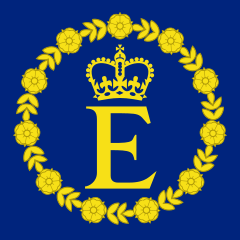
The tour marked the first in-the-fabric appearance of the Australian royal banner of arms (known officially as “The King’s Flag for Australia”), which was seen flying from the cockpit window and then later from several road and watercraft. The Australian banner follows Canada’s example by reverting to showing the national arms undifferenced, in contrast to the practice followed during Elizabeth II’s reign of defacing the banner with her own personal cypher. The King approved the present version on 30th August.

The current coat of arms of Australia was formalised in 1912. The shield is a composite in “quarterly of six” format, representing the six constituent states of the federation. The states of South Australia and Western Australia did not yet have full coats of arms at the time but all had heraldic badges (which are also shown on their respective civil flags) so these were used instead. The whole is surrounded by a bordure ermine.
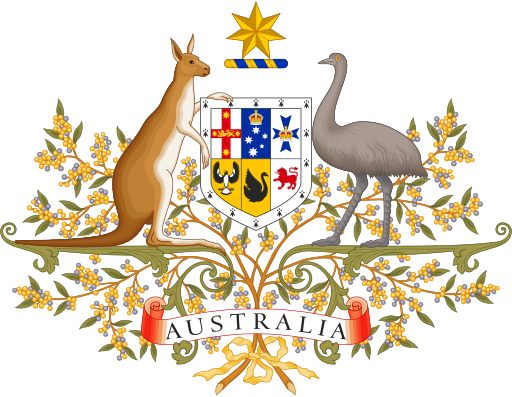
The whole federal armorial achievement is normally depicted with the crest on a torse hovering some distance above the shield – omitting helm, mantling or coronet – but the Imperial Crown appears as a charge on the badges of Victoria and Queensland, notably at different sizes.

As in Britain (though unlike Canada) the depiction of the crown in Australian royal symbols has changed from St Edward’s Crown to the Tudor Crown, though this has not yet entirely filtered through to all the state arms and flags themselves. I dimly remember – but can no longer find the proof – that the flag as approved on the government’s website in August still showed St Edward’s Crown, and that the graphic on Wikimedia Commons did likewise until photographs of the real flag caused an update.

The King at several points on the tour wore the sovereign’s badge of the Order of Australia along with a hefty line of other honours I will need time to identify. The Governor-General gave him honorary commissions at the top ranks of all three branches of the Australian armed forces. This is is a little perplexing from a legal perspective: One would have thought that the reigning monarch would hold these ranks substantively ex officio and would not need to be appointed to them by his own deputy.

The Queen is another story: For months now I have been looking out for signs of Camilla being granted the use of her own banner of arms – being the royal arms of the sovereign impaling those of her father Bruce Shand. This was finally seen to be the case during the Australian tour, flying from the bonnet of her car on a few occasions when she travelled without her husband. The videos did not show the flag long enough (and the stills tended to have it covered by the watermark) but from what little I can determine of the artistic subtleties of its design I reckon it is actually a printout of the vector file on the Commons. The car itself was a black Audi (I think a Q8) and the regular numberplates were obscured with plates bearing an image of the Tudor Crown. That image looks to have been taken from Wikimedia too, though I can’t find the exact image. The glaring problem here, of course, is that this banner shows Shand impaled by the British royal arms rather than the Australian, resulting in a mismatch with her husband. There is a burning irony that after all this time, the one occasion Camilla can be seen using a personalised banner of arms as Britain’s royal consort is the one occasion in which it was not appropriate to do so.

This unfortunately seems to be far for the course with royal tours – with the notable exception of Canada (probably because that country has its own heraldic authority), banners of royal arms in the other Commonwealth Realms seem to only be made for the reigning sovereign himself, with the rest of the royal family defaulting to their British blazons instead of coming up with a local variant. This may be marginally more convenient from a logistical and fiscal perspective, but it can be constitutionally misleading as it implies that they are representing a foreign state instead of that country’s own crown. If creating a personal one for each prince or princess is too onerous, it at least would be relatively easy to create a generic ermine-bordered version which they could all use when in the country. Admittedly that might not work in Australia where the sovereign’s own shield and banner have an ermine bordure already. For the royal wives, it might even make more sense to use banners of their paternal arms unimpaled so that they needn’t change based on location at all.

During the visit, His Majesty attended a service at St Thomas’s Anglican Church in North Sydney, made addresses to both the state Parliament of New South Wales and the national Parliament of Australia (sadly not from the throne in either case) and undertook a review of the fleet. God Save The King was played by a brass band while Charles inspected the troops and also by a solo amateur flautist during his walkabout but I can’t find any clip of it actually being sung at any point, in contrast to Advance Australia Fair which was sung by a children’s choir at Parliament House. That the monarch made no remark about his late friend Barry Humphries (a.k.a Dame Edna Everage) was also a little surprising.

When the royal party landed in Samoa they switched back to their British identities and the British royal banner was flown from the cockpit window alongside the Samoan flag, although the aeroplane itself was still very obviously branded as Australian.

While in Samoa Charles was invested with two honorific titles – Tui Taumeasina (King of Taumeasina) and Toa’iga o Tumua (Paramount Chief). The Queen was seen using a hand-fan with her royal cypher printed on it, which was given to her by Stewart Parvin in February. Both switched for much of the visit to bespoke white outfits in the local style.

Charles attended the CHOGM in his capacity as Head of the Commonwealth. Elizabeth II adopted a personal flag to represent herself in this capacity with no reference to any particular country. Her son so far appears not to have done so, which is a pity.
The official royal YouTube channel has uploaded some videos from these events. Not only are they continuing to use the outline of the British royal arms as the channel logo, they have also taken to including a new drawing of the arms in the thumbnails of individual videos. This, again, is a little problematic when the contents of the videos relate to other realms. I am left to wonder what recognisable symbol could be used here to avoid this problem. The livery badge of the House of Windsor might work, but even that technically has the British banner of arms included in it. The only solution that would truly work is, I suppose the CIIIR cypher on its own, without even a crown above it. Indeed, that could work for other family members’ flags and banners too.

The Death of Dame Maggie

Reported today was the death at age 89 of the actress Dame Maggie Smith, best known in recent decades for her roles in the Downton Abbey and Harry Potter series – the latter especially poignant as her co-star Sir Michael Gambon died exactly a year ago.

This post is not meant as a eulogy or obituary for her – many others can do that far better than I – but a discussion of two points of interest relating Dame Maggie to the topics covered on my blog.

First, her status as a Dame: In 1970 Smith was appointed Commander of the Most Excellent Order of the British Empire. Twenty years later she was promoted to Dame Commander. This is one means by which to certify her status among the “National Treasures” of British acting, nearly all of whom have had the chance to become a knight or dame even if a small number have declined. The Order of the British Empire was founded by King George V in 1917 and was the first British order of chivalry in the modern era to explicitly allow female recipients to have the title. The top two grades of the order are Knight/Dame Commander (K/DBE) and Knight/Dame Grand Cross (GBE). The DBE is by far the most common form of damehood and it is the only grade of any order at which dames outnumber knights. This is partly because the other orders (e.g. the Bath) are reserved for senior government and military officials, a group which tends to skew male anyway, and partly because there is no female equivalent of the honour of Knight Bachelor (i.e. knighthood unconnected to membership of an order of chivalry) which is the rank that the majority of knights possess (including fellow treasures like Gambon as aforesaid). Most of Britain’s orders of chivalry (the Royal Victorian Order is an exception) have statutory limits on how many there may be at any particular grade at any given time. For the grade of K/DBE that limit is 845, with male and female members counting the same towards the total. I do not actually know how close we are to hitting the limit. The English Wikipedia has a page listing all the people who have been awarded the status of DBE and they number over a thousand, but without going through each biography individually (and some don’t have their own pages anyway) I cannot tell how many are currently alive and still holding the same dignity.

In 2021 Netflix released an animated sitcom named The Prince, focusing on a fictionalised caricature of Prince George of Cambridge. It was produced and largely written by Gary Janetti, who previously wrote fourteen episodes of Family Guy, and it strongly resembles that series both tonally and aesthatically. Despite its star-studded cast the series received overwhelmingly negative reception for its offensive premise and unfunny execution. The series was neither renewed nor widely distributed and now is viewable only as a scattering of short clips on video-hosting site by either the studios’s own paltry few advertisements or other people’s reviews of it. The first episode features a minor subplot about the possibility of Elizabeth II conferring a damehood on either Kelly Ripa or Greta Thunberg. On two occasions the suggestion results in another character asking if Smith had just died, presuming there to be a moratorium. As explained above this reasoning is technically correct, although Janetti seems to have missed that neither Ripa (American) nor Thunberg (Swedish) were the late monarch’s subjects so could not receive substantive appointments to the order anyway. They could only receive honorary appointments (giving them the post-nominals but not the salutation) which would be supernumerary to the quota.

The news of Smith’s death has brought renewed interest in her earlier appearances, the most famous of which was the 1969 film The Prime of Miss Jean Brodie, based on the 1961 novel by Muriel Spark (who herself became a DBE in 1993). News features about Smith’s death kept playing the same speech by her character, which is also featured on the book’s TV Tropes page:

I am in the business of putting old heads on young shoulders, and all my pupils are the crème de la crème. Give me a girl at an impressionable age and she is mine for life. You girls are my vocation. If I were to receive a proposal of marriage from Lord Lyon, King of Arms, I would decline it. I am dedicated to you in my prime. And my summer in Italy has convinced me that I am truly in my prime.

Grant with the future George VI in 1933

I have not yet watched the film or read the novel in full, but searching a digital scan on Archive.org for the word “lyon” gives two instances, both of them in the context of Brodie turning down his hand, with the implication that he must be highly desirable and that declining him requires a serious force of will. The only other reference to heraldry in the book is a passing mention of the school’s “crest” which I think is really a shield. The book is set in the 1930s and the Lord Lyon King of Arms from 1929 to 1945 was Sir Francis James Grant, whose Wikipedia article is such a short stub that I don’t even know if he had a wife or not. He was sixty-eight by the time the novel was published, so not in his “prime” by any reasonable definition. Why his title was used in the book is unclear, and may be a matter I need to raise at a subsequent virtual heraldry lecture, whenever that comes up.

Late-Summer Heraldic News

In the past fortnight there have been a handful of significant developments in the world of British heraldry.

Firstly, on 15th August the College of Arms published the 76th edition of its newsletter. Much of the text deals with topics already explained (such as the coronation roll and the year’s garter appointments) but there were some new details, such as the grant of arms to the University for the Creative Arts, which will be another addition to my list on Wikipedia.

Secondly, there are two long-form videos on YouTube of armorial interest: On August 20th a video by the White House Historical Association about the making of the Presidential Seal and on August 23rd by American Ancestors interviewing the York Herald Peter O’Donoghue. These videos speak for themselves so I will not elaborate them.

Thirdly, and of most interest, is a Tweet from 24th August by Alastair Bruce. It includes three photographs from inside the High Kirk of Edinburgh, showing the stallplate and banner of Queen Camilla. There is not much of surprise about the composition of the arms – they show the arms of King Charles impaling the arms of Bruce Shand – but it is reassuring to have confirmation that both shield and banner exist in formal usage, given the persistent uncertainties of Her Majesty’s status in England.

The most intriguing of the three photographs is the one which shows Camilla’s stallplate accompanied by five other royal ones: In the left column are Prince William, Earl of Strathearn (middle) and Olav V, King of Norway (bottom). In the right column are Queen Elizabeth Bowes-Lyon (top) the Prince Philip, Duke of Edinburgh (middle) and the Prince Albert, Duke of York (bottom). The fact that these six achievements are put together like this is itself a little confusing since some of those members of the order had overlapping tenures so could not have occupied the same stall. Also noteworthy is the way in which the artistic styles have changed over the years:

  • The Prince Albert, (later King George VI) was appointed to the order by his father in 1923 and presumably this is what it says on the scroll underneath (although it’s not legible in the photograph). He uses the royal arms differenced by a label of three points argent the centre bearing an anchor Azure. He has the coronet of a child of the sovereign sitting on top of a forward-facing golden helmet, and the coronet itself is topped by the lion crest, gorged at the neck by another label of three points argent – although that one doesn’t have the anchor in the middle. While that could be dismissed as an omission by the painter (perhaps too small to draw properly) it is unmissable that this stallplate clearly uses the English version of the royal arms and crest as well as referring to the prince by his England-based title (Duke of York) instead of his Scottish-based one (Earl of Inverness).
  • Queen Elizabeth was appointed by her husband in 1937. Her stallplate shows his arms impaling those of Claude Bowes-Lyon. Again the English arrangement of the royal arms is used, especially confusing as Elizabeth was herself of Scottish ancestry. The shield is topped by the royal crown. I can’t work out if it is the English or Scottish version of the crown shown, given the vagaries of the art style.
  • The Prince Philip was appointed by his wife in 1952. His stallplate shows his arms as granted in 1949. He used the same coronet as his sons and uncles-in-law, but here it is depicted beneath the helm rather than atop it as in the other examples. Philip apparently used the same arms in every heraldic jurisdiction, as well as the same title. His personal motto “God Is My Help” appears on a scroll above the crest, as is the Scottish tradition.
  • Prince William was appointed by his grandmother in 2012. Earl of Strathearn was his secondary peerage, his primary being Duke of Cambridge. His arms are in the Scottish arrangement. He uses the coronet of a son of the heir apparent on top of a front-facing grey helmet with gold bars, itself topped by the Scottish royal crest. Both crest and shield are differenced by his label of three points Argent, the centre bearing an escallop Gules. The Scottish motto “In Defens” flies over the crest. The tinctures used for this stallplate look a little off, with the Or in particular being shown as a much darker shade of yellow than that used for all the others.
  • Queen Camilla was appointed by her husband in 2023. Her shield uses the Scottish arrangement of the arms. The royal crown is drawn rather differently to that used by her grandmother-in-law, but it’s still just as unclear which one it is supposed to be.
  • Olav V, the only foreign member here, was appointed by his first cousin one removed in 1962. Crests are not a traditional feature of Norwegian heraldry, but the royal crown of Norway is placed atop a forward-facing grey helm with gold bars. The mantling is Gules doubled Or whereas the British princes here use Or doubled Ermine. Domestic depictions of the Norwegian arms tend to omit helm and mantling altogether or use a pavillion Purpure doubled ermine.

Don’t They Look Younger Now?

Fresh from attending special sittings of the States of Jersey and the States of Deliberation in Guernsey, today Their Majesties returned to Westminster for the opening of the first session of the fifty-ninth Parliament of the United Kingdom.

This was the first King’s Speech under a Labour government since 1950. There is some symmetry, perhaps, between Charles III’s second speech and George VI’s second-to-last.

This is the only free-licence photograph of the event so far.

While the content of the speech was very lengthy and stood in radical contrast to the one delivered for Sunak’s government in November, in ceremonial terms there was very little change. The King’s getup was identical to that worn last time. The Queen’s changed a little – instead of her coronation gown, she has reverted to the style of dress she wore in 2019 and earlier. Reeta Chakrabarti, presenting the BBC’s coverage, described it as “very fine, off-white silk crepe embroidered by Fiona Claire”. She has not taken to wearing a sash again, but the star of the Order of the Garter appears around her left hip. This was also, incidentally, her 77th birthday.

Shabana Mahmood appeared as Lord Chancellor. Being a barrister, she wore the full-bottomed wig. This is the first time a woman has performed this role at a state opening, for Liz Truss’s brief tenure in the role did not include one. Justin Welby, the Archbishop of Canterbury, can be seen for the first time wearing the collar of the Royal Victorian Order.

The most striking visual difference was in the change of pages – last time King Charles’ train was carried by Nicholas Barclay, Ralph Tollemache, Charles van Cutsem and Lord Oliver Cholmondeley (three of whom also appeared at the coronation). This time Tollemache returned but the other three were replaced by William Sackville, Alfred Wellesley and Guy Tryon. I don’t know any biographical detail about them beyond what I can guess from their surnames but they all appeared to be several years younger than the boys whom they replaced. Queen Camilla continued to use William Keswick and Arthur Elliott as before. As at last year’s ceremony Her Majesty’s two pages held her robe in the middle rather than at the end so that the end still dragged along the carpet, whereas His Majesty’s four pages kept the whole garment elevated (despite it being longer than his wife’s).

Some other things of note – as is custom after the first state opening of a new parliament, the lower house appointed three temporary deputy speakers. The senior of these is Sir Edward Leigh. I don’t think a Father of the House has ever been appointed as a deputy speaker before. These three will hold office for the brief period until new deputies are elected. All three of the deputy speakers sitting before dissolution have now left the house (one against his will), which was last the case in 1997. There will thus be no continuity except for Sir Lindsay Hoyle himself. Also today the first life peerages of Sir Keir Starmer’s premiership were patented – Lord Vallance of Balham and Lady Smith of Malvern. It appears that the ministerial appointments will be taking priority over the dissolution honours after all.

EXTERNAL LINKS


Hello Mother, Hello Father

The fifty-ninth Parliament of the United Kingdom assembled for the first time today. As usual the first business was the re-election of the Speaker of the House of Commons.

The custom is that proceedings for the election of a speaker are presided over by the member, present in the chamber and not being a minister, with the longest continuous service. As of last week’s general election that member is Sir Edward Leigh, an MP since 1983. His predecessor, Sir Peter Bottomley (MP since 1975) sought re-election but was defeated. Had Leigh also been defeated then the task would have fallen to Jeremy Corbyn of Islington North (formerly Leader of the Labour Party, but now sitting as an independent).

This person also usually has the honorific title “Father of the House”. I say usually because the Father need only be the member with the longest continuous service, and there can be times when that person is also a minister and/or not present in the chamber for the speaker’s election. So far the title has always been Father and never Mother, for no woman has yet achieved this distinction.

In 2015 Harriet Harman declared herself Mother of the House on account of being the female MP with the longest continuous service (since 1982 in her case) and this caught on with a few other senior members (including prime ministers Cameron and May). It is not quite clear why Harman only claimed the status in 2015 given that it was already true a parliament earlier, nor whether this title ought to be applied retroactively all the way to Nancy Astor.

Harman would have been the actual Mother of the House and the member presiding had she been returned at this election, but she chose to retire and ascend to the Lords instead, as did runner-up Dame Margaret Beckett. That left Diane Abbott, MP for Hackney North and Stoke Newington since 1987, the most senior female member and the fifth most senior overall. She was called Mother of the House several times during speeches, and given a place of high precedence during the day’s events – i.e. taking the oath before the cabinet ministers did.

Despite the timetable not being as urgent, the fifty-ninth Parliament copied the fifty-eighth in having two royal commissions on the same day, one to actually open the session and the other to give the speaker-elect his approbation. In previous parliaments the approbation commission was deferred to the next day of sitting. As in 2019, the letters patent appointing the Lords commissioners were not read again the second time MPs arrived at the bar.

I noticed that the expedition from the lower house to the upper for the first commission was unusually small, consisting only of Leigh, Abbott and six other members (plus Black Rod and the Clerk of the House of course).

Finally I will note that the coordination of the hat-doffing by the commissioners themselves was frankly woeful. On the first occasion Lords Laming and True forgot to do it at all!

FURTHER READING

The Emperor’s New Collar

Naruhito & Masako, Emperor & Empress of Japan, conducted a three day visit to the United Kingdom this week. It was the third state visit to Britain during the present reign, and the first monarchical one since that by the King & Queen of the Netherlands in 2018.

The visit consisted of the expected activities – a state banquet at Buckingham Palace, then another banquet at the London Guildhall, as well as military parades and presentations.

According to the Court Circular for 25 June, the palace guest list included “Mr. Christopher Broad (Founder of YouTube channel, Abroad in Japan)”. This is thought to be the first time that a prominent YouTuber has been invited to a state event specifically in that capacity.

As is customary during state visits, the monarchs exchanged appointments to their respective orders of chivalry: Charles received the Collar of the Supreme Order of the Chrysanthemum while Naruhito became a Stranger Knight of the Most Noble Order of the Garter. It is a shame that his visit was not a few days earlier, or he could have marched in the procession.

File:Coat of Arms of Japanese Emperor (Knight of the Garter Variant).svg

Sodacan’s representation of the Japanese Garter arms.

Naruhito ascended the imperial throne in 2019 when his father Akihito abdicated. Japan now joins Spain and the Netherlands in having two Garter stalls simultaneously. What makes the Japanese representation different to the Spanish and Dutch is the different style of heraldry. The Japanese Imperial Seal is a mon representing a stylised chrysanthemum flower. Mon are normally standalone objects without a background – more visually similar to a Western crest or livery badge than a shield of arms. To make the symbol compatible with European heraldic customs for use in St George’s Chapel it is typically presented as the lone charge on a red background for the shield and banner, then again without a background as the crest atop the helm. The Emperor paid a private visit to Windsor Castle to view his predecessors’ stall plates there and to lay a floral wreath on Elizabeth II’s tomb.

The state banquet also marked the first appearance of the Royal Family Order of Charles III. Dating back to the reign of George IV, the royal family orders are an informal and highly personal decoration restricted to senior royal women. Each consists of a silk ribbon from which hangs a jeweled miniature portrait of the sovereign. The orders do not always have formal classes but their badges tend to come in different sizes which correlate to the seniority of the recipient. The colour of the ribbon varies: Charles III follows George V in using pale blue, whereas Victoria used white, Edward VII blue and red lined with gold, George VI pink and Elizabeth II yellow. The Queen was seen wearing the new Carolean order immediately above the Elizabethan one she received as Duchess of Cornwall in 2007, and there is a clear difference in size. The Duchess of Edinburgh also wore Elizabeth’s order to the banquet.

This state visit was a little unusual in that it happened during a general election campaign. Some changes had to be made to the itinerary to cut out the more obviously political elements: Unlike previous visiting sovereigns, the Emperor did not make an address to Parliament (since their isn’t one) and while the cabinet and opposition leaders attended the state banquet they did not have individual meetings with him. Notably Sir Keir Starmer and Sir Edward Davey were not wearing their respective knightly insignia.

Washing Up, Washing Out

Yesterday evening the fifty-eighth Parliament of the United Kingdom was prorogued for the fourth and final time, pending dissolution next Thursday. This meant that MPs had just two days of “wash up” in which any bills already in the pipeline are either hurried to completion or abandoned altogether.

Parliament is not always prorogued before dissolution, sometime it is merely adjourned – in the past fifty years the 46th, 47th, 48th, 49th, 52nd, 53rd and 57th parliaments were all open-ended. Irrespective of whether or not a prorogation was involved, the time elapsed between a parliament’s last sitting day and its dissolution varies highly: For the second general election of 1974 it seems that the 46th Parliament sat last on 31st July before rising for the summer recess then got dissolved on 20th September just before it could convene again, whereas in 1992 the 50th Parliament sat last and was dissolved on the same day.*

Rishi Sunak’s motivation for this particular timetable is unclear – if he had let the legislature sit on 28th and 29th May it would have allowed four days instead of two to finish business, so that fewer bills would have needed to be dropped. Perhaps Sunak felt it would be a waste of commuting time to sit for just two days between the bank holiday and the dissolution. Some have also speculated that he wanted Parliament closed as soon as possible to reduce the opportunity for his backbenchers to unseat him as party leader. A precedent might be found in John Major in 1997, who had the 51st Parliament prorogued more than a fortnight before it was dissolved and was suspected of doing so to block the publication of a select committee report against Neil Hamilton.

When a general election is looming, incumbent MPs have to make a decision: Step down and make one’s valedictory speech in the chamber before prorogation, or stand again and risk having to make it instead from the returning officer’s podium in the early hours after polls close. By the time the house closed more than a hundred members (over seventy of them Conservatives) had chosen the first option. The valedictory debate lasted nearly seven hours and obviously I have not yet been able to properly take in all of the speeches. So far my favourites were Sir James Duddridge (with its interventions by both Alicia Kearns and Dame Eleanor Laing), Julian Knight (who took the chance to lash out at former colleagues who had wronged him) and Tim Loughton (differentiating knowledge from wisdom in terms of putting tomatoes in fruit salads).

The prorogation ceremony was carried out in the usual way. There were two substitutions among the Lords Commissioners – Liberal Democrat leader Lord Newby was replaced by his deputy Lord Dholakia (as in 2019) while Convenor of the Crossbench peers Lord Kinnoull (still not a privy council member) stayed on the crossbenches and left his place on the woolsack to his predecessor-but-two Lord Laming. Eleven acts received assent.

As in the prorogation last November, the letters patent acknowledged that there had been a demise of the crown since the last general election, hence the phrase

…whereas Queen Elizabeth The Second did lately for divers difficult and pressing affairs concerning Us the State and defence of Our United Kingdom and Church ordain this Our present Parliament to begin and be holden at Our City of Westminster the seventeenth day of December in the sixty-eighth year of Her Reign on which day Our said Parliament was begun and holden and is there now holden…

which as Jack Blackburn of The Times aptly pointed out is the last time that the former monarch will be mentioned in Parliament in this context.

As I have mentioned before, the dissolution of Parliament creates a headache for Wikipedia editors as hundreds of people who for years or even were incumbent members of the House of Commons cease to be so for a matter of weeks, then (most of them) become so again after polling day. This time, rather than have many of us hurriedly scouring hundreds of pages to remove any trace of incumbency, I am trialing a solution I piloted at the devolved elections three years ago by placing a disclaimer tag at the top of each affected article. The beauty of this trick is that the template can be centrally edited, so I can go at a more leisurely pace adding it to MPs’ articles in the days before dissolution with the notice written in future tense and then on the day of dissolution change it to present tense. Of course, that still leaves a lot of work making long-term edits to the pages of those members who will permanently leave the house at this election (whether willingly or not) and creating new pages for their successors.

EXTERNAL LINKS

House of Commons Library

Privy Council Office

UPDATE (2nd June)

When looking through the Hansard records for this sitting, I noticed an interesting mistake:

End of the Fifth Session (opened on 7 November 2023) of the Fifty-Eighth Parliament of the United Kingdom of Great Britain and Northern Ireland in the Second Year of the Reign of His Majesty King Charles the Third.

The last sitting day before 7th November 2023 was 26th October, and the record for that day says it was the end of the third session. Quite when the fourth session came and went I have no idea.

*The 1993 documentary Days of Majesty covers the prorogation and dissolution process.

Why stop when you’re on a roll?

Today marks the first anniversary of Their Majesties’ coronation, and there have been some public ceremonies to commemorate.

A few days ago the coronation roll was unveiled, serving as a written record of the proceedings that took place in the abbey (and some of the key events leading up to it) as well as listing all the prominent attendees. As this was the first British coronation to take place in the internet age, a digital version of the roll has also been set up, interlaced with video interviews from many of the core participants.

David Torrance has produced a lengthy briefing document for the House of Commons library about it.

While I’m here, there is another aspect of the coronation on which I’d like to look back – the status of the chairs on which Their Majesties sat during the ceremony. Some weeks before the event the antiquarian Dr Allan Barton put out a video called When Is a Chair a Throne? The answer, essentially, is that it must be on some form of dais to raise it above the floor.

At the business end of the abbey during the coronation there are five seats of special importance: Closest to the alter is St Edward’s Chair, the ancient wooden relic on which the monarch is actually crowned. A few metres behind, in the crossing, sit two “throne chairs”, in this case a pair of X-framed armchairs (almost looking like something a film director would use) originally made for George VI & Elizabeth Bowes-Lyon. Perpendicular to these are chairs of estate, these ones originally made for Elizabeth II and Philip Mountbatten, allowing the couple to sit behind their respective faldstools.

From what I can see in images of past coronations, both painted and photographic, a pattern is clear – the consort’s throne sits on three steps and the monarch’s throne on five, while the chairs of estate and St Edward’s chair sit directly on the floor. The 2023 coronation breaks the trend – the monarch’s X-framed chair has just one block underneath it while the consort’s counterpart has none at all (though it still has upholstered footstools in front). Does this mean that, technically, only one of these chairs counts as a throne?

IMAGE REFERENCES

That Time of Year Again

Lord Kakkar by Roger Harris, 2019 (CC-BY-3.0)

St George’s Day – 23rd April – is the traditional day for announcing new appointments to the Order of the Garter. The King today named three new ordinary knights and one new royal lady:

  • The Lord Peach, Chief of the Defence Staff 2016-18. This is fairly unsurprising as another former chief, Lord Stirrup, is also part of the order, as were many other (though not all) chiefs before him.
  • The Lord Kakkar, former Chairman of the Appointments Commissions for both the House of Lords and the Judiciary. He is most prominently known for his work in business and medicine.
  • The Lord Lloyd-Webber, one of the musical composers for the coronation, is probably the most famous. It is perhaps a little surprising that he went directly to the Garter and was not offered the Royal Victorian Order first.
  • The Duchess of Gloucester, President of the Royal Academy of Music since 1997. This appointment is a bit of a departure from convention as, while royals by birth are nearly all given the Garter as a matter of course (Princess Margaret and Prince Michael being odd exceptions), royals by marriage (unless their spouse be first in line to the throne or already sitting on it) generally are not. This honour is presumably in thanks for the additional duties the duchess has taken on since the winding down of Elizabeth II’s reign, and in particular during Charles III’s recent illness. It remains to be seen if the Duchess of Kent will be extended the same.

In addition to these appointments, there was some reshuffling of honorary offices among the other orders of chivalry which in recent years had fallen vacant or merged with the crown: The Queen was made Grand Master of the Order of the British Empire (last held by the Prince Philip, 1953-2021) while the Prince of Wales was made Great Master of the Order of the Bath (last held by Charles himself from 1974 until his accession).

The most revolutionary of today’s changes regards the Order of the Companions of Honour. This was created in 1917 alongside the Order of the British Empire and designed to reward outstanding achievements in art, science, medicine or public service among people who would not accept titular dignities. Appointments are made on ministerial advice. Currently the order has a quota of sixty-five ordinary members, of which two places are currently vacant. There is also one honorary member, the Indian economist Amartya Sen. Until now, no member of the royal family had been appointed a Companion of Honour. Given the origins of the institution, it seems a little odd that His Majesty (or the Prime Minister) would choose to create the supernumerary category of Royal Companion (similar to that in the Garter), and to make his daughter-in-law the Princess of Wales the first incumbent. This stands in contrast to the Order of Merit, in which Elizabeth II appointed both her husband and her son as full members on the same basis as all the others.

In armorial terms, obviously this will mean four new banners to hang in St George’s Chapel. The Duchess of Gloucester’s arms are well-known, and I have already found and illustrated those of Lord Kakkar (though doubtless his increased prominence will lead to a better rendering by a different artist soon enough), but Peach and Lloyd-Webber are a mystery – the former having been ennobled too recently to appear in the last print of Debrett’s.

UPDATE (24th April)

There are now three vacancies among the Companions of Honour, as it transpires that the Lord Field of Birkenhead died while I was writing this post.

Review: Charles III by Robert Hardman

Robert Hardman is no stranger to royal biography, having already penned quite a handful about Elizabeth II in the last decade or so of her life, including Queen of Our Times which came out in March 2022 as part of her Platinum Jubilee season and then in December of the same year was released again in a “commemorative edition” to update for the fact that she’d died. Now he moves into the present reign with a biography of her eldest son. I am a little confused about the title of this one as the British publication is called “Charles III: New King. New Court. The Inside Story”1 but on Google Books I can see that the United States version is called “The Making of a King: King Charles III and the Modern Monarchy”. I suspect the titles must be written this way for SEO purposes, or perhaps he just couldn’t decide which description he wanted so used all of them at once. It must be quite a fraught process to come up with a distinctive and meaningful name for a biography when you know that lots of other biographies will be documenting the same person and all competing to emerge in future history as the one definitive authority thereon. Most likely in the long run the general public (maybe academics too) will discard the pretentious subtitle and just remember it as “[AUTHOR] on [SUBJECT]” (e.g. “Jenkins on Churchill”) instead.

Hardman’s lengthy volume covers the first year of the New Carolean era. As one might expect, this period in royal history was particularly dominated by two big ceremonial events: His mother’s funeral and his own coronation. In the book, the funeral (as well as the period of Operation London Bridge leading up to it) takes up chapters 3, 4 and 5 while the planning and execution of the coronation takes 9, 10, 11, 12, 13 and 14. That makes for nine chapters out of a total of eighteen across the whole book. The coronation section in particular is loaded with dense historical comparisons, detailing not just the crowning of Charles III but also quite a lot about those of George VI an Elizabeth II. A less charitable reader may accuse Hardman of padding here, though doubtless a lot of the innovations (and omissions) of 2023 cannot be fully appreciated without an understanding of what came before. Anyone buying this book at first printing will, doubtless, have already watched the public side of these events on television as they were happening, so the real value of these chapters is in reading the personal accounts of the people involved as to what went on behind the scenes, such as the aide who spontaneously hugged Princess Anne to console her in her grief, the brigadier getting a summons back to London while giving a speech at his daughter’s wedding in Corfu, the Duke of Norfolk getting his GCVO investiture in a rush so he could wear his sash in the procession or the royal pages being packed off into a side room with some video games. It is worth mentioning as well that Hardman directed a BBC documentary about the coronation and some other aspects of royal life that year which aired at Christmas and can be seen in some ways as the prelude to this book.

The other chapters are about the personalities of Charles & Camilla, the looming political challenges for the institution of the crown and some of the other projects in which the sovereign couple have engaged themselves (such as the Prince’s Trust/Charity/Foundation organisations which now all have to be renamed). The running thread is the process of establishing Charles’s approach to kingship and the need to assert, like most new incumbents whose predecessors served an unusually-long time, that he is his own person and is not obliged to become a clone of his forbear with whom the institution had become synonymous. Charles, of all our sovereigns, had the longest pre-accession life and a brings with him a much more complete (and publicly-known) individual persona, which makes this task all the more pressing. I was amused to read in Chapter 15 that an unnamed senior courtier refers to this as “Doctor Who syndrome”, showing that the habit of explaining the British constitution in terms of that franchise is one that runs all the way to the top. Given the relative perceptions of the new king and his late mother, I would especially see parallels to Colin Baker succeeding Peter Davidson, or Capaldi following Tennant and Smith.

Being acutely aware of some of the less-sympathetic perceptions that have swirled around the royal family as a whole in recent years, and around Charles in particular for many decades, Hardman occasionally includes explicit references to and arguments against ideas emanating from either that acclaimed Netflix drama or statements by the exiled Duke & Duchess of Sussex. At times it can feel as if he has a bit of an axe to grind. It’s probably redundant in any event, as the people likely to be credulous of the claims he’s refuting are not likely to picking up his book in the first place. I’d like to think this is merely a demonstration of Hardman’s passion for truth over sensationalism, but I can’t entirely trust him on that front given he writes for the Daily Mail after all.

These minor quibbles aside, New King New Court is an engaging and enlightening work which I would recommend to anyone interested in the topic area, though any customer (or library) sinking their money into the original edition now may wind up feeling short-changed he does another expanded version in the near future.

1The use of full stops means that the title mercifully evades what TV Tropes calls “Colon Cancer”, though I would have preferred commas.