Waving the White Flag

In recent weeks there has been some reshuffling of responsibilities within the royal family: The King and the Princess of Wales have both been undergoing cancer treatment, limiting their ability to carry out public engagements away from their residences. Consequently, a greater burden has fallen on His Majesty’s wife and ever-trusty sister.

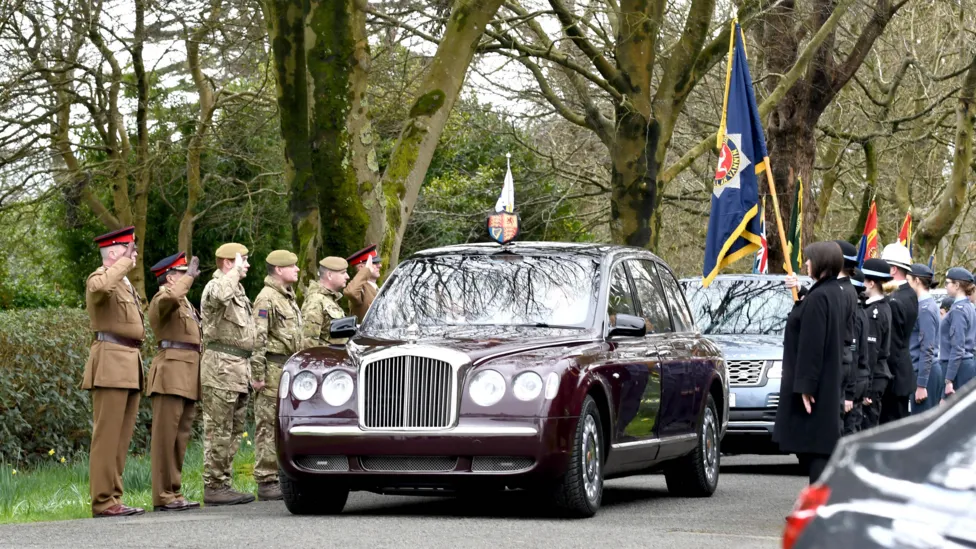
The Queen’s recent sole engagements have included Douglas City Hall on the Isle of Man (for the presentation of the letters patent to confer city status), and Worcester Cathedral (for the Maundy service ahead of Easter).

As was noted in Mark Scott’s lecture a month ago, the granting of banners of arms to members of the royal family is a separate event from the granting of the armorial achievement itself (rather than being automatic as it would be for lesser armigers). Eighteen months into her tenure as queen consort, it appears that Camilla’s own banner has not been granted, for I have repeatedly seen the Bentley State Limousine flying the ermine-bordered version of the royal standard used for lesser members of the firm who had not been granted personalised heraldic flags of their own, while the shield affixed to the roof shows the arms of the sovereign undifferenced.

As is so often the case, the Wikimedia Community have moved much faster than reality – a graphic representing Camilla’s banner as queen consort was uploaded preemptively way back in 2016 and has been used in multiple articles since her husband’s accession. Perhaps this will need to be revised in light of new evidence.

PHOTOGRAPHIC REFERENCES

In Honour of the Occasion

Photograph by sbclick, 2011 (CC-BY-1.0)

In theory the monarch can bestow practically any accolade on any person at any time and for any reason. In practice, since the late Victorian age there has been a trend towards grouping announcements into two big lists each year – one in June for the sovereign’s official birthday, one in December for the upcoming new year. There are also smaller lists issued at irregular intervals to commemorate particular events e.g. the deaths of senior royals, the dissolutions of parliaments and the resignations of prime ministers. The latter two types tend to be particularly controversial.

Wikipedians have generally maintained pages for all of the lists, great and small. They  have also created an annual page called “Special Honours”, which they use as a catch-all term for those titles and decorations which were issued outside of any named occasion.

Today’s announcement is a little confusing for those seeking categorisation – the Prime Minister’s office has released a list of honours and appointments for March 2024. The document as a whole does not have any particular name, but paragraphs within it do: Creative Industries Honours, Technology & Artificial Intelligence Honours, and Political Honours. The former has provoked the most recognition, appointing film producer Emma Thomas as a DBE and her husband Christopher Nolan (already a CBE since 2019) as a knight bachelor. There is also a short list new privy counsellors (e.g. Vaughan Gething, recently appointed as First Minister of Wales), though whether these count as honours in the way knighthoods do is debatable.

This new publication comes just forty-eight days after the list of “Political Peerages” (e.g. yet more new members of the House of Lords). It eludes me why today’s list was not brought forward to be merged with that one, or pushed back to fold in with the Birthday Honours in June. The only likely explanation is that these were Rishi Sunak’s personal picks and he (or His Majesty) wanted that distinction made clear in the public mind. Of course, that could also have been achieved by waiting for the looming dissolution honours at this year’s general election – or indeed Sunak’s resignation honours, which may well come earlier!

Edward gets the Thistle

The Prince Edward seems to have made a habit of collecting new titles on his birthdays. For the occasion of his wedding in 1999 he was ennobled as Earl of Wessex and Viscount Severn. These both refer to places in England, in contrast with the normal convention for royal peerages. On his fifty-fifth birthday he gained a surprise Scottish title – Earl of Forfar – and then for his fifty-ninth he gained another, long-awaited and far more prestigious one – Duke of Edinburgh. Now that his primary title refers to a Scottish place – and the capital at that – it would seem a little strange for him not to join Scotland’s highest order of chivalry.

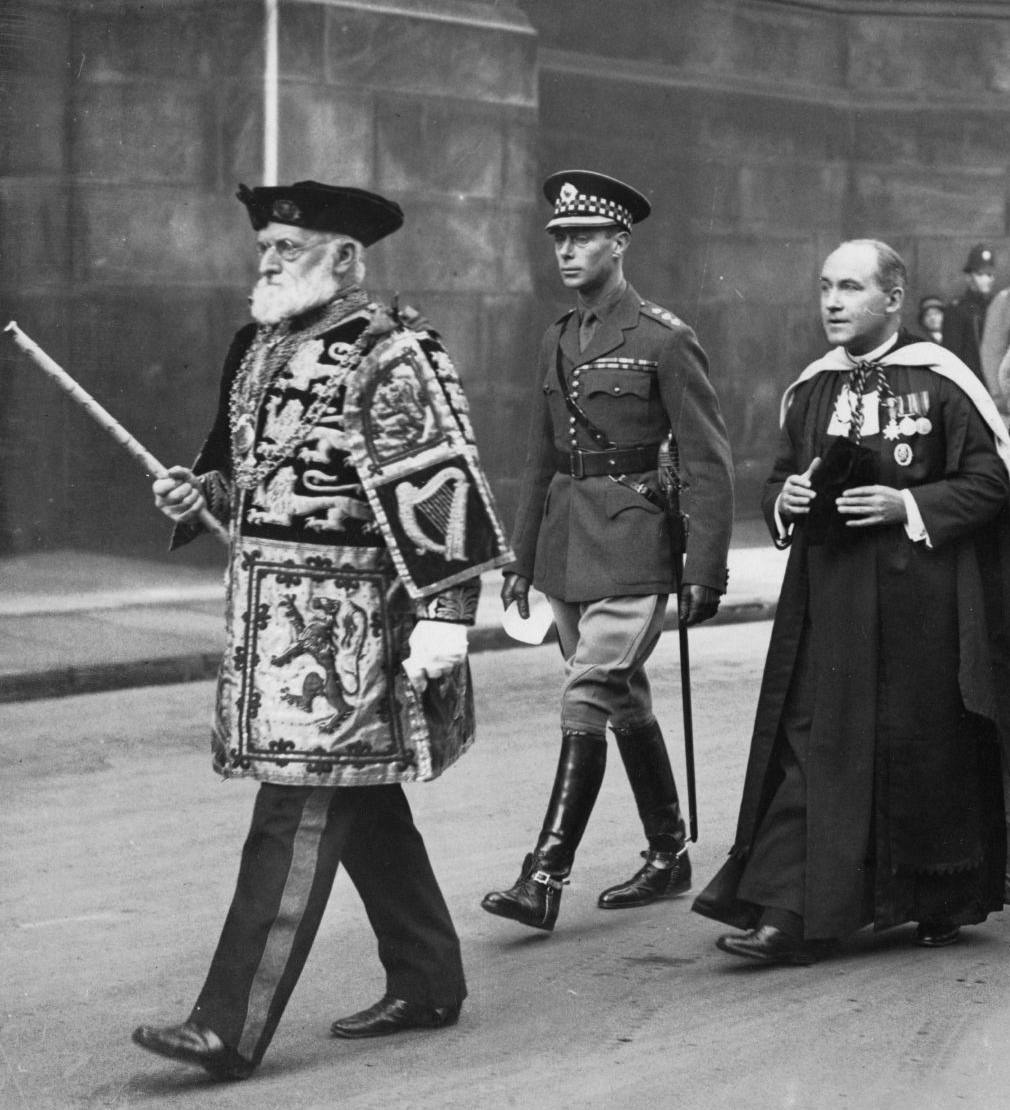
It was not exactly surprising, then, to learn that on his sixtieth birthday he had been appointed an Extra Knight of the Order of the Thistle. In this category he joins his nephew the Duke of Rothesay and his sisters the Queen and the Princess Royal. We can expect that soon his banner of arms will be hung alongside theirs at the High Kirk in his namesake city.

The King also announced three new appointments among the ordinary membership of the order – the Baroness Black of Strome, the Baroness Kennedy of The Shaws and Sir Godfrey “Geoff” Palmer – all of whom, curiously, have academic careers. This brings the order up to its full complement of sixteen members (excluding royals). It is unusual for all the appointments to be made today as traditionally they are announced on 18th June.

Finally, a concurrent press release confirmed that the duke had been appointed to a second term as Lord High Commissioner to the General Assembly of the Church of Scotland, a post which he last held in 2014-15. In the Scottish order of precedence he will rank immediately below the sovereign himself, rather than his natural precedence as a brother thereof.

Notes on the Memorial of Constantine II at Windsor

People of prominence often find that one period of mourning is not enough. For many of high status there will be the funeral itself within weeks of their death and then a separate, less formal, memorial service as much as a year later. Prince Philip had one of these in 2022, as did Lady Boothroyd last month.

Constantine II, King of the Hellenes 1964-73, died on 10 January 2023 and his funeral was held in Athens six days later. Yesterday a thanksgiving service took place at St George’s Chapel, Windsor, hosted and attended by the British royals.

Although it was a British-hosted event, only the Greek family’s website seems to list the order of service or any photographs. The order of service is has the late monarch’s arms illustrated on the first cover and those of the Order of the Garter on the last. This time the illustration is not that by Sodacan for Wikimedia Commons. I cannot identify the artist for this one, nor which typeface was used for the prose.

Most intriguing about the online material is that it highlights the contribution of the Lord Soames of Fletching. There is even a link to his website, which is still up even though it clearly hasn’t been updated since the most recent general election.

A Note on the Honours Given to Prime Ministers

Cameron’s ennoblement got me thinking about the general trend of honours given to former prime ministers. Combing through Wikipedia, I have produced a list of them. To keep it from becoming overly long (and to avoid ambiguities about who counts as a prime minister), I have restricted it to honours conferred after the end of Victoria’s reign.

Although their legal status is much the same, British orders of chivalry can be politically divided into two categories: The Baronetage, Knights Bachelor, the Orders of the Bath, St Michael & St George, the Companions of Honour and the British Empire are appointed on the advice of government ministers, while the Royal Victorian Order, the Order of the Hospital of St John of Jerusalem and the Order of Merit are conferred at the monarch’s personal whim. The Orders of the Garter and Thistle fell into the former category in the early eighteenth century but were changed to the latter in 1946. Peerages both life and hereditary are presumed to be in the former category.

Here is a simplified list of who received which kind of honour and when. Honours which a person held before ascending to the premiership are not included:

HONOURS IN THE MONARCH’S GIFT

Garter (post-’46)

  • Churchill in 1953 (while still prime minister, in advance of the coronation)
  • Attlee in 1956 (resigned as Labour leader the previous year)
  • Wilson in 1976 (three weeks after leaving office)
  • Callaghan in 1987 (three weeks before stepping down from the Commons)
  • Thatcher in 1995
  • Major in 2005
  • Blair in 2021 (New Year’s Eve)

Merit

  • Balfour in 1916
  • Lloyd George in 1919 (while still prime minister)
  • Churchill in 1946 (while opposition leader)
  • Attlee in 1951 (while opposition leader, ten days after premiership’s end)
  • Macmillan in 1976
  • Thatcher in 1990 (nine days after premiership’s end)

St John

  • Thatcher in 1991 (Dame of Justice)

HONOURS ON MINISTERS’ ADVICE

Garter (pre-’46)

  • Balfour in 1922 (backbench MP) (adv. Lloyd George)
  • Asquith in 1925 (adv. Baldwin)
  • Baldwin in 1937 (adv. Chamberlain) (immediately after resignation)

Companion of Honour

  • Attlee in 1945 (adv. Churchill) (shortly after resigning as Deputy PM)
  • Major in 1998 (adv. Blair)

Hereditary peerage

  • Balfour in 1922 (adv. Lloyd George)
  • Asquith in 1925 (adv. Baldwin)
  • Baldwin in 1937 (adv. Chamberlain)
  • Lloyd George in 1945 (adv. Churchill)
  • Attlee in 1955 (adv. Churchill)
  • Eden in 1961 (adv. Macmillan)
  • Macmillan in (adv. Thatcher)

Life peerage

  • Douglas-Home in 1974 (adv. Wilson)
  • Wilson in 1983 (adv. Thatcher) (dissolution honours)
  • Callaghan in 1987 (adv. Thatcher) (dissolution honours)
  • Thatcher in 1992 (adv. Major) (dissolution honours)
  • Cameron in 2023 (adv. Sunak)

It may also be worth considering honours given to the spouses of prime ministers, whether for achievements in their own right or by right of marriage.

  • Margaret Lloyd George: GBE in 1918 (adv. her husband)
  • Lucy Baldwin: GBE and DStJ in 1937 (former adv. Chamberlain)
  • Clementine Churchill: GBE in 1946 (adv. Attlee), life peer in 1965 (adv. Wilson)
  • Dorothy Macmillan: GBE in 1964 (adv. Douglas-Home)
  • Denis Thatcher: TD in 1982, baronet in 1990 (adv. Major), CStJ in 1991.
  • Norma Major: DBE in 1999 (adv. Blair)
  • Cherie Booth/Blair: CBE in 2013 (adv. Cameron)
  • Philip May: Knight bachelor in 2020 (adv. Johnson)

Unless I’ve missed any, no current or former prime minister (or their spouse) has, from 1901 onward, been appointed to the Order of the Bath, the Order of St Michael and St George, the Order of the Thistle or the Royal Victorian Order.

The Matter of Sir Martin

Yesterday the London Gazette published the list of British honours conferred to commemorate the sovereign’s official birthday. Among those appointed as Knights Bachelor was the writer and academic Martin Amis. This announcement was notable for two reasons, the most prominent being that he died almost a month ago.

Britain doesn’t generally do posthumous honours, but occasionally people who have accepted them die before the official announcement and the chancery (or Cabinet Office) decides to keep their names on the list.

In this case the supplement specifies “To be dated 18 May 2023” and from what has been reported so far, officials contacted Amis early last month then rushed through the administrative process to confer the award before he died, but asked his family to keep it secret until now. We can presume that no physical accolade was given, since he was in Florida at the time.

The second reason this raises eyebrows is that Amis never seemed like the sort of person who would desire a knighthood – in much the same way that it would feel strange for George Orwell or Christopher Hitchens to get one. He even said outright in a 2011 interview that he would never accept any honour from the crown. It is not clear what caused this apparent deathbed conversion, and I have seen comments from some people speculating what mental state he was in during his final days.

Obviously Sir Martin himself will have no opportunity to enjoy the trappings of knighthood, but his widow and daughters will, and the backdating means that they will have precedence above the wives and children of other Knights Bachelor appointed yesterday, or indeed in the Resignation Honours last week.

The Crown old and new

Early in the new reign, the College of Arms announced a new royal cypher for Charles III. A noted difference between this one and his mother’s (other than the name, of course) was the depiction of the crown.

“St Edward’s” crown, favoured by Charles II to Victoria

Up to and including Victoria’s reign, depictions of the crown in heraldic drawings could be inconsistent. Edward VII ordered a standardised depiction with simple arches, which has come to be known as “the Tudor crown” due to its resemblance to one supposedly commissioned by Henry VII or VIII (and seen in royal portraits up to the Civil War). Elizabeth II later decided to change this to a version with depressed arches, better resembling St Edward’s crown which monarchs actually wear at coronations, and which seemed to be favoured in heraldic drawings before Victoria’s time. The timing of these decisions created a general misconception that the Tudor crown is always used when the monarch is male and St Edward’s when the monarch is female. Charles’s decision is likely to reinforce that belief.

The “Tudor” crown, as used by Edward VII-George VI

On the day of the coronation, the Canadian Heraldic Authority unveilved their own new version of the crown, intended to be more distinctly Canadian. The overall shape of the crown is still based on the Tudor version, but the jewels have been replaced by a wavy blue line, the uppermost cross by a snowflake (as already used in the Order of Canada) and the crosses around the rim by – of course – golden maple leaves. The removal of explicit Christian symbols may be due to the lack of an established church in Canada, though the omission of fleurs-de-lis is a little perplexing, given the constitutional importance of the country’s French heritage.

https://upload.wikimedia.org/wikipedia/commons/thumb/d/d4/Crown_of_Canada_2023.svg/248px-Crown_of_Canada_2023.svg.png

The Canadian crown, as used by Charles III

It is not clear on exactly what timescale the new crown is to supersede the old. Four days after the coronation the government of Canada released a revised Canadian passport design. Though many radical changes have been made, the 1952 depiction of the crown retains pride of place. It is also not certain whether this will apply to the parliamentary maces. Currently the mace of the House of Commons is modeled on the Tudor crown while that of the Senate is modeled on St Edward’s. This is reflected in the heraldic badge of the parliament, showing both maces in saltire behind the shield. Funnily enough, British passports, though updating the introductory text to reference His Britannic Majesty instead of Hers, also still seem to have the prior crown on their covers.

The shield itself (fleurs and all) remains unchanged. It was announced on the same day that the arms of Canada may be flown as a banner to represent Charles and all future sovereigns. Previously Elizabeth II’s flag had the royal arms of Canada with her personal EIIR cypher imposed on a hurt in the middle. The removal of the cypher brings Canada closer in line with British heraldic practice whereby the reigning monarch bears the arms of dominion undifferenced, as well as avoiding the hassle of redesigning the flag for each subsequent reign. It remains to be seen whether the heraldic banners of other members of the royal family will also omit their cyphers and keep just the cadency labels.

FURTHER READING

A Note on Royal Peerages

Today it was announced that The Prince Edward, Earl of Wessex and Forfar, was created Duke of Edinburgh, a title formerly held by his father. This had been speculated for years, but the intriguing part of the news is that the title is only for life – Edward’s son James will not inherit it. This is the first life peerage above the degree of baron for more than two hundred years, and the first given to a royal since medieval times.

For a newly-ascended king to denounce the principle of heredity seems unlikely. I think there is a more pragmatic reason for this – a desire to keep the title in circulation for the sons and brothers of future kings. The firm does not want to run out of place names (especially in Scotland) to use for dukedoms.

It has been tradition in Britain for the better part of a millennium that the younger sons of the monarch are granted dukedoms referring to prominent locations within the isles. Indeed, there is a lot of tradition in which particular place names are used, and even for which place in birth order.

On second thought, however, this shouldn’t be possible – if these honours are separately hereditary, and given to the offspring expected not to take the crown, then how do the same titles keep coming up time and time again. This paradox reveals an important detail about the royal dynasties of the past thousand years – their cadet branches normally don’t branch very far. It’s remarkably rare to find examples of a legitimate male line emanating from a younger son of a king that lasts for more than three generations. Most of the time either the junior line dies out (either only having daughters, or having no children at all), or the senior line fails so that the junior line ascends to the throne. To make matters worse, on the few occasions where a divergent line has managed to sustain itself, there has nearly always been some kind of intervention that prevented the title from doing so. What follows is by no means a complete history of the royal lineage, but a list of the most commonly-used royal dukedoms roughly in descending order of number of creations, with an explanation of what happened to them.

York

The first use of the northern city for a royal dukedom came in 1385, when Richard II bestowed the title on his uncle Edmund of Langley. This founded the House of York, which was to be one of the principal factions in the Wars of the Roses after Richard’s death. Edmund was succeeded by his son Edward of Norwich, who died at Agincourt, then his grandson Richard of York, who lead the opposition against the regime of Henry VI. Richard died before winning the throne, so the dukedom passed to his own son, who not long later succeeded as King Edward IV.

The title of Duke of York has since been conferred ten more times (thrice combined with Albany), nearly always for the monarch’s second son. Five dukes ascended to the throne, another four died without sons. Prince Andrew looks set to continue the latter tradition.

Sussex

Conferred twice as a dukedom – the first was for The Prince Augustus Frederick, sixth son of George III. He married twice without permission so his children were deemed illegitimate and the title died with him. The second was for Prince Henry of Wales in 2018. He currently has one legitimate son. It is too early to speculate about grandsons. An earldom of Sussex was also given by Queen Victoria for her son Arthur (see Connaught).

Gloucester

Created as a dukedom five times (and used as an informal style on two others), the most memorable recipient being Richard III. All died without an heir until Prince Henry, son of George V, whose son Richard (b. 1944) holds the title to this day. He has a line of succession two generations deep (though only one person wide) so barring any accidents for Xan Windsor we can expect the title to escape from the royal family for most of the rest of this century. The title “Duke of Gloucester and Edinburgh” was created once and inherited once, the second duke dying childless in 1834.

Cambridge

Five creations and two more stylings. The first four dukes died as small children. Prince George (1706) and Prince William (2011) were both directly in line to the throne so their honours were doomed to merge. Prince Adolphus, son of George III, produced an heir but his children were born outside the Royal Marriages Act so they could not inherit. His daughter’s son, Prince Adolphus of Teck, was created Marquess of Cambridge in 1917 and passed it to his son George ten years later, but George only had a daughter and Frederick, his brother, died a bachelor.

Albany

First granted by Robert II to his third son (also Robert) in 1398, the title passed to his son Murdoch in 1420, but five years later Murdoch was attainted and his peerages removed. Conferred again by James II on his second son Alexander in 1458, it passed to his son John, but John died childless and brotherless in 1536. James V’s son Robert was styled as such in 1541, but he died at eight days old. Mary I conferred the dukedom on her husband Henry in 1565 and it was inherited by their son – later James VI, merging with the crown on his accession. James recreated the title for his second son Charles, but his first son died so Charles also became king. Charles II upon his restoration gave the title to his brother James, who succeeded him on the throne. Albany was also created three times as a joint peerage with York. The final creation was in 1881 for Victoria’s son Leopold, and inherited by his son Charles (also Duke of Saxe-Coburg and Gotha) until he was stripped of it in 1919. The claimant today would be his great-grandson Prince Hubertus.

Cumberland

First created for Charles I’s nephew Prince Rupert of the Rhine, then William & Mary’s brother-in-law Prince George of Denmark, then George II’s son Prince William. All died without sons to succeed them. Prince Henry Frederick, George III’s brother, was made Duke of Cumberland and Strathearn in 1766, but he died childless as well. George later made his fifth son, Prince Ernest Augustus, Duke of Cumberland & Teviotdale. Ernest passed the dukedom (and the Hanoverian crown) to his son George in 1851, then grandson Ernest Augustus in 1878, but he was deprived of the title in 1919. The claimant today would be the first duke’s great-great-great grandson Prince Ernest Augustus (born 1954).

Kent

Ignoring non-royal creations, the title was conferred on George V’s youngest (surviving) son in 1934, and passed to his son in 1942. Currently the duke is fortieth in line to the throne, with two direct heirs and six spares of his own, so neither extinction nor merging is likely in the forseeable future. The double-dukedom “Kent & Strathearn” has been used once, for Queen Victoria’s father, but he died with no sons.

Clarence

Referring to the town of Clare in Suffolk, the first two creations were for the second sons of their respective kings, both dying without legitimate sons. The third creation was for George Plantagenet, brother of Edward IV. He was survived by a son, but the title was not passed on as he was attainted and executed for treason. The title fell out of favour until 1789 when George III made his third son (later William IV) Duke of Clarence & St Andrews. William had several children out of wedlock who used “Fitzclarence” as a surname. Queen Victoria ennobled her senior grandson Albert Victor as Duke of Clarence & Avondale in 1890, but two years later he died just before his planned wedding. An earldom of Clarence was already in existence, created nine years earlier for Victoria’s fourth son (see Albany).

Bedford

Granted twice to John of Lancaster, son of Henry IV, but he died childless. Conferred on John Nevill, intended son-in-law of Edward IV, in 1470, but he was later attainted for treason. Given in 1478 to George, said king’s third son, who died young. Given in 1485 to Jasper Tudor, uncle of Henry VII, who died childless. Given in 1694 to the non-royal William Russell, whose descendants carry it to this day.

Edinburgh

The first creation was by George I in 1726, for his senior grandson Frederick. Frederick predeceased his father, and the dukedom was held for nine years by his own eldest son, who then acceded as George III. Victoria gave it to her second son Alfred in 1866. He died in 1900, his only son having died the year before. The third and likely most significant creation was by George VI in 1947, for his son-in-law Philip Mountbatten. Philip spent a record time as royal consort and founded an award scheme under that title, raising the name to a significance it had not previously enjoyed (despite being a capital). Philip died in 2021 and his peerages were inherited by his eldest son Charles, who six months ago became King. Today Charles conferred the title for life on his youngest brother Edward.

Kendal

Style of Charles II’s nephew in 1666. He died young.

Windsor

Created by George VI for his brother, the former king Edward VIII. Edward died childless in 1972.

She Spoke to Serve

The late Baroness Boothroyd has fascinated me for as long as I have followed British politics, and hers was among the deaths I most dreaded.

Just last October, with my newly-registered library card, I took out her autobiography. There are eighty pages before she actually becomes an MP (and she goes into detail of her multiple failed attempts), describing her childhood in impoverished Dewsbury, then her time as a Tiller girl, then going into politics as a secretary to two Labour MPs, then going overseas to work for JFK. Even when she gets into parliament, her struggles are as within her own party as against the others – this being the age of entryism by Militant, which she was instrumental in rooting out.

Before the release of the 2018 parliamentary portrait series ,(and note that her image is the one used on the PDS blog) Boothroyd was one of the many prominent politicians for whom I struggled long to find a free photograph to use on Wikipedia. The only one on which I could lay my hands was a poor-quality screenshot from President Obama’s speech in Westminster Hall in 2011, published on the White House channel and thus public domain. The baroness is shown looking the wrong way, sandwiched awkwardly between George Osborne and Douglas Alexander. For the top (indeed, only) illustration in a prominent online biography it just wasn’t good enough.

The other big challenge was her coat of arms – one of my earliest such works. Unlike her successor Michael Martin, Boothroyd’s arms were widely photographed and shown online. Recreating the lozenge visually was easy enough, though it wasn’t until years later that I tracked down the text of the blazon to go with it. My first attempt was not well-received by the residents of r/heraldry, so it was one of the few of my graphics which I completely remade.

I never got to see how the community (or anyone else) viewed my second attempt, for within hours of her death being announced another user, ProfAuthor, had replaced it with his own vector graphic. It is technically superior, of course, but still it is disappointing to know that my own efforts are made redundant. Something similar happened with Sir Ernest Shackleton the last time he was in the news.

Heralds-a-Heralding

Today and yesterday, Charles III was formally proclaimed as King across the world, following the meeting of his accession council. This is only the fourth accession in Britain since the invention of the television, and the first time that the council itself has been broadcast live. Indeed, to my knowledge the only other time that any meeting of the council in Britain has been recorded was for the 1993 documentary Days of Majesty, and even then only a small clip was shown. There was supposed to have been a meeting (probably done virtually) some days ago for the swearing in of Liz Truss’s new cabinet, but the fading of Queen Elizabeth’s health prevented it. When that session will eventually take place is unknown. We are in an odd situation where the new monarch is having his accession confirmed by a set of ministers whose own office-holding has not been fully confirmed either. The ceremony was something of a consolation prize for Penny Mordaunt, who lost the bid to become Prime Minister but was instead appointed Lord President. She took the lead role in the day’s proceedings. Once the proclamation had been approved and various oaths had been taken it was read out by David White, Garter King of Arms, on the palace’s balcony. Not long later it was repeated by Timothy Duke (Clarenceux) on the steps of the royal exchange. The next day it was read by Robert Noel (Norroy & Ulster) at Hillsborough Castle. Joseph Morrow (Lyon) read it at Mercat Cross, as did Morfudd Meredith (Lord Lieutenant of South Glamorgan) and Thomas Lloyd (Wales Herald) in Cardiff. The other proclamations made around the British Isles, and the Commonwealth, are far too numerous to list.

Times such as this are a rare opportunity (others being state openings and, next year, the coronation) to see officers of arms in their full finery. They will be very busy over the coming months.

It can be taken as read that, following his ascent to the throne, the undifferenced arms of the United Kingdom, and those of all his other realms and territories, now belong to His Majesty. The arms of his siblings, niblings and cousins have no reason to change from what they were before. The arms of his wife, sons, and daughters-in-law are all due for upgrades.

Probable arms of Camilla, Queen Consort

Camilla, as Queen Consort, can now be expected to impale the Shand arms with those of the King. Given that William now has all of the statuses and titles that his father held a week ago, it is most probable that he will bear the same heraldic achievement, with which Catherine will impale the Middleton arms. It is yet to be seen (and there are conflicting precedents) of the Duke & Duchess of Sussex will similarly upgrade by swapping their five-point cadency label for one of three points, and removing the strawberry leaves from their coronets. The ever-present yet ever-uncredited Sodacan has already uploaded multiple illustrations of how he expects the revised armorial achievements to look.

Probable arms of Catherine, Princess of Wales

There is some controversy over whether Charles will change the heraldic depiction of the crown from St. Edward’s (depressed arch) to Tudor (no depression). There is a perception that St. Edward’s Crown is for queens and the Tudor crown for kings (due to the latter being preferred from 1901 to 1952) but this is not binding and St. Edward’s was regularly used by kings before Victoria’s reign.

FURTHER VIEWING

UPDATE (April 2024)

I’ve just finished reading Charles III: New King. New Court. The Inside Story by Robert Hardman. Chapter Three: London Bridge explains that the Truss ministry was supposed to be sworn in on 7th September with the politicians meeting in Westminster and Queen Elizabeth attending by audio-only link from Balmoral, but the meeting was cancelled at short notice when her health took a downturn.

UPDATE (September 2025)

Historian Jason Loch has published this article analysing the intricacies of the accession council and the legal status of Truss’s cabinet.