The Curious Case of Barron Trump

There are many strange phenomena associated with Donald Trump and his immediate family, who spent many years in business and reality TV before acceding to the heart of government. The one that I will discuss today is the fandom that has developed in the last few years around his youngest son.

Donald Junior (1977) and Eric have been both executives in The Trump Organization and judges on The Apprentice. They are active in their father’s election campaigns and engaged in international business dealings. Ivanka (1981) was a board member of the Donald J. Trump Foundation now serving as Advisor to the President. She participated alongside her father at international conferences and diplomatic meetings. Her husband Jared (1981) was appointed Senior Advisor and Director of the Office of American Innovation, among other things. 2006-born Barron, of course, is too young to be involved in such matters, and his mother has made efforts to maintain for him an appropriate level of distance from public scrutiny. He is rarely heard to speak, and reportedly is not allowed a social media presence, so little can be known about him outside of what few snippets are uttered to the press by his parents and what can be spotted when he is brought to public events.

His relative anonymity gives Barron a fascinating quality – he becomes a sort of blank state onto which others can project their own imagination. Above all, his fans feel a pity for him having to grow up in the shadow of his dysfunctional elders, and a hope that he can be “saved” from their fates as an adult. As is to be expected, there are rumours of autism, with some even suggesting that this could have influenced his father’s credulity to anti-vaccination ideas. It is at least faintly plausible given that the president was fifty-nine years old when he conceived his last son (advanced paternal age being a known risk factor), but I would be more inclined to believe it were this not a trendy claim to make about seemingly everyone in the public eye nowadays. Of course, the common perceptions of those on the spectrum (some true, some false) often overlap with those of the people in these kinds of online communities, which could go some way to explaining why they feel a natural affinity with Barron – or at any rate more of an affinity than they feel for the rest of the entourage.

Prior to Barron in 2017, the last minor son of an incumbent POTUS was John F. Kennedy Junior, who was frequently under the spotlight during his years at the White House and is immortalised in the photograph of him saluting his father’s coffin. Generally speaking most presidents’ children in the last century or so reached their majority some time before their fathers’ election, so a dependent First Son is a rarity, which of course adds to the excitement whenever it does occur.

As with much about the Trump family, certain precedents can be found in royal dynasties of centuries ago: Edward of Middleham, lone son of Richard III & Anne Neville, lived so brief and so ill-recorded a life that there is even an uncertainty of four years as to when he was born, and of about forty miles as to where he was buried. Had he not died so young then the course of British history would have been very different – the House of York might have been secured on the throne for many more decades and the Tudor coup of 1485 averted. He is important in that sense, and obviously would have been well-documented had he survived to become king, but as it is he serves as little more than a placeholder. The only contemporary likeness is a crude cartoon on the Rous Roll, and the only personal characteristic recorded was his sickliness. Two other namesake Princes of Wales fare little better: He of Lancaster was active military (and indeed was England’s only heir apparent to die in battle) so we can at least record his movements, but what we know of his personality is limited to a few sensationalist excerpts and is almost certainly exaggerated for propaganda purposes. He of Warwick survived into adulthood, but spent most of his life hidden away in the Tower of London. Again he was important as a placeholder, for Yorkist forces rallied around him as a potential replacement for Henry VII, but almost nothing is known about the man himself except that he had a mental illness, and even that is based on a one-off line written years after his death. He of the Sanctuary fares a little better in this regard, perhaps because he actually made it to the throne if (of only for eleven weeks) and spent nearly all of his life before that as heir apparent. Details were therefore recorded of his upbringing and his education, and we even have a few snippets describing his character. Even so, he is more remembered for his death than for his life. His brother Richard is a case in point – except for his child marriages and peerage there is very little in his biography that would not also apply to Edward V, and it is suggested that so many more pretenders posed as Richard than Edward precisely because the younger son was less well-documented and so granted wider latitude for invention.

For a modern example, one possible candidate is Prince John, youngest son of George V & Mary of Teck. Like Edward of Middleham his health was poor and, like Barron Trump, many suspect autism. In 1916 he was removed from public life and sent to live at Wood Farm on the Sandringham Estate (where the Duke of Edinburgh has lived since retiring in 2017) due to his increasingly-frequent epileptic seizures. He died in 1919. He has been the subject of some intrigue since his death, styled as The Lost Prince or The Windsors’ Tragic Secret. Unlike the earlier examples there was plenty of contemporary documentation of his life, but it was made public for a long time after his death. The void encouraged fiction, and some writers liked to exaggerate John’s seclusion so as to paint the family in a negative light, but later revelations indicate that he was treated as well as could be expected for the time, especially given that the First World War was in full swing.

If I had to single out one example of a historical antecedent for Barron my choice would fall upon Gioffre Borgia, youngest son (if he was his son at all) of Pope Alexander VI, who lacked his relatives’ political ambition. He is generally regarded as the innocent one in a dynasty renowned for its depravity. This is best illustrated in the Horrible Histories song about the family from 2012, in which Gioffre sits in mute confusion while his father and siblings go on about their various crimes, scandals and machinations. Gioffre lived into his thirties, playing a modest role in the Second Italian War and ruling indirectly over the city principality of Squillace.

Barron, at this point, has already outlived most of the people to whom I have referred, and his encounter with SARS-CoV-2 appears not to have caused any harm. Nor, for that matter, has there been any sign of an assassination attempt. Only time will tell which path he ultimately takes, and whether his fans’ hopes will be fulfilled or betrayed. All we can say for certain at this point is that he’ll be extremely tall, which might be an omen for the Cambridge and Sussex children, too.

The Political Colour Wheel

It’s becoming almost cliché to say that the traditional left-right political scale is out of date, or that it doesn’t reflect reality, or that people don’t understand it. Attempts have been made to produce more sophisticated models, such as the ever-popular compass which takes the existing left-right economic axis and adds a vertical one for authoritarian-libertarian. Then you have the horseshoe, separating moderates from extremists.

Today I make my debut on the market with my invention (unless someone else has already done this, but I couldn’t find any examples online) based on the colour wheel (the subtractive one used in art rather than the additive one used in physics, since I know of few political parties that use cyan or magenta livery). The three primary colours represent the three largest political groupings in Western democracies – liberalism in yellow, conservatism in blue and socialism in red. Of course, there are other political subdivisions which can be perceived as hybrids between any two of the big three, and these are represented by the secondary colours.

Of course, despite my best efforts, this one still has major problems:

For one thing I’m not entirely sure that “Populism” is the right name for the purple section. Purple is, in this country, the colour of the United Kingdom Independence Party, which is often described as populist and which drew support from disaffected traditionalist members of the Labour and Conservative parties who did not approve of the economically and socially liberal turns those parties had taken over recent decades. Much of present discourse identifies Liberalism and Populism as the main adversarial forces in worldwide political trends, which corresponds to yellow and purple being opposite on the wheel. Of course, populism can also be described as a style rather than a substance, and one which can be applied to any existing ideology, so some may dispute its appearance here as a discrete category.

Social Democracy is here coloured orange – the hybrid of yellow liberalism and red socialism. Older readers will remember that in the 1980s the Social Democrats were a group that split away from Labour (red) and eventually merged with the Liberals (yellow) to become the party now called the Liberal Democrats (rather than the name referring to the ideology of Liberal Democracy as you might otherwise assume). They have demonstrated some confusion over the years as to what their colour should be, with orange and yellow both in use, sometimes simultaneously. To make matters worse the “Orange Bookers” among the Liberal Democrats are, generally speaking, those on the right of the party who supported to coalition with the Conservatives in 2010, rather than the left who would have preferred to ally with Labour.

Finally the green section for Libertarianism is starkly contrasted with observed practice, where most Libertarians use the same yellow livery that Liberals do. As the names imply, Liberals and Libertarians have similar roots, but in the present day would regard themselves as distinct sects. Libertarians favour maximising personal freedom and minimising the power and influence of government in all aspects of life, often crudely characterised as left-wing on social issues but right-wing on economic ones. This placement on the wheel gives it green by default, but of course in real life that colour is strongly associated with environmentalism, and most parties calling themselves “The Green Party” aim to achieve their anti-pollution goals through highly socialistic economic means (often earning them the epithet “Watermelon“). This makes them the polar opposite of Libertarians on the wheel, and indeed Libertarians in real life tend to oppose most Green policies.

If I had access to a more sophisticated graphics package I might have done the colours on a gradient so that the middle was white and the outer rim black, or vice versa. Of course, those colours are not political opposites either – white normally representing pacifism and black the orthogonal anarchism (or fascism, also seen in brown, which tends to preclude both of these).

Back to the drawing board, I suppose.

FURTHER READING

UPDATE (July 2024)

This has proven to be one of my most popular articles, so I’ve made a spiritual sequel of sorts.

A Heraldic Hat-Trick

The Earl of Mayo’s Investiture by Count Casimir Markievicz, 1905

Since the pandemic began, the College of Arms has been unusually inactive. While the Lyon Court took the opportunity to reach out to those bored by lockdown, its English counterpart practically disappeared. The college’s newsletter, which normally updates every quarter, had been on hold since January until yesterday when finally it was updated again. Sadly it was not triple-length to make up for lost time.

The “recent grants” section reveals that the college’s normal work had been continuing during the months of silence, I presume through correspondence. The most striking names among those whose arms are actually shown and blazoned were Dominic Aslan of Wandsworth and the married couple Eric & Denise Scots-Knight (who live in Westminster and are not knighted). The only one with a Wikipedia page (and thus of use to me) was Cindy Rose, Chief Executive of Microsoft UK. Also included was George Helon of Queensland, though his had already been revealed two months earlier on the separate grants page (which otherwise had been used just once in the past three years). It was said that supporters have been granted to The Lord Chartres, former Bishop of London, but they were not blazoned – indeed, I don’t know the details of what bearings he already had, either.

The Lyon Court, not to be outdone, released a paper on the artistic considerations of the heraldic compartment – the surface beneath the shield on which the supporters plant their feet. It may initially appear daunting that the article runs for twenty-nine sides of A4, but that is padded out by the inclusion of two dozen large colour illustrations.

Both college and court made reference to a new exhibition at Dublin Castle, headquarters of the Office of Arms for the Republic of Ireland. The exhibition includes a range of paintings, book covers, letters and relics of various kinds relating to the history of Ireland and its heraldry, all explained in exquisite detail.

The Public Register of Arms

The Lyon Court recently announced that it is giving a virtual tour of the Public Register of All Arms and Bearings in Scotland. The name “virtual tour” is a little misleading, implying as it does a 3D experience, or at least a video. Instead we have an illustrated guide, showing how blazons were recorded over the centuries, and how the style of heraldry changed – especially in the case of the “landscape” which became pervasive in the Georgian era.

The blog post can be found here.

The New Spitting Image

I was born a year and a half too late to see the original Spitting Image when it aired on television. My first encounter with the series was, if I recall correctly, in late 2013 when I discovered clips from it on YouTube (a great many of which have recently been purged). Occasionally a clip show would include snippets of it, or there would be a nostalgic documentary, but watching the series properly was unfeasible.

Over my lifetime there have been a few attempts to provide a spiritual successor, but none had the staying power – or indeed the cultural weight – of the original. 2DTV (2001-2004) with its crude animation, was eventually cancelled due to low viewing figures. Headcases (2008) ran for just eight episodes. Newzoids, which used physical puppets with CG faces, appeared in advance of the 2015 general election and returned for a second series in late 2016, but then unceremoniously faded away.

Just over a year ago news broke that Spitting Image itself would be returning. Three weeks ago, it finally did. However, as before, I haven’t actually seen it. As with so many new productions, the creators have opted to bypass standard television and go directly to a streaming service. In this instance, the satirical puppet show will be the first original commission on BritBox, which was set up in 2017. It seems that Spitting Image is intended to be the “flagship” of the service which will tempt new viewers aboard. From what I have seen on various forums, there is some skepticism of this approach, with many expressing fatigue at having to juggle so many online subscriptions to get what they previously would have done from broadcast television.

The upshot of all this is that, as with the classic series, I must rely on the clips that are steadily dribbled out on the series’ YouTube channel. I had mixed views about the first few clips – while the visual design was on form, many of the vocal impressions felt lackluster and forgettable, with the action and dialogue not quite having the energy of the original. Still, it was nice to see a few nods to the older series, such as the giant portrait of Margaret Thatcher, Priti Patel reprising Edwina Currie’s role vampire portrayal, or Mike Pence copying John Major’s grey face aesthetic.

Many question now whether political satire is even possible nowadays, when public figures are rarely granted any dignity in the first place and various sectors of society are so offense-prone that any seriously biting comedy is liable to be swiftly shut down. We will have to wait and see whether this franchise is able to weather that storm. Already there is one instance of a sketch being withdrawn – whereas the original dropped a parody of “Tomorrow Belongs To Me” from its 1987 election special, the new one has quickly removed a Supercalifragilisticexpialidocious parody about Jacinda Ardern because the sketch ended with her decapitating a COVID patient, shortly before a real beheading took place in France. A similar incident befell the Doctor Who episode Robot of Sherwood due to the murders of James Foley and Steven Sotloff.

Can the new Spitting Image succeed? Only time will tell.


Visual Details in the BBC’s Roadkill

This slideshow requires JavaScript.

Recently I watched the new BBC drama series Roadkill, starring Hugh Laurie as ambitious but morally-unsound cabinet minister Peter Laurence. Many have wondered how it would be possible to set political fiction in the 2016-2020 era without Brexit, Trump and now Coronavirus (although this series was filmed a little to early to know of that last one) completely dominating every character’s every thought, or indeed without those certain real names and faces with whom such events are so intimately intertwined. This series has the innovative solution of moving an unspecified time into the future, by which point these issues have supposedly been resolved and everything is back to normal. That alone would surely make it a utopian invention, but the purpose of this post is not to review the series on a dramatic basis. Instead, I wish to draw attention to the ways in which government location and insignia – including the royal arms – are depicted in television.

Television program-makers have to tread very carefully when depicting real life brand names, trademarks, uniforms or other insignia. This often leads to them creating slightly off-model versions for their fictional purposes, in the hope that the result will be different enough to avoid legal liability but similar enough for viewers to understand.

In Roadkill there are multiple shots in this miniseries of the grand staircase at 10 Downing Street, with its display of the portraits of former prime ministers. Exactly when the political history of this work diverges from real life is unknown, but the most recent leader seen on the stairs is Margaret Thatcher (whose premiership is likewise something of a fixed point in time). Comparisons to virtual tours of the real staircase (both taken during Cameron’s tenure) reveal that the portraits on set were from different photographs. They are also quite literally larger than life, as the real portraits from Baldwin onwards are seen to be rather diminutive within their frames.

Laurence begins the episode as Minister of Transport, and there is a shot of him pulling up outside his headquarters, with “Ministry of Transport” on plaques either side of the main entrance. In real life Britain last had an organisation by that name in 1970. Since 2002 it has been called the Department for Transport, though the initialism MOT is still used for vehicle safety tests. Later in the episode Laurence is moved to Justice. In his meeting with the Prime Minister she refers to “the Ministry of Justice” which is what it has been called in real life since 2007, yet later when we see our protagonist at his new desk his screensaver says “Department of Justice” instead. For the rest of the series he is called “Minister” rather than “Secretary of State” and there is no mention of him holding the office of Lord Chancellor. What’s striking about these examples is the subtlety of the change – the typeface doesn’t look any different, nor does the coat of arms, only the arrangement of the arms to the left of the text instead of above.

The current template for government letterheads debuted in 2012, alongside the rolling out of GOV.UK, in a drive to rationalise the costly and confusing sprawl of departmental websites and logos which had emerged over the past twenty years. Prior to that there was no consistency in branding – while some departments did use the royal arms, others just put their names in stylised lettering, or had some other unrelated imagery. While this looked rather poor for the real life institutions, it probably made things easier for creators of political fiction, who could plausibly make up just about any title design for their invented offices without having to carefully alter the official insignia. The DoSAC logo as used in The Thick of It, for example, is perfectly believable as part of the Whitehall lineup of that period.

A long time ago there was a Doctor Who episode called The Aliens of London, in which much of the action takes place at Number 10. There was an attempt at recreating the grand staircase – in this version the helical staircase ascends anticlockwise and the walls are red, with the portraits few and far between. A coat of arms can be seen printed on the window, but too distant for much clarity. A later scene shows a conference room in which the royal arms appear on a backlit screen. The crown, motto, garter circlet and shield are correct (albeit the tinctures are changed), but the supporters are swapped around so that the unicorn stands to the dexter of the shield and the lion to the sinister – as if in the Scottish version. The lion is chained this time while the unicorn wears the crown of Scotland. The unicorn is still gorged with a circlet at the neck.

This slideshow requires JavaScript.

I also have a distant recollection of a scene in Torchwood series 3 or 4 in which a much worse state emblem is seen – the supporters and motto of the royal arms but the shield just shown the Parliamentary portcullis badge. Unfortunately I haven’t been able to track down a screencap in order to check.

Arms of Arda

I have two out of four. Now I just need a peerage and an ancient hall.

Twice before I have mentioned creating Wikipedia pages compiling illustrated heraldic lists: One personal, for the Speakers of the House of Commons, and one corporate, for Britain’s many armigerous universities. Yesterday I started drafting another two such pages. The first was for all the schools (primary and secondary education) in the United Kingdom which bear arms, the second was for the armigerous entities – whether single characters, whole families or the polities they rule – within Tolkien’s Middle-earth.

I notified the heraldry and vexillology project of both of these undertakings. I also told the Middle-earth project, though only while typing this post did I find the project for schools. So far the schools page has garnered negligible attention. This was expected given the Speakers page took three months and three submission attempts to be published, while the Universities one took almost a year. The Tolkien page, however, has already been moved to mainspace, with editors from that project rushing in to cite academic papers analysing heraldry in the legendarium (including the two articles to which I linked back in May) as well as the exact points in the books themselves at which the various shields or banners were described.

The manner of description is where this armorial necessarily differs from the others I have done, for the Anglo-Norman terminology of blazon would be inappropriate in this fantastical pre-history. The devices which appear are thus constructed from plain English sentences, giving accessibility for layman at the expense of the precision desired by heraldists. The armorial ensigns of Middle-earth are far more primitive than those of the modern (or even later medieval) age, usually consisting of a single charge on a plain background – the white hand of Isengard, the red eye of Mordor, the coiled serpent of Harad and the running horse of Rohan. Some have no charge at all, though of course this strains uniqueness – the Elf lord Maeglin and the Vala devil Morgoth both used emblems of plain black. Repetition can occur even with the more complex designs – the lines of Elendil and Durin both set their main charge (the White Tree of Gondor, or the hammer & anvil of Moria) beneath a crown and a chevron of seven stars. For the kings of men these represented the palantíri from Númenor, for the dwarves the Valacirca constellation.

Legendarium figures were not immune to resorting to writing in their insignia: The stewards of Gondor inscribed their seal with the Tengwar form of R · ND · R – shorthand for the Quenya name of their office. Gandalf used a certh G on a grey roundel, and Saruman a certh S on white. It is not said if Radagast ever used a certh R on a brown roundel in the same way.

The sixteen-pointed lozenge of Finwë, High King of the Ñoldor.

Elves, as one might expect, exhibit a greater degree of sophistication in their devices, sometimes with details that could prove too fine for mere human eyes. Personal devices were on lozenges (for the males) or roundels (for the females). Squares bore the signs of entire dynasties, or the nations they led. The average Elven cognizance features either stars or flowers, with the number of points (either flares or petals) that touch the edge indicating the owner’s rank. In this way there is some resemblance to modern human heraldry with its many different coronets and helmets, though in Middle-earth these details must be placed on the shield for there are no such external ornaments.

Exceptions to this convention were found in the lost city of Gondolin, where the twelve houses each had their own emblems depicted on shields. Thankfully I did not have to add these all by myself, for the existing article on The Fall of Gondolin included a handy table for me to transclude. In many cases the shield merely depicts the image for which the house is named – the White Wing, the Pillar, the Tower of Snow, the Tree, the Golden Flower, the Fountain, the Harp. Some are less intuitive – the House of the King uses a crescent, sun and heart, and the House of the Heavenly Arch depicts a multi-coloured jewel. The House of the Hammer of Wrath shows the titular hammer striking an anvil, similar to Durin’s emblem.

There is one unfortunate omission – the Shire, which provides the main protagonists for Tolkien’s best-known stories, has was never given any flag, arms or seal by which to be identified. Perhaps this is to be expected given the minimalist government of the region and the rarity with which Hobbits interacted with other nations even for trade, much less war. Still, it is interesting to ponder what a fitting charge might be – a pipe, perhaps, or a bare, hairy foot? Far stranger coats of arms have been employed in the real world, after all.

UPDATE (June 2021)

In addition to Abarone’s Armorial, there is another sign of interest from the wider heraldic community – the York Herald recently retweeted a fan rendering of Luthien’s roundel.

The Lockdown Specials

One of the more interesting phenomena to emerge since the start of the pandemic has been the proliferation of makeshift online productions by those who previously would have been on mainstream television. The gap between amateur and professional has been noticeable diminished as a result of the virus, as actors and presenters have been deprived of their studious, props and make-up artists.

Only this year did I discover the radio sitcom Cabin Pressure. In March the writer John Finnemore launched the online video shorts entitled Cabin Fever. In April David Walliams and Matt Lucas performed a Little Britain compilation with improvised costumes. This was warmly received despite the main show having ended thirteen years ago and despite an ongoing controversy about some of its content. On the same night Dawn French released a “Parish Update” based on The Vicar of Dibley.

Especially notable about these online substitutes is the extent to which their creators are open to public contributions for ideas. Earlier examples included Jimmy Carr’s Little Tiny Quiz of the Lockdown. After a while he began asking viewers to suggest questions. I sent in a whole slideshow’s worth, but got no acknowledgement. The latest one – actually three months ago but I only just found it – was on the Sid City channel, a fan channel for actor Alexander Siddig. He played Lt. Dr. Julian Bashir on Star Trek: Deep Space Nine from 1993 to 1999. Although the series ended twenty-one years ago the fanbase goes strong. Fans writing their own stories about characters from their favoured franchise is hardly uncommon, but convincing the cast themselves to perform it is vanishingly rare. The circumstances obviously prohibit the cast from physically interacting, so the stories are formatted as futuristic epistolary novels in which the characters interact through video link. The premise of Alone Together is very topical, of course, being that Cardassia has been closed off due to the spread of a disease – though this one attacks its victims’ thought processes rather than their respiration. A later story, Curse from the Prophets, is even more on-point in its commentary about immigration.

It will be interesting to see which franchise is next to have this treatment – perhaps The Thick of It, as virtual conferences are now so dominant in real-life politics, although Iannucci has said that his satire is redundant now, and how many of the main cast in 2012 would have survived to 2020 is far from certain.

A Princely Gift

I suppose there are worse things he could be wearing.

A few days ago I discovered the YouTube channel Documentary Base, whose content is what you’d expect. What particularly caught my interest was the series Crown and Country. The Prince Edward writes and presents a historical tour of England’s royal landmarks, one of many documentaries put out by his ill-fated Ardent Productions. This programme is about the same age as I, and now so obscure that its IMDB page looks to be mostly guesswork.

As far as I can decipher there were three series (in the years 1996, 1998 and 2000 – the former typed in the credits as such while the latter two are rendered as MCMXCVIII and MM). The YouTube playlist does not have them in broadcast order – and I think it may even mislabel a few of them, which makes it a little confusing. Series 1 and 2 are differentiated by swapping some of the clips in the opening title sequence montage. Series 3 switches from 4:3 to 16:9, and the title sequence is crudely cropped. The first two series credit the presenter as “Edward Windsor”, the third as “Edward Wessex”.

Technical details aside, the programme is pervaded by an otherworldly quaintness. As with so many films of this type it seems to be designed for international syndication rather than domestic broadcast, and while many specific events and locations are discussed the production itself is curiously timeless. It bulges with luxuriant panning shots of rolling countryside, weathered stone and ornately carved wood panels. The overall tone puts me in mind of Mitchell & Webb’s Sunday afternoon relaxation DVD. There are other curiosities, too, such as the title music which occasionally sounds like the middle eight of the Doctor Who theme.

The parts most interesting to me, as a blogger on heraldry, were the visits to the College of Arms and St George’s Chapel, neither of which get as much screen time as I would like.

In more recent news, the Prince of Wales has launched RE:TV, a channel (or platform, it’s not entirely clear) centered around his environmental projects. I also found this virtual interior tour of Buckingham Palace by interior design blogger Ashley Hicks.

Scrapped

There are two ways of doing things – the Great Wikipedian Way or the wrong way.

On Thursday I rolled past 12,000 edits to the English Wikipedia, allowing me to upgrade to the rank of Veteran Editor II or Grand Tutnum. This feat, especially during the last few months, was helped by the appointment of the new life peers: Their pages all needed updating to reflect their new identities, and even in some cases moving to new names as well as creating redirects and expanding various lists. I also embarked on a project to add succession boxes to all existing life peers – well, the males at least – showing their place in the order of precedence. So far the contributions I have described still stand, and are likely to do so for the foreseeable future. Others are not so lucky.

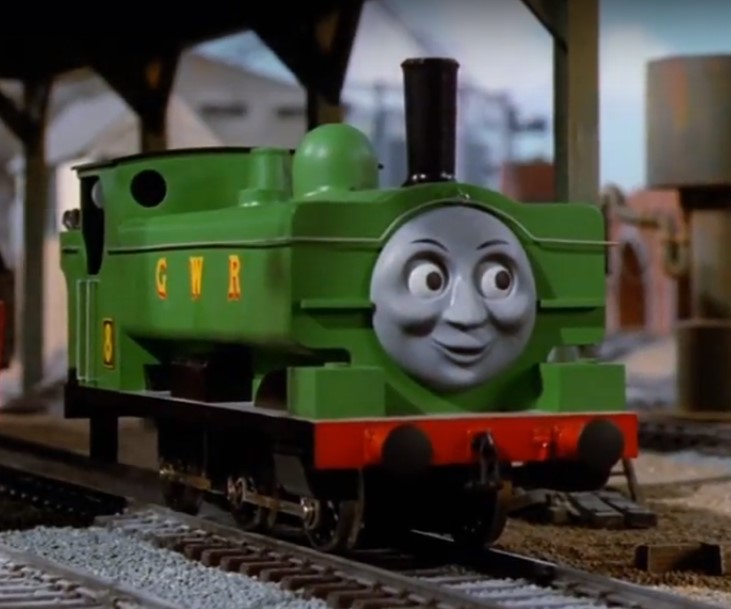
Early in 2018 I came looked across the numerous articles relating to The Railway Series and its television adaptation Thomas & Friends. In particular I noticed that the images used to illustrate character pages, especially the secondary characters, had been uploaded about a decade ago and were of rather poor quality – low resolution and harshly cropped. I set about replacing them with higher-clarity screenshots from videos I found online. I did this for Annie & Clarabel (both in one picture), Bertie, Diesel, Duck, Harold, Oliver, Peter Sam, Rheneas, Rusty, Salty, Sir Handel, Sir Topham Hatt, Terence and Trevor. Now, thirteen of those fourteen are gone.

This summer I noticed a string of alerts on my Talk page saying that my images were no longer being used in any articles and so would soon be deleted (because, as screenshots of a copyrighted TV series, they could only be uploaded under fair use, not Creative Commons). My first thought was that a different editor had uploaded images of their own to displace mine, or even that they had meanly decided any illustration would be too extravagant. Instead I discovered that the articles themselves were being deleted. Editors more powerful than I have determined that these pages were mere fancruft, and therefore unworthy of inclusion. At the time of writing only the “Steam Team”, Donald & Douglas and The Fat Controller above the waterline, with enough citations from outside the franchise itself to keep them on – though even these often sport multiple error boxes and tags for improvement. The secondary characters have been relegated to brief snippets in list articles. These lists themselves are being eyed up for deletion (in the words of one editor ” Combining two or more bad articles still produces a bad article that needs to be deleted in the end.“), so they may end up disappearing altogether. It should be noted that articles about the series itself outside of the fourth wall – whether in print or on television – are not threatened, rather it is the diegetic detail that tends to be in the crosshairs.

Some series fare better than others at this – the Doctor Who, Harry Potter, Star Trek and Star Wars franchises among others have hundreds upon hundreds of pages about characters, locations and species which do not seem to be in any immediate danger of purging. Tolkien’s Legendarium, of course, has been subject to plenty of discussion by formal academic publications and other secondary sources to solidify its presence. These franchises (along with many other detailed specific topics) also have their own independent wikis (often at fandom.com, formerly wikia.com) which can be tailored to focus on them individually and not limited by conformity to the standards of the vast Wikipedia project. In the case of Awdrey’s work, the community is rather small and has been barely active for a long time. The majority of the dedicated article-builders decided it was a more productive strategy to give up the main line and plough all of their efforts into the branch.

This is not the only area where such attitudes are encountered. Moving closer to my usual areas of interest, Wikipedia has a large number articles about royal pretenders – i.e. members of deposed dynasties. A few years ago the majority of these articles had the same formatting and templates as did those of still-enthroned royals, and even described subjects by the titles and styles they would enjoy under their respective monarchies. The talk pages of these articles often sported angry outbursts by those who deemed the prince-pretenders non-notable, or at least insisted that their “real” names should be used instead of their traditional titles (thought that itself would be a matter of some difficulty, as members of these families often have presences in multiple countries, and different countries afford differing levels of recognition to these people’s titles, such that they have different legal identities depending on location). Recently I have noticed that several of these articles have undergone significant revisions to decrease the level of perceived fluff around their styles and honours.

Sometimes this has affected things that I have personally created. Two years ago I made a navbox for the husbands of British suo jure princesses, seeing as we already had ones for the princesses themselves, the princes, and their wives (and equivalents for other countries of course). The template was swiftly deleted. I also spent a great deal of time putting together a navbox for all of Britain’s then-living life peers, in the style of those on the pages of their hereditary counterparts. That too was canned almost immediately.

I will not go into the wider issue of inclusionism and deletionism. My intention here is simply to highlight how easy it is for a person – or even many people – to dedicate a great deal of time and effort to a cause which is ultimately defeated, and its fruits at a whim obliterated, such that all their toil has been for nothing. This is a fact of life that long predates Wikipedia, and will likely never be escaped.