Encyclopedic Knowledge

The main selling point of Wikipedia is its open nature. Unlike other on-line information sources, Jimmy Wales’s gift to the world can be edited by anyone and everyone reading it. Further, where most forums or newspaper articles would request at least a name and an email address before permitting outsider contributions to be made, if not a full account established, Wikipedia allows strangers to interact with the site’s content with negligible effort or commitment. That being said, a great many regular users do sign up, as I did in February 2014. Since then I have made well over a thousand edits to various pages. The vast majority of these have been minor, often inconsequential details, but then that is how most Wikipedia edits go. Thousands of contributors make thousands of piecemeal amendments (linking one page to another, adding a picture, extending a paragraph by half a sentence, etc) which over time allow enormous and elaborate articles to grow. There are few pages which any individual can truly call their own work, for each is the product of less an elephant than an army of ants.

Theoretically any editor can write anything on any page. In practice, however, editors who attempt to cover all the information in the world will quickly find their efforts obliterated by another with superior local knowledge. In a community so vast, the generalist stands no chance. It is more prudent, therefore, to specialise in the extreme and carve out a niche, however minuscule, where one can reign supreme. In my case this was the correction and maintenance of the honorifics of British politicians.

While my primary interest would ordinarily have been the natural sciences, I knew that I would struggle to hold my own on any scientific topic compared to those with far greater qualification on the matter. I went instead for a relatively simple yet frequently error-laden topic where the corrections were simple to grasp and unlikely to be challenged.

By and large my edits were to pages rarely perused – such as colourising the illustration for John Fane, 10th Earl of Westmorland or establishing a new info-box for George Henry Roberts. Occasionally, though, I have moved to more populous wards, whose greater interest and attention can sometimes generate controversy and conflict. Margaret Thatcher, for instance, is hotly contested – not only for her divisive political legacy, but also the mere issue of whether she should be styled as “The Lady” or “The Baroness”. If edits to the biographies of the dead were contentious, those of the living are a minefield. In particular those involved in unfolding events tend to undergo short but dense periods of extremely heavy editing over seemingly minor but often quite important issues.

Since I took up this hobby, Britain has undergone two changes of government. The first was caused by a parliamentary general election whose date was advertised as 7th May, but whose origins were several weeks earlier: When a parliament of the United Kingdom has run its course it must dissolve, to be replaced by the product of the ensuing votes. In the past the dates of dissolution and election would be a closely guarded secret until its announcement by the prime minister, but the Fixed-term Parliaments Act 2011 removed this prerogative so that the expiration date of the fifty-fifth parliament was known in advance to be Sunday 30th March 2015. As midnight approached on Saturday 29th I was poised to strike, for dissolution means that the House of Commons no longer exists and thus the people formerly described as MPs are no longer entitled to that status. Their post-nominals must therefore be deleted and suggestions of incumbency rectified. On the first day of official campaigning I enacted this for the pages of more than a hundred politicians. On election night, of course, I had to begin putting them back again.

After a British general election it is traditional for the outgoing government to publish a list of Dissolution Honours. I created a page in waiting but no list appeared, and when I tried to add the names of new peers appointed immediately to the new parliament (Maude of Horsham, Altmann, Keen of Elie, Dunlop) they were swiftly struck down. Finally I gave up and, assuming that there was to be no list at all, requested that the useless page be deleted. When the list finally did appear I was on holiday with no access to the internet, so that the process was started again and almost completed without me. All that remained was to move the pages of lesser known recipients to less ambiguous addresses (such as Donald Foster (politician) to Don Foster, Baron Foster of Bath).

Later in the same year Canada had its own federal election. Though the Canadian parliamentary system is in many ways a carbon copy of our own, the events there elapsed rather differently – the Conservative Party was defeated and Stephen Harper announced he would step down as prime minister. Immediately (indeed, before the election had even concluded), the page of his victorious rival Justin Trudeau MP (Liberal, Papineau) had been edited to credit him as “Prime Minister of Canada”. He was unfit to be thus accredited, however, for his appointment to said office had not yet happened. Whereas British elections – excepting those which produce hung parliaments, of course – typically conclude with the leaders of the defeated parties vacating their posts before all of the seats have even declared, it remains in Canada conventional for several days to elapse before the resignation of a defeated incumbent actually takes effect. So it was last year that despite polling day having been 15th October, Trudeau the Younger did not come to power until 4th November. This, naturally, was too slow for the notoriously impatient citizens of the internet, so his info-box had instead oscillated between such unsupportable adornments as “Prime Minister-elect”, “Prime Minister-designate” and “Prime Minister (presumptive)” throughout the interlude until finally the undifferentiated appellation became reality.

Come 2016, the elections arrived for the Scottish Parliament, the National Assembly for Wales and the Northern Ireland Assembly. Again, I raced through page after page deleting MSP, AM and MLA from every info-box I could find. I also edited the pages of the legislatures themselves to set the memberships to zero and change the party balance pictures to show empty chambers. Again, these all had to be restored for the re-elected once the results had been announced. In simultaneous occurrence was the London mayoral election, in which a smaller group of candidates battled to replace Boris Johnson MP as Britain’s most popularly-mandated statesman. Elections of this type use the Supplementary Vote, a kind of cut-price Alternative Vote system in which all but the top two candidates would be eliminated after the first round. In this case it was obvious well in advance that said candidates would be Zac Goldsmith MP (Conservative) and Sadiq Khan MP (Labour). Given that London is more populous than Scotland, and that the mayoral race has the entire city as one enormous constituency, it is perhaps unsurprising that the counting process took over twenty-four hours. The editors naturally got twitchy. As soon as newspapers began reporting that Khan was “ahead” or “set to win” there came a series of edits and reverts as various users jostled to be the first to add the “Mayor of London” category. Again there were some “Mayor-elect” attempts also, regardless of the fact that the right honourable member for Tooting had not yet been formally (or even informally) declared the winner.

As long and as complicated as “Super Thursday” might have been it could never have been Britain’s primary political event in 2016. That distinction is the property of the referendum on 23rd June, in which some seventeen million voters decided that the United Kingdom should no longer be a member of the European Union. In spite of earlier insistence that he would remain regardless (and strong requests from ministerial colleagues on both sides to do so) David Cameron told the nation that fresh leadership was required and thus he would step down at some point in the autumn. His “term_end” was at once set to October 2016 before being swiftly reverted. Again there was a dispute between the semantics of announcing that one intends to resign, resigning, and ceasing to be incumbent.

There was no time to quibble over the status of the government, though, as events were unfolding rather more rapidly in the opposition. News emerged shortly after the referendum that Labour MPs (namely the Right Honourable Dame Margaret Hodge) had called for a motion of no confidence in their leader Jeremy Corbyn, following his alleged poor performance in the campaign. These sentiments were relayed to him personally by his shadow foreign secretary Hillary Benn, whom Corbyn promptly dismissed from his frontbench team. Mr Benn was swiftly followed by a steady trickle of other shadow ministers who resigned in protest, citing similar dissatisfactions with Corbyn’s leadership. Naturally I went to edit their respective pages to note their departures, only to realise that many of their offices had never been listed in the first place. When a person is appointed to be a minister of the crown – in particular a secretary of state – then there will be official correspondence including certain legal documents which explicitly say which job they have and when they got it. For junior ministers there is less available evidence (their appointments are not mentioned in Orders in Council) and though there is some documentation of their offices (such as Hansard, or official correspondence, or the government’s website) there can often be inconsistencies between references (sometimes they are just a minister of parliamentary undersecretary of state, name of department, others they have a more specific title) and often there are subtle changes in the exact portfolio whenever such a position changes hands. Marking out a clear line of succession for certain junior posts is therefore rather difficult. It is not helped by the fact that junior ministers are, by nature, given less media attention and so there are fewer sources to hand. Moving over to the opposition team, the shadow cabinet are usually fairly well documented, but it should be remembered that theirs are courtesy titles in the gift of the leader of the opposition. While mostly they correspond to the titles of those on the treasury bench, there are some (such as Michael Howard’s Shadow Secretary of State for the Family or Jeremy Corbyn’s Shadow Minister for Young People & Voter Registration) which do not, which heralds yet more confusion. Such was the state of affairs throughout the last week of June when, in the words of some otherwise-forgettable Twitter commentator “People whom I’ve never heard of are resigning from positions I didn’t know existed.” Eventually Mr Corbyn announced his new team, which was filled with people even more obscure. Richard Burgon MP, for example, became Shadow Lord Chancellor at the age of thirty-five, having only been elected to the House of Commons thirteen months prior. He, and many others in what surely must now be Labour’s C or even D team, had a biography shorter than that of Larry the Cat.

Eventually the “coup” subsided when there was nobody left to resign, and Corbyn still did not step down as leader. Over on the Conservative side, by contrast, the leadership election moved all too quickly. The first ballot saw Theresa May win the support of exactly half of the Conservative MPs, with Stephen Crabb and Liam Fox dropping out. The second ballot eliminated Michael Gove, which left the final battle between May and Andrea Leadsom. For the briefest of moments it appeared that an intense fight was about to erupt as Leadsom cast doubts on the barren May’s ability to govern as a non-mother. Then, suddenly, it was all over – on Monday 11th July the minister of state was seen announcing her withdrawal from the contest. The whole political landscape changed as Theresa May was left as the only candidate in the severely truncated race. Yet again the editors were quick to proclaim the new premier, as if First Lord of the Treasury were an actual barony whose abeyance had recently been terminated. Shortly after Leadsom’s surrender a meeting of the 1922 Committee was convened and May was officially declared Leader of the Conservative Party. Cameron, now even more of a lame duck than before, brought forward his resignation to Wednesday 13th July. The next two days saw an excruciating struggle to keep the relevant pages up (or rather down) to date against myriad attempts to publish the handover prematurely. After Cameron’s speech before the black door, the cameras hovered around Buckingham Palace waiting for the former prime minister to emerge and the incoming one to arrive. Finally – and after an awkward photograph of the home secretary shaking Her Majesty’s hand, Mrs May returned to Downing Street to announce that she had indeed accepted a request to form a government. Finally the moderators gave way and the edit could legitimately be made.

The relief was to be short-lived, for the new prime minister hurriedly enacted a cabinet reshuffle, sifting out the Notting Hill set in favour of her own allies. There were some short spells of confusion, such as when it appeared that Jeremy Hunt had been relieved of the Department of Health, only to find that he would remain in place (word had it that May had wanted Theresa Villiers to replace him, but then Villiers resigned and there were no other candidates available). Whereas the reshuffle was for the most part routine (if rather large), there were some notable differences with the establishment of three new departments of state (Exiting the European Union; International Trade and Business, Energy & Industrial Strategy) and the dissolution of two old ones (Energy & Climate Change and Business, Innovation & Skills). Many of her predecessors were criticised for rearranging departments too often, but Cameron was unusually passive in this regard – his one noticeable change was to have the department for children, schools & families renamed the Department for Education. Collectively the editors cocked up the transition where the business portfolio was concerned, as the new BEIS had a separate page created, thus preventing the old one from being moved until the erroneous creation had been deleted. Finally it was assumed that Greg Clark would be President of the Board of Trade, as all his predecessors had been. Instead, it transpired that this sinecure would actually belong to the Secretary of State for International Trade (The Right Honourable Dr Liam Fox MP). Amusingly we discovered that government officials had made the same error themselves, with Clark being appointed president for four days until Fox succeeded him.

Now, at the end of August, the British political line-up appears to have reached a moment of relative stability. No doubt there will be further resignations, appointments and re-elections in the foreseeable future, and no doubt there will be confusion over who has what, but I or others like me will always be around to ensure that, if nothing else, their post-nominals will be accurate.
Algae, the Green Death

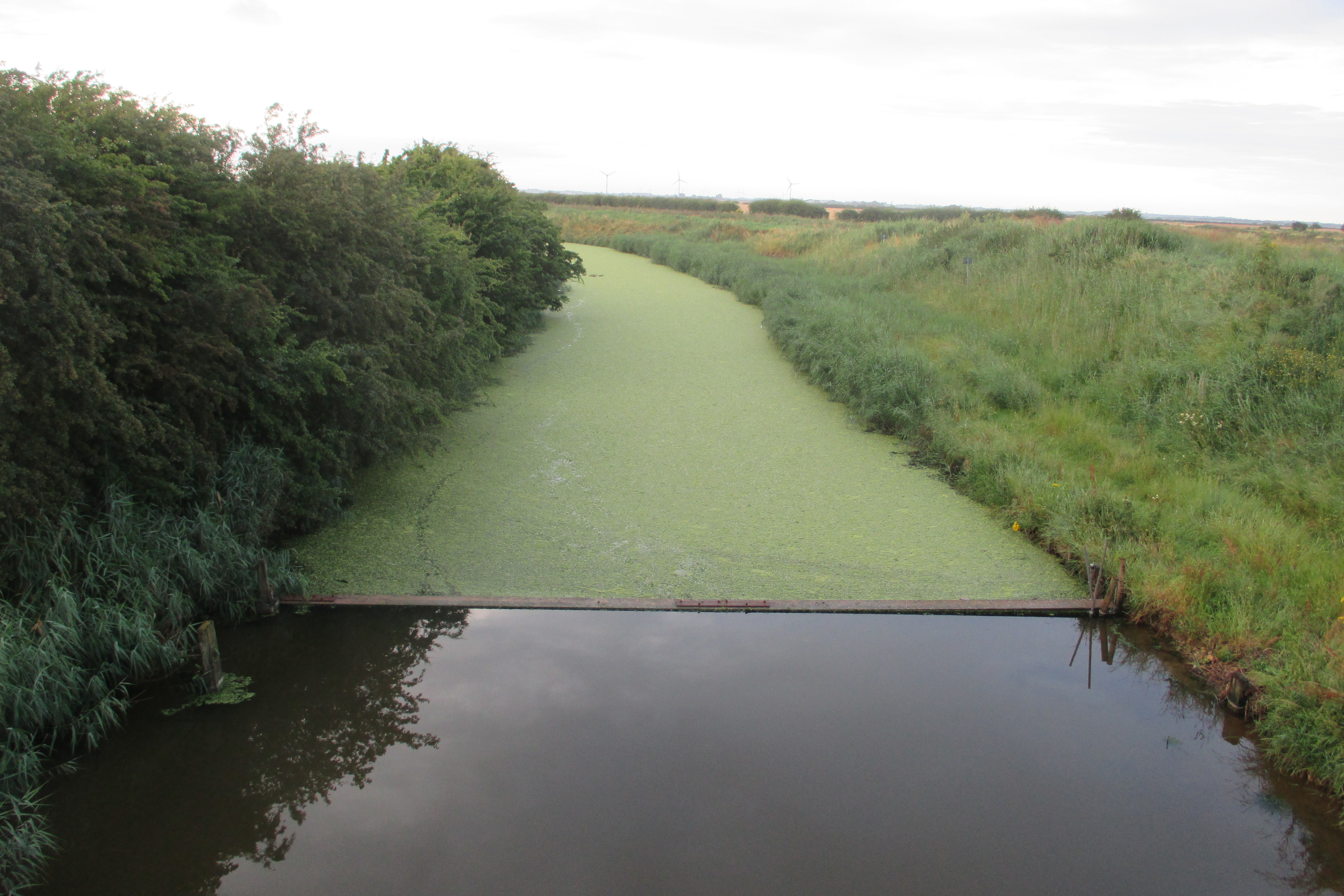
A brown river, crossed by a log behind which the surface is wholly covered in algae.

Keyingham Drain is entirely green on some days.

The algal bloom is a problem in many lakes and rivers. In the wrong weather conditions, a body once teeming with life can quickly become an water graveyard if certain organisms cannot be controlled.

An algal bloom is a rapid increase in the population of algae in an aquatic system. There is no fixed benchmark for when an algal growth becomes a bloom – some say the concentration should be in the hundreds of cells per millilitre, some say it should be in the thousands. A bloom occurs when a body of shallow, slow-moving water has an excess of phosphorus and nitrogen nutrients, usually caused by fertiliser leakage or waste-water. This leads to green plants and algae growing at an increased rate at the expense of other organisms. In particular the algae can clump together to form a gelatinous blanket on the surface of the water, which blocks out the light of the sun. The then-permanent darkness means that the plants beneath the surface can no longer photosynthesise, with the inevitable result that they perish. Their corpses are devoured by decomposers. The sudden abundance of food allows these organisms to grow and multiply rapidly, and they consume the oxygen in the water which – in the absence of photosynthesising plants – cannot be replaced. Once the oxygen is exhausted the fish and aquatic insects within the water body die off and the internal ecosystem collapses. Beneath the garish top layer, the water is devoid of life.

Adolphe_Millot_algues

A Decade Since Doomsday

Few analyses of the revived series of Doctor Who, much less the David Tennant era specifically, could be complete without this. It is easy to remember the moment where a new trend, a new idea or a new meme begins but often very difficult to pinpoint the moment at which it ends. Can we really know exactly when the Harlem Shake died off (or the Ice-Bucket challenge for that matter). We are often quick to notice when a new character or personality enters the public consciousness, but do not notice when they have gone, for we are already concentrated on the successors who eclipsed them. This is particularly noteworthy when you look at the quick stream of events in the weeks since the EU referendum – just look at the news coverage on Wednesday 22nd June and compare it to today’s to see how quickly events can move. Sometimes, however, a certain person or event, a certain character does have a lasting presence long after their departure. For the purpose of this article I am talking about Rose Tyler.

It would be wrong to suggest that Rose is universally considered the greatest companion in the franchise, nor even a contender – indeed many fans of the program are keen to express their dislike, even contempt for her. Nevertheless her position within the timeline of Doctor Who means that she cannot be easily forgotten. The very first episode was named after her, with the opening sequence being a catalogue of her existence. The Doctor himself does not appear until quite a long way in. It is also noteworthy that her companionship was structured very differently to that of her predecessors. Whereas most companions would leave their old lives behind to travel with the Doctor, departing from the TARDIS just as abruptly, Rose had a whole family in the supporting cast to which she would return every few episodes. There was no precedent for this from the classic series – except perhaps the UNIT crew, but that was a more professional relationship.

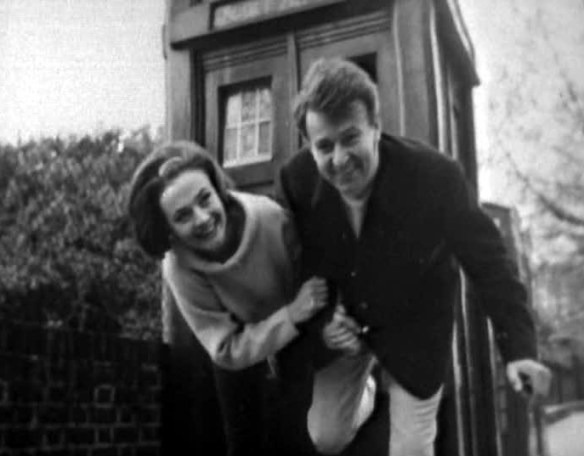
Ian and Barbara left Coal Hill in An Unearthly Child and did not return for another two years, after which they never featured in the series again. Ben and Polly left the TARDIS when they arrived back at their starting point by coincidence. Jamie and Zoe were unceremoniously plonked back in their homelands with no memory of their other adventures. Romana and K-9 II were abandoned in E-Space. Nyssa stayed behind at Terminus, Traken having been destroyed. The only companion who returned to mundane life before travelling again was Tegan, and even that was a one-off stunt. Furthermore, the appearance of a boyfriend usually only occurred at the end of each’s tenure as a way of detaching them from the Doctor – Susan with David, Jo with Clifford, Leela with Andred. Such pairings usually developed within a single serial and had little narrative foundation.

IanBarbaraRealPoliceBox

Ian & Barbara were perhaps the best-developed couple of the Classic Series.

The revival, however, changed all of this. Partly this was a matter of necessity. Russell T. Davies began his quest to bring back the series in 2003, in an environment where few remembered how to execute a science fiction series. The new program therefore had to be redesigned for an audience used to soaps and reality shows. To some extent this was referenced by the characters themselves – the Doctor said he didn’t do domestic.

Odd as it may have been, though, this model stuck with Doctor Who for several years: Martha Jones had regular encounters with her siblings and parents, and they even had her mother repeat the face-slap made famous by Jackie two years prior. In many ways it seemed like a conscious retread. In Gridlock, Martha commented “You’re taking me to the same places you took Rose.” with a muttering of “Rebound”. Indeed, much of Series 3 saw Martha being compared to Rose and a conscious retreading of the previous two years’ themes. Donna Noble likewise had a family, though they were structured differently – her mother Sylvia and her father Wilfred were used for comic relief more than for drama, though Wilfred later became a companion in his own right. The late Geoff Noble was also made something of a legacy character.

ClarasDinner

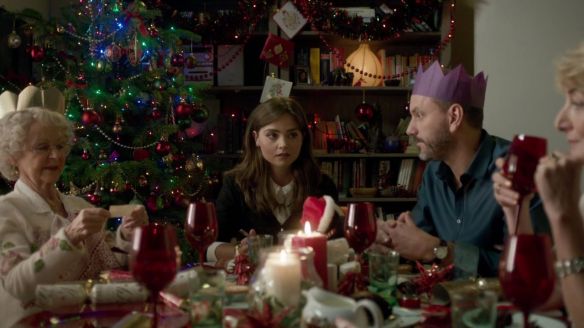
The less than memorable family of Clara Oswald, Christmas 2013.

Into the Moffat era, the companion family largely disappeared as an integral part of the story, but a vestigial presence remained. Amy Pond’s parents were absent for most of Series 5, having been erased from time. Their emergence in The Big Bang was a sign of sanity returned to the universe, though afterwards they never actually appeared afterwards. Brian Williams, however, played a prominent role towards the end of the Ponds’ tenure. Clara’s family had only one outing as a minor sub-plot in The Time of the Doctor, but her parents’ history had earlier been an important feature of her character arc. While the Oswalds had nothing like the narrative significance of the Tylers, it is notable that their block of flats was filmed somewhere that strongly resembled the Powell Estate. Even eight years, two Doctors and four sets of companions after the revival, Rose’s shadow still fell, however faintly, over her successors.

Were it insufficient for Rose’s archetype to continue shaping the series long after her departure, there is still the matter of Rose herself never quite going away. From the moment that Series 2 concluded, there was always speculation that the character would eventually return. There were hints and nods in Series 3, but by the time of Series 4 it was a certainty. The premiere, Partners in Crime, featured Rose in person, quietly disappearing in a cloud of mystery. Her face briefly flashed on screen in The Poison Sky and Midnight before she fully emerged in the finale. After a second farewell scene (again on Bad Wolf Bay) it appeared that her character was finally finished, her ghost having haunted the franchise for what then constituted more than half of its existence. Even so, there was still time for yet another goodbye in The End of Time, though this time with an earlier version prior to her début.

A shot from The Day of the Doctor (2013). Bad Wolf Girl, with glowing yellow eyes, stares at the camera from inside the barn.

Billie Piper as “Bad Wolf Girl”

When Billie Piper returned for the golden anniversary special The Day of the Doctor it was significant that she did not quite play Rose Tyler again. Instead she had the role of “Bad Wolf Girl”, a manifestation of galaxy-eating superweapon “The Moment”. She was visible only to John Hurt’s character, the War Doctor, with David Tennant’s never actually interacting with her. Evidently the producers wanted to avoid playing out her tearful departure a third time. Even so, it was in itself rather odd to find that Piper had returned as a nostalgic reference, rather than as an active incumbent. This, more than anything else, was the solid confirmation that the Rose era had actually concluded and would not be revived.

The legacy of Doomsday is not the long-awaited battle between the Daleks and the Cybermen, nor the introduction of the Torchwood Institute or even the first glimpse of Donna Noble but the departure of Rose Tyler as a regular companion. In particular, the episode is remembered for the closing dialogue on the Norwegian beach of Pete’s World and the Doctor’s abruptly-terminated “Rose Tyler…” before his final loss of contact. The viewer never learned what the end of this sentence would have been, but hints can be found in the commentary, where the executive producers had the following exchange:

Russell T Davies: “Rose Tyler, I owe you ten pence.”

Julie Gardner: “He was going to tell her he loved her. I will not have it any other way.”

The Middle Age of Beverley

Whereas it might have been more in line to devote this post to discussion of the European Union referendum, here instead is an account of a college trip to some medieval hotspots in Beverley.

That we should have been on such an excursion at all was an oddity – the locations featured were entirely focused on Medieval History, yet the Modern History class were allowed to tag along. This being the penultimate day of the term – and there being no more history lessons in the remainder of the timetable – the educational focus of the outing was light. No worksheets were distributed nor notes taken, though teachers occasionally stopped to explain the historical significance of the local landmarks.

A large black cylinder with wooden boards over the outlines of windows.

The tower at Beverley Westwood.

The first such place was the Black Mill at Beverley Westwood. It one of two survivors of the five windmills which once stood in Beverley, and lost its sails in 1868. The Westwood is one of few remaining areas of common land in England, meaning that residents have maintained their traditional rights to use the turf for grazing cattle or collecting firewood – indeed there were several cows (and cowpats) there to greet us as we ambled across. In the modern era, visible to us on our visit, the territory is also used for a golf course and for Beverley Racecourse.

Beverley escaped the Harrying of the North because the Normans knew of the area’s religious past. John of Beverley – then the Bishop of York – was believed to have performed miracles. He also founded Beverley’s first building, a church dedicated to St John the Evangelist, though this was abandoned in the Viking invasion. The settlement became a large town and was granted borough status in the twelfth century with special interest in trading wool and leather. In the late fourteenth century it became the tenth-largest town in England, having continued to grow despite the effects of the Black Death, the Peasants’ Revolt and the Hundred Years’ War which stunted the development of other parts of the country.

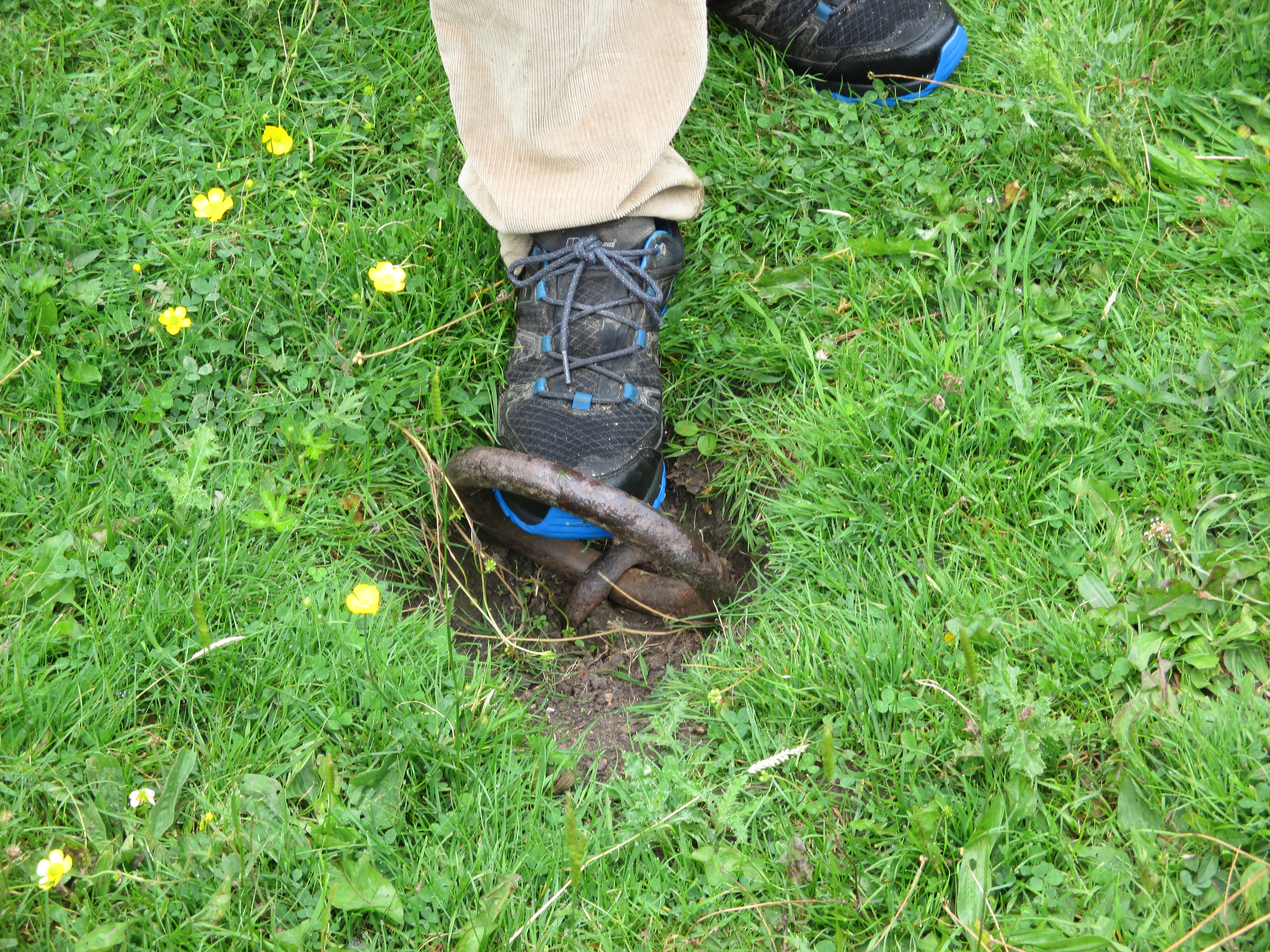
Having ambled across the turf, exploring the dips and bumps in the ground, we were lectured on the habitation of the settlement in the middle ages. We also were dispatched around this area to uncover a large metal hook in the ground. This was used for the medieval sport of bull-baiting: A bull would be attached to the hook while dogs were sent to attack it. Spectators would bet on the time taken for the bull to die and the number of dogs slain in the process. There was also a practical purpose – the adrenaline rush in the last moments of life improved the taste of the beef.

Grass, a dark circle of earth and a metal hoop protruding from the ground..

The bull-bating hook.

The second stop on our visit was the deserted village of Wharram Percy. Occupied almost continuously from the ninth century to the fifteenth, the village was then abandoned. There are some six thousand or so settlements of this type in Britain but few of them are so large or so well preserved. The nearest car park is some 750m away, so getting to the site requires a lengthy trek down an overgrown rocky slope which some members of our group found taxing. The land, overseen in its day by the Percy family (Earls of Northumberland, and relatives of Lord Percy Percy in the first two series of Blackadder) contains the church of St Martin, the outlines of several houses and, naturally, some more cows.

Having picnicked in the shade behind the minibus, we headed for Rudston Church. There lies the body of Winifred Holtby, the novelist and journalist best known for 1936’s South Riding, which was adapted to a BBC miniseries in 2011 (parts of which were filmed near my house).

IMG_0261

The graveyard at Rudston Church

Our next stop was at Burton Agnes. Though the location is normally advertised for its grand Elizabethan stately home, we headed for the smaller Norman building to its side. The dark, uneven ground floor and tight helical stairway belie the vast dining room above, though the overall appearance was still somewhat spartan, with nothing but a long wooden table in an otherwise empty expanse.

IMG_0263

Burton Agnes Norman Hall (left).

Finally we ventured to Skipsea Brough. Surrounded by grassland and yet more cows, this small hamlet features the motte of Skipsea Castle, built by Drogo de la Beuvrière circa 1086 to secure the region and its trading routes against an invasion by Denmark. The castle itself was destroyed following the rebellion of William de Forz in 1221. All that remains now is the artificial hill. The land was reclaimed for farming in the eighteenth century and taken over by the Office of Works in the twentieth.

IMG_0270

The view from the Motte

It may perhaps appear strange that we closed out the academic term by wandering around the countryside, carefully evading deposits of Bovine faecal material while discussing medieval history, but in many ways it was a blessing that East Yorkshire had such rich locations to offer, and that we were able to visit them all with time left at the end of the day to visit the polling station. Though this day out may well be overshadowed in most people’s memories by the referendum, it will stand out as an example of what rural England has to offer as well as that which can survive the many tests of time. That last point may well prove more important than ever given what is about to come.

Continue reading

A Date for the Calendar

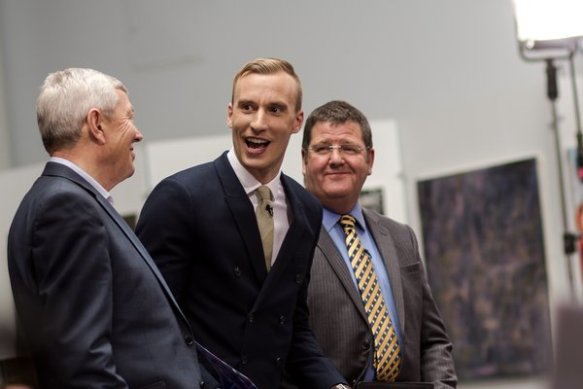
Left: Rt Hon Alan Johnson MP (a white-haired man in a grey suit); Middle: Paul Brand (short blonde hair, black suit, pale yellow/green tie); Right: Mike Hookem MEP (spectacles, short brown hair, grey suit with blue shirt and yellow/black stripy tie).

Paul Brand of Independent Television introduces the pundits.

Britain’s relationship with the European Union has been highly controversial since before it even began. Forty-one years ago after the original referendum on whether to stay in the European Economic Community, the question “Should the United Kingdom remain a member of the European Union or leave the European Union?” has been put to the people, to be answered on 23rd June. This has been the biggest talking point in British politics generally, and it has also been a recurring issue at Wilberforce College.

For a long time we knew relatively little about the debate. We knew that ITV Calendar would be covering it and that students were invited to ask questions, but we had no certain knowledge of the politicians in attendance. At various points we thought we might have David Davis, Karl Turner, Diana Johnson or Graham Stuart. Then we heard that we would have Alan Johnson and a UKIP MEP (we never knew which one). A few days before the debate we even heard that Johnson had “wobbled” and might pull out. The afternoon before the debate, as the atrium was evacuated and closed off to begin the conversion to a makeshift television studio, we still were none the wiser. On the morning of Friday 13th I was finally told that we had “Mike from UKIP” and subsequently I deduced that this was Mike Hookem, member of the European Parliament for Yorkshire & the Humber.

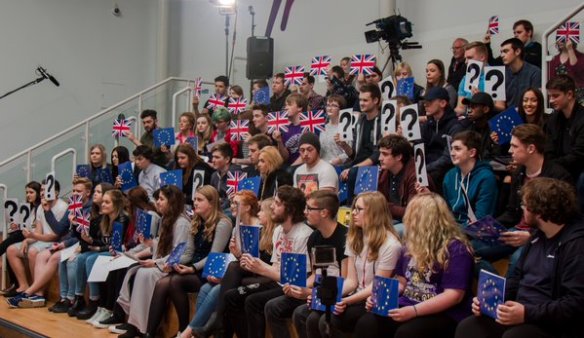
It was at 2pm that students were finally allowed into the atrium, and there we were introduced to Paul Brand, who was hosting the installment. We had all been provided with a pair of laminated cards: the first bore a black question mark, while the second was a choice between the Union Flag and the EU’s circle of stars. Several takes were expended before Brand managed not to say “Union Jack”. We were asked to hold up the image which represented our position before and after the debate. Eventually (around 3pm) we had our panellists arrive. The seating arrangement was unusual – we thought that Johnson and Hookem would be on the floor seating opposite the students on the steps, but instead they were positioned in our midst, with some other students filling up the additional seats. Nobody could quite understand this decision.

A crowd of adolescents on stepped seating. They hold up cards with Union Flags, EU Flags or Question Marks.

The students show their voting intentions.

The politicians began by making introductory speeches on the merits of staying or leaving. Johnson made the emotional appeal to the European project, saying that the Union had been a safeguard against war on the continent. He questioned the use of the Union flag for the Leave vote, saying that Brexit was not the patriotic British option. Hookem dismissed the romanticism of “Remainians” and warned the students about TTIP. We noticed that he was relying quite a lot on his iPad.

I was the first to ask a question, which was whether Brexit would revive Hull’s fishing industry. I seem to always end up on that topic when appearing on television. Other questions followed on immigration (naturally), terrorism, commerce and the obligatory quip that “You can’t go back to the British Empire.”. Throughout the debate it became clear that the two contestants were not evenly matched – Johnson had spent many years on the front line of politics including a period in the cabinet, whereas Hookem was a fairly obscure figure whose career in the European Parliament did not even stretch two years. He was rather obviously out of his depth during much of the debate and struggled to maintain a smooth flow of words when giving answers – whereas Johnson had spent decades polishing his speeches, Hookem often communicated in short, fragmented sentences.

The debate ended with a reprise of the flag display. By this point, Johnson had clearly proven the more effective debater as there had been a clear swing from Leave to Remain among the students in attendance. Six days later, the college launched its own referendum on-line, with the result that 63% of respondents preferred to remain. The result of the actual referendum (including for the Hull area) are likely to be much different.

Meeting Diana Johnson MP

johnson_diana-112028229

Diana Johnson, Member of Parliament for Kingston upon Hull North 2005-present.

As we move into the month of May 2016, we are nearly at the anniversary of the most recent general election. Four days from now, there will be a smorgasbord of other elections taking place: the Scottish Parliament, the National Assembly for Wales, the Northern Ireland Assembly, the Police & Crime Commissioners, the Mayor of London and some 125 local councils. Additionally there will be two by-elections to the House of Commons – one in Ogmore, the other in Sheffield Brightside and Hillsborough. Not long afterwards, of course, there will also be a UK-wide referendum on our membership of the European Union.

While many of these elections are relatively low-key affairs (certainly, it will be on Holyrood that media attention is focused), there is to me a special significance to the Police & Crime Commissioners because they represent the first occasion on which I am eligible to vote. There are four candidates standing and, whereas the original elections back in 2012 were notable for the large number of independent candidates (who actually won 12 positions compared to Labour’s 13 and the Conservatives’ 16), in my Humberside area this time there are only four, and they represent what are now established as England’s four main parties: Matthew Grove (Conservative and Unionist), Denis Healy (Liberal Democrat), Keith Hunter (Labour) and Michael Whitehead (United Kingdom Independence). The system used is the supplementary vote, which means I will be voting for as many candidates as I am turning down.

On the last Friday of April, I took part in a meeting with the honourable lady the member for Kingston upon Hull North. The subject of discussion was the upcoming EU referendum. A point which came up notably in the session was eligibility for voting – our delegation contained two students from outside the United Kingdom (but inside the European Union) who were not entitled to vote in the referendum. Several others were also barred for failure to attain the age of eighteen years. There had been much clamouring for the voting age to be lowered to sixteen, as had been done for the Scotland referendum, but these were thrice rejected by the House of Commons. Our guest was quite openly displeased about this fact, and stressed that it was vital for those of us who could vote to do so, lest our generation’s voice be politically ignored – she noted that pensioners had done quite well out of recent budgets because they tend to have the highest voting turnouts.

The honourable lady was quite insistent upon her party’s unity with regards to this issue: she explained that whereas in the previous referendum (She repeatedly said 1974, and none of us thought it pertinent to say it was actually 1975.) the Conservatives had been uniformly in favour of membership of the European Community and Labour divided, in this present era the situation had been reversed and that it was now the Conservatives who were thus fractured. I might have detected more than a grain of salt in this sentiment given that her current leader (The Right Honourable Jeremy Bernard Corbyn MP) was adamantly Euroskeptic for most of his life, and has only very recently (and rather meekly) proclaimed his support for our continued membership. There are, too, a handful of Labour officeholders campaigning to leave (Kate Hoey, Graham Stringer, Kelvin Hopkins and Roger Godsiff). Perhaps her position in the Shadow Foreign Office compels our visitor to gloss over this issue in public.

Returning to the area of youth engagement in politics, Mrs Johnson talked about the popularity of the President of the United States (His Excellency Barack Hussein Obama) – “He’s just so cool!” – and lamented, in her view that neither his charisma nor that of the Prime Minister of Canada (The Right Honourable Justin Pierre Trudeau MP PC), could be matched by our own statesmen, explicitly giving unfavourable status to Boris Johnson MP and Nigel Farage MEP. The point she was keen to make was that most elections – especially the EU referendum – affected the young more than the old (as they would not live to see out its full effects).

One memorable moment came when the honourable lady went around the table asking each of us our intention with regards to future studies and careers. Several people mentioned biology (which struck the elders in the room as unusual) and several others law (which did not, especially given the explanation that the college did not offer politics & government or economics). I said my pursuit was chemistry, which caused Mrs Johnson to remark that I could be the next Margaret Thatcher – though she moved quickly to eliminate any inferred suggestion of thinking me a Conservative.

At this point, perhaps far too late into this post, explain what was actually discussed about the European Union – that being the topic around which the meeting was centered. Ironically it is this component of the visit of which I have the least clarity in recollection. The points which stick out the most are that the EU has guaranteed decades of peace between European countries unseen before its development, that international cooperation is increasingly necessary for dealing with global threats and that the uncertainty of Britain’s existence following a Brexit would be dangerous to the economy. She did, though, confess to an agreement with the statement that few in Britain truly love the EU.

It remains to be seen if the fear of uncertainty or the gratitude for peace will ultimately prevail as the leading motive for remaining in the European Union. Indeed, that the Remain campaign should be victorious with either strategy cannot yet be confirmed. Most polling for this referendum has shown the balance shifting daily, such that a decisive victory for either camp seems improbable if not impossible. Already, many are stirring rumours of a second plebiscite to follow should the first attempt fail to yield the result they desire. Certainly, the United Kingdom’s constitutional identity is likely to be the subject of great debate for a long time to come.

Long To Reign Over Us

A dark-haired woman of 19 in a military uniform stands in from of a green truck with a large red cross on the right face.

HRH The Princess Elizabeth in April 1945.

Not many people, even among royalty, make it to the age of ninety years. George III and Victoria both expired at 81, while the first Elizabeth was a source of amazement for living to 69. Indeed, many a sovereign has died rather young – Henry V died at 36, Richard II at 33, Mary II at 32 and two Tudor monarchs (Edward VI and Lady Jane Grey) never reached adulthood. Edward V did not manage to reach his teens.

All the more impressive it then is for our diamond nonagenarian to reign as she does today. More so, it is a significant accomplishment that today’s birthday girl can still appear in public for her celebrations, whereas few others of her age could claim likewise. By the time that George III reached his final year he was bald, blind, and utterly insane. Among his many descendants he had outlived three of his children and three of his grandchildren. His wife, Princess Charlotte of Mecklenburg, tightly predeceased him as well.

Victoria had her own share of tragedies: having been one of few monarchs to truly marry for love, she spent thirty-nine years in mourning for her lost Prince Consort. Again, several princes could not outlive the Queen – Alice, Alfred (of Edinburgh), Leopold, Frederick, Sigismund, Waldemar, Albert Victor, Alexander John, Friedrich, Marie, Alfred (of Saxe-Coburg), Christian Victor, Harald, and two unnamed stillbirths.

Lilibet, by contrast, has her litter, and theirs, intact. Though she has lost her younger sister, the only death so far in the generation below her was Diana, Princess of Wales in 1997 (and she, by that point, was not actually a relative anymore). In that decade it was lamented that, in the family supposed to represent the bulwark of British integrity, three of her four children had divorced. Now, though, two have happily remarried while the third has seemingly reconciled with his former spouse.

Furthermore, the institution she represents has generally been stable – whereas Charles

Having been head of state in so many countries for so many years (with the result of featuring on so many coins, notes and stamps), Her Majesty has the most reproduced face in all of human history.

Welsh AMs Recall over Tata

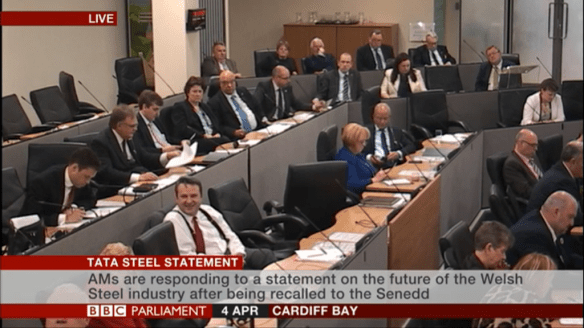
A small beige room with four rows of people behind wooden desks.

The debate by the Assembly

Recalls of legislative assemblies are not unknown: Parliament was recalled to Westminster in late August 2013 (a week before their summer recess was due to end) to discuss the response to chemical weapons in Syria, and again thirteen months later for developments in Iraq. Other causes for Parliamentary recalls include the Falkland Islands, Devaluation, the Suez Canal, the death of Queen Elizabeth the Queen Mother and the death of the Baroness Thatcher.

What is interesting about today’s recall of the National Assembly for Wales is that it will be the last time they ever meet. On Wednesday 6th April 2016 the National Assembly will dissolve and the election (for Thursday 5th May) will officially begin. Indeed, the Scottish Parliament dissolved eleven days ago and the Northern Ireland Assembly followed on the penultimate day of March – as did the Commons and the Lords a year earlier. This crisis meeting, therefore, is the last hurrah of the current body. After this week it will no longer exist, and the Assembly which meets in May will be a new one, with different members and possibly producing a different government.

This meeting is also strange because the Assembly is not housed in the Senned – which is currently closed for refurbishment – but in the Tŷ Hywel (formerly Crickhowell House) where its predecessor sat in the early days of Welsh devolution. The cramped chamber (resembling a university lecture theatre more than a parliament), hardly provides the grandeur that might be expected for the final meeting.

BBC parliament originally expected the meeting to last from 1330 to 1500, but naturally the Welsh talked for more than double that time. There have also been calls (including a petition by Labour leader Jeremy Corbyn) to have the Westminster Parliament recalled. The Prime Minister has rejected this, but the cabinet are working on strategies for dealing with the crisis.

The new Welsh assembly (the fifth since devolution) will meet at some point in May.

Council Report for Lent 2016

From 16:30 to 18:50 on Wednesday 23rd March I made my second appearance as an observer on the Corporation of Wilberforce Sixth Form College.

This time the council president was absent for reasons he was reluctant to explain the next day, so I delivered the Student Council’s report by myself, telling of the council’s activities since returning from Christmas.

On February 9th several of our number formed an interview panel for the position of Assistant Principal, which eventually went to the Director of STEM, Dr Karen Ashman.

Our biggest workload came on Tuesday 22nd March when we launched the Tour de Wilberforce – a fundraising event in which students and staff alike were encouraged to take turns riding exercise bikes. Together, they covered a distance equivalent to the entire Tour de Yorkshire cycling challenge.

On the same day, the college welcomed The Most Reverend and Right Honourable Doctor John Sentamu. He gave an interview to a group of students as part of his pilgrimage of prayer. We were told of how God must make himself known, how the name of marriage would not solve the problems faced by sexual minorities, how religion is so often contrived as an excuse for war and how the traditions of the first century prevented the consecration of women in the twentieth.

At the corporation meeting, the subject of a great deal of debate was the prospect of academisation. A gathering storm since 2010, this is the process by which a comprehensive school would be removed from the control of the local authorities and funded directly by the Department for Education and the faculty would be given much greater freedom in setting term lengths, opening hours and curricula. Already more than half of comprehensive secondary schools have been academised, and in the Autumn Statement 2015 (which came shortly before the previous corporation meeting) the Chancellor announced that the option was to be extended to sixth form colleges as well. Following the Budget Statement 2016 it became an inevitability that Wilberforce will convert to academy status by 2022. We therefore were led to discuss potential other institutions with whom a Multi-Academy Trust might be formed, namely Wyke or Hull College, as well as potentially Franklin. I was assured upon querying the matter that academy status would not cause any changes that would be noticeable to students who were outside of the corporation meetings.

The next meeting is likely to be sometime in late June. Before then, the college is to stage a mock referendum on Britain’s potential exit from the European Union. ITV Calendar have agreed to host a televised debate on the issue, with a number of politicians visiting the college. So far the only confirmed attendee is the honourable member for Kingston-upon-Hull North, Diana Johnson (shadow Foreign & Commonwealth minister).

Oxford Cambridge Conference at Aintree Racecourse

As part of the Inspire programme, I went on a trip with seven other students to Aintree racecourse near Liverpool, where a conference was underway for prospective students at the universities of Oxford and Cambridge.

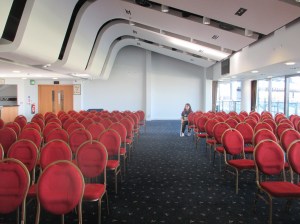
The journey to this was long and arduous. Setting off from Hull at 07:00, the minibus did not arrive until 10:50, nearly an hour after the first lecture had started. Upon arrival we split up to pursue our own interests in terms of subject areas. I began with a lecture on Chemistry and Earth Sciences at Oxford, given in the Corbière Suite.A long white room with a sloped ceiling and blue carpet. There are rows of empty red chairs.

In the afternoon I went to the Golden Miller Suite for two lectures: firstly on Making a Competitive Application, secondly on Student Finance and Careers. Finally I returned to Corbière for Natural Sciences at Cambridge.

The speakers throughout were keen to dispel the commonly circulated myths about elite universities – they insisted that dress standards would not factor into interviews and that student loan debt would not be a life-crushing burden.

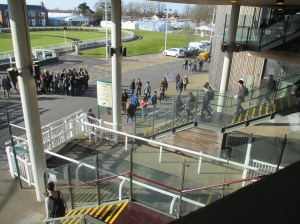
While the lectures themselves were certainly informative, the venue left something to be desired. There were an estimated three thousand students crammed into a venue which could not hold them. This was especially notable at lunchtime when the two food outlets still open (the rest being closed off or used for lectures) were crammed to bursting point and dozens of students could be seen awkwardly sitting on the floor. The transition between sessions was also a tight squeeze as masses of confused wanderers ambled up and down a series of outdoor staircases.A wide shot of metal stairs outside a building.

While I must sadly report that I recall fairly little of anything said in the lectures given, I can at least be appreciative of the fact that such an event was offered. This was by no means the first such excursion on which I have been dispatched, and I certainly hope it is not the last.