David Lammy and Bleak House

David Lammy, in his new role as Lord High Chancellor of Great Britain and Secretary of State for Justice, has recently announced plans to tackle a long-running backlog of cases in the English & Welsh judicial system by severely narrowing the circumstances in which juries are used for deciding the verdicts in criminal cases, transitioning trials for less serious offences to relying solely on the judge. These plans are highly controversial, with detractors expressing suspicion that he will undermine long-standing principles of English constitutionalism as well as scepticism that the move will actually save any time or money.

Lammy has attracted particular ridicule for a comment in an interview that was reported in The Times two days ago:

I remember studying Bleak House for my A-levels, and the Jarndyce and Jarndyce case that went on and on and on. We cannot go back to a Victorian system in which all new people who are the victims of crime don’t get justice.

The 1853-2 novel Bleak House is a satire of the English court system of the early nineteenth century and is credited with spurring on reforms later in that century, but to use the Jarndyce case (or any of the real one inspiring it) as a justification for Lammy’s proposals is nonsensical as this was a probate case in the Court of Chancery (later succeeded by the Chancery Division in the High Court of England & Wales) not a criminal case, and crucially it did not involve any juries!

Then again, the Lord Chancellor is not the only one to fail to understand that story: Over recent years (well, decades really) there have been growing concerns among the intellectual classes that their own numbers may functional literacy among the populations of developed countries is going into decline. One particular alarm bell was sounded last year in A Study of the Reading Comprehension Skills of English Majors at Two Midwestern Universities, entitled “They Don’t Read Very Well“, which used the first seven paragraphs of Bleak House as the yardstick. A worrying proportion of English majors (for whom reading literature should really be a specialist skill) struggled to understand it.

I listened to the LibriVox recording of Bleak House in 2022 and watched the BBC adaptation of it in 2024. I know from reading through Great Expectations that Dickens, being paid by the word, had a habit of using far too many when far fewer would do, but the idea that his works may be slipping out of human comprehension, even among those who have specifically chosen literature as a course of study, has implications which themselves are bleaker than the house could ever be.

August Armorial Announcements

The Queen’s heraldic banner continues to be a bugbear: Late last month, Sky Sports Racing Tweeted a short video of Her Majesty arriving (by helicopter) at Ascot. The commentator pointed out that upon Her Majesty’s appearance the royal standard was flown, but I noticed that it was again the generic ermine-bordered version and not that impaled with the arms of Bruce Shand, which has been seen in official usage recently. Perhaps the venue simply didn’t have a copy of that one yet?

The slow rollout of the Tudor Crown continues — on 1st August the Australian Department of Defence announced that all three service branches had updated their logos to use the new crown, as well as making other small adjustments to the rest of the graphics.

On the same day, the British Army announced a new cap badge for The King’s Gurkha Artillery Regiment, which likewise has the Tudor Crown on in. Since this regiment did not exist until this year, there was no St Edward’s version to remove in this case.

The King himself appeared at RAF Lossiemouth on 6th August to present a new standard to 42 (Torpedo Bomber) Squadron. I would assume that the Tudor Crown appeared on it, but none of the photographs or footage of the event gave a clear view of the standard itself — which is ironic given that was the whole point of the event!

Progress in the judiciary is less clear. I should remind readers that I am only speaking here about the judiciary of England and Wales, since that in Scotland uses the other version of the royal arms with the Crown of Scotland while that in Northern Ireland is reluctant to use explicit national symbols at all. The United Kingdom Supreme Court, and the Privy Council, have already been discussed.

From the PDFs of recent judgments, it appears that both civil and criminal divisions of the Court of Appeal are still using the old and rather ugly Royal Courts of Justice logo, with the almost-triangular royal shield topped by St Edward’s Crown, as are all three divisions of the High Court. Other courts are less consistent.

I have seen the Crown Court using several different ideas:

It looks as if every different court location has its own document template.

On Terence Etherton

Official parliamentary portrait from 2021 by Roger Harris (CC-BY-3.0)

The Lord Speaker today announced the death of Terence, Lord Etherton.

Etherton only took his seat in the House of Lords in 2021, having recently retired from the office of Master of the Rolls. Aged 73, he was only slightly older than the median for the Upper House, and still below the recently re-raised mandatory judicial retirement age.

Etherton is another of those people whose armorial bearings I know to exist but have never seen: That he received a grant was noted in the College of Arms newsletter no. 65, and a vague description is given on the Birkbeck, University of London website, which is repeated in Joshua Rozenberg’s obituary for him. While we are told that the motto was the Hebrew word הננ (Hineini) – “Here I Am.” we are not given any blazon for the rest of the achievement, only that it features sapphires and a sword.

Etherton’s career in fencing was, of course, also mentioned in the infamous “Enemies of the People” headline published by the Daily Mail in 2016.

I will have to hope that a photograph of the late noble and learned lord’s arms emerges at some point, for he was created too late to appear in the final print edition of Debrett’s Peerage and so it may be impossible to find out in the traditional way.

I Might Have Known

Three years ago I had a stab at designing a coat of arms for the Reverend Wilbert Vere Awdry, believing that he never had one officially granted or descended to him. Now, however, I discover that he most likely did.

When searching through the Internet Archive I found a digital copy of The Thomas The Tank Engine Man, a biography of Awdry by Brian Sibley (who also edited The Fall of Númenor and wrote several companion books about Tolkien’s legendarium and its cinematic adaptations).

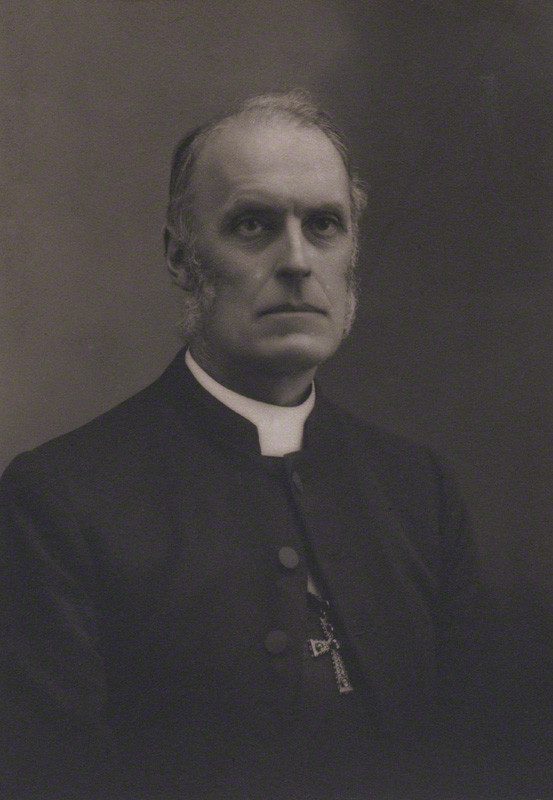
The early pages recount some of the vicar’s family history, including his uncle William and grandfather Sir John. Sir John Wither Awdry spent three years as Chief Justice of the Supreme Court of Judicature at Bombay and William Awdry spent twelve as Bishop of South Tokyo. I quickly found that these two men already had their own Wikipedia biographies, both of which mentioned their kinship to Wilbert. If only there had been links in the other direction I might have discovered this information much earlier.

William, August 1900

Unfortunately Debrett’s Peerage would be of no use here as it tends to list only the corporate and not the personal arms of the Lords Spiritual, and even then only those diocesan bishops within the United Kingdom – Awdry meeting neither condition. Happily, Sir John did have an entry in Burke’s Landed Gentry 1862, which lists his dynastic arms of unspecified antiquity as Argent three cinquefoils Or on a bend Azure cotised of the same with crest Out of a ducal coronet a lion’s head Azure and motto Nil Sine Deo.

William and Wilbert being legitimate agnatic descendants of Sir John, it naturally follows that whatever armorial ensigns he possessed, they possessed also. It is curious, therefore, to have found so little record of him or his son Christopher actually using them. This is amplified by the fact that the fact that he and his brother George clearly had an active interest in and working knowledge of heraldic blazon, which Sibley’s book even notes:

George…was exploring matters of heraldry and coats of arms ‘A real beauty occured to me for Tidmouth,’ he wrote to his brother, ‘It ought to be rather elaborate, as it is relatively new, and the simple ones are doubtless allotted already.’ The proposed arms for Tidmouth were to feature a smith’s hammer and tongs, a lymphad (a heraldic ship), three herrings and a wheel. ‘This,’ George explained, ‘covers all Tidmouth’s titles to importance: shipping, transport, fishing, engineering…’

I did, of course, illustrate Tidmouth’s arms two years ago as well.

Double David

For a while now the Supreme Court of the United Kingdom has had two vacancies, caused by the retirement of Lord Lloyd-Jones and Lady Arden of Heswall in January. Yesterday it was announced that appointments had been made: Arden’s place is to be taken by Sir David Richards, formerly of the Court of Appeal of England & Wales, while Lloyd-Jones’s successor is… Lord Lloyd-Jones.

The reason for this bizarre phenomenon is found by looking at legislation relating to mandatory retirement ages. The Judicial Pensions Act 1959 set the retirement age for people entering the judiciary thereafter at 75, though it was not binding on those already holding office by then (so Lord Denning and Lord Cameron continued until ages 83 and 85 respectively). The Judicial Pensions and Retirement Act 1993 lowered this to 70, but again was not retroactive so that those who had held judicial office before 31 March 1995 were grandfathered in. Lady Arden was the last such grandfathered member of the UKSC. The last overall was Sir James Holman, appointed a judge of the Family Division (EWHC) on 18 March 1995, who retired on 28 June.

The Public Service Pensions and Judicial Offices Act 2022 (which received Royal Assent on 10 March) raised the retirement age back to 75, and this time it was retroactive, so that those already in office can now serve an extra five years, and some who recently retired at age 70 (such as Lloyd-Jones and Richards) can come back for an encore.

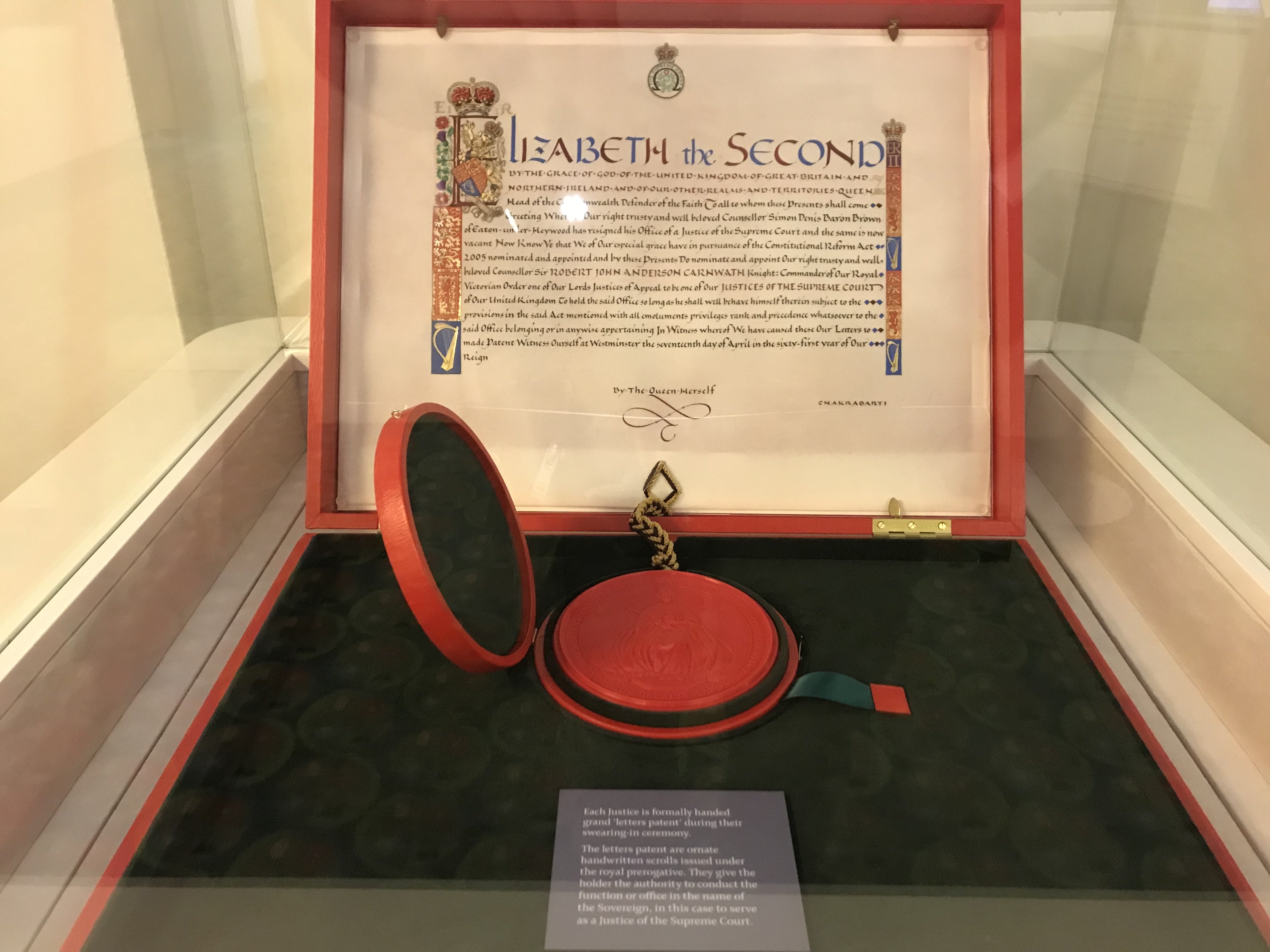
Incidentally, I discovered these appointments through the Twitter feed CrownOffFOIDs. The name is a shorthand for “Crown Office Freedom of Information Disclosures”. This is the Crown Office in Chancery, a small section of the Ministry of Justice responsible for the production and management of certain state and royal documents. Whether the office itself, or a private citizen, is operating the Twitter account is not clear. The output includes photographs of the Great Seal of the Realm as well as many of the different types of document to which it may be attached. There are writs, warrants, patents and proclamations of a great many kinds, including the proclamation of the present monarch’s accession, which the Tweet notes is not as physically impressive as one might have expected.

EXTERNAL LINKS

The ‘Brexit Freedoms’ Bill and Retained EU Law

Video

This was another session with the Constitution Unit of University College London.

The topic of “skeleton bills” and “Henry VIII powers”, which have been highlighted a lot in recent political blogs and podcasts, was also prominent here. Although this problem is said to be particularly bad in the post-referendum era, it has been in the making for many decades. I asked the panel (at 1 hour and 35 seconds in):

“If the trend towards skeleton bills and secondary legislation gas been noticed for many decades, does this indicate a problem with the permanent government rather than the politicians?”

It was put to the panel simultaneously with two other questions. I will try my best to disentangle the answers.

Doctor Tom West said: Absolutely this is a long-running trend. The Legislative and Regulatory Reform Act 2006 had very wide powers and people called it the “Abolition of Parliament” Bill. There are all sorts of examples of this being an issue, such as the financial crisis of 2008. Ministers, once they’re no longer in power, will come clean that there is an issue – Theresa May mentioned it at an IfG lecture last week. It’s very difficult while you’re in power to give up these very convenient ways of making law through secondary legislation. Brexit and COVID have raised the profile of this problem, but it is not exclusive to them. That’s what our Delegated Legislation Review Programme is looking at – we think there’s a need for a reset of the whole system of what these powers can be used for in the first place and how they can be scrutinised. We are in the middle of developing proposals.

Ruth Chambers said: This trend towards framework bills has been going on a long time. I’ve worked on environmental legislation for over twenty years. Just to give one practical example – it used to be that when governments would state consultation requirements on the face of the bill they would be quite explicit about which sorts of people and groups the minister should consult before taking powers forward. Now the more standard construction says the ministers can consult whoever they think they need to. Obviously that has consequences – bills often lack the future-proofing edge. It doesn’t matter how many times you have that conversation with ministers while they’re passing legislation, it doesn’t quite register that at some point in the future someone else will be wielding those powers. It also has huge implications for the public – the public businesses and civil society organisations really need to stay the course and engage with the secondary legislation not just the bill.

Fighting Corruption in the Judiciary

Many times before I have virtually attended the kinds of events that I could not attend in person. Sometimes it is because the location is too far away, other times because I am not a member of the organisation hosting. On this occasion it was both.

When I first found the flyer for today’s presentation on Eventbrite I assumed it would be an academic or professional presentation similar to all the others. Only upon entry did I realise it was actually the preparatory talk to a competition (which I obviously will not be entering).

The challenge was for high-schoolers and undergraduates to imagine that they were junior staffers at the justice ministry in a fictional Eastern European country which, having emerged from the Warsaw Pact, signed and ratified the United Nations Anti-Corruption Convention but then, after a change of government, withdrew from it, and wanted to make changes to the method of appointment and dismissal of judges. The student’s task was to make a video presentation about the meaning and consequence of corruption. They should outline the basics of a legal strategy to bring their fictional homeland in line with the convention again, and produce three key ideas on enhancing judicial independence.

The speaker, Alice Thomas, then went on to make some general points about political corruption: It exists everywhere in some shape or form. What we know is only what other people have found out, and in countries without an independent media it can be difficult to find out anything. Most countries have anti-corruption strategies, at least on paper. The United Nations often follows the work of smaller regional groups, because having fewer members means it takes less time to reach decisions. North Korea, unsurprisingly, did not sign the aforementioned treaty at all. Some countries signed but did not ratify. International cooperation is important for asset recovery and information exchange, since corruption is often a cross-border phenomenon. The judiciary, legislature and executive are there to monitor each other. In a country without a functioning judiciary everybody can basically do as they please. Corruption may take the form of individual judges being bribed or coerced rather than the whole system being controlled. For a government to ensure judicial independence without inadvertently encroaching on it is a complicated task, since attempts to scrutinise the courts would themselves resemble the executive applying  political pressure.

Rather amusingly, Thomas ended by telling participants to be careful about their sources and not to rely on Wikipedia because “it’s not always very accurate. It’s a very subjective thing. It relies on who writes what in it.” – me, for example.

EXTERNAL LINKS

Who am I to Judge?

This has been a busy week for state ceremony, yet you wouldn’t know it from the news.

Friday 1st October was the beginning of the legal year 2021-22 in England & Wales, marked by the procession of hundreds of judges in their full dress uniform to a special service at Westminster Abbey. This included readings by the Lord Chancellor and the Lord Chief Justice, as well as a sermon by the preacher of Lincoln’s Inn.

The legal year in Scotland began on Monday 27th September. It featured similar events at the Court of Session and St Giles’s Cathedral. The Lyon Court was one of the bodies involved and a number of new officers of arms had their inaugurations.

On Saturday 2nd October the sixth devolved Scottish Parliament had its ceremonial opening, though of course it has been sitting and legislating since May.  The Queen visited the chamber, accompanied by the Duke & Duchess of Rothesay and Edinburgh. Many heralds were in attendance carrying with them the crown of James V.

It is a little disappointing that these events were so ill-publicised, even accounting for the distraction of party conferences and fuel queues. Rather than major newspapers I have mostly had to piece together details of all three ceremonies from the websites and social media accounts of the people involved.

Curiously this is not consistent across time – footage of judges’ processions from a few years ago can be found on YouTube, and some from many decades back are archived by British Pathé.

EXTERNAL LINKS

Judges at Westminster Abbey

Heralds at the Court of Session

The Scottish Parliament

Ever to Succeed

News has broken that two days ago Her Royal Highness Princess Beatrice, Mrs Edoardo Mapelli Mozzi, gave birth for the first time. Her yet-unnamed daughter is eleventh in line to the throne. I wished to edit the relevant Wikipedia article accordingly, but that proved difficult as the list had multiple levels of indentation to reflect the generations and all the numbers had to be changed manually.

There is a challenge in deciding just how many names to include on the page. The legitimate non-Papist descendants of George I’s mother number well into the thousands nowadays and the vast majority of them are non-notable. The editors have here decided to limit the display to the descendants of the sons of George V. In practice this just means Bertie, Harry and Georgie, since David and John both died without issue. Even that restricted selection comprises sixty-three living people, of whom thirty-two have no pages of their own.

The clumsiness of editing this list brought up an idea I had some years ago for giving each member of the diaspora a numerical code to indicate their position within the succession. The electress herself, being the origin of the succession, would be 0. Her eldest son Georg Ludwig would be 1, her next son Frederick Augustus 2, Maximilian William 3 and so on. For each generation a digit is added, so Georg’s offspring George Augustus and Sophia Dorothea would be 1.1 and 1.2, while George Augustus’s children would be 1.11, 1.12, 1.13 and so forth. Under this system Princess Alexandrina Victoria of Kent & Strathearn would be 1.11141 while Princess Elizabeth Alexandra Mary of York would be 1.111411221. Prince Philip of Greece & Denmark would, I think, be 1.111416331. The beauty of this system is that the crown always goes to the living person with the lowest number, rather than each new birth or death close to the throne forcing everyone downstream to be renumbered.

There are downsides, of course. First, there is always the danger of one day discovering a missing sibling who died young and was forgotten to history. Second, until the commencement of the Perth Agreement the crown followed male-preference primogeniture, so any girl’s code was liable to change upon the arrival of a brother. Third, if any person in the line has more than nine legitimate children then the numerals would be inadequate (as in George III’s case, though perhaps there one could only number his nine sons and omit his six daughters, none of whom had surviving children of her own), and an alphabetical system might be needed instead – Elizabeth II would be AAAADAABBA and the late Prince Philip AAAADAFCCA.

On a related note, I have been keeping tabs on Judiciary UK for some months looking at new judgements as they come out. My main interest was Bell v Tavistock, but the day before that was resolved my eye was caught by the decision of Sir Andrew McFarlane (President of the Family Division) not to publish the Duke of Edinburgh’s will. Sir Andrew spoke at length about official etiquette regarding the royal family, and shed some light on that term’s definition. For Wikipedians, academics, press and others, there has always been a little confusion as to when membership of the family ends**. Is it the top X in line to the throne? Everyone descended from the current monarch? All descendants in the male line from George V? From Victoria? Everyone styled Royal Highness? Everyone on the balcony at Trooping the Colour? Then there are the gradations – often the headlines talk of “minor royals”, usually meaning the Dukes of Gloucester and Kent but sometimes including the Prince of Wales’s siblings and niblings, while mentions of “senior royals” are even more nebulous. One reason for this difficulty is that there are really three separate types of rank within group – precedence is determined by one’s relationship to the incumbent monarch, style and title by generations’ removal from any monarch and succession by primogeniture of descent from Sophia. McFarlane, in his judgement, may have given some more substance on which to build at least the latter’s definition.

From paragraph 15: This Court has been informed that in recent times the definition of the members of the Royal Family whose executors might,as a matter of course,apply to have the will sealed up has been limited to the children of the Sovereign or a former Sovereign, the Consort of the Sovereign or former Sovereign, and a member of the Royal Family who at the time of death was first or second in line of succession to the throne or the child of such a person. In addition, the wills of other, less senior, members of the Royal Family may have been sealed for specific reasons, or, as the list of names suggests, a wider definition of “Royal Family” may have been applied in this context in earlier times.

From paragraph 23: The confidential note that was disclosed and is attached to Charles J’s judgment contains an interesting account of the development of the practice of sealing Royal wills during the last century. That note provided that, in particular,the practice of applying to the Family Division applied, as a matter of course,to ‘senior members of the Royal Family’ who were defined as:

•The Consort of a Sovereign or former Sovereign;

•The child of a Sovereign or former Sovereign;and

•A member of the Royal Family who, at the time of His/or Her death, is first or second in line of succession to the throne or the child of such a person.

This means that, for judges’ purposes “senior royal” essentially means monarchs themselves, their consorts and their children (not necessarily children-in-law), as well as the first two in line to the throne and their children. Monarchs’ children are easy enough to spot from the rest, with the definitive article in their princely styles and their coronets of crosses interspersed with fleur-de-lys, but the latter category could be unstable – Princesses Elizabeth and Margaret of York would have been senior by this definition during their grandfather’s reign but would have lost that status had Edward VIII sired children of his own.

Applying it to the current situation, then, we can see that the seniors of the present royal family are:

  • HM The Queen
  • HRH The Prince Charles, Prince of Wales
  • HRH The Prince Andrew, Duke of York
  • HRH The Prince Edward, Earl of Wessex
  • HRH The Princess Anne, Princess Royal
  • HRH Prince William, Duke of Cambridge
  • HRH Prince Henry, Duke of Sussex
  • HRH Prince George of Cambridge
  • HRH Princess Charlotte of Cambridge
  • HRH Prince Louis of Cambridge

There is one part of the judgement with which I take issue – paragraph 13 says It is understood that the first member of the Royal Family whose will was sealed on the direction of the President of the Probate, Admiralty and Divorce Division was His Serene Highness Prince Francis of Teck. Prince Francis was the younger brother of Princess Mary of Teck who, upon her marriage to King George V, became Queen Mary in 1910. Later that same year, at the age of 40 years, Prince Francis died. An application was made for the will to be sealed and not published. The application was granted. This is a little misleading, as Mary married Prince George, Duke of York in 1893 and became Queen on his accession in 1910. The judge’s text implies that she didn’t marry him until he was already King.

*Some in the press have claimed that as her father is an Italian count, the baby will be a countess, but the title is not recognised by the Italian republic or by the United Kingdom. Most likely she will be Miss [[Firstname]] Mapelli Mozzi.
**Of course, any family can present this difficulty as few are consciously defined by any formal rules.

UPDATE (1st October)

Princess Beatrice’s baby is named Sienna Elizabeth Mapelli Mozzi.