A Cluster of Camerons

Donald Andrew John Cameron was elected to the devolved Scottish Parliament in 2016 on the regional list for Highlands & Islands. He served in many roles in the shadow cabinet at Holyrood, but last month resigned his seat upon appointment as Parliamentary Under-Secretary of State for Scotland in the national government at Westminster. To facilitate these duties he was ennobled yesterday as Baron Cameron of Lochiel, of Achnacarry in the County of Inverness. Although this is a life peerage, he also holds the hereditary chieftancy of Clan Cameron, of which two other members currently sit in the upper house – and both of them acted as supporters to his introduction ceremony.

Ewan James Hanning Cameron, Baron Cameron of Dillington, has sat as a crossbencher since 2004, having previously worked in semi-political rural advocacy roles during the premiership of Tony Blair. He is a grandson of Sir Donald Walter Cameron, the 25th Clan Chief, thus making him an agnatic first cousin once removed of Lord Cameron of Lochiel.

David William Donald Cameron, Baron Cameron of Chipping Norton, should already be familiar to most readers as the former prime minister and current foreign secretary. His consanguinity to the new peer is very distant, his great-great-grandfather Sir Ewen Cameron having claimed descent from the Camerons of Erracht, themselves being descended from a younger son of the 13th Lochiel and branching from the main clan in the sixteenth century.

The arms of Clan Cameron are Gules three bars Or. Lochiel naturally bears these undifferenced, while Dillington differences with in the honour point an escallop of the second. Chipping Norton differences with four bezants in chief.

The House of Commons also saw an introduction ceremony yesterday when George Galloway returned after a nine year absence having been elected MP for Rochdale. MPs who win by-elections are also traditionally escorted to the clerks’ table by two incumbent members. There were reports that Galloway had asked Jeremy Corbyn (Islington North) and Sir David Davis (Haltemprice & Howden) to act as his sponsors but both had turned him down. He was instead accompanied by Sir Peter Bottomley (Worthing West) and Neale Hanvey (Kirkcaldey & Cowdenbeath).

EXTERNAL LINKS

A Note on the Honours Given to Prime Ministers

Cameron’s ennoblement got me thinking about the general trend of honours given to former prime ministers. Combing through Wikipedia, I have produced a list of them. To keep it from becoming overly long (and to avoid ambiguities about who counts as a prime minister), I have restricted it to honours conferred after the end of Victoria’s reign.

Although their legal status is much the same, British orders of chivalry can be politically divided into two categories: The Baronetage, Knights Bachelor, the Orders of the Bath, St Michael & St George, the Companions of Honour and the British Empire are appointed on the advice of government ministers, while the Royal Victorian Order, the Order of the Hospital of St John of Jerusalem and the Order of Merit are conferred at the monarch’s personal whim. The Orders of the Garter and Thistle fell into the former category in the early eighteenth century but were changed to the latter in 1946. Peerages both life and hereditary are presumed to be in the former category.

Here is a simplified list of who received which kind of honour and when. Honours which a person held before ascending to the premiership are not included:

HONOURS IN THE MONARCH’S GIFT

Garter (post-’46)

  • Churchill in 1953 (while still prime minister, in advance of the coronation)
  • Attlee in 1956 (resigned as Labour leader the previous year)
  • Wilson in 1976 (three weeks after leaving office)
  • Callaghan in 1987 (three weeks before stepping down from the Commons)
  • Thatcher in 1995
  • Major in 2005
  • Blair in 2021 (New Year’s Eve)

Merit

  • Balfour in 1916
  • Lloyd George in 1919 (while still prime minister)
  • Churchill in 1946 (while opposition leader)
  • Attlee in 1951 (while opposition leader, ten days after premiership’s end)
  • Macmillan in 1976
  • Thatcher in 1990 (nine days after premiership’s end)

St John

  • Thatcher in 1991 (Dame of Justice)

HONOURS ON MINISTERS’ ADVICE

Garter (pre-’46)

  • Balfour in 1922 (backbench MP) (adv. Lloyd George)
  • Asquith in 1925 (adv. Baldwin)
  • Baldwin in 1937 (adv. Chamberlain) (immediately after resignation)

Companion of Honour

  • Attlee in 1945 (adv. Churchill) (shortly after resigning as Deputy PM)
  • Major in 1998 (adv. Blair)

Hereditary peerage

  • Balfour in 1922 (adv. Lloyd George)
  • Asquith in 1925 (adv. Baldwin)
  • Baldwin in 1937 (adv. Chamberlain)
  • Lloyd George in 1945 (adv. Churchill)
  • Attlee in 1955 (adv. Churchill)
  • Eden in 1961 (adv. Macmillan)
  • Macmillan in (adv. Thatcher)

Life peerage

  • Douglas-Home in 1974 (adv. Wilson)
  • Wilson in 1983 (adv. Thatcher) (dissolution honours)
  • Callaghan in 1987 (adv. Thatcher) (dissolution honours)
  • Thatcher in 1992 (adv. Major) (dissolution honours)
  • Cameron in 2023 (adv. Sunak)

It may also be worth considering honours given to the spouses of prime ministers, whether for achievements in their own right or by right of marriage.

  • Margaret Lloyd George: GBE in 1918 (adv. her husband)
  • Lucy Baldwin: GBE and DStJ in 1937 (former adv. Chamberlain)
  • Clementine Churchill: GBE in 1946 (adv. Attlee), life peer in 1965 (adv. Wilson)
  • Dorothy Macmillan: GBE in 1964 (adv. Douglas-Home)
  • Denis Thatcher: TD in 1982, baronet in 1990 (adv. Major), CStJ in 1991.
  • Norma Major: DBE in 1999 (adv. Blair)
  • Cherie Booth/Blair: CBE in 2013 (adv. Cameron)
  • Philip May: Knight bachelor in 2020 (adv. Johnson)

Unless I’ve missed any, no current or former prime minister (or their spouse) has, from 1901 onward, been appointed to the Order of the Bath, the Order of St Michael and St George, the Order of the Thistle or the Royal Victorian Order.

Chipping off the old block

One week after the announcement of his appointment, David Cameron took his seat in the House of Lords today. Although there is still no update on the London Gazette (their website tends to be quite slow in these matters), he was shown Parliament.UK as a member of the house from Friday and today the reading clerk confirmed he had been created Baron Cameron of Chipping Norton, of Chipping Norton in the County of Oxfordshire on 17th November.

Cameron is the fifth former prime minister to be ennobled in pursuance of the Life Peerages Act 1958 – the others being the Lord Home of the Hirsel (1974), the Lord Wilson of Rievaulx (1983), the Lord Callaghan of Cardiff (1987) and the Baroness Thatcher (1992).

Of those, only Thatcher had her introduction ceremony recorded for television. Hers was the older style featuring bicorne hats, bowing, and the reading of the writ of summons after the letters patent, all of which were omitted from 1997 onwards. Cameron’s is the post-2020 version which retains some changes to the choreography meant to comply with COVID-era social distancing requirements. His supporters, the Lord True and the Baroness Williams of Trafford, are both incumbent ministers (Leader of the House and Chief Whip respectively) and both were appointed to the upper house during Cameron’s premiership. Thatcher, in her maiden speech, remarked that some 214 then-members of the house were her own appointments. I don’t know quite what the present figure is for Cameron (though I do remember the late Lady Boothroyd complaining in 2015 about it being too high).

Cameron’s choice of territorial designation is slightly surprising – most would likely have expected him to choose Witney, his old constituency, rather than Chipping Norton, a fairly small town within it. Simply being “The Lord Cameron” without further specification would not have been allowed as there are already several other life peers and a Scottish clan by that surname. The prior example of a two-word location which comes most prominently to mind (at least as far as senior ministers are concerned) is the Lord Butler of Saffron Walden – though that had been Rab’s constituency name as well.

Curiously, it is not clear yet if Cameron has been properly appointed to the office of Secretary of State for Foreign, Commonwealth & Development Affairs as the latest Privy Council minutes do not mention him.

UPDATE (23rd November)

Cameron’s peerage was Gazetted on Tuesday, and his ministerial appointment was formalised on Wednesday. He also made his maiden speech on Tuesday.

Turn Right and Change the World!

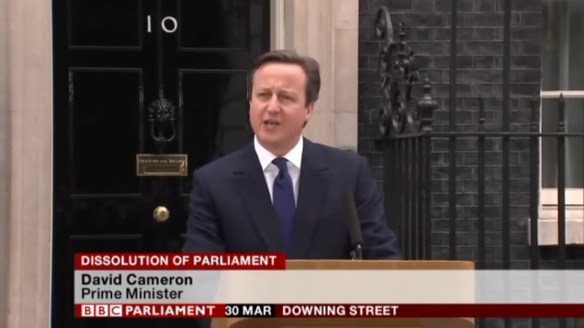
Cameron 2015 Dissolution

We are turning our country around… we must see this through together.

Five years ago, the fifty-fifth Parliament of the United Kingdom dissolved, commencing the general election campaign. As usual, proclamations were read out from the steps of the Royal Exchange in London, and from the Mercat Cross in Edinburgh, but on this occasion the text was quite a bit shorter than had been the norm before. The substance of the revised version concerns only the convocation date for the newborn legislature and the issue of writs of summons to the Lords Spiritual and Temporal. The act of dissolution itself was omitted, as was any reference to writs of election.

The reason for this was, of course, the Fixed-Term Parliaments Act 2011, which curtailed the monarch’s prerogative to make and break parliaments whenever her prime minister said so. From then on, a general election would happen on the first Thursday in May of the fifth year since the previous election took place, with dissolution occurring twenty-five working days in advance. There were of course some exceptions, but they will be detailed later.

For the first time, the date of the next general election was known years in advance. Even better, the death date of the 56th Parliament was known before it was even born: the five years after 2015 included two leap days to bring the days of the week right around, so this year the general election timetable is exactly the same as last time. Some commentators lamented that the element of surprise had been lost from British politics.

That at least was the dream, now to the reality: The second Cameron ministry did not gracefully live out a full term. Nor, for that matter, did the next three governments. The fifty-sixth Parliament dissolved on 3rd May 2017, after Cameron’s successor Theresa May successfully sought a two-thirds majority in the Commons for an early election motion under Section 2 of the Act. The fifty-seventh parliament was dissolved on 6th November 2019 by a special act of its own creation, May’s own successor Boris Johnson having tried a Section 2 motion several times and failed miserably. We are now in the time of the 58th Parliament, which is currently expected to expire on 25th March 2024, though that expectation has little solidity given that the present government intends to repeal the FTPA altogether at some point.

Jeremy Corbyn, who emerged from three decades of backbench obscurity to become Leader of the Labour Party in the aftermath of the 2015 general election, is due imminently to retire again. The result of the leadership election is due to be announced on Saturday, though the large conference originally planned has had to be scaled back dramatically due to the world events which have transpired in the meantime. It strikes me that, of the six Labour MPs who originally set out to be Corbyn’s replacement, four only joined the House of Commons in 2015. Had politics gone normally they would only now be at the end of their first term, instead of well into their third.

Obviously, it may have been awkward now if those snap elections hadn’t taken place, since all elections scheduled to take place on 7th May this year have been pushed back to 6th May 2021. Presumably the general election would have had to be delayed too*, the first instance of such an action since 1944.

As noted in my posts about Paul Danahar and Terence Casey, it has become common to remark that we currently inhabit the dark timeline, or words to that effect. Neither man could decide precisely on the point of divergence. Until someone else can suggest a better point, I will choose 2015. Obviously the COVID-19 pandemic is an entirely separate issue, but the issues that most prompted the calamitous musings prior to the outbreak were the presidency of Donald Trump in the United States and the exit of the United Kingdom from the European Union. These phenomena both had their gestation five years ago. It was in May that the Conservative & Unionist Party won the general election outright with a manifesto that included an In-Out referendum, which would likely have been dropped in coalition negotiations had that parliament been hung as expected. It was in June that Donald Trump came down that escalator and announced his desire for the GOP nomination.

Life would never be the same again. Still, at least I got to rack up my edit count in the past few years.

*Section 1 of the FTPA allows the prime minister to delay polling by statutory instrument, but only for two months as opposed to the twelve now in place.

UPDATE (9th November)

Turn Left is apparently trending on Twitter. It’s not entirely clear, but I think it’s something to do with the US presidential election.

UPDATE (March 2022)

The Dissolution and Calling of Parliaments Act has received Royal Assent, restoring the prerogative to call elections upon ministerial request.