Documentary Déjà Vu

Last month was the 200th anniversary of the opening of the Stockton & Darlington railway, the world’s first public railway to use steam locomotives. There have been quite a few commemorative events for this. The BBC has taken the opportunity to rerun a collection of some of their railway-related documentaries (not that they don’t have at least a handful of these at normal times anyway), which I have been watching on iPlayer over the last week or so.

When you watch a lot of documentaries about the same topic (e.g. railways, World War 2, the royal family, past general elections), especially if created by the same company, you will quickly notice a lot of repetition in what you’re being shown: You’ll notice the same stock film clips, the same talking points in the narration, the same talking heads being interviewed, the same background music being used. To some extent this is inevitable as, of course, they are all talking about the same event. Sometimes, however, the the resemblance is so specific as to be jarring.

Among the aforementioned documentaries were Ian Hislop Goes off the Rails, a standalone production, and The Last Days of Steam, an episode from series 8 of Timeshift. Both were originally aired in October 2008, the former on 2nd and the latter on 16th. When discussing the decline of the railways and the widespread adoption of the private motorcar, both show the same clip of a youngish couple in a red Austin-Healey roadster (registration 699 DON) driving on a motorway.

In Hislop’s documentary the clip starts at 39:19, accompanied by Terry Gourish, historian at LSE, saying

Well from the mid fifties things began to change. There was no fuel rationing affecting private motoring, road transport began to get a great impetus from new road-building, culminating in the first motorway, the M1, in 1959…

whereas in Timeshift‘s, it occurs at 41;30 as Jonathan Glancey, author of John Betjeman on Trains, says

The car from the mid-1950s was, apart from anything else, and beyond a means of transport, a consumer dream. It was something you could own. You can’t own a railway. A railway takes you where the railway goes. A care takes you, theoretically, where you want to go.

That the same clip should occur at almost exactly the same time in two documentaries produced by the same broadcaster a mere fortnight apart feels like a slight failure of quality control.

Some years ago I discovered the Railway Mania podcast series. Unfortunately that series has wound down a little recently, with just one new episode in almost a year. In its place I’ve recently turned to the Green Signals show, co-presented by Richard Bowker (former Chairman of the Strategic Rail Authority) and Nigel Harris, former editor of RAIL magazine. It’s a bit like the ex-politicians’ podcasts that have proliferated over recent years (e.g. Political Currency with Osborne & Balls) but more focused on industrial news.

Moving away from real railways, commemorations of the 80th anniversary year of The Railway Series continue. Today Historic England unveiled a blue plaque at 30 Rodborough Avenue in Stroud to mark that Wilbert Awdry had long ago lived there. The ceremony was attended by a group of his descendants. I was a little disappointed that so much of the news coverage identified him as the creator of Thomas the Tank Engine rather than of The Railway Series, including some incorrectly implying that the character debuted in 1945 rather than 1946. I also see that the display included a cardboard cut-out of the All Engines Go! version of Thomas himself, even though that series has been cancelled now and was generally disliked by most of the Awdry fandom. In some of the news videos a band outside can also be heard playing the Allcroft-era theme by O’Donnell & Campbell.

I also recently discovered that Thomas & Friends itself has an official 80th anniversary podcast. This is also includes many sound clips from the TV series. Curiously, the copyright notice credits the podcast to Gullane (Thomas) Ltd, showing that this company at least nominally still exists within the Mattel empire.

One Last Ride

I have mentioned before my delight at finding old documentaries uploaded for free on YouTube. One which has stuck with me for a long time is episode 10 of Monster Moves, in which a South African Class 15F tender engine is rescued from a breaker’s yard in Bloemfontein and returned to its birthplace in Glasgow.

As expected from this sort of program, every setback is milked for the drama. First, the lorry meant to move the engine to Durban turns out to be too small, so it has to be towed on rails by a diesel engine. Then the wheels all have to be re-lubricated so they don’t catch fire, then ten empty flatbeds have to be hauled behind for breaking capability, then the line is blocked by a stalled lorry, then the diesel breaks down just shy of the dock, then the ferry is diverted, then a giant floating crane is needed to lift the 100 tonnes aboard, then after arriving in Immingham another giant crane is needed to lift it off again, then the lorry trailer has to be redesigned for the narrower track gauge, then the load might be too high to get under British motorway bridges, then the long trailer struggles to navigate Glasgow’s tight corners. All of this is accompanied by a gloriously over-the-top orchestral Western song.

No. 3007 now resides at the Riverside Museum. It is a little disheartening to think that she can never actually run again – her track gauge being too narrow and her loading gauge too wide – and that the other old locomotives at the same depot probably won’t be saved. Many in the comments section also allege that South Africa’s rail infrastructure has deteriorated severely since 2006 and been hit by widespread looting during lockdown. All this makes the film’s ending a little bittersweet.

This was not the only rail-centric episode of the series – they also covered the relocation of two Gresley A4s from North America to York and the retrieval of two Stanier 8Fs from Turkey.

State Occasions

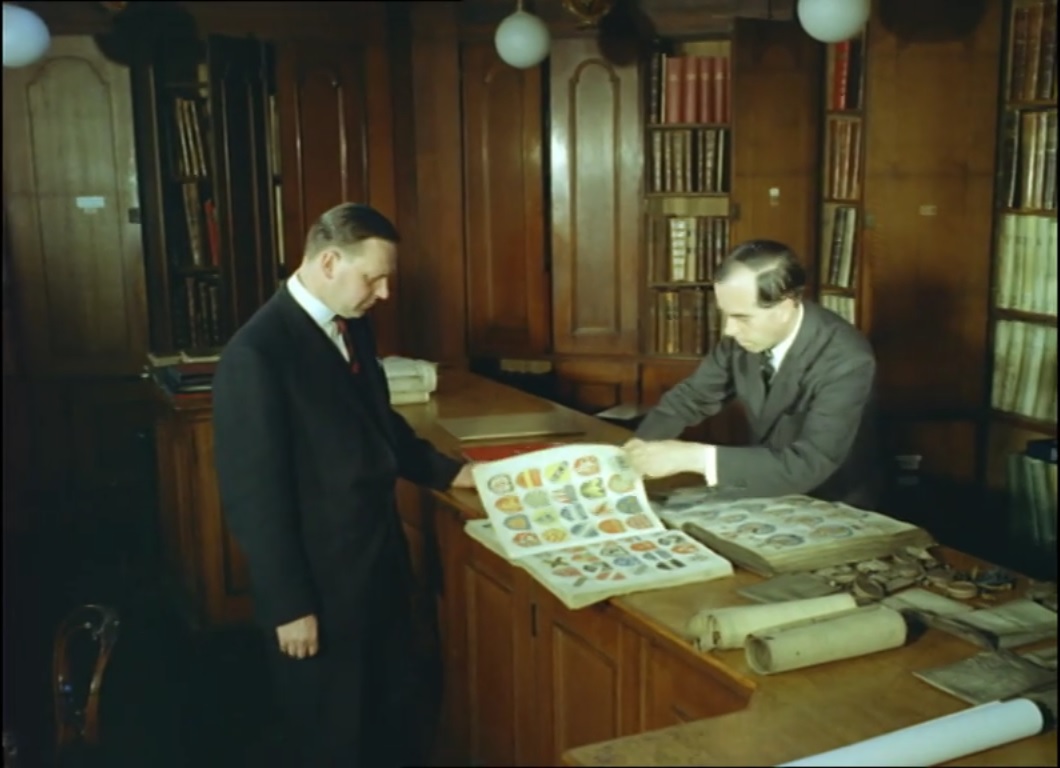
The York Herald’s Twitter feed recently led me to discover the 1960 short documentary series Look at Life, episode 7 of which is State Occasions. It follows the then-Earl Marshal (Bernard, 16th Duke of Norfolk) around the State Opening of Parliament and the Garter Day procession, as well as giving a tour inside the college of arms.

The narrator gives a concise but comprehensive overview of the college’s work and of heraldry as an artform, with ample footage of officers and artists going about their business as well as detailed closeups of the fruits of their labour.

It’s well worth a look.

The Decoy Docks

Given that so much of my YouTube intake is about history, civic architecture, and trains, it is perhaps surprising that I did not come across the Hull History Nerd sooner. Though the channel claims to date back to 2012 the videos list that I can see begins in 2019, and a large proportion of it focuses on forgotten Yorkshire railways.

This video, however, lays closer to home. The presenter is standing on the banks of the Humber about 1500m from my house. His topic is the construction upon the riverside mud of facsimiles of Hull’s docks to distract German bombers.

I don’t have much to add beyond what is said in the video itself, though it would have been nice if he had walked a little further down the bank to inspect some of the other World War Two relics nearby.

FURTHER READING

A Stark Vision

Amateur or professional, few students of Britain’s royal, political and constitutional history will be unaware of Dr David Starkey. With an extensive collection of literary and televisual credits, plus a famously oversized personality, he was for many years a giant among celebrity historians. His most prominent was his 2004 series Monarchy, followed by Magna Carta in 2015, but he can be traced back much earlier, appearing in The Trial of King Richard the Third in 1984. He has even been featured on the royal family’s own YouTube channel.

His career, though illustrious, has not been smooth sailing, for his character is notoriously abrasive and his reputation has been rocked by a string of ill-worded outbursts – in most notably in 2011 and 2015. His performance in directly teaching the youth was also rocky.

I was quite surprised, early in 2020, to see him interviewed on Akkad Daily. It taxed my mind to decide whether this pairing more represented Benjamin going up in the world or Starkey going down. Certainly the latter plummeted with great velocity that summer following a catastrophic episode with Darren Grimes, which resulted in many of his professional contracts being terminated and accolades withdrawn.

Given the severity of that latest offence, and given that he was seventy-five years old, one could have expected Starkey to vanish from public life altogether and slip quietly into retirement. For a few months that looked to be the case but then he began popping up again on various virtual conferences and current affairs broadcasts, suggesting there is still a place for him on the talking head circuit (well, the right-wing parts of it anyway).

A week ago he launched his own YouTube channel on which, seemingly alone, he gives lengthy speeches to his camera about his specialist subjects. Much of it recycles what he has already said in his earlier lectures and documentaries, some of which are of course no longer available. His motivation is not clear: it could simply be a charitable effort for the sake of public education (sort of a more sedate Crash Course) but then his website asks for monetary donations and boasts about the number of supporters he has in his “fight back”.

In between these was Charlie Brooker’s end of year mockumentary Death to 2020, in which Hugh Grant plays the historian Tennyson Foss. Judging by the hair, clothes, spectacles and voice I am fairly sure this is meant to be a pastiche of Starkey’s own interviews, although hints at the character’s backstory are clearly different.

In Those Circles

Five years ago I discovered a project called the Culture Concept Circle. It is run by Carolyn McDowall, an “independent cultural and social historian”. The YouTube channel comprises a long series of short documentaries about the history of art and design, a lot of them focusing on British architecture. The videos are not as polished as those you’d see on television – they are mostly just zooming or panning along stock still images (often low resolution) with a voiceover lecture – but this should not diminish their appeal for anyone already interested in the subject matter. If anything, they highlight how much of a modern TV documentary is essentially padding. The People Profiles are somewhere in between, as are History Matters and Extra History.

I’ve also recently discovered English Heritage podcasts. They cover an eclectic range of subjects from royal romances to Darwin’s gardens. The one that particularly caught me was How the railways shaped the nation. This is less because of its actual content than because it is narrated by collections curator Dr Matt Thompson, whose voice sounds remarkably similar to that of Ted Robbins.

A Princely Gift

I suppose there are worse things he could be wearing.

A few days ago I discovered the YouTube channel Documentary Base, whose content is what you’d expect. What particularly caught my interest was the series Crown and Country. The Prince Edward writes and presents a historical tour of England’s royal landmarks, one of many documentaries put out by his ill-fated Ardent Productions. This programme is about the same age as I, and now so obscure that its IMDB page looks to be mostly guesswork.

As far as I can decipher there were three series (in the years 1996, 1998 and 2000 – the former typed in the credits as such while the latter two are rendered as MCMXCVIII and MM). The YouTube playlist does not have them in broadcast order – and I think it may even mislabel a few of them, which makes it a little confusing. Series 1 and 2 are differentiated by swapping some of the clips in the opening title sequence montage. Series 3 switches from 4:3 to 16:9, and the title sequence is crudely cropped. The first two series credit the presenter as “Edward Windsor”, the third as “Edward Wessex”.

Technical details aside, the programme is pervaded by an otherworldly quaintness. As with so many films of this type it seems to be designed for international syndication rather than domestic broadcast, and while many specific events and locations are discussed the production itself is curiously timeless. It bulges with luxuriant panning shots of rolling countryside, weathered stone and ornately carved wood panels. The overall tone puts me in mind of Mitchell & Webb’s Sunday afternoon relaxation DVD. There are other curiosities, too, such as the title music which occasionally sounds like the middle eight of the Doctor Who theme.

The parts most interesting to me, as a blogger on heraldry, were the visits to the College of Arms and St George’s Chapel, neither of which get as much screen time as I would like.

In more recent news, the Prince of Wales has launched RE:TV, a channel (or platform, it’s not entirely clear) centered around his environmental projects. I also found this virtual interior tour of Buckingham Palace by interior design blogger Ashley Hicks.

A Strange Documentary Experience

https://www.youtube.com/watch?v=1Wng99iH8aE

In recent years several YouTube channels have emerged which play a large number of full-length old documentaries. One might be forgiven for thinking this was too good to be true and that these were pirate channels, but on closer investigation they appear to have been set up by the rights-holders themselves. The economics behind such a move are less than obvious – my best guess is that the content was not likely to be broadcast on television anymore and so there wasn’t much to lose by releasing them online.

One such documentary recently uploaded is the Channel 4 film from August 2012 The Girl Who Became Three Boys (here rebranded to changed “Girl” to “Woman”) about the late-teen aged Gemma Barker who created three online male personas in order to date her slightly-younger platonic female friends Jessica Sayers (who was extensively interviewed) and “Alice” (whose real identity was withheld). These relationships naturally ended badly and Barker herself wound up serving prison time.

I watched this documentary on the night it first aired. It was a confusing experience to say the least, and stuck with me for years afterwards. Almost nothing about the story makes sense: How did Barker’s victims not notice that she and her invented characters looked so similar? Why did Barker herself claim to have been assaulted? Why were all the adults in the girls’ lives (other than Jessica’s grandmother) eerily absent from events? How deep an emotional bond can you form with a man who has neither face nor voice (to say nothing of his other absent attributes)? If Barker had autism and “borderline learning disability” then how was she capable of manipulating her friends to that extent?

It might be expected, indeed hoped, that this film about two girls being abused in this way would be met with pity and grief, but instead the most common responses I found were confused frowns mixed with cackling laughter. The tragedy at the pinnacle of the narrative was greatly overshadowed by the farce of its foundations. The superfluous Sims-esque animated reconstructions did not help in this regard, nor indeed did Jessica’s contribution as a talking head in which, far from a sympathetic wounded victim, she often appeared to delight in milking our attention. Notably, her interviewer occasionally interrupted with incredulous requests to clarify the most especially outlandish points – such as how “Connor” would still communicate solely through text messages even when physically present. In online discussions of the documentary there were many who condemned the two victims for their apparent lack of intelligence or perception. Others found the events as presented to lie beyond plausibility, surmising instead that the documentary makers or the girls themselves were leaving out further details and fabricating their accounts.

What most fascinated me about the discussion, however, was that there were people who didn’t find this story absurd. A few even brought anecdotes from their own social groups in which girls whom they knew had pulled similar tricks. The most common refrain of this faction ran along the lines of “Well, that’s just what you’re like when you’re fifteen.” as if this kind of lunacy is to be expected as a standard part of adolescence! For as long as I can remember I have been fully aware that what most people assert as “normal” life is often sharply different to my own, yet here I cannot suspend my disbelief. Some months after the documentary aired it came up in discussion during an English lesson. I and the rest of my class were about the same age as Barker’s victims had been, yet all of us who had seen the documentary were baffled at the insanity on display. Our teacher’s reaction was little different. If what this documentary depicted is in any way representative of ordinary life then I am glad to be a freak.

UPDATE (December 2020)

The video I originally embedded has now been set to private for some reason, but the same documentary has also been uploaded whole here, and in pieces starting here.