For Gareth and the Empire!

Recently Gareth Ratcliffe, who represents Hay-on-Wye on Powys County Council, Tweeted a photograph of the royal warrant by which he was appointed an Ordinary Member of the Civil Division of the Most Excellent Order of the British Empire.

I have seen photographs and scans of similar documents before, but usually they were from a great many decades ago. I was interested to look at an up-to-date example.

The warrant begins with the sovereign’s full style (in English, of course) and concludes with the place and date. Notably it is accredited to St James’s Palace (which, rather than Buckingham, is the true headquarters of the crown), though I am quite certain that neither the monarch nor his clerks were actually in that place on New Year’s Eve signing thousands of such warrants in one go.

King Charles’s signature appears at the top of the page and Queen Camilla (in her capacity as Great Master of the Order) signs at the bottom. Six months ago I was told by the Foreign, Commonwealth & Development Office that warrants of appointment to these orders of chivalry do not depict a coat of arms, only the seal of the respective order. Embossed at the top of this warrant I can see that the seal itself actually contains the royal arms of the United Kingdom in the English arrangement, so the critical question of whether the design changes when in other realms is not necessarily resolved.

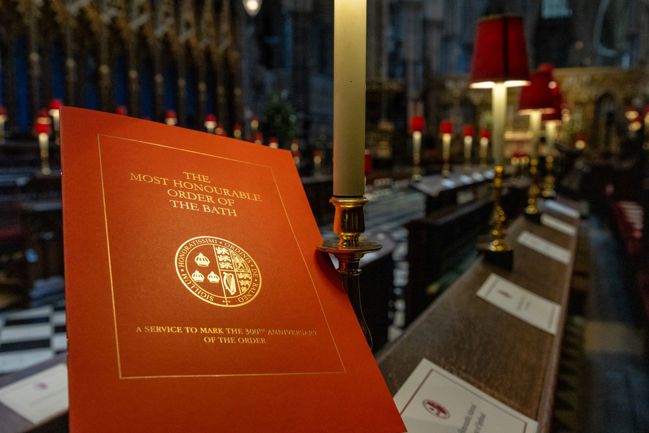
Also in the news this week was the 300th anniversary (or Tercentenary) of the Most Honourable Order of the Bath. The King (as Sovereign) and the Prince of Wales (as Great Master) attended a service in Westminster Abbey to commemorate. The cover of the Order of Service shows the seal of the order, which likewise has the British royal arms. I even found a photograph of a bound copy of the Statutes of the Order, which has the seal illustrated in full colour. There were also photographs taken of the stallplates of current and former Knights Grand Cross, including Great Masters. One hopes to see Prince William’s plate appear there too at some point, if only to get visual evidence of his full heraldic achievement as heir apparent.

Carney Summons The King

In the lead-up to, and immediate aftermath of, the Canadian general election, there were a few news pieces about the prospect of King Charles visiting in person to open the new Parliament. Most of these seemed like mere idle speculation or, indeed wishful thinking.

Today, however, it has been confirmed by both Buckingham Palace and the Office of the Prime Minister that Their Majesties will indeed be visiting for that purpose. This is unusually short notice for an overseas trip, particularly given the sovereign’s ongoing health problems and the length of the journey. As the couple are due to arrive on May 26th and leave on May 27th, it looks as if this will be a flying visit to Ottawa to perform the state opening and not much else, in contrast to last month’s state visit in Italy or last year’s royal tour of Australia. There has been no further detail about the hinted royal tour in 2026, but I presume any more elaborate plans are still delayed until then.

I know nothing at this point of the actual contents of the speech, and indeed suspect that the text will not be especially interesting from a literary perspective (throne speeches rarely are). Their Majesty’s attire may prove the more politically-contentious topic: When Elizabeth II opened Parliament in 1957 and 1977 she prominently wore the Order of the Garter, while Prince Philip wore a military uniform with his many decorations on it.

This will be the first time that the monarch has opened Parliament in person since the Patriation of the Constitution and, as much as Mark Carney is obviously an Anglophile, the purpose of this excursion is to reassert Canada’s sovereignty and national identity in the face of aggression from the United States. The King & Queen of Canada will need to find a distinctly Canadian look for themselves. This will be difficult as the Crown of Canada, before or after Trudeau’s controversial redesign, does not exist in real life as a physical object. Nor, for that matter, does the snowflake diadem. A separate set of Canadian royal robes does not exist either. To make matters worse, this won’t even be taking place in the real Parliament building, as that has been closed for major renovation works over the past few years. Currently the Senate meets in a repurposed railway station and the House of Commons in the West Block. These two buildings are a ten-minute walk apart, which could make the summoning of MPs a rather tedious ordeal. In 2021 shuttle buses were used for the 700m journey.

If maximum splendour is the goal then I suspect that Charles will wear a ceremonial military uniform (with corresponding hat) and Camilla either her coronation gown or a generic white dress with a tiara, both with all their Canadian medals as well as the sash of the Royal Victorian Order (since that is not realm-specific).

Finally, a point about Palace press releases – whereas the public sees these announcements on Royal.UK as text on a webpage, they seem to be sent to journalists as PDFs (which I only know because of how often I see journalists Tweeting them). Even now the old red outline illustration of Elizabeth II’s British arms (with St Edward’s Crown) is still used, despite this announcement relating to Canada. It’s also typed in Calibri, which irks me even more.

This story by Sky News includes a screenshot of an earlier version of the Tweet, in which the bullet points are punctuated with the French and British flags instead of the flag of Canada. Was this a clumsy attempt at representing Canada’s dual heritage, or had the template been mixed up with something intended for Macron’s state visit due this month?

Canada, Carney and Commonwealth

Sixty-two days after Trudeau announced his intention to step down, the leadership contest for the Liberal Party of Canada concluded last night. The winner, to the surprise of almost nobody, was former bank governor Mark Carney. He garnered 85.9% of the vote, albeit on only a 37% turnout, which really shows how uninspiring the other candidates must have been.

Carney’s Wikipedia page is already describing him as “Prime Minister Designate”, though the exact date at which the Governor General will formally appoint him to that office has not yet been decided. Canada tends to do governmental transitions at a rather slower pace than Britain does, with the time between leadership elections (or indeed general elections) and ministerial appointments often being measured in weeks rather than hours, but most indications are that this one will take place unusually quickly.

That the leadership election should eschew two experienced cabinet veterans in favour of someone who isn’t even an MP is a little surprising. In the Canadian constitution, as in the British, it is not illegal for a non-Parliamentarian to be appointed to a ministerial office, but it is considered improper and, above all, politically impractical. The nearest British precedent for Carney’s situation, and even then it is a very poor one, would be the much-discussed case of Sir Alec Douglas-Home disclaiming his peerages to jump back to the Commons in 1963. A more thorough comparison of these two situations may be worth a separate article.

Accession to the premiership will, of course, give Carney the right to constitutionally advise the King of Canada, including advising him to speak on Canadian matters.

For the moment, Charles continues in a state of political limbo. Following a long-established royal tradition, he must express himself in a cryptic, plausibly-deniable way, often through subtle sartorial cues.

Today is Commonwealth Day, which includes a service at Westminster Abbey and the publication of a message by His Majesty. As the position of Head of the Commonwealth has no formal powers at all, it is not subject to “advice” from the secretariat in the way that ministers advise their monarchs, and thus this is a rare opportunity for Charles to speak his own mind. Of course, the message is meant to broadly encompass all fifty-six-and-counting members of the organisation, so is still a poor venue for a determined diatribe about any particular one of them, so any comment about the defence of Canadian sovereignty must again be inferred rather than stated outright.

Sir Keir Starmer has been similarly cautious, Tweeting about “further deepening the UK-Canada relationship together” but not saying anything specific about what that would entail. It was also announced two days ago that the Department of National Defence had commissioned a fleet of new destroyers based on a British design, but this is likely unrelated to the state of relations with the White House.

Returning to more familiar territory, I notice that where the Commonwealth Day message has been quoted in photographic form, the coat of arms in the letterhead is now the new Timothy Noad illustration with the Tudor crown. Said illustration has also now replaced the earlier versions on the royal website as well. As I noted to Sodacan, the change was done at some point in the morning of Wednesday 5th March.

During the abbey service itself, I distinctly noticed Their Majesties sitting behind ornate wooden faldstools with what looked like the old-style royal arms of Canada on them. This is not in itself the cryptic clue that it might seem – they were donated by the Canada Club in 1949.

The most surprising recent development in the past few days has been the launch of another royal podcast. Whereas Camilla has been patronising The Queen’s Reading Room (of which a podcast is but one part) for some years, Charles has only just announced The King’s Music Room (probably named that way for congruence with his wife’s project), but it has already generated a lot more headlines. The format is very different from the Reading Room, being very explicitly the product of a partnership with Apple and only available to their subscribers, among which I am not.

A Look at Some Letterheads

In the past five days President Trump has in rapid succession hosted bilateral meetings at the White House with Emmanuel Macron, Sir Keir Starmer and Volodymyr Zelenskyy. I have not watched any of these events in full in order to write a proper political analysis – frankly, the small snippets I did see were already enough to leave me rocking in a corner – so am instead simply focusing on some aspects of government heraldry.

During a meeting in the oval office, Starmer gave Trump a letter from Charles III inviting him on a second state visit to the United Kingdom. The letter was marked “Private and Confidential”, yet presenting it in this way meant nearly all the words were caught on camera. I have copied out the text below (keeping the line breaks and punctuation the same) with equals signs representing the words that got obscured:

Dear Donald,

I just wanted to write and thank you for receiving====
in Washington so soon after your Inauguration. Given the====
breadth of challenges across the world, I can only think that====
of our two countries has a vital role to play in promoting and====
the values which matter so much to us all.

I remember with great fondness your visits to the United Kingdom
during your previous Presidency, and recall our nascent plan for you to
visit Dumfries House, in Scotland, as the global pandemic began and all
bets – and flights! – were off… I can only say that it would be a great
pleasure to extend that invitation once again, in the hope that you might at
some stage be visiting Turnberry and a detour to a relatively near
neighbour might not cause you too much inconvenience. An alternative
might perhaps be for you to visit Balmoral, if you are calling in at Menie.
There us much on both Estates which I think you might find interesting
and enjoy – particularly as my Foundation at Dumfries House provides
hospitality skills-training for young people who often end up as staff in
your own establishments!

Quite apart from this presenting an opportunity to discuss a wide
range of issues of mutual interest, it would also offer a valuable chance to
plan a historic second State Visit to the United Kingdom. As you will
====, this is unprecedented by a U.S. President. That is why I would find
it helpful for us to be able to discuss, together, a range of options for

location and programme content. In so doing, working together, I know
we will further enhance the special relationship between our two countries,
of which we are both so proud.

Yours Most Sincerely

Charles R

The letter is described as emanating from Buckingham Palace, and is topped by the familiar red outline of the British royal arms, still the old version with St Edward’s Crown.

On a related note, Starmer recently announced that, owing to the escalation of international military tensions, his government would be redirecting funds from international aid to defence. Anneliese Dodds, Minister of State for Development, resigned from the government in protest. The Prime Minister’s response to her resignation is published on Gov.UK as a PDF. His letterhead is the lesser version of the arms, again still using St Edward’s Crown.

One place (or rather a great many places) where the Tudor crown can now be seen in use is in the arms of Queen Camilla, as used by companies to which her royal warrant was granted late last year. The first example I’ve actually seen (through other heraldists pointing it out online, rather than in person) is Heaven Skincare, which proudly displays the warrant in the navigation bar of its website. Deborah Mitchell, the owner, Tweeted a photograph of the coat of arms on her branded packaging earlier today.

Quite the Collection

In addition to my two library cards and my many online sources I have during the past few years – commencing mainly in 2022 – accumulated a rather large collection of used books from a handful of charity shops I have frequented, mainly in Hull but also in some other East Yorkshire towns. Over the weekend I set about cataloguing the lot, though this list excludes those which I have given away as gifts to friends or family members. The small minority which I am currently reading or have already finished are shown in bold.


FICTION (arranged by author)

Dr. Gregory’s books have proven particularly easy to find at sub-£ prices.

  • Austen, Jane: The Complete Novels
  • Blyton, Enid: The Secret Seven (books 4-6)
    • Go Ahead
    • On The Trail
    • Good Work
  • Boyne, John: The Boy in Striped Pyjamas
  • Brooks, Max: World War Z
  • Chaucer, Geoffrey & Spearing, Anthony Colin: The Knight’s Tale
  • Dickens, Charles: Little Dorrit
  • Durrell, Lawrence: Sebastian
  • Gerber, Michael: Barry Trotter
    • and the Shameless Parody
    • and the Unnecessary Sequel
  • Gregory, Philippa
    • The Boleyn Inheritance
    • The Constant Princess
    • The Favoured Child
    • The Lady of the Rivers
    • The Other Boleyn Girl
    • The Other Queen
    • The Red Queen
    • The Taming of The Queen
    • The White Princess
    • The White Queen
    • Three Sisters, Three Queens
  • Keyes, Daniel: Flowers for Algernon
  • Lawrence, David Herbert
    • Lady Chatterley’s Lover
    • Women in Love
    • Sons and Lovers
  • Mallinson, Allan: A Call to Arms
  • Mantel, Dame Hilary: Bringing Up the Bodies
  • Mitchell, Margaret: Gone With The Wind
  • Naylor, Doug: Red Dwarf, Last Human
  • Orwell, George: The Complete Novels
  • Penman, Sharon: The Sunne in Splendour
  • Sachor, Louis: Holes
  • Sansom, Christopher John: Sovereign
  • Shakespeare, William: The Complete Works
  • Thackeray, William Makepeace: Vanity Fair
  • Tolkien, Christopher: The History of Middle-earth (volumes 1-7)**
    • The Book of Lost Tales, Part 1
    • The Book of Lost Tales, Part 2
    • The Lays of Beleriand
    • The Shaping of Middle-earth
    • The Lost Road and Other Writings
    • The Return of the Shadow
    • The Treason of Isengard
  • Tolkien, John Ronald Reuel: Sir Gawain & the Green Knight, Pearl and Sir Orfeo
  • Towles, Amor: A Gentleman in Moscow
  • Townsend, Sue: Adrian Mole, The Prostate Years
  • Tsiolkas, Christos: Dead Europe

NON-FICTION (arranged by topic)

ANCIENT WORLD

  • Beard, Dame Mary
    • How Do We Look? The Eye of Faith
    • Pompeii, The Life of a Roman Town
  • Graves, Robert: The Greek Myths, Vol. 1 & 2
  • Peddie, John: The Roman War Machine
  • Potter, Timothy William: Roman Italy
  • Taggart, Caroline: A Classical Education
  • Thucydides: History of the Peloponnesian War
  • Wells, Colin: The Roman Empire

ART & ARCHITECTURE

  • Cruickshank, Dan: Adventures in Architecture
  • Devonshire, Deborah, Duchess of: The House, Chatsworth
  • National Trust:
    • Beningbrough Hall*
    • Treasures of
  • Spalding, Frances: British Art Since 1900
  • Style, Colin & O-Ian: House Histories for Beginners
  • Suh, H. Anna: Leonardo’s Notebook
  • Taylor, Richard: How to Read a Church

BIOGRAPHIES AND MEMOIRS (arranged by protagonist)

  • Cameron of Chipping Norton, David, Baron: Cameron at 10 (Sir Anthony Seldon & Peter Snowdon)
  • Churchill, Sir Winston
    • The Churchills, In Love & War (Mary Sybilla Lovell)
    • Winston & Clementine, The Triumphs & Tragedies of the Churchills (Richard Hough)
  • Clark, Alan: Into Politics (himself)
  • Cook, James: Captain James Cook (Richard Hough)
  • Devonshire, Georgiana, Duchess of (Amanda Foreman)
  • Fowlds, Derek: A Part Worth Playing (himself)
  • Hodkinson, Mark: No One Round Here Reads Tolstoy (himself)
  • Holbein, Hans: The King’s Painter, The Life & Times of (Moyle, Franny)
  • Hudson, Kerry: Lowborn (himself)
  • Ishikawa, Tetsuya: How I Caused The Credit Crunch (himself)
  • Kaufman, Sir Gerald: How to be a Minister (himself)
  • Kay, Adam: Twas The Nightshift Before Christmas (himself)
  • Macron, Emmanuel: The French Exception (Alan Plowright)
  • Mitford, Nancy: The Letters of Nancy Mitford (Charlotte Mosley)
  • Mowlam, Mo: The Biography (Julia Langdon)
  • Newcastle, William, 1st Duke of: Portrait of a Cavalier (Geoffrey Trease)
  • Palin, Sir Michael: Full Circle (himself)
  • Pilkington, Karl: The World of Karl Pilkington (Ricky Gervais)
  • Riverdale, Robert “Skips”, Baron: A Life, A Sail, A Changing Sea (himself)
  • Smith, Matt: The Biography (Emily Herbert)
  • West, Timothy: Our Great Canal Journeys (himself)
  • Whitelaw, William, Viscount: The Whitelaw Memoirs (himself)

CONTEMPORARY POLITICS

  • Abell, Stig: How Britain Really Works
  • Brooks, Richard: The Great Tax Robbery
  • Cohen, Nick: Waiting for the Etonians
  • Harding, Luke: Shadow State, Murder, Mayhem & Russia’s Remaking of the West
  • Luce, Edward: In Spite of the Gods, The Strange Rise of Modern India
  • Minton, Anna: Ground Control
  • Runciman of Doxford, David, 4th Viscount: How Democracy Ends
  • Willetts, David, Baron: A University Education
  • Wilson, Andrew: The Ukraine Crisis, What It Means For The West

HISTORY (other)

  • Belchem, John: A New History of the Isle of Man, Vol. 5 The Modern Period 1830-1999
  • Briggs, Asa, Baron: A Social History of England
  • Browne, Harry: The Rule of British Trade Unions 1825-1914
  • Churchill, Sir Winston: A History of the English-Speaking Peoples, Vol. I
  • Crosby, Alan: Preston Gould, England’s Greatest Carnival
  • Thomas, Gordon: Inside British Intelligence
  • Hibbert, Christopher: A Social History of the English 1066-1945
  • Jones, Terry: Who Murdered Chaucer?
  • Laidler, Keith: The Head of God, The Lost Treasure of the Templars
  • Morfitt, Paul & Wells, Malcolm: Hull Corporation Buses*
  • Sandbrook, Dominic: Never Had It So Good
  • Stead, Neville: Kingston-upon-Hull, Images of a Rich Transport Heritage
  • Street, Sean: A Remembered Land, Recollections of Country Life 1880-1914

LINGUISTICS

  • Burrow, John Anthony: A Book of Middle English
  • Oxford
    • Dictionary of Idioms
    • Dictionary of Quotations & Proverbs Vol. I
  • Parkinson, Judy: I Before E
  • Taggart, Caroline & Wines, J. A.: My Grammar & I

LOCOMOTION

  • Allan, Ian: Railway Liveries 1923-1947
  • Atterbury, Paul: Discovering Britain’s Lost Railways
  • Morrison, G. W. & Whiteley, J. S.: Profile of the Deltics
  • Jones, Edgar: The Penguin Guide to the Railways of Britain
  • Ross, David: The Illustrated History of British Steam Railways

ROYAL FAMILY

  • Burns, Michael: The Queen’s Flight
  • Fraser, Lady Antonia: The Warrior Queens: Boadicea’s Chariot
  • Glenconner, Anne, Baroness: Lady in Waiting
  • Green, Candida Lycett & Wales, Charles, Prince of: The Garden At Highgrove
  • Junor, Penny: The Duchess, Camilla Parker Bowles
  • Kent, Princess Michael of: Crowned in a Far Country
  • Langley, Philippa & Jones, Michael: The Search for Richard III, The King’s Grave
  • Lisle, Leanda de: Tudor, The Family Story
  • Low, Valentine: Courtiers, The Hidden Power Behind the Crown
  • Mayer, Catherine: Charles, The Heart of a King
  • Phillips, Charles: Kings & Queens of Great Britain
  • Plumb, Sir John Harold: The First Four Georges
  • Rhodes, Margaret: The Final Curtsey
  • Weir, Alison: Katherine Swynford

SCIENCE, PHILOSOPHY & IDEAS

  • Attenborough, Sir David: Life on Earth
  • Darwin, Charles & Leakey, Richard: The Illustrated Origin of Species
  • Dawkins, Richard
    • The Extended Phenotype
    • The Greatest Show On Earth
  • Freeman, Betty Jo; Ornitz, Edward M. & Tanguay, Peter E.: Autism, Diagnosis, Current Research & Management
  • Garner, Alan: The Voice That Thunders
  • Harari, Yuval Noah: Homo Deus, A Brief History of Tomorrow
  • Shennan, Stephen: Genes, Memes & Human History

SECOND WORLD WAR

Churchill manages to appear on this list twice as an author and twice as a subject.

  • Beevor, Sir Anthony
    • D-Day
    • Stalingrad
  • Bryant, Sir Arthur: Triumph in the West
  • Bryant, Sir Chris: The Glamour Boys
  • Cawthorne, Nigel: Fighting Them on the Beaches
  • Churchill, Sir Winston: The Second World War, Vol. I
  • Faulks, Sebastian: The Vintage Book of War Stories
  • Felton, Mark: Zero Night
  • Gillies, Midge: The Barbed-Wire University
  • Levine, Joshua: Dunkirk, The History Behind The Major Motion Picture
  • Lomax Eric: The Railway Man
  • Roberts of Belgravia, Andrew, Baron: The Storm of War
  • Trigg, Jonathan: D-Day Through German Eyes
  • Wilson, Kevin: Men of Air, The Doomed Youth of Bomber Command

TELEVISION

  • Jay, Sir Antony & Lynn, Jonathan: The Diaries of the Right Hon. James Hacker Vol. II (Yes, Prime Minister)
  • Lloyd, John & Mitchinson, John: The Second Book of General Ignorance (QI)
  • McCann, Graham: The Story of a Television Classic (Dad’s Army)
  • Patterson, Dan: Only Book You’ll Ever Need (Mock the Week)
  • Porter, Richard: And On That Bombshell (Top Gear)

MISCELLANEOUS

  • Automobile Association:
    • 250 Tours of Britain
    • Book of British Villages
  • Lewis, Oliver: The Orwell Tour
  • Jordison, Sam & Kieran, Dan: Crap Towns Returns
  • Marshall, Enid Ann: General Principles of Scots Law
  • Which?: Book of Tax 1985/86
  • Wood, Michael: In Search of Shakespeare

*Unfortunately I left this one for some weeks in the boot of my car and upon eventually retrieving it I discovered the floor was damp. I can’t put it back on the shelf until the mold has been treated. (UPDATE 3rd February – I found another copy of Beningbrough Hall in a different charity shop for half the price at which I bought the first one.)
**These were purchased as a set for £15. Carrying them out of the shop was a bit tricky. I also acquired Volume 9, Sauron Defeated, as a gift in 2020. These may technically belong in the non-fiction section as the series constitutes more of a literary making-of documentary than a pure immersive story.

Realms and Revelations

When writing and reviewing textbooks, encyclopedia entries and anything else to be considered authoritative, it is important to be able to cite one’s sources of information. You may learn and know things from what you’ve heard and seen in person (or, in my case, on Zoom meetings) but this is almost worthless if it cannot be verified by the rest of the public – or at least the academic community.

For matters which relate to government and politics, Parliamentary questions and statements are very useful in this regard as they are recorded in Hansard. Of course, such statements are only made at all if MPs and peers are minded to discuss those topics. For the lay citizen, an alternative can be found in Freedom of Information requests, the principal avenue for which is the website WhatDoTheyKnow.

I recently tried my hand at resolving three questions through this method, with varying degrees of success:

Scottish Arms of the Royal Family

I have blogged many times before about the uncertainty of the armorial status of Queen Camilla, Prince William and various other royals in Scotland since the end of Elizabeth II’s reign. The obvious body to ask was the Lyon Court. WDTK lists the Court as a body which is not subject to the FOI act but which they believe ought to be. I have of course, interacted virtually with some Scottish officers of arms before, but that was in a much less formal context. It appears that I am the first person to attempt to contact the Court through this avenue. As expected, my request was refused. I found Kevin Greig’s use of the term “research” a little ill-fitting in this particular instance, though understandable if dictated by consistency with more general policy. He suggested that Scotland’s People would be the more appropriate place to look. The most surprising part of his response was the final sentence, implying that the Court only controls the sovereign’s undifferenced arms and that those of the other royals, including the Scottish versions, are held by the College in London.

Membership Quotas on Orders of Chivalry

After the death of Dame Maggie Smith got me thinking about the topic, I sent the question to the Cabinet Office, as they are the government department responsible for the management of the larger honours list. They got back to me a month later to say that while they maintain statistics on the numbers of new appointments to each order each time, they have none relating to the cumulative totals. They suggested that the Central Chancery of the Orders of Knighthood might know, but their data were probably also incomplete and that in any case they are not subject to the FOI Act either.

The King’s Honours in His Other Realms

This request also concerned the honours system, or rather systems, for I noted that many “British” honours (such as the Royal Victorian Order, or the Order of St Michael & St George) are also awarded in other countries with Charles III as monarch. I wanted to know whether his awards given to e.g. Canadians and Papuans were formally granted in his capacity as monarch of those countries or as monarch of this one – including what royal style and insignia were used on the relevant letters patent.

I initially sent this one to the Cabinet Office as well. They didn’t hold the necessary information here either, recommending that I instead ask the Crown Office in Chancery (within the Ministry of Justice) and if that failed then the Foreign, Commonwealth & Development Office. I asked both simultaneously to save time. The Crown Office held none of the information at all, but the FCDO was able to supply most of what I wanted. Crucially, they confirmed the the sovereign honours the other realms’ subjects in his relevant local capacity not his British one. They also clarified that these appointments are done by warrant rather than by patent and that the documents don’t display coats of arms but do include the seals of the orders of chivalry themselves.

It was a long trek but it was nice to eventually get something out of all of these requests. I will consider chasing up the Chancery at a later date.

The Sovereign’s Crown and the Southern Cross

The King & Queen in Sydney (NSW Gov, CC BY 4.0). The King’s mouth is unfortunately hanging open in this shot, which combined with the opaque glasses makes for a bit of a Hubert Farnsworth look.

The King & Queen have just spent the past nine days on a tour of Australia and Samoa. Bizarrely, the Palace’s press release called this an “Autumn Tour” even though in the destination countries it was spring. The tour was originally supposed to have included New Zealand as well, but His Majesty’s cancer diagnosis earlier this year forced the itinerary to be severely reduced.

Charles wore three distinct metaphorical “hats” during the course of the tour: First as King of Australia conducting domestic business, second as King of Great Britain & Northern Ireland conducting a bilateral state visit, and third as Head of the Commonwealth presiding over the biennial Heads of Government Meeting.

Photographs of the sovereign couple at these events are unfortunately few and far between. Australian governments both federal and state lack official Flickr accounts with clear licensing indications as their British counterparts have, and the paltry few hosted on their websites are also of uncertain origin – at time of posting a handful have been accepted on Wikimedia Commons but these all look so suspiciously similar to those on Getty and Alamy that I wouldn’t be surprised if they ended up getting deleted shortly afterwards. There seem to be no free-licence photographs of the state visit to Samoa at all. Number 10 and the FCDO both have albums from the CHOGM, but only one picture of the lot actually shows Charles and none at all show Camilla.

I do not know the full details of the travel arrangements, but what I can gather is that Their Majesties and a small entourage took a commercial flight from Heathrow to Singapore, whence they were picked up by the Royal Australian Air Force and taken to Sydney Kingsford Smith Airport in New South Wales.

The tour marked the first in-the-fabric appearance of the Australian royal banner of arms (known officially as “The King’s Flag for Australia”), which was seen flying from the cockpit window and then later from several road and watercraft. The Australian banner follows Canada’s example by reverting to showing the national arms undifferenced, in contrast to the practice followed during Elizabeth II’s reign of defacing the banner with her own personal cypher. The King approved the present version on 30th August.

The current coat of arms of Australia was formalised in 1912. The shield is a composite in “quarterly of six” format, representing the six constituent states of the federation. The states of South Australia and Western Australia did not yet have full coats of arms at the time but all had heraldic badges (which are also shown on their respective civil flags) so these were used instead. The whole is surrounded by a bordure ermine.
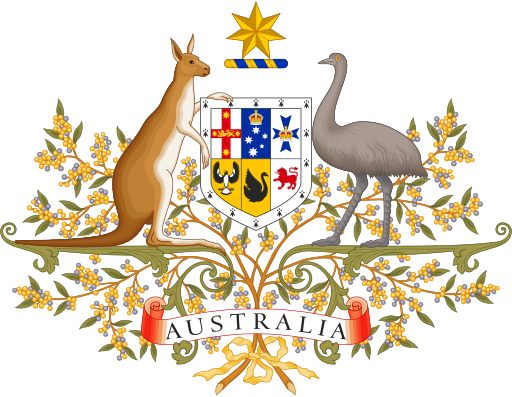
The whole federal armorial achievement is normally depicted with the crest on a torse hovering some distance above the shield – omitting helm, mantling or coronet – but the Imperial Crown appears as a charge on the badges of Victoria and Queensland, notably at different sizes.

As in Britain (though unlike Canada) the depiction of the crown in Australian royal symbols has changed from St Edward’s Crown to the Tudor Crown, though this has not yet entirely filtered through to all the state arms and flags themselves. I dimly remember – but can no longer find the proof – that the flag as approved on the government’s website in August still showed St Edward’s Crown, and that the graphic on Wikimedia Commons did likewise until photographs of the real flag caused an update.

The King at several points on the tour wore the sovereign’s badge of the Order of Australia along with a hefty line of other honours I will need time to identify. The Governor-General gave him honorary commissions at the top ranks of all three branches of the Australian armed forces. This is is a little perplexing from a legal perspective: One would have thought that the reigning monarch would hold these ranks substantively ex officio and would not need to be appointed to them by his own deputy.

The Queen is another story: For months now I have been looking out for signs of Camilla being granted the use of her own banner of arms – being the royal arms of the sovereign impaling those of her father Bruce Shand. This was finally seen to be the case during the Australian tour, flying from the bonnet of her car on a few occasions when she travelled without her husband. The videos did not show the flag long enough (and the stills tended to have it covered by the watermark) but from what little I can determine of the artistic subtleties of its design I reckon it is actually a printout of the vector file on the Commons. The car itself was a black Audi (I think a Q8) and the regular numberplates were obscured with plates bearing an image of the Tudor Crown. That image looks to have been taken from Wikimedia too, though I can’t find the exact image. The glaring problem here, of course, is that this banner shows Shand impaled by the British royal arms rather than the Australian, resulting in a mismatch with her husband. There is a burning irony that after all this time, the one occasion Camilla can be seen using a personalised banner of arms as Britain’s royal consort is the one occasion in which it was not appropriate to do so.

This unfortunately seems to be far for the course with royal tours – with the notable exception of Canada (probably because that country has its own heraldic authority), banners of royal arms in the other Commonwealth Realms seem to only be made for the reigning sovereign himself, with the rest of the royal family defaulting to their British blazons instead of coming up with a local variant. This may be marginally more convenient from a logistical and fiscal perspective, but it can be constitutionally misleading as it implies that they are representing a foreign state instead of that country’s own crown. If creating a personal one for each prince or princess is too onerous, it at least would be relatively easy to create a generic ermine-bordered version which they could all use when in the country. Admittedly that might not work in Australia where the sovereign’s own shield and banner have an ermine bordure already. For the royal wives, it might even make more sense to use banners of their paternal arms unimpaled so that they needn’t change based on location at all.

During the visit, His Majesty attended a service at St Thomas’s Anglican Church in North Sydney, made addresses to both the state Parliament of New South Wales and the national Parliament of Australia (sadly not from the throne in either case) and undertook a review of the fleet. God Save The King was played by a brass band while Charles inspected the troops and also by a solo amateur flautist during his walkabout but I can’t find any clip of it actually being sung at any point, in contrast to Advance Australia Fair which was sung by a children’s choir at Parliament House. That the monarch made no remark about his late friend Barry Humphries (a.k.a Dame Edna Everage) was also a little surprising.

When the royal party landed in Samoa they switched back to their British identities and the British royal banner was flown from the cockpit window alongside the Samoan flag, although the aeroplane itself was still very obviously branded as Australian.

While in Samoa Charles was invested with two honorific titles – Tui Taumeasina (King of Taumeasina) and Toa’iga o Tumua (Paramount Chief). The Queen was seen using a hand-fan with her royal cypher printed on it, which was given to her by Stewart Parvin in February. Both switched for much of the visit to bespoke white outfits in the local style.

Charles attended the CHOGM in his capacity as Head of the Commonwealth. Elizabeth II adopted a personal flag to represent herself in this capacity with no reference to any particular country. Her son so far appears not to have done so, which is a pity.
The official royal YouTube channel has uploaded some videos from these events. Not only are they continuing to use the outline of the British royal arms as the channel logo, they have also taken to including a new drawing of the arms in the thumbnails of individual videos. This, again, is a little problematic when the contents of the videos relate to other realms. I am left to wonder what recognisable symbol could be used here to avoid this problem. The livery badge of the House of Windsor might work, but even that technically has the British banner of arms included in it. The only solution that would truly work is, I suppose the CIIIR cypher on its own, without even a crown above it. Indeed, that could work for other family members’ flags and banners too.

Late-Summer Heraldic News

In the past fortnight there have been a handful of significant developments in the world of British heraldry.

Firstly, on 15th August the College of Arms published the 76th edition of its newsletter. Much of the text deals with topics already explained (such as the coronation roll and the year’s garter appointments) but there were some new details, such as the grant of arms to the University for the Creative Arts, which will be another addition to my list on Wikipedia.

Secondly, there are two long-form videos on YouTube of armorial interest: On August 20th a video by the White House Historical Association about the making of the Presidential Seal and on August 23rd by American Ancestors interviewing the York Herald Peter O’Donoghue. These videos speak for themselves so I will not elaborate them.

Thirdly, and of most interest, is a Tweet from 24th August by Alastair Bruce. It includes three photographs from inside the High Kirk of Edinburgh, showing the stallplate and banner of Queen Camilla. There is not much of surprise about the composition of the arms – they show the arms of King Charles impaling the arms of Bruce Shand – but it is reassuring to have confirmation that both shield and banner exist in formal usage, given the persistent uncertainties of Her Majesty’s status in England.

The most intriguing of the three photographs is the one which shows Camilla’s stallplate accompanied by five other royal ones: In the left column are Prince William, Earl of Strathearn (middle) and Olav V, King of Norway (bottom). In the right column are Queen Elizabeth Bowes-Lyon (top) the Prince Philip, Duke of Edinburgh (middle) and the Prince Albert, Duke of York (bottom). The fact that these six achievements are put together like this is itself a little confusing since some of those members of the order had overlapping tenures so could not have occupied the same stall. Also noteworthy is the way in which the artistic styles have changed over the years:

  • The Prince Albert, (later King George VI) was appointed to the order by his father in 1923 and presumably this is what it says on the scroll underneath (although it’s not legible in the photograph). He uses the royal arms differenced by a label of three points argent the centre bearing an anchor Azure. He has the coronet of a child of the sovereign sitting on top of a forward-facing golden helmet, and the coronet itself is topped by the lion crest, gorged at the neck by another label of three points argent – although that one doesn’t have the anchor in the middle. While that could be dismissed as an omission by the painter (perhaps too small to draw properly) it is unmissable that this stallplate clearly uses the English version of the royal arms and crest as well as referring to the prince by his England-based title (Duke of York) instead of his Scottish-based one (Earl of Inverness).
  • Queen Elizabeth was appointed by her husband in 1937. Her stallplate shows his arms impaling those of Claude Bowes-Lyon. Again the English arrangement of the royal arms is used, especially confusing as Elizabeth was herself of Scottish ancestry. The shield is topped by the royal crown. I can’t work out if it is the English or Scottish version of the crown shown, given the vagaries of the art style.
  • The Prince Philip was appointed by his wife in 1952. His stallplate shows his arms as granted in 1949. He used the same coronet as his sons and uncles-in-law, but here it is depicted beneath the helm rather than atop it as in the other examples. Philip apparently used the same arms in every heraldic jurisdiction, as well as the same title. His personal motto “God Is My Help” appears on a scroll above the crest, as is the Scottish tradition.
  • Prince William was appointed by his grandmother in 2012. Earl of Strathearn was his secondary peerage, his primary being Duke of Cambridge. His arms are in the Scottish arrangement. He uses the coronet of a son of the heir apparent on top of a front-facing grey helmet with gold bars, itself topped by the Scottish royal crest. Both crest and shield are differenced by his label of three points Argent, the centre bearing an escallop Gules. The Scottish motto “In Defens” flies over the crest. The tinctures used for this stallplate look a little off, with the Or in particular being shown as a much darker shade of yellow than that used for all the others.
  • Queen Camilla was appointed by her husband in 2023. Her shield uses the Scottish arrangement of the arms. The royal crown is drawn rather differently to that used by her grandmother-in-law, but it’s still just as unclear which one it is supposed to be.
  • Olav V, the only foreign member here, was appointed by his first cousin one removed in 1962. Crests are not a traditional feature of Norwegian heraldry, but the royal crown of Norway is placed atop a forward-facing grey helm with gold bars. The mantling is Gules doubled Or whereas the British princes here use Or doubled Ermine. Domestic depictions of the Norwegian arms tend to omit helm and mantling altogether or use a pavillion Purpure doubled ermine.

Don’t They Look Younger Now?

Fresh from attending special sittings of the States of Jersey and the States of Deliberation in Guernsey, today Their Majesties returned to Westminster for the opening of the first session of the fifty-ninth Parliament of the United Kingdom.

This was the first King’s Speech under a Labour government since 1950. There is some symmetry, perhaps, between Charles III’s second speech and George VI’s second-to-last.

This is the only free-licence photograph of the event so far.

While the content of the speech was very lengthy and stood in radical contrast to the one delivered for Sunak’s government in November, in ceremonial terms there was very little change. The King’s getup was identical to that worn last time. The Queen’s changed a little – instead of her coronation gown, she has reverted to the style of dress she wore in 2019 and earlier. Reeta Chakrabarti, presenting the BBC’s coverage, described it as “very fine, off-white silk crepe embroidered by Fiona Claire”. She has not taken to wearing a sash again, but the star of the Order of the Garter appears around her left hip. This was also, incidentally, her 77th birthday.

Shabana Mahmood appeared as Lord Chancellor. Being a barrister, she wore the full-bottomed wig. This is the first time a woman has performed this role at a state opening, for Liz Truss’s brief tenure in the role did not include one. Justin Welby, the Archbishop of Canterbury, can be seen for the first time wearing the collar of the Royal Victorian Order.

The most striking visual difference was in the change of pages – last time King Charles’ train was carried by Nicholas Barclay, Ralph Tollemache, Charles van Cutsem and Lord Oliver Cholmondeley (three of whom also appeared at the coronation). This time Tollemache returned but the other three were replaced by William Sackville, Alfred Wellesley and Guy Tryon. I don’t know any biographical detail about them beyond what I can guess from their surnames but they all appeared to be several years younger than the boys whom they replaced. Queen Camilla continued to use William Keswick and Arthur Elliott as before. As at last year’s ceremony Her Majesty’s two pages held her robe in the middle rather than at the end so that the end still dragged along the carpet, whereas His Majesty’s four pages kept the whole garment elevated (despite it being longer than his wife’s).

Some other things of note – as is custom after the first state opening of a new parliament, the lower house appointed three temporary deputy speakers. The senior of these is Sir Edward Leigh. I don’t think a Father of the House has ever been appointed as a deputy speaker before. These three will hold office for the brief period until new deputies are elected. All three of the deputy speakers sitting before dissolution have now left the house (one against his will), which was last the case in 1997. There will thus be no continuity except for Sir Lindsay Hoyle himself. Also today the first life peerages of Sir Keir Starmer’s premiership were patented – Lord Vallance of Balham and Lady Smith of Malvern. It appears that the ministerial appointments will be taking priority over the dissolution honours after all.

EXTERNAL LINKS


Sightings in the Channel

A few months ago I noted that, during the illness of her husband, Queen Camilla had been carrying out royal engagements solo, and had been flying the generic ermine-bordered version of the royal banner of arms.

The King has since recovered at least enough to be allowed out, and today Their Majesties jointly visit the Bailiwick of Jersey – a crown dependency in the English channel. Although a self-governing country with its own coat of arms, Jersey is part of the realm of the United Kingdom (i.e. it doesn’t count as a separate crown from the British one) and the sovereign’s heraldic identity is the same as in England.

In the disappointingly-limited series of photographs and videos I have found so far (none of them free-licence) I could not see much evidence of the sovereign’s banner flying over buildings, though I did see it on the roof of the Bentley State Limousine. What intrigued me was seeing (at 2m08s in the video above) some enthusiasts who had brought their own banner of Her Majesty’s arms and draped it over the railing. Based on the art style, I am dead certain it is a printout of this creation by Fry1989. The King actually reacts to it, though I can’t quite make out the words he says. The presumed owner of the flag says to him “I hope you enjoyed France last year.” in what I take to be a French accent.

EXTERNAL LINKS