More Armorials

Photographs by Baz Manning, 2014

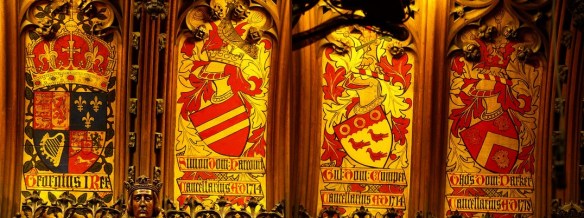
A month ago I mentioned that I was creating a Wikipedia armorial page for schools in the United Kingdom. Since then I have moved the page from Draft to Mainspace. Whether it can be called successful is not yet clear – nobody has attempted to delete it, but few have come to contribute to it either. Having run out of obvious categories of corporate arms, I went back to a personal one. Having already created a page for Speakers of the House of Commons, earlier this year I drafted one for their old counterparts, the Lord Chancellors. These were generally easier to source than those of the speakers of the lower house, for the chancellors acceded to the peerage – and thus the pages of Burke or Debrett – at the beginning of their tenures rather than the end. The Constitutional Reform Act 2005 complicates matters somewhat, as the office has since been given to a disturbingly rapid succession of MPs, none of whom are yet armigerous as far as I know. The new, separate office of Lord Speaker has only had three incumbents so far and I have no information on any of their heraldic bearings or lack thereof.

That page having apparently worked, yesterday I embarked on yet another armorial, this time for the Chancellors of the Exchequer. Already I have filled in most of the entries for those who have held the office since the dawn of the eighteenth century, helped in part because the list significantly overlaps with that of the prime ministers. Now I am unsure of how to tread further, for the office is not as simple as it appears. The Chancellor of the Exchequer of the United Kingdom is a merger (confusingly not done until sixteen years after the kingdoms themselves were merged) of the Chancellor of the Exchequer of Ireland with the Chancellor of the Exchequer of Great Britain. The latter was itself a merger of the Chancellor of the Exchequer of England with the Treasurer-depute of Scotland. The Lord Chancellorship similarly has existed in various forms in multiple polities. I am not sure that it would be possible to make armorial pages for all of them, for some of the lists stretch back to the high medieval era and there are many uncertain entries. If even their names are not remembered then it is not likely that their blazons would be.

On a slightly different note, most major media sources have determined beyond reasonable doubt (though reason has been tested in the last few years) that Joe Biden is the President-elect of the United States. Parliamentary democracies tend to have a full-time shadow cabinet whose members are ready to form the real cabinet at moment’s notice should their party win power. In the states there is a lengthy period between election and inauguration during which the outgoing and incoming presidents negotiate the transfer of power and decisions can be made in advance about the composition of the new administration. In at least the last three instances the transition team has been construed as a formal office with its own website and its own insignia. Obama’s team used a wide rectangle with the national coat of arms adjacent to the name in a stylised typeface, notable in that it shows the heraldic achievement separated from the context of the round seal, and rather resembles the departmental branding seen in Roadkill. Trump used an oval with a depiction of the White House in the centre and his own title around the border. Biden’s team is currently using a minimalist version of the presidential seal with the number 46 at the base. Though its cause was ultimately jossed, in 2012 a Romney transition was planned, its logo being a conjoined circle and oval, the former showing what I assume to be an eagle volant, though the resolution is too poor to make out. I have yet to find one for Hillary Clinton in 2016. It remains to be seen if future presidential transitions will settle on a standardised emblem, for it seems a pity to put so much work into a brand that will only be used for a couple of months. Personally I would quite like to see the shield differenced by the three-point label of an heir apparent – though actually that could belong to the Vice-President as well. Another thing to note is that, at noon on inauguration day the White House website and all associated social media accounts are wiped clean ready for the new president to start again, with all previous content copied swiftly onto an archive site. This is necessary so that communications by an earlier administration are not attributed to those of a later one. I have a faint memory of this being a problem for the Mayor of London’s account on Twitter, where if you crawl back far enough you can see Boris Johnson’s words alongside Sadiq Khan’s face, with somewhat confusing results. It is interesting that since the launch of the World Wide Web there have not yet between two consecutive POTUSes from the same party, and I wonder how the digital transition would then be handled – especially if the new leader had been a senior figure in the administration of his predecessor.

Back to the main topic, recently I discovered (though how recently it happened I cannot say for certain) that the Heraldry Society has released its 2019 articles from The Coat of Arms as downloadable pdfs. The 2020 article titles are listed but presumably the content will remain reserved for members only until next year. The most tantalising of these is Arms and the woman: the heraldry of women parliamentarians by Duncan Sutherland, which I had already seen advertised as a live event but obviously did not have the means to attend. If the lecture was recorded then the video is not one to which I have access.

UPDATE (13th November)

No sooner had I completed the pages than a user by the name of Fram prodded several of them for deletion, as well as a few earlier such armorials that I did not create, on the grounds that the lists of coats of arms are not notable in their own right. I have a week to argue my case. So far nobody else from the heraldry and vexillology project seems to have noticed. Just in case I fail, I have backed up the code for all the affected pages in my own userspace – which was not possible for the Sudrian material on account of the non-free photographs.

UPDATE (August 2022)

Though I did not create the page Armorial of prime ministers of the United Kingdom, I have contributed a fair amount of its content. Recently a thread was opened on the Heraldry Subreddit about Prime Ministers’ coats of arms, which included a few of my illustrations.

A Heraldic Hat-Trick

The Earl of Mayo’s Investiture by Count Casimir Markievicz, 1905

Since the pandemic began, the College of Arms has been unusually inactive. While the Lyon Court took the opportunity to reach out to those bored by lockdown, its English counterpart practically disappeared. The college’s newsletter, which normally updates every quarter, had been on hold since January until yesterday when finally it was updated again. Sadly it was not triple-length to make up for lost time.

The “recent grants” section reveals that the college’s normal work had been continuing during the months of silence, I presume through correspondence. The most striking names among those whose arms are actually shown and blazoned were Dominic Aslan of Wandsworth and the married couple Eric & Denise Scots-Knight (who live in Westminster and are not knighted). The only one with a Wikipedia page (and thus of use to me) was Cindy Rose, Chief Executive of Microsoft UK. Also included was George Helon of Queensland, though his had already been revealed two months earlier on the separate grants page (which otherwise had been used just once in the past three years). It was said that supporters have been granted to The Lord Chartres, former Bishop of London, but they were not blazoned – indeed, I don’t know the details of what bearings he already had, either.

The Lyon Court, not to be outdone, released a paper on the artistic considerations of the heraldic compartment – the surface beneath the shield on which the supporters plant their feet. It may initially appear daunting that the article runs for twenty-nine sides of A4, but that is padded out by the inclusion of two dozen large colour illustrations.

Both college and court made reference to a new exhibition at Dublin Castle, headquarters of the Office of Arms for the Republic of Ireland. The exhibition includes a range of paintings, book covers, letters and relics of various kinds relating to the history of Ireland and its heraldry, all explained in exquisite detail.

The Public Register of Arms

The Lyon Court recently announced that it is giving a virtual tour of the Public Register of All Arms and Bearings in Scotland. The name “virtual tour” is a little misleading, implying as it does a 3D experience, or at least a video. Instead we have an illustrated guide, showing how blazons were recorded over the centuries, and how the style of heraldry changed – especially in the case of the “landscape” which became pervasive in the Georgian era.

The blog post can be found here.

Visual Details in the BBC’s Roadkill

This slideshow requires JavaScript.

Recently I watched the new BBC drama series Roadkill, starring Hugh Laurie as ambitious but morally-unsound cabinet minister Peter Laurence. Many have wondered how it would be possible to set political fiction in the 2016-2020 era without Brexit, Trump and now Coronavirus (although this series was filmed a little to early to know of that last one) completely dominating every character’s every thought, or indeed without those certain real names and faces with whom such events are so intimately intertwined. This series has the innovative solution of moving an unspecified time into the future, by which point these issues have supposedly been resolved and everything is back to normal. That alone would surely make it a utopian invention, but the purpose of this post is not to review the series on a dramatic basis. Instead, I wish to draw attention to the ways in which government location and insignia – including the royal arms – are depicted in television.

Television program-makers have to tread very carefully when depicting real life brand names, trademarks, uniforms or other insignia. This often leads to them creating slightly off-model versions for their fictional purposes, in the hope that the result will be different enough to avoid legal liability but similar enough for viewers to understand.

In Roadkill there are multiple shots in this miniseries of the grand staircase at 10 Downing Street, with its display of the portraits of former prime ministers. Exactly when the political history of this work diverges from real life is unknown, but the most recent leader seen on the stairs is Margaret Thatcher (whose premiership is likewise something of a fixed point in time). Comparisons to virtual tours of the real staircase (both taken during Cameron’s tenure) reveal that the portraits on set were from different photographs. They are also quite literally larger than life, as the real portraits from Baldwin onwards are seen to be rather diminutive within their frames.

Laurence begins the episode as Minister of Transport, and there is a shot of him pulling up outside his headquarters, with “Ministry of Transport” on plaques either side of the main entrance. In real life Britain last had an organisation by that name in 1970. Since 2002 it has been called the Department for Transport, though the initialism MOT is still used for vehicle safety tests. Later in the episode Laurence is moved to Justice. In his meeting with the Prime Minister she refers to “the Ministry of Justice” which is what it has been called in real life since 2007, yet later when we see our protagonist at his new desk his screensaver says “Department of Justice” instead. For the rest of the series he is called “Minister” rather than “Secretary of State” and there is no mention of him holding the office of Lord Chancellor. What’s striking about these examples is the subtlety of the change – the typeface doesn’t look any different, nor does the coat of arms, only the arrangement of the arms to the left of the text instead of above.

The current template for government letterheads debuted in 2012, alongside the rolling out of GOV.UK, in a drive to rationalise the costly and confusing sprawl of departmental websites and logos which had emerged over the past twenty years. Prior to that there was no consistency in branding – while some departments did use the royal arms, others just put their names in stylised lettering, or had some other unrelated imagery. While this looked rather poor for the real life institutions, it probably made things easier for creators of political fiction, who could plausibly make up just about any title design for their invented offices without having to carefully alter the official insignia. The DoSAC logo as used in The Thick of It, for example, is perfectly believable as part of the Whitehall lineup of that period.

A long time ago there was a Doctor Who episode called The Aliens of London, in which much of the action takes place at Number 10. There was an attempt at recreating the grand staircase – in this version the helical staircase ascends anticlockwise and the walls are red, with the portraits few and far between. A coat of arms can be seen printed on the window, but too distant for much clarity. A later scene shows a conference room in which the royal arms appear on a backlit screen. The crown, motto, garter circlet and shield are correct (albeit the tinctures are changed), but the supporters are swapped around so that the unicorn stands to the dexter of the shield and the lion to the sinister – as if in the Scottish version. The lion is chained this time while the unicorn wears the crown of Scotland. The unicorn is still gorged with a circlet at the neck.

This slideshow requires JavaScript.

I also have a distant recollection of a scene in Torchwood series 3 or 4 in which a much worse state emblem is seen – the supporters and motto of the royal arms but the shield just shown the Parliamentary portcullis badge. Unfortunately I haven’t been able to track down a screencap in order to check.

Arms of Arda

I have two out of four. Now I just need a peerage and an ancient hall.

Twice before I have mentioned creating Wikipedia pages compiling illustrated heraldic lists: One personal, for the Speakers of the House of Commons, and one corporate, for Britain’s many armigerous universities. Yesterday I started drafting another two such pages. The first was for all the schools (primary and secondary education) in the United Kingdom which bear arms, the second was for the armigerous entities – whether single characters, whole families or the polities they rule – within Tolkien’s Middle-earth.

I notified the heraldry and vexillology project of both of these undertakings. I also told the Middle-earth project, though only while typing this post did I find the project for schools. So far the schools page has garnered negligible attention. This was expected given the Speakers page took three months and three submission attempts to be published, while the Universities one took almost a year. The Tolkien page, however, has already been moved to mainspace, with editors from that project rushing in to cite academic papers analysing heraldry in the legendarium (including the two articles to which I linked back in May) as well as the exact points in the books themselves at which the various shields or banners were described.

The manner of description is where this armorial necessarily differs from the others I have done, for the Anglo-Norman terminology of blazon would be inappropriate in this fantastical pre-history. The devices which appear are thus constructed from plain English sentences, giving accessibility for layman at the expense of the precision desired by heraldists. The armorial ensigns of Middle-earth are far more primitive than those of the modern (or even later medieval) age, usually consisting of a single charge on a plain background – the white hand of Isengard, the red eye of Mordor, the coiled serpent of Harad and the running horse of Rohan. Some have no charge at all, though of course this strains uniqueness – the Elf lord Maeglin and the Vala devil Morgoth both used emblems of plain black. Repetition can occur even with the more complex designs – the lines of Elendil and Durin both set their main charge (the White Tree of Gondor, or the hammer & anvil of Moria) beneath a crown and a chevron of seven stars. For the kings of men these represented the palantíri from Númenor, for the dwarves the Valacirca constellation.

Legendarium figures were not immune to resorting to writing in their insignia: The stewards of Gondor inscribed their seal with the Tengwar form of R · ND · R – shorthand for the Quenya name of their office. Gandalf used a certh G on a grey roundel, and Saruman a certh S on white. It is not said if Radagast ever used a certh R on a brown roundel in the same way.

The sixteen-pointed lozenge of Finwë, High King of the Ñoldor.

Elves, as one might expect, exhibit a greater degree of sophistication in their devices, sometimes with details that could prove too fine for mere human eyes. Personal devices were on lozenges (for the males) or roundels (for the females). Squares bore the signs of entire dynasties, or the nations they led. The average Elven cognizance features either stars or flowers, with the number of points (either flares or petals) that touch the edge indicating the owner’s rank. In this way there is some resemblance to modern human heraldry with its many different coronets and helmets, though in Middle-earth these details must be placed on the shield for there are no such external ornaments.

Exceptions to this convention were found in the lost city of Gondolin, where the twelve houses each had their own emblems depicted on shields. Thankfully I did not have to add these all by myself, for the existing article on The Fall of Gondolin included a handy table for me to transclude. In many cases the shield merely depicts the image for which the house is named – the White Wing, the Pillar, the Tower of Snow, the Tree, the Golden Flower, the Fountain, the Harp. Some are less intuitive – the House of the King uses a crescent, sun and heart, and the House of the Heavenly Arch depicts a multi-coloured jewel. The House of the Hammer of Wrath shows the titular hammer striking an anvil, similar to Durin’s emblem.

There is one unfortunate omission – the Shire, which provides the main protagonists for Tolkien’s best-known stories, has was never given any flag, arms or seal by which to be identified. Perhaps this is to be expected given the minimalist government of the region and the rarity with which Hobbits interacted with other nations even for trade, much less war. Still, it is interesting to ponder what a fitting charge might be – a pipe, perhaps, or a bare, hairy foot? Far stranger coats of arms have been employed in the real world, after all.

UPDATE (June 2021)

In addition to Abarone’s Armorial, there is another sign of interest from the wider heraldic community – the York Herald recently retweeted a fan rendering of Luthien’s roundel.

Lecture on London Livery

No Wikipedia editors… yet.

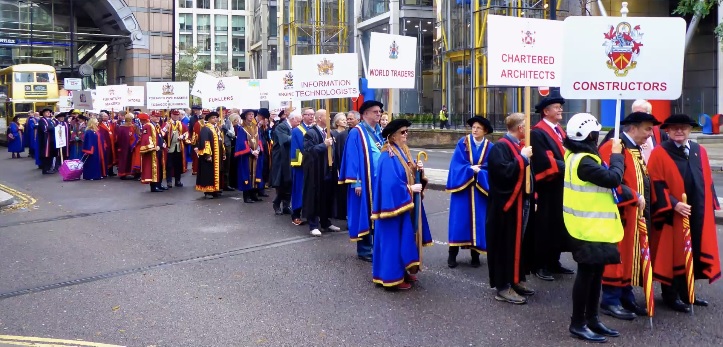
Today I attended a virtual lecture by The Heraldry Society – Arms of the City of London and its Livery Companies. The content was much as said on the tin. Obviously there wasn’t time to laboriously describe each company’s achievement in detail, but a broad overview was given of the city’s municipal and corporate heraldry with a few favourites picked out for closer inspection.

The meeting, as with so many these days, took place over Zoom. I found the arrangements less than satisfactory: We were emailed the link at 2pm, with the lecture itself running from 6pm to 7pm. Household and family distractions were hard to navigate. There was no function to pause or rewind, and the video was not recorded. The email told us:

Several persons have asked us if we are going to record the lecture. The answer to that is, we are sorry to report, a no. The Heraldry Society’s Council has discussed the implications of recording lectures at considerable length, evaluated all the pros and cons and taken an very well informed and conscious decision not to record lectures. This decision is unlikely to change as the topic has been thoroughly discussed and explored from all angles. The drawbacks outweigh the advantages at present.

That said, the Society has a plan to bring more content to the digital realm, so keep and eye open (and and ear tuned in) for news in the coming months.

Last month the society held a lecture on English Tudor Heraldic Glass in Philadelphia, which I missed completely due to these sub-optimal arrangements. Next month is one on Heraldry in the Battle of Barnett 1471 which I could well also end up missing depending on what circumstances prevail by then.

There were other problems – for the first couple of minutes there was no sound as the audio was not linked properly. Then someone drew a squiggle on the screen using the annotation function, which stayed there for nearly half of the lecture and was the subject of several digressions before the host figured out how to remove it. The chat section repeatedly flashed and popped up in an irritating manner.

The entire experience contrasts unfavourably with that provided by the Royal Armouries in their virtual lectures this summer. These were done on Microsoft Teams, a platform which proved far smoother and more versatile at least so far as concerned this format. As I have lamented before, heralds and heraldists are not prone to making their material easily available – presumably because they would then have no means of garnering funds – and so even in these times will go to lengths to keep access restricted by using conference calls and other semi-private environments instead of uploading the lecture to a video-sharing platform. Admittedly Lyon has made some moves this way in recent months but overall the picture in this regard is bleak.

Heraldry in Upstart Crow

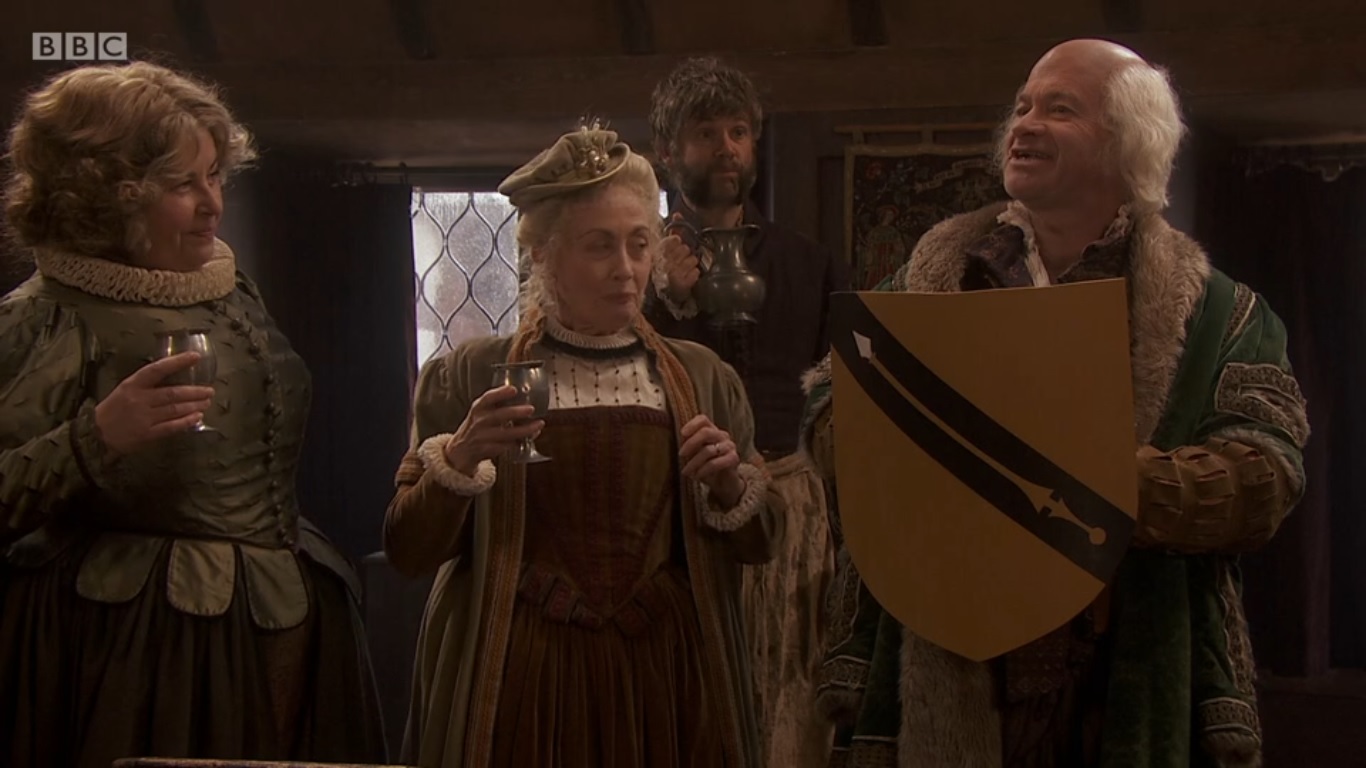
Ben Elton’s BBC sitcom Upstart Crow, covering the life of William Shakespeare (David Mitchell), contains some interesting heraldic treasures. A subplot of the series involves the playwright’s attempt to elevate himself to the gentry with the acquisition of a grant of arms. Robert Greene (Mark Heap), Master of the Revels, seeks to deny him this, viewing the Shakespeares as of insufficiently high birth.

Success comes in the third season, Elizabeth I allegedly having been so impressed by Shakespeare’s latest play that she decreed “Only the son of a gentleman could have writ such wit!” and thus elevated the bard’s father accordingly.

There are other armorial treats, though also causes for confusion: At the theatre where Shakespeare and his troupe are seen rehearsing, there is a large cloth of the royal arms at the time – quarterly France & England – hanging in the background. There appear to be multiple versions of this prop used. On some occasions the arms are depicted in the correct tinctures, on others the field colours are swapped so that the fleur de lis are on gules and the lions on azure. There are other curiosities in that same set, for on either side are other shields which also get swapped out at various points. On the right, in seasons 1 and 2, is a shield resembling that of the Dauphin of France, though again with the background tinctures changed, while those appearing on the left are not those I can identify.

The Queen herself (Emma Thompson) appears at Hampton Court Palace in the 2017 special A Christmas Crow. Behind her is a large, colourful relief of the modern-day royal arms, showing quarterings for Scotland and Ireland but not for France, and featuring a unicorn argent as the sinister supporter. These elements would not be brought together until the union of the crowns, which of course occurred at Elizabeth’s death. The specific iteration shown in this episode, with the motto scroll floating in the air, would belong to the reigns of Victoria, Edward VII, George V, Edward VIII and George VI.

NOTABLE CLIPS

FURTHER READING

The Arms of the Universities

Almost a year ago I embarked on a draft Wikipedia page listing the armorial ensigns of Britain’s many higher education institutions. I spent about a month on it before moving onto other projects, returning only a few months later to keep up a token level of activity so that the draft wouldn’t be deleted. In March, having decided that I had done enough by myself, I left guidelines on the talk page for other contributors and then stood back. Three days ago, without much ceremony, I discovered that another editor had taken up the mantle and, after further enlarging the page’s content, launched it into mainspace.

Unlike those of humans, arms of institutions are not recorded in Burke’s and Debrett’s. Luckily for us, the great heraldic scholar Arthur Charles Fox-Davies recorded the arms of a great many universities (and other organisations) in The Book of Public Arms in 1915. Of course, a lot of new universities have come into being since then, and I do not know of any similar book – or at least none in the public domain – published in the present millennium. I did, however, find a smattering of more recent arms on Heraldry of the World, a private Wiki set up solely to record impersonal heraldry, although that site’s own sources are unfortunately not listed. Many establishments have details about their armorial achievements on their own websites, though the level of precision is far from consistent.

The ancient universities and their constituent colleges often assumed arms in a time before heraldry was regulated, and subsequently had them recorded during the Tudor-era visitations. Later institutions matriculated from the College of Arms and the Lyon Court in the usual way. One interesting phenomenon to note is that the older institutions are mostly restricted to a mere freestanding shield, whereas the newer ones sport crests and supporters. The proliferation of such ornaments into corporate heraldry is a relatively new phenomenon, with heralds consenting to granting them only after realising that institutions would otherwise assume them anyway. Paradoxically, this means that new universities who seek grants of arms in order to approach the prestige of old ones may actually be sabotaging their own objectives by displaying them.

There was some difficulty in arranging categories, as not all universities have neccessarily always been universities – some started off as constituent colleges of others but later broke away, others evolved from more specific bodies such as teacher training colleges or medical schools. Arms could be matriculated at any stage, and possibly but not definitely carried forward through reconstitutions. Then there was the issue of how to list schools in Ireland which were part of the United Kingdom when their armorial grants were first issued.

My next list page, which I began on 10th March, is for the arms of who have held the office of Lord High Chancellors of Great Britain. Hopefully it won’t take a whole year to get that one approved.

UPDATE (August 2021)

Edward Teather, a Medium blogger, has written a graphic design critique of British academic heraldry.

A Shield For Wilbert

Wilbert Awdry, so far is I know, was not armigerous. As a belated part of The Railway Series‘s anniversary celebrations, I have toyed with the medieval practice of heraldic attribution.

Escutcheon: Azure two sections of railroad track between four steam whistles Or.

Crest: Issuant from a funnel Sable a cloud of smoke Argent.

Motto: I Can And I Will.

Badge: A wheel Azure surmounted by a bar Gules thereon a goat statant Argent horned Or hooved Sable holding in its mouth a top hat of the last.

A crest is included for the sake of completeness, though Awdry as a priest might have used a galero-type hat instead. Also in place is the medal of an Officer of the Order of the British Empire, to which he was appointed in 1995. The motto is based on James’s refrain when hauling a troublesome goods train up Gordon’s hill. The more familiar “Really Useful” did not quite feel appropriate for a personal motto. The badge is, of course, a parody of the “cycling lion” once used by British Rail.

I had originally hoped to include more references to Awdry’s ecclesiastical career, perhaps by taking charges from the arms of parishes he served, but what little heraldic material I could find didn’t really seem to fit. By happy coincidence I discovered afterwards that the real-life municipal crest of Barrow-in-Furness includes a ram’s head with golden horns, though of course its mouth is empty. For those wondering how to tell the difference between the two caprines, a goat’s horns tend to be short and straight while a ram’s tend to curl back.

Since the previous post compared Awdry’s world to that of J. R. R. Tolkien, it is worth taking a brief look at him here, too. While Tolkien designed a lot of heraldic devices for the cultures of Middle Earth, his own armigerous status is uncertain. This article is the only one I can find going into detail.

FURTHER READING

http://www.northernvicar.co.uk/2018/10/26/upwell-norfolk-st-peter/

UPDATES

July 2020

The franchise itself, both in print and on television, features a smattering of characters who would grace the pages of Burke and Debrett. Among them is Robert Norramby, Earl of Sodor, manager of Ulfstead Castle. The man himself is an invention of the television series – introduced in the 2013 special King of the Railway – but his family and their seat were established in The Island of Sodor: Its People, History and Railways in 1987.

sodor_achievementThe Earl’s coat of arms is seen a few times on parts of his home, as well as on the cab of his private engine Millie.

My best guess for the blazon of the shield would be Azure a pale Argent over all issuant from the base a representation of the guard house of Ulfstead Castle Proper atop each of the two turrets a flagstaff erect flying therefrom to the sinister a pennant Or. The supporters are much easier – on either side a lion rampant Or. The absence of a crest or motto is intriguing, as is the use of what resembles a colourfully-jewelled Eastern crown instead of the standard coronet of an Earl.

The Duke of Boxford often sports a vaugely-heraldic image on the left breast of his suit jacket, though the detail is too poor for me to blazon it properly. Curiously the Hatt baronets themselves are never indicated to be armigerous.


February 2021
In wandering around the wider WordPress community I have found two blog posts discussing Awdry’s clerical career. St Edmund’s Church in Emneth, Norfolk has a stained glass window dedicated to him. Instead of a coat of arms (and on a feminine lozenge instead of a shield) is an image of Thomas in steam. Elsworth church in Cambridgeshire (the inspiration for the fictional Wellsworth) has Thomas embroidered into the stole, where heraldic emblems have occasionally appeared.

August 2021
Rev Wilbert Awdry (Elsworth Stole)
Series 13 episode 1 of Great Canal Journeys has Gyles Brandreth and Sheila Hancock visiting Emneth and meeting Veronica Awdry. It’s a nice piece, although some of the images shown on screen don’t quite match the dialogue.

September 2021

This Unlucky Tug video on Skarloey sang the praises of Luke Ryan of the Talyllyn Railway, saying “he pretty often posts interesting facts and tidbits from Awdry’s notes none of us knew before”, and shown on screen at that point is a quartet of heraldic sketches for places on the Island of Sodor, accompanied by written blazons. I have not yet found the particular video in which those were featured, but hopefully you can.

October 2021

Another plaque has been placed on the wall of St Nicholas’s Church in Kings Norton.

June 2023

Max Davies (aka Terrier55Stepney), has made a video about another stained-glass window in the parish church of Rodborough, Gloucestershire.

My New Gallery

It has been a few years since I started making heraldic illustrations for Wikimedia Commons. My earliest, according to what the file page says, was that of William Pitt the Younger, uploaded on 11th September 2016. By 8th August 2017 I had made twenty-two, and decided it would be useful to collate them on a subpage. I originally formatted them as a fairly simple two-column table showing each image with a short description next to it. New images collected slowly and intermittently for a year after that, but a sudden growth spurt occured in the latter half of August 2018 when more than eighty new files were added following my discovery of Cracroft’s Peerage. As 2019 dawned I had counted two hundred and forty images in total.

Having found copies of Burke’s and Debrett’s in the university library and the internet archive I was able to expand the collection at a steady pace. In the last few months I noticed that the list had grown very long and was difficult to navigate effectively. This week, therefore, I decided to move them into a gallery format, with files sorted by type rather than by date.

It took several hours to move each individual image from the old page to the new and add the appropriate captions. The principal advantage of the new gallery format, at least for me, is that with the images sorted into neat rows instead of one long column it is now easier to count how many there are. The total presently stands at an ominous six hundred and sixty-six, though this does not include two which the community – one for the Baroness Hale of Richmond for which I couldn’t confirm a source, and a speculative placeholder for the Duchess of Sussex which was subsequently jossed.

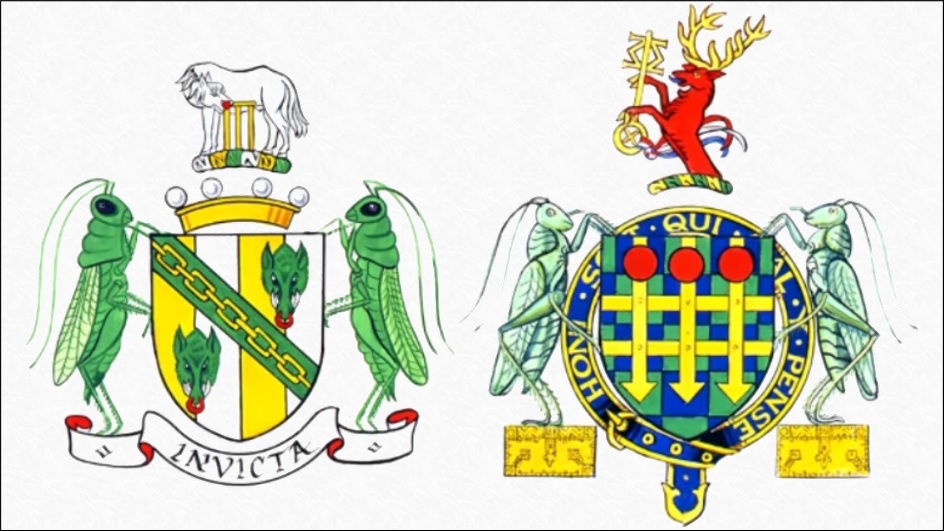
My armorial collection is still some way off the size of Sodacan’s, of course, but it’s a start.