Are You Equal To It?

Several times before now I have written of the frustration in locating up-to-date sources of heraldic information. For the last few years the latest edition of Debrett’s Peerage I could access was from the year 2000 and the latest of Burke’s was from 2003.

Earlier this week I found Debrett’s Peerage 2019 advertised on Amazon. Unusually it had the “Look Inside” feature enabled. Ordinarily this preview only allows one to read the first chapter, with some barely even getting through the title and contents pages. This one, however, had hundreds of pages included. That made it all the more annoying that so many of the early pages were spent on essays, anecdotes, company history, biographies of the royal family and explanations of the peerage system itself (the latter two generally not changing much from one edition to the next). For some time I feared that the preview would end before it actually got to the part for which I was looking. Thankfully that did not occur, and I got as far as Chorley before the page went blank. I was able to harvest previously-unknown blazons for more than a dozen recent-ish life peers and a few hereditaries as well. For those whose titles come later in the alphabet I had to think of alternative strategies.

The Baroness Hale of Richmond is one whose blazon I have sought for many years. Her arms, or rather the motto that goes with them, has been elevated to fame in certain media circles, particularly after her prorogation ruling. Despite this, the newspapers almost and press releases never actually showed a picture of her arms nor quoted any part of the blazon. As with Michael Martin, it leads me to wonder if none of the journalists have actually seen it either and they’re all just copying each other. When I spoke to her ladyship over Teams two weeks ago I considered asking her outright to find her letters patent and hold them up to the camera, but ultimately opted for a more lecture-relevant question instead. In fact I had seen her arms before, in August 2018 when someone on a forum somewhere (I cannot find it again) linked to a photograph of her lozenge, showing two scrolls in saltire between four towers in cross. Unfortunately the picture included no contextual clues to its authenticity, so when I recreated that image and it added to her Wikipedia page it was swiftly removed for lack of evidence. On the day of the prorogation ruling the heraldry subreddit discussed her arms using my image as their reference. From that thread one user (account since deleted) posted a link to a different illustration which included the motto and supporters (presumably a photograph of the letters patent), but which still omitted the blazon and any other contextual details so was no more useful for encyclopedic purposes. Still, it gave me an idea:

Google Books is variable in what it shows you – a book out of copyright usually has its full text available, but one still protected may show you only a small sample, the exact extent of which is at the discretion of the owner. A lot of books have a generous preview, others yield nothing at all. Debrett’s Peerage 2015 and 2019 were of the latter sort, but 2008 and 2011 allowed the “snippet view”, where if you search the text for a certain word or phrase it will bring up screenshots of those terms with maybe a couple of lines above and below. In Hale’s case I was fortunate to already know what I wanted to find and, upon typing “two frogs” into the small search bar, found it. I was amused to see that Debrett’s had translated the motto Omnia Feminae Aequeissimae as “Everything to the Most Just Woman” and not “Women are equal to everything” as her fans have widely quoted.

The Lord Tebbit was a similar case. I found a few scattered references to his coat of arms including a polecat – derived from what had originally been an insulting political nickname – but no further detail or illustration. Searching for “polecat” returned the blazon for his crest, supporters and motto, then searching for bits of those eventually got me the blazon for his shield. The Lord Brittan of Spennithorne’s arms were completely unknown to me, but when I searched for him by name the snippet showed the top of his crest. I guessed it was a sheep, then searched for “crest – a sheep” and found the full details.

All in all this is quite a cumbersome process but not entirely fruitless. I hope to find more soon.

It Mitre Be Good

Bowyer (left) and Burgoin (right)

My assault on the Eventbrite buffet continues with Crosiers, and Mitres, and Tiaras, Oh My: A Gamboling Journey Through Ecclesiastical Heraldry by David Bowyer. The session was hosted by Jason Burgoin, president of the Toronto Branch of the Royal Canadian Heraldry Society.

Logging on was difficult: I had expected the meeting to begin at 7pm as listed on the advertisement but then it became apparent that this was Toronto time, so for attendees from the British Isles it would actually be taking place from midnight. The first few minutes were a little tense as the audio quality was very poor and an unknown person let out several primal-sounding screeches that left the rest of us confused. Burgoin, pleading that “We are not IT folks.” advised us that the bandwidth would be conserved and quality improved if everybody not presenting would turn off their cameras and microphones, and indeed there was some improvement. When Bowyer began his presentation he was swiftly interrupted by a notice that the screen share feature was not on.

Bowyer’s presentation eventually got moving. There were 119 PowerPoint slides, each showing an illustration of the titular ecclesiastical objects either in real life or represented in heraldry. He explained the history and symbolism of all the different kinds of hats that could be placed above a clergyman’s arms and the other embellishments that could be placed behind.

After nearly two hours the talk concluded and Burgoin resumed the screen to announce other upcoming events. He was conscious that many overseas viewers had been forced to stay up very late and was keen to answer any questions before they started logging off en masse. There was some time left over for idle chitchat, with one Englishwoman commenting that she had never used Eventbrite before signing up to this two months ago, and that it wasn’t a problem for Brits be up past midnight but she didn’t expect it to go on until 2am. I, in my first verbal interjection to any virtual conference, remarked that one of the advantages of the virtual format was the ability to attend from in bed. Lyon then told us how annoyed he was that the College of Arms in England had granted arms to Bishop Seabury of Connecticut* even though he had been consecrated in Aberdeen. He then announced that he had recently granted arms to the Principal Presbyterian Theological College. They had requested that their supporters be “one man, one woman, one white, one black, one in one academic gown, one in another academic gown” and that “when I described it in the blazon they decided it wasn’t gender-neutral enough so I had to go back and look at new language to be able to express what the students’ aspirations were for the supporters which I managed to do.” I then asked how long the blazon ended up being, expecting that the effort to account for every demographic permutation would have consumed reams of parchment. Instead he replied “Very short, I ended up just blazoning it “two human figures one wearing X one wearing Y representative of inclusion” and they can do what they like with it after that as far as I’m concerned.” and then departed saying he had to preach in the morning. I noted after he had gone that I now had an unusual claim to fame – very few can say that they spoke to Scotland’s chief herald from in bed at 2am. Another member said “We’ll just have to invite Garter to one of these.” and indeed I have often wondered when I will get to see any representatives of the English college on Zoom.

I recognised some of the names, faces and avatars from earlier conferences – such as Liam Devlin. Alexandra Fol, David G. Scott, Richard d’Apice, Brian Abel Ragen and Douglas Anderson were also among the names, though I cannot be certain that they were the ones I have linked.

There are plenty more heraldry conferences to come, as well as plenty on other topics – such as Lady Hale of Richmond discussing her 2019 prorogation judgement. All in good time.

*It wasn’t clear from context if he meant Seabury’s personal arms or the official arms of the diocese.

Documenting Scottish Armory


Last year I noted that the Lyon Court was putting out an online crash course in Scottish heraldry. A major component of this was the list of all the blazons of defunct local councils. Yesterday I decided to take this ready-made armorial and convert it into a Wikipedia page. I intended this to complement the page that already existed on English counties, begun almost sixteen years ago.

The vast majority of the arms concerned had not already been illustrated, and for that matter the municipal corporations themselves did not have biographies to the level of their English counterparts – if at all. Fortunately there is a much greater degree of standardisation among the heraldry of Scottish local government, especially the regional councils of which all but one had the same background and differed only in their central charges, and so to create and upload a large number of emblazonments to fill the gaps was a relatively rapid process. There is a long way still to go, however, especially in finding blazons for present-day institutions.

On a partly-related note, earlier today I discovered a YouTube channel dedicated to Scottish Heraldry – Abarone’s Armorial by Ethan L. MacDonald, Herald of Clan MacKinnon USA. Though I had not seen the channel before I recognised the man’s face and voice from some of the virtual heraldic conferences I have attended over the past few months. MacDonald also managed to arrange a one-on-one interview with Lyon. By and large his content is not original – much like A Royal Heraldry it mainly reiterates the information already known to anyone who has read the relevant Wikipedia pages and the images are the familiar ones from the Commons. In particular I found it a little suspicious that he put out a video on heraldry from Tolkien’s Legendarium just a few months after I initiated the article on it. Still, it is nice to see more coverage of the subject in video form, as until a few years ago there was very little, and what did exist was overwhelmingly focused on the rudiments of heraldry from the middle ages or from the perspective of fantasists and reenactors, with precious little about the modern era. That Scottish heraldry is so much more likely than English to be documented on YouTube is also a bit of a mystery.

Sentamu Returns

It was not the norm for bishops to retire. They could be translated to another – preferably more senior – diocese, but one they reached the upper ranks they would expect to serve until death*.

Change began in 1928 when the octogenarian Randall Davidson, Archbishop of Canterbury since 1903, decided to step down. He had been one of the Lords Spiritual since his appointment as Bishop of Winchester in 1895 and two days after retirement was reintroduced to the upper house among the Lords Temporal (Baron Davidson of Lambeth, of Lambeth in the County of London). His successor, Cosmo Gordon Lang, retired in 1942 and was likewise ennobled. There was a break in the new trend when William Temple died suddenly in 1944**, but after that the next six (Fisher, Ramsay, Coggan, Runcie, Carey and Williams) were granted baronies after stepping down. The Ecclesiastical Offices (Age Limit) Measure 1975 imposed an obligation for each bishop to retire upon his seventieth birthday. Justin Welby must therefore relinquish his post on 6th January 1926.

The first Archbishop of York to resign voluntarily was William Maclagan in 1908. He died two years later as a commoner. Four of the next five Archbishops were translated from that office to Canterbury, three of them being ennobled as already mentioned. The exception was Cyril Garbett (1942-1955) who died forty-seven weeks after retirement, having accepted the offer of a peerage (reportedly Baron Garbett of Tongham) but not seen the patent sealed. Later Archbishops Stuart Blanch (1975-1983), John Habgood (1983-1995) and David Hope (1995-2005) were all ennobled shortly after the ends of their tenures.

John Sentamu‘s timeline was rather more drawn out. His retirement was announced on 1st October 2018 but did not take effect until 7th June 2020. When the dual honours lists were announced on 31st July there was some consternation that he had not been included. The list released on 22nd December did include him, but it was not until 27th this April that his barony was conferred. Today, nearly a year after leaving the house he was finally introduced. I had expected him to have other former bishops as his supporters (e.g. Carey of Clifton and Chartres) but instead he chose Lady Hale of Richmond and Lord Popat.

Two things struck me about the ceremony. First was the presence of Thomas Woodcock as Garter King of Arms, which surprised me as the College of Arms also has a retirement age of seventy and his is thus five days overdue. The second was that Sentamu, along with so many other peers introduced this year and last, got a little too close to the Lord Privy Seal.

Long before the pandemic it was the norm for the front benches on either side of the chamber to be left empty during an introduction ceremony. I presume this is to reduce the risk of the robed newcomer tripping over other peers’ legs. Ministers tend to wait by the doorway at the right of the throne (leading to the Content lobby) and greet the new peer as he leaves the chamber. This I have seen taking place at a great many introduction ceremonies and I find it quite alarming that often the new member gets right up to the leader of the house’s face without either wearing a mask and in many cases they even shake hands. That nobody else apparently notices this glaring breach of COVID-safety protocol is a real headscratcher.

*There have been rare cases of bishops being deposed for political reasons.
**He was the son of Frederick Temple, Davidson’s predecessor and thus the last in the regular line of those dying incumbent.

The Arms Business

https://dailymotion.com/video/k5stMU5mFy8GWpwTZ3z?autoplay=1

Two days ago I was contacted by Charles Matthews, former Wikimedian in Residence for the Betty & Gordon Moore Library at Cambridge, saying that Karl Wilcox, developer of DrawShield, wanted volunteers to assist with the next stage. Matthews contacted me because I was, in his mind, “certainly adept with heraldry software”. It was with a heavy heart that I told him the less glamorous truth: I do all of my heraldic art on PowerPoint and Paint. He said it was still interesting to know my methods, so I put together a video of the process by which I make each piece.

For those unfamiliar, blazon is heraldry’s own language, and DrawShield is an attempt at a translator tool. The software allows you to type a blazon into a small box, for which it then generates an illustration of the shield, comprising charges drawn from a bank from Wikimedia Commons. As anyone who has had to use an online translator will know, the subtleties of even an apparently-simple phrase can be difficult to teach to a machine. Drawshield occasionally has difficulty when sentences are factorised for word economy (e.g. noting the tincture at the end of a list of multiple charges, rather than separately for each one) or when it is asked to illustrate a charge not encountered before. Syntax also tends to be a difficulty as blazons are generally written with as little punctuation as possible and attempts to break up the long run-on sentences can drastically change the meaning.

It seems, based on the snippets given to me, that Matthews and Wilcox are attempting to rectify exactly these problems, with the former showing me a list of new charges sought for inclusion. He also boasts a substantial gallery of those he has already made.

More troubling, though, is the artistic element: To depict an aesthetically-pleasing shield requires careful consideration of the relative sizes of elements within the escutcheon. Sometimes the same charge may be depicted in different ways within the same emblazonment, tapering or stretching to fit the curves of the shield. Furthermore an asymmetric charge may have a centre of gravity which is distinct from its centre of width, requiring careful spacing. These decisions are too fine and too subjective for the computer, which instead drops out coats with a lot of empty background and charges too small to properly see. The end result is often an image that is technically correct but looks subjectively cheap and inauthentic. The main advantage, of course, is speed – even my relatively crude pictures take 20-40 minutes depending on complexity while those of Sodacan or RS-Nourse must take a far longer time, but DrawShield can spit out multiple coats of arms in a minute. It would therefore be a very useful tool in filling any gaps or catching up on backlogs in instances where blazons are known but images have not yet been added. I would not, however, recommend it as a permanent solution for the arms of anyone whose page is viewed with a serious degree of regularity. Matthews says “It would be great to work on a reference collection for heraldry that was uniform.” but compared to the works that already exist I fear such uniformity would represent a levelling-down rather than up.

The Gunpowder Plotters – Gentlemen all

Earlier this evening I attended yet another virtual lecture, this time by Martin Goldstraw for the Yorkshire Heraldry Society. As the title implies, the lecture concerned the attempt by a group of Catholic conspirators on 5th November 1605 to thirty-six barrels of gunpowder beneath the Palace of Westminster while James I was performing the state opening of Parliament, then provoke a revolution which would install his daughter Elizabeth (later Queen consort of Bohemia) as a pro-papist successor to the throne.

Goldstraw spoke at length about each conspirator in turn, giving not just the blazon of each man’s armorial bearings but also background details of the lineages through which he acquired them. He had digitally illustrated a great many of their shields himself and for this was lauded by many in attendance, but confessed that there were many other artists of ability far beyond his. I tried to plug my own uploads for Wikimedia Commons though I’m not sure if anyone noticed.

After the presentation had finished there was the usual question & answer session. This included some joking about whether Bridlington (where Goldstraw’s sister lived) was part of Yorkshire or “North Humberside”, which prompted Malcolm Lobley (Honorary Treasurer) to talk about the East Yorkshire signs being put up by residents sick of the Humberside name. That the transition took place twenty-five years ago appeared to have slipped his mind.

The College of Arms usually publishes quarterly newsletters in January, April, July and October. Last year it was just January and October. When they didn’t publish an April edition this year either I asked if if this represented a permanent change, but the York Herald (Peter O’Donoghue) reassured me that the college intended to revert to normal after the COVID setbacks of passed. Now, perhaphs for the first time ever, a May edition has been released. Usually my primary interest when reading these is to find an exemplification and blazon for at least one person who has a Wikipedia page. The star in this latest edition is Sir Ciarán Devane, chief executive of the British Council since 2015. Also mentioned, though frustratingly not elaborated, were grants of arms to the Baroness Stuart of Edgbaston and Lord Justice Leveson.

The head of the college is the Garter Principal King of Arms, an office held since 1st April 2010 by Thomas Woodcock, who must retire upon his seventieth birthday tomorrow. His successor has not yet been named. The two assistant kings of arms have also retired recently, as noted in the newsletter.

EXTERNAL LINKS

Ahead of Yourself

https://upload.wikimedia.org/wikipedia/commons/thumb/0/03/George_Hayter_-_The_Marriage_of_Queen_Victoria%2C_10_February_1840_-_WGA11229.jpg/640px-George_Hayter_-_The_Marriage_of_Queen_Victoria%2C_10_February_1840_-_WGA11229.jpg

To the extent that most people have heard of heraldry at all, they conceive it as the study and management of coats of arms. Certainly that is what the majority of my posts on the topic have discussed. That is not a herald’s only concern, however, for armory tends to intersect with other interests. Genealogy, vexillology and phaleristics are the obvious ones, but also within orbit are matters of ceremony and protocol, which often centre heavily on precedence.

Orders of precedence determine the seating plans of formal dinners and the sequencing of parades or processions. Certain institutions whether public or private may have their own specific orders of precedence, and even unaffiliated civilians may be required to adopt them for their extended families at weddings and funerals. What tends to concern heralds and heraldists, though, is the general order of precedence for an entire country.

The order of precedence for England & Wales (though that distinction is a recent one) can be documented descriptively as early as 1399, but the earliest extant prescriptions are the House of Lords Precedence Act 1539 and an ordinance issued by commissioners of the office of Earl Marshal in 1595 (itself based largely on the Lord Chamberlain’s order from 1520). It arranges the royal family and the grades of the aristocracy (peers, knights, esquires, gentlemen and their offspring) as well as the holders of important government, judicial and ecclesiastical offices. The sequence reflects the relative importance of certain jobs in Tudor times and earlier, which is often rather different to the level of power they exercise today. The Lord President of the Council and the Lord Keeper of the Privy Seal – now sinecures given to the leaders of the houses of Parliament – rank just below the royal family while the secretaries of state who make up the bulk of the cabinet rank just below barons and the Chancellor of the Exchequer has a redundant setting below the privy council.

The bulk of the scale has remained intact to the present day – and been repeated at the start of each edition of Burke’s and Debrett’s, though royal warrants have been issued on occasion to make small updates, such as the insertion of new orders of chivalry or of offices not formerly recognised.

The Lord High Treasurer was once a great officer of state*, but when it was put into commission the commissioners had no precedence, even after it became convention for the First Lord of the Treasury to be the de facto head of government. Victoria’s prime ministers would frequently walk into formal gatherings behind barons of their own nomination. The job of Prime Minister was at last given formal recognition by a warrant in December 1905 placing him in the position his grandfather office would have conferred. The Speaker of the House of Commons ranked rather low until a warrant in 1919 put him just after the Lord President. Other offices have fallen away over time, such as the Vice-Regent in Spirituals, the Lord High Steward and the Lord High Constable.

As with so many such matters, the situation in Scotland is less well documented. The earliest extant prescription is Edward VII’s royal warrant from February 1905. Indeed, that may be the earliest ever such instrument, for the preamble admits “a Scale of Precedence in Scotland has not been defined with due authority” and “doubts and a diversity of practice have arisen in consequence”. The order within the royal family is much the same as for England, with the exception that the Lord High Commissioner to the General Assembly of the Church of Scotland during the sitting of the General Assembly outranks everyone except the sovereign – including the Duke of Rothesay. The office is currently held by Prince William, who thus temporarily precedes his own father. Following the nephews of the sovereign – cousins are mysteriously omitted – there is a complicated insertion explaining that the Lord Lieutenants, Lord Provosts and Sheriffs Principal rank above the Lord Chancellor within their own jurisdictions. Following the Lord Chancellor the other Scottish high officers are listed, then the ranks of the peerage and orders of chivalry in a manner near-identical to the English version. The Church of Scotland is rather different in status and structure to the Church of England so there are no bishops listed for the Scottish scale. Senators of the College of Justice are ranked similarly to High Court judges and Lords Justices of Appeal, though other senior Scottish judicial figures are ranked above the viscounts whereas their English counterparts are below barons. I note that the position for Secretaries of State is not defined in the Scottish scale either.

Small amendments have been made to the scale in subsequent years – most prominently in 1999 to clarify the positions of office-holders in the devolved administration. Even so, there are some glaring omissions:

A series of constitutional reforms in the latter noughties saw the duties of the Lord Chancellor carved up: His administrative role in the English & Welsh judiciary was devolved to the Lord Chief Justice, his executive powers to the Secretary of State and his presidency of the upper house of Parliament to the elected Lord Speaker. Plans to abolish the chancery altogether were dropped and the incumbent’s ceremonial precedence was not pushed down, but it was deemed necessary for the others to be raised up. The Lord Speaker was given precedence immediately after the Speaker of the House of Commons. It is curious that the upper house was not given ceremonial priority here, though that could be in recognition of the superior vintage of the latter office as well as the greater degree of power he has within his institution. The Lord Chief Justice had previously been placed below the Chancellor of the Duchy of Lancaster, similarly redundant as all holders in nearly three centuries had been privy councillors and/or peers. A warrant in 2007 promoted him to just below the Lord Speaker, as well as moving the Master of the Rolls (still usually commoners) to just below the barons.

The Lords of Appeal in Ordinary previously ranked solely by their necessary peerages. Upon their reconstitution as a separate Supreme Court, the justices (who from then on would not be ennobled) were placed immediately below the Master of the Rolls, while the President was placed immediately below the Lord Speaker – and thus above the Lord Chief Justice. A difficulty arises here because the Supreme Court is a UK-wide institution while the Master of the Rolls only exists in England & Wales. The precedence of non-baronial Supreme Court justices in Scotland is thus undefined – though all at least are members of the Privy Council. The President also has this problem, although it may be masked by the complexity of the incremental insertions – Scotland had its own privy council prior to the Acts of Union, with its own Lord President whose responsibilities and status were comparable to those of his English counterpart. Logically the Lord President for Great Britain (and later the United Kingdom) would continue to have the same precedence as his provincial predecessors, but the Scottish scale from 1905 makes no reference to the post. This in turn means that the Speaker of the House of Commons, the Lord Speaker and the President of the Supreme Court are all without a defined rank in Scotland. Even the Prime Minister is left without a place, since the Archbishop of York is England-only**. It is no wonder that the Scottish scale was described by one contributor in 2011 as “a bit of a mess” and by another as “complete horlicks”.

Northern Ireland is an even worse story – there is no scale properly defined, and the Wikipedia article uses an unofficial, descriptive list from Burke’s 106th edition in 1999, which tellingly says “as in England” rather frequently.

A common feature of all three is that men and women are listed separately***. The bishoprics and various public offices are exclusively listed in the male scale. There were insertions into the women’s for dames of various orders of chivalry (outranking wives of knights of the same), but subsequent warrants regarding ministers and judges do not bother to specify which list they are altering. A convention has developed among Wikipedians (and probably everyone else who has to mind these matters) that any office held by a woman is temporarily transposed to the female scale, but without authoritative guidance we cannot be certain.

Another curiosity is that the general scale is formally headed by “The Sovereign” while the ladies’ scale is headed by “The Queen”, such that a queen regnant is technically first man as well as first woman, and while a king’s wife is a queen consort a queen’s husband is nothing at all until a special warrant is issued for his benefit. While we’re on the subject of the royal family, our attention should turn to the four – soon five – grandchildren of the Prince of Wales.

It is unusual for an heir apparent to be a grandfather before his accession to the throne. George IV (as regent) almost managed it in 1817 when his daughter Princess Charlotte of Wales was pregnant but she and the baby predeceased him. Edward VII had quite a few – Lady Alexandra Duff (later Duchess of Fife) in 1891, Lady Maud Duff (later Countess of Southesk) in 1893, Prince Edward of York (later Edward VIII) in 1894, Prince Albert of York (later George VI) in 1985, Princess Mary of York (later Princess Royal), Prince Henry of York (later Duke of Gloucester) in 1900. The first two were through a daughter so don’t really count for these purposes and the latter four were still small children when Victoria died, which means it was never necessary to define their place at state functions, though their titles and styles were subject to some dispute. Prince George of Cambridge is now older than Edward VIII was at his great-grandmother’s death and could be into adulthood – or at least adolescence – by the time of the next demise of the crown. Without any specific place for them within the royal family section, Wikipedians have determined that George and his cousin Archie rank as eldest sons of dukes of the blood royal. This status is below the non-royal dukes, who in turn are below the great officers already described****. Charlotte, as the daughter of a royal duke, similarly ranks below the duchesses. This makes sense if you consider royal dukes to be an unofficial sixth extra rank of the peerage above the normal dukes. By extension one would expect Prince Louis, as younger son of a royal duke, to rank immediately below the eldest sons of normal dukes who in turn are just below the marquesses. Instead his place is just below the earls but above the eldest sons of marquesses. This placement is rather confusing as it breaks the otherwise-consistent pattern by which children of peers are stationed. I don’t think there were any royal dukes in England with children of their own in 1520 and there certainly weren’t any in 1595, so the logic behind the original decision eludes me.

EXTERNAL LINKS

*The great officers of state (Lord High whatever) in ancient times are not to be confused with the great offices of state (Prime Minister, Chancellor of the Exchequer, Home Secretary, Foreign Secretary).

**Whether any of the Church of England’s officials should have precedence in Wales is questionable after 1920.

***Bizarrely, in the Scottish warrant from 1905 these were called “The Scale of General Precedence” and “The Scale of Precedence for Ladies”. The ladies are therefore special, one logically presumes.

****One must wonder if the current Lord President of the Council has ever sought a bow from the prince – only to follow protocol, of course.

Something Flagged Up

Regular readers know by now that I am a keen heraldist and am always on the lookout for new – hopefully free – material on the subject. Indeed, I am rapidly closing in on my nine hundredth armorial illustration for Wikimedia Commons. I have not written so much about vexillology, although of course the topics frequently intersect. Earlier this week I was trawling through EventBrite to see if there were any more events coming up soon by the Heraldry Society and instead found an advertisement for the fiftieth birthday of the Flag Institute.

After the standard Zoom introduction by Chairman John Hall, President Malcolm Farrow lectured on the development of the institute itself and of British flag culture more generally over the past fifty years. “The flag institute is instrumental in slowly changing the culture of Britain from a nation which rarely flew flags, to one in which flying flags is becoming the law.” An overview was given of how local and regional flags have proliferated over the past two decades, having rarely if ever seen use before.

Andrew Rosindell MP gave a speech about his efforts to change public attitudes surrounding flags, in particular his campaign – including a personal conversation with The Queen – to have the Union Flag flown over the Victoria Tower throughout the year instead of only when Parliament was sitting. He also mentioned the recent erection of three new flagpoles in New Palace Yard.

There was also a lengthy preview of the documentary Look Away, Look Away by Patrick O’Connor about last year’s change of state flag by Mississippi. Unfortunately the video feed cut out midway through and had to be restarted after some awkward fumbling.

Later a guest asked if the “All-party” Parliamentary Group on Flags & Heraldry could really be called that when six of the ten officers were Conservatives with Labour, SNP, DUP and Crossbench contributing just one each. Rosindell reassured as that there were plenty more within the rank-and-file, but sadly it was hard to make out his words as his audio feed was suddenly plagued by feedback noise. I think he said that anything so traditionalist in nature was bound to disproportionately attract those of a conservative outlook but that there were still plenty of others who recognised the importance of flags and/or held a deep patriotism.

Here it would be prudent to make a distinction between heraldry and vexillology: A coat of arms, even when displayed on a flag, must represent a person. That could be a natural person (Betty Boothroyd, Johnny Hon, Desmond Wilcox) or a legal one (The Association of British Neurologists, Guy’s Hospital, Totnes Town Council). Flags cover a much broader remit, and can represent such abstracts as religions, ethnicities, and political ideals. Another important difference is that arms are only properly borne by their owners (though heralds can wear their masters’ arms and badges can be worn by servants or soldiers) whereas flags unless specifically restricted can be flown by anyone. It is only natural that use of flags is much more prevalent than that of arms, and also that any particular flag is a lot more likely to cause a stir than any particular escutcheon.

There is a prevalent line of thought which deems too overt an invocation of British patriotism to be distasteful and thus, in itself, anti-British. Another related line says that nations more generally are not a meaningful affiliation and that flags – along with their natural companion, anthems – are a distraction for feeble minds. Attitudes toward our national insignia are quite sharply polarised by partisan affiliation and by demographic divides. HM Government has been conspicuously campaigning over recent months for greater use of the Union Flag in both public and private, resulting in praise from some quarters and mockery from others.

It doesn’t look as if there will be any more from the Flag Institute for some time, but the Heraldry Society will be back on 14th May with Crosses and Crossings – Huguenot Heraldry. That the banner heading shows a star looking to be by Sodacan and a coat of arms by Rs-nourse is intriguing by itself.

EXTERNAL LINKS

The Badge of The Magpie

HMS Magpie, circa 1944.

I am always on the lookout for heraldry-related literature, especially if it can be read online for free. Yesterday I discovered that the county of Somerset and the former county of Middlesex have – or at least had – their own heraldry societies, and each publishes on its website a large back-catalogue of society journals – the Somerset Dragon and the Seaxe respectively.

The Seaxe‘s 34th edition (from September 2000), contains an article about the heraldic badges used by HMS Magpie, which the late Duke of Edinburgh once captained.

HMS Magpie and her Badges by Roland Symons

It has become the fashion recently for Royal Naval badges to be redrawn or even completely changed. Some have been altered for aesthetic reasons, some to reflect in status and some because the original design is now considered ‘politically incorrect’! The badge of HMS Forward for example originally consisted of a hunting cap and horn but, being the Royal Naval Reserve Establishment in Birmingham, it now carries the crest of the City of Birmingham. This may be current fashion but one change of badge design came as a result of a schoolboy’s initiative in 1952. There have been seven Magpies in the Royal Navy. The first was a re-named prize – a four-gun schooner captured at Perros in 1807. The last was a sloop of the Black Swan Class, launched in 1943. She saw active service in the Atlantic, the Arctic and off Normandy whilst in 1944 she formed part of Captain F J Walker’s Second Support Group and, along with HMS Starling, HMS Kite and HMS Wild Goose, helped in the sinking of U238 and U592 in that year. In January 1943 had been granted a badge consisting of a magpie volant proper. In September 1952 a pupil from Monkton Combe Junior School, in Bath, saw HMS Magpie at Gibraltar. The badge of the School happened to be a magpie and this appeared on the cover of the School’s magazine. And so, armed with a copy of the magazine, young Michael Swift boarded the Magpie! This contact led to links being forged between the School and the ship. The captain of the Magpie, Commander Graham Lumsden DSC, was rather taken by the design of the magpie used by the School and which had been designed by the art mistress, Miss Bulmer. He enlisted the support of a previous captain of HMS Magpie, HRH Prince Philip, in an effort to get the ship’s badge changed and in January 1953 a letter arrived at Monkton Combe Junior School stating that His Royal Highness feels that your magpie is nicer than the present ship’s badge and he has asked me to write to the Admiralty to suggest that it might be substituted for the one in existence. In May 1953 this was achieved and a new badge and a new badge was granted; this could be blazoned as white within an annulet black a magpie statant rousant proper.

Apart from the bird being turned around to face the right way, the badge was that of Monkton Combe Junior School. Sir Arthur Cochrane, however, surrounded the badge with a black annulet. An annulet is symbolic of unity and friendship, here officially linking school and ship, but it may also be derived from the ‘magpie’ found on a shooting target. Sadly, in 1956, HMS Magpie went into reserve and then to the breakers’ yard in 1959. One of Magpie’s final appearances was to ‘act’ the part of HMS Amethyst in the film The Yangste Incident – and when Amethyst moves in that film, it is in reality Magpie! As a token of her friendship with Monkton Combe Junior, the School was presented with with the ship’s bell and Division Trophies -the former is still used for the christening of children of staff members! In 1970 another chapter in the story was written when the Magpie’s badge made an appearance in the South Atlantic, this time on a postage stamp – the ascension 2s.6d. issue, being one of a series featuring Royal Naval badges. In 1988 Monkton Combe applied for a Grant of Arms and to accompany it, the Junior School asked for its badge to be registered on the same Grant. There was a moment of worry – could the School retrieve its magpie from the Royal Navy? Thanks to the efforts of Hubert Chesshyre a design was produced which satisfied all concerned. It is blazoned within an annulet embellished in chief with a fleur-de-lys Azure a magpie proper. Somewhere amid the cast-off clothing of the Prince of Wales and the Princess Royal there are two rather small sweaters featuring the new badge of their father’s old command. They were given by the School as presents in 1953! and, of course, there was the Warship Class diesel locomotive named Magpie but that is a story for the Editor to tell !

***

The Editors Tale is unfortunately all too quickly told. When the Railway Modernisation Plan of 1955 got under way the Western Region of British Railways (the old Great Western Railway) surprisingly obtained authority to pursue the development of diesel traction, based on a German technology, which was completely different from that authorised for the rest the country. As part of this development several hundred highly individual locomotives were built between between 1958 and 1963, including a batch of 71 intended for hauling express trains between London Bristol and the West of England. The WR in a characteristic gesture of defiance to the dictates then coming down from the British Railways Board gave these engines names commemorating well-known warships primarily of the World War II period. No.829 which was built at Swindon and entered service in 1960 was Magpie, the name being carried on impressive aluminium plates on either side of the locomotive. Many of these engines were also adorned with beautiful cast plaques bearing the appropriate ship’s badge but in the case of Magpie this was regrettably not to be. The arrival of the new 2,200 hp diesel-hydraulic locomotive was reported in the Monkton Combe School Magazine at the time and the School’s Railway Correspondent commented: These diesels will go on running for forty or even fifty years yet, so let’s hope that the then headmaster will acquire the name-plate or any other part of value to go with the bell of its fellow Warship! His prophecy was unfortunately to prove highly inaccurate, the bitter internal politics of British Rail eventually leading to the damning of the “Warships” on the grounds of high maintenance costs and they rapidly disappeared from the scene. Magpie fell victim to the cutter’s torch in 1972, being then just under twelve years old. The nameplates almost certainly still exist, such items nowadays commanding very high prices – but regrettably one did not find its way to Monkton Combe.

It is fascinating to have uncovered this story so soon after publishing my grandmother’s memoir relating to the ship. Unfortunately I have not found any articles about the Pelican‘s badges just yet.

FURTHER READING


The Late Duke

His Royal Highness Prince Philip of Greece & Denmark was born on 10th June 1921. He was the only son of His Royal Highness Prince Andrew of Greece & Denmark, who in turn was a younger son of His Majesty King George I of the Hellenes. Through his agnatic line he was a member of the House of Schleswig-Holstein-Sonderburg-Glücksburg, while his mother Princess Alice was from the House of Battenberg. Queen Victoria was his enatic great-great grandmother.

Philip’s titles have an interesting history, in that he was born a prince of Greece and of Denmark but later renounced these titles to obtain British citizenship. This move later turned out to be unnecessary as the Sophia Naturalization Act 1705 meant he had British citizenship already. He adopted the surname Mountbatten, which was used by his maternal uncle Louis (later Earl Mountbatten of Burma) and represented an Anglicised version of Battenberg. The subsequent controversy over whether his descendants should be the House of Windsor or Mountbatten-Windsor is a little ironic given that Philip himself was already effectively going by his mother’s maiden name rather than his father’s.

The marriage certificate says Philip Mountbatten.

New titles were bestowed rapidly in advance of his wedding: On 19th November George VI appointed him a Royal Knight of the Garter (one day after The Princess Elizabeth, to maintain her seniority) and granted him the style of Royal Highness (on British authority this time), then on 20th raised him to the peerage of the United Kingdom as Duke of Edinburgh, Earl of Merioneth and Baron Greenwich – all of which now belong to his eldest son. The lack of simultaneity between these events means that for a single day he was styled “Lieutenant His Royal Highness Sir Philip Mountbatten”. On the 21st his title was inserted into the Book of Common Prayer. He was ceremonially introduced to the House of Lords on 21st July 1948. For a while there was some controversy over whether or not he was a prince. This was resolved on 22nd February 1957 when his wife, now sovereign, made him a Prince of the United Kingdom of Great Britain & Northern Ireland, which put him level with her sons and uncles. There were some suggestions of making him “Prince Consort” like Albert or “Prince of the Commonwealth” to reflect the monarchy’s larger purview but these were ultimately turned down.

His precedence at this time is unclear, though obviously the lowest he could have ranked was as the newest ordinary duke. A royal warrant on 26th September 1952 declared his should “upon all occasions and in all Meetings except where otherwise provided by Act of Parliament have, hold and enjoy Place, Pre-eminence and Precedence next to Her Majesty”, which again followed the example set by Victoria with Albert. This technically made him second man in the land, for the monarch is always first man even when female, and is the reason he was often seen walking two paces behind his wife on formal occasions.

Heraldic banner at St Giles’s Cathedral in Edinburgh, 2010

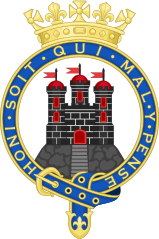
Philip’s heraldic status in his youth is not clear to me, but as a British adult he was – rather unconventionally – given two grants of arms. In 1947 his armorial achievement showed the arms of Greece surmounted by those of Denmark, which in turn were surmounted by those of his great-grandmother Alice (albeit omitting the Saxe-Coburg inescutcheon she used, which the British royals had abandoned in 1917). For reasons difficult to uncover these were deemed “unsatisfactory” so in 1949 the shield was replaced by a new quarterly version. The first quarter showed the lesser arms of the Kingdom of Denmark, the second quarter the white cross of Greece, the third the black and white stripes of Battenberg and the fourth a castle on a rock for Edinburgh. That last part is especially unusual as peers’ shields do not normally incorporate the municipal insignia of their nominal territories. These arms were of course rendered as a rectangular flag (confusingly called a royal standard, even though “standard” refers to a very different style of flag) and a square banner above his Garter stall at Windsor. In composing this article I also discovered that he had a badge, showing the castle surmounted by a princely coronet and encircled by the Garter, though I do not recall ever seeing it in use. Livery colours are not so prominent in modern times, and those of the royal family no longer change with the dynasty. Philip had his own personal livery of “Edinburgh Green”, used for his personal cars and the uniforms of his staff.

New badge illustration, published mere minutes ago.

Sodacan has of course illustrated all of these for Wikimedia Commons, and already I have spotted several instances of his illustrations being used in television coverage of his death as well as in reports online.

EXTERNAL LINKS