Who am I to Judge?

This has been a busy week for state ceremony, yet you wouldn’t know it from the news.

Friday 1st October was the beginning of the legal year 2021-22 in England & Wales, marked by the procession of hundreds of judges in their full dress uniform to a special service at Westminster Abbey. This included readings by the Lord Chancellor and the Lord Chief Justice, as well as a sermon by the preacher of Lincoln’s Inn.

The legal year in Scotland began on Monday 27th September. It featured similar events at the Court of Session and St Giles’s Cathedral. The Lyon Court was one of the bodies involved and a number of new officers of arms had their inaugurations.

On Saturday 2nd October the sixth devolved Scottish Parliament had its ceremonial opening, though of course it has been sitting and legislating since May.  The Queen visited the chamber, accompanied by the Duke & Duchess of Rothesay and Edinburgh. Many heralds were in attendance carrying with them the crown of James V.

It is a little disappointing that these events were so ill-publicised, even accounting for the distraction of party conferences and fuel queues. Rather than major newspapers I have mostly had to piece together details of all three ceremonies from the websites and social media accounts of the people involved.

Curiously this is not consistent across time – footage of judges’ processions from a few years ago can be found on YouTube, and some from many decades back are archived by British Pathé.

EXTERNAL LINKS

Judges at Westminster Abbey

Heralds at the Court of Session

The Scottish Parliament

Discerning Dukes

This afternoon I missed a turnoff on the way to my second COVID vaccination. While navigating back to where I should have been I discovered Church Street where there was a pub called the Duke of York. This struck me because the pub’s sign showed an illustration of the duke’s coat of arms which I instantly recognised as Sodacan’s illustration from Wikimedia Commons. Unfortunately I wasn’t in a position to stop and take a photograph and what I can find in the pub’s own galleries or on Google Street View isn’t very clear, so I cannot work out which particular duke is being honoured here.

The Prince Andrew, Duke of York since 1986, uses the royal arms of the United Kingdom differenced by a label of three points Argent, the centre bearing an anchor Azure. This same cadency label was also used by his grandfather George VI from 1920 to 1936, and by his father George V from 1892 to 1901. It plainly cannot be George V represented here since his arms as Duke of York included the inescutcheon of Saxony. The main identifier, therefore, is the harp of Ireland – versions made during the present reign use a plain harp, while those issued in earlier reigns show a woman’s head and chest carved into the side. I think that this pub sign shows the modern version but the image resolution is too low to be sure.

A Grand Total

It is not entirely easy to count how many heraldic illustrations I have made for Wikimedia Commons over the years. Do I count badges separately from shields? Do I include achievements I’ve made twice? What about ones that have been deleted?

When I finished updating my gallery at the end of July the shields and lozenges collectively numbered nine-hundred and sixty-six. Over the course of August I have illustrated at least another thirty-four.

My official one thousandth coat of arms is that of the Barons Darebury, a relatively short and low-profile line of peers whose distinctions include High Sheriff of Cheshire and Chairman of Aintree Racecourse.

Having cleared this benchmark, I move onto the next project. Last year I unveiled my armorial of universities in the United Kingdom. This year I have made a similar list for the universities in Canada. This one has so far progressed much more rapidly, as Canadian heraldry is very easily searchable in the Public Register of Arms, Flags and Badges, in contrast to British heraldry which often involves a great deal of searching around for clues. The register had blazons for fifty-four fully-fledged universities, as well as twenty-nine subsidiary colleges or faculties and four related voluntary bodies.

The items in this list are organised by province, though they are not evenly spread – forty of the eighty-seven institutions are in Ontario, with the University of Toronto alone having fifteen distinct grants. Newfoundland & Labrador and Prince Edward Island, by contrast, boast only one each. Another strange trend is that Canada’s heralds seem to have been inordinately fond of sealing their letters patent on the fifteenth and twentieth days of the month.

I am struck by one major problem – although I have quickly compiled many dozens of blazons I can find illustrations for only two of them. On the actual pages of these institutions one can frequently find an image of the coat of arms copied directly from either the register or the university’s own website, claimed under fair use. Such a justification does not fly on pages such as the one I am making, so I will have to call on the aid of all Wikimedia’s great armorial artists to fill the gaps.

Thanks to my Supporters

Early this morning I made another virtual visit to the Toronto Branch of the Royal Heraldry Society of Canada.This time the speaker was D’Arcy Boulton, Emeritus Professor of History & Medieval Studies at the University of Notre Dame, and the topic was The Development of the Forms and Uses of Supporters by the Peers of England to 1580, as shown in the Earliest Armorials of the Peerage.

The session opened with a fair amount of technological fumbling. Eventually Boulton got his slideshow going and warned us that we would be seeing a lot of manuscripts, which would be identified by collection numbers instead of by names.

We were shown a rapid succession of medieval and Tudor armorials. That by Gelre (1370-1395) was the first to display crests, followed by Shirley’s roll (c. 1450) which still mainly restricted them to foreign kings. Supporters, Boulton said, played a very small role below the level of princes prior to the late sixteenth century. There were many attempts in that era to produce books which contained a full account of the arms of the English peerage, though each omitted at least a few peers for whatever reason. It was further observed that during this time specialised helmets and coronets for peers began appearing in the records. An interesting phenomenon is the solidification of supporters as indicating noble rank, for until the seventeenth century they were not formally restricted to peers and garter knights but examples of usage by lesser knights and gentlemen were still rare.

Later in his talk, our guest discussed some statistics about peers’ supporters. Among seventy-four distinct achievements found by the middle of Charles I’s reign, he found that twenty-four used identical pairs and fifty used non-identical, making one hundred and twenty-four distinct supporters in total. Different peers used the same supporter only if they were agnates of the same lineage or co-heirs of a split peerage. He also identified four fundamental types of supporter: Human, wholly natural beast (eighteen species), semi-natural beast (three species) and imaginary beast or monster (thirteen species). He saw that human supporters were much less popular among English peers of the time than among their Scottish and continental contemporaries.

At the end of the lecture there was time for questions. I asked if he knew anything about the emergence of supporters in corporate heraldry (as opposed to the personal heraldry he had so far covered). He said that corporations began to acquire supporters at a relatively early stage, including all of the greater livery companies of the City of London.

It is often the case that the discussion after the lecture is as blog-worthy as the event proper. On this occasion most of the conversation – punctuated with some very long silences – was between Darrel Kennedy and Sean in New Zealand, the latter showing off his newborn son Arthur. This was the first time I had known anyone bring a baby to a Zoom conference. He joked about being able to blazon infants’ clothes – Argent semé of Blue Whales Proper.

Charles Veale asked if a grant had yet been made to Mary Simon, the new Governor-General. Kennedy said that nothing was yet known but “it’s coming eventually”. I asked about the process behind the heraldic badge granted some months ago to Canada’s Supreme Court. Kennedy said it had started some years ago under Claire Bodreau. He said there seemed to be a fad for every court to have its own arms. I relayed the story of our own Supreme Court’s logo, whose launch in 2009 had met with some public dismay.

Sean then wondered aloud how the supporters of post-1958 life peers differed from those of the pre-modern hereditaries. I recounted my anecdotal experience of nearly-1000 Wikimedia heraldic illustrations that the proportion of peers seeking arms at all is much lower now. I also noted that from about 1800 onwards human supporters appeared more frequently – and are a pain to illustrate. I speculated that life peers might be more disposed to them as non-hereditary supporters could afford to be more personalised. He asked if, in the age of identity politics, human supporters could prove inordinately troublesome. I concurred that there were various heraldic elements – such as Saracen heads, savages and cartoonish African garments – that could be liable to spark outrage among certain circles, and that undoing the damage would be very difficult as coats of arms are not supposed to be redesigned in the manner of corporate logos. Sean recalled speaking to a herald about the design of the old coat of arms of Toronto. There were some First Nations individuals who even volunteered to model for the drawing of the supporters, but wanted to be depicted in Armani suits with mobile phones. I brought up the precedent from the Victorian era that inclusion of modern technology in heraldic achievements tends not to date well. There seemed to be a consensus among the group that one was better off sticking to abstract animal figures.
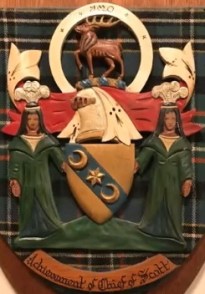
Moira Scott then asked if any remaining participants could identify the supporters on her clan chief’s arms, but we were none-the-wiser and could make no more profound an observation than that the dark brown women were probably not from Scotland. She noted the resemblance of the feathers to those of the Prince of Wales and wondered if she could incorporate something similar into her own arms without incurring his wrath.

After 01:50 the conversation had reached the point where we were talking about our domestic pets and Arthur’s “deposit”, and it became clear that the session needed to adjourn.

As a coda, I will return to the Sudrian realm. We are not far from the official US debut of All Engines Go and already some Spanish editions have been released. The general reaction from those who have seen them is that they are nowhere near as bad as implied by the trailers and leaked test footage, but still fall short of being good as art in their own right or a worthy successor to the franchise’s legacy.

In aid of that latter goal, I looked for armorial opportunities. Already I have invented arms for the Thin Clergyman himself and illustrated those of the Norrambys, but institutional heraldry has not been covered before. Its People, History and Railways gives two examples of heraldry: The badge of the Sodor regiment is actually blazoned Sable two gloves Argent saltirewise charged in fess with the Rose of Lancaster Proper. The shield of arms of Suddery – the capital city – is not truly blazoned but described as “St Luoc arrayed as a bishop standing in a coracle and holding his crozier” with the motto “Luoc Sodoris Lux”,  St Luoc being a legendary Irish missionary of the fifth century. I have illustrated the regimental badge for Wikipedia but the city arms are impossible without knowing the tinctures, or indeed what Luoc looked like.

The island as a whole is not said to have any armorial bearings nor a civic flag. The latter was invented by the television series, roughly blazonable as Azure a fess Argent fimbriated Or, though it could equally be Tenné.

Another School of Thought

Having already concocted an armorial of Britain’s universities, this year I moved onto the schools. The article at present is at least in a releasable state, although obviously it is not complete, and possibly never can be. There are, of course, far more primary and secondary schools in the United Kingdom than there are places of higher education, and probably a much lower proportion of them have acquired (whether by grant or assumption) armorial bearings. A major difficulty is working out what actually counts as a coat of arms, as many schools have logos designed in the traditional shape of a shield but with contents not blazonable, or not conforming to heraldic rules (e.g. faux quartering, overlapping charges, too much writing).

Geographic representation has also been a problem – I found way more shields for schools in England than in Scotland, Wales and Northern Ireland combined even accounting for population difference, so eventually had to split that country into its own page.

UPDATE (June 2022)

My illustration of the shield of Bangor Grammar School in Northern Ireland was featured on the Heraldry Subreddit. It was reviewed positively, at least compared to the other images in the same post, though it was primarily commenting on the design rather than my graphical skill.

Arms and the Woman

The heraldic achievements of the Baronesses Hornsby-Smith (left) and Miller of Hendon (right)

This evening I returned to the Yorkshire Heraldry Society for a virtual lecture by Duncan Sutherland, detailing the arms which were sought and borne by Britain’s female parliamentarians since 1958. This is far from the first time that he has made this presentation – in 2019 he performed it in person at the Palace of Westminster. Today, however, was my first time to witness it, thanks to the virtual format.

The majority of these cases were baronesses for life, but there were some others, including the posthumous grant of arms that was made to the late Jo Cox for display in the chamber of the Commons.

In other news, yesterday Ruth Davidson finally took her seat in the Lords, with the title Baroness Davidson of Lundin Links, of Lundin Links in the County of Fife. Also yesterday I made a disappointing excursion to Hull Central Library: some months ago I found in their online catalogue a copy of Debrett’s Peerage 2015 – a much more recent edition than the ones in the university’s library – but of course as the libraries were still under semi-lockdown conditions I could not actually go there to access it. Once the restrictions were lifted I went there hoping to scoop up hundreds of new(er) blazons only to discover that, while the ground floor of the library was open again, the reference section on the first floor was closed for a refurbishment and the staff had no idea when it would open again. Blast!

UPDATE (September 2021)

The Heraldry Society has updated the publication section of its website. Sutherland’s presentation can be read as a PDF.

Two Newcomers

The Lord Stevens of Birmingham was introduced to the upper house at noon today, having been ennobled yesterday.

This is the first introduction ceremony since Sentamu’s, and the first to feature David Vines White, who succeeded Sir Thomas Woodcock as Garter Principal King of Arms last Thursday.

Even though she left the Scottish Parliament two months ago, we are still waiting for Ruth Davidson’s peerage to be Gazetted.

On Ladies’ Garters

Dr Andrew Gray

Just a day after York’s presentation, I attended yet another heraldic zoom lecture, this time by Dr Andrew Gray for the Heraldry Society, concerning Ladies of the Order of the Garter. I made a post about this topic two years ago and advertised it in the chat box. Unusually the host actually drew attention to it, and my site traffic is already seeing an uptick.

The lecture began with the special statute enacted by the newly-ascendant Edward VII in 1901 to appoint his wife Alexandra to the order, followed by a similar instrument in 1910 for Queen Mary. Gray noted that this was unusual at the time but not unprecedented. In 1358, just ten years into the order’s creation, Edward III made Philippa of Hainault a lady of it. Gray mentions that the early gentlemen of the Garter had ladies in their company on ceremonial occasions, though their status – and even identity – is vague. In the period of 1358-1495 Gray identified seventy-four Ladies of the Garter in the records, most of whom were wives of the knights and/or members of the royal family. He notes that there were probably a lot more but the necessary records are missing. The ladies received robes, and wore the garter itself on the upper arm (whereas the men wore it on the leg).

There then followed an examination of the ladies appointed in that time, their arms, and their relation to the contemporary monarchs. One of those highlighted was Jacquetta, Countess Rivers, whom Gray noted had been made famous by Philippa Gregory. She was allegedly descended from the water goddess Melusine and gifted psychic powers, which the present monarch has presumably inherited.

The appointments of ladies of the order ended in 1495 with Margaret, Countess of Richmond and mother of Henry VII. Over the next few centuries there were five female sovereigns of the Garter but no female appointees until the sudden spurt in the twentieth century. There was also some discussion of the issues I raised in my aforementioned 2019 post regarding female crests and helms.

While I enjoyed the presentation it still left me a little confused – I don’t recall learning any explanation as to why the installation of ladies was discontinued in the sixteenth century, nor the precise distinction between plain “Lady” and “Lady Companion”. Still, at least I got to flog the blog rather effectively this time.

The society’s lecture series is taking a break now, and will return on 24th September.

The College of Arms in the Eighteenth Century

The early decades of the eighteenth century saw the College of Arms at its lowest point in its history, when its relevance and even its survival seemed to be in doubt. Very few grants of Arms were being made, heraldic regulation was increasingly ineffective, and the practices of its Officers were in decline. Appointments were sometimes made for the wrong reasons, so that Officers might not be there for their heraldic or genealogical skills. Could the century see a revival of the fortunes of this ancient institution? Could it find new venues for its activities, new areas of expertise, and new sources of revenue? Could heraldry adapt to the changing fashions and aesthetics of the Enlightenment and Romanticism? This talk will seek to examine and answer these questions.

So said the online invitation. Today’s virtual heraldic lecture was given by Peter O’Donoghue, York Herald since 2012. As the title implies, the lecture covered the ups and downs of life and work at the college from 1701 to 1800. As this one, unusually, has been uploaded to YouTube, I do not think it necessary in this instance to type out a long account.

Are You Equal To It?

Several times before now I have written of the frustration in locating up-to-date sources of heraldic information. For the last few years the latest edition of Debrett’s Peerage I could access was from the year 2000 and the latest of Burke’s was from 2003.

Earlier this week I found Debrett’s Peerage 2019 advertised on Amazon. Unusually it had the “Look Inside” feature enabled. Ordinarily this preview only allows one to read the first chapter, with some barely even getting through the title and contents pages. This one, however, had hundreds of pages included. That made it all the more annoying that so many of the early pages were spent on essays, anecdotes, company history, biographies of the royal family and explanations of the peerage system itself (the latter two generally not changing much from one edition to the next). For some time I feared that the preview would end before it actually got to the part for which I was looking. Thankfully that did not occur, and I got as far as Chorley before the page went blank. I was able to harvest previously-unknown blazons for more than a dozen recent-ish life peers and a few hereditaries as well. For those whose titles come later in the alphabet I had to think of alternative strategies.

The Baroness Hale of Richmond is one whose blazon I have sought for many years. Her arms, or rather the motto that goes with them, has been elevated to fame in certain media circles, particularly after her prorogation ruling. Despite this, the newspapers almost and press releases never actually showed a picture of her arms nor quoted any part of the blazon. As with Michael Martin, it leads me to wonder if none of the journalists have actually seen it either and they’re all just copying each other. When I spoke to her ladyship over Teams two weeks ago I considered asking her outright to find her letters patent and hold them up to the camera, but ultimately opted for a more lecture-relevant question instead. In fact I had seen her arms before, in August 2018 when someone on a forum somewhere (I cannot find it again) linked to a photograph of her lozenge, showing two scrolls in saltire between four towers in cross. Unfortunately the picture included no contextual clues to its authenticity, so when I recreated that image and it added to her Wikipedia page it was swiftly removed for lack of evidence. On the day of the prorogation ruling the heraldry subreddit discussed her arms using my image as their reference. From that thread one user (account since deleted) posted a link to a different illustration which included the motto and supporters (presumably a photograph of the letters patent), but which still omitted the blazon and any other contextual details so was no more useful for encyclopedic purposes. Still, it gave me an idea:

Google Books is variable in what it shows you – a book out of copyright usually has its full text available, but one still protected may show you only a small sample, the exact extent of which is at the discretion of the owner. A lot of books have a generous preview, others yield nothing at all. Debrett’s Peerage 2015 and 2019 were of the latter sort, but 2008 and 2011 allowed the “snippet view”, where if you search the text for a certain word or phrase it will bring up screenshots of those terms with maybe a couple of lines above and below. In Hale’s case I was fortunate to already know what I wanted to find and, upon typing “two frogs” into the small search bar, found it. I was amused to see that Debrett’s had translated the motto Omnia Feminae Aequeissimae as “Everything to the Most Just Woman” and not “Women are equal to everything” as her fans have widely quoted.

The Lord Tebbit was a similar case. I found a few scattered references to his coat of arms including a polecat – derived from what had originally been an insulting political nickname – but no further detail or illustration. Searching for “polecat” returned the blazon for his crest, supporters and motto, then searching for bits of those eventually got me the blazon for his shield. The Lord Brittan of Spennithorne’s arms were completely unknown to me, but when I searched for him by name the snippet showed the top of his crest. I guessed it was a sheep, then searched for “crest – a sheep” and found the full details.

All in all this is quite a cumbersome process but not entirely fruitless. I hope to find more soon.