Warwick the Kingmaker by John Reid

Today I attended another virtual meeting of the Richard III Society Gloucester Branch. The presentation was by John Reid, discussing the historical reputation of Richard’s father-in-law Richard Neville, 16th Earl of Warwick, popularly nicknamed “The Kingmaker”.

Warwick has been hugely divisive to contemporaries as well as historians, Ricardians, Lancastrians and Yorkists. He was England’s greatest celebrity of the fifteenth century and his fame (or infamy) carried on into the twentieth). He even had a board game named after him.

He became the premier earl in England in 1449 due to lucky deaths. His family were great winners in the lottery of aristocratic marriages – picking up the estates of the Beauchamps and Despensers. His patchwork of armorial quartering reflects the complexity of his family connections. He had initially supported Henry VI, but changed sides in 1452 largely due to his inheritance disputes with the Duke of Somerset.

Henry VI, due in part to inherited mental health troubles, proved spectacularly incompetent, and many considered Richard, Duke of York to be king by right – though Reid showed us York’s signature on the letters patent of 1454 appointing Henry’s son Edward of Lancaster as Prince of Wales, clearly showing that even at this late stage he was not disputing the latter’s right. When eventually he rebelled against the Lancastrian crown he had Warwick’s invaluable support. York’s son Edward, Earl of March rescued Warwick from Margaret of Anjou and Warwick in turn arranged his coronation as Edward IV. For the first three years of Edward’s reign Warwick was thought “third king”, being virtual governor of the realm, acquiring even more land (after he confiscated the estates of the Percy and Clifford families, he wound up with lordships in twenty-eight English counties and a handful in Wales) and an annual income of at least £10,000 (nearly £11m in 2021 money).

Matters of matrimony spoiled his status: Warwick had spent months lobbying for a French princess to marry his king, and was humiliated by the revelation that Edward had already married – in secret – to Elizabeth Woodville, a dowager dame whose family had fought for the Lancastrian side. He described the parvenu Woodvilles as “grasping and charmless”, resenting how many titles, offices and marriages were given to them at the expense of his own dynasty, and how their influence over the crown came to displace his. Reid drew parallels with the modern-day rivalry between Carrie Symonds and Dominic Cummings.

Warwick’s first coup against Edward occurred in the summer of 1469. He launched his second in 1471, making a deal with Margaret of Anjou on 22 July and reinstating Henry VI on 3 October. He was killed at the Battle of Barnet on 14 April 1471. Reid noted that this was the only time he had fought on foot rather than horseback, leaving him with no easy way to escape when the tide turned against him and he was isolated from his allies on the field. This was very similar to the way Richard III would die fourteen years later.

The earl was adept at his own spin so contemporary sources are often too kind to him. Later writers were often too harsh. In particular Burgundian writers made him a bogeyman, believing that his policies would lead to their absorption by France. He had something of a rehabilitation under the Tudors – Henry VII wanted Henry VI to be declared a saint.

In summing up, Reid discussed Warwick’s virtues and vices. He was confident, charismatic, charming, courageous and energetic. He was treated shabbily by Edward IV after 1464. He may have been the model for Sir Lancelot as envisioned by Sir Thomas Mallory. On the other hand he can be seen as seeking power only for himself and being motivated by personal feuds rather than the national interest. His military skill is doubted, as is his necessity in the Yorkist accession. Could Edward IV have made himself king without Warwick’s help? Were the Woodvilles any worse than the Nevilles?

After the presentation itself had concluded and most attendees had logged out, there was a lengthy discussion between one attendee (Sean O’Neill) and the host (Cynthia) over the intricacies of Zoom functions – because various buttons were appearing and disappearing depending on the settings of individual hosts and updates by the company. This led to an explanation of the difficulties of an organisation managing virtual meetings, then one into internet difficulties generally as well as experiences of coronavirus. I mentioned having tested positive in November, and my experience with Hubbnet. I remarked that I would have been truly screwed had the pandemic hit in the period of 2009-13 when my house relied on plugabble WiFi dongles for very limited internet access. The two were surprised to realise that I lived near Hull, the former having once lived in North Ferriby and the latter in Hessle. They started asking me if Kingston Telecoms or Kingston Communications still existed (they do).

A Thistly Issue

I have written before about the intricacies of the Order of the Garter. Although it technically has only one grade (in contrast to the Bath which has three, or the British Empire which has five), there are many finely differentiated categories of membership. It is traditionally said that the order is limited to twenty-four knights companion at a time, but of course the reigning monarch himself is always the sovereign of the order (and all others), so really it was twenty-five. Then the Princes of Wales had automatic membership, so it was twenty-six. On top of that, George III in 1786 created the separate status of “royal knight”, so that his unusually large brood of sons could be installed without crowding out everybody else. In 1813 a further category of “stranger knight” was instituted so as to allow the appointment of supernumerary foreign members.

The position of female members is even more complicated. From the time of Richard II it was common to appoint ladies of the order, though even after many years I am still unsure as to their exact status and function. The last such lady appointed was Margaret Beaufort, Henry VII’s mother, in 1488. After that the installation of women to the order was discontinued completely, and for the next four hundred years the only women to wear the Garter robes were the queens regnant. After Victoria’s passing her son Edward VII, her grandson George V and her great-grandson George VI each installed their consorts as royal ladies by special statute. The Princess Elizabeth was also made a royal lady in 1947 and the stranger category came to include foreign female monarchs. From 1987 the statues were altered to allow non-royal women to be Ladies Companion of the order on the same basis as the non-royal men, the first example being the Duchess of Norfolk in 1990.

Wikipedia’s list of members for the order took pains to colour-code and differentiate between the different categories of membership. Curiously, while the modern ladies from Queen Alexandra onwards were all included, the medieval ladies were omitted. Long ago there had been a separate smaller page listing them, but it had been deleted on the recommendation to merge with the larger list. For unknown reasons that merger was never actually carried out, so that the medieval ladies were simply forgotten.

Yesterday, with the aid of one other editor, I worked to correct that problem. The sixty-four Garter ladies of the fourteenth and fifteenth centuries are now included in the table with their own colour code and numbering. For completeness, I have also added entries for those monarchs who were not already members of the order prior to accession.

Having finished that task, I then wondered if the page for the Order of the Thistle – Scotland’s Garter equivalent – would need a similar refurbishment. The list page I found was of a very different table design to that used for the Garter, or indeed the other chivalric orders, bearing sharp black borders around cells and being organised by century instead of by monarch. It took just over a day to completely convert the content to the more usual format. On the one hand, the Thistle has fewer categories than the Garter – sixteen knights brethren and supernumerary extra knights. On the other, the list did not differentiate one type of member from the other in the way that the Garter’s did, so in many cases guesswork was required and it is likely that the whole numbering system will need to be redone at some point to account for any I’ve missed.

While going through this, I received a notice that I had been granted access to the Wikipedia Library. This was intriguing, for it was an innocuous, easy-to-miss announcement of what turned out to be quite an important perk of being an editor. According to a video I found from last summer, the library has actually been around for about a decade, but until recently there was no systematic effort to advertise it, and so the vast majority of eligible members (including me) had no clue it existed. Having only discovered the resource today I cannot yet report on how useful it will be, but it looks promising so far.

It’s not all good news – for a long time I have been vexed by the positioning of “Sir” and “Dame” in the infoboxes of such subjects as are entitled to them. I prefer them to be in the name field, rather than among the honorific prefixes. Previously this appeared to be the consensus among the editors who frequented the articles of knighted politicians and civil servants, though not necessarily those of actors and musicians, with only a small number of persistent miscreants persisting otherwise. A fortnight ago this was discussed and my contribution was sought. It appeared that my stance was going to win out, but when the matter went to vote my supporters were rarely to be seen. We’re doomed to ugly box-headers for the forseable future, one supposes.

Guts for Garters

For the last few Decembers I have eagerly awaited the release of the new year honours list. Normally they arrive a few days before the actual new year, but this time around they came with barely an hour to spare.

There were, as to be expected, a great many awards given on ministerial advice for those involved in fighting COVID, but at the very top were three new appointments made at Her Majesty’s personal discretion to the Order of the Garter: Camilla, Duchess of Cornwall, her daughter-in-law; Valerie, Baroness Amos, former Lord President of Her Privy Council; and Tony Blair, her former Prime Minister.

While sons (and in modern times also daughters) of the reigning monarch are appointed to the order routinely it is rare for royals by marriage. The only examples in the past two hundred years are of those married to the sovereigns themselves – Albert two months in advance of his wedding, Alexandra, Mary and Elizabeth shortly after their husbands’ accessions. Camilla and the late Prince Philip are the only consorts to receive the garter while their spouses were not yet on the throne. I wonder if she shall use the same stall that he did?

Amos is a former leader of the House of Lords (like Lord Salisbury, and indeed others of that title before him). She also served a brief term as High Commissioner to Australia and an even briefer one as International Development Secretary.

Tony Blair appointed Amos to most of those offices. It used to be the norm for former Prime Ministers to join the order, up to and including John Major in 2005 it became rare to see party politicians appointed. It was long assumed that Blair had declined any honours if indeed he was ever offered them, whether that was due to his personal distaste for them (he portrayed himself as a moderniser rather than a traditionalist, and was often observed to behave more like a US President than a British minister), or potential public backlash over controversies stemming from his premiership. What has persuaded him to accept the award now, fifteen years on, is not yet known.

These are the first appointments to the order since 2019. There were no Garter Day ceremonies in 2020 or 2021 due to the pandemic. This year is set to be Elizabeth II’s Platinum Jubilee, so one presumes that the Firm will be keen to make up for lost time.

Today’s news will have interesting ramifications heraldry-wise: Camilla has of course been openly armigerous since 2005, and Sodacan has already updated his graphic of her arms to include the Garter circlet. Amos has been a peeress all my life, and typically appears early on in the pages of Burke’s and Debrett’s, but has never been shown with any armorial design. She may therefore receive a brand new grant in the coming months. Blair is especially confusing, though he is joining an English order of chivalry, he may be Scottish for heraldic purposes and so it would be Lyon not Garter arranging his grant.

SEE ALSO

Hard to Track Down

Following Gordon Casely’s talk on the subject two months ago, I have pursued the topic further with the creation of another Wikipedia armorial.

As with the Middle-earth one, I notified both the relevant WikiProject groups beforehand. Nobody in the heraldry group responded, as per usual. The UK railways group took a lot more interest, though so far none have directly contributed to the article. One controversy was how to name the article – at present it is called ”Armorial of railways in Great Britain” as I have decided the island of Ireland should be a separate article to reflect its railways having always been a separate administration, though this does leave some ambiguity over how to classify the railway heraldry of the smaller islands. It may expand to ”Armorial of railways in the British Isles” at a later date.

The other controversy, of course, was over what to count as heraldry. As Casely’s lecture pointed out – and as many in the latter talk page reminded me – most railway armory in the UK is entirely bogus in terms of legal authority and trite in terms of artistic merit. This leads to some difficulties in how to cite the various insignia being catalogued, since few will appear in the works of Burke, Debrett or Fox-Davies, though the latter’s Book of Public Arms still proved very useful in blazoning the civic arms which railway emblems so frequently appropriated. Most of the illustrations are not by me, nor by other heraldic artists, but photographs of emblems as they appear on the sides of old locomotives, stock and stations or scans from very old books (William Weaver Tomlinson’s The North Eastern Railway; its rise and development being especially handy). A good handful of the company seals found are easy enough to recognise in terms of blazonry (such as the York, Berwick & Newcastle Railway, which just had the shields of those towns in a triangle formation) but others (such as Hull & Selby) have no armorial pretensions at all and look more suited to the Soviet Union.

The list is still far from complete at present, and it will be difficult by nature to judge when completeness has been achieved, but I hope this has at least got the fire started – and allowed at least one of the Sudrian shields to get a viewing.

In further heraldry news, the Lyon Court recently opened a YouTube channel, and the second uploaded video is of the installation of new heralds at the Court of Session that I covered some time ago.

State Occasions

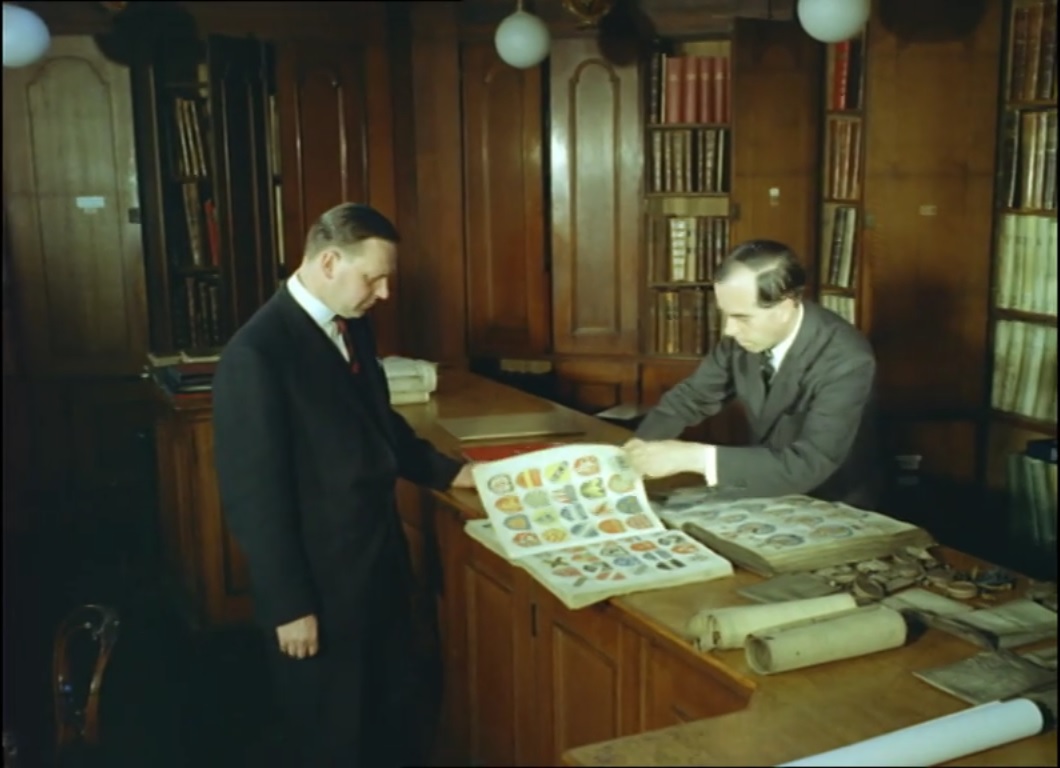
The York Herald’s Twitter feed recently led me to discover the 1960 short documentary series Look at Life, episode 7 of which is State Occasions. It follows the then-Earl Marshal (Bernard, 16th Duke of Norfolk) around the State Opening of Parliament and the Garter Day procession, as well as giving a tour inside the college of arms.

The narrator gives a concise but comprehensive overview of the college’s work and of heraldry as an artform, with ample footage of officers and artists going about their business as well as detailed closeups of the fruits of their labour.

It’s well worth a look.

Railway Heraldry with Gordon Casely

Casely with the Scotsman, 10th April 1966

Today I virtually attended the Alan Watson Memorial Lecture by the Heraldry Society of Scotland, focusing on the coats of arms of Britain’s railway companies since Victorian times.

Before the presentation proper, Edward Mallinson gave a speech commemorating Alan Watson himself – a heraldist, philatelist and trainspotter who died last year.

Gordon Casely added to the tributes, then began his lecture. He noted that the society had never covered railway heraldry in its lectures before, and insisted that “to sample the pleasures of such heraldry, one doesn’t need to be a railway enthusiast, far less a loco-spotter, number-bagger, rivet-counter, or even an anorak. Casely himself had been a railway journalist in the 1960s, and in later decades a campaigner for higher quality rail services in Scotland.

He prefaced his historical tour was a health warning – railway heraldry is an absolute mess, almost all being borrowed, bogus or thieved. He also said that much of it amounts to heraldry we don’t really deserve – badges, totems, insignia, emblems, motifs or devices, rather than coats of arms. As to why this had occurred, he suggested that Victorian-era Lyons and Garters had both “missed their trains” when it came to “the heraldic iron horse”. He said that he had examined over two hundred sets of heraldic devices used by railways in Britain, and could count on his fingers the real coats of arms. Still, railway heraldry was always interesting and entertaining.

His first example was a plaque at Edinburgh Waverley station commemorating Sir Nigel Gresley. The coat of arms above the text is that of the London & North Eastern Railway (real and legal, unusually), rather than Gresley’s own.

In the next slide, I am sad to say that our speaker made an error. He showed my illustration of the arms of the Gooch baronets of Benacre Hall, although he attributed them to Sir Daniel Gooch, 1st Baronet of Clewer Park and Chairman of the Great Western Railway. He compared these to the arms to those displayed on the stall plate of Major John Gooch in the chapter room of the Order of St John, and thought it curious that the latter’s arms contained railway references (a wheel in centre chief and on the crest) while the former’s did not. Having checked in Burke’s, I can say that the arms of Sir Daniel and his successors do contain those elements, and that Casely was simply using the wrong image.

The vast majority of railway arms showed a shield within a strap and buckle. Within the Scottish clan system, such an arrangement marks that one is a junior member of the group rather than the chief, and thus the captains of industry were making themselves look like mere corporals. Of the five major railways in Scotland circa 1920, four used a buckle around their main emblem while the Caledonian Railway simply copied the pre-1603 royal arms of Scotland. Scottish railways in modern times are no better. Casely recalled writing to the chief executive of the Great North Eastern Railway in 1996 suggesting arms be adopted. What resulted was, in Casely’s words, “a real fruit salad”, featuring two oval shields within a strap and generic Scottish floral emblems crammed between. Particularly bad was the logo of the English, Welsh & Scottish Railway, which instead of the unicorn represented Scotland with a stag more appropriate to Northern Ireland. A case study was made of the Deltics (“a proper locomotive”, Mallinson interjected). An earlier plan was for this class to be called Heralds, with individual vehicles named after specific heralds (i.e. Albany, Rothesay, Ross, Orkney, Marchmont and Stirling, plus Glasgow).

Moving down to England, the Great Western Railway used the “entirely bogus” emblem simply placing the arms and crests of London and Bristol side by side, even though the line ended at Paddington and never penetrated the square mile. The Lancashire & Yorkshire Railway borrowed the shields of the two county towns, while an early emblem for the Hull & Barnsley Railway used an ermine pavillion based on those employed (incorrectly even then) by peers of the realm. Casely was particularly contemptuous of the Cornwall railway, whose seal used the shield of the Duchy, ensigned it with the heir apparent’s feathers, and shoved some industrial tools behind it. A smorgasboard of other railway emblems was shown, most following the trend of simply stealing the civic arms of their connected towns or badges of the royal family.

At last some “real” heraldry was featured – the Great Central Railway matriculated from the College in 1898, making it likely the first railway in Britain with legal heraldry, and used them on just about everything.

Arms were adopted for British Rail following nationalistation in 1948, technically those of the British Transport Commission. The crest alone was used on a roundel on the sides of many trains. Two versions of this were used – with the lion facing either dexter or sinister depending on which side of the train you stood. Allegedly Garter Bellew went apoplectic upon realising this. The famous cycling lion was similarly reversible.

Casely also mentioned that a handful of lines never used any kind of emblem – such as the North Sunderland Railway which he personally visited in 1951. His conclusion was that though railways have long used a large selection of emblems, badges and other quasi-heraldic insignia, the majority of it would not be heraldry as we know it. He wondered if heraldists had “some work to do” in convincing modern rail companies to seek legal grants of arms.

This was, by the speaker’s assertion, the society’s first in-person lecture for eighteen months. A hybrid system was in place, with an uncertain number of people sitting in the lecture hall and two dozen (including myself) attending virtually. What annoyed me about this setup was that all of the virtual attendees had been forcibly muted and the chatbox was disabled. Members physically present were invited to ask questions at the end of the presentation, but we had no ability to interact. This was a deep disappointment as I was keen to advertise the island armory post that I published a week ago. The only function I found still working was the “raise hand” button, which I and one other attendee used, but I never got to see if this was acknowledged by the hosts as while Mallinson was advertising an upcoming lecture my internet connection failed. By the time I got it working again the meeting had concluded and the session had closed.

FURTHER READING

Islanders’ Arms

Ever since the seventy-fifth anniversary of The Railway Series last May, I have been looking to bridge my interest in that franchise with my hobby as a heraldist. I had long known that the thin clergyman had invented coats of arms for many characters and institutions within his fictional world, but it was difficult to actually find them.

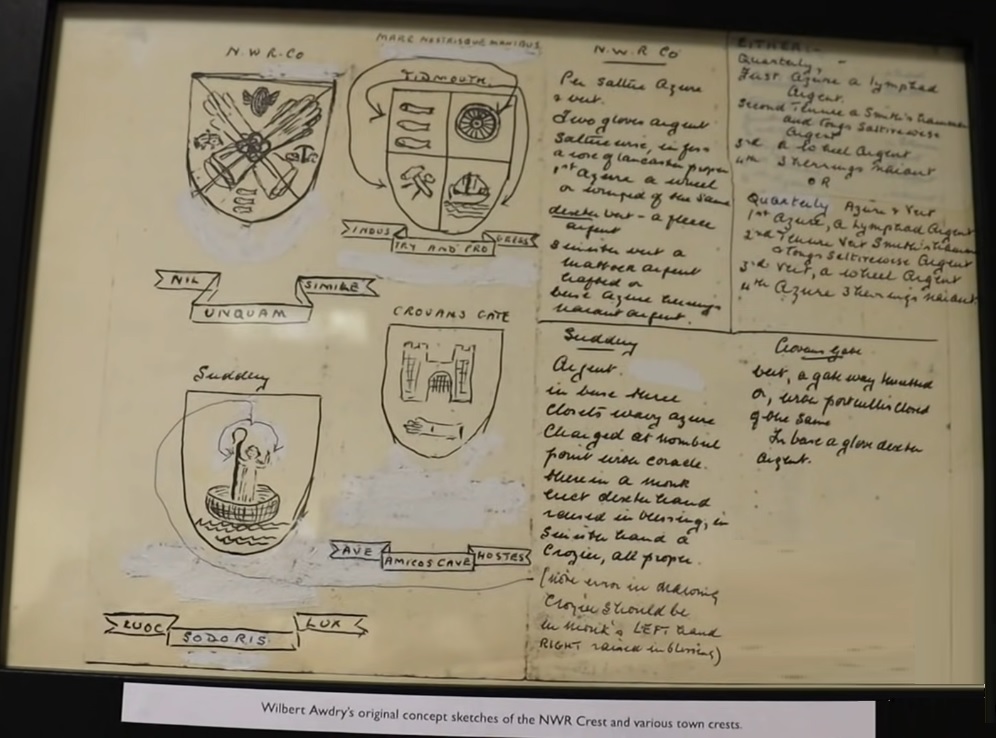
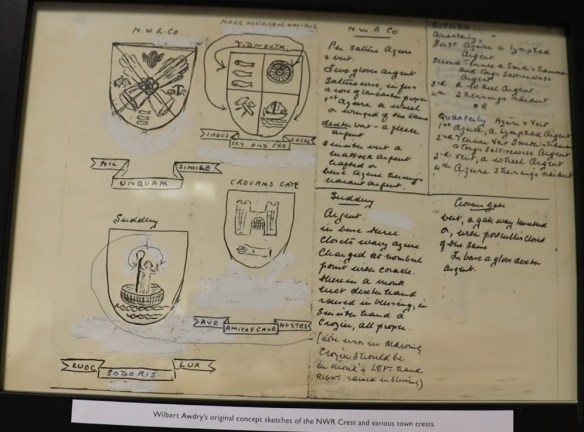
Of especial importance was a video by Max Davies, better known as Terrier55Stepney, documenting one of many visits that he and other tankies have made to the Talyllyn Railway. This particular video is valuable because at fifteen minutes and ten seconds in it shows a front-on close-up shot of an old sheet of paper on which Awdry had sketched and blazoned four different fictional coats of arms. I had glimpsed this before but never in quite enough clarity to make out the details. Even in this version the handwriting is not always legible. Luckily I found a handful of old posts on the Sodor Island Forums where other fans had also attempted to decipher the text. I have now illustrated all four shields there depicted and uploaded the results to Wikimedia Commons, though whether I shall be able to use them on any Wikipedia articles following last year’s purge is debatable.

CROVAN’S GATE

Escutcheon: Vert a gateway kernelled Or with portcullis closed of the same. In base a glove dexter Argent.

Motto: Ave Amicos Cave Hostes (Welcome Friends, Beware Enemies)

The symbolism here is fairly obvious – the gate is a literal interpretation of the proverbial “gate” (the narrow pass in the hills between eastern and central Sodor) at which King Godred Crovan held the Normans at bay in 1089, while the glove is one of his famous white leather gauntlets.

SUDDERY


Escutcheon: Argent in base three closets wavy Azure charged at the nombril point with a coracle therein a monk erect dexter hand raised in blessing in sinister hand a crozier all Proper.

Motto: Luoc Sodoris Lux (Luoc, the Light of Sodor)

This was the hardest to do and the least visually-satisfying at the end. The arms are pictorial heraldry, showing the legendary arrival of Saint Luoc on the island in the fifth century. There is a discrepancy between sources here – the above blazon refers to simply “a monk” but The Island of Sodor: Its People, History and Railways twice asserts that the arms have him “arrayed as a bishop”, the latter reference specifying “in cope and mitre”. I have said before that human figures usually don’t work well in heraldry, and this is no exception. Awdry does not describe Luoc’s appearance nor his liturgical vestements, so I took a drawing of St Vallier and changed the colours to give a more Anglo-Irish aesthetic, with the mitre using the blue and green shown on the other coats of arms here.

TIDMOUTH
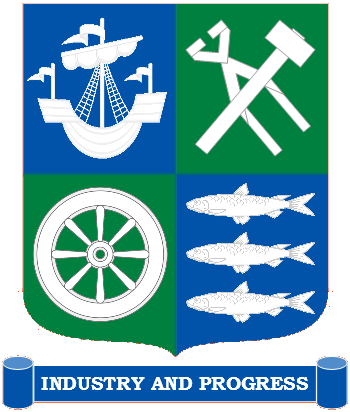
Escutcheon: Quarterly Azure and Vert 1st a lymphad 2nd a Smith’s hammer & tongs saltirewise 3rd a wheel 4th three herrings naiant all Argent.

Motto: Industry and Progress

There is some obvious faux-quartering here, though at least the colour scheme works. The first and fourth quarters refer to the towns history of fishing and later ship-building while the second and third refer to the other industries based there – possibly including the big train station.

THE NORTH WESTERN RAILWAY

Escutcheon: Per saltire Azure and Vert two gloves Argent saltirewise in fess a rose of Lancaster Proper in chief Azure a wheel or winged of same dexter Vert a fleece Argent sinister Vert a mattock Argent hafted Or in base Azure three herrings naiant Argent.

Motto: Nil Unquam Simile (There’s Nothing Quite Like It)

The gloves are here again, though I have elongated and narrowed them to fit the saltire. The herrings also make a reappearance. The winged wheel has a long history in heraldry and has appeared in the arms of a few real-life transport companies. The fleece and mattock presumably represent agriculture and industry, both of which are serviced by the railway but do not have any more specific importance. The rose refers to Sodor’s attachment to the Duchy of Lancaster, though of course its symbolism as such is very much a modern affectation.

While we are here, let us recap the other heraldic images I have mentioned here before:

THE SODOR REGIMENT

Escutcheon: Sable two gloves Argent saltirewise, charged in fess with the Rose of Lancaster Proper.

The blazon is given in the book (described as the regiment’s “colours”), though I wasn’t sure which shape to use for the field. The significance of the red rose and the white gloves has already been explained. The military is not covered much in the franchise so there is little detail to give here.

THE EARL OF SODOR
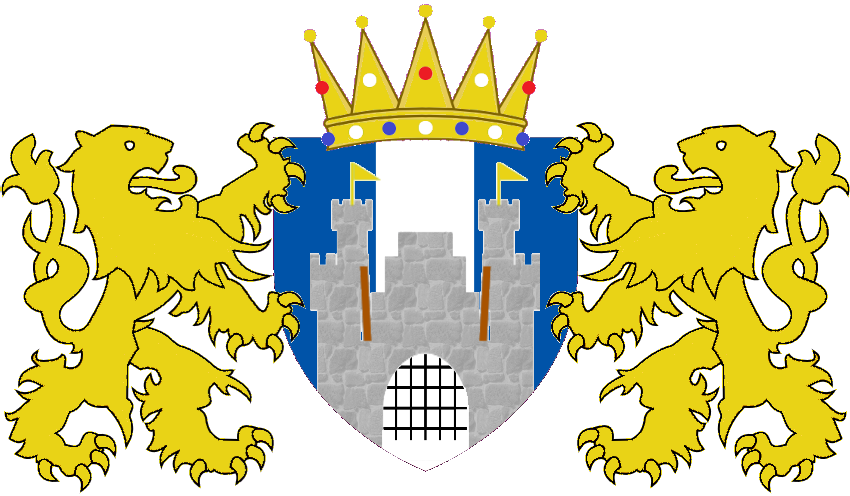
The Norramby line is mentioned in the book but nothing is said of them armorially. When the earl appears in the 2013 special “King of the Railway” his shield is Azure a pale Argent bearing a representation of Ulfstead Castle, with a jewelled Eastern crown on top and two lions rampant Or as supporters.

Taken as a whole, the Sudrian arms are a mixed bag – just as in real life. The time of matriculation for any of these devices is not specified, though we can guess from both content and context – the North Western Railway was formed in 1915 so its arms cannot be older unless inherited from one of the predecessor companies (earliest 1853). It looks a little too busy, as do those of many real railway companies from the time. The regimental badge, featuring the red rose, is probably from no earlier than Victoria’s reign. The faux-quartering on Tidmouth’s shield suggests a much more modern adoption, most likely by assumption in the mid-twentieth century. The shield of Crovan’s Gate is simple enough that it could be medieval. I am not sure about Suddery as I do not know how far back precedent can be found for the depiction of humanoid religious icons in heraldry.

I notice that blue and white seem to be the most persistent (though of course not universal) colours in the island’s civic and corporate heraldry as well as in the flag. This could be the diagetic reason for the majority of the main characters on the North Western Railway being painted blue. It would also fit the historical connections made in the source material, as blue and white were the livery colours of both the House of Lancaster and the Lordship of Ireland.

UPDATE (1st November)

I have just discovered the website Railway Mania, dedicated to building and running model trains. A subsidiary project is Sodor Histories, an attempt at re-imagining Awdry’s island in as much detail and as realistic a manner as possible. It’s well worth a look for the truly dedicated railfan.

UPDATE (June 2022)

Looking again at Burke’s General Armory, I have found two entries (on page 467) for the surname Hatt:

  • Hatt (co. Berks, Orsett, co. Essex, and London) escutcheon Quarterly Argent and Gules on a bend Sable three chaplets Or crest A falcon’s head quarterly Argent and Gules between two wings expanded Sable.
  • Hatt, or Hatte escutcheon Argent a chevron Sable between three annulets Azure.

Of course neither of these is necessarily linked to the Fat Controller. The only thing ‘People, History & Railways says about his origins is that he was apprenticed in Swindon – which is in Wiltshire, one county to the west from Berkshire, two from London and three from Essex.

UPDATE (October 2025)

This post has been referenced by Tumblr user Whumpster Fire, who has used my illustration of the regimental colours to make some alternative designs for a Sudrian flag.

Matters of the Harp

Heraldists and historians will know that there have long been two versions of the British royal arms. Prior to the death of Elizabeth I the arms of England had been three yellow lions passant guardant on a red background, while those of Scotland had been one red lion rampant on a yellow background. When James VI of Scotland ascended to the English he quartered the arms of both countries to indicate their personal union, albeit varying the precedence so that each kingdom had its own arms in both the first and fourth quarters with the other’s confined to the second. This duality continued even after the 1707 union into Great Britain, although the “English” version is the standard one used internationally, with the Scottish version being purely for internal purposes. Though the first, second and fourth quarters of the shield have chopped and changed much over the centuries, the third quarter of both shields has consistently been Azure a harp Or stringed Argent. This represented the Kingdom of Ireland since its creation in 1542, though its usage in other capacities can be traced back much further. Prior to 1603 Ireland was not referenced in the English royal arms. What is a little perplexing to those interested in this subject is that neither James nor his successors ever created a distinct Irish arrangement of the shield as he had English and Scottish ones. Instead it seems that Ireland (both before and after the 1801 union) used either the same arrangement as in England or the harp alone.

One might have expected some other curious heraldist to have come up with such illustrations by now – for the interpolation is fairly simple – but I could not find any, so set about performing the thought experiment myself. After a few hours of cutting and splicing Sodacan’s familiar pictures I had produced Irish arrangements not just of the royal arms in their present state, but for every other variation that has occurred since the union of the crowns.

There were some aesthetic challenges here, the most prominent of which is that the harp in the fourth quarter has to be significantly smaller than that in the first to fit the curve of the shield, though that would be alleviated if the instrument would face right rather than left (as in the Guiness logo). It also produces some interesting colour combinations – especially in the 1714 version where the impalement of England & Scotland lines up perfectly with that of Brunswick & Lüneburg.

Readers will note that I have only made shields here, not full achievements. That is largely because I was unsure what the other elements would be. While the crowns, supporters, mottos and crests for England and Scotland solidified long before their personal union and have been consistent ever since despite numerous changes to the shield, those of Ireland are much less clear. A crest was designed for James I (A tower triple towered Or from the portal a hart springing Argent attired and unguled also Or) but it was not much used, and neither supporters nor motto were granted at all. Occasionally depictions can be found which copy those pieces from the English achievement, but this is the result of artistic fancy rather than official sanction. I would hesitate to put the Order of St Patrick around the shield, since it was only instituted in 1783 and became dormant in 1974, never achieving the same prominence as the Garter or Thistle nor appearing much in heraldic art. Certainly the present Republic of Ireland uses the shield alone and the achievement of the government of Northern Ireland from 1924-1972 is of sufficiently different appearance and origin to be ruled out as any indication of what to use here.

On a different note, the YouTube channel Terrier55Stepney recently put out a video documenting another visit to the Talyllyn Railway. Fifteen minutes in the camera points at a framed page of drawings and blazons for Sudrian heraldic devices. I mentioned this before but this time I could see the whole page (though the legibility of the handwriting remains a difficulty). I hope to have illustrated at least some of them fairly soon.

More Heraldry on Screen

In the last few weeks I have discovered the old ITV series Crown Court, which simulated high criminal trials in the fictional town of Fulchester. It debuted in October 1972, just 292 days after the establishment of the real Crown Court in England & Wales took effect.

The series ran for over eleven years, and the set underwent multiple refurbishments. In the earliest episodes the courtroom was furnished in plain wood panel, but by the end of the seventies this had been replaced with darker wood in more ornate carvings. In 1982 what looked like a sheet of marble was placed behind the judges chair and the tables were lined with copious red padding.

Freak Out

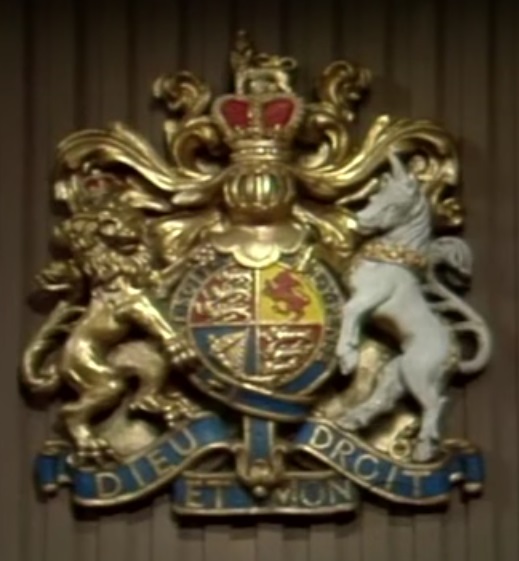
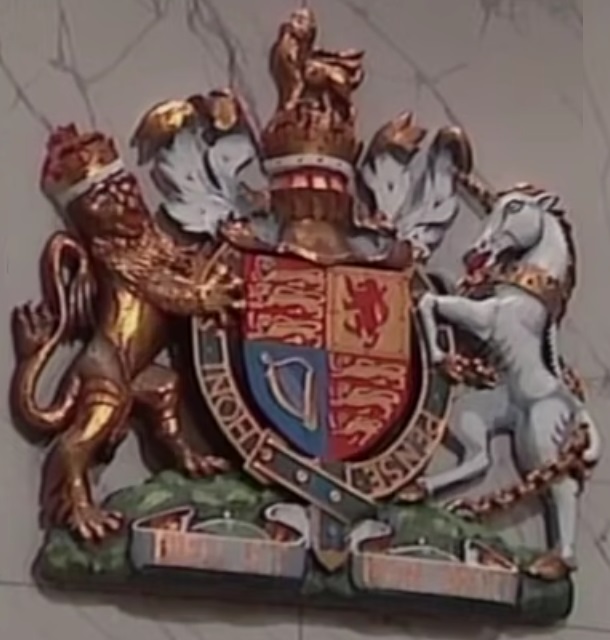
The focus of this post is on the depiction of the royal arms behind the judge. In the pilot episode Doctor’s Neglect? it is rarely focused on, and looks to be a grey cutout, little detail of which is discernible at such low resolution. For much of the early seasons a fully-coloured relief is used, and the camera often focuses on it at the beginning and end of a story. The depiction is a curious hybrid of the greater and lesser versions of the achievement, for it has the escutcheon fully enclosed by the Garter circlet as in the latter but also shows the helm and crest as in the former. The motto “DIEU ET MON DROIT” is shown on a blue ribbon below the shield. Otherwise the only real errors that I can make out are the absence of the double tressure from the Scottish quarter and the mantling being Or instead of Ermine, though that could be considered an artistic choice. Possibly the unicorn is missing its chain, but that could be a trick of the light.

Cat in Hell

In Cat in Hell (1978), a bizarre mistake can be seen – everything else about the achievement looks the same (including the missing tressure) but the scroll is now golden and bears the motto “NEMO ME IMPUNE LACESSIT” normally only seen on the Scottish version. Why this would be used in an English courtroom is not explained. By 1979’s Question of Care the original scroll has been restored.

Leonora

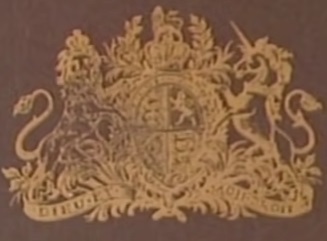
Leonora (1981) is even more confusing – the familiar relief is still used as the background for the credits, but looking behind the judge during the episode proper one can see an entirely different design on the wall – the shield sticking out of the circlet and a green compartment beneath the supporters. Then, during the transition cards before the commercial breaks, a third variant is shown – a golden drawing upon a brown backdrop. This one is very intricate in style, similar to those used in the Georgian and Victorian eras.

Ignorance in the Field

By Ignorance in the Field (1982) the fuller variant is being shown up close. This depiction is unambiguously the greater version, with Ermine mantling, the tressure in place and the unicorn’s chain clearly visible. The tinctures are very bold on this one, almost giving it an 8-bit appearance. The crowns are rather angular in design, and seem to be based on the Tudor crown instead of St Edward’s. The motto is in gold letters on a pale blue scroll, which makes it a bit hard to read.

The Jolly Swagmen

On some episodes a completely different shield can be glimpsed on the back wall of the courtroom which perhaps is intended to represent Fulchester’s municipal arms. The only time I’ve gotten a good look at it is in The Jolly Swagmen (1976). It appears to be per pall inverted Gules Azure and Or. The charge in the dexter chief is clearly a key Or, that in the sinister chief perhaps an oak tree Or. The base shows a castle triple-towered Argent windows and port Sable on top of a mound of grass. There is another charge at the very bottom of the shield which I cannot make out. The crest and motto similarly indecipherable. In any case I have not seen the insides of enough courtrooms to know whether or not the inclusion of local civic heraldry is standard practice.

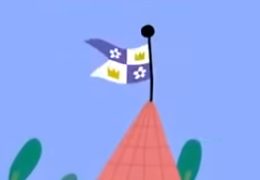
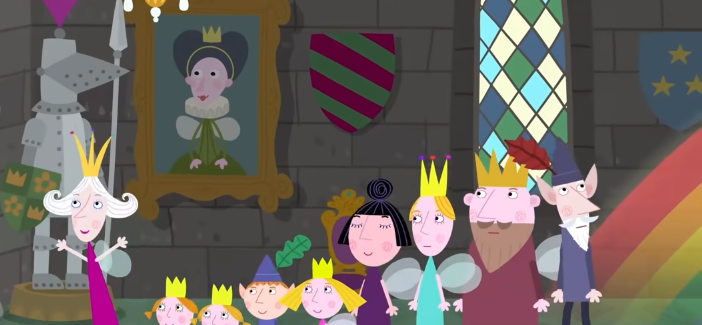
Shifting genre a little, I have spent much of the last year babysitting, which has left me far too familiar with the Channel 5 series Ben & Holly’s Little Kingdom. It is produced by the same companies responsible for Peppa Pig, and essentially is to that series as is American Dad to Family Guy. There is only one piece of heraldry or vexillology with prominence in the series – the forked banner flying over the Little Castle, blazonable as quarterly 1st & 4th Argent an ancient crown Or 2nd & 3rd Azure a cinquefoil pierced Argent. This seems to function as both King Thistle’s personal arms and as the nation’s civil flag. The design features on shield’s carved into the king & queen’s thrones and the sash worn by the Fairy Mayor. The tinctures sometimes vary.

In one episode King Thistle’s parents, Viktor & Milicent, are visited at their own much larger in the clouds. From the towers many different-coloured pennons are flying charged with golden crowns and cinquefoils. Inside we see several more off-tincture versions of the Little Kingdom’s arms, as well as two other shields hanging on the wall in a corridor – one of them Purpure three bends Vert, the other Azure three mullets one and two Or. Given their simplicity these are likely to be the arms of real people, though I have not yet identified them.

King & Queen Marigold also had their own castle (resembling St Basil’s Cathedral in Moscow) but there wasn’t any heraldry that I could see. Perhaps it was too old-fashioned for them?

The Heraldry of the Pastons

This afternoon I attended a virtual presentation by the Norfolk Record Office concerning the heraldry of the Paston family. I knew little of these people before signing up, but the topic was as intriguing as any other heraldry lecture.

The presenter was Dr John Alban of the University of East Anglia. He apologised for not being physically present in the office – having to divide his time equally between Norfolk and South Wales – but said it didn’t matter since in a virtual lecture he was not restricted by location. That comment fell quickly into irony. The first few minutes of the lecture were plagued by technical difficulties as the audio failed completely for many in the audience, requiring us to log out of the session and then back in again. That was far from ideal, of course, since it caused us to miss the introductory sentences. At least we could see the slides, including establishing what the Paston arms were in their simplest form: Argent six fleurs-de-lis three two and one Azure a chief indented Or. He then showed us a gallery of uses of those arms in various places and by various institutions, whether alone or marshalled with others.

The main thrust of the presentation was in showing how arms mutated and evolved in the period before heraldic regulation, and how even after that armigers would be keen to manipulate the historical record for their own ends. Thus we saw a few alternate prototype versions of the Paston arms and their appearances in medieval and Tudor records. One especially interesting case study shown to us was William Cecil, 1st Baron Burghley, whose family history before Henry VII’s accession Alban reckoned to be entirely fabricated.

At the end of the presentation an attendee asked Dr Alban to recommend books on heraldry. He suggested the works of Charles Boutell and Arthury Charles Fox-Davies, and was pleased when I pointed out that older works such as these were available for free on Google Books or Archive.org for those who could not access physical copies.

In these meetings I tend to scan the list of attendees for anyone remotely famous. This time I found Elizabeth Roads, Lyon Clerk from 1986 to 2018. As per usual I attempted at the end of the session to plug this blog. I probably left it a little too late as we were being instructed to log out (and I’m fairly certain Roads already had), but there already seems to be a bit of an uptick in view count, so at least someone spotted it.