Heritage Day at Sunk Island

Every summer the diminutive parish of Sunk Island puts on a heritage event, displaying billboards about the social and environmental history of the place, as well as selling a few mementos. I was invited to attend today’s to help with carrying some of the materials in and out.

The event is hosted at Holy Trinity Church, which ceased to operate as a place of worship in 1983 but remains open as a community centre (especially since the demolition of the village hall nearby). The history of the church itself (including the contest between rival Christian denominations for recruitment of parishioners) was a major theme of the display. The other big theme was the dredging up of the mud banks, followed by the cutting of new drains and the building of the sluice gates.

Some of the displays looked like they had been made many years ago and brought out unedited each time. There is a familiar style common to these kinds of displays by churches, village halls and primary schools in small settlements in rural Britain around the turn of the millennium. In particular I noticed a poster about the Crown Estate, which still referred to it paying for the civil list (as opposed to the sovereign grant).

What particularly piqued my interest was a patchwork quilt entitled “Treasures of Holderness”, each patch made by a member of a local sewing group. That by Sue Daniels showed the shield of arms of Holderness Borough Council. The full achievement was also shown on a wooden plaque affixed to the wall of the entrance hall. The borough itself, along with its governing council,was dissolved in 1996 and merged into the East Riding of Yorkshire unitary authority. Holderness no longer has a heraldic personhood distinct from the rest of the county but the old arms carry on informally by force of cultural inertia. None of the individual parishes seem to have arms individually granted.

EXTERNAL LINKS

Comparing Dissolution Proclamations

The Fifty-Eighth Parliament of the United Kingdom is no more. It dissolved just after midnight… or did it?

Parliament’s own website and guidance documents seem to indicate that dissolution took effect at 00:01 today, but I doubt the factual accuracy of this and I am not the only one.

I spent much of today keeping a close eye on the Privy Council website to see when there would be an update about today’s meeting. It arrived sometime before 13:00. The PDF records that His Majesty ordered the Lord Chancellor to affix the Great Seal of the Realm to the proclamation, and also (alongside the Secretary of State for Northern Ireland) to arrange the issuance of writs of summons and election. The text of the proclamation itself is reproduced below:

Whereas We have thought fit, by and with the advice of Our Privy Council, to dissolve this
present Parliament, which stands prorogued to Friday, the thirty-first day of May: We do, for
that End, publish this Our Royal Proclamation, and do hereby dissolve the said Parliament
accordingly: And the Lords Spiritual and Temporal, and the Members of the House of
Commons, are discharged from further Attendance thereat: And We being desirous and
resolved, as soon as may be, to meet Our People, and to have their Advice in Parliament, do
hereby make known to all Our loving Subjects Our Royal Will and Pleasure to call a new
Parliament: and do hereby further declare, that, by and with the advice of Our Privy Council,
We have given Order that Our Chancellor of Great Britain and Our Secretary of State for
Northern Ireland do respectively, upon Notice thereof, forthwith, issue out Writs, in due Form
and according to Law, for calling a new Parliament: And We do hereby also, by this Our
Royal Proclamation under Our Great Seal of Our Realm, require Writs forthwith to be issued
accordingly by Our said Chancellor and Secretary of State respectively, for causing the Lords
Spiritual and Temporal and Commons who are to serve in the said Parliament to be duly
returned to, and give their Attendance in, Our said Parliament on Tuesday, the ninth day of
July next, which Writs are to be returnable in due course of Law.

Given at Our Court at Buckingham Palace, this thirtieth day of May in the Year of our Lord
two thousand and twenty four and in the second year of Our Reign.

The Privy Council website does not give texts like these for 2010 and earlier, but sound recordings of those earlier occasions confirm that the same wording was in use. The most notable feature of these proclamations is that they specify dissolution taking place immediately upon the date given and also fix the date for the new parliament to assemble, but don’t actually say when polling day will be.

The FTPA Era

The Fixed-term Parliaments Act 2011 substantially altered the mechanics of British general elections. No longer could the sitting prime minister simply “go to the country” whenever he pleased, instead the date of the general election would be fixed as the first Thursday in May in the fifth year since the previous general election, unless two thirds of the House of Commons voted to have one earlier. Dissolution of the outgoing legislature would occur automatically twenty-five working days before polling.

In a moment of supreme constitutional pettiness, the act even transferred the authority for writs of election for MPs (though curiously not writs of summons for peers) to the Lord Chancellor and Northern Ireland Secretary to act without the monarch’s instruction, so that this element was taken out of the proclamation.

Three general elections occurred while the FTPA was in force – the fifty-fifth Parliament was allowed to run its natural course, the fifty-sixth was dissolved early by the two thirds motion and the fifty-seventh by a special act of its own passage. Despite these very different constitutional circumstances, the proclamations in all cases were identical (save of course the specific dates mentioned). Below is the text of the proclamation from 2019:

Whereas We, by and with the advice of Our Privy Council, being desirous and
resolved, as soon as may be, to meet Our People, and to have their Advice in
Parliament, do publish this, Our Royal Proclamation, and do hereby make known to
all Our loving Subjects Our Royal Will and Pleasure to call a new Parliament to be
holden at Westminster on Tuesday the seventeenth day of December next: And We do
hereby also, by this Our Royal Proclamation under Our Great Seal of Our Realm,
require Writs to be issued by Our Lord High Chancellor for causing the Lords
Spiritual and Temporal who are to serve in the said Parliament to give their
Attendance in Our said Parliament on the said date.

Given at Our Court at Buckingham Palace, this sixth day of November in the Year of
our Lord two thousand and nineteen and in the sixty-eighth year of Our Reign.

The 2017 version can be read here, and that of 2015 heard here. The 2017 election also had a different proclamation nine days earlier to appoint the polling date, though this proclamation did not enjoy any of the latter’s accompanying ceremony despite clearly being the more politically important of the two.

As you can see, this version of the proclamation is a pathetic sliver of its former self – the issuance of writs refers entirely to the House of Lords and thus doesn’t actually say anything to the general public about participating in an election. The only substantive agency which Her Majesty retained was in choosing the date on which the new Parliament met – and per the other provisions of the FTPA this no longer had any knock-on effect for subsequent elections. Even the name was changed – it became simply “A Proclamation for declaring the calling of a new Parliament” instead of “A Proclamation for dissolving the present Parliament and declaring the calling of another”.

Changes in Procedure

Although it may seem a question of semantics, there is an important difference in the sequence of events between FTPA-era elections and earlier ones: Traditional practice involves a proclamation to dissolve Parliament with immediate effect, then an election happening a certain time after that. FTPA practice was for the election date to be fixed far in advance (whether by the other type of proclamation or by statute) and dissolution would happen a certain number of days before that. In the old system a privy council comprising incumbent parliamentarians would convene to cause their own dissolution and the other matters connected, whereas in under the FTPA they would meet to arrange the other matters several hours after dissolution had already occurred.

That brings us to the key point of this article – the time of day at which dissolution actually takes effect: With the FTPA in place and thus the dissolution date pre-ordained without the need for further action, it was logical to treat it as happening as soon as that date arrived*, which would also have been the case under the old system if a Parliament had been allowed to run its full course. When Parliament is being dissolved by a specific proclamation for that purpose, then it obviously must stay in existence until the proclamation is actually produced – and it is rare for a privy council to be convened at midnight. None of the proclamations specified delaying their effects until the end of the date, and obviously they cannot be retroactive to the beginning of the date because, as mentioned in the previous post, there have been instances of Parliaments still sitting earlier on the same date as that on which they would be dissolved, and retroactive dissolution would have meant that the sitting (including any acts passed and royal assents given thereat) was invalid.

In today’s example, the fifty-eighth Parliament had already been prorogued from 24th May to 31st, but until the privy council held around noon there had been nothing in law to cause it to dissolve, and its natural expiration was still many months away. If Sunak’s government had suddenly gotten cold feet about calling an election, or if His Majesty was somehow prevented from attending (for the sake of the hypothetical let us assume he could not arrange any counsellors of state to be there either) and thus the meeting to approve the proclamation had not gone ahead, then Parliament would have remained in existence and reconvened the next day for the beginning of a fifth session.

Given that the Dissolution and Calling of Parliament Act 2022 repealed the Fixed-term Parliaments Act with the explicit intention to revert to pre-2011 procedure as far as possible, it does not make sense for parliamentary authorities to declare in their guidance and press briefings that the legislature had dissolved many hours before any such thing had actually taken place. The most logical explanation (pending further research) that comes to mind is that that the guidance was written during the 2011-22 period and not updated thereafter, so that the FTPA mentality remains in force even though the law itself does not.

This whole business also caused some difficulty for me as a Wikipedia editor, since I noticed upon rising this morning that another editor had, just after midnight, already changed the tense of my disclaimer flairs on the biographies of still-current MPs. I reverted the change and did not set it forward again until many hours later when I had actually seen the proclamation published online. In all fairness the other editor was merely following reliable sources as we are bound to do. Unfortunately this goes to show that there are many times when the reliable sources can still get things wrong.

*There is a secondary deliberation as to whether this means exactly midnight or, to avoid ambiguity, one minute later. I will not quibble with that particular question here as it does not affect the primary matter I am discussing.

UPDATE (May 2024)

David Torrance has produced a research briefing for the House of Commons Library. Page 7 cites this post and states that “This timing was intended for operational purposes rather than as a statement of the legal position.” with page 10 confirming that the actual dissolution occurred at 11:57am with the application of the Great Seal to the proclamation.

A Proliferation of Signs: Badges in the Medieval World

Video

It has been a while since I attended any virtual events by the Royal Heraldry Society of Canada. Today’s was rather different in style to the ones I remember during the COVID years.

The speaker was Ann Marie Rasmussen, Professor and Diefenbaker Memorial Chair in German Literary Studies at the University of Waterloo. Her lecture was divided into three parts.

Badges are small devices found mainly in north west Europe. They were easy and cheap to make, usually from pewter in moulds carved from stone. We have an example of a surviving stone mould in Mont-Saint-Michel showing the image of St Michael slaying the dragon. Pewter can show fine details well, but it has the weakness of tarnishing easily. Currently there are more than twenty-thousand medieval badges surviving in museums, and during the middle ages there were probably more than a million in existence. Badges were designed to be decoded. Pilgrim badges were one type, made and sold at holy sites showing religious imagery (e.g. one from Canterbury shows Thomas Becket, one from the Vatican shows crossed keys with a tiara). There survives an anonymous painting of Christ himself among the pilgrims, all of them wearing badges.

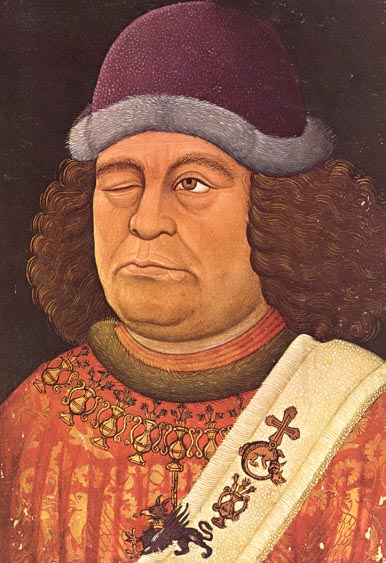
Almost all retainers and employees would have a badge to show the identity of the lord, household or organisation for which they worked. There are even examples of badges made of children’s toys. A 1432 portrait of the poet Oswald von Wolkenstein shows him wearing a badge of a dragon and griffin.

The separation of the spiritual and temporal realms is a modern idea. The types of badges often crossed over. Not all imagery was reverential – there are some humourous ones designed to resemble unsightly body parts, and there are records from medieval times of people complaining about indecent badges being worn and distributed around festival times.

EXTERNAL LINKS

UPDATE (June 13th)

The Society has uploaded the lecture to its YouTube channel, so I am spared from writing out a long description of its contents.

Why stop when you’re on a roll?

Today marks the first anniversary of Their Majesties’ coronation, and there have been some public ceremonies to commemorate.

A few days ago the coronation roll was unveiled, serving as a written record of the proceedings that took place in the abbey (and some of the key events leading up to it) as well as listing all the prominent attendees. As this was the first British coronation to take place in the internet age, a digital version of the roll has also been set up, interlaced with video interviews from many of the core participants.

David Torrance has produced a lengthy briefing document for the House of Commons library about it.

While I’m here, there is another aspect of the coronation on which I’d like to look back – the status of the chairs on which Their Majesties sat during the ceremony. Some weeks before the event the antiquarian Dr Allan Barton put out a video called When Is a Chair a Throne? The answer, essentially, is that it must be on some form of dais to raise it above the floor.

At the business end of the abbey during the coronation there are five seats of special importance: Closest to the alter is St Edward’s Chair, the ancient wooden relic on which the monarch is actually crowned. A few metres behind, in the crossing, sit two “throne chairs”, in this case a pair of X-framed armchairs (almost looking like something a film director would use) originally made for George VI & Elizabeth Bowes-Lyon. Perpendicular to these are chairs of estate, these ones originally made for Elizabeth II and Philip Mountbatten, allowing the couple to sit behind their respective faldstools.

From what I can see in images of past coronations, both painted and photographic, a pattern is clear – the consort’s throne sits on three steps and the monarch’s throne on five, while the chairs of estate and St Edward’s chair sit directly on the floor. The 2023 coronation breaks the trend – the monarch’s X-framed chair has just one block underneath it while the consort’s counterpart has none at all (though it still has upholstered footstools in front). Does this mean that, technically, only one of these chairs counts as a throne?

IMAGE REFERENCES

A Note on the Honours Given to Prime Ministers

Cameron’s ennoblement got me thinking about the general trend of honours given to former prime ministers. Combing through Wikipedia, I have produced a list of them. To keep it from becoming overly long (and to avoid ambiguities about who counts as a prime minister), I have restricted it to honours conferred after the end of Victoria’s reign.

Although their legal status is much the same, British orders of chivalry can be politically divided into two categories: The Baronetage, Knights Bachelor, the Orders of the Bath, St Michael & St George, the Companions of Honour and the British Empire are appointed on the advice of government ministers, while the Royal Victorian Order, the Order of the Hospital of St John of Jerusalem and the Order of Merit are conferred at the monarch’s personal whim. The Orders of the Garter and Thistle fell into the former category in the early eighteenth century but were changed to the latter in 1946. Peerages both life and hereditary are presumed to be in the former category.

Here is a simplified list of who received which kind of honour and when. Honours which a person held before ascending to the premiership are not included:

HONOURS IN THE MONARCH’S GIFT

Garter (post-’46)

  • Churchill in 1953 (while still prime minister, in advance of the coronation)
  • Attlee in 1956 (resigned as Labour leader the previous year)
  • Wilson in 1976 (three weeks after leaving office)
  • Callaghan in 1987 (three weeks before stepping down from the Commons)
  • Thatcher in 1995
  • Major in 2005
  • Blair in 2021 (New Year’s Eve)

Merit

  • Balfour in 1916
  • Lloyd George in 1919 (while still prime minister)
  • Churchill in 1946 (while opposition leader)
  • Attlee in 1951 (while opposition leader, ten days after premiership’s end)
  • Macmillan in 1976
  • Thatcher in 1990 (nine days after premiership’s end)

St John

  • Thatcher in 1991 (Dame of Justice)

HONOURS ON MINISTERS’ ADVICE

Garter (pre-’46)

  • Balfour in 1922 (backbench MP) (adv. Lloyd George)
  • Asquith in 1925 (adv. Baldwin)
  • Baldwin in 1937 (adv. Chamberlain) (immediately after resignation)

Companion of Honour

  • Attlee in 1945 (adv. Churchill) (shortly after resigning as Deputy PM)
  • Major in 1998 (adv. Blair)

Hereditary peerage

  • Balfour in 1922 (adv. Lloyd George)
  • Asquith in 1925 (adv. Baldwin)
  • Baldwin in 1937 (adv. Chamberlain)
  • Lloyd George in 1945 (adv. Churchill)
  • Attlee in 1955 (adv. Churchill)
  • Eden in 1961 (adv. Macmillan)
  • Macmillan in (adv. Thatcher)

Life peerage

  • Douglas-Home in 1974 (adv. Wilson)
  • Wilson in 1983 (adv. Thatcher) (dissolution honours)
  • Callaghan in 1987 (adv. Thatcher) (dissolution honours)
  • Thatcher in 1992 (adv. Major) (dissolution honours)
  • Cameron in 2023 (adv. Sunak)

It may also be worth considering honours given to the spouses of prime ministers, whether for achievements in their own right or by right of marriage.

  • Margaret Lloyd George: GBE in 1918 (adv. her husband)
  • Lucy Baldwin: GBE and DStJ in 1937 (former adv. Chamberlain)
  • Clementine Churchill: GBE in 1946 (adv. Attlee), life peer in 1965 (adv. Wilson)
  • Dorothy Macmillan: GBE in 1964 (adv. Douglas-Home)
  • Denis Thatcher: TD in 1982, baronet in 1990 (adv. Major), CStJ in 1991.
  • Norma Major: DBE in 1999 (adv. Blair)
  • Cherie Booth/Blair: CBE in 2013 (adv. Cameron)
  • Philip May: Knight bachelor in 2020 (adv. Johnson)

Unless I’ve missed any, no current or former prime minister (or their spouse) has, from 1901 onward, been appointed to the Order of the Bath, the Order of St Michael and St George, the Order of the Thistle or the Royal Victorian Order.

Armory and Architecture

This evening I attended a virtual lecture at Arts University Bournemouth. The presenter was David Lund and the subject was the history of architectural model-making, particularly that of John Brown Thorp.

Modelling is an invisible profession to most people as the model-makers are largely executing the ideas of architects, who thus take all the credit for the design. British model-making kicked off in the late sixteenth century with the arrival of trends from Italy. The earliest record is of a 1567 model of Longleat House, made for Sir John Finn. Sir Christopher Wren would go on to commission architectural miniatures on a regular basis.

Originally timber was favoured for model-building, but card proved to be more adaptable. Thorp is considered the grandfather of architectural model-making. He had his headquarters near to the Inns of Court, and his extremely-detailed scale models were used in court cases. By 1940 his firm was employing forty other modellers. The emergence of modelling as a dedicated profession allowed an increase in the size and standards of their creations.

Modelling boomed in the 1950s and ’60s, with the material fashions of the models changing in line with those of the buildings themselves – card representing brick was replaced by perspex representing glass and steel. The economic slump of the 1970s caused a change in clientele, with modellers working for private developers instead of state architects. Nowadays it is common for models to be designed on computers and then 3D-printed, incorporating lighting and even animation.

In the Q&A session, Lund was asked about the phenomenon of public disappointment when a finished construction fails to live up to what the model promised. Lund conceded that models and artistic renderings often gave a sanitised, optimistic prediction of the built environment, replete with happy people and clean surfaces, whereas the reality (especially in modernist constructions) proved quite different. Developers and the public often unfairly blame the artists and modellers for this, even though they are only following what the developers tell them to do.

On an entirely unrelated note, late last night I discovered that Sir Lindsay Hoyle, Speaker of the House of Commons since 2019, has finally been granted a coat of arms. I was relieved to come across this news at all, yet also a little perplexed to realise that the news articles were from almost a month ago. I don’t know how I missed this, given that I have been obsessively looking out for this ever since his election. The not-so-grand reveal came at the unveiling of a new set of stained-glass windows in the Palace of Westminster, the other panels of which were decorated with the arms of British Overseas Territories.

None of the news articles I have uncovered so far gave the blazon for the new achievement, so my illustration for Wikimedia Commons is based on visual inspection of the artwork in the photograph. It indeed includes the red rose of Lancaster, “busy bee” and rugby references as Sir Lindsay hinted two years ago. The use of the parliamentary mace Or on a fess conjoined to a bordure Vert is almost certainly copied from the arms of Sir Harry Hylton-Foster, who became speaker sixty years before Hoyle did – though one has to hope that Hoyle does not end his tenure quite so abruptly. The window shows mantling Gules and Argent (rather than Vert to match the shield), so I have copied that. It is not clear exactly when the grant was made, nor whether the grant was to Sir Lindsay himself or to his noble father (the mace makes the latter seem unlikely).

The search for other new grants continues. Last month I got a pretty strong hint about the arms of Lady Amos, but those of Sir Tony Blair remain as elusive as ever.

William IV & the Royal Visit of 1827

Today’s virtual lecture was presented by Owen Ryles, Chief Executive of the Plymouth Athenaeum. It concerned the time that the Duke of Clarence (later King William IV) visited the naval yards at Plymouth.

The lecture began with a preamble establishing the titular character: William was his father’s third son, long expected to lead a relatively quiet life. Even his creation as Duke of Clarence & St Andrews was not guaranteed, being granted only because he threatened otherwise to stand as MP for Totnes. He was sent into the navy at age 13 to keep him away from the perceived negative influence of his elder brother George IV. In his active career he was the first British royal to set foot in the American colonies, took command of HMS Pegasus in 1786 and gave away Frances Nisbet in her wedding to Horatio Nelson in 1787. He was commissioned as an honorary admiral in 1798, and then appointed to the office of Lord High Admiral in 1827 during the brief ministry of George Canning. In his private life, he scandalised Georgian society by cohabiting with his mistress Dorothea Bland and siring ten illegitimate children with her. He gave her a stipend on the condition that she would not return to acting, and later took legal action against her when she did anyway. When his niece Princess Charlotte of Wales unexpectedly died in childbirth William moved up in the line of succession and was forced into a royal marriage, but his wife’s children all died young.

For the grand occasion the duke arrived on HMS Lightning to a deafening chorus from onlookers. He did not disembark until 7pm. He visited the original Admiralty House, later renamed Hamoaze House, and met the Superintendent of Works Jay Whitby. On 12th July he inspected the Plymouth Division of the Royal Marines and said that Plymouth was his favourite naval resort (it was also the first borough in which he had been made a freeman). On 13th he received a loyal address by the mayor and municipal corporation at the Royal Hotel. Among the military men with whom he dined was his own son, Colonel Frederick Fitzclarence.

Also during the visit he laid the top stone of the sea wall at the Royal William Victualling Yard and donated ten guineas to each of the workmen. He also witnessed a demonstration by William S. Harris of the application of fixed lightning conductors to ships.

William’s tenure as Lord High Admiral did not last long – the next year he was dismissed after taking HMS Britannia to sea for ten days without government permission. In 1830 he acceded to the throne, the eldest until Charles III last autumn. He was reluctant to have a coronation at all, eventually spending just £30k on it compared with his elder brother’s £420k. His reign was short, and he clung to life just long enough to see his niece Victoria come of age. He was regarded as the “least obnoxious Hanoverian”, which some might consider high praise.

A Note on Royal Peerages

Today it was announced that The Prince Edward, Earl of Wessex and Forfar, was created Duke of Edinburgh, a title formerly held by his father. This had been speculated for years, but the intriguing part of the news is that the title is only for life – Edward’s son James will not inherit it. This is the first life peerage above the degree of baron for more than two hundred years, and the first given to a royal since medieval times.

For a newly-ascended king to denounce the principle of heredity seems unlikely. I think there is a more pragmatic reason for this – a desire to keep the title in circulation for the sons and brothers of future kings. The firm does not want to run out of place names (especially in Scotland) to use for dukedoms.

It has been tradition in Britain for the better part of a millennium that the younger sons of the monarch are granted dukedoms referring to prominent locations within the isles. Indeed, there is a lot of tradition in which particular place names are used, and even for which place in birth order.

On second thought, however, this shouldn’t be possible – if these honours are separately hereditary, and given to the offspring expected not to take the crown, then how do the same titles keep coming up time and time again. This paradox reveals an important detail about the royal dynasties of the past thousand years – their cadet branches normally don’t branch very far. It’s remarkably rare to find examples of a legitimate male line emanating from a younger son of a king that lasts for more than three generations. Most of the time either the junior line dies out (either only having daughters, or having no children at all), or the senior line fails so that the junior line ascends to the throne. To make matters worse, on the few occasions where a divergent line has managed to sustain itself, there has nearly always been some kind of intervention that prevented the title from doing so. What follows is by no means a complete history of the royal lineage, but a list of the most commonly-used royal dukedoms roughly in descending order of number of creations, with an explanation of what happened to them.

York

The first use of the northern city for a royal dukedom came in 1385, when Richard II bestowed the title on his uncle Edmund of Langley. This founded the House of York, which was to be one of the principal factions in the Wars of the Roses after Richard’s death. Edmund was succeeded by his son Edward of Norwich, who died at Agincourt, then his grandson Richard of York, who lead the opposition against the regime of Henry VI. Richard died before winning the throne, so the dukedom passed to his own son, who not long later succeeded as King Edward IV.

The title of Duke of York has since been conferred ten more times (thrice combined with Albany), nearly always for the monarch’s second son. Five dukes ascended to the throne, another four died without sons. Prince Andrew looks set to continue the latter tradition.

Sussex

Conferred twice as a dukedom – the first was for The Prince Augustus Frederick, sixth son of George III. He married twice without permission so his children were deemed illegitimate and the title died with him. The second was for Prince Henry of Wales in 2018. He currently has one legitimate son. It is too early to speculate about grandsons. An earldom of Sussex was also given by Queen Victoria for her son Arthur (see Connaught).

Gloucester

Created as a dukedom five times (and used as an informal style on two others), the most memorable recipient being Richard III. All died without an heir until Prince Henry, son of George V, whose son Richard (b. 1944) holds the title to this day. He has a line of succession two generations deep (though only one person wide) so barring any accidents for Xan Windsor we can expect the title to escape from the royal family for most of the rest of this century. The title “Duke of Gloucester and Edinburgh” was created once and inherited once, the second duke dying childless in 1834.

Cambridge

Five creations and two more stylings. The first four dukes died as small children. Prince George (1706) and Prince William (2011) were both directly in line to the throne so their honours were doomed to merge. Prince Adolphus, son of George III, produced an heir but his children were born outside the Royal Marriages Act so they could not inherit. His daughter’s son, Prince Adolphus of Teck, was created Marquess of Cambridge in 1917 and passed it to his son George ten years later, but George only had a daughter and Frederick, his brother, died a bachelor.

Albany

First granted by Robert II to his third son (also Robert) in 1398, the title passed to his son Murdoch in 1420, but five years later Murdoch was attainted and his peerages removed. Conferred again by James II on his second son Alexander in 1458, it passed to his son John, but John died childless and brotherless in 1536. James V’s son Robert was styled as such in 1541, but he died at eight days old. Mary I conferred the dukedom on her husband Henry in 1565 and it was inherited by their son – later James VI, merging with the crown on his accession. James recreated the title for his second son Charles, but his first son died so Charles also became king. Charles II upon his restoration gave the title to his brother James, who succeeded him on the throne. Albany was also created three times as a joint peerage with York. The final creation was in 1881 for Victoria’s son Leopold, and inherited by his son Charles (also Duke of Saxe-Coburg and Gotha) until he was stripped of it in 1919. The claimant today would be his great-grandson Prince Hubertus.

Cumberland

First created for Charles I’s nephew Prince Rupert of the Rhine, then William & Mary’s brother-in-law Prince George of Denmark, then George II’s son Prince William. All died without sons to succeed them. Prince Henry Frederick, George III’s brother, was made Duke of Cumberland and Strathearn in 1766, but he died childless as well. George later made his fifth son, Prince Ernest Augustus, Duke of Cumberland & Teviotdale. Ernest passed the dukedom (and the Hanoverian crown) to his son George in 1851, then grandson Ernest Augustus in 1878, but he was deprived of the title in 1919. The claimant today would be the first duke’s great-great-great grandson Prince Ernest Augustus (born 1954).

Kent

Ignoring non-royal creations, the title was conferred on George V’s youngest (surviving) son in 1934, and passed to his son in 1942. Currently the duke is fortieth in line to the throne, with two direct heirs and six spares of his own, so neither extinction nor merging is likely in the forseeable future. The double-dukedom “Kent & Strathearn” has been used once, for Queen Victoria’s father, but he died with no sons.

Clarence

Referring to the town of Clare in Suffolk, the first two creations were for the second sons of their respective kings, both dying without legitimate sons. The third creation was for George Plantagenet, brother of Edward IV. He was survived by a son, but the title was not passed on as he was attainted and executed for treason. The title fell out of favour until 1789 when George III made his third son (later William IV) Duke of Clarence & St Andrews. William had several children out of wedlock who used “Fitzclarence” as a surname. Queen Victoria ennobled her senior grandson Albert Victor as Duke of Clarence & Avondale in 1890, but two years later he died just before his planned wedding. An earldom of Clarence was already in existence, created nine years earlier for Victoria’s fourth son (see Albany).

Bedford

Granted twice to John of Lancaster, son of Henry IV, but he died childless. Conferred on John Nevill, intended son-in-law of Edward IV, in 1470, but he was later attainted for treason. Given in 1478 to George, said king’s third son, who died young. Given in 1485 to Jasper Tudor, uncle of Henry VII, who died childless. Given in 1694 to the non-royal William Russell, whose descendants carry it to this day.

Edinburgh

The first creation was by George I in 1726, for his senior grandson Frederick. Frederick predeceased his father, and the dukedom was held for nine years by his own eldest son, who then acceded as George III. Victoria gave it to her second son Alfred in 1866. He died in 1900, his only son having died the year before. The third and likely most significant creation was by George VI in 1947, for his son-in-law Philip Mountbatten. Philip spent a record time as royal consort and founded an award scheme under that title, raising the name to a significance it had not previously enjoyed (despite being a capital). Philip died in 2021 and his peerages were inherited by his eldest son Charles, who six months ago became King. Today Charles conferred the title for life on his youngest brother Edward.

Kendal

Style of Charles II’s nephew in 1666. He died young.

Windsor

Created by George VI for his brother, the former king Edward VIII. Edward died childless in 1972.

The Heraldry of Haiti

Malcolm Lobley’s lecture tonight for the Yorkshire Heraldry Society concerned the country which has long been a source of cult fascination among armory enthusiasts.

He began with a short history of how the country came to be – which was, by his own admission, a way of padding the event’s length.

Henry Christophe founded the Kingdom of Haiti in 1811. In addition to proclaiming himself as monarch, he established a native nobility on the European model consisting of four princes, eight dukes, twenty-two counts, thirty-seven barons and forty chevaliers. He assumed arms of dominion for his realm, and also created a heraldic authority to assign arms to his appointees.

Lobley noted that as in Britain there was a convention on helmet usage according to rank – nobles used a barred helmet, the most senior affrontee and the rest facing dexter. Some of the titles of the peers, based on contemporary local place names, sounded comical to English speakers, such as the Duc de la Marmelade and the Duc de Limonade. Lobley was especially drawn to the Duc de l’Anse, which he translated to “jug handle”. Hyenas were a common choice as supporters. The contents of the shield tended to a medieval degree of simplicity though incorporating more modern imagery, such as Baron de Beliard with his rake and watering can.

The lecture was also used as an opportunity to advertise the Armorial Général du Royaume d’Hayti, which the College of Arms has been trying to flog for more than a decade.