Why stop when you’re on a roll?

Today marks the first anniversary of Their Majesties’ coronation, and there have been some public ceremonies to commemorate.

A few days ago the coronation roll was unveiled, serving as a written record of the proceedings that took place in the abbey (and some of the key events leading up to it) as well as listing all the prominent attendees. As this was the first British coronation to take place in the internet age, a digital version of the roll has also been set up, interlaced with video interviews from many of the core participants.

David Torrance has produced a lengthy briefing document for the House of Commons library about it.

While I’m here, there is another aspect of the coronation on which I’d like to look back – the status of the chairs on which Their Majesties sat during the ceremony. Some weeks before the event the antiquarian Dr Allan Barton put out a video called When Is a Chair a Throne? The answer, essentially, is that it must be on some form of dais to raise it above the floor.

At the business end of the abbey during the coronation there are five seats of special importance: Closest to the alter is St Edward’s Chair, the ancient wooden relic on which the monarch is actually crowned. A few metres behind, in the crossing, sit two “throne chairs”, in this case a pair of X-framed armchairs (almost looking like something a film director would use) originally made for George VI & Elizabeth Bowes-Lyon. Perpendicular to these are chairs of estate, these ones originally made for Elizabeth II and Philip Mountbatten, allowing the couple to sit behind their respective faldstools.

From what I can see in images of past coronations, both painted and photographic, a pattern is clear – the consort’s throne sits on three steps and the monarch’s throne on five, while the chairs of estate and St Edward’s chair sit directly on the floor. The 2023 coronation breaks the trend – the monarch’s X-framed chair has just one block underneath it while the consort’s counterpart has none at all (though it still has upholstered footstools in front). Does this mean that, technically, only one of these chairs counts as a throne?

IMAGE REFERENCES

That Time of Year Again

Lord Kakkar by Roger Harris, 2019 (CC-BY-3.0)

St George’s Day – 23rd April – is the traditional day for announcing new appointments to the Order of the Garter. The King today named three new ordinary knights and one new royal lady:

  • The Lord Peach, Chief of the Defence Staff 2016-18. This is fairly unsurprising as another former chief, Lord Stirrup, is also part of the order, as were many other (though not all) chiefs before him.
  • The Lord Kakkar, former Chairman of the Appointments Commissions for both the House of Lords and the Judiciary. He is most prominently known for his work in business and medicine.
  • The Lord Lloyd-Webber, one of the musical composers for the coronation, is probably the most famous. It is perhaps a little surprising that he went directly to the Garter and was not offered the Royal Victorian Order first.
  • The Duchess of Gloucester, President of the Royal Academy of Music since 1997. This appointment is a bit of a departure from convention as, while royals by birth are nearly all given the Garter as a matter of course (Princess Margaret and Prince Michael being odd exceptions), royals by marriage (unless their spouse be first in line to the throne or already sitting on it) generally are not. This honour is presumably in thanks for the additional duties the duchess has taken on since the winding down of Elizabeth II’s reign, and in particular during Charles III’s recent illness. It remains to be seen if the Duchess of Kent will be extended the same.

In addition to these appointments, there was some reshuffling of honorary offices among the other orders of chivalry which in recent years had fallen vacant or merged with the crown: The Queen was made Grand Master of the Order of the British Empire (last held by the Prince Philip, 1953-2021) while the Prince of Wales was made Great Master of the Order of the Bath (last held by Charles himself from 1974 until his accession).

The most revolutionary of today’s changes regards the Order of the Companions of Honour. This was created in 1917 alongside the Order of the British Empire and designed to reward outstanding achievements in art, science, medicine or public service among people who would not accept titular dignities. Appointments are made on ministerial advice. Currently the order has a quota of sixty-five ordinary members, of which two places are currently vacant. There is also one honorary member, the Indian economist Amartya Sen. Until now, no member of the royal family had been appointed a Companion of Honour. Given the origins of the institution, it seems a little odd that His Majesty (or the Prime Minister) would choose to create the supernumerary category of Royal Companion (similar to that in the Garter), and to make his daughter-in-law the Princess of Wales the first incumbent. This stands in contrast to the Order of Merit, in which Elizabeth II appointed both her husband and her son as full members on the same basis as all the others.

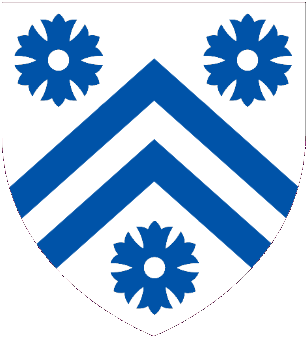
In armorial terms, obviously this will mean four new banners to hang in St George’s Chapel. The Duchess of Gloucester’s arms are well-known, and I have already found and illustrated those of Lord Kakkar (though doubtless his increased prominence will lead to a better rendering by a different artist soon enough), but Peach and Lloyd-Webber are a mystery – the former having been ennobled too recently to appear in the last print of Debrett’s.

UPDATE (24th April)

There are now three vacancies among the Companions of Honour, as it transpires that the Lord Field of Birkenhead died while I was writing this post.

Review: Charles III by Robert Hardman

Robert Hardman is no stranger to royal biography, having already penned quite a handful about Elizabeth II in the last decade or so of her life, including Queen of Our Times which came out in March 2022 as part of her Platinum Jubilee season and then in December of the same year was released again in a “commemorative edition” to update for the fact that she’d died. Now he moves into the present reign with a biography of her eldest son. I am a little confused about the title of this one as the British publication is called “Charles III: New King. New Court. The Inside Story”1 but on Google Books I can see that the United States version is called “The Making of a King: King Charles III and the Modern Monarchy”. I suspect the titles must be written this way for SEO purposes, or perhaps he just couldn’t decide which description he wanted so used all of them at once. It must be quite a fraught process to come up with a distinctive and meaningful name for a biography when you know that lots of other biographies will be documenting the same person and all competing to emerge in future history as the one definitive authority thereon. Most likely in the long run the general public (maybe academics too) will discard the pretentious subtitle and just remember it as “[AUTHOR] on [SUBJECT]” (e.g. “Jenkins on Churchill”) instead.

Hardman’s lengthy volume covers the first year of the New Carolean era. As one might expect, this period in royal history was particularly dominated by two big ceremonial events: His mother’s funeral and his own coronation. In the book, the funeral (as well as the period of Operation London Bridge leading up to it) takes up chapters 3, 4 and 5 while the planning and execution of the coronation takes 9, 10, 11, 12, 13 and 14. That makes for nine chapters out of a total of eighteen across the whole book. The coronation section in particular is loaded with dense historical comparisons, detailing not just the crowning of Charles III but also quite a lot about those of George VI an Elizabeth II. A less charitable reader may accuse Hardman of padding here, though doubtless a lot of the innovations (and omissions) of 2023 cannot be fully appreciated without an understanding of what came before. Anyone buying this book at first printing will, doubtless, have already watched the public side of these events on television as they were happening, so the real value of these chapters is in reading the personal accounts of the people involved as to what went on behind the scenes, such as the aide who spontaneously hugged Princess Anne to console her in her grief, the brigadier getting a summons back to London while giving a speech at his daughter’s wedding in Corfu, the Duke of Norfolk getting his GCVO investiture in a rush so he could wear his sash in the procession or the royal pages being packed off into a side room with some video games. It is worth mentioning as well that Hardman directed a BBC documentary about the coronation and some other aspects of royal life that year which aired at Christmas and can be seen in some ways as the prelude to this book.

The other chapters are about the personalities of Charles & Camilla, the looming political challenges for the institution of the crown and some of the other projects in which the sovereign couple have engaged themselves (such as the Prince’s Trust/Charity/Foundation organisations which now all have to be renamed). The running thread is the process of establishing Charles’s approach to kingship and the need to assert, like most new incumbents whose predecessors served an unusually-long time, that he is his own person and is not obliged to become a clone of his forbear with whom the institution had become synonymous. Charles, of all our sovereigns, had the longest pre-accession life and a brings with him a much more complete (and publicly-known) individual persona, which makes this task all the more pressing. I was amused to read in Chapter 15 that an unnamed senior courtier refers to this as “Doctor Who syndrome”, showing that the habit of explaining the British constitution in terms of that franchise is one that runs all the way to the top. Given the relative perceptions of the new king and his late mother, I would especially see parallels to Colin Baker succeeding Peter Davidson, or Capaldi following Tennant and Smith.

Being acutely aware of some of the less-sympathetic perceptions that have swirled around the royal family as a whole in recent years, and around Charles in particular for many decades, Hardman occasionally includes explicit references to and arguments against ideas emanating from either that acclaimed Netflix drama or statements by the exiled Duke & Duchess of Sussex. At times it can feel as if he has a bit of an axe to grind. It’s probably redundant in any event, as the people likely to be credulous of the claims he’s refuting are not likely to picking up his book in the first place. I’d like to think this is merely a demonstration of Hardman’s passion for truth over sensationalism, but I can’t entirely trust him on that front given he writes for the Daily Mail after all.

These minor quibbles aside, New King New Court is an engaging and enlightening work which I would recommend to anyone interested in the topic area, though any customer (or library) sinking their money into the original edition now may wind up feeling short-changed he does another expanded version in the near future.

1The use of full stops means that the title mercifully evades what TV Tropes calls “Colon Cancer”, though I would have preferred commas.

Waving the White Flag

In recent weeks there has been some reshuffling of responsibilities within the royal family: The King and the Princess of Wales have both been undergoing cancer treatment, limiting their ability to carry out public engagements away from their residences. Consequently, a greater burden has fallen on His Majesty’s wife and ever-trusty sister.

The Queen’s recent sole engagements have included Douglas City Hall on the Isle of Man (for the presentation of the letters patent to confer city status), and Worcester Cathedral (for the Maundy service ahead of Easter).

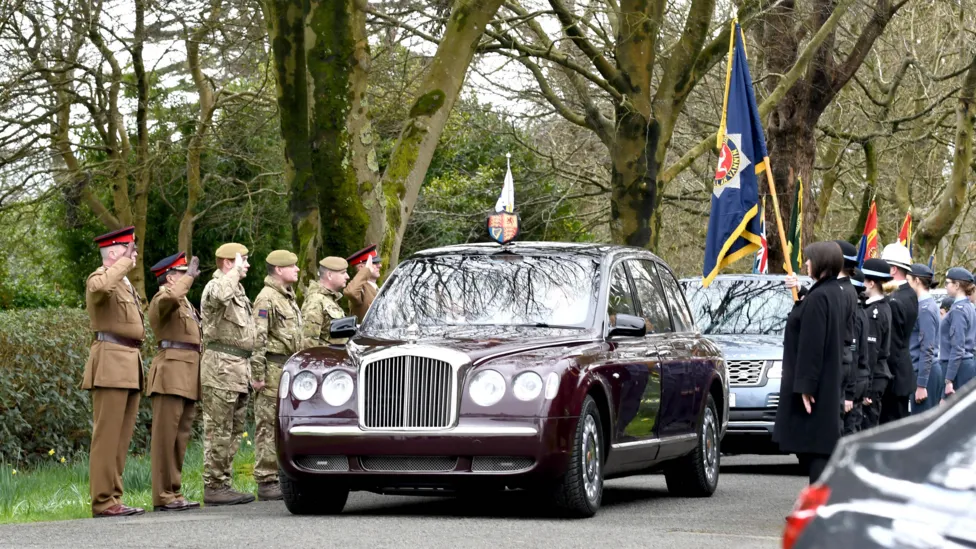
As was noted in Mark Scott’s lecture a month ago, the granting of banners of arms to members of the royal family is a separate event from the granting of the armorial achievement itself (rather than being automatic as it would be for lesser armigers). Eighteen months into her tenure as queen consort, it appears that Camilla’s own banner has not been granted, for I have repeatedly seen the Bentley State Limousine flying the ermine-bordered version of the royal standard used for lesser members of the firm who had not been granted personalised heraldic flags of their own, while the shield affixed to the roof shows the arms of the sovereign undifferenced.

As is so often the case, the Wikimedia Community have moved much faster than reality – a graphic representing Camilla’s banner as queen consort was uploaded preemptively way back in 2016 and has been used in multiple articles since her husband’s accession. Perhaps this will need to be revised in light of new evidence.

PHOTOGRAPHIC REFERENCES

Edward gets the Thistle

The Prince Edward seems to have made a habit of collecting new titles on his birthdays. For the occasion of his wedding in 1999 he was ennobled as Earl of Wessex and Viscount Severn. These both refer to places in England, in contrast with the normal convention for royal peerages. On his fifty-fifth birthday he gained a surprise Scottish title – Earl of Forfar – and then for his fifty-ninth he gained another, long-awaited and far more prestigious one – Duke of Edinburgh. Now that his primary title refers to a Scottish place – and the capital at that – it would seem a little strange for him not to join Scotland’s highest order of chivalry.

It was not exactly surprising, then, to learn that on his sixtieth birthday he had been appointed an Extra Knight of the Order of the Thistle. In this category he joins his nephew the Duke of Rothesay and his sisters the Queen and the Princess Royal. We can expect that soon his banner of arms will be hung alongside theirs at the High Kirk in his namesake city.

The King also announced three new appointments among the ordinary membership of the order – the Baroness Black of Strome, the Baroness Kennedy of The Shaws and Sir Godfrey “Geoff” Palmer – all of whom, curiously, have academic careers. This brings the order up to its full complement of sixteen members (excluding royals). It is unusual for all the appointments to be made today as traditionally they are announced on 18th June.

Finally, a concurrent press release confirmed that the duke had been appointed to a second term as Lord High Commissioner to the General Assembly of the Church of Scotland, a post which he last held in 2014-15. In the Scottish order of precedence he will rank immediately below the sovereign himself, rather than his natural precedence as a brother thereof.

Notes on the Memorial of Constantine II at Windsor

People of prominence often find that one period of mourning is not enough. For many of high status there will be the funeral itself within weeks of their death and then a separate, less formal, memorial service as much as a year later. Prince Philip had one of these in 2022, as did Lady Boothroyd last month.

Constantine II, King of the Hellenes 1964-73, died on 10 January 2023 and his funeral was held in Athens six days later. Yesterday a thanksgiving service took place at St George’s Chapel, Windsor, hosted and attended by the British royals.

Although it was a British-hosted event, only the Greek family’s website seems to list the order of service or any photographs. The order of service is has the late monarch’s arms illustrated on the first cover and those of the Order of the Garter on the last. This time the illustration is not that by Sodacan for Wikimedia Commons. I cannot identify the artist for this one, nor which typeface was used for the prose.

Most intriguing about the online material is that it highlights the contribution of the Lord Soames of Fletching. There is even a link to his website, which is still up even though it clearly hasn’t been updated since the most recent general election.

The King’s Accession: Fast and Slow

The royal journalist Robert Hardman recently released his latest publication Charles III. New King. New Court. The Inside Story, which covers the end of the previous reign and the beginning of this one. Confusingly the same book seems to have been published under at least three titles: I’m also seeing it called Charles III: The Making of a Modern Monarch and The Making of a King: Charles III and the Modern Monarchy.

Reading the whole thing will obviously take some time, but I have managed to get through the first few pages, including those covering the decease of Elizabeth II. I was particularly fascinated by this passage:

…for visibility, Prince Charles was raised on his mother’s mantra that ‘I have to be seen to be believed’. Immediately after her death, it became clear that he would abide by this. Duties and conventions which might have been spread over many months at the start of the previous reign kicked in almost immediately. His first broadcast as monarch was recorded within twenty-four hours (Elizabeth II’s first broadcast, which was by radio, came ten and a half months into her reign). There would be visits to all the home nations within days. Court mourning, which continued for two and a half months after the state funeral of George VI, would end precisely one week after that of Elizabeth II. In less than three weeks, the King’s cypher, ‘CIIIR’ (Charles III Rex), was ready and released for immediate use on post boxes, military uniforms and official documents. It had taken more than five months before the design for ‘EIIR’ was approved in 1952. Investitures were up and running again within the month.

Of course, this is still slower than I would have liked, especially in heraldic, numismatic and vexillological matters: Sixteen months into the present reign, there is still uncertainty about the arms of The Queen and the Prince & Princess of Wales (especially in Scotland), as well as His Majesty’s personal banners in most other Commonwealth Realms. Though in almost all cases it is trivial to predict what they ought to look like, there are few in which I am certain that such designs have actually been granted. In addition, I am still yet to personally encounter any coinage or banknote bearing the current monarch’s face.

The slowness in updating online profiles is particularly baffling, given that it requires no physical material to be changed. This month there has been a hint of movement by His Majesty’s Revenue & Customs, whose Twitter icon now shows the Tudor crown, although the logo on the website itself still uses the St Edward version. The cover images for recent policy posts show both versions in use, suggesting that the filtering through of the new design is still ongoing.

UPDATE (19th February)

The crown logo is now updated across government websites.

Everyone on the Same Page

Minutes of His Majesty’s Most Honourable Privy Council usually make for quite dry reading. Despite the speculations of conspiracy theorists, and apart from grand occasions such as the accession of a new king, plenary sessions are mainly filled by the appointments of new officeholders (especially in recent years, as ministerial churn as grown), amendments to charters of public bodies, closures of overcrowded graveyards, and the designs of commemorative coin series.

The formatting is similarly dull, being little but a list of links to PDFs, in which each order in council has its own A4 page with the main text in what I presume is Times New Roman with St Edward’s Crown (surrounded by the national floral badges) in the header. Beginning each document is a contents list typed in a sans serif font (most likely Arial).

Last month, though, a small change was seen – the individual orders in council now have page numbers in their footers (in the sans serif font, and clearly not actually part of the order) while the contents pages now have hyperlinks in their right margins. A new front page has also been added, with the Privy Council Office prominently featured. The PCO’s logo is slightly different to that used by most other government departments – it features the royal shield encircled by the Garter and ensigned by the crown, but without supporters or motto. An interesting thing to note here is that although this stylistic modernisation debuted more than a year into the New Carolean era, the depiction used on the front page and in the orders themselves is still St Edward’s Crown and not the Tudor Crown as the current monarch apparently prefers.

EXTERNAL LINK

Arms, Flags, Paint Pots & Queens

Having written a few times now about heraldry as featured in The Railway Series, as well as significant events in that franchise, I felt that now would be a good time to do a spotlight on the most particularly heraldry-heavy story.

Today is the seventieth anniversary of the UK publication of Gordon the Big Engine, the eighth book in the series, came just fifteen days after Elizabeth II’s coronation. I will, of course be focusing on the fourth chapter in the book (and its 1995 television adaptation), in which the monarch herself visits the big station.

The written story has seven illustrations by Clarence Reginald Dalby, of which only the last three are relevant here. The television episode obviously has a large number of potential screenshots. The images used below are linked from the bountiful gallery on ttte.fandom.com and are labelled by their timestamp within the episode (not counting opening credits) in case of future link rot.

5th illustration

6th illustration

7th illustration

The text of the story says:

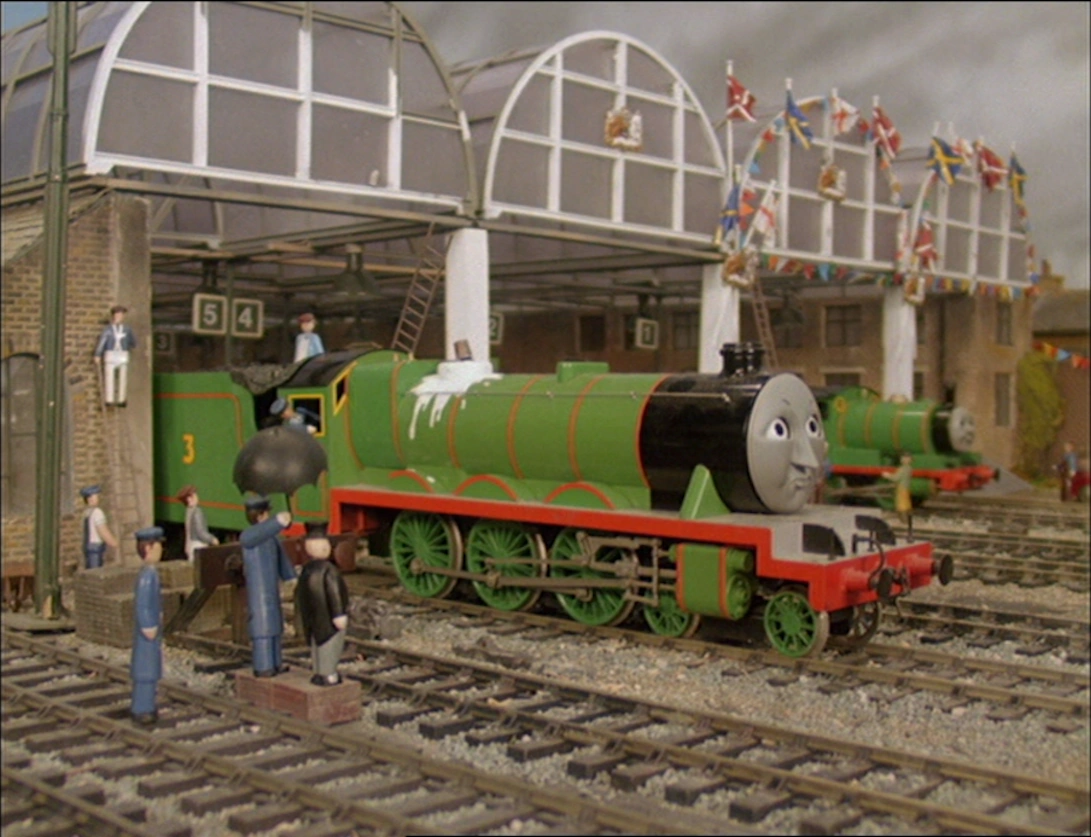
Edward steamed in, looking smart with flags and bright paint.
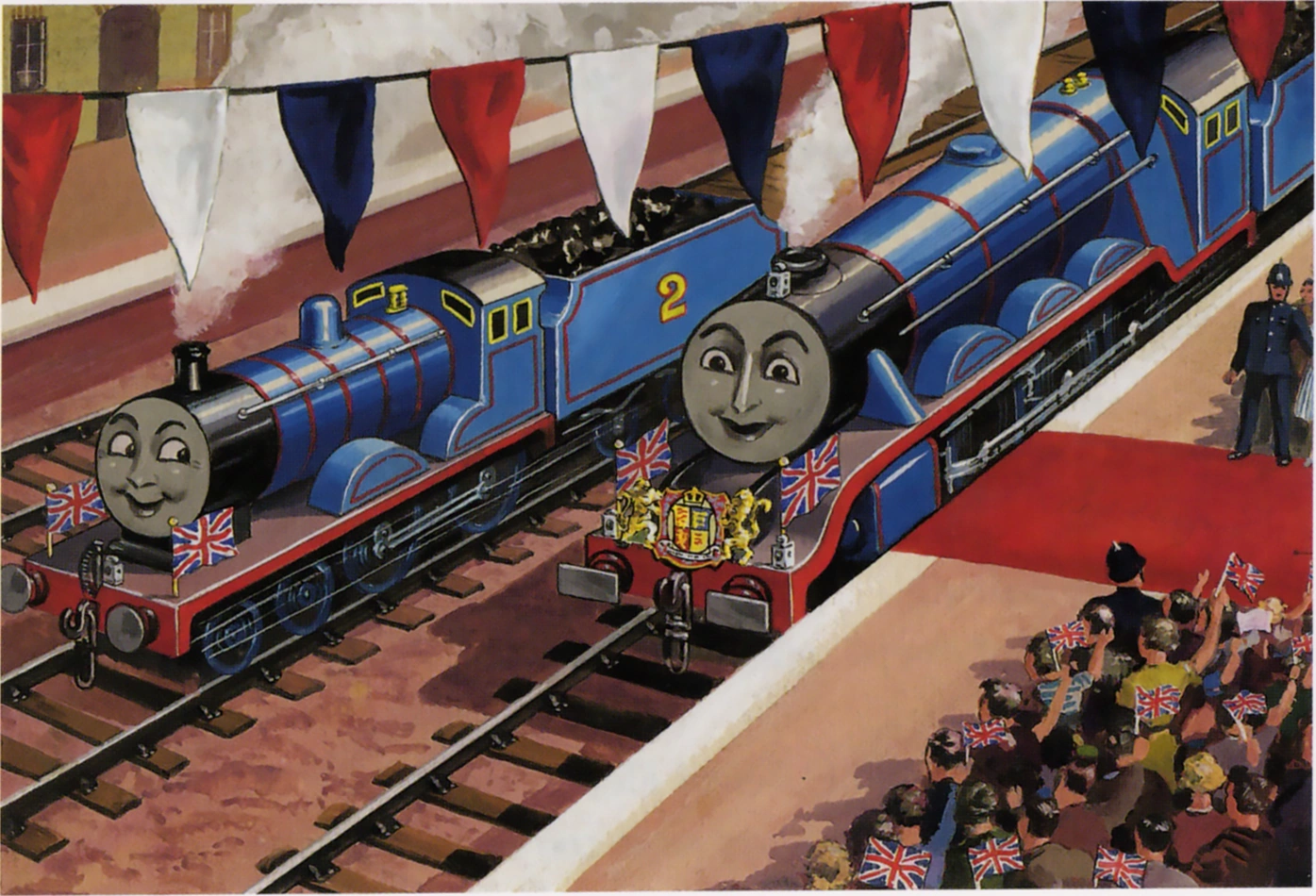
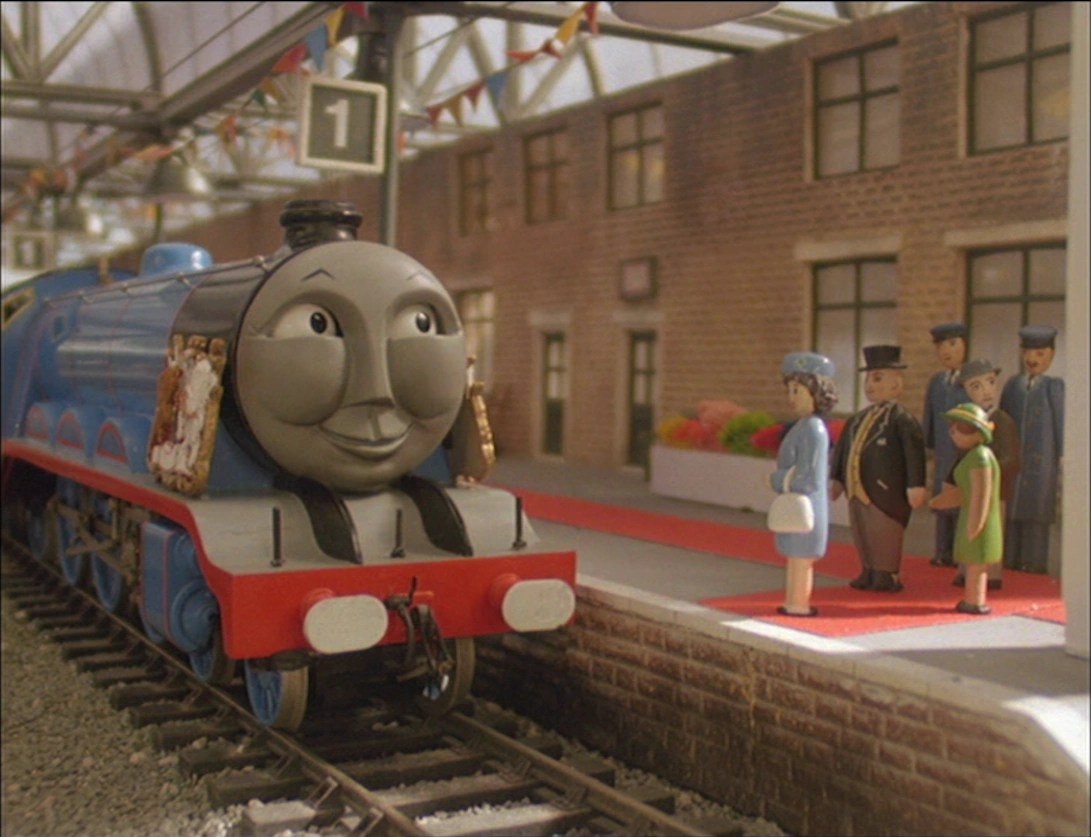
…the Queen’s train glided into the station. Gordon was spotless, and his brass shone. Like Edward, he was decorated with flags, but on his buffer beam he proudly carried the Royal Arms.

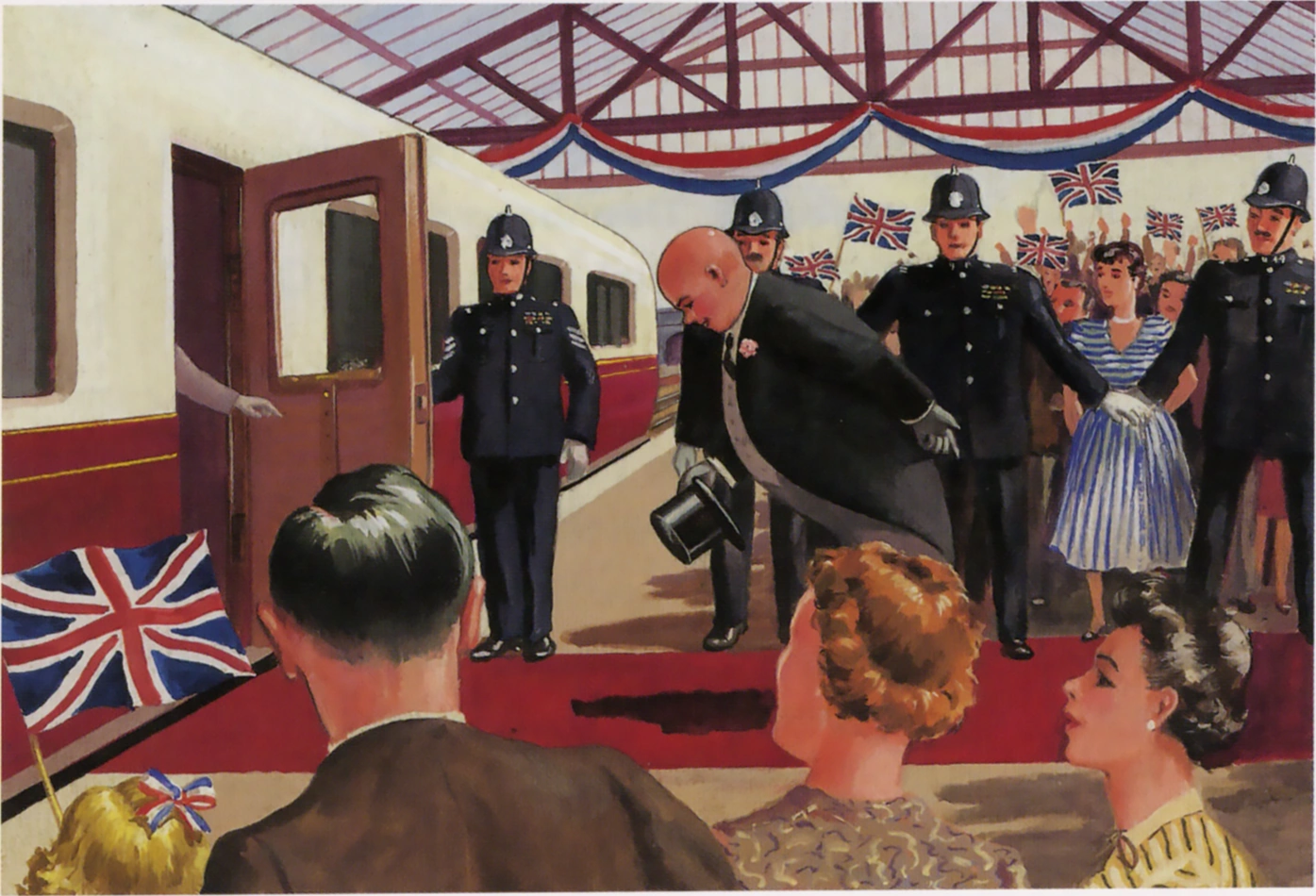
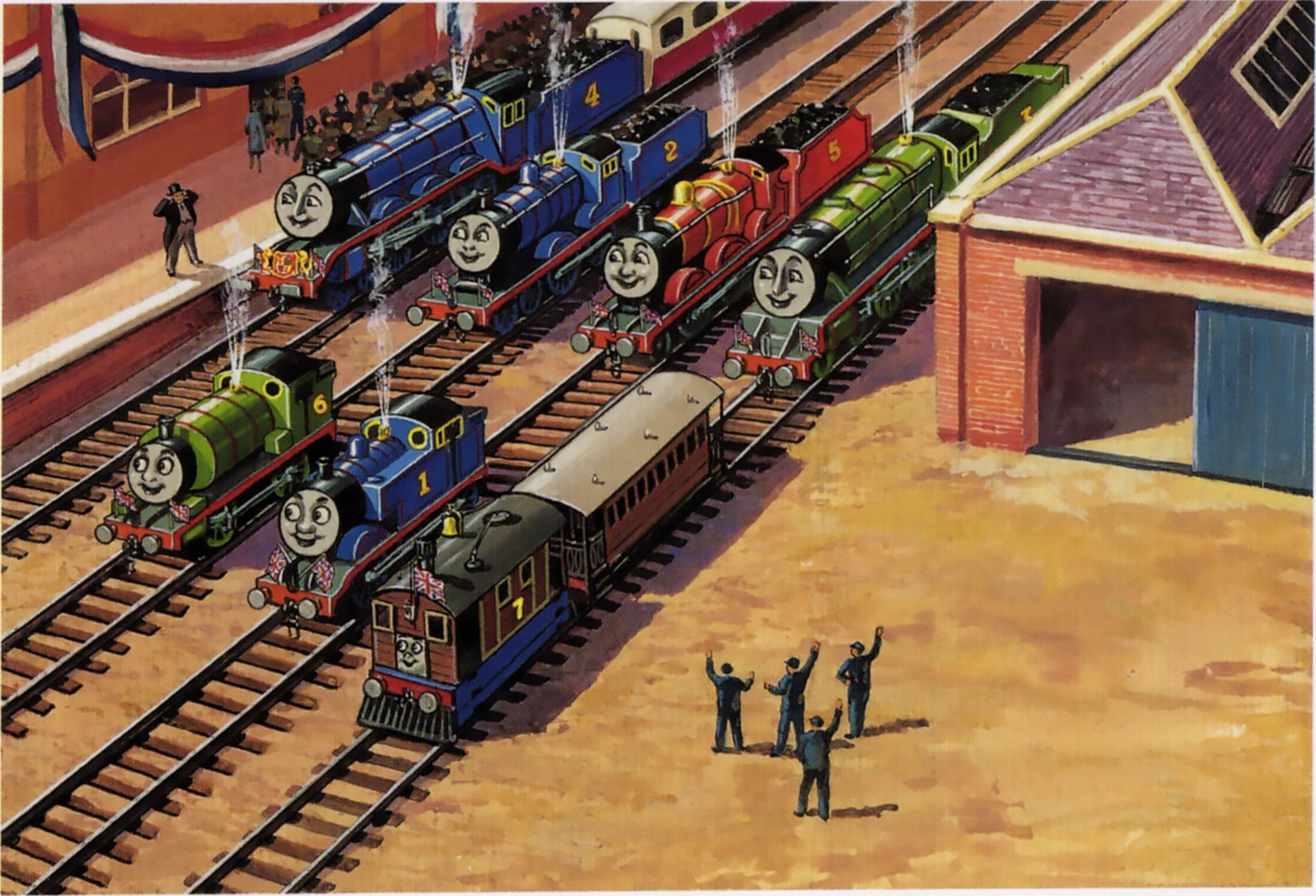
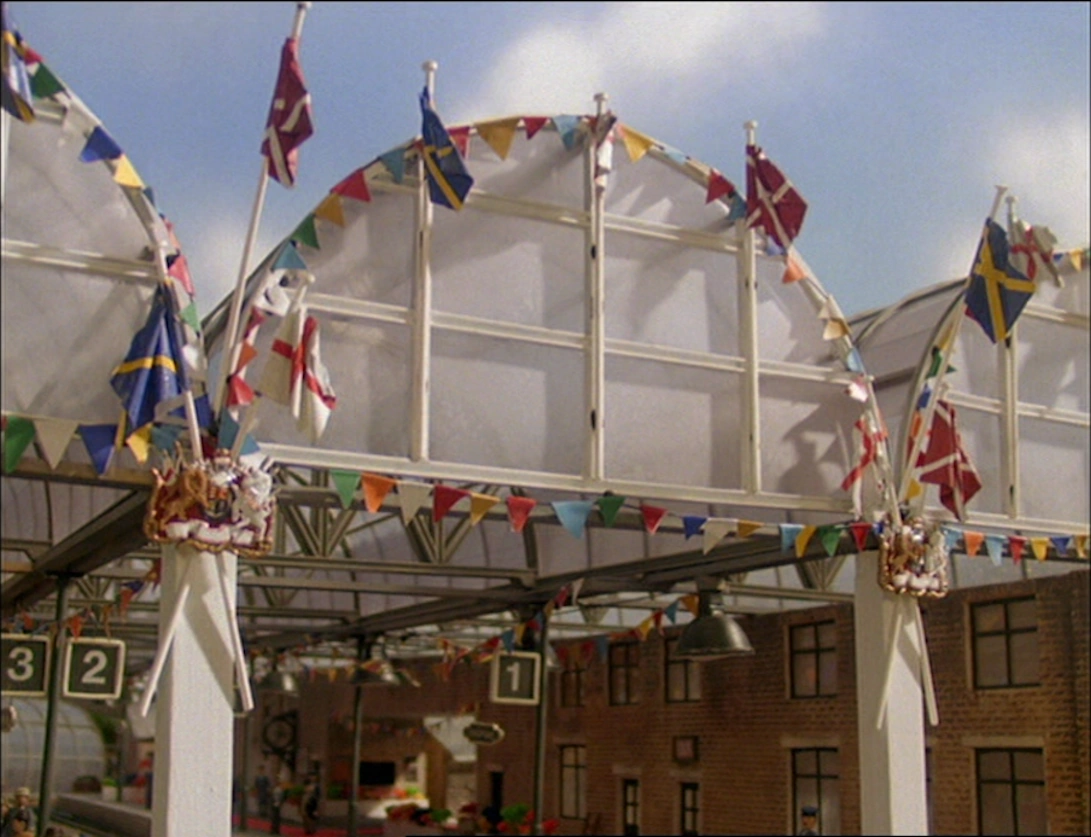
In the illustrations themselves we can see Union Flags galore, as well as a string of pennons in the national colours.There is also a tricolor drape across the frame of the station which runs the risk of inadvertently looking French or Dutch. Gordon’s carving of the royal arms is obviously the centrepiece here: It looks to have a lion Or as the supporter on both sides with the quarterings being first and fourth Or, second Azure third Gules. The actual charges on them cannot be deciphered but the crown looks like a reasonable approximation of either the Tudor crown or St Edward’s (the former likely still being in wide usage at this early stage of Elizabeth’s reign).

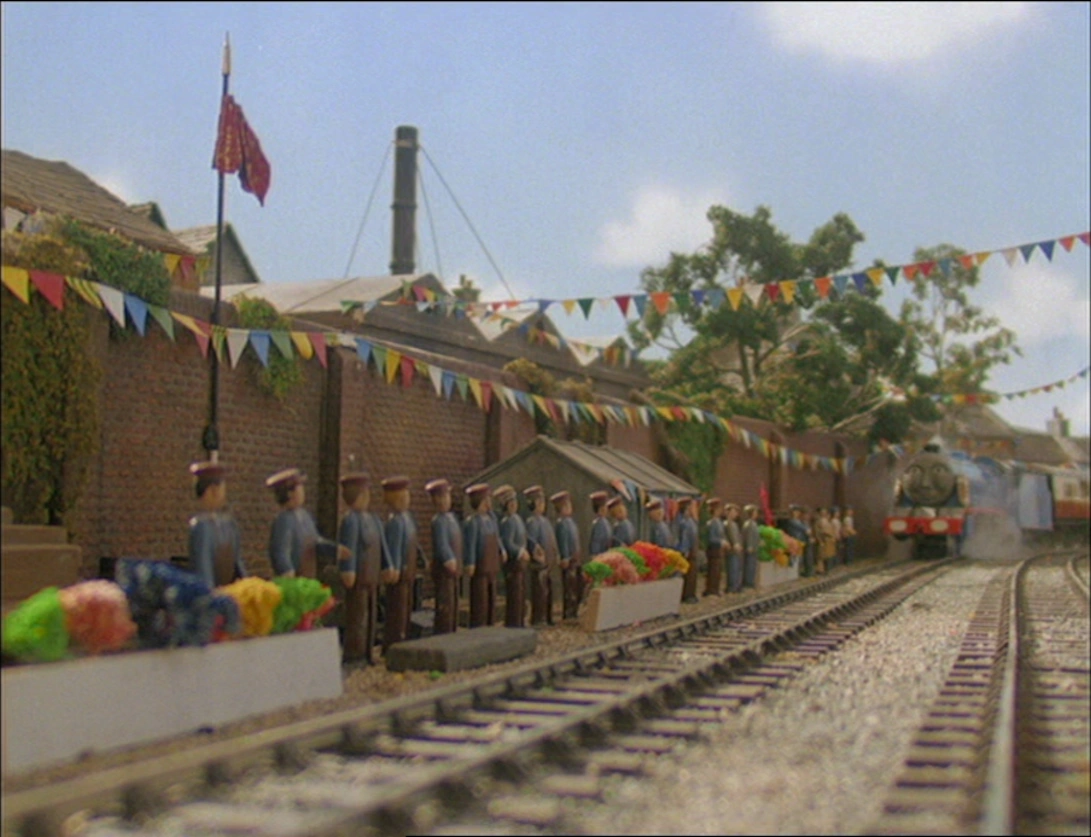
The television adaptation depicts things a little differently – Britt Allcroft at this stage was keen to present Sodor as a mystical fantasy land and dissociate it from the United Kingdom (although clearly not from the monarch), so the Union Flags are entirely absent and the bunting is generically technicoloured. We do, however, see multiple carvings of the royal arms – one leaning on either side of Gordon’s smokebox and at least four more attached to the station itself – originally on the glass of the canopy but later moving to the pillars and a nearby lamppost.

2m02s

2m43s

3m24s

4m20s

Also flying from the canopy are three flags of more definite designs, the first Argent a cross Gules, the second Azure a saltire Or and the third Murrey a saltire Argent. The first is obviously the flag of England but I don’t know the origin of the other two. We don’t get a close-up shot of the royal arms, but they are clearly supported by a golden lion and a white unicorn in the right arrangement. The shield itself looks to be blue in both the lower quarters but the upper quarters for England and Scotland are potentially correct. A red banner with indecipherable golden embroidering also flies outside the station as Gordon approaches.

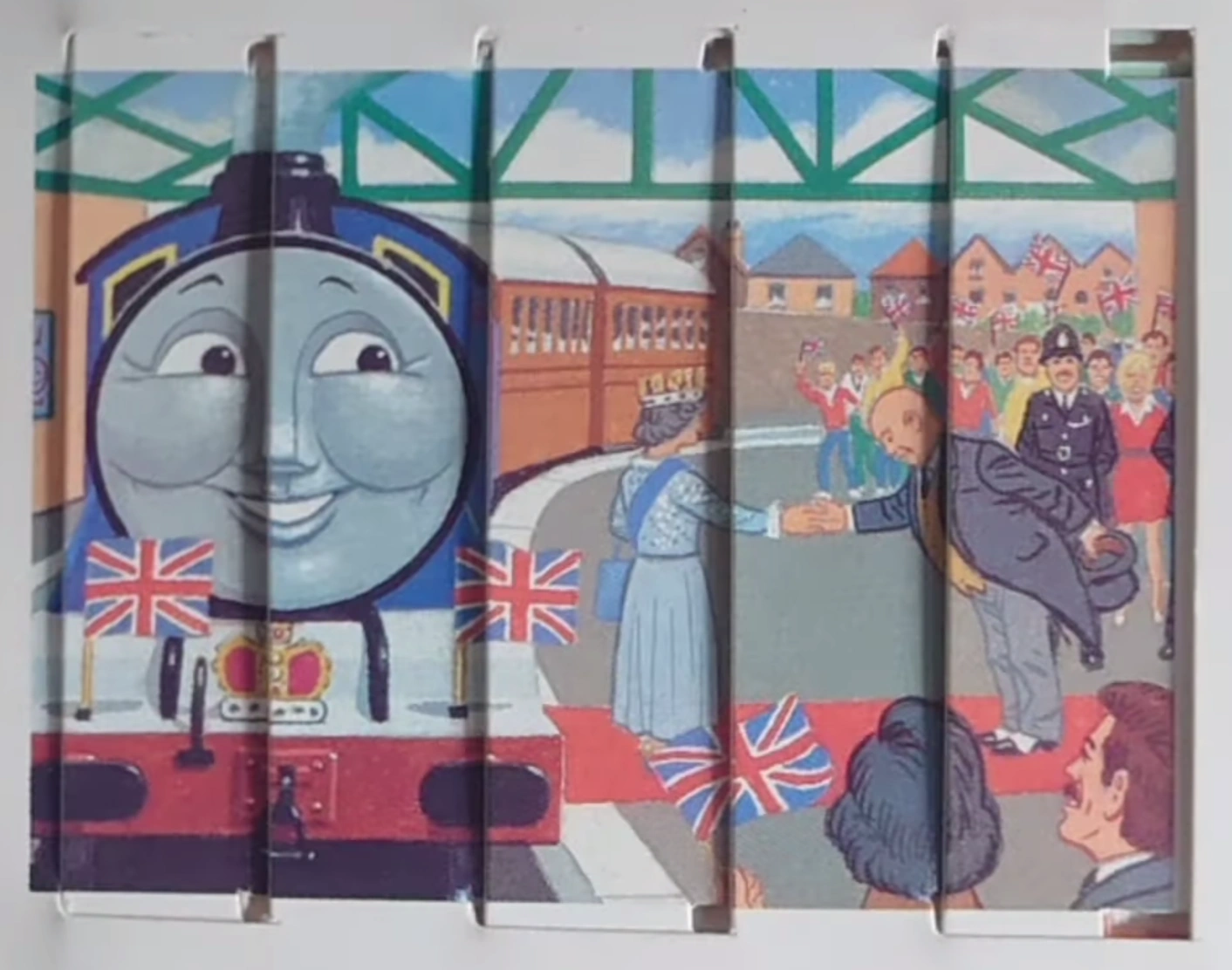
This, incidentally, was not the first adaptation of the source material, for the story was republished as part of a series of Changing Picture Books called Busy Engines in 1994. The illustrations here (by Arkadia Illustration Ltd.) show many Union Flags as in the original book but no royal arms. Gordon’s footplate instead carries a large facsimile of St Edward’s Crown (perhaps foreshadowing the Duchess of Loughborough).

The Queen’s own appearance also changes – in the 1953 book she is shown only as an arm emerging from her carriage, in the 1994 book wearing a golden circlet trimmed with ermine and a thick blue sash from her right shoulder (very formal for a day trip on a steam train) and in the 1995 episode in a light blue dress with matching hat. It has been suggested but never confirmed that the man in the brown jacket is meant to be her husband and the short woman in the green dress her mother, which might be the clue as to why the story title implies that more than one queen visited.

The Crown old and new

Early in the new reign, the College of Arms announced a new royal cypher for Charles III. A noted difference between this one and his mother’s (other than the name, of course) was the depiction of the crown.

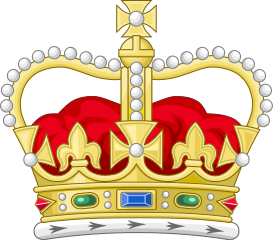
“St Edward’s” crown, favoured by Charles II to Victoria

Up to and including Victoria’s reign, depictions of the crown in heraldic drawings could be inconsistent. Edward VII ordered a standardised depiction with simple arches, which has come to be known as “the Tudor crown” due to its resemblance to one supposedly commissioned by Henry VII or VIII (and seen in royal portraits up to the Civil War). Elizabeth II later decided to change this to a version with depressed arches, better resembling St Edward’s crown which monarchs actually wear at coronations, and which seemed to be favoured in heraldic drawings before Victoria’s time. The timing of these decisions created a general misconception that the Tudor crown is always used when the monarch is male and St Edward’s when the monarch is female. Charles’s decision is likely to reinforce that belief.

The “Tudor” crown, as used by Edward VII-George VI

On the day of the coronation, the Canadian Heraldic Authority unveilved their own new version of the crown, intended to be more distinctly Canadian. The overall shape of the crown is still based on the Tudor version, but the jewels have been replaced by a wavy blue line, the uppermost cross by a snowflake (as already used in the Order of Canada) and the crosses around the rim by – of course – golden maple leaves. The removal of explicit Christian symbols may be due to the lack of an established church in Canada, though the omission of fleurs-de-lis is a little perplexing, given the constitutional importance of the country’s French heritage.

https://upload.wikimedia.org/wikipedia/commons/thumb/d/d4/Crown_of_Canada_2023.svg/248px-Crown_of_Canada_2023.svg.png

The Canadian crown, as used by Charles III

It is not clear on exactly what timescale the new crown is to supersede the old. Four days after the coronation the government of Canada released a revised Canadian passport design. Though many radical changes have been made, the 1952 depiction of the crown retains pride of place. It is also not certain whether this will apply to the parliamentary maces. Currently the mace of the House of Commons is modeled on the Tudor crown while that of the Senate is modeled on St Edward’s. This is reflected in the heraldic badge of the parliament, showing both maces in saltire behind the shield. Funnily enough, British passports, though updating the introductory text to reference His Britannic Majesty instead of Hers, also still seem to have the prior crown on their covers.

The shield itself (fleurs and all) remains unchanged. It was announced on the same day that the arms of Canada may be flown as a banner to represent Charles and all future sovereigns. Previously Elizabeth II’s flag had the royal arms of Canada with her personal EIIR cypher imposed on a hurt in the middle. The removal of the cypher brings Canada closer in line with British heraldic practice whereby the reigning monarch bears the arms of dominion undifferenced, as well as avoiding the hassle of redesigning the flag for each subsequent reign. It remains to be seen whether the heraldic banners of other members of the royal family will also omit their cyphers and keep just the cadency labels.

FURTHER READING