It Mitre Be Good

Bowyer (left) and Burgoin (right)

My assault on the Eventbrite buffet continues with Crosiers, and Mitres, and Tiaras, Oh My: A Gamboling Journey Through Ecclesiastical Heraldry by David Bowyer. The session was hosted by Jason Burgoin, president of the Toronto Branch of the Royal Canadian Heraldry Society.

Logging on was difficult: I had expected the meeting to begin at 7pm as listed on the advertisement but then it became apparent that this was Toronto time, so for attendees from the British Isles it would actually be taking place from midnight. The first few minutes were a little tense as the audio quality was very poor and an unknown person let out several primal-sounding screeches that left the rest of us confused. Burgoin, pleading that “We are not IT folks.” advised us that the bandwidth would be conserved and quality improved if everybody not presenting would turn off their cameras and microphones, and indeed there was some improvement. When Bowyer began his presentation he was swiftly interrupted by a notice that the screen share feature was not on.

Bowyer’s presentation eventually got moving. There were 119 PowerPoint slides, each showing an illustration of the titular ecclesiastical objects either in real life or represented in heraldry. He explained the history and symbolism of all the different kinds of hats that could be placed above a clergyman’s arms and the other embellishments that could be placed behind.

After nearly two hours the talk concluded and Burgoin resumed the screen to announce other upcoming events. He was conscious that many overseas viewers had been forced to stay up very late and was keen to answer any questions before they started logging off en masse. There was some time left over for idle chitchat, with one Englishwoman commenting that she had never used Eventbrite before signing up to this two months ago, and that it wasn’t a problem for Brits be up past midnight but she didn’t expect it to go on until 2am. I, in my first verbal interjection to any virtual conference, remarked that one of the advantages of the virtual format was the ability to attend from in bed. Lyon then told us how annoyed he was that the College of Arms in England had granted arms to Bishop Seabury of Connecticut* even though he had been consecrated in Aberdeen. He then announced that he had recently granted arms to the Principal Presbyterian Theological College. They had requested that their supporters be “one man, one woman, one white, one black, one in one academic gown, one in another academic gown” and that “when I described it in the blazon they decided it wasn’t gender-neutral enough so I had to go back and look at new language to be able to express what the students’ aspirations were for the supporters which I managed to do.” I then asked how long the blazon ended up being, expecting that the effort to account for every demographic permutation would have consumed reams of parchment. Instead he replied “Very short, I ended up just blazoning it “two human figures one wearing X one wearing Y representative of inclusion” and they can do what they like with it after that as far as I’m concerned.” and then departed saying he had to preach in the morning. I noted after he had gone that I now had an unusual claim to fame – very few can say that they spoke to Scotland’s chief herald from in bed at 2am. Another member said “We’ll just have to invite Garter to one of these.” and indeed I have often wondered when I will get to see any representatives of the English college on Zoom.

I recognised some of the names, faces and avatars from earlier conferences – such as Liam Devlin. Alexandra Fol, David G. Scott, Richard d’Apice, Brian Abel Ragen and Douglas Anderson were also among the names, though I cannot be certain that they were the ones I have linked.

There are plenty more heraldry conferences to come, as well as plenty on other topics – such as Lady Hale of Richmond discussing her 2019 prorogation judgement. All in good time.

*It wasn’t clear from context if he meant Seabury’s personal arms or the official arms of the diocese.

Henry and the Trackside Trees

Euan Roger (left) John Varley (right)

This week I got a little carried away with Eventbrite, and consequently this afternoon I attended two virtual talks in rapid succession – both on Teams rather than Zoom.

The first was All aboard a railway for people and wildlife by Women in Sustainable Rail. The session began less than formally with John Varley (Estate Director of Clinton Devon Estates) and Dr Neil Strong (Biodiversity Strategy Manager for Network Rail) getting carried away in a conversation about beavers. Varley spoke about the review he had done in 2018 for the Department of Transport, commissioned by then-minister Jo Johnson.  Varley concluded that the review was about nature and not just trees. He stated that in the 1950s there were fewer trees immediately bordering Britain’s railways than today, yet there was greater overall biodiversity. He noted that people tend to have a spiritual relationship with trees that is not extended to other plants. He delightedly recalled one day being given his own train in the North of England to go around inspecting the ground and interviewing the locals. He urged Network Rail to treat nature as an asset equal with its man-made infrastructure. The next speaker was Jane Dodds, Portfolio Head of Project at the Rail Safety & Standards Board. She told of the negative public perception surrounding Network Rail’s approach to managing vegetation around the lines. Strong then recounted the story of the implementation of the review. He showed photographs of a pilot scheme in Kent where a large row of trees was cut down from the side of the line, with the intention to plant a meadow there instead. He presented a long list of organisations with which he liaised over the course of the scheme. There was a question & answer session at the end which concluded in a similarly awkward fashion with the host offering to send slides and asking anyone still listening to email further questions. I couldn’t think of anything to ask (and wasn’t sure if my microphone worked) to ask so logged off sheepishly.

The second was event Readeption and Revenge: The final years of Henry VI by the National Archives. This detailed the later life of the last monarch from the House of Lancaster, though the lecturer Euan Roger included a brief overview of his early life, when he inherited the throne at aged nine months and was ruled by regents until coming of age. He founded Eton College and King’s College Cambridge, and was said to be overly generous with petitions, even granting the same estate to two people on the same day, to the point where his ministers began screening documents before the King was allowed to see them. The people perceived that senior officials were enriching themselves at the crown’s expense and that profligate royal pardons were undermining the rule of law. Henry’s reign took a serious turn for the worse in 1453 when his mental illness first appeared. He was barely lucid for much of the time, so unable to carry out duties of state. When he recovered he dedicated his life to religious pursuits instead of administrative or military ones. Roger noted, though, that reports of infirmity could have been exaggerated by those seeking political advantage. Without wishing to tell the whole story of the Wars of the Roses again, Henry was deposed by Edward IV in 1461. The new king eventually captured the old, but his imprisonment was relatively comfortable by the standards of the time. Contemporary documents referred to him as “Henry of Windsor” or “late by fact but not by right King of England”. One calls him “Henry Beaufort”, which Rogers suggested could be an attempt by the Yorkists to reframe his ancestry. A fall-out within Edward IV’s court saw the Duke of Clarence and Earl of Warwick depose him, restoring Henry to the throne as a puppet under their joint protection. The readeption only lasted six months before Edward IV had taken the throne again, and weeks later Henry died, officially of natural illness but more probably through blunt head injuries. Henry was buried at Chertsey Abbey, but in 1484 was relocated to St George’s Chapel, Windsor. For this lecture questions were asked in the chat box, but I waited too long to ask mine and so the session ran out of time to answer it.

EXTERNAL LINKS

I had wished to know why the Yorkists had killed Henry in such an obviously violent manner rather than poisoning him or denying him food, so that it would have been more plausible to claim that his death had been peaceful. Even Philippa Gregory’s version of events had him suffocated with pillows instead of beaten.

The Gunpowder Plotters – Gentlemen all

Earlier this evening I attended yet another virtual lecture, this time by Martin Goldstraw for the Yorkshire Heraldry Society. As the title implies, the lecture concerned the attempt by a group of Catholic conspirators on 5th November 1605 to thirty-six barrels of gunpowder beneath the Palace of Westminster while James I was performing the state opening of Parliament, then provoke a revolution which would install his daughter Elizabeth (later Queen consort of Bohemia) as a pro-papist successor to the throne.

Goldstraw spoke at length about each conspirator in turn, giving not just the blazon of each man’s armorial bearings but also background details of the lineages through which he acquired them. He had digitally illustrated a great many of their shields himself and for this was lauded by many in attendance, but confessed that there were many other artists of ability far beyond his. I tried to plug my own uploads for Wikimedia Commons though I’m not sure if anyone noticed.

After the presentation had finished there was the usual question & answer session. This included some joking about whether Bridlington (where Goldstraw’s sister lived) was part of Yorkshire or “North Humberside”, which prompted Malcolm Lobley (Honorary Treasurer) to talk about the East Yorkshire signs being put up by residents sick of the Humberside name. That the transition took place twenty-five years ago appeared to have slipped his mind.

The College of Arms usually publishes quarterly newsletters in January, April, July and October. Last year it was just January and October. When they didn’t publish an April edition this year either I asked if if this represented a permanent change, but the York Herald (Peter O’Donoghue) reassured me that the college intended to revert to normal after the COVID setbacks of passed. Now, perhaphs for the first time ever, a May edition has been released. Usually my primary interest when reading these is to find an exemplification and blazon for at least one person who has a Wikipedia page. The star in this latest edition is Sir Ciarán Devane, chief executive of the British Council since 2015. Also mentioned, though frustratingly not elaborated, were grants of arms to the Baroness Stuart of Edgbaston and Lord Justice Leveson.

The head of the college is the Garter Principal King of Arms, an office held since 1st April 2010 by Thomas Woodcock, who must retire upon his seventieth birthday tomorrow. His successor has not yet been named. The two assistant kings of arms have also retired recently, as noted in the newsletter.

EXTERNAL LINKS

Something Flagged Up

Regular readers know by now that I am a keen heraldist and am always on the lookout for new – hopefully free – material on the subject. Indeed, I am rapidly closing in on my nine hundredth armorial illustration for Wikimedia Commons. I have not written so much about vexillology, although of course the topics frequently intersect. Earlier this week I was trawling through EventBrite to see if there were any more events coming up soon by the Heraldry Society and instead found an advertisement for the fiftieth birthday of the Flag Institute.

After the standard Zoom introduction by Chairman John Hall, President Malcolm Farrow lectured on the development of the institute itself and of British flag culture more generally over the past fifty years. “The flag institute is instrumental in slowly changing the culture of Britain from a nation which rarely flew flags, to one in which flying flags is becoming the law.” An overview was given of how local and regional flags have proliferated over the past two decades, having rarely if ever seen use before.

Andrew Rosindell MP gave a speech about his efforts to change public attitudes surrounding flags, in particular his campaign – including a personal conversation with The Queen – to have the Union Flag flown over the Victoria Tower throughout the year instead of only when Parliament was sitting. He also mentioned the recent erection of three new flagpoles in New Palace Yard.

There was also a lengthy preview of the documentary Look Away, Look Away by Patrick O’Connor about last year’s change of state flag by Mississippi. Unfortunately the video feed cut out midway through and had to be restarted after some awkward fumbling.

Later a guest asked if the “All-party” Parliamentary Group on Flags & Heraldry could really be called that when six of the ten officers were Conservatives with Labour, SNP, DUP and Crossbench contributing just one each. Rosindell reassured as that there were plenty more within the rank-and-file, but sadly it was hard to make out his words as his audio feed was suddenly plagued by feedback noise. I think he said that anything so traditionalist in nature was bound to disproportionately attract those of a conservative outlook but that there were still plenty of others who recognised the importance of flags and/or held a deep patriotism.

Here it would be prudent to make a distinction between heraldry and vexillology: A coat of arms, even when displayed on a flag, must represent a person. That could be a natural person (Betty Boothroyd, Johnny Hon, Desmond Wilcox) or a legal one (The Association of British Neurologists, Guy’s Hospital, Totnes Town Council). Flags cover a much broader remit, and can represent such abstracts as religions, ethnicities, and political ideals. Another important difference is that arms are only properly borne by their owners (though heralds can wear their masters’ arms and badges can be worn by servants or soldiers) whereas flags unless specifically restricted can be flown by anyone. It is only natural that use of flags is much more prevalent than that of arms, and also that any particular flag is a lot more likely to cause a stir than any particular escutcheon.

There is a prevalent line of thought which deems too overt an invocation of British patriotism to be distasteful and thus, in itself, anti-British. Another related line says that nations more generally are not a meaningful affiliation and that flags – along with their natural companion, anthems – are a distraction for feeble minds. Attitudes toward our national insignia are quite sharply polarised by partisan affiliation and by demographic divides. HM Government has been conspicuously campaigning over recent months for greater use of the Union Flag in both public and private, resulting in praise from some quarters and mockery from others.

It doesn’t look as if there will be any more from the Flag Institute for some time, but the Heraldry Society will be back on 14th May with Crosses and Crossings – Huguenot Heraldry. That the banner heading shows a star looking to be by Sodacan and a coat of arms by Rs-nourse is intriguing by itself.

EXTERNAL LINKS

21st Century Scots Heraldry with Gordon Casely

Left: Casely finishes his speech. Right: Lyon models his hoodie.

Today I attended another Zoom lecture, this time arranged by the Heraldry Society of Scotland. This one went rather more smoothly than the one six months ago, though I still think that putting it on YouTube or similar would be more practical in the long run.

Our main speaker today was Gordon Casely, described as “a freelance journalist, heraldist and piper” by the host Edward Mallinson (the Society’s Social Secretary). His presentation was on what he perceived as a rise in grants of arms and interest in heraldry more generally. His anecdotal evidence for this was that he had attached a new hard drive to his overloaded computer for all of his hi-resolution heraldic images – a problem I too have encountered since last summer. More objective information was provided in the form of grant and matriculation records from the Lyon court in certain years: fourteen for the year 1720, four each for 1820 and 1821, then thirty in 1920. He described these as appalling output figures, which would shock any work study manager or time & motion engineer. Later in the session Dr Joseph Morrow – on the seventh anniversary of his appointment as Lord Lyon King of Arms – confirmed that in modern times the norm is between fifty and sixty-five new grants per year as well as matriculations, and that about 10% of the court’s business is from the commercial sector. He also said that in the last year, due to people having more time on their hands for such things, the court had seen a 50% increase in new petitions, though all of them had to be managed by electronic correspondence rather than meeting in person.

Casely told us of the records for time taken to complete an application, the longest being Banchory Community Council (thirty-seven years) and the shortest the Aberdeen Association of Civil Engineers (twelve minutes). He complimented the latter’s multilayered symbolism – simultaneously it represented a bridge over water, a stream, a cross section of a pipe half-filled with water, the sweep of a bend in a road, a ditch and a mound, as well as the letters ACE.  He was less happy with the arms of Gordon District Council, describing them as “how not to design a coat of arms, unless you’re in the Clydesdale Bank school of heraldry”.

He sang the praises of the late Anthony Maxwell, his longtime colleague. He drew attention to a commission Maxwell had done of the arms of Dr Tom Tait on the side of a carriage at a railway heritage centre in Derbyshire. He confirmed to “those anoraks who are watching” that it was the only British Rail Class 119 Diesel Multiple Unit in preservation. I did a little searching and can now say more specifically that it is DMCB 51073 on the Ecclesbourne Valley Railway.

After the main talk had ended there was an opportunity to ask questions, though on this occasion I couldn’t think of one – and indeed I wasn’t sure that my microphone was working. When the structured questions and answers concluded the session moved to informal chatter among the veteran members with occasional interjections by outsiders. This included showing some rather garish heraldic tattoos that they had seen, and then Lyon putting on a heraldic hoodie that he had received as a novelty gift.

A few more heraldic zoom lectures are scheduled for later this year, including a Canadian one that, for Brits, begins at midnight. That could prove an interesting experience!

Lecture on London Livery

No Wikipedia editors… yet.

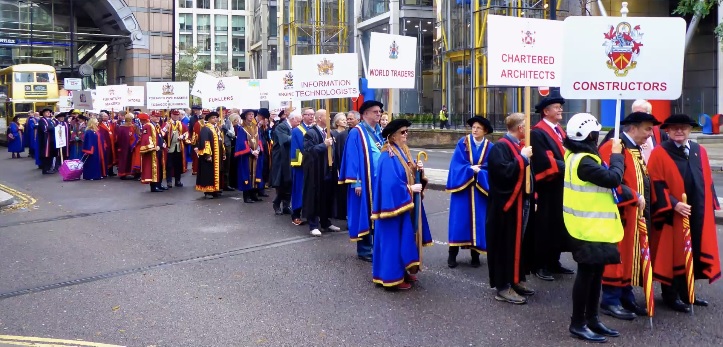
Today I attended a virtual lecture by The Heraldry Society – Arms of the City of London and its Livery Companies. The content was much as said on the tin. Obviously there wasn’t time to laboriously describe each company’s achievement in detail, but a broad overview was given of the city’s municipal and corporate heraldry with a few favourites picked out for closer inspection.

The meeting, as with so many these days, took place over Zoom. I found the arrangements less than satisfactory: We were emailed the link at 2pm, with the lecture itself running from 6pm to 7pm. Household and family distractions were hard to navigate. There was no function to pause or rewind, and the video was not recorded. The email told us:

Several persons have asked us if we are going to record the lecture. The answer to that is, we are sorry to report, a no. The Heraldry Society’s Council has discussed the implications of recording lectures at considerable length, evaluated all the pros and cons and taken an very well informed and conscious decision not to record lectures. This decision is unlikely to change as the topic has been thoroughly discussed and explored from all angles. The drawbacks outweigh the advantages at present.

That said, the Society has a plan to bring more content to the digital realm, so keep and eye open (and and ear tuned in) for news in the coming months.

Last month the society held a lecture on English Tudor Heraldic Glass in Philadelphia, which I missed completely due to these sub-optimal arrangements. Next month is one on Heraldry in the Battle of Barnett 1471 which I could well also end up missing depending on what circumstances prevail by then.

There were other problems – for the first couple of minutes there was no sound as the audio was not linked properly. Then someone drew a squiggle on the screen using the annotation function, which stayed there for nearly half of the lecture and was the subject of several digressions before the host figured out how to remove it. The chat section repeatedly flashed and popped up in an irritating manner.

The entire experience contrasts unfavourably with that provided by the Royal Armouries in their virtual lectures this summer. These were done on Microsoft Teams, a platform which proved far smoother and more versatile at least so far as concerned this format. As I have lamented before, heralds and heraldists are not prone to making their material easily available – presumably because they would then have no means of garnering funds – and so even in these times will go to lengths to keep access restricted by using conference calls and other semi-private environments instead of uploading the lecture to a video-sharing platform. Admittedly Lyon has made some moves this way in recent months but overall the picture in this regard is bleak.