A Note on the Honours Given to Prime Ministers

Cameron’s ennoblement got me thinking about the general trend of honours given to former prime ministers. Combing through Wikipedia, I have produced a list of them. To keep it from becoming overly long (and to avoid ambiguities about who counts as a prime minister), I have restricted it to honours conferred after the end of Victoria’s reign.

Although their legal status is much the same, British orders of chivalry can be politically divided into two categories: The Baronetage, Knights Bachelor, the Orders of the Bath, St Michael & St George, the Companions of Honour and the British Empire are appointed on the advice of government ministers, while the Royal Victorian Order, the Order of the Hospital of St John of Jerusalem and the Order of Merit are conferred at the monarch’s personal whim. The Orders of the Garter and Thistle fell into the former category in the early eighteenth century but were changed to the latter in 1946. Peerages both life and hereditary are presumed to be in the former category.

Here is a simplified list of who received which kind of honour and when. Honours which a person held before ascending to the premiership are not included:

HONOURS IN THE MONARCH’S GIFT

Garter (post-’46)

  • Churchill in 1953 (while still prime minister, in advance of the coronation)
  • Attlee in 1956 (resigned as Labour leader the previous year)
  • Wilson in 1976 (three weeks after leaving office)
  • Callaghan in 1987 (three weeks before stepping down from the Commons)
  • Thatcher in 1995
  • Major in 2005
  • Blair in 2021 (New Year’s Eve)

Merit

  • Balfour in 1916
  • Lloyd George in 1919 (while still prime minister)
  • Churchill in 1946 (while opposition leader)
  • Attlee in 1951 (while opposition leader, ten days after premiership’s end)
  • Macmillan in 1976
  • Thatcher in 1990 (nine days after premiership’s end)

St John

  • Thatcher in 1991 (Dame of Justice)

HONOURS ON MINISTERS’ ADVICE

Garter (pre-’46)

  • Balfour in 1922 (backbench MP) (adv. Lloyd George)
  • Asquith in 1925 (adv. Baldwin)
  • Baldwin in 1937 (adv. Chamberlain) (immediately after resignation)

Companion of Honour

  • Attlee in 1945 (adv. Churchill) (shortly after resigning as Deputy PM)
  • Major in 1998 (adv. Blair)

Hereditary peerage

  • Balfour in 1922 (adv. Lloyd George)
  • Asquith in 1925 (adv. Baldwin)
  • Baldwin in 1937 (adv. Chamberlain)
  • Lloyd George in 1945 (adv. Churchill)
  • Attlee in 1955 (adv. Churchill)
  • Eden in 1961 (adv. Macmillan)
  • Macmillan in (adv. Thatcher)

Life peerage

  • Douglas-Home in 1974 (adv. Wilson)
  • Wilson in 1983 (adv. Thatcher) (dissolution honours)
  • Callaghan in 1987 (adv. Thatcher) (dissolution honours)
  • Thatcher in 1992 (adv. Major) (dissolution honours)
  • Cameron in 2023 (adv. Sunak)

It may also be worth considering honours given to the spouses of prime ministers, whether for achievements in their own right or by right of marriage.

  • Margaret Lloyd George: GBE in 1918 (adv. her husband)
  • Lucy Baldwin: GBE and DStJ in 1937 (former adv. Chamberlain)
  • Clementine Churchill: GBE in 1946 (adv. Attlee), life peer in 1965 (adv. Wilson)
  • Dorothy Macmillan: GBE in 1964 (adv. Douglas-Home)
  • Denis Thatcher: TD in 1982, baronet in 1990 (adv. Major), CStJ in 1991.
  • Norma Major: DBE in 1999 (adv. Blair)
  • Cherie Booth/Blair: CBE in 2013 (adv. Cameron)
  • Philip May: Knight bachelor in 2020 (adv. Johnson)

Unless I’ve missed any, no current or former prime minister (or their spouse) has, from 1901 onward, been appointed to the Order of the Bath, the Order of St Michael and St George, the Order of the Thistle or the Royal Victorian Order.

UPDATE (August 2024)

Theresa May has received a life peerage, for which she was nominated by Rishi Sunak in the dissolution honours last month.

FURTHER READING

Chipping off the old block

One week after the announcement of his appointment, David Cameron took his seat in the House of Lords today. Although there is still no update on the London Gazette (their website tends to be quite slow in these matters), he was shown Parliament.UK as a member of the house from Friday and today the reading clerk confirmed he had been created Baron Cameron of Chipping Norton, of Chipping Norton in the County of Oxfordshire on 17th November.

Cameron is the fifth former prime minister to be ennobled in pursuance of the Life Peerages Act 1958 – the others being the Lord Home of the Hirsel (1974), the Lord Wilson of Rievaulx (1983), the Lord Callaghan of Cardiff (1987) and the Baroness Thatcher (1992).

Of those, only Thatcher had her introduction ceremony recorded for television. Hers was the older style featuring bicorne hats, bowing, and the reading of the writ of summons after the letters patent, all of which were omitted from 1997 onwards. Cameron’s is the post-2020 version which retains some changes to the choreography meant to comply with COVID-era social distancing requirements. His supporters, the Lord True and the Baroness Williams of Trafford, are both incumbent ministers (Leader of the House and Chief Whip respectively) and both were appointed to the upper house during Cameron’s premiership. Thatcher, in her maiden speech, remarked that some 214 then-members of the house were her own appointments. I don’t know quite what the present figure is for Cameron (though I do remember the late Lady Boothroyd complaining in 2015 about it being too high).

Cameron’s choice of territorial designation is slightly surprising – most would likely have expected him to choose Witney, his old constituency, rather than Chipping Norton, a fairly small town within it. Simply being “The Lord Cameron” without further specification would not have been allowed as there are already several other life peers and a Scottish clan by that surname. The prior example of a two-word location which comes most prominently to mind (at least as far as senior ministers are concerned) is the Lord Butler of Saffron Walden – though that had been Rab’s constituency name as well.

Curiously, it is not clear yet if Cameron has been properly appointed to the office of Secretary of State for Foreign, Commonwealth & Development Affairs as the latest Privy Council minutes do not mention him.

UPDATE (23rd November)

Cameron’s peerage was Gazetted on Tuesday, and his ministerial appointment was formalised on Wednesday. He also made his maiden speech on Tuesday.

I Might Have Known

Three years ago I had a stab at designing a coat of arms for the Reverend Wilbert Vere Awdry, believing that he never had one officially granted or descended to him. Now, however, I discover that he most likely did.

When searching through the Internet Archive I found a digital copy of The Thomas The Tank Engine Man, a biography of Awdry by Brian Sibley (who also edited The Fall of Númenor and wrote several companion books about Tolkien’s legendarium and its cinematic adaptations).

The early pages recount some of the vicar’s family history, including his uncle William and grandfather Sir John. Sir John Wither Awdry spent three years as Chief Justice of the Supreme Court of Judicature at Bombay and William Awdry spent twelve as Bishop of South Tokyo. I quickly found that these two men already had their own Wikipedia biographies, both of which mentioned their kinship to Wilbert. If only there had been links in the other direction I might have discovered this information much earlier.

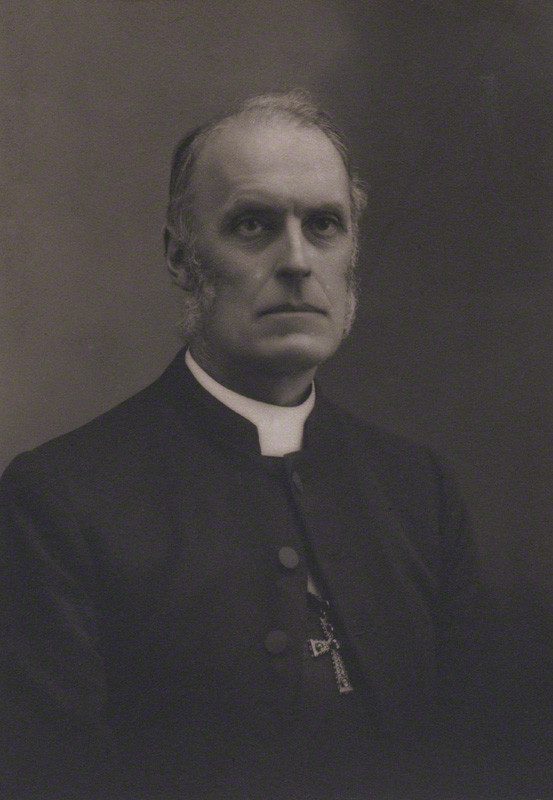
William, August 1900

Unfortunately Debrett’s Peerage would be of no use here as it tends to list only the corporate and not the personal arms of the Lords Spiritual, and even then only those diocesan bishops within the United Kingdom – Awdry meeting neither condition. Happily, Sir John did have an entry in Burke’s Landed Gentry 1862, which lists his dynastic arms of unspecified antiquity as Argent three cinquefoils Or on a bend Azure cotised of the same with crest Out of a ducal coronet a lion’s head Azure and motto Nil Sine Deo.

William and Wilbert being legitimate agnatic descendants of Sir John, it naturally follows that whatever armorial ensigns he possessed, they possessed also. It is curious, therefore, to have found so little record of him or his son Christopher actually using them. This is amplified by the fact that the fact that he and his brother George clearly had an active interest in and working knowledge of heraldic blazon, which Sibley’s book even notes:

George…was exploring matters of heraldry and coats of arms ‘A real beauty occured to me for Tidmouth,’ he wrote to his brother, ‘It ought to be rather elaborate, as it is relatively new, and the simple ones are doubtless allotted already.’ The proposed arms for Tidmouth were to feature a smith’s hammer and tongs, a lymphad (a heraldic ship), three herrings and a wheel. ‘This,’ George explained, ‘covers all Tidmouth’s titles to importance: shipping, transport, fishing, engineering…’

I did, of course, illustrate Tidmouth’s arms two years ago as well.

Sir David’s Day

Just over two years have passed since the murder of Sir David Amess, MP for the town (now city) of Southend-on-Sea. It was announced at an intermediate point that he would have his shield of arms fixed to the wall of the Commons chamber, in the manner of other murdered MPs – the most recent example being Jo Cox.

Now, at long last, the shield has been revealed.

Sir David was presumably non-armigerous during his lifetime, with this being a posthumous grant arranged through his widow Julia. So far no news source that I can find (and certainly not the College of Arms) has published the blazon, which I would guess is something like Azure on a chief conjoined to a pale between two talbots rampant Or five roses Gules barbed and seeded Proper. According to press releases the roses represent his five children as well as his gardening hobbies while the talbots represent his animal welfare campaigns and his time at Bournemouth University.

Most intriguing is the motto of His Life Remains, which Julia chose because “wherever I go, I am reminded of him in some way: someone he has helped, a charity he has supported and people whose lives he has touched”. It is unusual for a heraldic motto (unless referring to God, of course) to use third-person language and this decision wouldn’t really make sense except in the concept of a memorial for the deceased.

On an aesthetic level I would rate this achievement higher than Cox’s, due to the superior tincture contrast, although the arrangement of elements is a little unsatisfactory and requires a slightly more rectangular shield shape.

The details of his crest remain unknown.

Everyone on the Same Page

Minutes of His Majesty’s Most Honourable Privy Council usually make for quite dry reading. Despite the speculations of conspiracy theorists, and apart from grand occasions such as the accession of a new king, plenary sessions are mainly filled by the appointments of new officeholders (especially in recent years, as ministerial churn as grown), amendments to charters of public bodies, closures of overcrowded graveyards, and the designs of commemorative coin series.

The formatting is similarly dull, being little but a list of links to PDFs, in which each order in council has its own A4 page with the main text in what I presume is Times New Roman with St Edward’s Crown (surrounded by the national floral badges) in the header. Beginning each document is a contents list typed in a sans serif font (most likely Arial).

Last month, though, a small change was seen – the individual orders in council now have page numbers in their footers (in the sans serif font, and clearly not actually part of the order) while the contents pages now have hyperlinks in their right margins. A new front page has also been added, with the Privy Council Office prominently featured. The PCO’s logo is slightly different to that used by most other government departments – it features the royal shield encircled by the Garter and ensigned by the crown, but without supporters or motto. An interesting thing to note here is that although this stylistic modernisation debuted more than a year into the New Carolean era, the depiction used on the front page and in the orders themselves is still St Edward’s Crown and not the Tudor Crown as the current monarch apparently prefers.

EXTERNAL LINK

Some News At Last!

Long-time readers will be familiar with my frustrations in discovering the heraldic achievements of former ministers and recent Garter companions Lady Amos and Sir Tony Blair. Now, at last, some progress is being made.

My guess at Amos’s lozenge.

Almost a month ago the Right Reverend Graham Usher, Bishop of Norwich, Tweeted a photograph of the inside of St George’s Chapel. Among the familiar Garter banners I noticed one I had not seen before – per saltire Gules and Or, two of the sections charged with counterchanged circular devices. Presumably the other two sections had them as well, but Sir Thomas Dunne’s banner obscured them. I wasn’t entirely sure what the symbols were – Jukudlick, another Wikipedian, reckoned they were gyroscopes. Without any specific, reliable matching of the arms to the person I was not prepared to add the graphic to her page.

Today’s update comes from the website of Ian G. Brennan, the man who actually constructs the wooden models of knights’ crests to go above their stalls. He includes a photographic gallery of all the crests he has made… and now Blair’s is among them. I had not been paying much attention to his website as it did not look to be frequently updated – indeed the overall design looks to be stuck around the middle of Blair’s premiership. Judging by what I saw when checking the Wayback Machine, this update happened within the last ten days.

No blazon is given, but my best guess for Blair’s crest is a mute swan’s head erased Proper holding in the beak a rose Gules seeded Or barbed slipped and leaved Vert.

The torse is depicted as Azure, Or and Gules, which gives some hints as to the principal tinctures of the shield. The red rose is almost certainly a reference to his thirteen-year leadership of the Labour Party.


The website also has a photograph of Amos’s crest. Whether this actually is a crest or just a badge is yet to be seen – I note that the photograph is framed so as not to reveal the presence or absence of a torse. Here the round object looks more clearly like a gyroscope, while the beast holding it is, I would say, a panther sejant guardant Proper. As always with heraldry, you can’t be sure until you’ve read the blazon.

This year’s Garter ceremony was held on Monday. Blair and Amos attended for the second time, as did first-timers Lady Ashton of Upholland and Lord Patten of Barnes. Ashton is already King of Arms for the Order of St Michael and St George (even attending the coronation in that capacity), yet her own bearings are not recorded in any issue of Debrett’s I’ve seen. Patten has no record either. Based on this, I don’t expect any revelation until 2025.

The Matter of Sir Martin

Yesterday the London Gazette published the list of British honours conferred to commemorate the sovereign’s official birthday. Among those appointed as Knights Bachelor was the writer and academic Martin Amis. This announcement was notable for two reasons, the most prominent being that he died almost a month ago.

Britain doesn’t generally do posthumous honours, but occasionally people who have accepted them die before the official announcement and the chancery (or Cabinet Office) decides to keep their names on the list.

In this case the supplement specifies “To be dated 18 May 2023” and from what has been reported so far, officials contacted Amis early last month then rushed through the administrative process to confer the award before he died, but asked his family to keep it secret until now. We can presume that no physical accolade was given, since he was in Florida at the time.

The second reason this raises eyebrows is that Amis never seemed like the sort of person who would desire a knighthood – in much the same way that it would feel strange for George Orwell or Christopher Hitchens to get one. He even said outright in a 2011 interview that he would never accept any honour from the crown. It is not clear what caused this apparent deathbed conversion, and I have seen comments from some people speculating what mental state he was in during his final days.

Obviously Sir Martin himself will have no opportunity to enjoy the trappings of knighthood, but his widow and daughters will, and the backdating means that they will have precedence above the wives and children of other Knights Bachelor appointed yesterday, or indeed in the Resignation Honours last week.

Arms, Flags, Paint Pots & Queens

Having written a few times now about heraldry as featured in The Railway Series, as well as significant events in that franchise, I felt that now would be a good time to do a spotlight on the most particularly heraldry-heavy story.

Today is the seventieth anniversary of the UK publication of Gordon the Big Engine, the eighth book in the series, came just fifteen days after Elizabeth II’s coronation. I will, of course be focusing on the fourth chapter in the book (and its 1995 television adaptation), in which the monarch herself visits the big station.

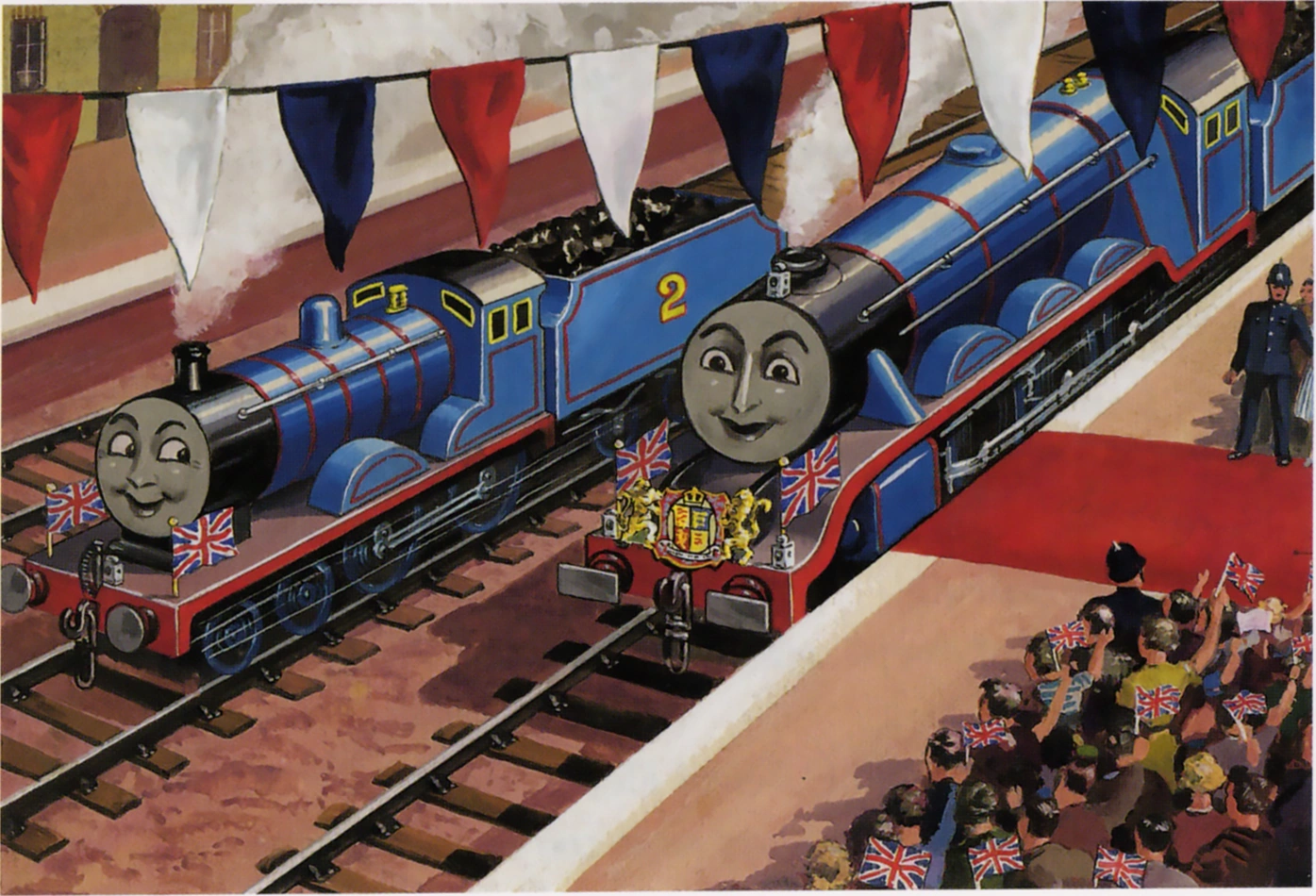
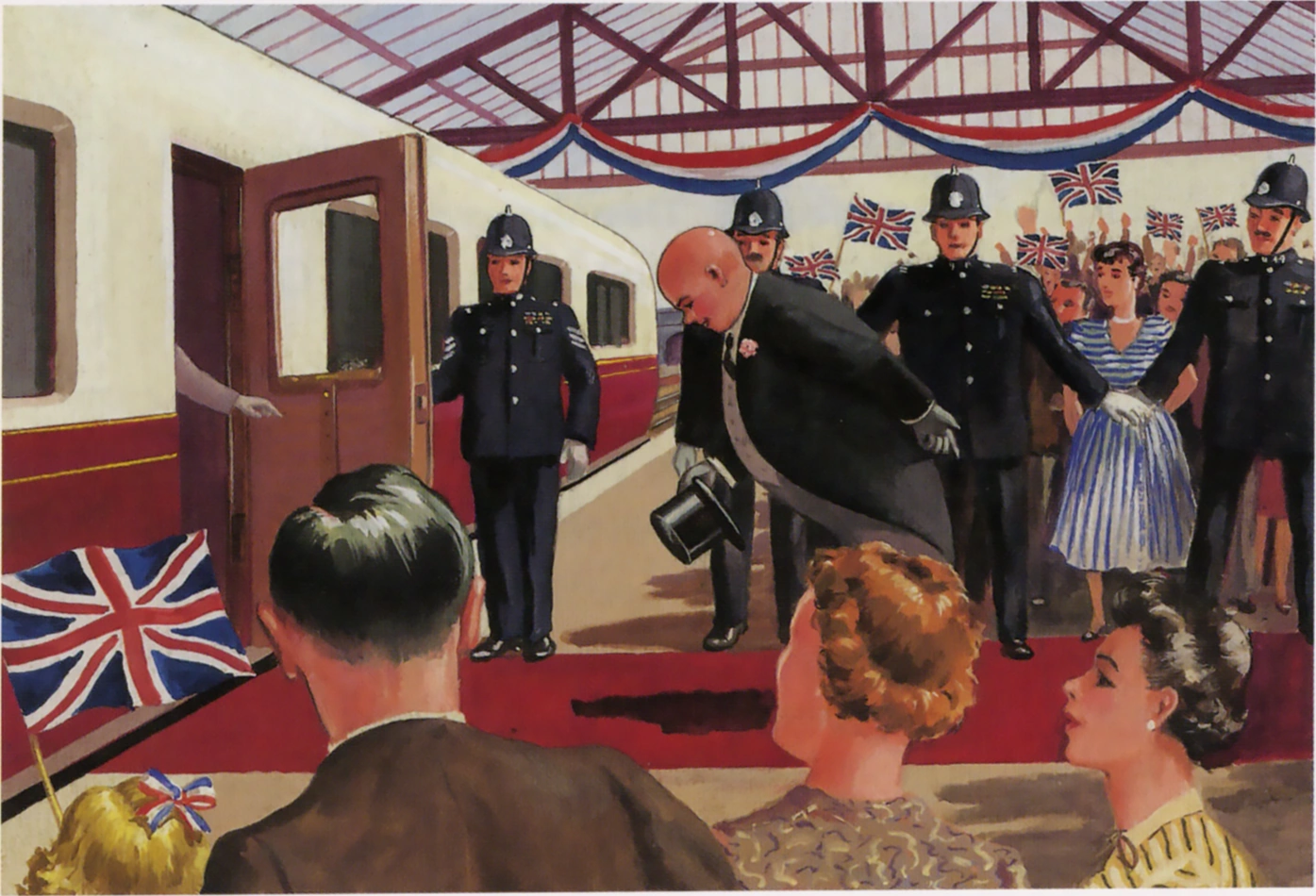
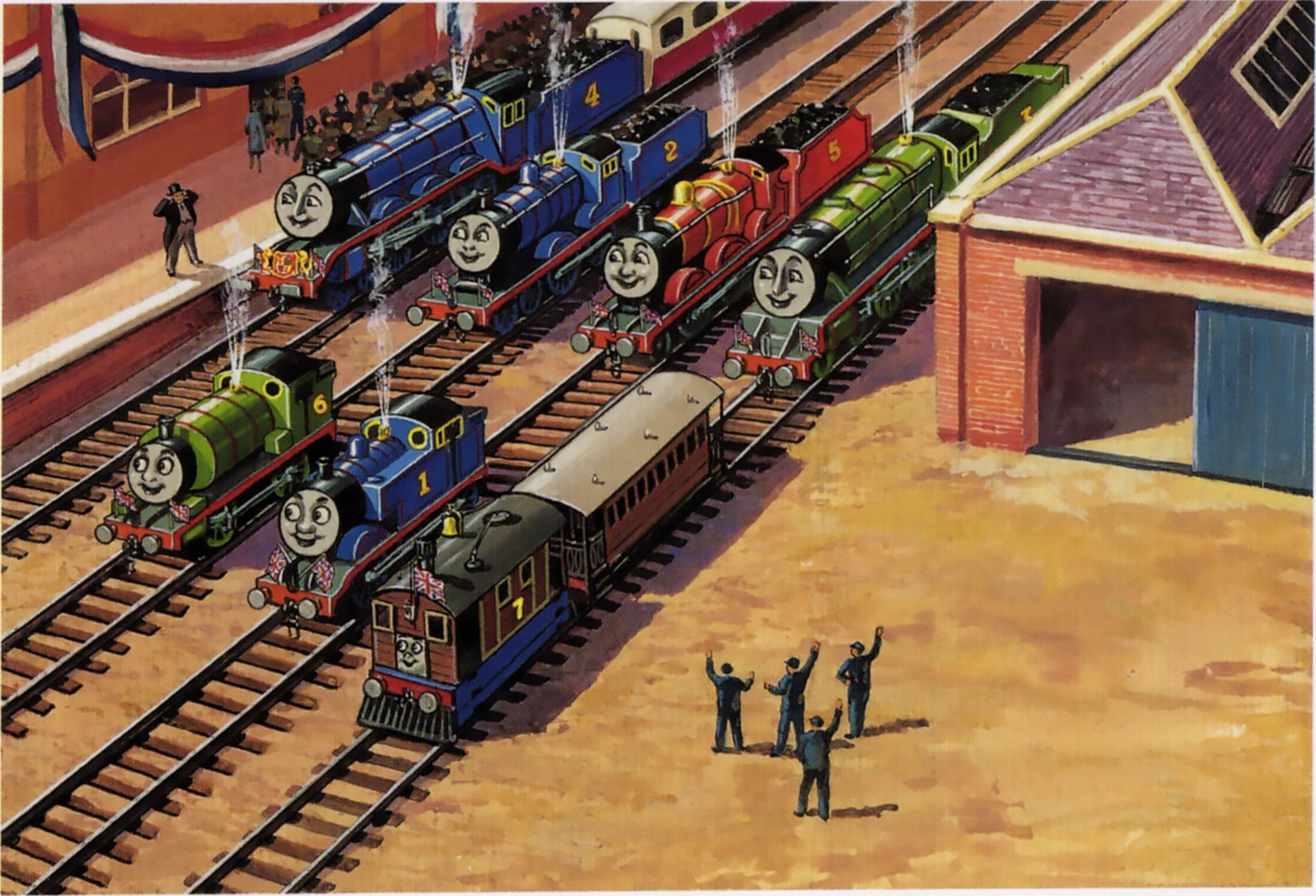
The written story has seven illustrations by Clarence Reginald Dalby, of which only the last three are relevant here. The television episode obviously has a large number of potential screenshots. The images used below are linked from the bountiful gallery on ttte.fandom.com and are labelled by their timestamp within the episode (not counting opening credits) in case of future link rot.

5th illustration

6th illustration

7th illustration

The text of the story says:

Edward steamed in, looking smart with flags and bright paint.
…the Queen’s train glided into the station. Gordon was spotless, and his brass shone. Like Edward, he was decorated with flags, but on his buffer beam he proudly carried the Royal Arms.

In the illustrations themselves we can see Union Flags galore, as well as a string of pennons in the national colours.There is also a tricolor drape across the frame of the station which runs the risk of inadvertently looking French or Dutch. Gordon’s carving of the royal arms is obviously the centrepiece here: It looks to have a lion Or as the supporter on both sides with the quarterings being first and fourth Or, second Azure third Gules. The actual charges on them cannot be deciphered but the crown looks like a reasonable approximation of either the Tudor crown or St Edward’s (the former likely still being in wide usage at this early stage of Elizabeth’s reign).

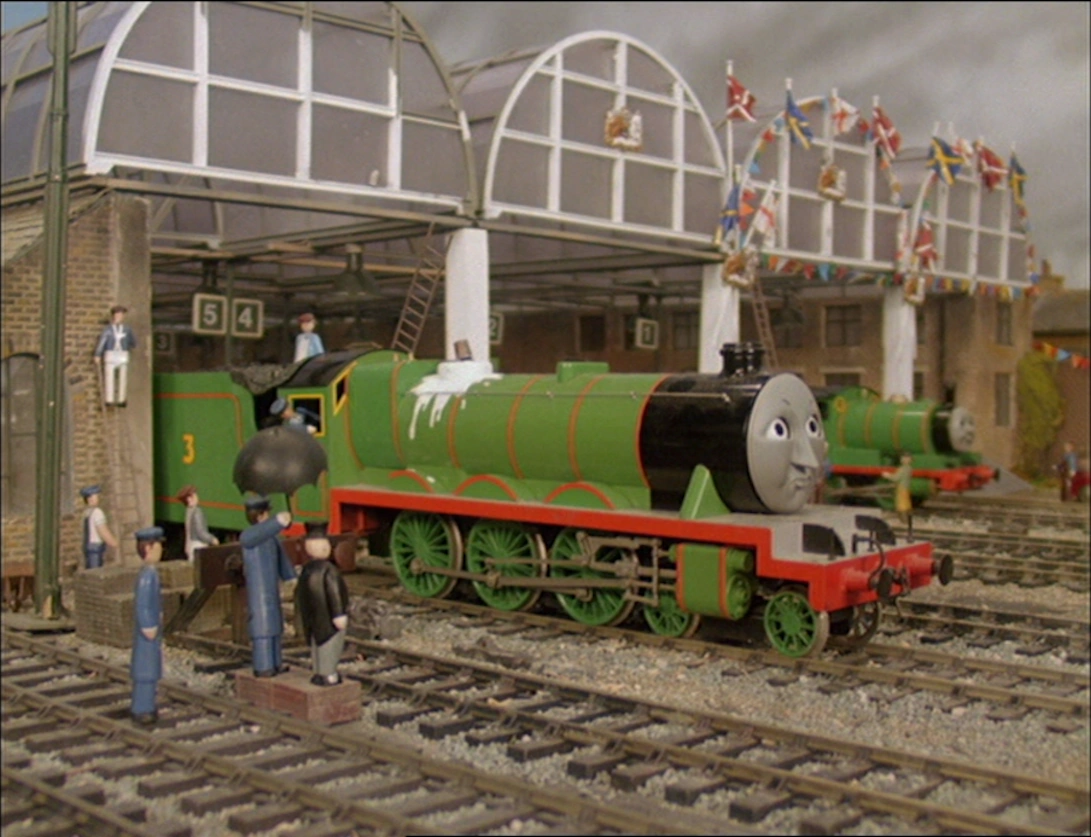
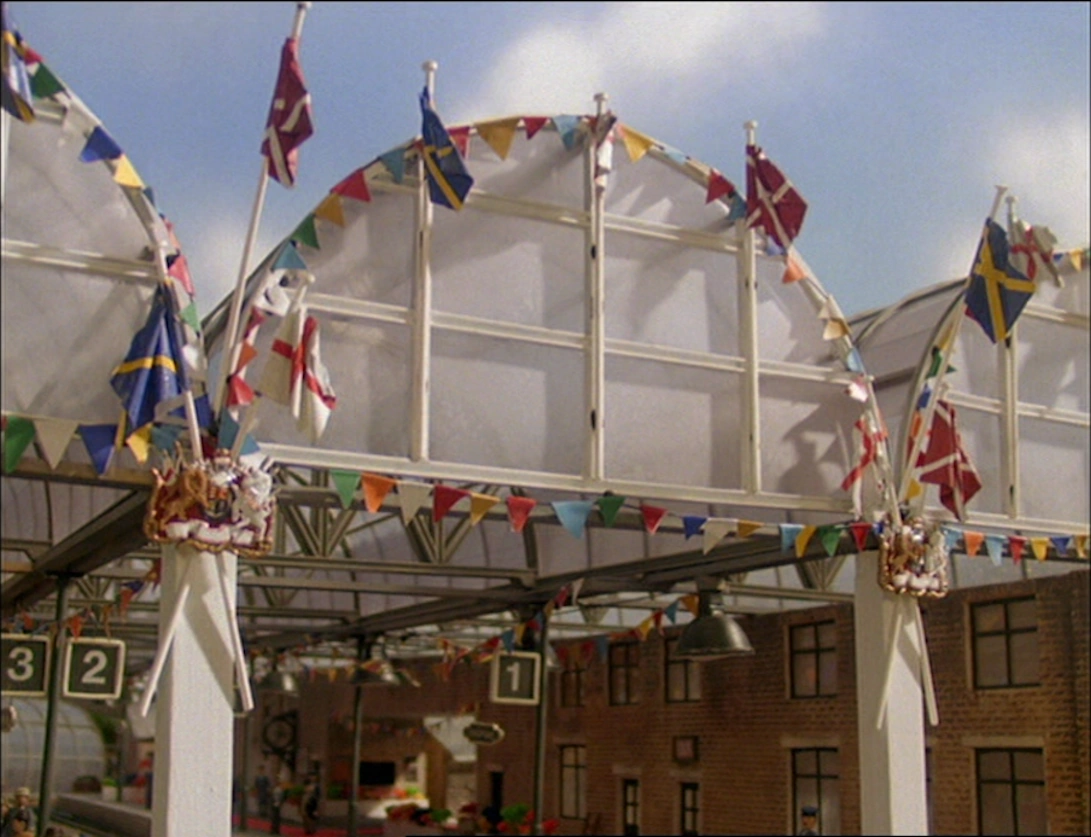
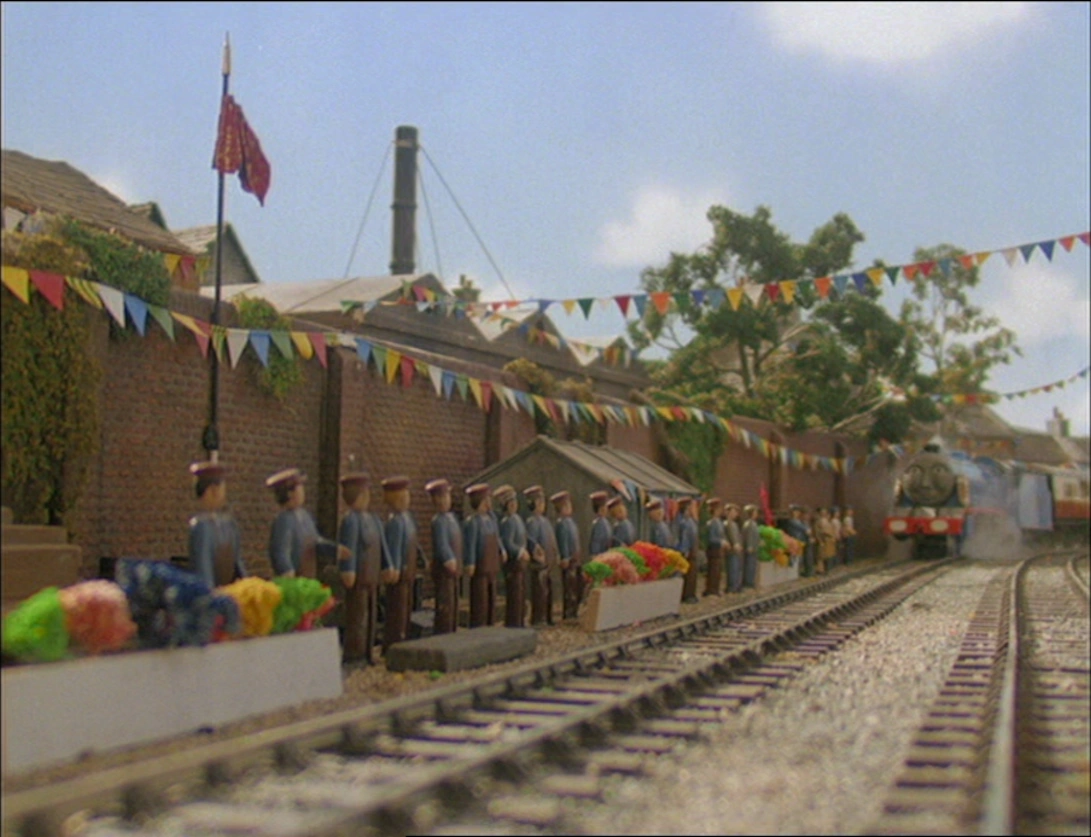
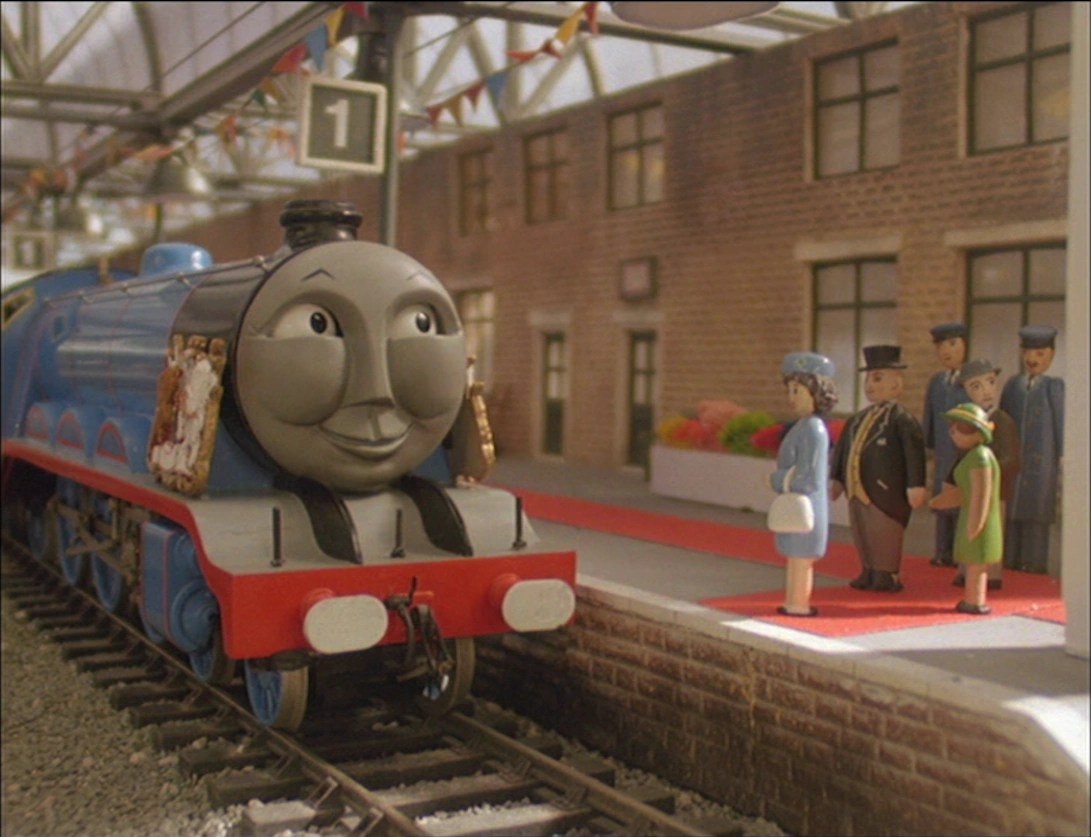
The television adaptation depicts things a little differently – Britt Allcroft at this stage was keen to present Sodor as a mystical fantasy land and dissociate it from the United Kingdom (although clearly not from the monarch), so the Union Flags are entirely absent and the bunting is generically technicoloured. We do, however, see multiple carvings of the royal arms – one leaning on either side of Gordon’s smokebox and at least four more attached to the station itself – originally on the glass of the canopy but later moving to the pillars and a nearby lamppost.

2m02s

2m43s

3m24s

4m20s

Also flying from the canopy are three flags of more definite designs, the first Argent a cross Gules, the second Azure a saltire Or and the third Murrey a saltire Argent. The first is obviously the flag of England but I don’t know the origin of the other two. We don’t get a close-up shot of the royal arms, but they are clearly supported by a golden lion and a white unicorn in the right arrangement. The shield itself looks to be blue in both the lower quarters but the upper quarters for England and Scotland are potentially correct. A red banner with indecipherable golden embroidering also flies outside the station as Gordon approaches.

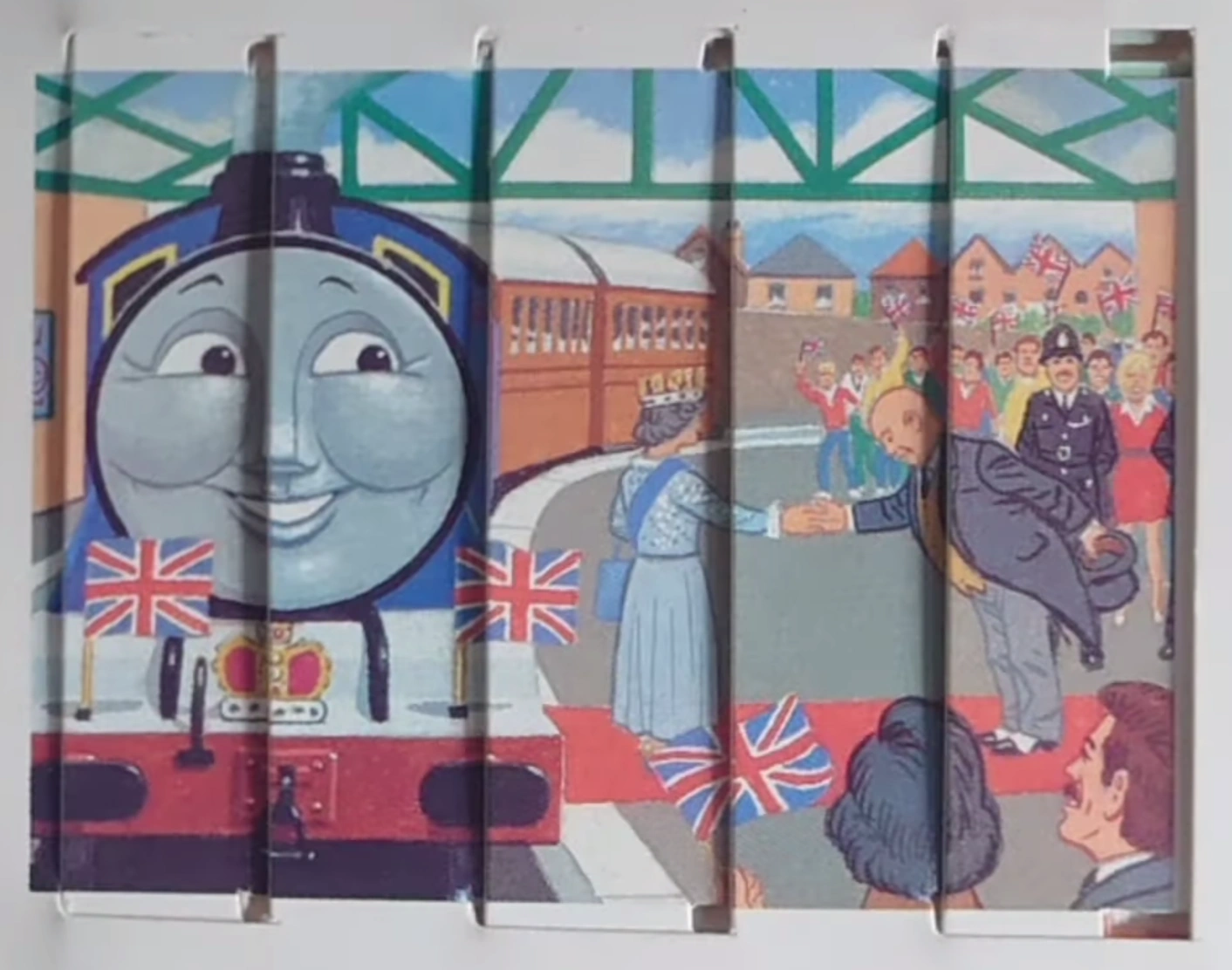
This, incidentally, was not the first adaptation of the source material, for the story was republished as part of a series of Changing Picture Books called Busy Engines in 1994. The illustrations here (by Arkadia Illustration Ltd.) show many Union Flags as in the original book but no royal arms. Gordon’s footplate instead carries a large facsimile of St Edward’s Crown (perhaps foreshadowing the Duchess of Loughborough).

The Queen’s own appearance also changes – in the 1953 book she is shown only as an arm emerging from her carriage, in the 1994 book wearing a golden circlet trimmed with ermine and a thick blue sash from her right shoulder (very formal for a day trip on a steam train) and in the 1995 episode in a light blue dress with matching hat. It has been suggested but never confirmed that the man in the brown jacket is meant to be her husband and the short woman in the green dress her mother, which might be the clue as to why the story title implies that more than one queen visited.