The Duchess of Kent’s Funeral

The funeral took place today at Westminster Cathedral. It was not televised, but there was a press-pool camera outside which livestreamed to YouTube. Unfortunately the camera feed only covered the outside of the cathedral, and our view of the inside was limited to a handful of still images (which seem to be of guests filing in rather than the ceremony itself), and what could be seen from the outside once the doors were opened. Since it was broad daylight from the outside, it took a while for the camera’s light sensitivity to adjust so that proceedings inside were actually visible. This was briefly undone every time someone in a white cassock walked across the camera’s field of vision outside, so that the interior became a black void again. I will make here what few observations I can, mainly about flags and cars.

When viewed from the piazza, the flagpole on the left of the main door normally flies the flag of the Holy See (or Vatican City) while that on the right flies the Union Flag (or Jack). This time the Vatican flag flew full-mast throughout while the right pole flew the sovereign’s banner of arms at full-mast in his presence and the Union Flag at half-mast in his absence.

Katharine did not have the use of a banner of her own arms (the Duke of Kent impaling Sir William Worsley) so her coffin was draped in the generic royal banner with the ermine bordure. Attendees on departure could be seen clutching the printed order of service with Katharine’s royal cypher (the letter K topped by a coronet of crosses and strawberry leaves, curiously not the version shown on Wikimedia Commons). The order of service itself has not been released, but the royal family website has this article explaining events that took place. An announcement on the cathedral’s website uses Sodacan’s illustration of the late duchess’s heraldic achievement.

The doors opened as the piper was walking out, after which the national anthem was played. Two verses were sung, preceded by Gordon Jacob’s fanfare. It was played on the cathedral’s organ but I don’t think any brass players were present.

I took notes on which royals arrived in which car:

  • The Late Duchess herself was carried in the claret Jaguar hearse (no numberplate) also seen at Elizabeth II’s funeral.
  • The Duke & Duchess of Gloucester in OY20FUL (a dark red diesel Jaguar)
  • Prince & Princess Michael in a blue BMW (probably YK74MHB, electric)
  • The Duke & Duchess of York in KN74EFK (a green hybrid Range Rover)
  • Sir Tim Laurence & The Princess Anne in DK74CMV (a blue petrol Bentley Bentayga)
  • The Prince & Princess of Wales in KU25UPR (a blue hybrid Range Rover)
  • The Duke of Kent & Lady Helen Taylor in a blue Jaguar (registration not shown in footage)
  • The King and Sir Clive Alderton in the Bentley State Limousine (no numberplate needed).

The Duke of York looked a little confused on the way out, walking towards the cars, then back to the cathedral, then to the car again, as if not sure which one he was meant to be using. A short wheelbase bus was used for several other family members, including Lord & Lady Frederick Windsor.

The Duke of Kent, aged 89, understandably looked rather frail and shrivelled. His siblings Prince Michael and Princess Alexandra were both seen in wheelchairs at some points, then walking with canes at others. The Queen did not attend, having pulled out at the last minute due to a sudden bout of acute sinusitis. It is not confirmed if she will still be attending the imminent American state visit.

The Deputy & The Duchess

The Duchess’s Heraldic Achievement

Documentaries about the stormy second premiership of Harold Wilson (1974-6) often mention his determination to take the nation by surprise after months of all his government’s secrets being leaked to a vicious press. In the end he pulled off the particularly-impressive trick of resigning on the same day that the Princess Margaret finalised her divorce from the Earl of Snowdon, and therefore knocked the latter story off the front pages. No doubt this spared the royal family a lot of grief.

Today a similar coincidence has been achieved in reverse – Angela Rayner resigned as Deputy Prime Minister, and Buckingham Palace announced the death of the Duchess of Kent. There is something a little uncanny in these events happening so close to the anniversary of Liz Truss’s accession to the premiership and Charles III’s accession to the throne. The public mourning over the deceased Queen Elizabeth obviously didn’t save the Truss government, but did at least postpone its inevitable disintegration. Neither of today’s events are quite on the scale of those but, even so, the cabinet will likely be glad of the news – and Parliament – having a different story to occupy their time.

I will deal with Rayner first. Obviously her property tax scandal is a further reputational blow for a government whose public approval ratings were already abysmal. Her departure could cause some practical issues, too. Rayner simultaneously resigned from three offices: Deputy Prime Minister of the United Kingdom, Deputy Leader of the Labour Party and Secretary of State for Housing, Communities & Local Government. The latter is the one of greatest constitutional substance, for each Secretary of State is a corporation sole defined in statute with responsibility for a government department, in this case the Ministry of Housing, Communities & Local Government. The MHCLG cannot operate effectively without its secretary of state so a successor to Rayner will need to be appointed within days and confirmed at a meeting of the Privy Council shortly afterward. The middle is of course not a government office but a party one. Deputy Leaders are elected by a postal ballot of the rank-and-file partisans in an operation that typically takes months. This will be the first time in decades that the Deputy has been replaced without the actual Leader also changing (unless Sir Keir Starmer somehow also ends up resigning imminently) and, given the unpopularity of the current government among the party’s base, it could be a major opportunity for dissident factions to attempt a strike against front bench. The internecine fighting is bound to highlight controversies and resentments on which the opposition parties can pounce. The former will be the more interesting to watch: As I have mentioned before, the Deputy Prime Minister is constitutionally little more than a courtesy title rather than a substantive office and many premiers can do without appointing one. There is no obligation for the Deputy Leader of the Labour Party to be deputy leader (whether en titre or de facto) of a Labour government – notably Harriet Harman wasn’t. Even so, the Deputy probably need to have some kind of senior government post, for as a backbencher they would be too free to criticise and challenge the incumbent. If the eventual winner of the election is not already a cabinet minister then it may necessitate another minor reshuffle. In the meantime, though the Prime Minister will need a designated survivor, he would probably be better off not appointing a new DPM, nor a First Secretary of State, as whoever landed that job would then have then have to endure the indignity of relinquishing it a few months later and, since everyone would predict this in advance, would probably struggle to accomplish much of worth during that time.

Moving on to the Duchess: Born in 1933, she was the oldest among the royal family, a status which now passes to her 89-year-old widower Edward. Her death does not create a vacancy in the Firm, as she very quietly retired from public duties a few years ago and was absent for nearly all of the big ceremonial gatherings since then.1 At the time of writing the exact date of the Duchess’s funeral has not been announced, but based on usual time lapses it should be concluded before the halfway point of this month and thus narrowly avoid clashing with either Donald Trump’s state visit to the United Kingdom or the Duke of Edinburgh’s attendance at Papua New Guinea’s semicentennial independence celebrations. Katharine was the first British royal since the Glorious Revolution to convert to Roman Catholicism, and it has been stated that her funeral will follow Catholic liturgy. That will be an innovation for the House of Windsor too, as the only thing approaching a recent precedent is the reinterment of Richard III in 2013, and even that was technically an ecumenical affair. The Duke of Kent has been steadily winding down his commitments in recent years but is still considered a senior working royal. It is yet to be seen if the death of his wife will lead to any changes in his arrangements. The Ferens Building at the University of Hull (not to be confused with Ferens Hall) has her name on its keystone and the Prime Minister’s statement this afternoon mentioned that she was “giving her time and working anonymously as a music teacher at a school in Hull”. It will be interesting to see if any of her pupils are involved in the funeral, or indeed if there will be any local ceremonies to celebrate her association.

1The latest reference I can find in the Court Circular to her attending in person, rather than being represented by someone else, is 8th June 2019. I note that the “Where is Kate?” crisis of eighteen months ago failed to notice or care that the other Katharine had been “missing” for a much longer time.

UPDATE (8pm)

In the time between drafting this article and uploading it, Sir Keir has ignored my advice and carried out a full reshuffle, appointing David Lammy as DPM and Lord Chancellor (interestingly making the same career move as Dominic Raab four years ago) and replacing Rayner at MHCLG with Steve Reed, among many other changes. No timetable or candidates have yet been confirmed for the Deputy Leadership.

On Terence Etherton

Official parliamentary portrait from 2021 by Roger Harris (CC-BY-3.0)

The Lord Speaker today announced the death of Terence, Lord Etherton.

Etherton only took his seat in the House of Lords in 2021, having recently retired from the office of Master of the Rolls. Aged 73, he was only slightly older than the median for the Upper House, and still below the recently re-raised mandatory judicial retirement age.

Etherton is another of those people whose armorial bearings I know to exist but have never seen: That he received a grant was noted in the College of Arms newsletter no. 65, and a vague description is given on the Birkbeck, University of London website, which is repeated in Joshua Rozenberg’s obituary for him. While we are told that the motto was the Hebrew word הננ (Hineini) – “Here I Am.” we are not given any blazon for the rest of the achievement, only that it features sapphires and a sword.

Etherton’s career in fencing was, of course, also mentioned in the infamous “Enemies of the People” headline published by the Daily Mail in 2016.

I will have to hope that a photograph of the late noble and learned lord’s arms emerges at some point, for he was created too late to appear in the final print edition of Debrett’s Peerage and so it may be impossible to find out in the traditional way.

A View of Prescott’s Funeral

The Lord Prescott, former Deputy Prime Minister of the United Kingdom, died on 20th November last year but his funeral only took place today.

His can reasonably be considered the greatest political heavyweight (no pun intended) among all Hullensians of this or the previous century and his death brought about the highest concentration of political celebrities the city has likely ever seen.

The window of time in which I was able to visit the site in person was unfortunately brief, but I was able to catch the moment the hearse and limousine departed (they were indeed two Jaguars) and the guests came streaming out of the main doors of Hull Minster.

I did not see any of the current cabinet, but I was able to spot a few local grandees (flooding minister Emma Hardy, former Home Secretary Alan Johnson, former energy minister Graham Stuart and former EU Secretary Sir David Davis) as well as some national ones (former Welsh first minster Mark Drakeford, former LibDem leader Lord McNally and Lord Speaker Lord McFall of Alcluith).

EXTERNAL LINKS

Note on the Decease of Britt Allcroft

Hilary Mary Allcroft, commonly known as Britt, was the television producer and director responsible for turning The Railway Series into Thomas the Tank Engine & Friends. She was at the helm of the franchise from 1984 to 2003, overseeing its first seven series and the film Thomas & the Magic Railroad. She also created the companion series Shining Time Station for the American market and in early years was part of the production team for Blue Peter.

Directly or indirectly, to this day she remains a commanding influence in the childhoods of many millions in the United Kingdom and around the world. Though no longer in charge of the franchise for more than twenty years she remained a grandee until her death and – however controversial some of her adaptation decisions may have been – her presence was much appreciated by the surrounding community.

Her death occurred on Christmas Day, but was not made public until today. Her family arranged for the first announcement of her demise – preceding any newspapersto be given by the filmmaker Brannon Carty, in whose documentary An Unlikely Fandom she had recently appeared.

I was not aware of the death of director David Mitton when it happened, nor even born yet when Wilbert Awdry himself passed away. I hope it will be many years before his son Christopher dies.

Farewell Britt, your presents were much appreciated.

UPDATE (4th January)

The aforementioned Brannon Carty has also uploaded his interview with BBC Radio 5.

The Death of Dame Maggie

Reported today was the death at age 89 of the actress Dame Maggie Smith, best known in recent decades for her roles in the Downton Abbey and Harry Potter series – the latter especially poignant as her co-star Sir Michael Gambon died exactly a year ago.
This post is not meant as a eulogy or obituary for her – many others can do that far better than I – but a discussion of two points of interest relating Dame Maggie to the topics covered on my blog.

First, her status as a Dame: In 1970 Smith was appointed Commander of the Most Excellent Order of the British Empire. Twenty years later she was promoted to Dame Commander. This is one means by which to certify her status among the “National Treasures” of British acting, nearly all of whom have had the chance to become a knight or dame even if a small number have declined. The Order of the British Empire was founded by King George V in 1917 and was the first British order of chivalry in the modern era to explicitly allow female recipients to have the title. The top two grades of the order are Knight/Dame Commander (K/DBE) and Knight/Dame Grand Cross (GBE). The DBE is by far the most common form of damehood and it is the only grade of any order at which dames outnumber knights. This is partly because the other orders (e.g. the Bath) are reserved for senior government and military officials, a group which tends to skew male anyway, and partly because there is no female equivalent of the honour of Knight Bachelor (i.e. knighthood unconnected to membership of an order of chivalry) which is the rank that the majority of knights possess (including fellow treasures like Gambon as aforesaid). Most of Britain’s orders of chivalry (the Royal Victorian Order is an exception) have statutory limits on how many there may be at any particular grade at any given time. For the grade of K/DBE that limit is 845, with male and female members counting the same towards the total. I do not actually know how close we are to hitting the limit. The English Wikipedia has a page listing all the people who have been awarded the status of DBE and they number over a thousand, but without going through each biography individually (and some don’t have their own pages anyway) I cannot tell how many are currently alive and still holding the same dignity.

In 2021 Netflix released an animated sitcom named The Prince, focusing on a fictionalised caricature of Prince George of Cambridge. It was produced and largely written by Gary Janetti, who previously wrote fourteen episodes of Family Guy, and it strongly resembles that series both tonally and aesthatically. Despite its star-studded cast the series received overwhelmingly negative reception for its offensive premise and unfunny execution. The series was neither renewed nor widely distributed and now is viewable only as a scattering of short clips on video-hosting site by either the studios’s own paltry few advertisements or other people’s reviews of it. The first episode features a minor subplot about the possibility of Elizabeth II conferring a damehood on either Kelly Ripa or Greta Thunberg. On two occasions the suggestion results in another character asking if Smith had just died, presuming there to be a moratorium. As explained above this reasoning is technically correct, although Janetti seems to have missed that neither Ripa (American) nor Thunberg (Swedish) were the late monarch’s subjects so could not receive substantive appointments to the order anyway. They could only receive honorary appointments (giving them the post-nominals but not the salutation) which would be supernumerary to the quota.

The news of Smith’s death has brought renewed interest in her earlier appearances, the most famous of which was the 1969 film The Prime of Miss Jean Brodie, based on the 1961 novel by Muriel Spark (who herself became a DBE in 1993). News features about Smith’s death kept playing the same speech by her character, which is also featured on the book’s TV Tropes page:

I am in the business of putting old heads on young shoulders, and all my pupils are the crème de la crème. Give me a girl at an impressionable age and she is mine for life. You girls are my vocation. If I were to receive a proposal of marriage from Lord Lyon, King of Arms, I would decline it. I am dedicated to you in my prime. And my summer in Italy has convinced me that I am truly in my prime.

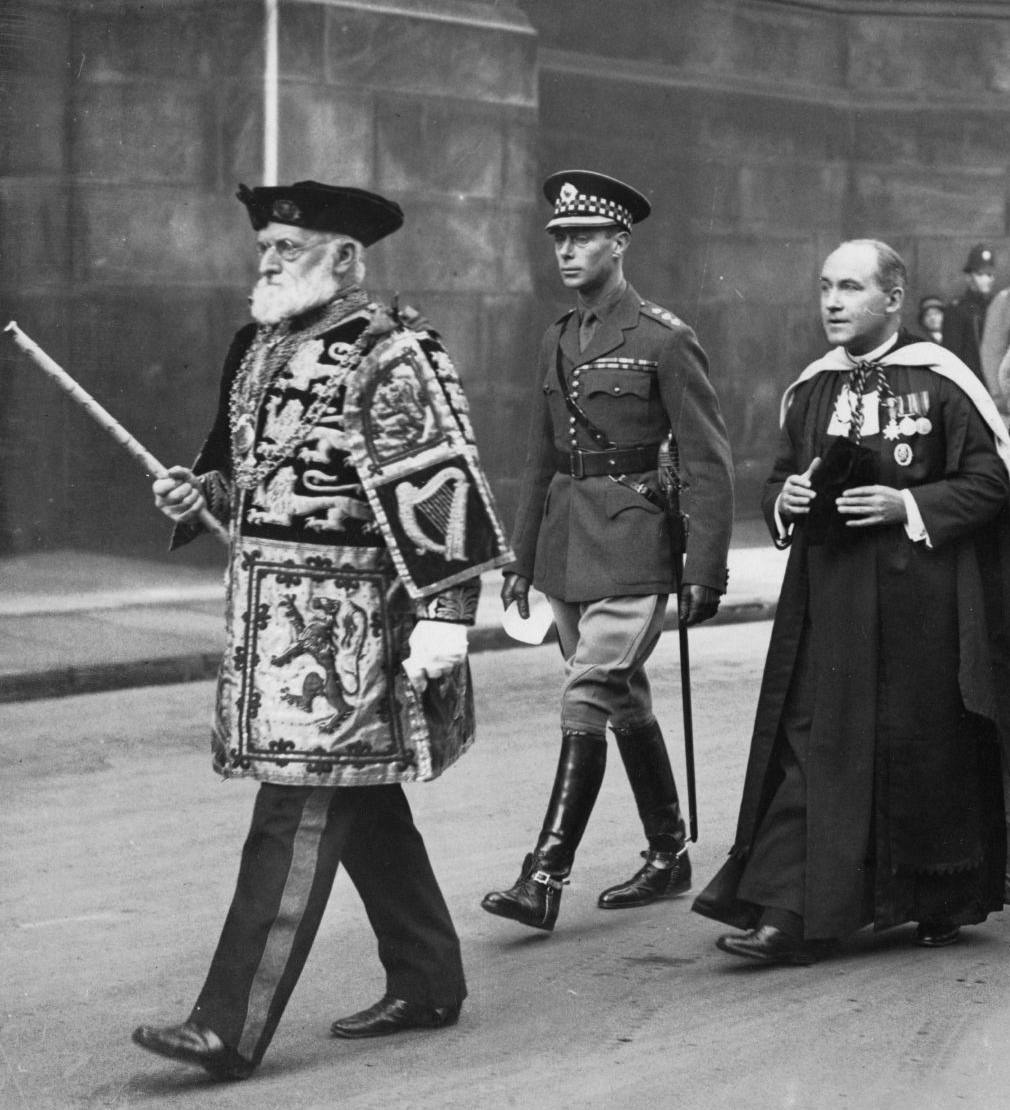
Grant with the future George VI in 1933

I have not yet watched the film or read the novel in full, but searching a digital scan on Archive.org for the word “lyon” gives two instances, both of them in the context of Brodie turning down his hand, with the implication that he must be highly desirable and that declining him requires a serious force of will. The only other reference to heraldry in the book is a passing mention of the school’s “crest” which I think is really a shield. The book is set in the 1930s and the Lord Lyon King of Arms from 1929 to 1945 was Sir Francis James Grant, whose Wikipedia article is such a short stub that I don’t even know if he had a wife or not. He was sixty-eight by the time the novel was published, so not in his “prime” by any reasonable definition. Why his title was used in the book is unclear, and may be a matter I need to raise at a subsequent virtual heraldry lecture, whenever that comes up.

Review: Charles III by Robert Hardman

Robert Hardman is no stranger to royal biography, having already penned quite a handful about Elizabeth II in the last decade or so of her life, including Queen of Our Times which came out in March 2022 as part of her Platinum Jubilee season and then in December of the same year was released again in a “commemorative edition” to update for the fact that she’d died. Now he moves into the present reign with a biography of her eldest son. I am a little confused about the title of this one as the British publication is called “Charles III: New King. New Court. The Inside Story”1 but on Google Books I can see that the United States version is called “The Making of a King: King Charles III and the Modern Monarchy”. I suspect the titles must be written this way for SEO purposes, or perhaps he just couldn’t decide which description he wanted so used all of them at once. It must be quite a fraught process to come up with a distinctive and meaningful name for a biography when you know that lots of other biographies will be documenting the same person and all competing to emerge in future history as the one definitive authority thereon. Most likely in the long run the general public (maybe academics too) will discard the pretentious subtitle and just remember it as “[AUTHOR] on [SUBJECT]” (e.g. “Jenkins on Churchill”) instead.

Hardman’s lengthy volume covers the first year of the New Carolean era. As one might expect, this period in royal history was particularly dominated by two big ceremonial events: His mother’s funeral and his own coronation. In the book, the funeral (as well as the period of Operation London Bridge leading up to it) takes up chapters 3, 4 and 5 while the planning and execution of the coronation takes 9, 10, 11, 12, 13 and 14. That makes for nine chapters out of a total of eighteen across the whole book. The coronation section in particular is loaded with dense historical comparisons, detailing not just the crowning of Charles III but also quite a lot about those of George VI an Elizabeth II. A less charitable reader may accuse Hardman of padding here, though doubtless a lot of the innovations (and omissions) of 2023 cannot be fully appreciated without an understanding of what came before. Anyone buying this book at first printing will, doubtless, have already watched the public side of these events on television as they were happening, so the real value of these chapters is in reading the personal accounts of the people involved as to what went on behind the scenes, such as the aide who spontaneously hugged Princess Anne to console her in her grief, the brigadier getting a summons back to London while giving a speech at his daughter’s wedding in Corfu, the Duke of Norfolk getting his GCVO investiture in a rush so he could wear his sash in the procession or the royal pages being packed off into a side room with some video games. It is worth mentioning as well that Hardman directed a BBC documentary about the coronation and some other aspects of royal life that year which aired at Christmas and can be seen in some ways as the prelude to this book.

The other chapters are about the personalities of Charles & Camilla, the looming political challenges for the institution of the crown and some of the other projects in which the sovereign couple have engaged themselves (such as the Prince’s Trust/Charity/Foundation organisations which now all have to be renamed). The running thread is the process of establishing Charles’s approach to kingship and the need to assert, like most new incumbents whose predecessors served an unusually-long time, that he is his own person and is not obliged to become a clone of his forbear with whom the institution had become synonymous. Charles, of all our sovereigns, had the longest pre-accession life and a brings with him a much more complete (and publicly-known) individual persona, which makes this task all the more pressing. I was amused to read in Chapter 15 that an unnamed senior courtier refers to this as “Doctor Who syndrome”, showing that the habit of explaining the British constitution in terms of that franchise is one that runs all the way to the top. Given the relative perceptions of the new king and his late mother, I would especially see parallels to Colin Baker succeeding Peter Davidson, or Capaldi following Tennant and Smith.

Being acutely aware of some of the less-sympathetic perceptions that have swirled around the royal family as a whole in recent years, and around Charles in particular for many decades, Hardman occasionally includes explicit references to and arguments against ideas emanating from either that acclaimed Netflix drama or statements by the exiled Duke & Duchess of Sussex. At times it can feel as if he has a bit of an axe to grind. It’s probably redundant in any event, as the people likely to be credulous of the claims he’s refuting are not likely to picking up his book in the first place. I’d like to think this is merely a demonstration of Hardman’s passion for truth over sensationalism, but I can’t entirely trust him on that front given he writes for the Daily Mail after all.

These minor quibbles aside, New King New Court is an engaging and enlightening work which I would recommend to anyone interested in the topic area, though any customer (or library) sinking their money into the original edition now may wind up feeling short-changed he does another expanded version in the near future.

1The use of full stops means that the title mercifully evades what TV Tropes calls “Colon Cancer”, though I would have preferred commas.

Notes on the Memorial of Constantine II at Windsor

People of prominence often find that one period of mourning is not enough. For many of high status there will be the funeral itself within weeks of their death and then a separate, less formal, memorial service as much as a year later. Prince Philip had one of these in 2022, as did Lady Boothroyd last month.

Constantine II, King of the Hellenes 1964-73, died on 10 January 2023 and his funeral was held in Athens six days later. Yesterday a thanksgiving service took place at St George’s Chapel, Windsor, hosted and attended by the British royals.

Although it was a British-hosted event, only the Greek family’s website seems to list the order of service or any photographs. The order of service is has the late monarch’s arms illustrated on the first cover and those of the Order of the Garter on the last. This time the illustration is not that by Sodacan for Wikimedia Commons. I cannot identify the artist for this one, nor which typeface was used for the prose.

Most intriguing about the online material is that it highlights the contribution of the Lord Soames of Fletching. There is even a link to his website, which is still up even though it clearly hasn’t been updated since the most recent general election.

Sir David’s Day

Just over two years have passed since the murder of Sir David Amess, MP for the town (now city) of Southend-on-Sea. It was announced at an intermediate point that he would have his shield of arms fixed to the wall of the Commons chamber, in the manner of other murdered MPs – the most recent example being Jo Cox.

Now, at long last, the shield has been revealed.

Sir David was presumably non-armigerous during his lifetime, with this being a posthumous grant arranged through his widow Julia. So far no news source that I can find (and certainly not the College of Arms) has published the blazon, which I would guess is something like Azure on a chief conjoined to a pale between two talbots rampant Or five roses Gules barbed and seeded Proper. According to press releases the roses represent his five children as well as his gardening hobbies while the talbots represent his animal welfare campaigns and his time at Bournemouth University.

Most intriguing is the motto of His Life Remains, which Julia chose because “wherever I go, I am reminded of him in some way: someone he has helped, a charity he has supported and people whose lives he has touched”. It is unusual for a heraldic motto (unless referring to God, of course) to use third-person language and this decision wouldn’t really make sense except in the concept of a memorial for the deceased.

On an aesthetic level I would rate this achievement higher than Cox’s, due to the superior tincture contrast, although the arrangement of elements is a little unsatisfactory and requires a slightly more rectangular shield shape.

The details of his crest remain unknown.

The Matter of Sir Martin

Yesterday the London Gazette published the list of British honours conferred to commemorate the sovereign’s official birthday. Among those appointed as Knights Bachelor was the writer and academic Martin Amis. This announcement was notable for two reasons, the most prominent being that he died almost a month ago.

Britain doesn’t generally do posthumous honours, but occasionally people who have accepted them die before the official announcement and the chancery (or Cabinet Office) decides to keep their names on the list.

In this case the supplement specifies “To be dated 18 May 2023” and from what has been reported so far, officials contacted Amis early last month then rushed through the administrative process to confer the award before he died, but asked his family to keep it secret until now. We can presume that no physical accolade was given, since he was in Florida at the time.

The second reason this raises eyebrows is that Amis never seemed like the sort of person who would desire a knighthood – in much the same way that it would feel strange for George Orwell or Christopher Hitchens to get one. He even said outright in a 2011 interview that he would never accept any honour from the crown. It is not clear what caused this apparent deathbed conversion, and I have seen comments from some people speculating what mental state he was in during his final days.

Obviously Sir Martin himself will have no opportunity to enjoy the trappings of knighthood, but his widow and daughters will, and the backdating means that they will have precedence above the wives and children of other Knights Bachelor appointed yesterday, or indeed in the Resignation Honours last week.