Recently Gareth Ratcliffe, who represents Hay-on-Wye on Powys County Council, Tweeted a photograph of the royal warrant by which he was appointed an Ordinary Member of the Civil Division of the Most Excellent Order of the British Empire.
I have seen photographs and scans of similar documents before, but usually they were from a great many decades ago. I was interested to look at an up-to-date example.
The warrant begins with the sovereign’s full style (in English, of course) and concludes with the place and date. Notably it is accredited to St James’s Palace (which, rather than Buckingham, is the true headquarters of the crown), though I am quite certain that neither the monarch nor his clerks were actually in that place on New Year’s Eve signing thousands of such warrants in one go.
King Charles’s signature appears at the top of the page and Queen Camilla (in her capacity as Great Master of the Order) signs at the bottom. Six months ago I was told by the Foreign, Commonwealth & Development Office that warrants of appointment to these orders of chivalry do not depict a coat of arms, only the seal of the respective order. Embossed at the top of this warrant I can see that the seal itself actually contains the royal arms of the United Kingdom in the English arrangement, so the critical question of whether the design changes when in other realms is not necessarily resolved.
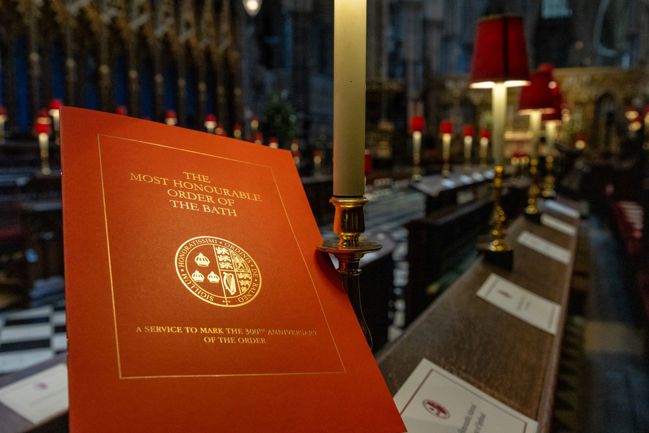
Also in the news this week was the 300th anniversary (or Tercentenary) of the Most Honourable Order of the Bath. The King (as Sovereign) and the Prince of Wales (as Great Master) attended a service in Westminster Abbey to commemorate. The cover of the Order of Service shows the seal of the order, which likewise has the British royal arms. I even found a photograph of a bound copy of the Statutes of the Order, which has the seal illustrated in full colour. There were also photographs taken of the stallplates of current and former Knights Grand Cross, including Great Masters. One hopes to see Prince William’s plate appear there too at some point, if only to get visual evidence of his full heraldic achievement as heir apparent.




 Robin Stanley Taylor