Quite the Collection

In addition to my two library cards and my many online sources I have during the past few years – commencing mainly in 2022 – accumulated a rather large collection of used books from a handful of charity shops I have frequented, mainly in Hull but also in some other East Yorkshire towns. Over the weekend I set about cataloguing the lot, though this list excludes those which I have given away as gifts to friends or family members. The small minority which I am currently reading or have already finished are shown in bold.


FICTION (arranged by author)

Dr. Gregory’s books have proven particularly easy to find at sub-£ prices.

  • Austen, Jane: The Complete Novels
  • Blyton, Enid: The Secret Seven (books 4-6)
    • Go Ahead
    • On The Trail
    • Good Work
  • Boyne, John: The Boy in Striped Pyjamas
  • Brooks, Max: World War Z
  • Chaucer, Geoffrey & Spearing, Anthony Colin: The Knight’s Tale
  • Dickens, Charles: Little Dorrit
  • Durrell, Lawrence: Sebastian
  • Gerber, Michael: Barry Trotter
    • and the Shameless Parody
    • and the Unnecessary Sequel
  • Gregory, Philippa
    • The Boleyn Inheritance
    • The Constant Princess
    • The Favoured Child
    • The Lady of the Rivers
    • The Other Boleyn Girl
    • The Other Queen
    • The Red Queen
    • The Taming of The Queen
    • The White Princess
    • The White Queen
    • Three Sisters, Three Queens
  • Keyes, Daniel: Flowers for Algernon
  • Lawrence, David Herbert
    • Lady Chatterley’s Lover
    • Women in Love
    • Sons and Lovers
  • Mallinson, Allan: A Call to Arms
  • Mantel, Dame Hilary: Bringing Up the Bodies
  • Mitchell, Margaret: Gone With The Wind
  • Naylor, Doug: Red Dwarf, Last Human
  • Orwell, George: The Complete Novels
  • Penman, Sharon: The Sunne in Splendour
  • Sachor, Louis: Holes
  • Sansom, Christopher John: Sovereign
  • Shakespeare, William: The Complete Works
  • Thackeray, William Makepeace: Vanity Fair
  • Tolkien, Christopher: The History of Middle-earth (volumes 1-7)**
    • The Book of Lost Tales, Part 1
    • The Book of Lost Tales, Part 2
    • The Lays of Beleriand
    • The Shaping of Middle-earth
    • The Lost Road and Other Writings
    • The Return of the Shadow
    • The Treason of Isengard
  • Tolkien, John Ronald Reuel: Sir Gawain & the Green Knight, Pearl and Sir Orfeo
  • Towles, Amor: A Gentleman in Moscow
  • Townsend, Sue: Adrian Mole, The Prostate Years
  • Tsiolkas, Christos: Dead Europe

NON-FICTION (arranged by topic)

ANCIENT WORLD

  • Beard, Dame Mary
    • How Do We Look? The Eye of Faith
    • Pompeii, The Life of a Roman Town
  • Graves, Robert: The Greek Myths, Vol. 1 & 2
  • Peddie, John: The Roman War Machine
  • Potter, Timothy William: Roman Italy
  • Taggart, Caroline: A Classical Education
  • Thucydides: History of the Peloponnesian War
  • Wells, Colin: The Roman Empire

ART & ARCHITECTURE

  • Cruickshank, Dan: Adventures in Architecture
  • Devonshire, Deborah, Duchess of: The House, Chatsworth
  • National Trust:
    • Beningbrough Hall*
    • Treasures of
  • Spalding, Frances: British Art Since 1900
  • Style, Colin & O-Ian: House Histories for Beginners
  • Suh, H. Anna: Leonardo’s Notebook
  • Taylor, Richard: How to Read a Church

BIOGRAPHIES AND MEMOIRS (arranged by protagonist)

  • Cameron of Chipping Norton, David, Baron: Cameron at 10 (Sir Anthony Seldon & Peter Snowdon)
  • Churchill, Sir Winston
    • The Churchills, In Love & War (Mary Sybilla Lovell)
    • Winston & Clementine, The Triumphs & Tragedies of the Churchills (Richard Hough)
  • Clark, Alan: Into Politics (himself)
  • Cook, James: Captain James Cook (Richard Hough)
  • Devonshire, Georgiana, Duchess of (Amanda Foreman)
  • Fowlds, Derek: A Part Worth Playing (himself)
  • Hodkinson, Mark: No One Round Here Reads Tolstoy (himself)
  • Holbein, Hans: The King’s Painter, The Life & Times of (Moyle, Franny)
  • Hudson, Kerry: Lowborn (himself)
  • Ishikawa, Tetsuya: How I Caused The Credit Crunch (himself)
  • Kaufman, Sir Gerald: How to be a Minister (himself)
  • Kay, Adam: Twas The Nightshift Before Christmas (himself)
  • Macron, Emmanuel: The French Exception (Alan Plowright)
  • Mitford, Nancy: The Letters of Nancy Mitford (Charlotte Mosley)
  • Mowlam, Mo: The Biography (Julia Langdon)
  • Newcastle, William, 1st Duke of: Portrait of a Cavalier (Geoffrey Trease)
  • Palin, Sir Michael: Full Circle (himself)
  • Pilkington, Karl: The World of Karl Pilkington (Ricky Gervais)
  • Riverdale, Robert “Skips”, Baron: A Life, A Sail, A Changing Sea (himself)
  • Smith, Matt: The Biography (Emily Herbert)
  • West, Timothy: Our Great Canal Journeys (himself)
  • Whitelaw, William, Viscount: The Whitelaw Memoirs (himself)

CONTEMPORARY POLITICS

  • Abell, Stig: How Britain Really Works
  • Brooks, Richard: The Great Tax Robbery
  • Cohen, Nick: Waiting for the Etonians
  • Harding, Luke: Shadow State, Murder, Mayhem & Russia’s Remaking of the West
  • Luce, Edward: In Spite of the Gods, The Strange Rise of Modern India
  • Minton, Anna: Ground Control
  • Runciman of Doxford, David, 4th Viscount: How Democracy Ends
  • Willetts, David, Baron: A University Education
  • Wilson, Andrew: The Ukraine Crisis, What It Means For The West

HISTORY (other)

  • Belchem, John: A New History of the Isle of Man, Vol. 5 The Modern Period 1830-1999
  • Briggs, Asa, Baron: A Social History of England
  • Browne, Harry: The Rule of British Trade Unions 1825-1914
  • Churchill, Sir Winston: A History of the English-Speaking Peoples, Vol. I
  • Crosby, Alan: Preston Gould, England’s Greatest Carnival
  • Thomas, Gordon: Inside British Intelligence
  • Hibbert, Christopher: A Social History of the English 1066-1945
  • Jones, Terry: Who Murdered Chaucer?
  • Laidler, Keith: The Head of God, The Lost Treasure of the Templars
  • Morfitt, Paul & Wells, Malcolm: Hull Corporation Buses*
  • Sandbrook, Dominic: Never Had It So Good
  • Stead, Neville: Kingston-upon-Hull, Images of a Rich Transport Heritage
  • Street, Sean: A Remembered Land, Recollections of Country Life 1880-1914

LINGUISTICS

  • Burrow, John Anthony: A Book of Middle English
  • Oxford
    • Dictionary of Idioms
    • Dictionary of Quotations & Proverbs Vol. I
  • Parkinson, Judy: I Before E
  • Taggart, Caroline & Wines, J. A.: My Grammar & I

LOCOMOTION

  • Allan, Ian: Railway Liveries 1923-1947
  • Atterbury, Paul: Discovering Britain’s Lost Railways
  • Morrison, G. W. & Whiteley, J. S.: Profile of the Deltics
  • Jones, Edgar: The Penguin Guide to the Railways of Britain
  • Ross, David: The Illustrated History of British Steam Railways

ROYAL FAMILY

  • Burns, Michael: The Queen’s Flight
  • Fraser, Lady Antonia: The Warrior Queens: Boadicea’s Chariot
  • Glenconner, Anne, Baroness: Lady in Waiting
  • Green, Candida Lycett & Wales, Charles, Prince of: The Garden At Highgrove
  • Junor, Penny: The Duchess, Camilla Parker Bowles
  • Kent, Princess Michael of: Crowned in a Far Country
  • Langley, Philippa & Jones, Michael: The Search for Richard III, The King’s Grave
  • Lisle, Leanda de: Tudor, The Family Story
  • Low, Valentine: Courtiers, The Hidden Power Behind the Crown
  • Mayer, Catherine: Charles, The Heart of a King
  • Phillips, Charles: Kings & Queens of Great Britain
  • Plumb, Sir John Harold: The First Four Georges
  • Rhodes, Margaret: The Final Curtsey
  • Weir, Alison: Katherine Swynford

SCIENCE, PHILOSOPHY & IDEAS

  • Attenborough, Sir David: Life on Earth
  • Darwin, Charles & Leakey, Richard: The Illustrated Origin of Species
  • Dawkins, Richard
    • The Extended Phenotype
    • The Greatest Show On Earth
  • Freeman, Betty Jo; Ornitz, Edward M. & Tanguay, Peter E.: Autism, Diagnosis, Current Research & Management
  • Garner, Alan: The Voice That Thunders
  • Harari, Yuval Noah: Homo Deus, A Brief History of Tomorrow
  • Shennan, Stephen: Genes, Memes & Human History

SECOND WORLD WAR

Churchill manages to appear on this list twice as an author and twice as a subject.

  • Beevor, Sir Anthony
    • D-Day
    • Stalingrad
  • Bryant, Sir Arthur: Triumph in the West
  • Bryant, Sir Chris: The Glamour Boys
  • Cawthorne, Nigel: Fighting Them on the Beaches
  • Churchill, Sir Winston: The Second World War, Vol. I
  • Faulks, Sebastian: The Vintage Book of War Stories
  • Felton, Mark: Zero Night
  • Gillies, Midge: The Barbed-Wire University
  • Levine, Joshua: Dunkirk, The History Behind The Major Motion Picture
  • Lomax Eric: The Railway Man
  • Roberts of Belgravia, Andrew, Baron: The Storm of War
  • Trigg, Jonathan: D-Day Through German Eyes
  • Wilson, Kevin: Men of Air, The Doomed Youth of Bomber Command

TELEVISION

  • Jay, Sir Antony & Lynn, Jonathan: The Diaries of the Right Hon. James Hacker Vol. II (Yes, Prime Minister)
  • Lloyd, John & Mitchinson, John: The Second Book of General Ignorance (QI)
  • McCann, Graham: The Story of a Television Classic (Dad’s Army)
  • Patterson, Dan: Only Book You’ll Ever Need (Mock the Week)
  • Porter, Richard: And On That Bombshell (Top Gear)

MISCELLANEOUS

  • Automobile Association:
    • 250 Tours of Britain
    • Book of British Villages
  • Lewis, Oliver: The Orwell Tour
  • Jordison, Sam & Kieran, Dan: Crap Towns Returns
  • Marshall, Enid Ann: General Principles of Scots Law
  • Which?: Book of Tax 1985/86
  • Wood, Michael: In Search of Shakespeare

*Unfortunately I left this one for some weeks in the boot of my car and upon eventually retrieving it I discovered the floor was damp. I can’t put it back on the shelf until the mold has been treated. (UPDATE 3rd February – I found another copy of Beningbrough Hall in a different charity shop for half the price at which I bought the first one.)
**These were purchased as a set for £15. Carrying them out of the shop was a bit tricky. I also acquired Volume 9, Sauron Defeated, as a gift in 2020. These may technically belong in the non-fiction section as the series constitutes more of a literary making-of documentary than a pure immersive story.

Liberating a musical relic

In discussions of artistic and intellectual property it is often remarked that “There is nothing new under the sun.” in reference to the frequency with which works under copyright turn out themselves to have been copied or derived from older material which may or may not have been public domain already – such as popular film scores taking cues from classical compositions.

One example is Howard Shore’s In Dreams, part of his soundtrack to The Fellowship of the Ring. The melody, especially the first seven notes, came from the 1901 hymn This Is My Father’s World.

The lyrics were written by Presbyterian minister Maltie Babcock and set to music by composer Franklin Sheppard. Despite the musical similarity, thematically they are entirely different: Babcock’s lyrics are mainly about the beauty of natural creation, with a few explicit references to scripture, and obviously multiple references to the Christian deity. Shore’s song, in common with everything else in Jackson’s films, avoids any direct mention of Eru Ilúvatar. Principally the song seems to be about perseverance through adversity and the emotional pain of separation from close friends. Given how the story ends, it could be interpreted as anticipating reunification after death. That the song should allude to spiritual principles without actually naming a real religion is in keeping with Tolkien’s conception of the book (albeit he was Catholic not Presbyterian).

This was the favourite childhood church song of prominent atheist Penn Jillette, who even parodied it for the opening them of his podcast. Personally I only discovered the hymn when searching backwards from the FOTR score, and on further investigation it does not seem to have made much of a cultural penetration outside North America. Searching for it on YouTube mainly brings up American religious schools.

Given the song’s publication and Babcock’s death both occurred in 1901, with Sheppard dying in 1930, the music and lyrics have both been in the public domain for some time, so I was a little surprised to see that Wikimedia Commons did not have an audio file. I set about creating one, based on a photograph they did have of a printout of the sheet music. It had been a long time since last I used MuseScore, but in about an hour I had relearned enough to copy out the page, render it as a sound file and upload it. Obviously mine is instrumental only as MuseScore does not have a singing function and I did not wish to record my own voice for this.

EXTERNAL LINKS

  • This Is My Father’s World, performed by pupils of Fountainview Academy, British Columbia. They really seem to be leaning into the LOTR comparisons with the rowboats and the fallen leaves.
  • Extract from LOTR making-of documentary, showing the recording of In Dreams.
  • Rendition by Sean Holshouser. Twelve years and forty videos later (many of them being actual Christian songs), this remains by far his most popular.

Public Domain Day 2024

Public Domain Day this year is a little different: Relatively few artists of interest (to me, at least) have been released from copyright in Britain (probably the most culturally significant is the poet Dylan Thomas), but there have been major happenings overseas.

J. R. R. Tolkien died on 2 September 1973, so The Hobbit and The Lord of the Rings are set free today in countries with copyright terms of fifty years – most notably New Zealand, where Sir Peter Jackson adapted them for film. This might also have been the case in Canada, but the law was changed with effect from the end of 2022 to extend Canada’s posthumous copyright duration from fifty to seventy years. Tolkien’s works were thus among the first cohort to be delayed in their release. Of course, this only applies to works published in J. R. R.’s own lifetime – the great many posthumous works which were “edited” by his son Christopher (such as The Silmarillion and The Children of Húrin) will likely remain copyrighted until 2091 and those after Christopher’s death edited by Brian Sibley (e.g. The Fall of Númenor) could stay well into the twenty-second century (that’s before we even consider any other significant involved persons who may wish to claim co-authorship credit). The absurdity of this situation is compounded when one remembers that John Tolkien originally wrote some of these story ideas as early as the First World War.

The other big IP-related news story this year is the very long-awaited expiration of the copyright on Steamboat Willie, the 1928 cartoon film in which Mickey and Minnie Mouse made their first proper appearances. This film is now arguably less famous as an artistic work than as a symbol of copyright disputes, with the copyright term having been extended multiple times by acts of the United States Congress. From 2007 onwards Disney has been using an excerpt of the film as part of its production logo, which many perceived as a shift in strategy to have the image protected as a trademark once their luck with copyright extensions ran out. The Wikipedia page for the film has undergone a vast series of edits in the past twenty-four hours as multiple screenshots and stills are newly available on Wikimedia Commons.

The Archives Arrive

The BBC Archive YouTube channel claims to have existed since 2018, but their videos only go back three months. I discovered them just yesterday. My favourite thus far is an interview with J. R. R. Tolkien explaining the writing of The Lord of the Rings. Also featured is the Shildon steam celebration of 1975, which includes an interview with Wilbert Awdry (strangely called “William” in the voiceover), and at least two short documentaries about the making of Classic Doctor Who.

It’s too early yet to know just how many videos this channel will post. If it’s anything like British Pathé I will be greatly impressed.

Documenting Scottish Armory


Last year I noted that the Lyon Court was putting out an online crash course in Scottish heraldry. A major component of this was the list of all the blazons of defunct local councils. Yesterday I decided to take this ready-made armorial and convert it into a Wikipedia page. I intended this to complement the page that already existed on English counties, begun almost sixteen years ago.

The vast majority of the arms concerned had not already been illustrated, and for that matter the municipal corporations themselves did not have biographies to the level of their English counterparts – if at all. Fortunately there is a much greater degree of standardisation among the heraldry of Scottish local government, especially the regional councils of which all but one had the same background and differed only in their central charges, and so to create and upload a large number of emblazonments to fill the gaps was a relatively rapid process. There is a long way still to go, however, especially in finding blazons for present-day institutions.

On a partly-related note, earlier today I discovered a YouTube channel dedicated to Scottish Heraldry – Abarone’s Armorial by Ethan L. MacDonald, Herald of Clan MacKinnon USA. Though I had not seen the channel before I recognised the man’s face and voice from some of the virtual heraldic conferences I have attended over the past few months. MacDonald also managed to arrange a one-on-one interview with Lyon. By and large his content is not original – much like A Royal Heraldry it mainly reiterates the information already known to anyone who has read the relevant Wikipedia pages and the images are the familiar ones from the Commons. In particular I found it a little suspicious that he put out a video on heraldry from Tolkien’s Legendarium just a few months after I initiated the article on it. Still, it is nice to see more coverage of the subject in video form, as until a few years ago there was very little, and what did exist was overwhelmingly focused on the rudiments of heraldry from the middle ages or from the perspective of fantasists and reenactors, with precious little about the modern era. That Scottish heraldry is so much more likely than English to be documented on YouTube is also a bit of a mystery.

Arms of Arda

I have two out of four. Now I just need a peerage and an ancient hall.

Twice before I have mentioned creating Wikipedia pages compiling illustrated heraldic lists: One personal, for the Speakers of the House of Commons, and one corporate, for Britain’s many armigerous universities. Yesterday I started drafting another two such pages. The first was for all the schools (primary and secondary education) in the United Kingdom which bear arms, the second was for the armigerous entities – whether single characters, whole families or the polities they rule – within Tolkien’s Middle-earth.

I notified the heraldry and vexillology project of both of these undertakings. I also told the Middle-earth project, though only while typing this post did I find the project for schools. So far the schools page has garnered negligible attention. This was expected given the Speakers page took three months and three submission attempts to be published, while the Universities one took almost a year. The Tolkien page, however, has already been moved to mainspace, with editors from that project rushing in to cite academic papers analysing heraldry in the legendarium (including the two articles to which I linked back in May) as well as the exact points in the books themselves at which the various shields or banners were described.

The manner of description is where this armorial necessarily differs from the others I have done, for the Anglo-Norman terminology of blazon would be inappropriate in this fantastical pre-history. The devices which appear are thus constructed from plain English sentences, giving accessibility for layman at the expense of the precision desired by heraldists. The armorial ensigns of Middle-earth are far more primitive than those of the modern (or even later medieval) age, usually consisting of a single charge on a plain background – the white hand of Isengard, the red eye of Mordor, the coiled serpent of Harad and the running horse of Rohan. Some have no charge at all, though of course this strains uniqueness – the Elf lord Maeglin and the Vala devil Morgoth both used emblems of plain black. Repetition can occur even with the more complex designs – the lines of Elendil and Durin both set their main charge (the White Tree of Gondor, or the hammer & anvil of Moria) beneath a crown and a chevron of seven stars. For the kings of men these represented the palantíri from Númenor, for the dwarves the Valacirca constellation.

Legendarium figures were not immune to resorting to writing in their insignia: The stewards of Gondor inscribed their seal with the Tengwar form of R · ND · R – shorthand for the Quenya name of their office. Gandalf used a certh G on a grey roundel, and Saruman a certh S on white. It is not said if Radagast ever used a certh R on a brown roundel in the same way.

The sixteen-pointed lozenge of Finwë, High King of the Ñoldor.

Elves, as one might expect, exhibit a greater degree of sophistication in their devices, sometimes with details that could prove too fine for mere human eyes. Personal devices were on lozenges (for the males) or roundels (for the females). Squares bore the signs of entire dynasties, or the nations they led. The average Elven cognizance features either stars or flowers, with the number of points (either flares or petals) that touch the edge indicating the owner’s rank. In this way there is some resemblance to modern human heraldry with its many different coronets and helmets, though in Middle-earth these details must be placed on the shield for there are no such external ornaments.

Exceptions to this convention were found in the lost city of Gondolin, where the twelve houses each had their own emblems depicted on shields. Thankfully I did not have to add these all by myself, for the existing article on The Fall of Gondolin included a handy table for me to transclude. In many cases the shield merely depicts the image for which the house is named – the White Wing, the Pillar, the Tower of Snow, the Tree, the Golden Flower, the Fountain, the Harp. Some are less intuitive – the House of the King uses a crescent, sun and heart, and the House of the Heavenly Arch depicts a multi-coloured jewel. The House of the Hammer of Wrath shows the titular hammer striking an anvil, similar to Durin’s emblem.

There is one unfortunate omission – the Shire, which provides the main protagonists for Tolkien’s best-known stories, has was never given any flag, arms or seal by which to be identified. Perhaps this is to be expected given the minimalist government of the region and the rarity with which Hobbits interacted with other nations even for trade, much less war. Still, it is interesting to ponder what a fitting charge might be – a pipe, perhaps, or a bare, hairy foot? Far stranger coats of arms have been employed in the real world, after all.

UPDATE (June 2021)

In addition to Abarone’s Armorial, there is another sign of interest from the wider heraldic community – the York Herald recently retweeted a fan rendering of Luthien’s roundel.

Rails Go Ever Ever On

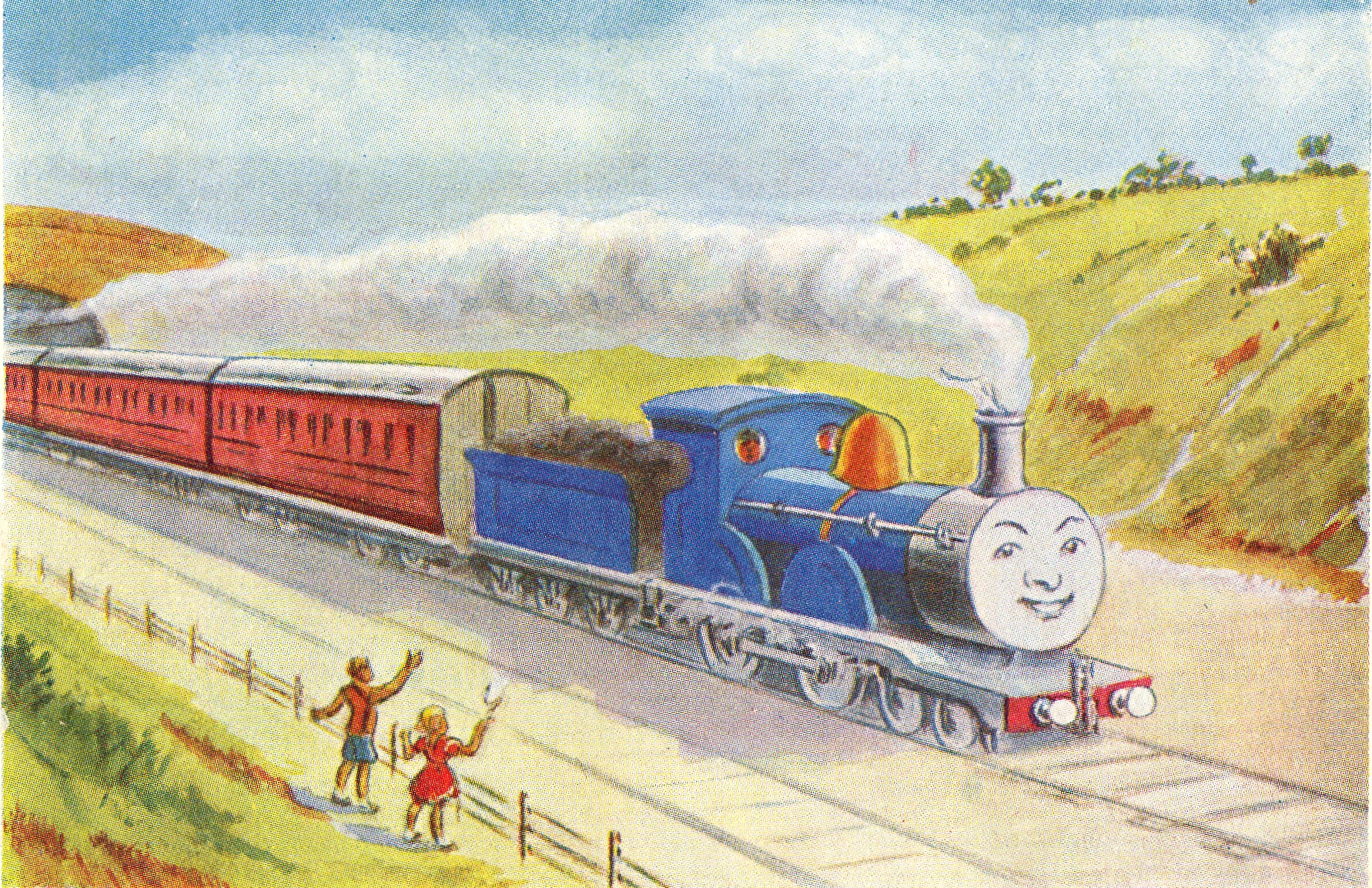
Illustration of “Edward’s Day Out” by William Middleton

The Reverend Wilbert Vere Awdry’s The Three Railway Engines, first instalment in what would become the world famous Railway Series, was originally published seventy-five years before today. After his death, the franchise he created was carried on by his son Christopher. That can, of course, be said of another great English writer, though sadly his Christopher’s own demise came earlier this year. Present circumstances impede me from coming up with a more comprehensive tribute, but perhaps this could be the basis for a joint effort between Clamavi de Profundis and The Tuggster Intensifies one day:

Rails go ever ever on,
Over rock and under tree.
By tunnels where no sun has shone,
Canals that never find the sea;
Ploughed through snow by winter sown,
And past the merry flowers of June,
Over sleepers lain on stone,
And viaducts o’er valleys hewn.

Rails go ever ever on,
Under cloud and under star.
Yet wheels that thundering have gone
Roll at last to home afar.
Eyes that fire and smoke have seen,
And horror in the smelter’s place
Look at last on buffer clean,
In cosy sheds they longed to face.

The track goes ever on and on
Down from the door where it began.
Now far ahead the line has gone,
And I must follow, if I can,
Pursuing it with weary wheels,
Until it joins some larger way,
Where many points and switches meet.
And whither then? I cannot say.

The track goes ever on and on
Out from the yard where it began.
Now far ahead the line has gone.
Let others follow, if they can!
Let them a journey new begin.
But I at last with pistons worn
To silent sidings will crawl in,
To down for night and sleep ’till dawn.

Still ’round the next bend there may wait
A new branch or secret gate;
And though I long have roamed this isle,
I never could lose cause to smile
Upon the realm my line does span
West of Barrow, East of Mann.

Adapted from The Road Goes Ever On by J. R. R. Tolkien, circa 1937.

UPDATE (22nd October)

Search engine results show that at least one other has thought of this connection before I did – EndlessWire94 on DeviantArt.