Arms, Flags, Paint Pots & Queens

Having written a few times now about heraldry as featured in The Railway Series, as well as significant events in that franchise, I felt that now would be a good time to do a spotlight on the most particularly heraldry-heavy story.

Today is the seventieth anniversary of the UK publication of Gordon the Big Engine, the eighth book in the series, came just fifteen days after Elizabeth II’s coronation. I will, of course be focusing on the fourth chapter in the book (and its 1995 television adaptation), in which the monarch herself visits the big station.

The written story has seven illustrations by Clarence Reginald Dalby, of which only the last three are relevant here. The television episode obviously has a large number of potential screenshots. The images used below are linked from the bountiful gallery on ttte.fandom.com and are labelled by their timestamp within the episode (not counting opening credits) in case of future link rot.

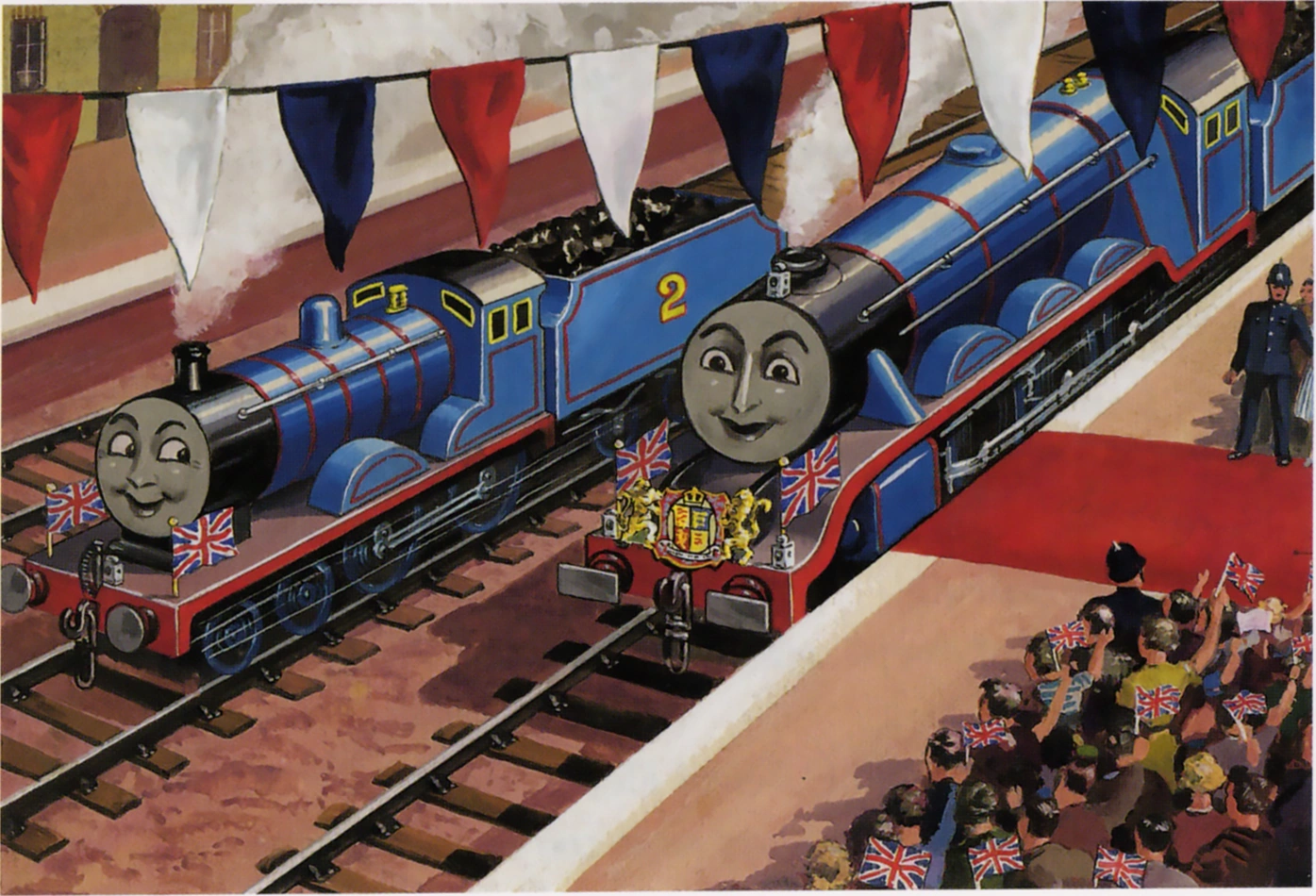
5th illustration

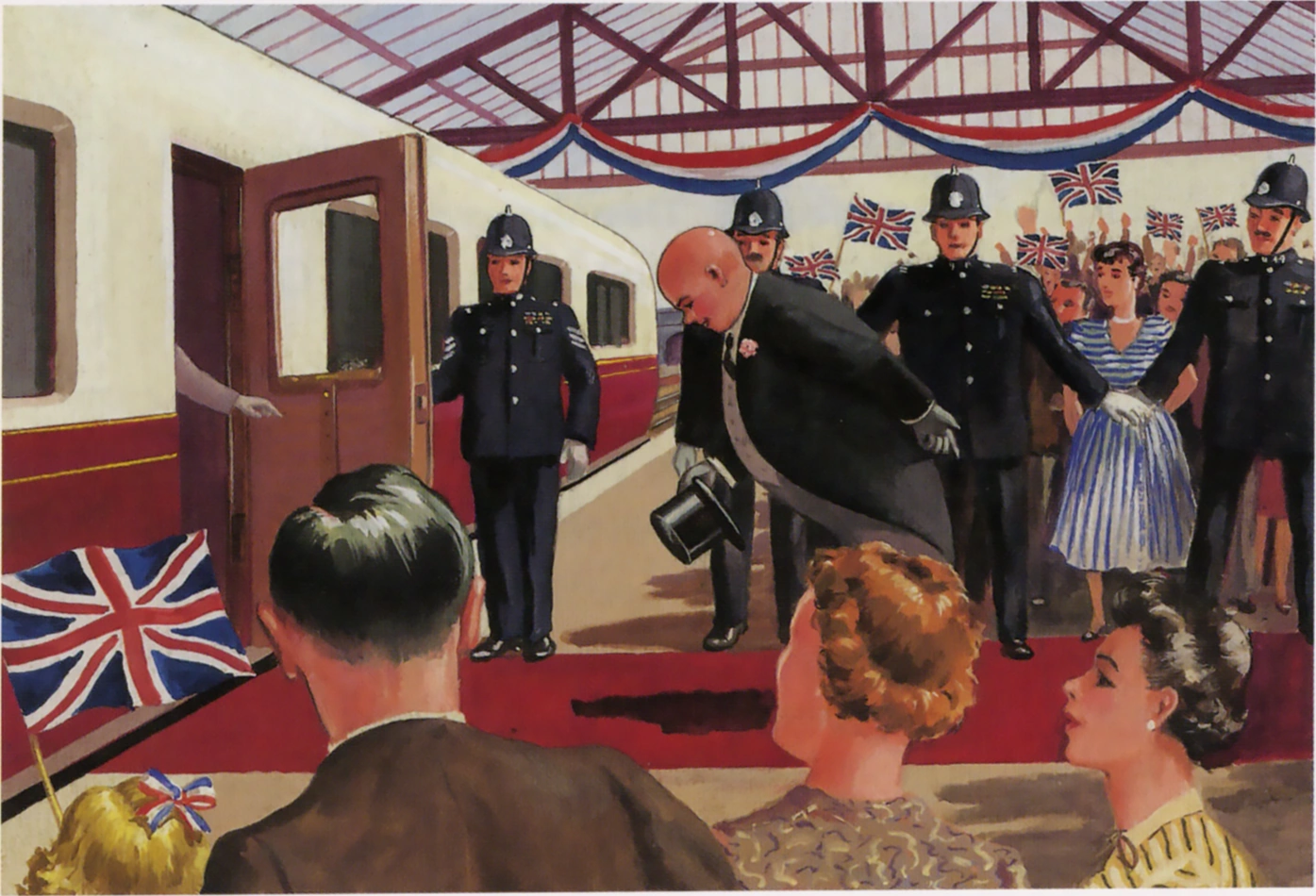
6th illustration

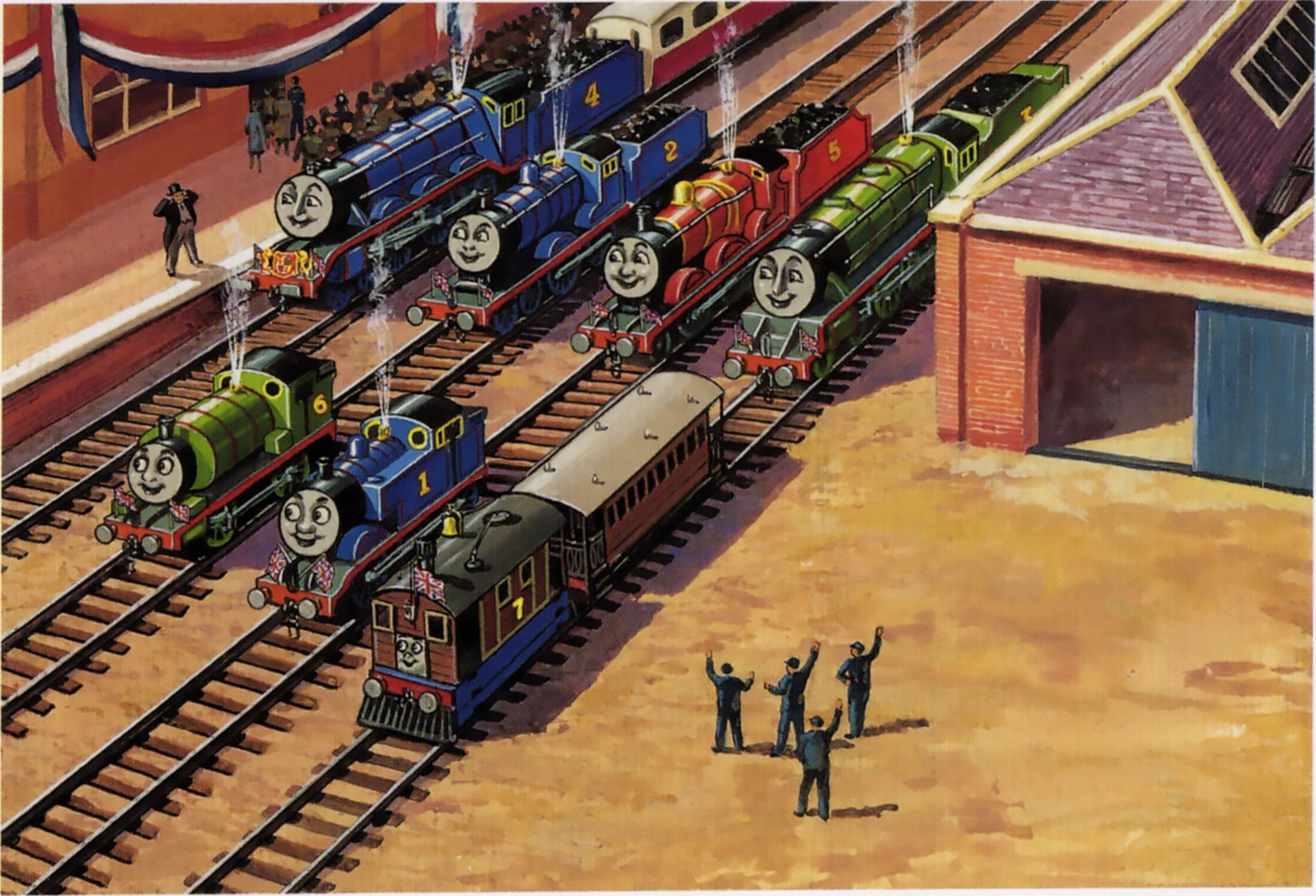
7th illustration

The text of the story says:

Edward steamed in, looking smart with flags and bright paint.
…the Queen’s train glided into the station. Gordon was spotless, and his brass shone. Like Edward, he was decorated with flags, but on his buffer beam he proudly carried the Royal Arms.

In the illustrations themselves we can see Union Flags galore, as well as a string of pennons in the national colours.There is also a tricolor drape across the frame of the station which runs the risk of inadvertently looking French or Dutch. Gordon’s carving of the royal arms is obviously the centrepiece here: It looks to have a lion Or as the supporter on both sides with the quarterings being first and fourth Or, second Azure third Gules. The actual charges on them cannot be deciphered but the crown looks like a reasonable approximation of either the Tudor crown or St Edward’s (the former likely still being in wide usage at this early stage of Elizabeth’s reign).

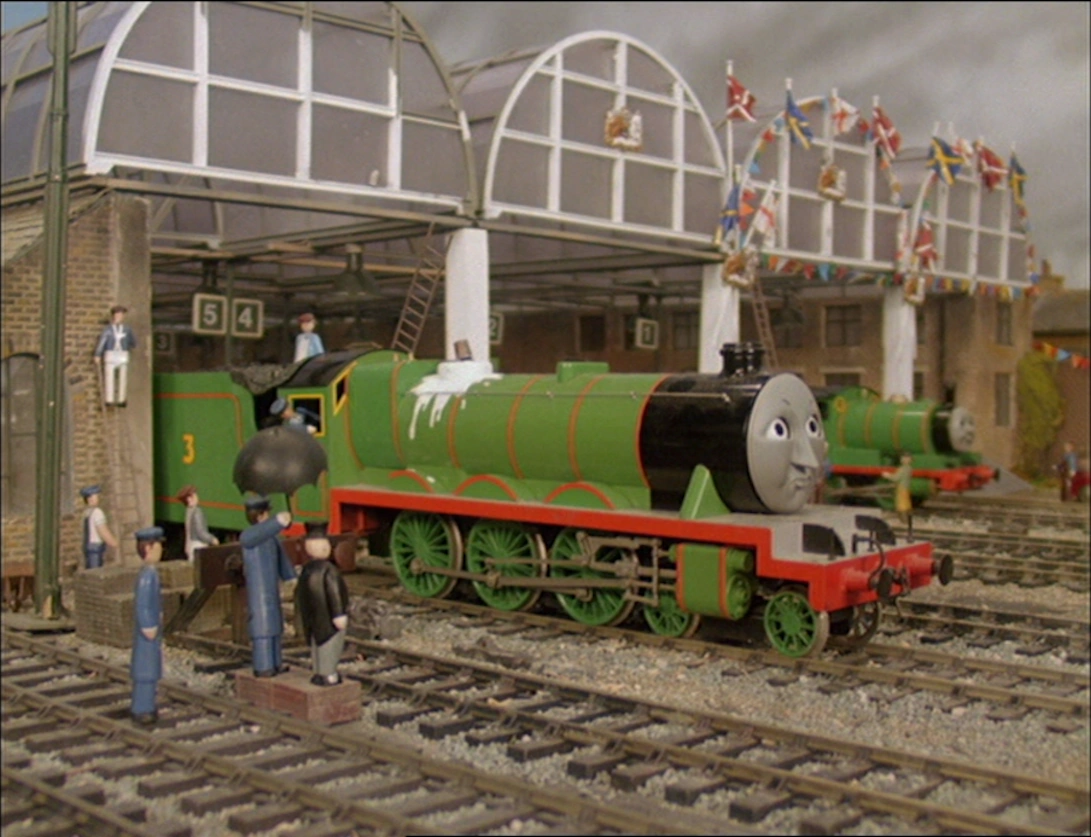
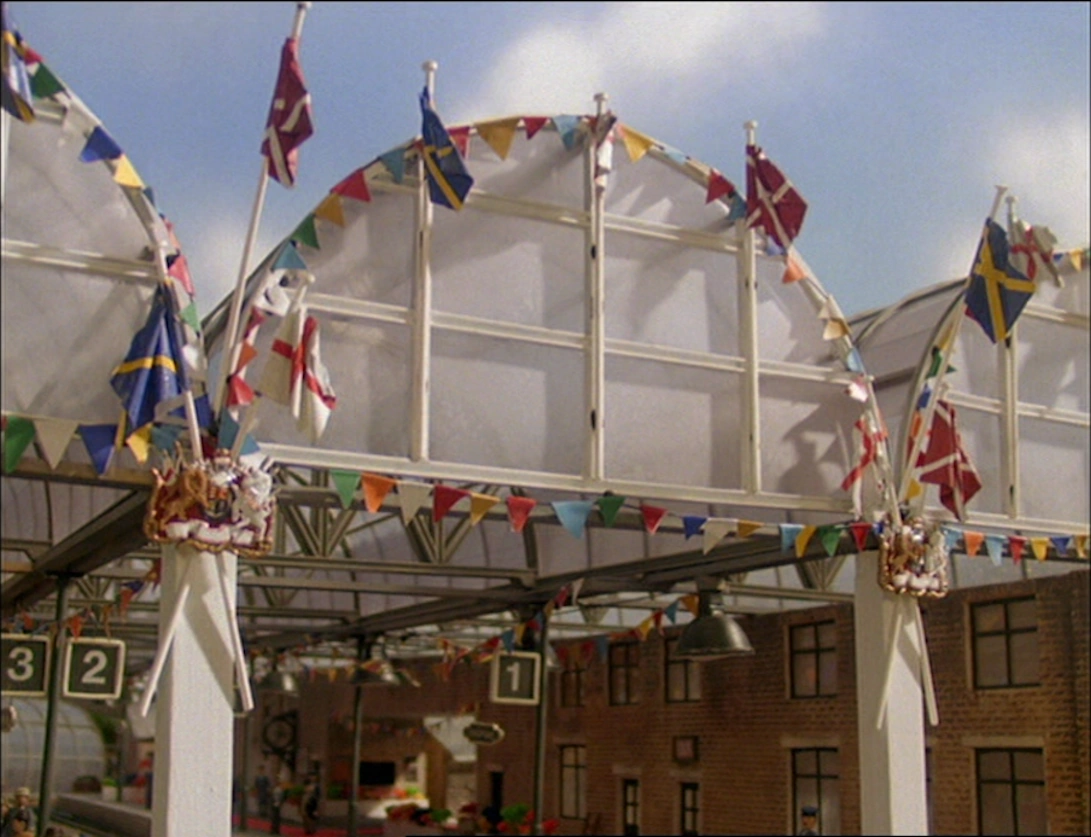
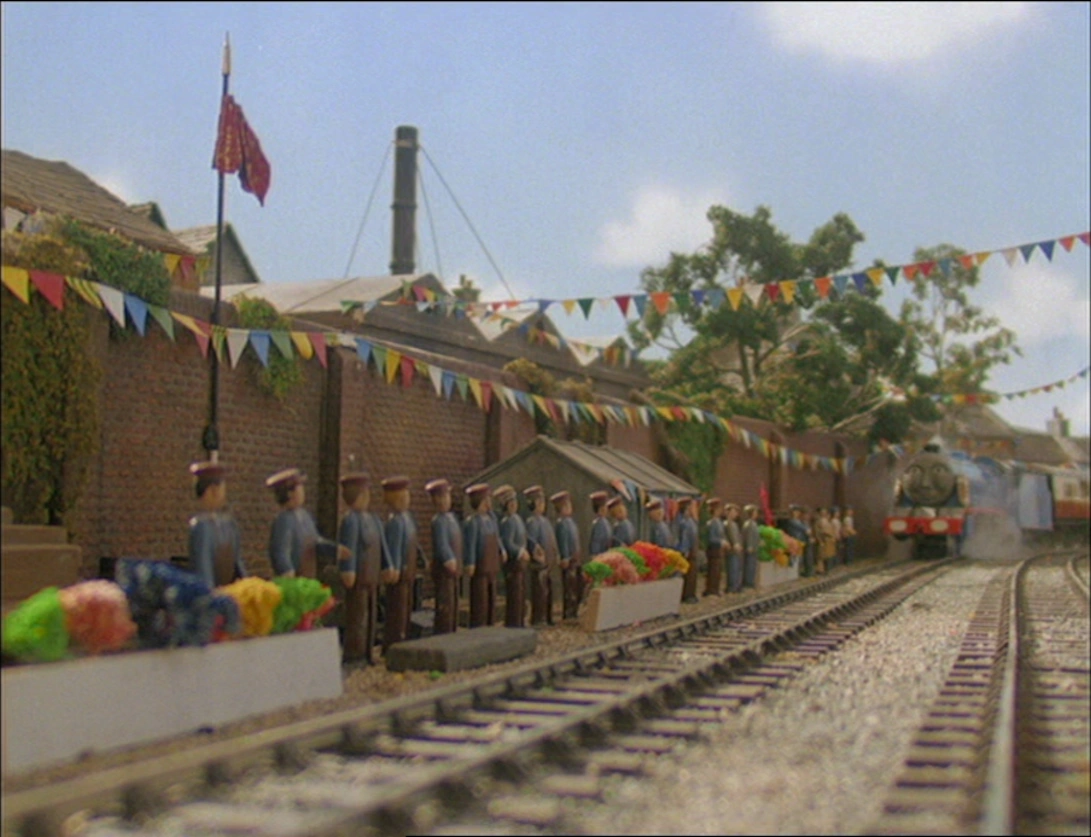
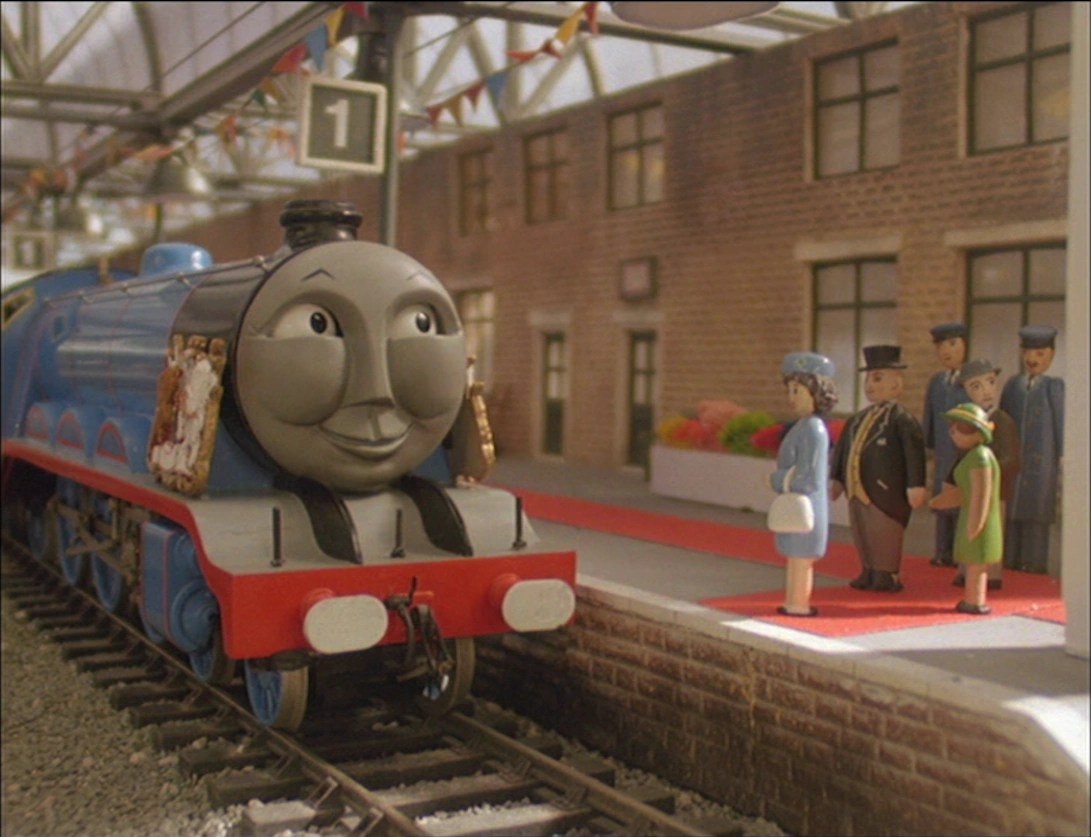
The television adaptation depicts things a little differently – Britt Allcroft at this stage was keen to present Sodor as a mystical fantasy land and dissociate it from the United Kingdom (although clearly not from the monarch), so the Union Flags are entirely absent and the bunting is generically technicoloured. We do, however, see multiple carvings of the royal arms – one leaning on either side of Gordon’s smokebox and at least four more attached to the station itself – originally on the glass of the canopy but later moving to the pillars and a nearby lamppost.

2m02s

2m43s

3m24s

4m20s

Also flying from the canopy are three flags of more definite designs, the first Argent a cross Gules, the second Azure a saltire Or and the third Murrey a saltire Argent. The first is obviously the flag of England but I don’t know the origin of the other two. We don’t get a close-up shot of the royal arms, but they are clearly supported by a golden lion and a white unicorn in the right arrangement. The shield itself looks to be blue in both the lower quarters but the upper quarters for England and Scotland are potentially correct. A red banner with indecipherable golden embroidering also flies outside the station as Gordon approaches.

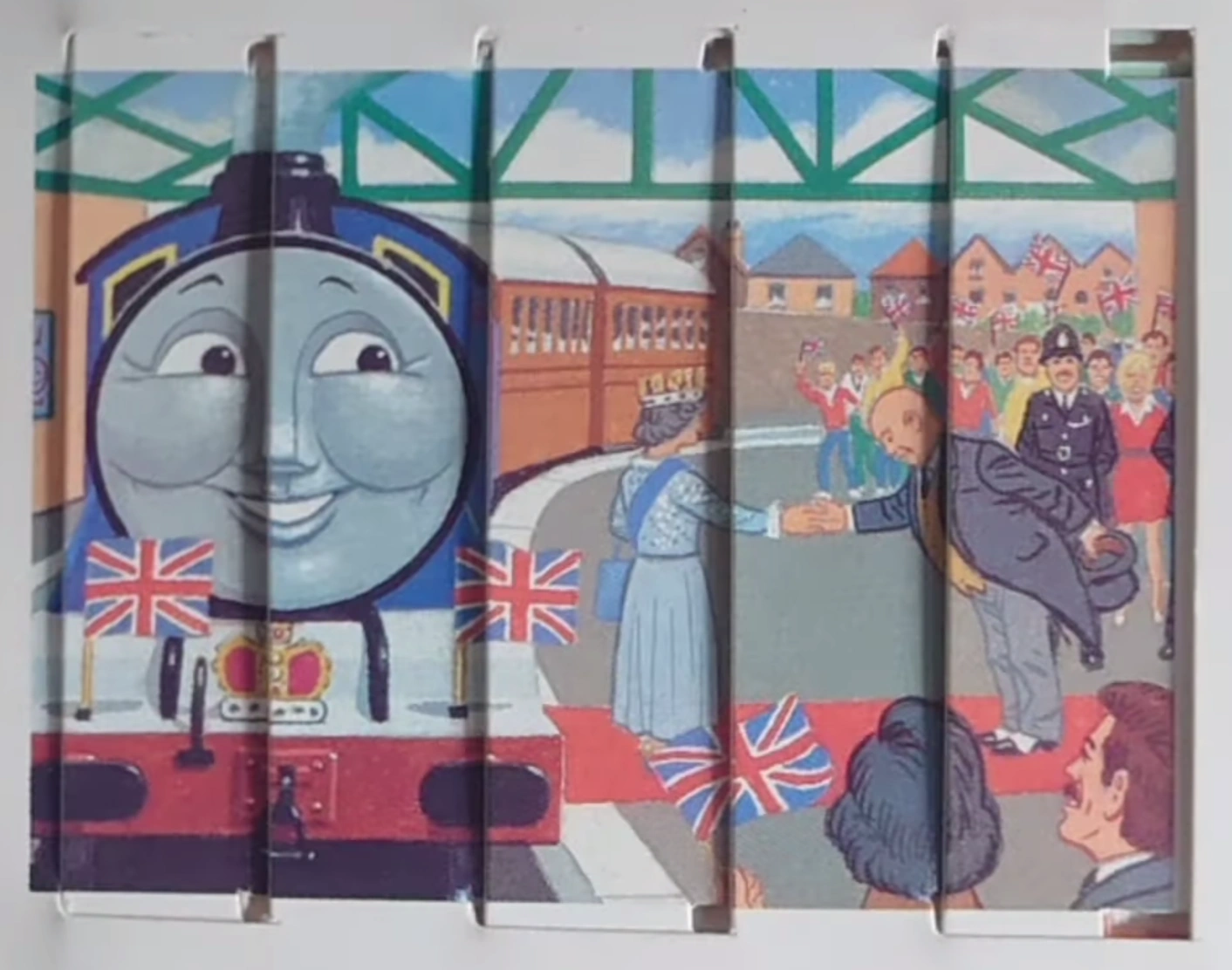
This, incidentally, was not the first adaptation of the source material, for the story was republished as part of a series of Changing Picture Books called Busy Engines in 1994. The illustrations here (by Arkadia Illustration Ltd.) show many Union Flags as in the original book but no royal arms. Gordon’s footplate instead carries a large facsimile of St Edward’s Crown (perhaps foreshadowing the Duchess of Loughborough).

The Queen’s own appearance also changes – in the 1953 book she is shown only as an arm emerging from her carriage, in the 1994 book wearing a golden circlet trimmed with ermine and a thick blue sash from her right shoulder (very formal for a day trip on a steam train) and in the 1995 episode in a light blue dress with matching hat. It has been suggested but never confirmed that the man in the brown jacket is meant to be her husband and the short woman in the green dress her mother, which might be the clue as to why the story title implies that more than one queen visited.

Armory and Architecture

This evening I attended a virtual lecture at Arts University Bournemouth. The presenter was David Lund and the subject was the history of architectural model-making, particularly that of John Brown Thorp.

Modelling is an invisible profession to most people as the model-makers are largely executing the ideas of architects, who thus take all the credit for the design. British model-making kicked off in the late sixteenth century with the arrival of trends from Italy. The earliest record is of a 1567 model of Longleat House, made for Sir John Finn. Sir Christopher Wren would go on to commission architectural miniatures on a regular basis.

Originally timber was favoured for model-building, but card proved to be more adaptable. Thorp is considered the grandfather of architectural model-making. He had his headquarters near to the Inns of Court, and his extremely-detailed scale models were used in court cases. By 1940 his firm was employing forty other modellers. The emergence of modelling as a dedicated profession allowed an increase in the size and standards of their creations.

Modelling boomed in the 1950s and ’60s, with the material fashions of the models changing in line with those of the buildings themselves – card representing brick was replaced by perspex representing glass and steel. The economic slump of the 1970s caused a change in clientele, with modellers working for private developers instead of state architects. Nowadays it is common for models to be designed on computers and then 3D-printed, incorporating lighting and even animation.

In the Q&A session, Lund was asked about the phenomenon of public disappointment when a finished construction fails to live up to what the model promised. Lund conceded that models and artistic renderings often gave a sanitised, optimistic prediction of the built environment, replete with happy people and clean surfaces, whereas the reality (especially in modernist constructions) proved quite different. Developers and the public often unfairly blame the artists and modellers for this, even though they are only following what the developers tell them to do.

On an entirely unrelated note, late last night I discovered that Sir Lindsay Hoyle, Speaker of the House of Commons since 2019, has finally been granted a coat of arms. I was relieved to come across this news at all, yet also a little perplexed to realise that the news articles were from almost a month ago. I don’t know how I missed this, given that I have been obsessively looking out for this ever since his election. The not-so-grand reveal came at the unveiling of a new set of stained-glass windows in the Palace of Westminster, the other panels of which were decorated with the arms of British Overseas Territories.

None of the news articles I have uncovered so far gave the blazon for the new achievement, so my illustration for Wikimedia Commons is based on visual inspection of the artwork in the photograph. It indeed includes the red rose of Lancaster, “busy bee” and rugby references as Sir Lindsay hinted two years ago. The use of the parliamentary mace Or on a fess conjoined to a bordure Vert is almost certainly copied from the arms of Sir Harry Hylton-Foster, who became speaker sixty years before Hoyle did – though one has to hope that Hoyle does not end his tenure quite so abruptly. The window shows mantling Gules and Argent (rather than Vert to match the shield), so I have copied that. It is not clear exactly when the grant was made, nor whether the grant was to Sir Lindsay himself or to his noble father (the mace makes the latter seem unlikely).

The search for other new grants continues. Last month I got a pretty strong hint about the arms of Lady Amos, but those of Sir Tony Blair remain as elusive as ever.

The Crown old and new

Early in the new reign, the College of Arms announced a new royal cypher for Charles III. A noted difference between this one and his mother’s (other than the name, of course) was the depiction of the crown.

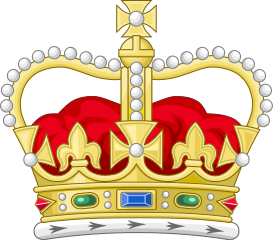
“St Edward’s” crown, favoured by Charles II to Victoria

Up to and including Victoria’s reign, depictions of the crown in heraldic drawings could be inconsistent. Edward VII ordered a standardised depiction with simple arches, which has come to be known as “the Tudor crown” due to its resemblance to one supposedly commissioned by Henry VII or VIII (and seen in royal portraits up to the Civil War). Elizabeth II later decided to change this to a version with depressed arches, better resembling St Edward’s crown which monarchs actually wear at coronations, and which seemed to be favoured in heraldic drawings before Victoria’s time. The timing of these decisions created a general misconception that the Tudor crown is always used when the monarch is male and St Edward’s when the monarch is female. Charles’s decision is likely to reinforce that belief.

The “Tudor” crown, as used by Edward VII-George VI

On the day of the coronation, the Canadian Heraldic Authority unveilved their own new version of the crown, intended to be more distinctly Canadian. The overall shape of the crown is still based on the Tudor version, but the jewels have been replaced by a wavy blue line, the uppermost cross by a snowflake (as already used in the Order of Canada) and the crosses around the rim by – of course – golden maple leaves. The removal of explicit Christian symbols may be due to the lack of an established church in Canada, though the omission of fleurs-de-lis is a little perplexing, given the constitutional importance of the country’s French heritage.

https://upload.wikimedia.org/wikipedia/commons/thumb/d/d4/Crown_of_Canada_2023.svg/248px-Crown_of_Canada_2023.svg.png

The Canadian crown, as used by Charles III

It is not clear on exactly what timescale the new crown is to supersede the old. Four days after the coronation the government of Canada released a revised Canadian passport design. Though many radical changes have been made, the 1952 depiction of the crown retains pride of place. It is also not certain whether this will apply to the parliamentary maces. Currently the mace of the House of Commons is modeled on the Tudor crown while that of the Senate is modeled on St Edward’s. This is reflected in the heraldic badge of the parliament, showing both maces in saltire behind the shield. Funnily enough, British passports, though updating the introductory text to reference His Britannic Majesty instead of Hers, also still seem to have the prior crown on their covers.

The shield itself (fleurs and all) remains unchanged. It was announced on the same day that the arms of Canada may be flown as a banner to represent Charles and all future sovereigns. Previously Elizabeth II’s flag had the royal arms of Canada with her personal EIIR cypher imposed on a hurt in the middle. The removal of the cypher brings Canada closer in line with British heraldic practice whereby the reigning monarch bears the arms of dominion undifferenced, as well as avoiding the hassle of redesigning the flag for each subsequent reign. It remains to be seen whether the heraldic banners of other members of the royal family will also omit their cyphers and keep just the cadency labels.

FURTHER READING

Some Developments, Old and New

My hobby as an amateur armorial artist has been going in earnest for six years now and is fast approaching 1,400 illustrations. Every now and again I go back to revisit one of my earlier works to see if it can be improved.

Today’s retrospective was Lord Walker of Aldringham, former Chief of the Defence Staff, whose arms I first did in January 2019. I found an old thread about it on r/heraldry and, predictably, they weren’t very impressed.

I set out to remake the shield from scratch, smoothing out the fracture of the orle, refining the colours and, crucially, making the acorns a little more recognisable. The main difficulty I had was fitting the four acorns above and below the chevrons, for this arrangement works more naturally with three. When reading the blazon on Walker’s page I saw that there was no source given for it, and set out to find one. Reading Debrett’s Peerage 2019 (page 4691) I discovered that there were indeed three acorns not four, and corrected the image accordingly. I must wonder how that error originated (since it was written as a word not a numeral, so a simple typo would be difficult) and how far it has proliferated.

With nine days to go until King Charles’s coronation, his cypher has started to be seen on the liveries of royal soldiers. The Yeoman Warders (or “Beefeaters”) at the Tower of London recently debuted their new blue undress uniforms, and the state trumpeters have updated theirs as well.

UPDATE (30th April)

I see that on the same day I uploaded my re-illustration the Prime Minister’s Flickr account published a photograph taken inside Westminster Abbey, with Walker’s banner hanging in the background. Sure enough, three acorns only.

A Note on Royal Peerages

Today it was announced that The Prince Edward, Earl of Wessex and Forfar, was created Duke of Edinburgh, a title formerly held by his father. This had been speculated for years, but the intriguing part of the news is that the title is only for life – Edward’s son James will not inherit it. This is the first life peerage above the degree of baron for more than two hundred years, and the first given to a royal since medieval times.

For a newly-ascended king to denounce the principle of heredity seems unlikely. I think there is a more pragmatic reason for this – a desire to keep the title in circulation for the sons and brothers of future kings. The firm does not want to run out of place names (especially in Scotland) to use for dukedoms.

It has been tradition in Britain for the better part of a millennium that the younger sons of the monarch are granted dukedoms referring to prominent locations within the isles. Indeed, there is a lot of tradition in which particular place names are used, and even for which place in birth order.

On second thought, however, this shouldn’t be possible – if these honours are separately hereditary, and given to the offspring expected not to take the crown, then how do the same titles keep coming up time and time again. This paradox reveals an important detail about the royal dynasties of the past thousand years – their cadet branches normally don’t branch very far. It’s remarkably rare to find examples of a legitimate male line emanating from a younger son of a king that lasts for more than three generations. Most of the time either the junior line dies out (either only having daughters, or having no children at all), or the senior line fails so that the junior line ascends to the throne. To make matters worse, on the few occasions where a divergent line has managed to sustain itself, there has nearly always been some kind of intervention that prevented the title from doing so. What follows is by no means a complete history of the royal lineage, but a list of the most commonly-used royal dukedoms roughly in descending order of number of creations, with an explanation of what happened to them.

York

The first use of the northern city for a royal dukedom came in 1385, when Richard II bestowed the title on his uncle Edmund of Langley. This founded the House of York, which was to be one of the principal factions in the Wars of the Roses after Richard’s death. Edmund was succeeded by his son Edward of Norwich, who died at Agincourt, then his grandson Richard of York, who lead the opposition against the regime of Henry VI. Richard died before winning the throne, so the dukedom passed to his own son, who not long later succeeded as King Edward IV.

The title of Duke of York has since been conferred ten more times (thrice combined with Albany), nearly always for the monarch’s second son. Five dukes ascended to the throne, another four died without sons. Prince Andrew looks set to continue the latter tradition.

Sussex

Conferred twice as a dukedom – the first was for The Prince Augustus Frederick, sixth son of George III. He married twice without permission so his children were deemed illegitimate and the title died with him. The second was for Prince Henry of Wales in 2018. He currently has one legitimate son. It is too early to speculate about grandsons. An earldom of Sussex was also given by Queen Victoria for her son Arthur (see Connaught).

Gloucester

Created as a dukedom five times (and used as an informal style on two others), the most memorable recipient being Richard III. All died without an heir until Prince Henry, son of George V, whose son Richard (b. 1944) holds the title to this day. He has a line of succession two generations deep (though only one person wide) so barring any accidents for Xan Windsor we can expect the title to escape from the royal family for most of the rest of this century. The title “Duke of Gloucester and Edinburgh” was created once and inherited once, the second duke dying childless in 1834.

Cambridge

Five creations and two more stylings. The first four dukes died as small children. Prince George (1706) and Prince William (2011) were both directly in line to the throne so their honours were doomed to merge. Prince Adolphus, son of George III, produced an heir but his children were born outside the Royal Marriages Act so they could not inherit. His daughter’s son, Prince Adolphus of Teck, was created Marquess of Cambridge in 1917 and passed it to his son George ten years later, but George only had a daughter and Frederick, his brother, died a bachelor.

Albany

First granted by Robert II to his third son (also Robert) in 1398, the title passed to his son Murdoch in 1420, but five years later Murdoch was attainted and his peerages removed. Conferred again by James II on his second son Alexander in 1458, it passed to his son John, but John died childless and brotherless in 1536. James V’s son Robert was styled as such in 1541, but he died at eight days old. Mary I conferred the dukedom on her husband Henry in 1565 and it was inherited by their son – later James VI, merging with the crown on his accession. James recreated the title for his second son Charles, but his first son died so Charles also became king. Charles II upon his restoration gave the title to his brother James, who succeeded him on the throne. Albany was also created three times as a joint peerage with York. The final creation was in 1881 for Victoria’s son Leopold, and inherited by his son Charles (also Duke of Saxe-Coburg and Gotha) until he was stripped of it in 1919. The claimant today would be his great-grandson Prince Hubertus.

Cumberland

First created for Charles I’s nephew Prince Rupert of the Rhine, then William & Mary’s brother-in-law Prince George of Denmark, then George II’s son Prince William. All died without sons to succeed them. Prince Henry Frederick, George III’s brother, was made Duke of Cumberland and Strathearn in 1766, but he died childless as well. George later made his fifth son, Prince Ernest Augustus, Duke of Cumberland & Teviotdale. Ernest passed the dukedom (and the Hanoverian crown) to his son George in 1851, then grandson Ernest Augustus in 1878, but he was deprived of the title in 1919. The claimant today would be the first duke’s great-great-great grandson Prince Ernest Augustus (born 1954).

Kent

Ignoring non-royal creations, the title was conferred on George V’s youngest (surviving) son in 1934, and passed to his son in 1942. Currently the duke is fortieth in line to the throne, with two direct heirs and six spares of his own, so neither extinction nor merging is likely in the forseeable future. The double-dukedom “Kent & Strathearn” has been used once, for Queen Victoria’s father, but he died with no sons.

Clarence

Referring to the town of Clare in Suffolk, the first two creations were for the second sons of their respective kings, both dying without legitimate sons. The third creation was for George Plantagenet, brother of Edward IV. He was survived by a son, but the title was not passed on as he was attainted and executed for treason. The title fell out of favour until 1789 when George III made his third son (later William IV) Duke of Clarence & St Andrews. William had several children out of wedlock who used “Fitzclarence” as a surname. Queen Victoria ennobled her senior grandson Albert Victor as Duke of Clarence & Avondale in 1890, but two years later he died just before his planned wedding. An earldom of Clarence was already in existence, created nine years earlier for Victoria’s fourth son (see Albany).

Bedford

Granted twice to John of Lancaster, son of Henry IV, but he died childless. Conferred on John Nevill, intended son-in-law of Edward IV, in 1470, but he was later attainted for treason. Given in 1478 to George, said king’s third son, who died young. Given in 1485 to Jasper Tudor, uncle of Henry VII, who died childless. Given in 1694 to the non-royal William Russell, whose descendants carry it to this day.

Edinburgh

The first creation was by George I in 1726, for his senior grandson Frederick. Frederick predeceased his father, and the dukedom was held for nine years by his own eldest son, who then acceded as George III. Victoria gave it to her second son Alfred in 1866. He died in 1900, his only son having died the year before. The third and likely most significant creation was by George VI in 1947, for his son-in-law Philip Mountbatten. Philip spent a record time as royal consort and founded an award scheme under that title, raising the name to a significance it had not previously enjoyed (despite being a capital). Philip died in 2021 and his peerages were inherited by his eldest son Charles, who six months ago became King. Today Charles conferred the title for life on his youngest brother Edward.

Kendal

Style of Charles II’s nephew in 1666. He died young.

Windsor

Created by George VI for his brother, the former king Edward VIII. Edward died childless in 1972.

The Heraldry of Haiti

Malcolm Lobley’s lecture tonight for the Yorkshire Heraldry Society concerned the country which has long been a source of cult fascination among armory enthusiasts.

He began with a short history of how the country came to be – which was, by his own admission, a way of padding the event’s length.

Henry Christophe founded the Kingdom of Haiti in 1811. In addition to proclaiming himself as monarch, he established a native nobility on the European model consisting of four princes, eight dukes, twenty-two counts, thirty-seven barons and forty chevaliers. He assumed arms of dominion for his realm, and also created a heraldic authority to assign arms to his appointees.

Lobley noted that as in Britain there was a convention on helmet usage according to rank – nobles used a barred helmet, the most senior affrontee and the rest facing dexter. Some of the titles of the peers, based on contemporary local place names, sounded comical to English speakers, such as the Duc de la Marmelade and the Duc de Limonade. Lobley was especially drawn to the Duc de l’Anse, which he translated to “jug handle”. Hyenas were a common choice as supporters. The contents of the shield tended to a medieval degree of simplicity though incorporating more modern imagery, such as Baron de Beliard with his rake and watering can.

The lecture was also used as an opportunity to advertise the Armorial Général du Royaume d’Hayti, which the College of Arms has been trying to flog for more than a decade.

She Spoke to Serve

The late Baroness Boothroyd has fascinated me for as long as I have followed British politics, and hers was among the deaths I most dreaded.

Just last October, with my newly-registered library card, I took out her autobiography. There are eighty pages before she actually becomes an MP (and she goes into detail of her multiple failed attempts), describing her childhood in impoverished Dewsbury, then her time as a Tiller girl, then going into politics as a secretary to two Labour MPs, then going overseas to work for JFK. Even when she gets into parliament, her struggles are as within her own party as against the others – this being the age of entryism by Militant, which she was instrumental in rooting out.

Before the release of the 2018 parliamentary portrait series ,(and note that her image is the one used on the PDS blog) Boothroyd was one of the many prominent politicians for whom I struggled long to find a free photograph to use on Wikipedia. The only one on which I could lay my hands was a poor-quality screenshot from President Obama’s speech in Westminster Hall in 2011, published on the White House channel and thus public domain. The baroness is shown looking the wrong way, sandwiched awkwardly between George Osborne and Douglas Alexander. For the top (indeed, only) illustration in a prominent online biography it just wasn’t good enough.

The other big challenge was her coat of arms – one of my earliest such works. Unlike her successor Michael Martin, Boothroyd’s arms were widely photographed and shown online. Recreating the lozenge visually was easy enough, though it wasn’t until years later that I tracked down the text of the blazon to go with it. My first attempt was not well-received by the residents of r/heraldry, so it was one of the few of my graphics which I completely remade.

I never got to see how the community (or anyone else) viewed my second attempt, for within hours of her death being announced another user, ProfAuthor, had replaced it with his own vector graphic. It is technically superior, of course, but still it is disappointing to know that my own efforts are made redundant. Something similar happened with Sir Ernest Shackleton the last time he was in the news.

Stories in Scotland’s Skies by Philip Tibbets

Today’s virtual lecture took me back to the Heraldry Society of Scotland, where our speaker – the Lyon Court’s vexillologist – gave a fascinating talk about the history of flag culture in Scotland, and the process by which flags – heraldic or otherwise – come to be invented.

At least I think that was what happened. Unfortunately I cannot say for certain due to glaring technical problems. We virtual attendees did not actually see the inside of the venue, for the visual feed was only of the slideshow (and even that did not seem to be aligned properly with the speech), but we guessed that the microphone was positioned a great distance away from Mr Tibbetts’s mouth and much closer to an audience member with a recurrent cough. As a result only about half of the speaker’s syllables could be heard, which rendered most sentences unintelligible. Edward Mallinson made several attempts to resolve the sound problem but it made no difference. He even turned on the automated subtitles, but those are notoriously poor even when the sound is good. Before even thirty minutes into the planned ninety-minute event I and a few other Zoom-watchers had given up and logged out.

It was, to say the least, a grave disappointment.

Heralds-a-Heralding

Today and yesterday, Charles III was formally proclaimed as King across the world, following the meeting of his accession council. This is only the fourth accession in Britain since the invention of the television, and the first time that the council itself has been broadcast live. Indeed, to my knowledge the only other time that any meeting of the council in Britain has been recorded was for the 1993 documentary Days of Majesty, and even then only a small clip was shown. There was supposed to have been a meeting (probably done virtually) some days ago for the swearing in of Liz Truss’s new cabinet, but the fading of Queen Elizabeth’s health prevented it. When that session will eventually take place is unknown. We are in an odd situation where the new monarch is having his accession confirmed by a set of ministers whose own office-holding has not been fully confirmed either. The ceremony was something of a consolation prize for Penny Mordaunt, who lost the bid to become Prime Minister but was instead appointed Lord President. She took the lead role in the day’s proceedings. Once the proclamation had been approved and various oaths had been taken it was read out by David White, Garter King of Arms, on the palace’s balcony. Not long later it was repeated by Timothy Duke (Clarenceux) on the steps of the royal exchange. The next day it was read by Robert Noel (Norroy & Ulster) at Hillsborough Castle. Joseph Morrow (Lyon) read it at Mercat Cross, as did Morfudd Meredith (Lord Lieutenant of South Glamorgan) and Thomas Lloyd (Wales Herald) in Cardiff. The other proclamations made around the British Isles, and the Commonwealth, are far too numerous to list.

Times such as this are a rare opportunity (others being state openings and, next year, the coronation) to see officers of arms in their full finery. They will be very busy over the coming months.

It can be taken as read that, following his ascent to the throne, the undifferenced arms of the United Kingdom, and those of all his other realms and territories, now belong to His Majesty. The arms of his siblings, niblings and cousins have no reason to change from what they were before. The arms of his wife, sons, and daughters-in-law are all due for upgrades.

Probable arms of Camilla, Queen Consort

Camilla, as Queen Consort, can now be expected to impale the Shand arms with those of the King. Given that William now has all of the statuses and titles that his father held a week ago, it is most probable that he will bear the same heraldic achievement, with which Catherine will impale the Middleton arms. It is yet to be seen (and there are conflicting precedents) of the Duke & Duchess of Sussex will similarly upgrade by swapping their five-point cadency label for one of three points, and removing the strawberry leaves from their coronets. The ever-present yet ever-uncredited Sodacan has already uploaded multiple illustrations of how he expects the revised armorial achievements to look.

Probable arms of Catherine, Princess of Wales

There is some controversy over whether Charles will change the heraldic depiction of the crown from St. Edward’s (depressed arch) to Tudor (no depression). There is a perception that St. Edward’s Crown is for queens and the Tudor crown for kings (due to the latter being preferred from 1901 to 1952) but this is not binding and St. Edward’s was regularly used by kings before Victoria’s reign.

FURTHER VIEWING

UPDATE (April 2024)

I’ve just finished reading Charles III: New King. New Court. The Inside Story by Robert Hardman. Chapter Three: London Bridge explains that the Truss ministry was supposed to be sworn in on 7th September with the politicians meeting in Westminster and Queen Elizabeth attending by audio-only link from Balmoral, but the meeting was cancelled at short notice when her health took a downturn.

UPDATE (September 2025)

Historian Jason Loch has published this article analysing the intricacies of the accession council and the legal status of Truss’s cabinet.

Demise and Disarray

The death of Elizabeth II is a time of serious grief for her family and her many peoples. It is also a time of mild confusion for public bodies, and of course Wikipedians. Here is a run-down of some of the changes that have recently been made.

The Monarch

The man long known as Charles, Prince of Wales is now King. For many years there had been speculation that he would take the regnal name George VII in honour of his maternal grandfather and great-grandfather, but shortly after his accession it was confirmed that he would indeed go by Charles III. There was a brief period when his page was at Charles, King of the United Kingdom before being changed to Charles III. There is an ongoing debate as to whether the article title should include “of the United Kingdom”. The side in favour argues that there have been many other monarchs over the centuries called Charles III from whom the present monarch needs to be differentiated. The side against argues that Charles is king of far more than just Britain, and that if you included one realm in his title you would have to include all of them, lest you imply that one is more important than another.

The Consort

Camilla Shand, at the time of her marriage in 2005, was not popular among much of the public still grieving Diana Spencer. So as to avoid appearing to usurp her legacy, she never styled herself “Princess of Wales”, instead going by “Duchess of Cornwall”. It was also suggested back then that, upon her husband’s accession, she would be styled “Princess Consort” (presumably derived from Prince Albert) rather than Queen. How true this proved to be was always a matter of public relations rather than constitutional law. By the start of this year it was clear that her reputation had recovered sufficiently to abandon that idea, and Elizabeth II in an open letter explicitly endorsed her daughter-in-law to be called Queen Consort. Currently all major media and government sources are very insistent on styling her “The Queen Consort”, rather than simply “The Queen” as other queens consort were before her. It is not yet clear if she will be described this way for the whole of Charles’s reign or if it is simply a temporary measure so as not to confuse the public while the late queen regnant is still being mourned. Again, there is dispute over whether her article title should include “of the United Kingdom”.

The Heir Apparent

In 2011 Prince William of Wales was ennobled by his grandmother as Duke of Cambridge, Earl of Strathearn and Baron Carrickfergus in the peerage of the United Kingdom. He has not ceased to hold these titles, but they are now buried beneath several others. The dukedom of Cornwall, in the peerage of England, is governed by a 1337 Charter instructing that it belongs automatically to the eldest living legitimate son of the incumbent monarch and the heir apparent to the throne, and that if these two statuses are held by different people then the title is left vacant. This means that all dukes (save Richard of Bordeaux) are deemed to have held the original peerage, rather than it being created anew each time. The Duchy of Cornwall, a substantial land-holding corporation in the south of England, is governed by the same. The dukedom of Rothesay in the peerage of Scotland is mandated by an Act of Parliament from 1469 to follow an identical succession, as are the titles Earl of Carrick, Baron of Renfrew, Lord of the Isles, Prince of Scotland and Great Steward of Scotland. The titles of Prince of Wales and Earl of Chester, by contrast, are not automatic. They are conferred by letters patent at the discretion of the monarch. It appears from news reports that Charles III has opted to do so almost immediately after coming to the throne, though I am still waiting to see this formally confirmed in the Gazette or the Court Circular. There was a short interlude in which the royal website and Wikipedia styled him “Duke of Cornwall and Cambridge”. I argued that it was poor form to include Cambridge while leaving out Rothesay, to which an anonymous user replied:

It would, but we don’t have a basis for that usage in Wikipedia practice. The hierarchy is very much What the Papers Say > legal/heraldic/formal/official names > anything that actually makes sense. I’m guessing there will be a followup announcement about his distinct style in Scotland and indeed in Northern Ireland, and maybe they’ll end up with something more logical and less clumsy. After workshopping every other possibility.

The Others

The accession of a new sovereign causes a reshuffle in the orders of precedence among the royal family. In the male order, Charles is naturally now on top. His sons William and Harry also move up, as do his grandsons George, Louis and Archie (their position before, as great-grandsons of the sovereign, was a little unclear). Andrew and Edward are demoted from sons to brothers, James and Peter from grandsons to nephews, and the Earl of Snowdon from nephew to cousin. The Dukes of Gloucester and Kent and Prince Michael are unaffected. On the female side Camilla achieves supremacy, followed by Catherine, then Meghan, then Charlotte, then Lilibet, then Sophie, Anne, Beatrice, Eugenie, Louise, Zara, Birgitte, Katharine, Marie-Christine, Sarah and Alexandra.

The styles and titles of Charles’s descendants are also upgraded (though those of his siblings and niblings are not diminished). William and Harry both gain a definitive article in their princely titles. George, Charlotte and Louis are now “of Wales” rather than “of Cambridge”. There has, of course, already been a famous Princess Charlotte of Wales, so until an alternative solution emerges their Wikipedia pages must be differentiated by the awkward use of years in brackets. Archie and Lilibet, as children of a younger son of the sovereign, now qualify as royals under the terms of the 1917 letters patent. They could now correctly be styled as “His Royal Highness Prince Archie of Sussex” and “Her Royal Highness Princess Lilibet of Sussex”, though no move has been made in that direction so far. The situation regarding the Earl of Wessex’s children remains ambiguous. Charles could, of course, amend or revoke the letters patent however he wishes, but there has not yet been any indication in that regard.

The dukedom of Edinburgh, earldom of Merioneth and barony Greenwich, which were conferred by George VI on his daughter’s fiancé Philip Mountbatten in 1947, and were then inherited by Charles in 2021, have now merged with the crown. Any of them can be bestowed anew on whomever His Majesty chooses. His brother Edward has long been presumed to receive them next, but no decision has been taken at this time.

Under the Regency Act 1937 Camilla (consort) and Beatrice (fourth adult in line) have become Counsellors of State.

The office of Lord Great Chamberlain of England (not the same as Lord Chamberlain of the Household) has automatically transferred from the 7th Marquess of Cholmondeley to the 7th Baron Carrington. The former therefore loses membership of the House of Lords under Section 2 of the 1999 Act while the latter gains it. What happens to the place he already held among the ninety elected hereditary peers is still to be determined.

The Courts

The Queen’s Bench Divisions of the High Courts of England & Wales and of Northern Ireland, as well as the Courts of Queen’s Bench for the Canadian provinces of Alberta, Manitoba, New Brunswick and Saskatchewan, have all been renamed King’s Bench. The status of Queen’s Counsel in Australia, Britain, Canada and New Zealand has likewise changed to King’s Counsel, and all who hold it have had to amend their post-nominals accordingly. Only last month I created a new template for judges of the Queen’s Bench Division and had scrupulously added the specification to each of their infoboxes. Now I have had to change all of them. Still, it helps boost my edit count I suppose.

UPDATE (March 2023)

A few months late but better than never, the Palace now confirms that Archie & Lilibet have princely titles, as well as that Edward has become a duke.