A virtual talk by the Paul Mellon Centre, featuring Anne Dulau Beveridge, Nigel Leask and John Bonehill.

A virtual talk by the Paul Mellon Centre, featuring Anne Dulau Beveridge, Nigel Leask and John Bonehill.

Today’s virtual lecture was by Rory MacLellan at the Society for Court Studies.
To recap for those unaware: The Lancastrian dynasty came to power in England in 1399 when Henry of Bolingbroke, Duke of Lancaster, deposed his cousin Richard II, and acceded as Henry IV. It was continued by his eldest son Henry V after 1413, and then grandson Henry VI after 1422. Richard II had no children or siblings, and Bolingbroke was his heir presumptive according to agnatic primogenture, but by the male-preference cognatic method that was the consensus then in England the throne should have passed to Edmund Mortimer, 5th Earl of March. Even if Bolingbroke’s claim had been legitimate, the overthrow (and later probable murder) of his predecessor stained him in the eyes of his people, and of God. Henry V made some efforts to atone for his father’s treason. He won the respect of the population by his glorious victory at the Battle of Agincourt in 1415, and subsequent capture of the crown of France. Henry VI was beset by mental health problems and under his weak leadership English politics fell into severe disarray, resulting in the loss of most of the French possessions he had inherited. Opposition to his government was lead by Richard, Duke of York (Edmund Mortimer’s grand-nephew and Richard II’s cognatic heir), whose own son eventually unseated Henry to become Edward IV in 1461.
MacLellan’s research concerned the manner in which the three Lancastrian monarchs were officially remembered under the Yorkist regime. They were clear that the 1399 coup was illegal and that the Lancastrian line was thus illegitimate. Each was called “King in deed but not in right”. It was easy enough to condemn Henry IV for having committed regicide, and Henry VI for losing France, but Henry V presented a challenge – all the territories his son lost were only held by England in the first place due to the supreme military, chivalric and diplomatic skill of his father, whose accomplishments are revered even to this day and which the Yorkists themselves strove to honour.
Later historians have given differing reviews of how Henry V was regarded under Edward IV’s first reign (1461-70). Jonathan Hughes found “universal respect and praise” and Russell Butcher said “one of the most successful medieval kings was difficult to criticise”, but Alison Allan said he was “usually quietly ignored” so as to maintain the Yorkist line that Lancastrian rule was a misery.
The only positive comments by Yorkists about any Lancastrian were made in the 1450s while the latter dynasty still reigned, and while Richard still insisted he only opposed Henry’s advisors instead of Henry himself. Once the White Rose had supplanted the Red the line quickly changed, with Speaker Strangeways recanting the new official version to Parliament. An act was passed to overturn the 1415 treason conviction of Richard of Conisburgh (Edward’s grandfather), saying that “a pretensed session had reached an erroneous judgement”. All other official correspondence from this time made clear that Henry had been king by usurpation. Even during Edward’s own 1467-8 bid for France, when Henry V’s legacy would have been useful, it was kept under wraps.
In Edward’s second reign (1471-83), when the House of Lancaster had been extinguished, it was politically safe for his government to recognise the personal virtues and accomplishments of Henry V though still condemning his illegitimacy. MacLellan noted that whereas Edward had been hostile to Henry VI’s establishment of Eton College and King’s at Cambridge he still patronised the religious organisations (Syon Abbey and Sheen Priory) set up by his father. Richard III also owned several books that praised Henry V, such as The Book of the Order of Chivalry (Caxton’s translation) and The Book of Noblesse (William Worcester). Perhaps Richard could be somewhat more tolerant of the Lancastrian legacy, not being the first Yorkist king.
In the Q&A the only attendees (there were but twelve of us) to ask questions were myself and Fabianpersson. He asked how Henry V was perceived by other Lancastrians, and then by the early Tudors. MacLellan said that he was revered up until the point at which his French conquests were lost, after which they simply stopped mentioning him. To lean on his glory would only have served to highlight how poorly his son was performing by comparison. Even John Fortescue’s Commendation of the Laws of England, written for Edward of Lancaster, does not mention his grandfather. Henry VII rarely brought up his namesake-but-one, except for a pamphlet around 1510 using his precedent for another campaign in France. Fabian suggested that political memory fades after 20-40 years, though MacLellan countered that the Yorkist side still brought up precedents from as early as Henry I to support their cause. Fabian also asked how Henry VI’s perception was affected by that of his father and grandfather, and how either dynasty dealt with Richard II’s own problems. MacLellan said that it was risky to criticise the foundation of the Lancastrian dynasty while it still reigned. Henry VI had the advantage that he was born into an already-established succession rather than personally being involved in its installation, and that he was well-known to be much more pious than his grandfather. The Yorkists presented Richard II as entirely blameless in his own demise. Henry V made some effort to rehabilitate him, including a reburial, but it was still to early to cede much moral ground to the former monarch without jeopardising his own crown.
I asked how the Tudor dynasty, which claimed to be the union of York and Lancaster, reconciled the competing claims of the two houses in their own official communications. MacLellan wasn’t sure about Henry IV, but said that later pamphlets were generally positive about both Edward IV and Henry V. The counterpart question to the original study- how was Edward IV was regarded during Henry’s readeption. MacLellan replied that what little had been written during Henry’s second reign was swiftly destroyed once Edward returned. He also surmised that the Lancastrians just weren’t as good at this sort of political propaganda as the Yorkists had been. I asked how long it took for historical tensions between York and Lancaster to finally subside, having heard from other historians that the controversy lingered well into Elizabeth I’s reign. He said it was slightly out of his period of study, but noted that there were still Yorkist claimants in the late fifteenth century and that it probably wasn’t until the next change of dynasty (with James VI of Scotland’s arrival) that the issue faded, though there remained a legal vaguery as to which claim was more legitimate. Finally I noted that there were many references in his own speech and in other historians’ accounts to Parliament praising whichever dynasty was then in power and condemning the one that had gone before, and asked to what extent the medieval Parliament of England simply acted to give a veneer of retroactive legitimacy to what had already happened by force. MacLellan said this was definitely the case, and that most of the parliamentary speeches that survive were written on behalf of the then-incumbent monarch so as to persuade other representatives of whatever narrative was politically convenient.
EXTERNAL LINKS

At 4pm today (or 11am for them) I attended yet another virtual lecture put on by the Toronto Branch of the Royal Heraldry Society of Canada. The speaker was Bernard Juby and the topic was heraldic bookplates – meaning a decorative label pasted into the early pages of a book, illustrating the arms of the copy’s owner. Juby told us, and showed many examples, of heraldic artists in Canada and around the world who had been commissioned to make such pieces. He said that the convention began in late fifteenth-century Germany, and that until relatively recently books of all kinds were primarily owned by the elite social classes, most of whom would be armigers.
His presentation focused on breadth rather than depth, moving at considerable speed through the portfolios of over a hundred artists. The rushing by of so many luxuriously detailed and coloured artworks was quite dazzling. It was indicated that a recording of the presentation will shortly be available on the society’s YouTube channel, so I need not attempt to describe them all again.
Towards the end of this presentation, Jason Burgoin casually mentioned that later in the same day the British Columbia & Yukon branch of the society would be holding its annual general meeting. This began at 1pm BC time, which was 4pm in Toronto or 9pm in Yorkshire.*
The meeting was chaired by Steve Cowan. He welcomed the presence of Angélique Bernard, one of the branch’s patrons, and then announced that this would probably be the last Zoom meeting for a little while. He moved swiftly and efficiently through the agenda, including a handful of financial statements and appointments of various society officers (He noted that everybody else turned their cameras off at that point. “Very wise”.). The main concern was the content of The Blazon, the branch’s newsletter, and anticipation of upcoming commemorations (Commonwealth Day, Platinum Jubilee and the branch’s own fortieth anniversary). I was pleased to be able to witness this, as practice for the NERA’s AGM in May.
After an ten-minute adjournment, another presentation followed. This was by Charles Maier, former Athabaska Herald, and concerned the armorial history of Sir Winston Churchill. Maier said that while we often talk of him as one of the great men of history, his heraldry is great in itself. Winston was born a nephew of the Duke of Marlborough. He was proud of his lineage but also wanted to secure his own accomplishments. It is a lingering curiosity that he consistently refused to differentiate his own arms from those of his uncle.
 The first Sir Winston Churchill was a cavalier soldier who was stripped of his lands and wealth under the republic. It was most likely during this time that the motto “Faithful Though Disinherited” was adopted. His branch of the family had borne arms Sable a lion rampant Argent over all a bend Gules, but in Charles II’s reign the bend was removed and replaced with a canton Argent thereon a cross Gules, presumably as an augmentation in reward for his services.
 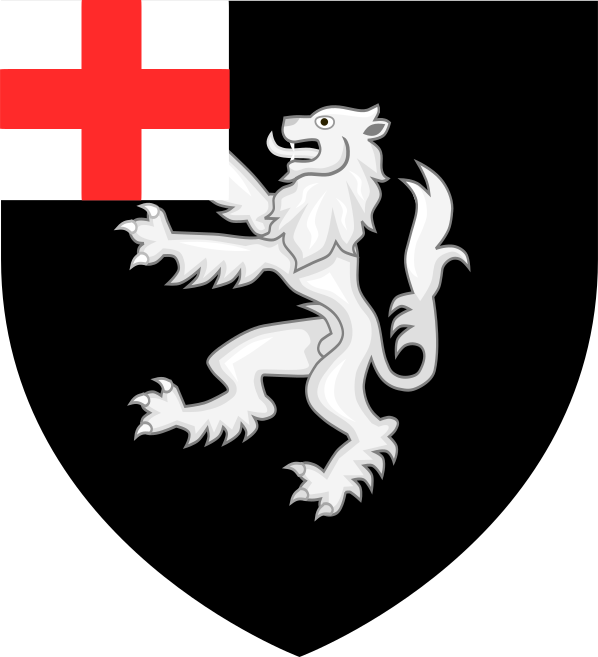 The crest, a lion holding a red flag, also seems to date from this time. John Churchill, 1st Duke of Marlborough, was also made a Prince of the Holy Roman Empire in 1704 and Prince of Mindelheim in 1705. This allowed him to use the Imperial Eagle as a supporter behind the shield in addition to the wyverns on either side. A further augmentation (an inescutcheon Argent a cross Gules, surmounted by another inescutcheon Azure three fleur-de-lys Or) was granted in time for his funeral in 1722, and carried on flags in his procession. A special act of Parliament allowed Churchill’s English peerages to pass to his daughters, and through them into the Spencer family. The Spencer dukes gave their own quarterings priority over his until 1817 when they swapped them around and changed their name to Spencer-Churchill. They used a griffin and a wyvern as supporters. The modern day dukes continue to use the heraldic accoutrements of their principality, despite titles of the Holy Roman Empire never being allowed to pass through the female line, and also in spite of all German monarchies having been abolished in 1918. I found it a little strange that the Churchills continue to cling to a token given by the Germans for defeating the French, given that their name is now associated with saving the French from the Germans.
 The later Winston was appointed Lord Warden of the Cinque Ports in 1941, allowing him to use the arms of that office. He became a Knight of the Garter in 1953, requiring a banner and stallplate of his arms to be placed in St George’s Chapel. Churchill disliked his first banner and had another one made in “a more striking, modern style”. He also had two stall plates – the first was made by Harold Soper in 1954, but never affixed because the herald responsible was not satisfied with its artistic quality. The second was made in 1958 by George Friend. He received a state funeral in 1965. This was conducted by the Earl Marshal, who had Nelson and Wellington as his only precedents. Banners of Churchill’s own arms, and those of the Cinque Ports, were held by heralds in his procession. The funeral banner had a small blue crescent for difference, which Churchill had refused to use when alive. The coffin went from Victoria to Bladen by train, the namesake locomotive bearing a plaque of his arms on its boiler.
 Maier pointed to some other examples of his heraldic legacy – HMS Churchill, HMCS Churchill, Churchill College Cambridge and the 1965 Churchill postal stamp, whose launch coincided with the introduction of the modern flag of Canada, ironically symbolic of the passing of the very age with which he was most associated. His arms were also borne, impaled, by his daughter Mary Soames, who became a Lady of the Garter in 2005. Of course, he also brought up Churchill’s time in Canada: The famous “roaring lion” portrait was taken by Yousuf Karsh in 1941, and Churchill’s expression is of anger at having his cigar taken away. William McKenzie-King, Prime Minister of Canada at the time, was desperate to be photographed with Churchill, though that picture is less well known. When Churchill was Secretary of State for the Colonies he argued with the Garter King of Arms about whether a warrant or a proclamation was needed for Canada’s new blazon.
Patrick Crocco asked if there was any particular system for assigning Garter stalls. Maier said it was simply whichever stall had been recently vacated. He also mentioned that HM Treasury covers all expenses relating to the order’s insignia.
There followed even more post-presentation chat, including a lengthy discussion between Cowan and Burgoin about women’s naval bowler hats. Sean from New Zealand was again present with his baby (whose burblings could be heard). I said that I had spent much of the past two years baby-sitting, thus becoming familiar with the heraldic banners featured in Ben & Holly among other programs. I also mentioned that I had been reading The History of the English-Speaking Peoples aloud to my mother, and trying to master Churchill’s voice.
All in all, today’s three events took up a lot of virtual time, but was well worth it. More are coming soon.
FURTHER READING
*A considerable amount of the post-presentation chat concerned the confusion that arises due to holding virtual meetings across multiple time zones. To make matters worse, different countries do daylight savings at different times – in Canada it begins tomorrow, but in Britain not for another fortnight.
Almost two years ago, it was becoming clear in Britain and most other countries that the coronavirus was a global problem and not merely a regional one. There were cases identified in the UK in January 2020, through February its news coverage slowly outgrew that of Brexit, with stories of panic buying and rising case rates, but much of ordinary life went on. By mid-March the crisis had become unavoidable – the government was giving daily press conferences and many public places (including universities) were shutting down. Hand sanitiser dispensers and social distance signs popped up all over. Then, on 23rd, the entire country went into the first lockdown. The Britain at the end of that month felt like a wholly different world from what it had been at the beginning. For other countries the exact dates vary but the overall phenomenon is very much the same. In retrospect, there was something particularly surreal about the week of 17th-23rd, where for many it may have felt like an unplanned holiday, the full weight of the disaster looming but having yet to hit.
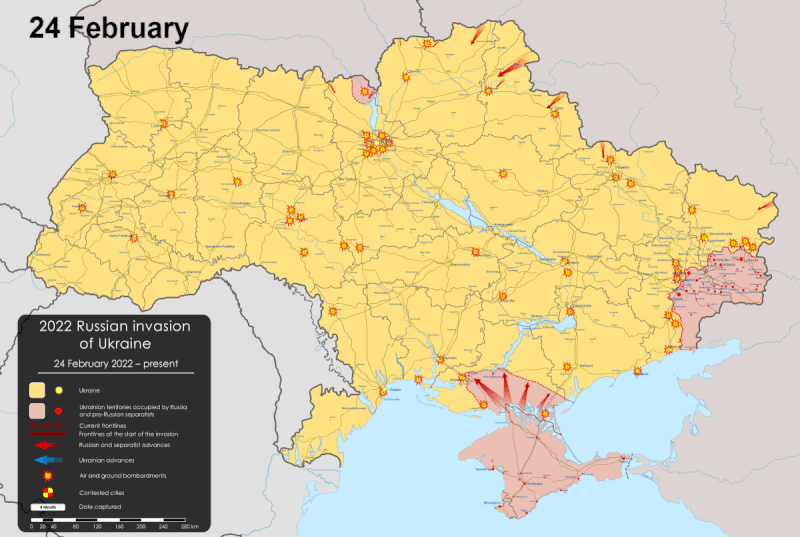
Now, after twenty-three months of on-and-off disease control, much of the developed world is transitioning from “pandemic” to “endemic” and returning to something like normality. In Scotland and Wales, all remaining COVID-induced restrictions are set to be lifted by the end of next month. In Northern Ireland they were lifted on 15th of this one. In England they went on Thursday. By superb coincidence, that was the same day the Vladimir Putin launched a full-on invasion of Ukraine.
Compared to the virus, this is neither as surprising nor as sudden – Russia has been in a state of war with its western neighbour for just over eight years, and diplomatic relations with other countries have been tense throughout that time, including many accusations of election meddling, political bribery and even assassination. Over the last few months the pressure could be seen rising. It was generally understood that war would properly break out at some point, but not exactly when. I remember Lucy Worsley’s Empire of the Tsars airing in early 2016, with quite a few online quips that the BBC wanted to get the filming done quickly in case war was imminent. Now, at the time of typing, it looks as if momentum has gathered – countries are, with varying degrees of enthusiasm, freezing (soon it could even be seizing) the financial assets of Russian businessmen and officials, as well as banning such people from their airspace. Sporting organisations look to ban Russia from their games. Britain is even sending troops to Eastern Europe. Other countries are doing likewise, or at least supplying equipment to the Ukranians themselves.
All that being said, we are not yet actually at war. British and Russian embassies to each other remain open, as do those in most other countries. It remains to be seen how long that lasts. The situation of the tens of thousands of Russian people living in Britain is perilous, as is that of Russian businesses trading here, or vice versa. This week’s invasion has been dubbed the largest conventional warfare operation in Europe since World War 2, and cries of World War 3 are widespread – and they are not meant jokingly this time. In the books that my late grandmother bought for me about the first two, it was mentioned that before the United States’s involvement, British and German ambassadors in Washington DC were competing with each other for American military contracts, and that private businesses within the allied and axis territories continued trading with each other (including weapons) right up until the declarations of war took effect. It will be interesting to see how much of that is repeated with Russia Today.
Speaking of Russia Today, RT continues to broadcast in this country. Suffice to say, its coverage of the invasion differs sharply from that of most other networks. The channel has been under review by Ofcom, and the leaders of the Labour and Scottish National parties have called for its termination. This has already been done in Poland and Germany, though the latter’s own public broadcasting service was reciprocally banned in Russia and there are fears that the BBC would suffer the same fate. I discovered RT in late 2012, at the same time as I was covering the Soviet Union for GCSE history. I appreciated the level of attention it gave to topics other channels thought less important, such as SOPA/PIPA/CISPA/ACTA and the Snowden revelations, as well as its documentaries on a variety of topics. If nothing else, it was good for checking the aspect ratio settings on one’s television, being for the time one of very few networks still airing in 4:3. All that being said, as a state-controlled news outlet it was never entirely trustworthy, and one could always sense that it was going out of its way to depict western democracies – and indeed “The West” as a concept – in the worst possible light and to encourage any kind of crankery that would undermine Russia’s strategic rivals.
As many are now pointing out, the true strength of Russian propaganda is online rather than on television, and that will be much trickier to sort out. The powers, rights and obligations of the large social media sites to intervene on political matters has long been controversial, as have measures to restrict the digital activity of Russia in particular. If the situation continues to escalate we may well see YouTube channels and Twitter accounts being suspended en-masse, as well as purges of suspicious users from message boards. As far as the pandemic comparison goes, we must currently be at least at the second or third week of March. I dread to think what the fourth looks like.
OTHER ANALYSES
UPDATE (2nd March)
RT’s television channel is off air and YouTube, along with other platforms, has hidden all of its videos.

This one was taken by Terry Foulger circa 1977, just to confuse you.
Today’s virtual lecture was put on by the North Eastern Railway Association. The Zoom session opened half an hour before the start of the actual presentation. This allowed the veteran members of the association to resolve technical issues, and also to trade jokes about Vladimir Putin. Neil Mackay, the association’s chairman, said that the upcoming Annual General Meeting would be held on Zoom due to the trustees’ lack of confidence in physical attendance, and asked if anyone would volunteer to be minutes secretary.
Our speaker was David Thomas. He had come to show off his photographs of the Class 55 diesel locomotives – popularly known as the Deltics, taken at various points along the East Coast Mainline in the period of 1977-1982, in anticipation of their displacement by the Class 43 High Speed Trains. Originally the photographs were taken with a Kodak Retinec 1B and the sound was captured by a Philips cassette tape recorder. Thomas’s original plan was to produce a tape-slide presentation, but this proved too costly at the time. Rather than settle for a less-than-professional presentation, he simply withheld the pictures until Microsoft Powerpoint came along to make things easier.
There followed a long stream of images. I will not attempt to describe them all. Thomas said that the Deltic engine was originally a marine concept, the admiralty having wanted a powerplant for its minesweepers. There were some technical diagrams included, and photographs of smashed engines undergoing repair. There were also insights into his personal life – he mentioned rushing to get a shot of No. 003 Meld at Holloway before going to see his wife give birth in York. He noted, too, where the environment in his photographs had changed, such as the “re-greening” around the viaduct at Leeds or the disappearance of poplar trees on the A64. Important moments in railway history were captured, such as the centenary of York Station in June 1978 and the final Deltic Scotsman service in February 1982.
The title of the lecture derived from Sigh for a Merlin by Alex Henshaw. The Rolls Royce Merlin engine had unofficially given its name to the Lancaster Bomber aeroplanes which used it, just as the Napier Deltic engine had done for the Class 55s. Thomas admitted that he didn’t like the locomotives originally but he grew to love them and he ended his talk by saluting all the volunteers who keep them working in preservation, the fleet between them having covered sixty-eight million miles.
EXTERNAL LINKS
UPDATE (8th March)
Chairman Mackay has accepted my offer to act as Minutes Secretary at the Annual General Meeting in May.
This afternoon’s virtual outing was with the Leeds Civic Trust, who have posted it online for all to see.
Today’s event was put on by the Newcomen Society. Professor Felix Schmidt took us on a historical tour of the international quest for ever faster locomotion, from the Hetton Colliery Railway in 1822 to the Shinkansen today. The society has placed the whole thing on its YouTube channel, so I needn’t type a detailed synopsis.
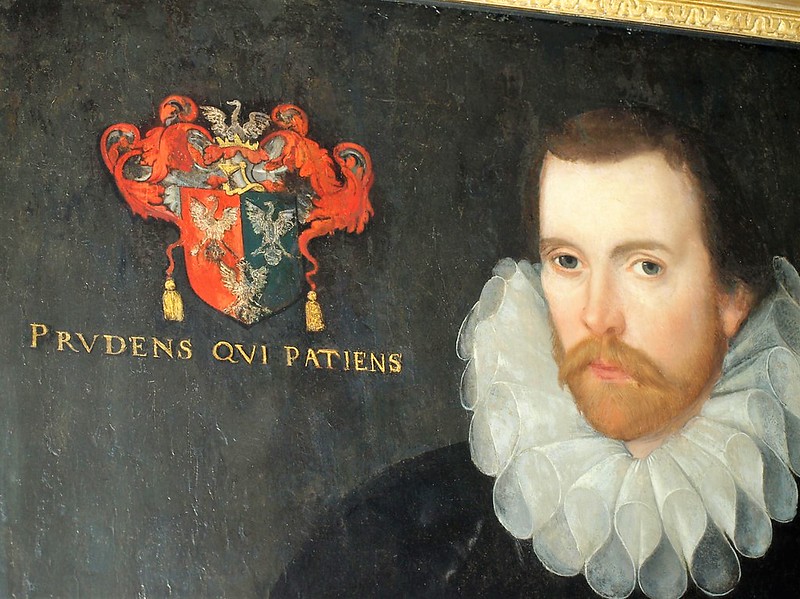
Almost three years ago I constructed, for Wikipedia, a list of all the coats of arms borne by Speakers of the House of Commons. That list covered the lower houses of Great Britain (1707-1800) and the United Kingdom (1801-present). Finding sources for the later incumbents was difficult – quite a few were missing from Burke’s and Debrett’s, so I had to get creative in looking for visual evidence, often relying on photographs from corporate events at Speaker’s House.
A few weeks ago the heraldic artist Baz Manning, whose photographs from Lincoln’s Inn I had already used for a similar page about Lords of Appeal, contacted me to say that he had taken extensive photographs inside the Palace of Westminster of the speakers’ arms, and would be uploading those on Flickr too. Not content with merely documenting those speakers who served since the Acts of Union, he had photographed the shields commemorating just about every speaker since the age of Henry III. It was therefore only natural that I should make a Wikipedia list for them as well.
In addition to these photographs I had written the written source of the 1850 book The Lives of the Speakers of the House of Commons by James Alexander Manning (Related? I’ll have to ask.), which I had already used for the earlier entries in the British list. The relative ease of accessing these compared to what I had before meant the prequel was much more easily accomplished than the original.
That is not to say that there were no difficulties, however – whereas speakers from the Georgian age onward generally served a good number of years in the green chair before ascending to the red bench*, in medieval to Stuart times their tenures were often very brief – indeed, the legislatures themselves were often only in existence for a few weeks. It was also much more common for members to serve non-consecutive terms, which means confusion about how to arrange their entries.
A particularly knotty problem is that many of these men lived and died in an age long before English spelling was nailed down, which means tricky decisions on what to actually call them (e.g. Guildesborough or Goldsborough, Broke or Brooke). Another is that different sources often contradict each other as to what exactly their armorial bearings were, Baz even pointing out quite a few instances where the painted shield on the wall does not conform to the blazon in the grant, or when there are two separate illustrations that are not in agreement.
Still, the page is up, and unlike last time it does not appear that I will be stuck waiting months for review and clearance, so I’m counting this as a success. It remains to be seen if one more armorial page can be squeezed out of this topic. Obviously the old Parliament of Scotland had no elected speaker (being unicameral and chaired by the Lord Chancellor much like the House of Lords), but the House of Commons of Ireland before 1801 had one much like its English counterpart. I will have to see if a similar gallery of painted shields is maintained at College Green, and if any other budding heraldists have been able to photograph it.
*Only five speakers of the English House of Commons ever ascended to the peerage, whereas only ten speakers of the British house have not, and several of them died in office. Quite a lot of English speakers were at least knights or baronets, though that introduces the further difficulty of finding out if each one was knighted before or after their time in office.

Today I attended another virtual meeting of the Richard III Society Gloucester Branch. The presentation was by John Reid, discussing the historical reputation of Richard’s father-in-law Richard Neville, 16th Earl of Warwick, popularly nicknamed “The Kingmaker”.
Warwick has been hugely divisive to contemporaries as well as historians, Ricardians, Lancastrians and Yorkists. He was England’s greatest celebrity of the fifteenth century and his fame (or infamy) carried on into the twentieth). He even had a board game named after him.
 He became the premier earl in England in 1449 due to lucky deaths. His family were great winners in the lottery of aristocratic marriages – picking up the estates of the Beauchamps and Despensers. His patchwork of armorial quartering reflects the complexity of his family connections. He had initially supported Henry VI, but changed sides in 1452 largely due to his inheritance disputes with the Duke of Somerset.
Henry VI, due in part to inherited mental health troubles, proved spectacularly incompetent, and many considered Richard, Duke of York to be king by right – though Reid showed us York’s signature on the letters patent of 1454 appointing Henry’s son Edward of Lancaster as Prince of Wales, clearly showing that even at this late stage he was not disputing the latter’s right. When eventually he rebelled against the Lancastrian crown he had Warwick’s invaluable support. York’s son Edward, Earl of March rescued Warwick from Margaret of Anjou and Warwick in turn arranged his coronation as Edward IV. For the first three years of Edward’s reign Warwick was thought “third king”, being virtual governor of the realm, acquiring even more land (after he confiscated the estates of the Percy and Clifford families, he wound up with lordships in twenty-eight English counties and a handful in Wales) and an annual income of at least £10,000 (nearly £11m in 2021 money).
Matters of matrimony spoiled his status: Warwick had spent months lobbying for a French princess to marry his king, and was humiliated by the revelation that Edward had already married – in secret – to Elizabeth Woodville, a dowager dame whose family had fought for the Lancastrian side. He described the parvenu Woodvilles as “grasping and charmless”, resenting how many titles, offices and marriages were given to them at the expense of his own dynasty, and how their influence over the crown came to displace his. Reid drew parallels with the modern-day rivalry between Carrie Symonds and Dominic Cummings.
Warwick’s first coup against Edward occurred in the summer of 1469. He launched his second in 1471, making a deal with Margaret of Anjou on 22 July and reinstating Henry VI on 3 October. He was killed at the Battle of Barnet on 14 April 1471. Reid noted that this was the only time he had fought on foot rather than horseback, leaving him with no easy way to escape when the tide turned against him and he was isolated from his allies on the field. This was very similar to the way Richard III would die fourteen years later.
The earl was adept at his own spin so contemporary sources are often too kind to him. Later writers were often too harsh. In particular Burgundian writers made him a bogeyman, believing that his policies would lead to their absorption by France. He had something of a rehabilitation under the Tudors – Henry VII wanted Henry VI to be declared a saint.
In summing up, Reid discussed Warwick’s virtues and vices. He was confident, charismatic, charming, courageous and energetic. He was treated shabbily by Edward IV after 1464. He may have been the model for Sir Lancelot as envisioned by Sir Thomas Mallory. On the other hand he can be seen as seeking power only for himself and being motivated by personal feuds rather than the national interest. His military skill is doubted, as is his necessity in the Yorkist accession. Could Edward IV have made himself king without Warwick’s help? Were the Woodvilles any worse than the Nevilles?
After the presentation itself had concluded and most attendees had logged out, there was a lengthy discussion between one attendee (Sean O’Neill) and the host (Cynthia) over the intricacies of Zoom functions – because various buttons were appearing and disappearing depending on the settings of individual hosts and updates by the company. This led to an explanation of the difficulties of an organisation managing virtual meetings, then one into internet difficulties generally as well as experiences of coronavirus. I mentioned having tested positive in November, and my experience with Hubbnet. I remarked that I would have been truly screwed had the pandemic hit in the period of 2009-13 when my house relied on plugabble WiFi dongles for very limited internet access. The two were surprised to realise that I lived near Hull, the former having once lived in North Ferriby and the latter in Hessle. They started asking me if Kingston Telecoms or Kingston Communications still existed (they do).
This was a presentation by the University of Liverpool, concerning the history, primarily between the seventh and nineteenth centuries, of how England has dealt with human corpses.
The main speaker was Ruth Nugent. She wanted to examine how the dead were handled literally, emotionally, ethically, spiritually and ideologically. She found that there was rarely much commentary on the relationship between bodies and tombs, students of other subjects would focus on associated details of architecture, geneaology, heraldry and religion but the principles of burial itself were often overlooked.
Until the eleventh century burial within a church building (as opposed to the yard outside) was reserved for royals, saints and clergy. Until the thirteenth it was monasteries that were most sought after as resting places. Due to the long-term problem of overcrowding it was common for bodies to be moved after a hundred years so that the plot could be used for someone else, or because the church was undergoing renovation work. There were cases of corpses stolen by one church from another, and legal disputes between families of the deceased over where the remains could be placed. Sometimes churchmen would claim to “discover” the bodies of legendary figures such as King Arthur. Epidemics, such as the Great Plague, put increased pressure on churchyards due to sudden mass burials. In the nineteenth century secular public cemeteries were opened to give alternatives to church burials, and cremation became more accepted. Laws were passed against intramural burials and exhumation to recycle spaces.
Physical upkeep was always a problem. Tombstones would be chipped away to make ingredients for magical medicines, and sometimes families would carry out clandestine removals of their own ancestors to escape from vandalism. Elizabeth I ordered churches to restore their tombs but often the churches lacked the money to comply. The Civil War left cathedrals in particularly poor condition and soldiers often looted graves. Large numbers of graves underneath churches could cause subsidence. Antiquarians (she named John Leland, John Stow, William Camden, John Waver and William Dering) determined to make written records of tombs and their contents in the hopes that the information could survive even if the physical structures didn’t – partly through interest in history, partly to safeguard their own futures.
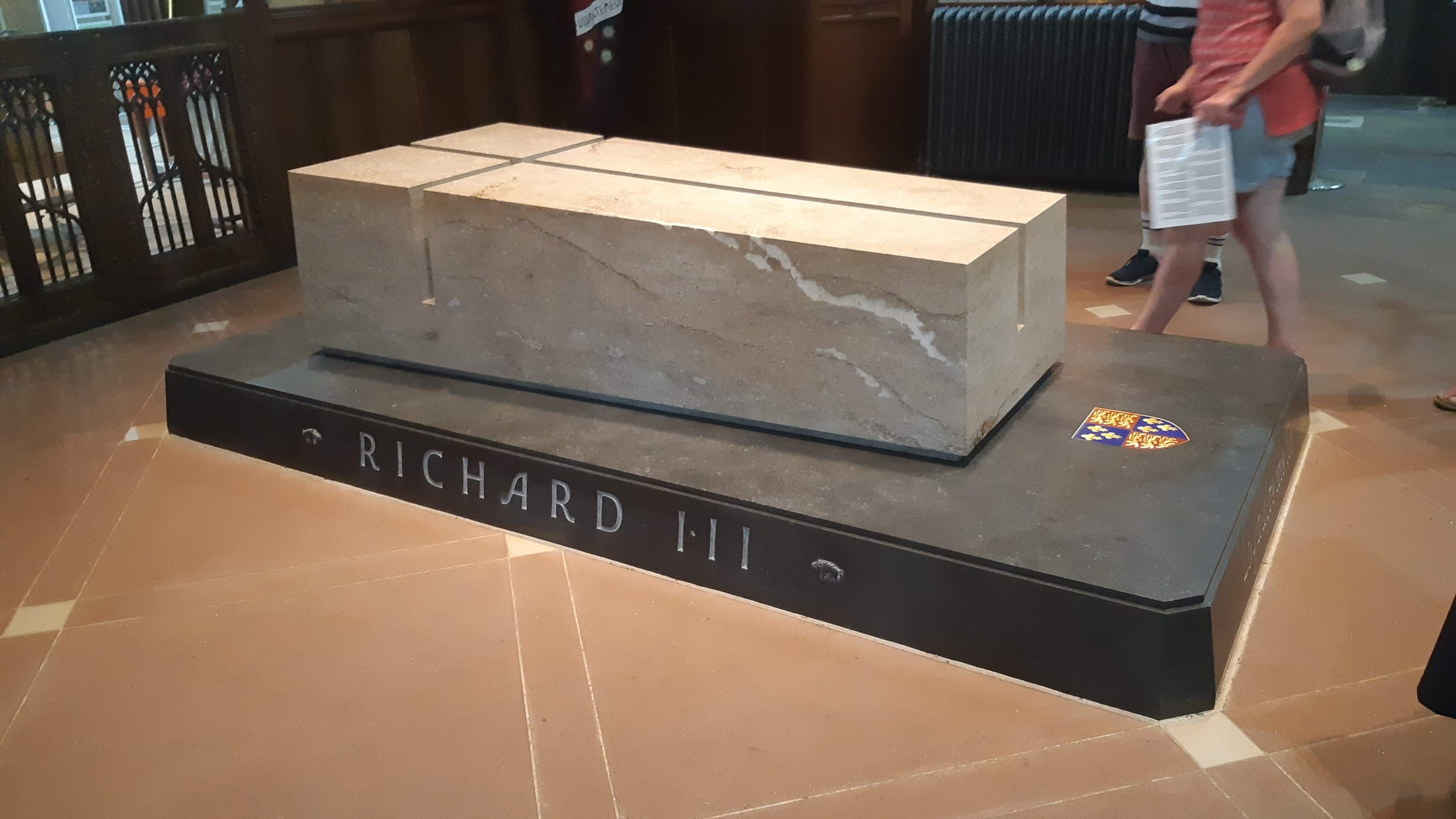
The next speaker was David Monteith, who recalled his experience with the reburial of Richard III in 2015. Public consultation revealed a very wide spectrum of preferences for the appropriate manner in which to deal with the late king – some wanting a full tomb, others a simpler box. He noted that many people’s feelings about Richard were hard to separate from his Shakespearean portrayal, and that if the rediscovery had occurred a few years later he would have needed to contend with much more polarised attitudes to memorials. He said that even in Richard’s day it was normal for the dead to be moved or their surroundings altered – Edward IV rebuilt many tombs of his relatives, as later would Elizabeth I. Burial styles changed over the centuries and so there were many valid ways of disposing of Richard. He did, though, have to discourage visitors at Leicester Cathedral from taking photographs with the casket.
Harold Mytum followed. The Church of England has policies for bodies found on consecrated land that parallel those of secular authorities. In medieval times English burials were much the same as continental ones, including frequent recycling of plots. Most above-ground interments in Europe lasted only twenty-five years before the cadaver was moved elsewhere. The Church has a duty to protect and respect human remains, but exhumation can be allowed if it serves the public interest, e.g. the advancement of science.
Andrea Bradley spoke of the challenges involved in securing land for HS2 – with its own bespoke system for the removal and reburial of human remains. They have a specific legal agreement with the Archbisop’s Council that corpses uprooted from consecrated ground must be put down in other consecrated ground.
Ian Dungavell said that burial spaces in cities are getting full again, and few now expect a large grave for themselves in perpetuity, instead accepting that after some time they will be relocated. Re-use of graves in this way has been allowed again (although only in London) since 2007 because there is no alternative possible.
Lin Foxhall, the host, took questions from the audience.
EXTERNAL LINKS
 Robin Stanley Taylor