Rails Go Ever Ever On

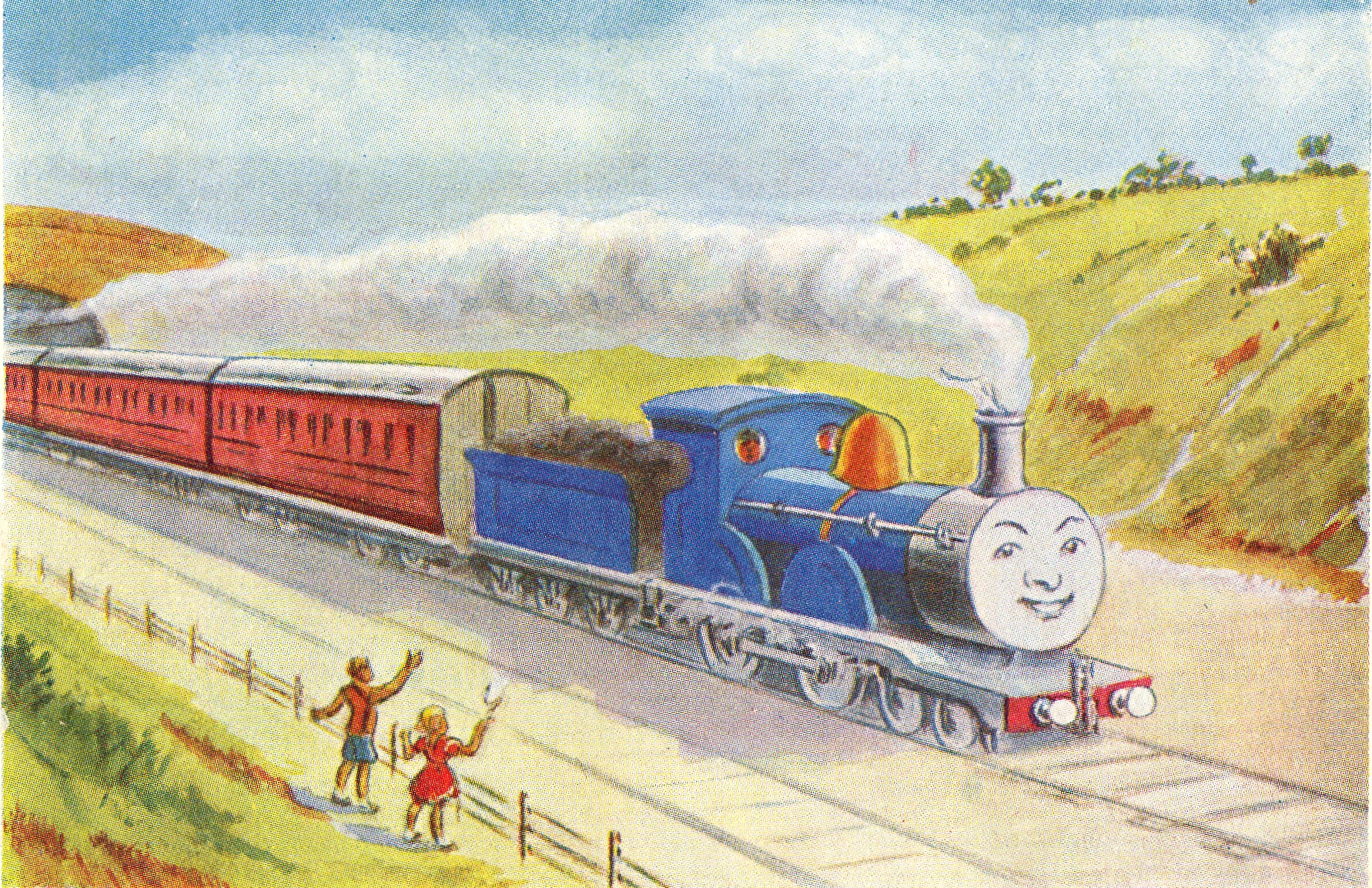
Illustration of “Edward’s Day Out” by William Middleton

The Reverend Wilbert Vere Awdry’s The Three Railway Engines, first instalment in what would become the world famous Railway Series, was originally published seventy-five years before today. After his death, the franchise he created was carried on by his son Christopher. That can, of course, be said of another great English writer, though sadly his Christopher’s own demise came earlier this year. Present circumstances impede me from coming up with a more comprehensive tribute, but perhaps this could be the basis for a joint effort between Clamavi de Profundis and The Tuggster Intensifies one day:

Rails go ever ever on,
Over rock and under tree.
By tunnels where no sun has shone,
Canals that never find the sea;
Ploughed through snow by winter sown,
And past the merry flowers of June,
Over sleepers lain on stone,
And viaducts o’er valleys hewn.

Rails go ever ever on,
Under cloud and under star.
Yet wheels that thundering have gone
Roll at last to home afar.
Eyes that fire and smoke have seen,
And horror in the smelter’s place
Look at last on buffer clean,
In cosy sheds they longed to face.

The track goes ever on and on
Down from the door where it began.
Now far ahead the line has gone,
And I must follow, if I can,
Pursuing it with weary wheels,
Until it joins some larger way,
Where many points and switches meet.
And whither then? I cannot say.

The track goes ever on and on
Out from the yard where it began.
Now far ahead the line has gone.
Let others follow, if they can!
Let them a journey new begin.
But I at last with pistons worn
To silent sidings will crawl in,
To down for night and sleep ’till dawn.

Still ’round the next bend there may wait
A new branch or secret gate;
And though I long have roamed this isle,
I never could lose cause to smile
Upon the realm my line does span
West of Barrow, East of Mann.

Adapted from The Road Goes Ever On by J. R. R. Tolkien, circa 1937.

UPDATE (22nd October)

Search engine results show that at least one other has thought of this connection before I did – EndlessWire94 on DeviantArt.

Kilnsea Sound Mirror

A year ago I and my parents attempted to reach the sound mirror at Kilnsea, but could not traverse the terrain. Today we made a second attempt, parking rather closer and walking in from the other direction. We found the large concrete concavity surrounded tightly by a primitive fence and dappled with lichen. The land around the fence is dense with weeds and getting to the mirror required a lot of creative stomping. There were some notice boards explaining the features of the landscape but they were few and far between. From some angles the structure appears merely to be a solitary artifice in the middle of nowhere. Still, at least there is no entrance fee.

By Her Majesty’s Commission

A bit quicker there, Norman!

Keen scholars of British politics will know that Parliament has three fundamental components – the monarch, the Lords and the Commons. Most of the time MPs and peers debate in separate chambers, while the monarch merely signs off the the papers which are brought to her. There are, however, special occasions on which it is necessary for all three components to come together. These are done in the chamber of the House of Lords – normally described as the upper house, but in this context more like the middle – with the monarch enthroned at the south end of the room, MPs standing behind the bar at the north, and peers themselves on their usual red benches in between.

The most famous of these is the state opening, which commences a new parliamentary session. The others are prorogation (the end of a session), granting royal assent to new acts (often combined with prorogation), the opening of a new parliament (in which the first state opening is delayed until MPs and peers are sworn) and the approbation of the lower house’s speaker (done on the second day of a new parliament, and/or after the old speaker departs). The state opening gets more attention than the others partly because it unveils the government’s main legislative agenda – and is thus the main battleground for the presence or absence of parliamentary confidence in the ministry – and partly because in modern practice it is the only event which the monarch attends in person.

The Lords and Commons have three-figure memberships with respective quora of just 30 and 40, so the absence of even large numbers of members – especially backbenchers – does not threaten to invalidate such events as these. The Queen is only one person, and thus physically invisible. Fortunately, methods have been devised which allow Her Most Excellent Majesty to be projected into the legislature while her most singular body remains elsewhere. Enter the Lords Commissioners.

The Queen, by letters patent under the Great Seal of the Realm, appoints a team of three to seven privy counsellors (who are nearly always peers) to carry out these parliamentary functions on her behalf.

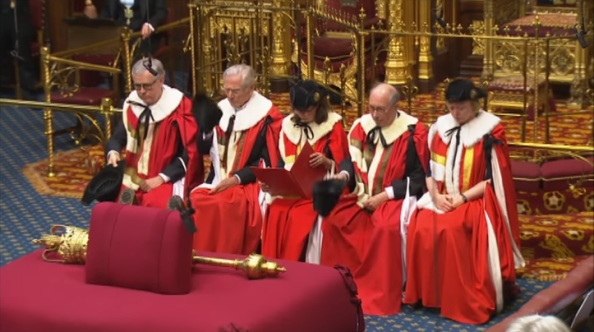
There are variations depending on the specific type of ceremony, but certain details are common to all: The Leader of the House of Lords announces that, it not being convenient for Her Majesty to be personally present there that day, a commission has been passed appointing several Lords therein named to do whatever is needed on her behalf. The Lord Speaker rises from the woolsack and vacates the chamber along with several other peers. The commissioners, robed and hatted, then file in and sit adjacent on a temporary bench before the steps of the throne. Black Rod is sent to summon the Commons, and then MPs come to the bar of the house, exchanging bows with their lordships (at which point the male commissioners doff their hats with varying levels of synchronisation). A parliamentary clerk reads out the letters patent to verify that the commissioners have the required authority, each one bowing (and doffing) invididually as his name is mentioned. At the end bows are exchanged again while MPs back out.

In one of the most pointless projects ever undertaken, I have gone through the online Hansard archives noting down all the named members of various commissions in the last two hundred years, and put them into a colour-coded spreadsheet. A few explanatory notes first:

  1. Hansard, and thus the spreadsheet, only lists those who physically attended. Archbishops and Lord Chancellors are named in the patent ex officio but do not actually take part are omitted.
  2. On some occasions the record only says that there was a commission, rather than specifying who was in it. For these I obviously have no information to include. Annoyingly there is a huge stretch from 1905 to 1916 about which I can only guess.
  3. I have listed New Parliaments, Approbations, Sessions Opened and Prorogations. Unless combined with the latter I have not listed Royal Assents, for these are not intuitive to locate in the timeline and, when I have found them, they have uniformly declined to mention commissioners by name.

From what information I have managed to gather, a curious tale can be told:

In the nineteenth century it was the norm for all Lords Temporal involved in the commission to be from the governing party, and even for most or all of them to be government ministers, though the leader of the house (perhaps not yet a well-defined office) was not normally among them. In the first half of the century it was reasonably common for the Archbishop of Canterbury to personally attend, but in the second half this tailed off. Very occasionally the Bishop of London appears. There is even one instance, when setting up the fifth UK parliament in 1812, of the Prince Regent’s younger brothers taking part. Their formal political affiliation is unclear.

The World Wars, and the interbellum period, saw an abnormal frequency of complex and confusing multi-party governments, whether confidence-and-supply or full coalition. This is reflected in the composition of the royal commissions, which frequently include peers from more than one party and even a few whom I took to be Crossbenchers. The approbation of Captain Edward Fitzroy as Commons Speaker in 1928 is the first instance I can find of a Labour peer taking part – Kenneth Muir Mackenzie, between terms as a junior government whip. The general election of 1929 saw the Labour Party win a plurality of seats in the Commons for the first time (though the Conservatives won the popular vote), and Ramsay MacDonald formed a minority government which lasted just over two years (Ramsay had earlier governed for nine months in 1924, but in that instance the transition of power occured after the session had already started). The two commissions at the start of that parliament feature Labour’s John Sankey as Lord Chancellor, but flanked by two Conservatives and two Crossbenchers. The absence of other Labour peers may be explained by their small presence in the upper house at the time, but the preference of opposition Conservatives over allied Liberals is not so clear.

By the time of the 1931 general election a three-way coalition had been formed, with senior Conservative and Liberal figures included. This coalition fought the election together and won by an overwhelming landslide. The specifics of this would be too great a digression from the purpose of this article, but the main Labour Party expelled MacDonald and others who remained in his government. They formed a splinter group called the National Labour Organisation. For convenience I have kept Sankey in red here although the party actually fought in green. The commissions for 3rd and 4th November that year both featured Sankey as Lord Chancellor, but that for the new parliament straddled him with three Conservatives plus the Crossbench Sumner, then that for the Speaker’s approbation involved another three Conservatives plus the Liberal Islington. Stanley Baldwin replaced MacDonald as Prime Minister before the 1935 election, and the two commissions beginning that parliament were mostly Conservative, with one Liberal each and once a crossbencher but no Labour peers.

The commission for Douglas Clifton-Brown’s approbation in 1943 (by which time another wartime grand coalition had been formed) involved Lords Crewe and Addison, leaders of the Liberal and Labour parties in the upper house. Curiously, then-Conservative leader Cranborne was left out in favour of his father and predecessor Salisbury.

Attlee’s 1945 landslide saw the beginning of the modern two-party system. The commission opening that parliament was led by Lord Chancellor Jowitt, accompanied by house leader Addison. Salisbury and Cranborne represented the Conservatives (Yes, father and son together!) while Samuel took part as Liberal leader. Oddly the approbation commission the next day had only Jowitt in common, the others being Air Secretary Stansgate (Tony Benn’s father) and one Conservative and two Liberals. The two commissions at the beginning of Attlee’s second term in 1950 approach what would eventually become the norm, with one member each from the Conservative, Liberal and Crossbench factions.

From the 1955 general election until Wilson’s accession in 1964, the commissioners tended to be three Conservative and two Labour. After that a fairly consistent pattern emerged – albeit with occasional substitutions – a royal commission comprised the Lord Chancellor, the Leader of the House, the leaders of the two main opposition parties, and a third peer from the government side chosen seemingly at random. This convention lasted until 1993. In the prorogation commission that year the Chancellor and three leaders attended as before, but instead of the rotating government peer Lord Weatherill was appointed to complete the group. Speaker of the Commons until the year before, he became Convenor of the Crossbenchers. From then on it became the norm to have a crossbencher in the commissions – usually the Convenor, but if (s)he was not a privy counsellor then someone else might act in his stead.

The next change occured followed the Constitutional Reform Act 2005, and the establishment in the following year of the elected office of Lord Speaker, separated from the Chancellorship. Lady Hayman took office in July and the next commission took place in November. On that occassion the Chancellor (Lord Falconer of Thoroton) still led the commission as before and Hayman effectively replaced the crossbench representative. A reshuffle in 2007 saw Falconer replaced by Jack Straw, the first MP to hold that office for centuries. As with the Archbishop of Canterbury the Lord Chancellor continued to be named in the letters patent, but a technicality of the Standing Orders of the House of Lords meant he could not perform prorogations in person. From then on nearly all commissions (exceptions to be specified) were led by the Leader of the House – for which there were precedents in earlier ceremonies when the Chancellor could not attend, or even where the office was vacant for a while – accompanied by the Lord Speaker, the opposition leaders and the convenor – all members thus having different affiliations.

The restriction did not apply to approbations, so Straw was able to lead the commission for John Bercow in 2009, with the Lord Speaker waiting outside the chamber. The other commissions in 2009-10 followed the new pattern. There was no commission in 2011 due to the session being extended. The prorogation ceremony in 2012 saw Lord Shutt of Greetland, on his last day as Deputy Chief Whip, substitute for Lord McNally as Liberal Democrat leader. That of 2013 saw Labour leader Lady Royall of Blaisdon absent, though she was still named in the patent. The commissions of 2014-17 were unremarkable. In 2018 there was again no new session, nor did Bercow resign his speakership as originally promised. The bicorn hats were thus not seen at all that year. In the latter third of 2019, however, the commissioners would be very busy.

Boris Johnson’s attempted five-week prorogation was so controversial that the opposition peers all boycotted the ceremony, including those who would have been commissioners. The procedure was thus performed to a nearly-empty chamber in the small hours of the morning by the minimal quorum of three – Evans of Bowes Park (Leader), Fowler (Speaker) and Hope of Craighead (Convenor). That prorogation was annulled by the Supreme Court, but Johnson was eventually permitted to try again – although only for the usual few days this time. The second attempt went normally with Smith and Newby attending as normal (though Lord Judge had replaced Hope as Convenor).

On the penultimate day of that parliament Bercow finally retired and his deputy Sir Lindsay Hoyle was elected to replace him as Speaker. Following Straw’s precedent a decade earlier, Robert Buckland performed the approbation, though his hat had to be precariously perched upon his wig rather than fitting around it. Lord Dholakia subsituted for Newby, and doffed a few times more than necessary.

Following the snap December general election, the 58th Parliament had to be set up in something of a hurry. For what appears to be the first time in at least two hundred years, both of the normal commissions were performed on the same day – presumably to allow MPs to start swearing in earlier. Both commissions involved the standard lineup, though there was an awkward moment when Evans forgot to turn over the page in her script.

This session is due to run until May 2021, and thus we seem to be in for another doff-free year, which the commissioners themselves may find a relief, though for some viewers at home it is no doubt a disappointment.

Key  
* Lord Chancellor
^ Leader of the House of Lords
~ Lord Speaker
  Tory, Conservative, Unionist, National
  Whig, Liberal, Liberal Democrat
  Labour
  Spiritual
  Impartial
  Affiliation unclear
  Crossbench
  Social Democratic
   
Notes  
-1 The Baroness Royall of Blaison was named in the patent but did not appear in the ceremony and was not mentioned in Hansard.

aengoaenrgioneroinoh

Date Type 1st 2nd 3rd 4th 5th 6th
12/07/05 Prorogation Canterbury Eldon* Camden Hawkesbury^    
15/12/06 New Parliament Canterbury Erskine* Aylesford Walsingham    
16/12/06 Approbation Erskine* Aylesford Spencer Walsingham    
27/04/07 Prorogation Eldon* Camden Hawkesbury^      
22/06/07 Approbation Canterbury Eldon* Aylesford Hawkesbury^    
14/08/07 Prorogation Canterbury Eldon* Camden Hawkesbury^    
21/01/08 Session Opened Canterbury Eldon* Camden Aylesford Dartmouth  
04/07/08 Prorogation Canterbury Eldon* Camden Westmorland Montrose  
19/01/09 Session Opened Canterbury Eldon* Camden Montrose    
21/06/09 Prorogation Eldon* Canterbury Camden Dartmouth Westmorland  
23/01/10 Session Opened Canterbury Eldon* Camden Aylesford Dartmouth  
24/07/11 Prorogation Canterbury Eldon* Camden Westmorland Aylesford  
07/01/12 Session Opened Canterbury Eldon* Wellesley Camden Westmorland  
24/11/12 New Parliament York & Albany Cumberland & Teviotdale Eldon* Liverpool^ Westmorland  
02/06/17 Approbation Eldon* Cholmondeley Shaftesbury Bathurst Liverpool^  
14/01/19 New Parliament Harrowby Westmorland Wellington Shaftesbury Liverpool^  
21/04/20 New Parliament Eldon* Canterbury Wellington Westmorland Shaftesbury  
14/11/26 New Parliament Eldon* Wellington Westmorland Liverpool^ Harrowby  
04/02/30 Session Opened Lyndhurst* Bathurst Rosslyn Wellington^ Aberdeen  
26/10/30 New Parliament Lyndhurst* Canterbury Buckingham Rosslyn Bathurst  
27/10/30 Approbation Lyndhurst* Rosslyn Bathurst Ellenborough Melville  
14/06/31 New Parliament Canterbury Brougham & Vaux* Wellesley Grey^ Durham  
15/06/31 Approbation Brougham & Vaux* Richmond Lansdowne Durham    
29/01/33 New Parliament Brougham & Vaux* Grey^ Richmond Lansdowne Auckland  
31/01/33 Approbation Brougham & Vaux* Richmond Lansdowne Albermarle Auckland  
19/02/35 Session Opened Canterbury Lyndhurst* Rosslyn Wharncliffe Jersey  
31/01/37 Session Opened Canterbury Cottenham* Lansdowne Duncannon Melbourne^  
15/11/37 New Parliament Cottenham* Lansdowne Conygham Mulgrave Duncannon  
28/05/39 Approbation Cottenham* Lansdowne Duncannon Shaftesbury Falkland  
07/10/41 Prorogation Lyndhurst* Wellington^ Buckingham & Chandos Shaftesbury Wharncliffe  
02/02/43 Session Opened Lyndhurst* Canterbury Wharncliffe Buccleugh Shaftesbury  
05/09/44 Prorogation Lyndhurst* Wharncliffe Buccleugh Wellington^ Del La Warr Dalhousie
18/11/47 New Parliament Canterbury Cottenham* Lansdowne^ Spencer Auckland  
19/11/47 Approbation Lansdowne^ Langdale Grey Auckland Campbell  
01/08/49 Prorogation Lansdowne^ Minto Clanricarde Saint Germans Campbell  
31/01/50 Session Opened Cottenham* Lansdowne Minto Breadalbane London  
04/11/52 New Parliament St Leonards* Lonsdale Salisbury Montrose Northumberland  
05/11/52 Approbation St Leonards* Salisbury Montrose Eglinton Colchester  
20/08/53 Prorogation Cranworth* Granville Argyll Breadalbane Newcastle  
14/08/55 Prorogation Cranworth* Granville Argyll Stanley of Alderley Harrowby  
29/07/56 Prorogation Cranworth* Harrowby Stanley of Alderley Willoughby D’Eresby Monteagle of Brandon  
30/04/57 New Parliament Cranworth* Harrowby Spencer Stanley of Alderley Argyll  
01/05/57 Approbation Cranworth* Granville^ Harrowby Spencer Argyll  
28/08/57 Prorogation Canterbury Cranworth* Granville^ Harrowby Panmure  
02/08/58 Prorogation Chelmsford* Salisbury Hardwicke De La Warr Beaufort  
13/08/59 Prorogation Campbell* Granville^ Somerset Saint Germans Sydney  
28/08/60 Prorogation Campbell* Somerset Sydney Stanley of Alderley Monteagle of Brandon  
06/08/61 Prorogation Westbury* Granville^ Saint Germans Sydney Monteagle of Brandon  
06/02/62 Session Opened Westbury* Saint Germans Sydney Stanley of Alderley    
07/08/62 Prorogation Westbury* Saint Germans Russell Kingsdown    
05/02/63 Session Opened Westbury* Argyll Saint Germans Sydney Stanley of Alderley  
28/07/63 Prorogation Westbury* Saint Germans Newcastle Stanley of Alderley Wensleydale  
04/02/64 Session Opened Westbury* Argyll Saint Germans Sydney Stanley of Alderley  
29/07/64 Prorogation Westbury* Saint Germans De Grey Sydney Wensleydale  
07/02/65 Session Opened Westbury* Somerset Saint Germans Sydney Stanley of Alderley  
06/07/65 Prorogation Granville^ Saint Germans Sydney Eversley Wensleydale  
01/02/66 New Parliament Cranworth* Argyll Sydney Bessborough Stanley of Alderley  
02/02/66 Approbation Cranworth* Argyll Sydney Bessborough Dalhousie  
10/08/66 Prorogation Chelmsford* Buckingham & Chandos Malmesbury Bradford Cadogan  
21/08/67 Prorogation Chelmsford* Richmond Bradford Beaufort Devon  
19/11/67 Session Opened Chelmsford* Marlborough Malmesbury Buckingham Cadogan  
31/07/68 Prorogation Cairns* Malmesbury Beaufort Buckingham Devon  
10/12/68 New Parliament Hatherley* De Grey Kimberley Sydney Ailesbury  
11/12/68 Approbation Hatherley* De Grey Kimberley Sydney Argyll  
16/02/69 Session Opened Hatherley* De Grey Kimberley Sydney Ailesbury  
11/08/69 Prorogation Hatherley* Kimberley Granville Sydney Foley  
08/02/70 Session Opened Hatherley* De Grey Kimberley Bessborough Sydney  
10/08/70 Prorogation Hatherley* Halifax Kimberley Normanby Sydney  
21/08/71 Prorogation Hatherley* Halifax Saint Albans Cowper Cork  
06/02/72 Session Opened Hatherley* Ripon Halifax Sydney Bessborough  
12/02/72 Approbation Hatherley* Halifax Bessborough Cork Eversley  
10/08/72 Prorogation Hatherley* Ailesbury Granville^ Kimberley London  
06/02/73 Session Opened Selborne* Ripon Halifax Kimberley Cork  
05/08/73 Prorogation Selborne* Granville^ Cowper Sydney Bessborough  
05/03/74 New Parliament Cairns* Richmond^ Hertford Beauchamp Bradford  
06/03/74 Approbation Cairns* Richmond^ Beauchamp Skelmersdale    
07/08/74 Prorogation Cairns* Beauchamp Derby Bradford Skelmersdale  
05/02/75 Session Opened Cairns* Malmesbury Hertford Beauchamp Skelmersdale  
13/08/75 Prorogation Cairns* Richmond^ Beauchamp Shrewsbury Hardwicke  
15/08/76 Prorogation Cairns* Richmond^ Hardwicke Hertford Bradford  
14/08/77 Prorogation Cairns* Richmond Salisbury Harrowby Skelmersdale  
17/01/78 Session Opened Cairns* Richmond Hertford Beauchamp Skelmersdale  
16/08/78 Prorogation Cairns* Richmond Northumberland Hertford Skelmersdale  
05/12/78 Session Opened Cairns* Richmond Northumberland Beauchamp Skelmersdale  
15/08/79 Prorogation Cairns* Northumberland Beauchamp Hardwicke Skelmersdale  
07/09/80 Prorogation Selborne* Sydney Kenmare Kimberley Cork  
27/08/81 Prorogation Selborne* Spencer Cork Kenmare Monson  
07/02/82 Session Opened Selborne* Sydney Kenmare Cork Monson  
02/12/82 Prorogation Selborne* Granville^ Kimberley Carrington Monson  
15/02/83 Session Opened Selborne* Carlingford Sydney Cork Monson  
25/08/83 Prorogation Selborne* Derby Sydney Kenmare Monson  
05/02/84 Session Opened Selborne* Sydney Kenmare Monson Carrington  
14/08/84 Prorogation Selborne* Sydney Derby Kenmare Monson  
23/10/84 Session Opened Selborne* Carlingford Kimberley Kenmare Monson  
14/08/85 Prorogation Halsbury* Lathom Waterford Coventry Hardwicke  
12/01/86 New Parliament Halsbury* Cranbrook Iddesleigh Coventry Barrington  
13/01/86 Approbation Halsbury* Cranbrook Iddesleigh Coventry Barrington  
25/09/86 Prorogation Halsbury* Iddesleigh Stanley of Preston Kintore Barrington  
27/01/87 Session Opened Halsbury* Lathom Cross Kintore Coventry  
16/09/87 Prorogation Halsbury* Cross Stanley of Preston Brownlow Lothian  
09/02/88 Session Opened Halsbury* Lathom Cross Kintore Rosslyn  
24/12/88 Prorogation Halsbury* Coventry Kintore Colville of Culross Esher  
21/02/89 Session Opened Halsbury* Cranbrook Kintore Lathom Cross  
11/02/90 Session Opened Halsbury* Mount Edgcumbe Limerick Cross Knutsford  
25/11/90 Session Opened Halsbury* Lathom Coventry Brownlow Knutsford  
09/02/92 Session Opened Halsbury* Portland Coventry Mount Edgcumbe Cross  
04/08/92 New Parliament Halsbury* Rutland Cross Knutsford Lathom  
05/08/92 Approbation Halsbury* Rutland Cross Knutsford Balfour of Burleigh  
18/08/92 Prorogation Herschell* Kimberley Spencer Ripon Oxenbridge  
31/01/93 Session Opened Herschell* Spencer Kimberley Breadalbane Carrington  
25/08/94 Prorogation Herschell* Kimberley Breadalbane Carrington Chesterfield  
05/02/95 Session Opened Herschell* Spencer Tweedmouth Breadalbane Carrington  
22/04/95 Approbation Herschell* Kimberley Spencer Carrington Kensington  
05/09/95 Prorogation Halsbury* Cross Norfolk Limerick Belper  
11/02/96 Session Opened Halsbury* Cross Lathom Ashbourne Kintore  
14/08/96 Prorogation Halsbury* Cross Coventry Balfour of Burleigh James of Hereford  
19/01/97 Session Opened Halsbury* Cross Pembroke Balfour of Burleigh Kintore  
06/08/97 Prorogation Halsbury* Norfolk Cross Ashbourne    
12/08/98 Prorogation Halsbury* Norfolk Coventry Waldegrave Rathmore  
07/02/99 Session Opened Halsbury* Hopetoun Coventry Balfour of Burleigh James of Hereford  
17/10/99 Session Opened Halsbury* Pembroke Marlborough Coventry Balfour of Burleigh  
30/01/00 Session Opened Halsbury* Cross Hopetoun Kintore Belper  
03/12/00 New Parliament Halsbury* Clarendon Kintore Pembroke Belper  
20/06/05 Approbation Halsbury* Waldegrave Kintore      
15/02/16 Session Opened Buckmaster* Devonshire Lincolnshire Sandhurst Farquhar  
04/02/19 New Parliament Birkenhead* Crawford Donoughmore Farquhar Sandhurst  
05/02/19 Approbation Birkenhead* Crawford Donoughmore Ribblesdale Newton  
28/04/21 Approbation Birkenhead* Lincolnshire Kintore Sandhurst Balfour of Burleigh  
08/01/24 New Parliament Cave* Cromer Shaftesbury Desart Somerleyton  
09/01/24 Approbation Cave* Cromer Desart Fitzalan of Derwent Huntly  
02/12/24 New Parliament Cave* Shaftesbury Kintore Donoughmoure Newton  
03/12/24 Approbation Cave* Donoughmore Kintore Fitzalan of Derwent Finlay  
21/06/28 Approbation Hailsham* Kintore Strachie Muir Mackenzie Darling  
25/06/29 New Parliament Sankey* Stanhope Kintore Atkin Southborough  
26/06/29 Approbation Sankey* Stanhope Kintore Atkin Southborough  
03/11/31 New Parliament Sankey* Sumner Somerleyton Darling Stonehaven  
04/11/31 Approbation Sankey* Londonderry Onslow Stanhope Islington  
26/11/35 New Parliament Hailsham* Stanmore Thankerton Russell of Killowen Rennell  
27/11/35 Approbation Hailsham* Crawford Goschen Stonehaven Rhayader  
09/03/43 Approbation Simon* Salisbury Crewe Fitzalan of Derwent Addison  
01/08/45 New Parliament Jowitt* Salisbury Samuel Addison Cranborne  
02/08/45 Approbation Jowitt* Fitzalan of Derwent Stansgate Stanmore Mottistone  
01/03/50 New Parliament Jowitt* Addison^ Mersey Hardinge of Penthurst Llewellin  
02/03/50 Approbation Jowitt* Addison^ Mersey Swinton Hardinge of Penthurst  
31/10/51 New Parliament Simonds* Mersey Swinton Hall Ismay  
01/11/51 Approbation Simonds* Mersey Swinton Hall Llewellin  
07/06/55 New Parliament Kilmuir* Home Hall Woolton Ogmore  
08/06/55 Approbation Kilmuir* Home Hall Woolton Ogmore  
20/10/59 New Parliament Kilmuir* Hailsham Saint Aldwyn Stansgate Silkin  
21/10/59 Approbation Kilmuir* Hailsham Saint Aldwyn Stansgate Silkin  
27/10/64 New Parliament Gardiner* Longford^ Carrington Listowel Rea  
28/10/64 Approbation Gardiner* Longford^ Carrington Listowel Rea  
26/10/65 Approbation Gardiner* Dilhorne Listowel Henderson Ogmore  
18/04/66 New Parliament Gardiner* Longford^ Carrington Rea Donovan  
19/04/66 Approbation Gardiner* Longford^ Carrington Rea Morris of Borth-y-Gest  
29/06/70 New Parliament Hailsham of Saint Marylebone* Jellicoe^ Listowel Rea Shackleton  
30/06/70 Approbation Hailsham of Saint Marylebone* Jellicoe^ Listowel Rea Shackleton  
12/01/71 Approbation Hailsham of Saint Marylebone* Jellicoe^ Listowel Rea Shackleton  
06/03/74 New Parliament Elwyn-Jones* Listowel Windlesham Shackleton Byers  
07/03/74 Approbation Elwyn-Jones* Shepherd^ Listowel Saint Aldwyn Byers  
22/10/74 New Parliament Elwyn-Jones* Shepherd^ Listowel Windlesham Byers  
23/10/74 Approbation Elwyn-Jones* Champion Listowel Saint Aldwyn Byers  
03/02/76 Approbation Elwyn-Jones* Shepherd^ Listowel Byers Hailsham of Sain Marylebone  
09/05/79 New Parliament Hailsham of Saint Marylebone* Soames^ Aberdare Byers Elwyn-Jones  
10/05/79 Approbation Hailsham of Saint Marylebone* Soames^ Aberdare Byers Elwyn-Jones  
15/06/83 New Parliament Hailsham of Saint Marylebone* Aberdare Belstead Byers Cledwyn of Penrhos  
16/06/83 Approbation Hailsham of Saint Marylebone* Aberdare Belstead Byers Cledwyn of Penrhos  
07/11/86 Prorogation Hailsham of Saint Marylebone* Whitelaw^ Llewelyn-Davies of Hastoe Diamond Elwyn-Jones  
17/06/87 New Parliament Havers* Whitelaw^ Seear Aberdare Cledwyn of Penrhos  
18/06/87 Approbation Havers* Whitelaw^ Seear Aberdare Cledwyn of Penrhos  
15/11/88 Prorogation Mackay of Clashfern* Belstead^ Nugent of Guildford Cledwyn of Penrhos Jenkins of Hillhead  
16/11/89 Prorogation Mackay of Clashfern* Belstead^ Aberdare Cledwyn of Penrhos Jenkins of Hillhead  
01/11/90 Prorogation Mackay of Clashfern* Aberdare Denham Cledwyn of Penrhos Jenkins of Hillhead  
22/10/91 Prorogation Mackay of Clashfern* Aberdare Waddington^ Cledwyn of Penrhos Jenkins of Hillhead  
16/03/92 Prorogation Mackay of Clashfern* Aberdare Waddington^ Cledwyn of Penrhos Jenkins of Hillhead  
27/04/92 New Parliament Mackay of Clashfern* Caithness Aberdare Seear Cledwyn of Penrhos  
28/04/92 Approbation Mackay of Clashfern* Ferrers Aberdare Cledwyn of Penrhos Jenkins of Hillhead  
05/11/93 Prorogation Mackay of Clashfern* Wakeham^ Richard Seear Weatherill  
03/11/94 Prorogation Mackay of Clashfern* Cranborne^ Richard Seear Weatherill  
08/11/95 Prorogation Mackay of Clashfern* Cranborne^ Ampthill Jenkins of Hilhead Richard  
17/10/96 Prorogation Mackay of Clashfern* Cranborne^ Jenkins of Hilhead Richard Weatherill  
21/03/97 Prorogation Mackay of Clashfern* Cranborne^ Jenkins of Hilhead Ampthill Richard  
07/05/97 New Parliament Irvine of Lairg* Richard^ Jenkins of Hilhead Cranborne Weatherill  
08/05/97 Approbation Irvine of Lairg* Richard^ Thomson of Monifieth Cranborne Weatherill  
19/11/98 Prorogation Irvine of Lairg* Cranborne Rodgers of Quarry Bank Jay of Paddington^ Chalfont  
11/11/99 Prorogation Irvine of Lairg* Strathclyde Rodgers of Quarry Bank Jay of Paddington^ Weatherill  
23/10/00 Approbation Irvine of Lairg* Jay of Paddington^ Mackay of Ardbrecknish Rodgers of Quarry Bank Weatherill  
30/11/00 Prorogation Irvine of Lairg* Jay of Paddington^ Marsh Strathclyde Rodgers of Quarry Bank  
13/06/01 New Parliament Irvine of Lairg* Williams of Mostyn^ Strathclyde Moore of Wolvercote Jenkins of Hillhead  
14/06/01 Approbation Irvine of Lairg* Williams of Mostyn^ Moore of Wolvercote Strathclyde Williams of Crosby  
07/11/02 Prorogation Irvine of Lairg* Williams of Mostyn^ Williams of Crosby Strathclyde Molyneaux of Killead  
20/11/03 Prorogation Falconer of Thoroton* Amos^ Strathclyde Thomson of Monifieth Donaldson of Lymington  
18/11/04 Prorogation Falconer of Thoroton* Amos^ Blatch Donaldson of Lymington Williams of Crosby  
11/05/05 New Parliament Falconer of Thoroton* Amos^ Strathclyde Donaldson of Lymington Roper  
12/05/05 Approbation Falconer of Thoroton* Amos^ Strathclyde Roper Donaldson of Lymington  
08/11/06 Prorogation Falconer of Thoroton* Amos^ Hayman~ Strathclyde McNally  
30/10/07 Prorogation Ashton of Upholland^ Hayman~ Strathclyde McNally Williamson of Horton  
26/11/08 Prorogation Royall of Blaisdon^ Hayman~ Strathclyde McNally Williamson of Horton  
22/06/09 Approbation Royall of Blaisdon^ Strathclyde McNally D’Souza Jack Straw*  
12/11/09 Prorogation Hayman~ Strathclyde McNally Royall of Blaisdon^ D’Souza  
08/04/10 Prorogation Royall of Blaisdon^ Hayman~ Strathclyde Shutt of Greetland D’Souza  
18/05/10 New Parliament Strathclyde^ Hayman~ McNally Royall of Blaisdon D’Souza  
19/05/10 Approbation Strathclyde^ Hayman~ McNally Royall of Blaisdon D’Souza  
01/05/12 Prorogation Shutt of Greetland D’Souza~ Strathclyde^ Williamson of Horton Royall of Blaisdon  
25/04/13 Prorogation Williamson of Horton D’Souza~ Hill of Oareford^ McNally -1  
14/05/14 Prorogation Butler of Brockwell D’Souza~ Hill of Oareford^ Royall of Blaisdon Wallace of Tankerness  
26/03/15 Prorogation D’Souza~ Hunt of Kings Heath Laming Newby Stowell of Beeston^  
18/05/15 New Parliament Stowell of Beeston^ D’Souza~ Royall of Blaisdon Wallace of Tankerness Laming  
19/05/15 Approbation Stowell of Beeston^ D’Souza~ Royall of Blaisdon Laming Wallace of Tankerness  
12/05/16 Prorogation Wallace of Tankerness D’Souza~ Stowell of Beeston^ Hope of Craighead Smith of Basildon  
27/04/17 Prorogation Evans of Bowes Park^ Hope of Craighead Fowler~ Newby Smith of Basildon  
13/06/17 New Parliament Evans of Bowes Park^ Fowler~ Smith of Basildon Newby Hope of Craighead  
14/06/17 Approbation Evans of Bowes Park^ Fowler~ Smith of Basildon Newby Hope of Craighead  
09/09/19 Prorogation Evans of Bowes Park^ Fowler~ Hope of Craighead      
08/10/19 Prorogation Evans of Bowes Park^ Fowler~ Newby Judge Smith of Basildon  
04/11/19 Approbation Robert Buckland* Evans of Bowes Park^ Dholakia Judge Smith of Basildon  
17/12/19 New Parliament Evans of Bowes Park^ Fowler~ Smith of Basildon Newby Judge  
17/12/19 Approbation Evans of Bowes Park^ Fowler~ Smith of Basildon Newby Judge  

UPDATE (March 2020)

I recently came across the Journals of the House of Lords which, unlike Hansard, do list all the commissioners and even describe their seating order. I will not be remaking the spreadsheet though. Firstly I just can’t be bothered, and secondly only certain years of the journals are available online, so the updated recored would have several serious gaps.

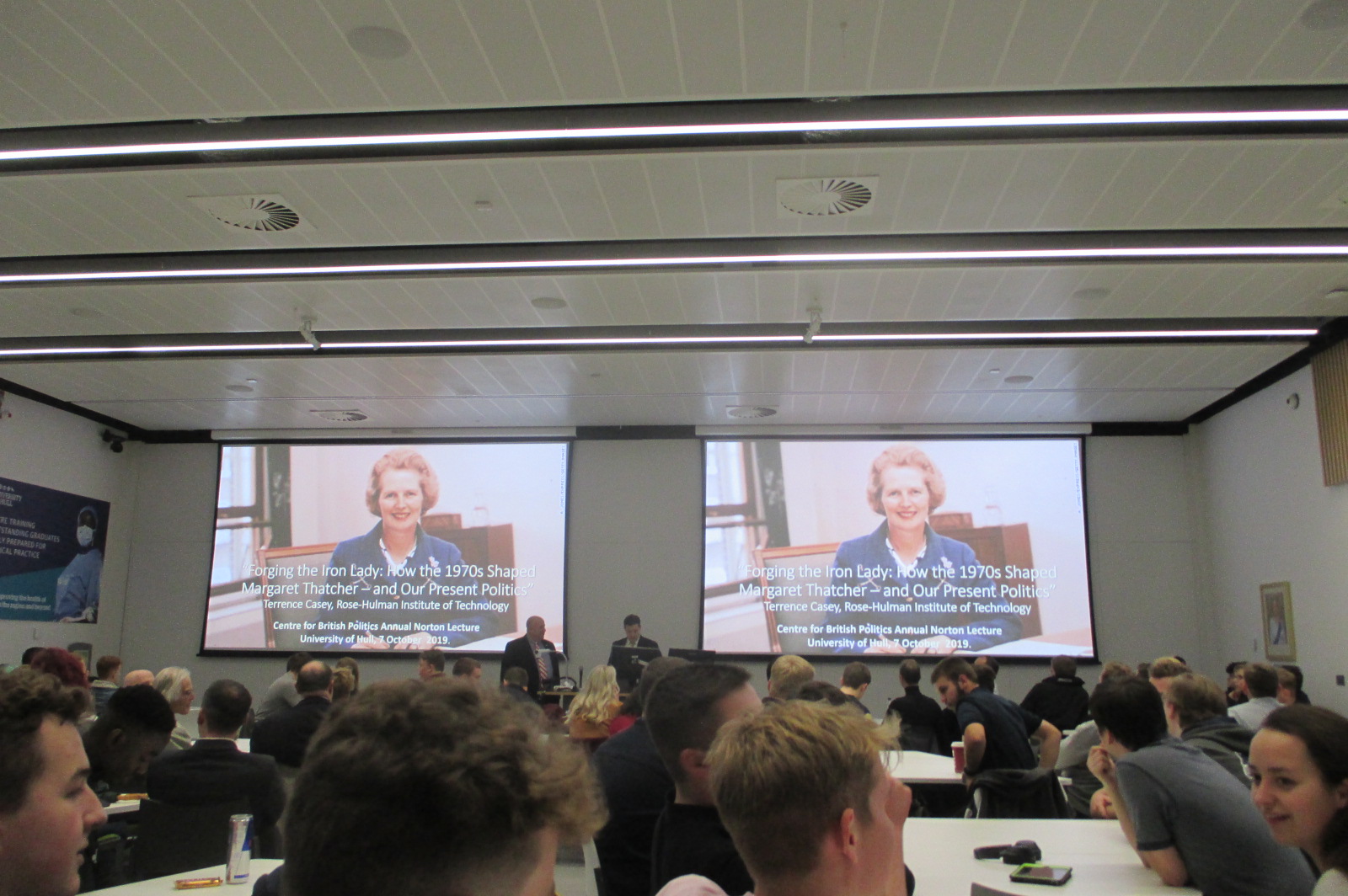
Forging the Iron Lady with Terrence Casey

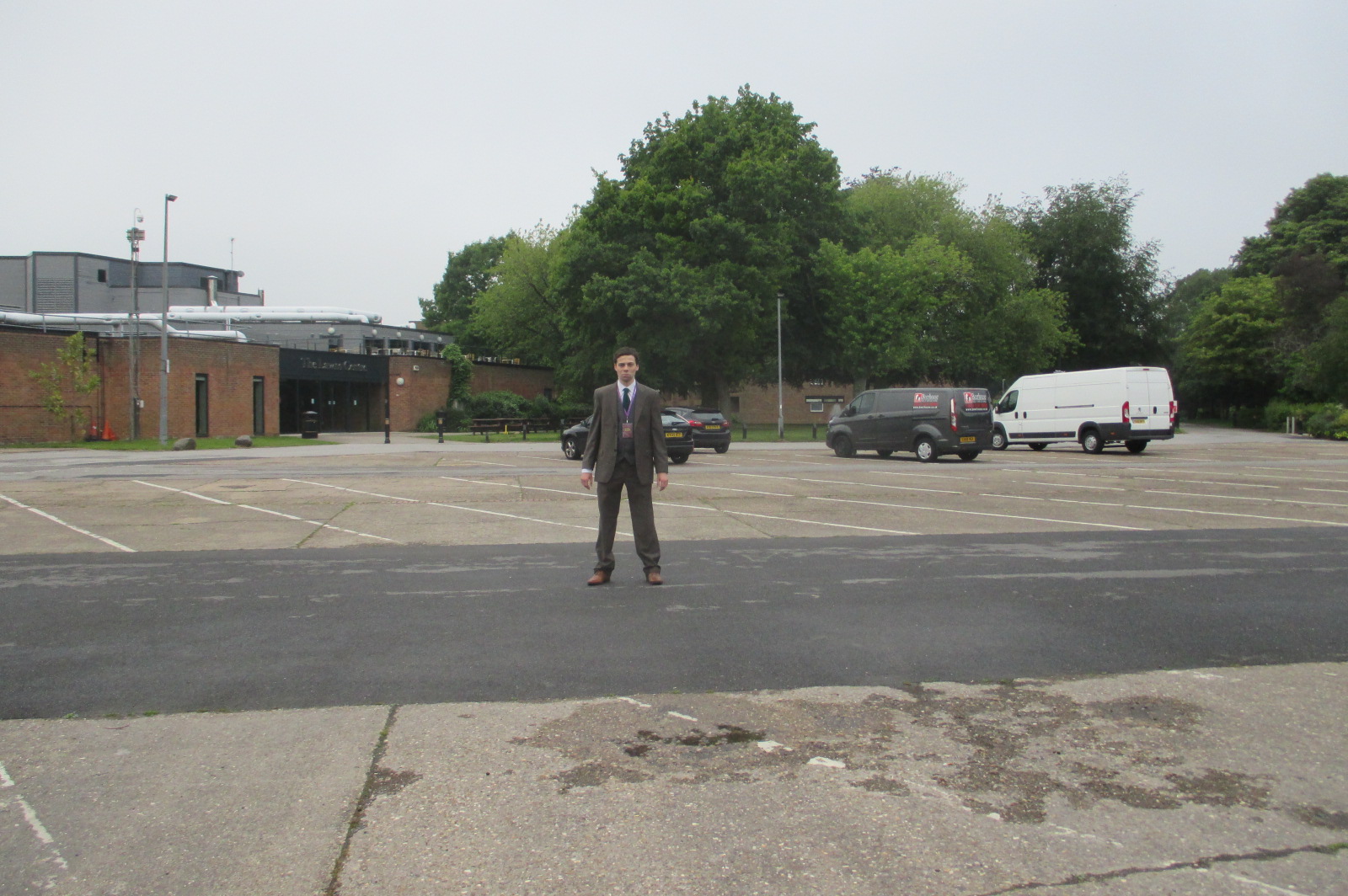
This could be the venue, or it could be the set for an upcoming Ken Loach remake of Nineteen Eighty-Four.

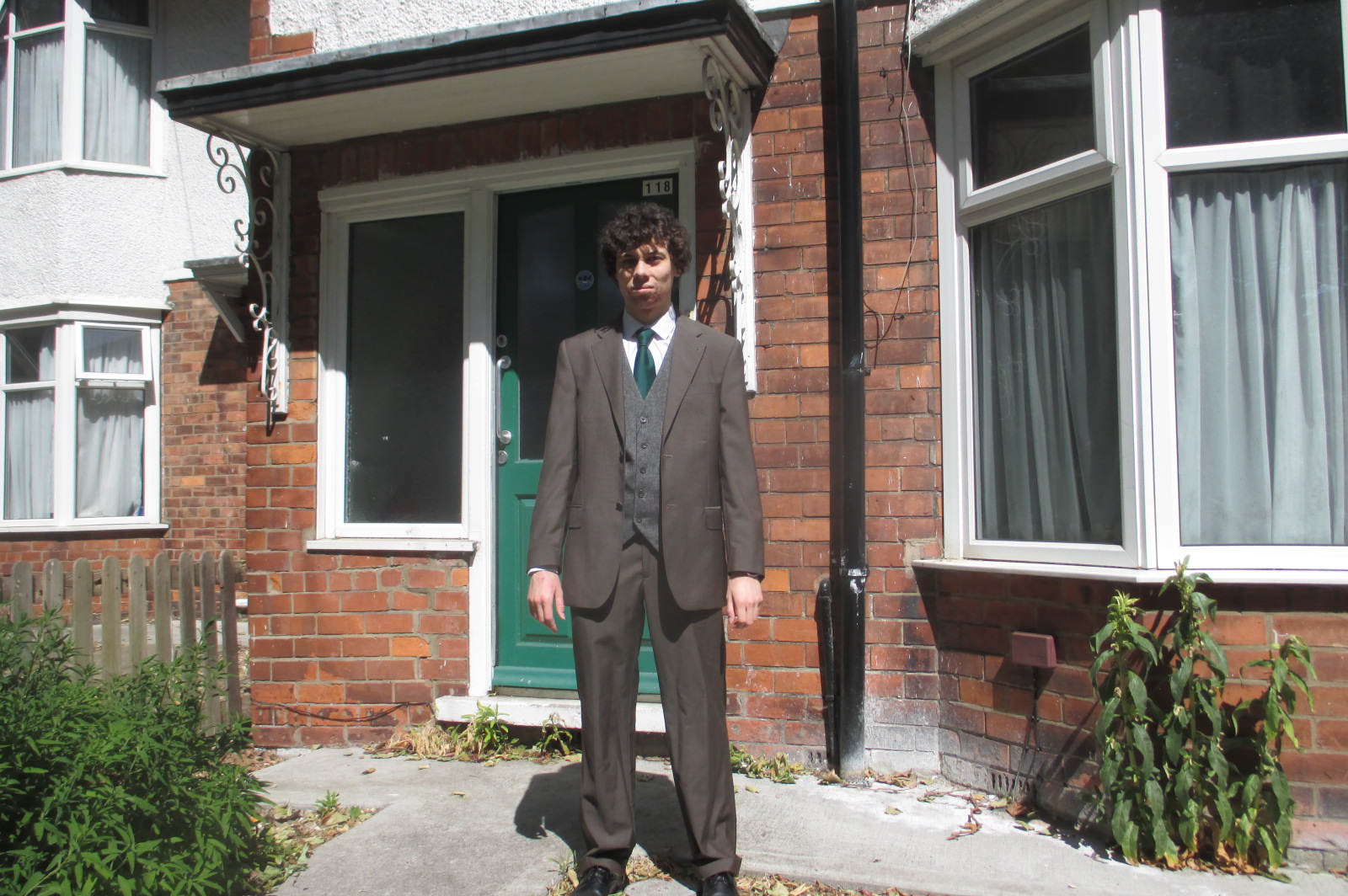
Having attended quite a few guest speeches by this point, I expected tonight’s to fit into the familiar mould. I was a little thrown-off, as were the those in charge, to find that the fixed tiers of seats in the lecture hall were folded away at the back wall and instead we were circled around a splatter of smaller tables. In retrospect it felt a misstep to wear a business suit to the occasion.

This was the Annual Norton Lecture, delivered by Professor Terrence Casey of the Rose-Hulman Institute of Technology. Trying very hard to minimise his references to Trump or Brexit, he spoke to us about the turbulent politics of the 1970s and the rise of Margaret Thatcher.

As someone who has watched a lot of old documentaries about British politics, as well as listened to a lot of Professor Vernon Bogdanor’s lectures for Gresham College, I was on familiar ground for much of the talk. Casey took us through the story of how the post-war economic consensus broke down through the tenure’s of Heath, Wilson and Callaghan, from the imposition of far-reaching price controls in 1972 to the Winter of Discontent in 1979. There was also the concurrent parliamentary story of the “Who Governs?” election, followed by Wilson’s achievement of a very slim majority, then the pacts with the Liberals when that got worn away.

The more original parts of the lecture (from my perspective at least) were on the backstage parts of the story – how policies were formulated and parties managed. Casey was keen to stress that the Margaret Thatcher of 1970, newly appointed as Secretary of State for Education & Science, was a far cry from the character that exists in public memory now. At that point, the notion of her ever becoming prime minister, let alone the godmother of a new political age, would have been considered farcical. Her emergence as a right-wing firebrand, he said, was more by a series of random chances (such as Callaghan’s decision against an election in 1978, or the backbench resentment of Heath in 1975) than by any divine ordination.

Casey rejected the idea that “Neoliberalism” – a term rarely spoken kindly but rather spat out in contempt by those who use it at all – was thrust upon the unwilling masses in an unethical manner by a nefarious elite. Instead he described it as the natural result of the masses falling out of love with the Keynesian regime that had prevailed before and looking for an alternative solution which the Thatcherite faction – with particular mention of Sir Keith Joseph – provided them. He also noted that whereas the throwing out of what is sometimes called Butskellism occurred quite rapidly after the economic breakdown and industrial unrest of the 1970s, the backlash against Blatcherism ensuing from the 2008 credit crunch took a much longer time to result in any serious change of course from the governments of the nations affected.

In the lengthy question & answer session which followed, I asked Professor Casey the same question which I had put to Paul Danahar ten months ago – When does he last remember politics being normal? He replied that there could never be a clear single cause or moment identified, but that the tide would have been turned by the culmination of many small factors. He also reassured us that although he had singled out the nineteen-seventies and the new tens for the purpose of his speech tonight he was aware of many other much rougher times in public discourse, all of which society survived mostly intact.

Musings on the Garter

Lady Mary Peters by Nedkennedy and her armorial achievement by Heralder (CC BY-SA 4.0)

Earlier this year Dame Mary Peters, Gold Medalist in the Pentathlon at the 1972 Munich Summer Olympics, was appointed a Lady Companion of the Most Noble Order of the Garter. Last year the same honour was conferred on Dame Mary Fagan, former Lord Lieutenant of Hampshire. The Garter is England’s oldest order of chivalry. Membership is marked by, among other things, a carving of one’s crest atop a stall in the quire of St George’s Chapel Windsor. Here a problem emerges – women don’t have crests!

English heraldry grants crests only to men (“men” includes Queens Regnant), and they are transmissible only through the agnatic line unless by special warrant. This is consistent throughout the armorial traditions of most countries where crests are used at all – Canada being a notable exception, for its heraldic authority was founded relatively recently and is subject to that country’s stringent equality laws. What, then, do Garter ladies put atop their stalls?

Up until this point, the absence of female crests has been worked around by using their coronets instead, though in many cases this leads to a loss of uniqueness. Margaret Thatcher, Mary Soames and Elizabeth Manningham-Buller have been represented by baronial coronets, Lavinia Fitzalan-Howard by a ducal one. Queens Alexandra, Mary and Elizabeth used the royal crown, while the Princess Royal and the Honourable Lady Ogilvy used lesser crowns appropriate to a child or grandchild of the sovereign respectively. It is not just women to whom this applies – many times the Garter has been given to foreign princes (more on them later) to whose native heraldry the crest is unknown, and they too have simply used their crowns or coronets in its place – although Japanese kamon are sufficiently dissimilar that Emperor Akihito had to improvise a little with his chrysanthemum seal.

The challenge that Fagan and Peters present is that they are neither princesses nor peeresses, and thus would not have coronets to put above their shields (or indeed lozenges) either. The solution was to grant them each a badge – a paraheraldic device that is normally worn by the owner’s staff and retainers rather than the owner herself. This is not as revolutionary as may first appear, for in the mists of time the badge may well have been the origin of the crest and they are sometimes used interchangeably. Though a blazon is not readily available, Fagan’s badge shows a blue boar standing on a red cap of maintenance and Peters’s shows a Ulysses butterfly on the dome of Belfast City Hall. Their armorial achievements still omit the helm, torse and mantling which normally go between the crest and the shield.

At this point it is worth a mention of these Marys’ Caledonian counterpart Lady Marion Fraser. In 1996 she was appointed to the Order of the Thistle, essentially Scotland’s equivalent to the Garter, whose members’ crests are similarly displayed at the High Kirk of Edinburgh. As with the Garter, Ladies of the Thistle before Fraser had invariably been peeresses and/or princesses, so could use their coronets instead. Lady Marion was a special exception in receiving a grant to use a helm and crest (A demi-female richly attired holding in her dexter hand at the shoulder a thistle slipped and leaved all Proper and in her sinister hand at the hip a fraise Argent), which are displayed on her stall in the same way as the men’s.

Moving back to the foreign princes, in 1988 King Juan Carlos of Spain was made a Stranger Knight of the Garter. In 1989 Queen Beatrix of the Netherlands was made a Stranger Lady. As monarchs, they bore the undifferenced royal arms of their respective countries. Beatrix abdicated in 2013 and Juan Carlos in 2014, in favour of their sons Willem-Alexander and Felipe VI. The new king of Spain was admitted to the order himself in 2017, and the Dutch king in 2018. The decision to appoint these two monarchs while their predecessors are still alive means that the royal banners of their countries will now appear twice each in the chapel. Beatrix, reverting to Princess, has since adopted a differenced version of her arms (quartering with the arms of the former Principality of Orange, then surmounting them with an inescutcheon of the arms of her father Prince Bernhard), though it remains to be seen if her Garter banner will be updated. Juan Carlos, still styling himself King (though not The King as with British Queens Dowager) has adopted new external ornamentation but his shield remains the same. The only domestic example of this was Edward VIII, whose honours all merged into the crown upon his accession and were granted anew following his abdication. As Duke of Windsor he differenced the royal arms with a label of three points Argent, the centre bearing the Imperial Crown Proper.

EXTERNAL LINKS

UPDATE (April 2021)

I have come across some documentation of the Spanish kings’ banners – that of Juan Carlos has a lion Gules and a pomegranate Gules seeded Or, whereas Felipe’s has a lion Purpure and a pomegranate Proper seeded Gules. There are also subtle differences in the artistic depictions of the castle and the chain orle. In the footage of Prince Philip’s funeral you can see the two versions either side of the banner of King Harald V of Norway.

Heraldic Humour – A History

Eight days ago the President of the United States gave an address at the Teen Student Action Summit of the political organisation Turning Point USA. As is often the case for such appearances, he was flanked by projections of the presidential seal. This time, however, something was wrong.

A derivative of the Great Seal, the presidential seal is known less for the rather diminutive escutcheon (Paly of thirteen Argent and Gules, a chief Azure.) than for the much larger supporter – a bald eagle displayed, holding in its dexter talon an olive branch and in the sinister thirteen arrows all Proper – and for the motto of “E Pluribus Unum”, which was considered the effective motto for the whole country until the controversial imposition of “In God We Trust” in 1956. The presidential seal in all its variants is famous worldwide. Even my own letterhead is based on it, though swapping the eagle for my namesake passerine. This very familiarity makes it all the odder for the recent substitution to have gone unnoticed until too late.

The seal which appeared beside the president last week may have looked legitimate at first glance, but on the second there are some glaring differences. The most obvious is that the bundle of arrows has been replaced with a set of golf clubs. The next is that the eagle has two heads pointing in opposite directions. Peering closely at the emblem, it can also be seen that the olive branch has been replaced by a wad of dollar bills and that the motto scroll says “45 es un títere”.

Designed by Charles Leazott, a once-loyal Republican who defected after the rise of Donald Trump, the doctored image paints the incumbent as a puppet of the Russian Federation whose primary concern is for his own wealth and leisure.

This is far from the first instance of heraldry being used for satirical purposes. During the American Civil War, H. H. Tilley produced a mock coat of arms for the Confederacy – which had not yet adopted a real state emblem. A cigar-smoking plantation owner and a hand-manacled slave support a shield of cotton, tobacco, and sugar, with three slaves hoeing the fields in base and some of their owners’ characteristic tools in chief. The motto given is “Servitudo Esto Perpetua”. Behind the crest rooster are two flags in saltire. One is clearly the battle flag used by several of the southern armies, the other is a skull and crossbones with the number 290. This latter flag could refer to the CSS Alabama, which was built in secret and known merely as “Hull No. 290” prior to launch.

Going back further to 1814, the Anglo-German publisher Rudolph Ackermann released and Explanation of the Arms of Napoleon Bonaparte. This particularly savage illustration has, for a crest, the world being set on fire and stabbed with French standards. The escutcheon, a montage of eight acts of barbarity attributed to the recently-deposed Emperor, is supported on the dexter by Death holding an hourglass and on the sinister by Satan wearing an iron crown.

Not all heraldic satire is quite so brutal: a 1909 Punch cartoon by Bernard Patridge alludes to the art by citing “an heraldic inversion”, in which the prime minister Herbert Asquith has to stand with his limbs awkwardly spread out to hold Winston Churchill (President of the Board of Trade) and David Lloyd George (Chancellor of the Exchequer) on his shoulders. The drawing was made during the crisis over the “People’s Budget”, the commentary being that Asquith’s prominent ministers were the real protagonists of the government, their nominal leader being in fact subservient.

A famous Gillray cartoon from 1797 shows William Pitt the Younger looming over the House of Commons. Notable is the suggestive positioning of the royal coat of arms (affixed to the canopy above the speaker’s chair to indicate the royal authority of the legislature) between the premier’s legs. The message is that Pitt had no passion beyond the accumulation and exercise of state power.

These armorial parodies continue into the modern day – many being found on Wikimedia Commons, though these do not see much use. A particularly memorable instance comes from 2011, showing the arms of Princess Beatrice of York, the coronets replaced by the unusual hat she wore to the wedding of her cousin the Duke of Cambridge.

FURTHER READING

Farewell to Cottingham

Compared to other students who live in far off regions of the country, or indeed the world, university was no great distance away for me. Even so, the years I spent getting up at the crack of dawn for school and college convinced me that moving closer to campus would still be preferable to more long commutes.

In recent years Hull has constructed much new and lavish accommodation for its undergraduates, which it is keen to advertise to new applicants. There are also several private companies dotted around the campus offering homes to students. Since I accepted my offer at short notice it quickly became apparent that all of the more prestigious lodgings had been taken. In a fraught telephone exchange I was told that I could be offered a temporary dwelling on a camp bed until a space opened up somewhere else. A day later I was contacted again to say that a vacancy had been found at Ferens Hall. Through quick research online (mostly on The Student Room), I discovered that this was generally considered the least desirable of The Lawns’s buildings, the few compliments being reserved specifically for the recently-refurbished M block which I did not occupy.

In fact, my room turned out to be the perfect location, as I was opposite a bathroom and beside a kitchenette, as well as having one of the shortest walks to either the dining hall or the main road. Each shopping trip might have been up to ten minutes shorter than that endured by a resident of Grant Hall at the other end of the complex. Most importantly, for an undergraduate at least, it must have been some of the cheapest student accommodation in Britain.

One notable anecdote is of Christmas 2017 when Colin Colborn, the hall’s warden, invited residents to a film quiz. I was partnered with his daughter, and we were the winning team, which I found surprising given that I haven’t been to a cinema for about a decade.

That said, there were certain issues: The dining facilities comprised a small kitchenette on the first and second floor of each block, plus a proper kitchen directly under my bedroom which was apparently shared with two neighbouring blocks. This arrangement proved woefully inefficient as a cooked meal had often had to be carried back to one’s own room for lack of sitting space. We also had persistent problems with stiff windows that either jammed open in winter or closed in summer. Then there was the time that part of a ceiling spontaneously collapsed, though luckily few people were in the building at the time.

That hall was removed from the options list after 2018, as the university planned to sell it off. In the event it still ended up being used for temporary accommodation in the first few weeks of this academic year because some of the newer buildings on campus were not finished on time. By the winter it had become a ghost hall, with all the rooms empty but, for some reason, many lights left on, including new desktop lamps which projected ghostly white spots into the night.

For my second year I went to Lambert Hall. I chose it specifically because it was the one closest to where I had been before. In the autumn of 2018 there were several occasions on which I absentmindedly wandered back to my old door at Ferens and wondered why the key didn’t fit.

The experience here has been different, as it is easier to establish a sense of community with split levels and wide landings instead on discrete floors and narrow corridors. Whereas Ferens was built in the traditional quadrangle shape, the others are built in a more experimental design. Another distinction is that nearly every room has a small balcony, which sometimes gives the impression of being in a holiday camp. The much larger kitchen provisions also helped.

In my earlier posts I have noted the transitory presence which a student body constitutes, and how this is particularly true of Hull due to its major reorganisations and redevelopments in the last few years. Threads and discussions from as late as 2013 can already feel like archives from a lifetime ago, and therefore public records can be seriously out of date. In particular I noticed references to the use of lounges and common rooms in the individual halls, but I would never experience this in my own time. During my term at Ferens I took every opportunity to sneak into all the other blocks in search of the place I had seen pictured on Wikimedia Commons from ten years before my arrival. I never found it. I can only assume that it was obliterated long ago. For the other halls the common rooms can be seen but not accessed. Through the windows I often saw that they were being used for storage of spare bedding. Opposite can be seen other locked doors with faded signage marking them as the entrance to laundry rooms, and next to them are empty post racks. All of these facilities have been transferred to The Lawns Centre. Notably I have often seen the lights on at Reckitt Hall’s common room as well as reasonably modern-looking books on the shelves, but never anybody in there.

Throughout the last few years the university has been focusing all of its efforts, and the students all their demands, on the central campus. This means that the satellite facilities have suffered a slow death. Returning last September, I and my fellow residents observed that our little commune was much quieter than it had been the previous year, with several blocks across the site being unoccupied. One could walk by the other halls and peer through the windows to see bare shelves and uncovered blue mattresses. This spring we received letters to tell us that, since only a small handful of students had applied to live here in the 2019-2020 term, the whole site would be closed down and sold off. This follows the closure of nearby Needler Hall in 2016 (I witnessed it being demolished and rebuilt as an Aldi.) and Thwaite Hall in 2017 (still sitting there, boarded up and waiting for sale). The secondary campus in Scarborough appears to have suffered a similar fate. I have the odd distinction of being the last occupant of my hall two years in a row.

I have stayed on later than most other students, the majority of whom were quick to depart once their examinations concluded. For the last fortnight I have continually seen parents driving in to collect their offspring, and trudging past my window with suitcases whose tiny wheels dragged noisily over the undulated path. Eventually I found myself all alone in a house and park strewn with other people’s abandoned leftovers. Still, I got my money’s worth out of it.

UPDATE (June 2020)

This post is by far the most popular of any on the blog, so I thought I’d write a sequel.

EXTERNAL LINKS

The Arms of the Speakers

On the whole, my ideas for new Wikipedia pages have not gotten far. My template for life peers was rejected because the category was too large. My template for husbands of princesses was rejected because the topic was considered irrelevant. My plot to list all current members of the House of Commons by length of continuous service was aborted once I found that such an article already existed.

Recently, and without having received any direct notice, I discovered that one of my proposed articles had been accepted  – a list of the armorial bearings of all the Speakers of the House of Commons since 1707.

From the Acts of Union of England & Scotland (a useful jumping-on point for “British” parliamentary history, though the death of Elizabeth in 1603 could also work for the royal component), there have been thirty-three holders of the office. Each of them acquired a grant of arms during their term if they were not armigerous already. Depictions of their arms appear on small wooden escutcheons which are carved onto the interior walls of the speaker’s official residence in the Palace of Westminster.

To create a Wikipedia list of these grants seemed natural given the presence of similar armorial lists for heads of state and government in this and various other countries. Unfortunately my first submission of the list was swiftly rejected for the lack of reliable sources. Cracroft, it seems, is not considered worthy.

Scouring the subject on Google Books, I discovered a tome from 1851 which gave biographical accounts of a great many former speakers, each concluding with his blazon. It is a shame that modern publications do not consider such details so important. Speakers John Smith to Charles Shaw-Lefevre were covered thus, but their successors from the latter half of the nineteenth century were not so easily ticked off. I tried looking for biographies of later speakers, but frequently found that only limited previews were available.

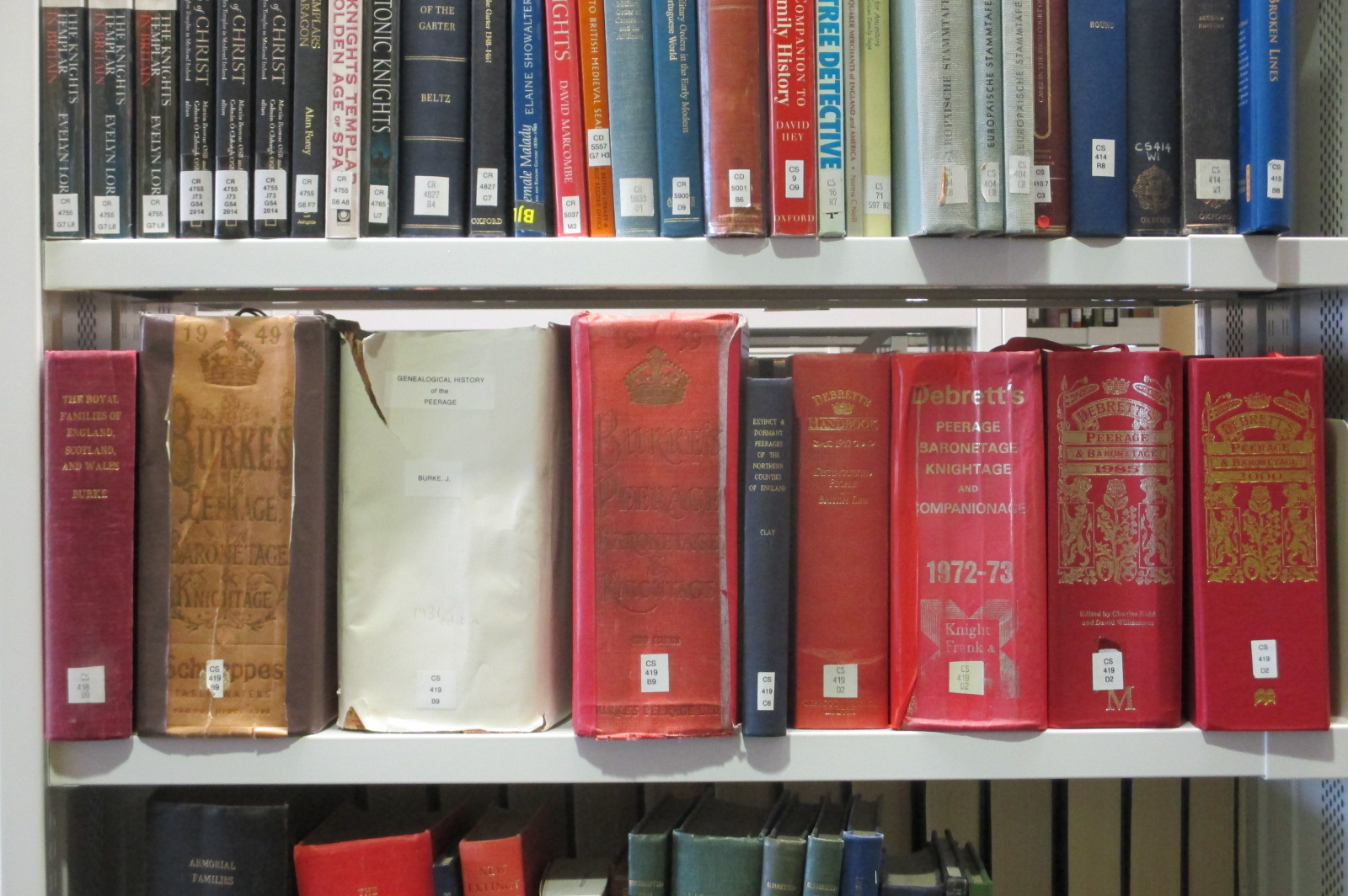
Only rather a long time into my heraldic hobby did a thought occur to me which, in retrospect, should have been obvious from the beginning – that being in a university library I could find many of those same books in physical form. Sure enough a scout around the fourth floor uncovered several such books. More importantly, I also found a shelf holding several old copies of Burke’s and Debrett’s accounts of the Peerage & Baronetage.

A Herald’s Treasure Chest

These titles were not new to me, for I had heard and read them referenced many times in relation to matters of the British aristocracy. Previously I had understood these volumes to be address books and genealogical guides for upper class, which indeed they are. I had not, however, realised that they also functioned as an armorial database. This discovery allowed me to vastly expand my portfolio for all heraldic uploads, but in particular it gave me access to the arms of several speakers in the twentieth century.

As the names imply, Burke and Debrett detail the peers and baronets of the United Kingdom and its predecessor states. Some also document the knightage and companionage, but these entries do not include arms. This means that speakers who are neither peers nor baronets will not have their arms listed – a problem for several of the individuals being studied.

It is customary for a retiring speaker to leave the house altogether and ascend to the other place – the monarch having been petitioned by MPs to confer some mark of her royal favour upon him, and the prime minister having recommended that this be a peerage. George Thomas’s arms can therefore be located as those of the Viscount Tonypandy, as can William Morrison’s as Viscount Dunrossil. Some speakers, though, never moved from the green leather to the red. This can either be because they preferred to remain commoners (in the case of Whitley) or because they did not leave office alive (in the case of Fitzroy and Hylton-Foster). A difficulty also occurs for those speakers whose peerages were short-lived: The shelf had volumes from 1949, 1959, 1972-3, 1985 and 2000. The viscountcy Ruffside does not feature, having existed only from 1951 to 1958. The barony Selwyn-Lloyd (1976-78) was similarly absent. Of course, the deferment of elevation until one’s retirement means that no edition would include the contemporary speaker, only the emeriti. In a few cases I was helped by other Wikipedians who had access to editions which I did not, but that still left me with a smattering of omissions from the record.

As explained before, when no blazon can be found then one can only resort to replication by visual inspection. Speaker’s House is often used for public events, and pictures often make their way online. Of course, the photographers are typically not there to take closeups of the wall decorations, but in a handful of cases I was able to get a good look at the escutcheons which had previously eluded me. The shields are arranged sequentially, so that if at least one of them is already known then a viewer can count along the line to identify the others. It was an easy deduction that the Stuart-era royal arms defaced by a bendlet sinister would belong to Edward Fitzroy, agnate of the Dukes of Grafton. Selwyn-Lloyd’s could be spotted two spaces down from Weatherill’s, but the depth of field made it difficult to precisely identify the charges.

Michael Martin’s arms were a challenge to reproduce as they contain a great many non-standard charges and a motto in Gaelic, “Gorbals Mick” wishing to emphasise the proletarian lineage which set him apart from most other politicians. The display of large graphics online had become much easier by the time John Bercow matriculated his arms, so that their appearance was widely distributed by various news outlets. There is currently some uncertainty as to when, if ever, he will relinquish the chair, but it is likely that the achievements of his eventual successors will receive similar publicity.

The only remaining gaps in the list are for John Henry Whitley and Sir Harry Hylton-Foster, both of whose shields I have seen in the photographs, but too far away to capture the fine details. The latter case is especially infuriating because although Sir Harry perished as a mere knight, a barony was conferred upon his widow, Audrey – who also happened to be Ruffside’s daughter. I sought out her entry in Debrett’s expecting to see the arms of her father and husband impaled, but instead the books gave her no heraldic information at all.

As I am unlikely to be invited to the speaker’s residence in person any time soon – being not a politics student, after all – these last two items may well stay beyond my grasp indefinitely. Still, it’s nice to finally have an article I may call my own after all these years.

UPDATE (January 2021)

Late in 2019 the Chairman of Ways & Means Sir Lindsay Hoyle was elected to replace Bercow as Speaker. His father was ennobled decades ago, but I could not find any arms recorded for him. Recently I found this piece by BBC Radio Lancashire, in which Sir Lindsay muses about a future grant. He says “I’d like to think maybe a bumble bee, the busy bee… who knows? And of course, if I was to do that, I would want a Lancashire rose.” though a year later there is still no news of him getting it.

UPDATE (January 2022)

Baz Manning, having read this post, is putting together a new Flickr album of photographs inside Speaker’s House. I am now able to fill in the remaining gaps, and have learned that Morrison had a Scottish grant separate to his English one.

EXTERNAL LINKS

  • E. Churton – The Lives of the Speakers of the House of Commons by James Alexander Manning, 1851.
  • Burke’s Peerage – The General Armory of England, Scotland, Ireland & Wales by Sir Bernard Burke, 1864.
  • C-SPAN – Bernard Weatherill reflects on his career, 7th April 1992.
  • C-SPAN – Betty Boothroyd shows of her residence, 1st July 1995.
  • Whitehall 1212 -Torcuil Chrichton sheds some light on Michael Martin’s charges, 4th December 2008.
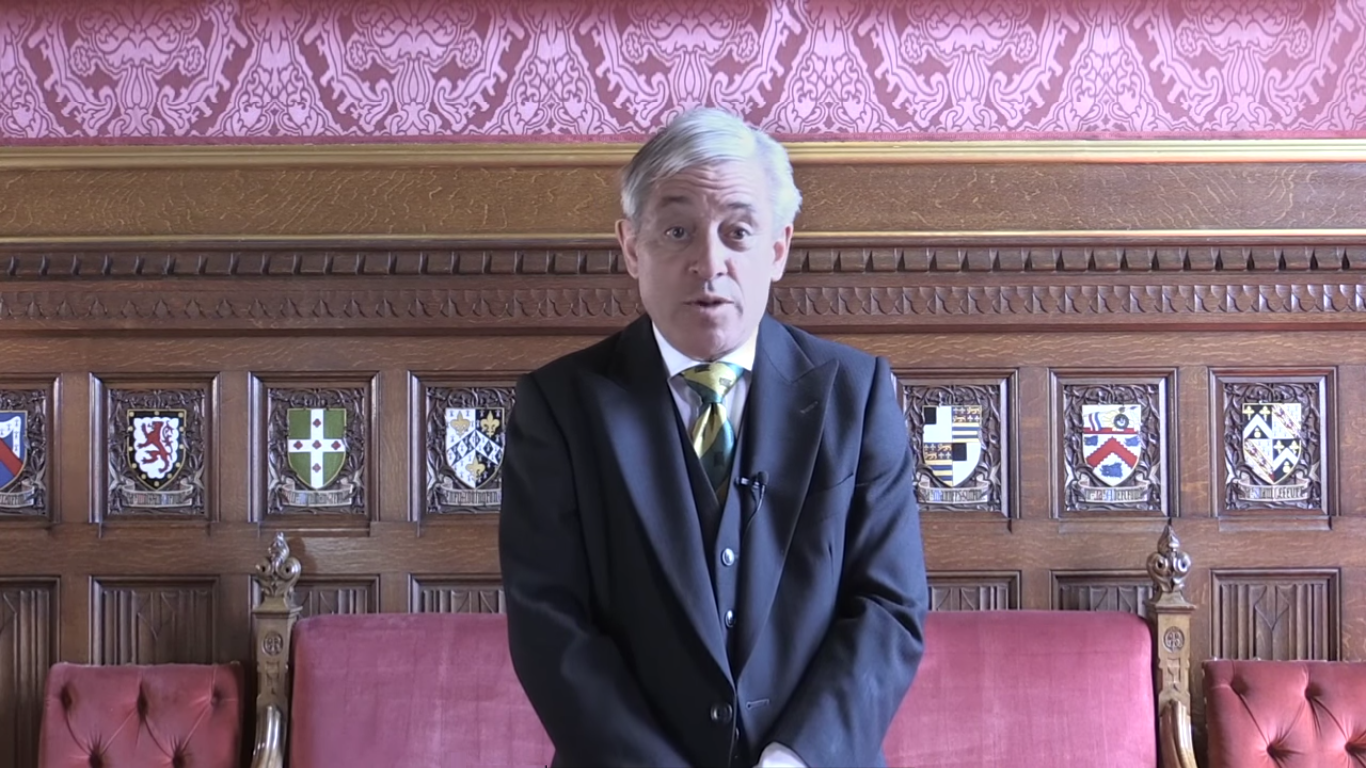
  • UK Parliament – John Bercow is interviewed with some escutcheons behind him, 7th September 2009.
  • The Daily Telegraph – Response to Bercow’s arms and portrait by Christopher Hope, 28th November 2011.
  • The Guardian – Report on Bercow’s arms, 28th November 2011.
  • The Workers’ Photos Archive – Photographs inside the speaker’s chamber, 19th June 2013.
  • I CAN – Photograph inside the speaker’s chamber showing the arms of Selwyn Lloyd, 26th November 2013.
  • UK Parliament – Bercow before row of escutcheons paying tribute to Jo Cox, 15th June 2017.
  • Hansard – Bercow pays tribute to his deceased predecessor, including a brief description of his arms, 1st May 2018.
  • Reddit – Members were not impressed by my first attempt at Boothroyd’s lozenge, 28th January 2019.

Wikipedian Heraldry in ITV’s Victoria

Last night “A Show of Unity”, the fifth episode of the third series of ITV’s Victoria, premiered in Britain. It featured two heraldic anomalies that I wanted to examine.

Some of this episode takes place at Classiebawn Castle on the Palmerston estate in County Sligo. A dining room scene features a blue cloth hanging from the back wall which bears an illustration of Palmerston’s arms. Shortly afterwards there is an establishing shot of the outside of the building showing a flag of similar composition (although smaller and portrait) supported by a sculpture of a dog (possibly a talbot sejant, as in Palmerston’s crest). In both cases the depiction of the arms looks suspiciously similar to this one by heraldic artist Rs-nourse, who has produced a great many armorial illustrations for Wikimedia Commons. His works are distinguishable from Sodacan’s in that they are generally more stylised, with greater texturing and shading. As per usual, there was no attribution in the credits.

The use of this particular image also creates an anachronism. This episode, featuring The Queen’s first visit to Ireland and the discovery of her seventh pregnancy, should be set in 1849. Nourse‘s graphic, however, has the shield surrounded by the blue circlet of the Order of the Garter – to which Lord Palmerston was appointed in 1856. Another strange anomaly is that the outdoor flag seems to be topped by a flat metal impression of a coronet. Only four pearls are seen, implying the rank of baron. Meanwhile the printed display already features a coronet with seven pearls, appropriate to Palmerston’s rank of viscount (though he did have the subsidiary title Baron Temple).*

These scenes are surrounded by two scenes back at Buckingham Palace. Even though the monarch is absent, the establishing shots of the palace both feature the Royal Standard flying over the Marble Arch. The flag is too far away and too crumpled for me to determine where they found the image.

*In reality a baronial coronet features six pearls around its rim and a vicomital coronet sixteen, but on a two-dimensional drawing it is not possible to show all of them simultaneously.

The Hidden Heritage of Holderness

IMG_3432

This time of year, after the end of winter examinations but before the beginning of a new trimester, is rather uneventful as far as undergraduates are concerned. I therefore have the opportunity to leave my student dwellings and go home for a week. Today my parents took me on a tour of some interesting locations in the sparsely-populated parishes of South East Holderness. I had seen many of these locations before when delivering leaflets for the Hubb, but this excursion was focusing more on the historical perspective.

Our first landmark was the Gunpowder Plot sculpture, erected in 2013 in Welwick. The sculpture depicts conspirators Guy Fawkes, Robert Caseby, Jack Wright and Kit Wright – the latter two being brothers from this village. The work was unveiled by Graham Stuart MP, whom the plaque incorrectly styles as a privy council member.

Taking up the bulk of our day was the Church of St Helen, in the parishes of Skeffling (civil) and Easington (ecclesiastical). Constructed in the early reign of King Edward IV, it held regular congregations until last summer when, after several years of dwindling audiences, the Church Commissioners decided to close it down. Inside everything looks much as one would expect: stone arches, wooden pews, and haunting streams of sunlight through the stained-glass windows (this building has no electricity, though it does have candles and what looked like gas lamps.). Though nothing was obviously missing, one could sense from the thin layer of dust on so many surfaces and the abrupt skipping of years in the guestbook that this was no longer the centre of any significant activity.

The church contained a few references to the aforementioned Wright brothers, but what most interested us, given our association with the Tower, were the many monuments to the Holme family, both verbal and heraldic. The bodies of John Holme, Esq (d. 1744) and his wife Dinah, née Burgh (d. 1729) are contained here, along with those of two sons (Henry & John, the latter being rector of Brands-Burton & Barmston) and a daughter (Margaret, Mrs Thomas Reaston). Above these large luxurious engravings are several depictions, in varying states of repair, of the Holme escutcheon – Barry of six Or and Azure, on a canton Argent a chaplet gules. The most prominent of these is topped by the Holme crest – Out of a mural coronet Gules a hound’s head erased Or – and impaled with the arms of Burgh – Argent on a saltire Sable five swans Proper.

This slideshow requires JavaScript.

There were many more references among the many dusty documents to the Holmes of various generations, though the task of constructing a coherent timeline is confounded by the fact that, like so many families prior to the nineteenth century, they frequently recycled the same limited pool of names and were not much concerned with consistent spelling.

Having left the church, we went in search of the sound mirror at Kilnsea. Constructed around much of the north east coat during the First World War, these large concrete hemispheres would focus the engine noise from approaching aircraft, so that advance warning could be given of imminent bombing raids. The mirrors were ultimately rendered obsolete by the invention of faster aeroplanes and later RADAR.

We did not make it to the mirror, however, because the intermediate terrain was not navigable. Much of the surrounding land has been given over to a nature reserve managed by the Yorkshire Wildlife Trust. To approach our target we had to troop over a lot of damp, thorny ground and long grass. Then there was the problem of the artificial lake. I walked along the full length of the narrow strait depicted above, but it did not quite reach the bank at the other side, and I judged the water to be a little over what I could reasonably ford – both in width and in depth. None of us wanted to risk spending the next few hours trudging about with mud-soaked legs and squelching boot-soles, so we gave up and turned back.

Our final stop, for a rather belated lunch, was at Spurn Discovery Centre. Opened ten months ago, this rather controversial building is the headquarters of the Spurn National Nature Reserve. My family have visited Spurn many times during my life, and on each occasion found it to be a slightly different shape. Coastal erosion here is very fast, due to the soft nature of the boulder clay, and the entire landmass moves two metres westwards every year. Nearly two years ago a major storm wiped out part of the road to the head, creating a tidal island. Some months earlier the trust abandoned attempts to preserve shoreline, instead planning to “let nature take its course”. Tourists are driven across the peninsula using a “Unimog” bought from the Dutch Army, but even that struggles to get across when it rains or the tide rises.

The café had a wide selection of reference books and memorabilia, most of which related to the birds and other creatures which inhabited the surrounding sand. Ornithology – despite what my name and logo may imply – is not my area of interest or expertise, so I have little to comment on these. I was rather hoping that there would be some material relating to the human history of the region, for up until the nineteenth century there were dozens of small towns dotted along this section of the coast, all now submerged by the north sea. If nothing else, I could have hoped to find some interesting heraldry somewhere.