Demise and Disarray

The death of Elizabeth II is a time of serious grief for her family and her many peoples. It is also a time of mild confusion for public bodies, and of course Wikipedians. Here is a run-down of some of the changes that have recently been made.

The Monarch

The man long known as Charles, Prince of Wales is now King. For many years there had been speculation that he would take the regnal name George VII in honour of his maternal grandfather and great-grandfather, but shortly after his accession it was confirmed that he would indeed go by Charles III. There was a brief period when his page was at Charles, King of the United Kingdom before being changed to Charles III. There is an ongoing debate as to whether the article title should include “of the United Kingdom”. The side in favour argues that there have been many other monarchs over the centuries called Charles III from whom the present monarch needs to be differentiated. The side against argues that Charles is king of far more than just Britain, and that if you included one realm in his title you would have to include all of them, lest you imply that one is more important than another.

The Consort

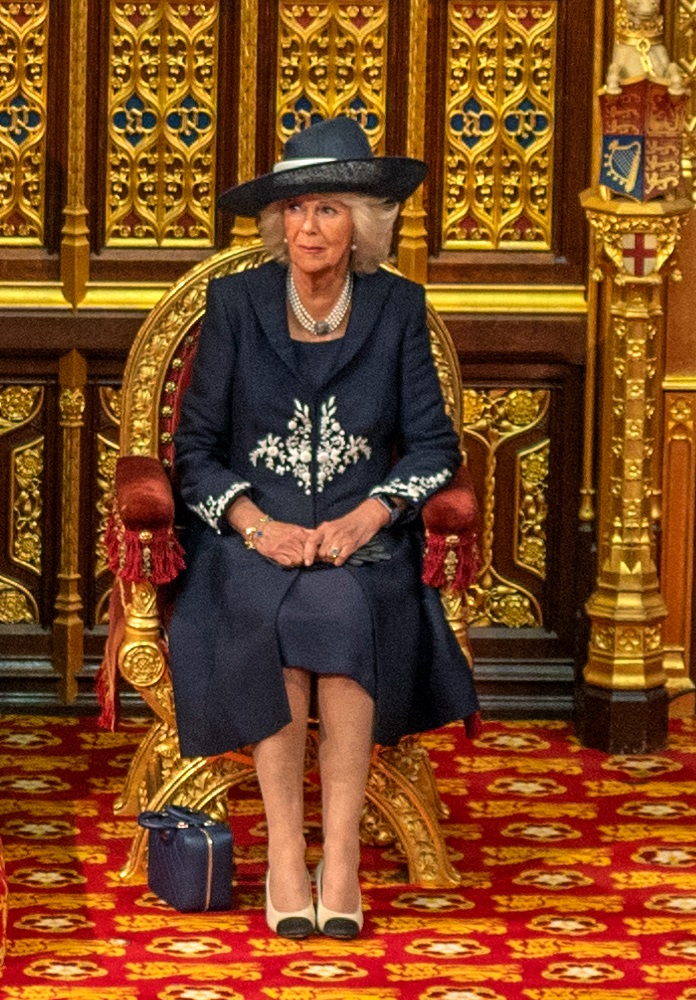
Camilla Shand, at the time of her marriage in 2005, was not popular among much of the public still grieving Diana Spencer. So as to avoid appearing to usurp her legacy, she never styled herself “Princess of Wales”, instead going by “Duchess of Cornwall”. It was also suggested back then that, upon her husband’s accession, she would be styled “Princess Consort” (presumably derived from Prince Albert) rather than Queen. How true this proved to be was always a matter of public relations rather than constitutional law. By the start of this year it was clear that her reputation had recovered sufficiently to abandon that idea, and Elizabeth II in an open letter explicitly endorsed her daughter-in-law to be called Queen Consort. Currently all major media and government sources are very insistent on styling her “The Queen Consort”, rather than simply “The Queen” as other queens consort were before her. It is not yet clear if she will be described this way for the whole of Charles’s reign or if it is simply a temporary measure so as not to confuse the public while the late queen regnant is still being mourned. Again, there is dispute over whether her article title should include “of the United Kingdom”.

The Heir Apparent

In 2011 Prince William of Wales was ennobled by his grandmother as Duke of Cambridge, Earl of Strathearn and Baron Carrickfergus in the peerage of the United Kingdom. He has not ceased to hold these titles, but they are now buried beneath several others. The dukedom of Cornwall, in the peerage of England, is governed by a 1337 Charter instructing that it belongs automatically to the eldest living legitimate son of the incumbent monarch and the heir apparent to the throne, and that if these two statuses are held by different people then the title is left vacant. This means that all dukes (save Richard of Bordeaux) are deemed to have held the original peerage, rather than it being created anew each time. The Duchy of Cornwall, a substantial land-holding corporation in the south of England, is governed by the same. The dukedom of Rothesay in the peerage of Scotland is mandated by an Act of Parliament from 1469 to follow an identical succession, as are the titles Earl of Carrick, Baron of Renfrew, Lord of the Isles, Prince of Scotland and Great Steward of Scotland. The titles of Prince of Wales and Earl of Chester, by contrast, are not automatic. They are conferred by letters patent at the discretion of the monarch. It appears from news reports that Charles III has opted to do so almost immediately after coming to the throne, though I am still waiting to see this formally confirmed in the Gazette or the Court Circular. There was a short interlude in which the royal website and Wikipedia styled him “Duke of Cornwall and Cambridge”. I argued that it was poor form to include Cambridge while leaving out Rothesay, to which an anonymous user replied:

It would, but we don’t have a basis for that usage in Wikipedia practice. The hierarchy is very much What the Papers Say > legal/heraldic/formal/official names > anything that actually makes sense. I’m guessing there will be a followup announcement about his distinct style in Scotland and indeed in Northern Ireland, and maybe they’ll end up with something more logical and less clumsy. After workshopping every other possibility.

The Others

The accession of a new sovereign causes a reshuffle in the orders of precedence among the royal family. In the male order, Charles is naturally now on top. His sons William and Harry also move up, as do his grandsons George, Louis and Archie (their position before, as great-grandsons of the sovereign, was a little unclear). Andrew and Edward are demoted from sons to brothers, James and Peter from grandsons to nephews, and the Earl of Snowdon from nephew to cousin. The Dukes of Gloucester and Kent and Prince Michael are unaffected. On the female side Camilla achieves supremacy, followed by Catherine, then Meghan, then Charlotte, then Lilibet, then Sophie, Anne, Beatrice, Eugenie, Louise, Zara, Birgitte, Katharine, Marie-Christine, Sarah and Alexandra.

The styles and titles of Charles’s descendants are also upgraded (though those of his siblings and niblings are not diminished). William and Harry both gain a definitive article in their princely titles. George, Charlotte and Louis are now “of Wales” rather than “of Cambridge”. There has, of course, already been a famous Princess Charlotte of Wales, so until an alternative solution emerges their Wikipedia pages must be differentiated by the awkward use of years in brackets. Archie and Lilibet, as children of a younger son of the sovereign, now qualify as royals under the terms of the 1917 letters patent. They could now correctly be styled as “His Royal Highness Prince Archie of Sussex” and “Her Royal Highness Princess Lilibet of Sussex”, though no move has been made in that direction so far. The situation regarding the Earl of Wessex’s children remains ambiguous. Charles could, of course, amend or revoke the letters patent however he wishes, but there has not yet been any indication in that regard.

The dukedom of Edinburgh, earldom of Merioneth and barony Greenwich, which were conferred by George VI on his daughter’s fiancé Philip Mountbatten in 1947, and were then inherited by Charles in 2021, have now merged with the crown. Any of them can be bestowed anew on whomever His Majesty chooses. His brother Edward has long been presumed to receive them next, but no decision has been taken at this time.

Under the Regency Act 1937 Camilla (consort) and Beatrice (fourth adult in line) have become Counsellors of State.

The office of Lord Great Chamberlain of England (not the same as Lord Chamberlain of the Household) has automatically transferred from the 7th Marquess of Cholmondeley to the 7th Baron Carrington. The former therefore loses membership of the House of Lords under Section 2 of the 1999 Act while the latter gains it. What happens to the place he already held among the ninety elected hereditary peers is still to be determined.

The Courts

The Queen’s Bench Divisions of the High Courts of England & Wales and of Northern Ireland, as well as the Courts of Queen’s Bench for the Canadian provinces of Alberta, Manitoba, New Brunswick and Saskatchewan, have all been renamed King’s Bench. The status of Queen’s Counsel in Australia, Britain, Canada and New Zealand has likewise changed to King’s Counsel, and all who hold it have had to amend their post-nominals accordingly. Only last month I created a new template for judges of the Queen’s Bench Division and had scrupulously added the specification to each of their infoboxes. Now I have had to change all of them. Still, it helps boost my edit count I suppose.

UPDATE (March 2023)

A few months late but better than never, the Palace now confirms that Archie & Lilibet have princely titles, as well as that Edward has become a duke.

The Late Queen

The inevitable moment I and so many others around the world had long dreaded finally arrived tonight – Buckingham Palace announced the death of Elizabeth II. It is a blessing that she survived to see her Platinum Jubilee and the end of the pandemic, but also a disappointment that she missed her centenary.
Last year, shortly after the death of her consort Philip, I blogged an extract from my grandmother’s writings, concerning the time she spent in Malta with then-Lieutenant Mountbatten. I sent a letter about such recollections to his widow. Some weeks later I received a thank-you note from Mary Anne Morrison, Woman of the Bedchamber.

I would have liked to be able to recall a more direct interaction with Her Late Majesty, but sadly my only in-person encounter was a drive-by glimpse in 2017. My time with the new monarch has been similarly brief – I once got a wave from him at the Valley Gardens in Withernsea in July 2013.

More words will come when I have had time to compose them.

Double David

For a while now the Supreme Court of the United Kingdom has had two vacancies, caused by the retirement of Lord Lloyd-Jones and Lady Arden of Heswall in January. Yesterday it was announced that appointments had been made: Arden’s place is to be taken by Sir David Richards, formerly of the Court of Appeal of England & Wales, while Lloyd-Jones’s successor is… Lord Lloyd-Jones.

The reason for this bizarre phenomenon is found by looking at legislation relating to mandatory retirement ages. The Judicial Pensions Act 1959 set the retirement age for people entering the judiciary thereafter at 75, though it was not binding on those already holding office by then (so Lord Denning and Lord Cameron continued until ages 83 and 85 respectively). The Judicial Pensions and Retirement Act 1993 lowered this to 70, but again was not retroactive so that those who had held judicial office before 31 March 1995 were grandfathered in. Lady Arden was the last such grandfathered member of the UKSC. The last overall was Sir James Holman, appointed a judge of the Family Division (EWHC) on 18 March 1995, who retired on 28 June.

The Public Service Pensions and Judicial Offices Act 2022 (which received Royal Assent on 10 March) raised the retirement age back to 75, and this time it was retroactive, so that those already in office can now serve an extra five years, and some who recently retired at age 70 (such as Lloyd-Jones and Richards) can come back for an encore.

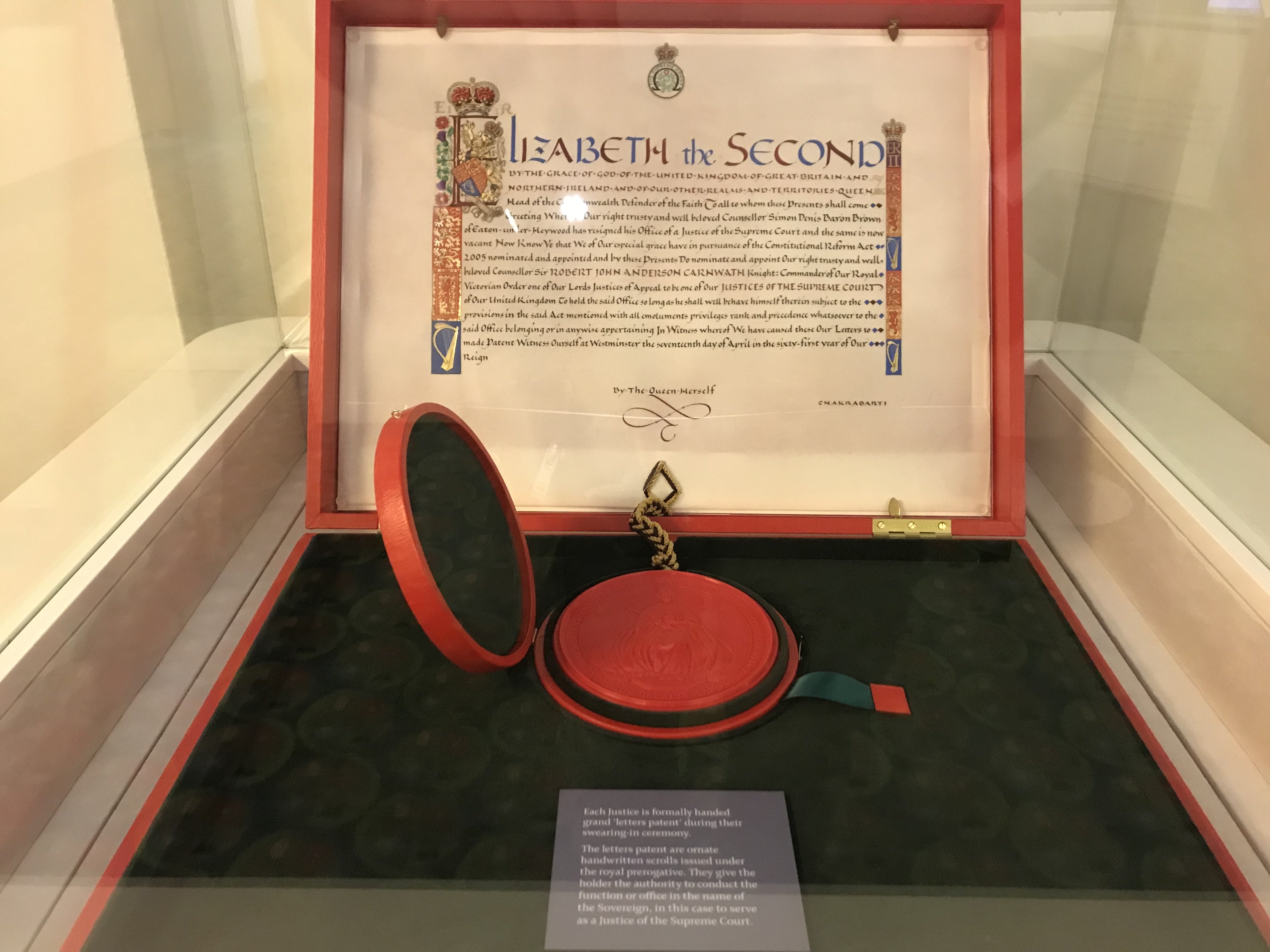
Incidentally, I discovered these appointments through the Twitter feed CrownOffFOIDs. The name is a shorthand for “Crown Office Freedom of Information Disclosures”. This is the Crown Office in Chancery, a small section of the Ministry of Justice responsible for the production and management of certain state and royal documents. Whether the office itself, or a private citizen, is operating the Twitter account is not clear. The output includes photographs of the Great Seal of the Realm as well as many of the different types of document to which it may be attached. There are writs, warrants, patents and proclamations of a great many kinds, including the proclamation of the present monarch’s accession, which the Tweet notes is not as physically impressive as one might have expected.

EXTERNAL LINKS

Lyon Lectures

Video

A downside of the fading of the pandemic and return to normalcy is that a lot of the institutions which had taken to putting on virtual meetings have now reverted to doing them in person only. Since these events are in many different locations around the world, far away from each other and from me, my ability to attend is severely limited.

One particular frustration has been been the Lyon Court, which for the last few months has been commemorating the 350th anniversary of the Lyon Register. Many times I have seen these lectures advertised on EventBrite, but I have not been able to go to them.

Now, belatedly, there is happy news, for the Lyon Court’s formerly-sparse YouTube channel has in the past fortnight seen a flurry of uploads from this lecture series. It is a little disappointing to have to catch up months later instead of taking part live, but getting to see them at all is still a great improvement compared to what would have been expected three years ago.

Developments in England have been less encouraging – there has been no newsletter from the College of Arms for this July. Upon inquiry, Portcullis told me that they hope to publish one later in the year. The heraldic decisions of Amess, Amos, Blair and Hoyle remain elusive.

A Blackmailer at Frogmore

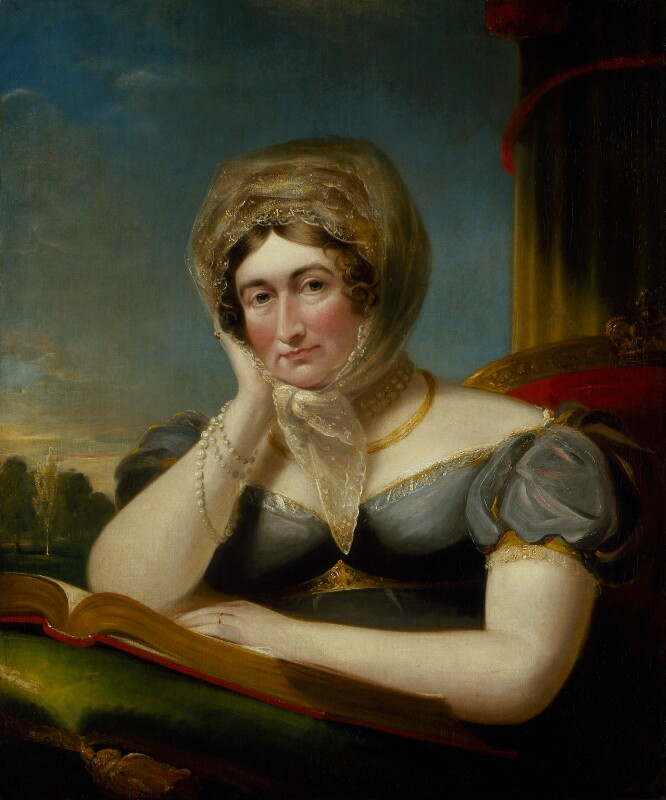
Today’s virtual outing was with the National Archives again. James Travers, Cultural Property Manager, was promoting his new book on the “ghost” of Caroline of Brunswick, Queen of George IV.

The centrepiece of the book, and the lecture, was Thomas Ashe, whom the injured consort had commissioned to write her memoirs. His book The Claustral Palace was suppressed from publication, for it would have revealed the intimate life stories of her sisters-in-law who were confined at Frogmore House.

How much of the novel was true is unclear, but it put Ashe in conflict with the government as well as George IV’s brother the Duke of Cumberland (later Ernest Augustus I of Hanover).

Travers’s lecture was quite convoluted in its story, which combined with his soft way of speaking and some technical glitches at my end meant it wasn’t always easy to follow the plot, so reading the book itself is probably necessary to get a full understanding.

Power and pageantry: The coronation of King Richard III and Queen Anne

Another date with the National Archives, this time featuring Dr Sean Cunningham,the head of Medieval Records.

I was faintly amused when he brought up a still from The White Queen (2013) featuring Aneurin Barnard and Faye Marsay, if only so he could point out the inaccuracies. Then again, this coronation does not have many other televisual depictions to my knowledge.

Heraldic Headache

Five and a half months since the announcement of their appointments, the installation of the Duchess of Cornwall, the Baroness Amos and Sir Tony Blair in the Order of the Garter finally took place today. Suspended for two years due to the pandemic, the ceremony was revived with the knights, ladies, heralds and soldiers marching through the grounds of Windsor Castle in all their finery.

Getting photographs of this event has proven annoyingly difficult. The Royal Household itself has not made a proper film of it, nor have the major news networks covered it in much detail, so I have had to piece it together from commercial photographers (whose shots I would not risk directly embedding here), crowd-members short films and attendees’ Tweets. The end result is less than satsifactory.

Most importantly, I have yet to see any photographs from inside the chapel since the new members were installed, so remain none the wiser as to the appearance of their armorial banners – my main reason for waiting so expectantly all this time! Sir David Amess and Sir Lindsay Hoyle remain similarly elusive.

While we’re here, it’s worth mentioning yet another podcast I have discovered: the Commonwealth Poetry Podcast by Gyles & Aphra Brandreth, whose first episode features the Duchess of Cornwall and Dame Joanna Lumley as its guest stars.

EXTERNAL LINKS

UPDATE (12th August)

By searching “Garter” on the Parliamentary Archives website, I have found this photographic album of the procession from 1996. Hopefully there will be more of its kind in the same place.

Accessions and Assumptions

Today was another virtual double-helping. The first was a Teams presentation from The National Archives in which Dr Tracy Borman, Joint Chief Curator of Historic Royal Palaces, plugged her new book Crown & Sceptre: a new history of the British Monarchy.

Borman gave a synopsis of her publication, which essentially amounted to a summary of English and then British royal history since 1066. That part I will not type out again. She called Elizabeth I a brilliant propagandist and “the greatest monarch of all time”. She thought less of Victoria, who spent so much time in retirement after Albert’s death that the institution of the crown was nearly disbanded. She also called Edward VIII’s abdication a lucky escape, noting the callous attitude he had both to the institution and his family members. She spotted a theme that the best monarchs were those never originally supposed to reign – including the present one. Another important point was that after the Civil War and the Glorious Revolution, Britain’s monarchs were reduced to ceremonial figureheads, focusing their efforts on charity and patronage instead of direct political power. This earned them mockery from other still-absolute monarchs at the time, but seems in the long term to have greatly contributed to outlasting them.

In the Q&A, I asked how much the present day royal family was influenced by the Scottish half of their pre-C17 ancestry, since her book was focused on the English side. Borman said that the constitutional model which Britain still has today (and has exported around the world) largely resulted from the absolutist attitudes of the House of Stuart clashing with the English parliamentary system, without which its seminal conflicts would likely never have happened.

While I enjoyed the presentation I am not sure that I will end up buying the book. While Borman claimed to be “inspired” by the Platinum Jubilee giving the opportunity to look back over the last millennium, I suspect it was more a matter of judging the point in the media cycle when such a book would get most sales. I am reminded of J. P. Nettl’s preface to his 1967 book The Soviet Achievement, beginning with “Anyone should have serious doubts before adding to the mountain of literature on the Soviet Union. The fiftieth anniversary of the October revolution provides an occasion, perhaps, but no automatic excuse.”, a sentiment that could apply equally well here.

The second event was a Zoom lecture by the Heraldry Society. Marcus Meer‘s talk “And No Recently Assumed Arms…” was about the display of, and attitudes around, heraldry in medieval German cities, and something of a sequel to his “Lest They Pass to the Peasants” lecture to the Scottish society in March.

Urban centres in the Middle Ages were festooned with heraldic marks of the municipalities themselves as well as the guilds, corporations and individuals resident within. They would be set in stained glass, carved into stone walls or moulded on cutlery. The use of such images was a shared focal point for citizens’ attention, helping to maintain communal stability. They were also used to demarcate sections of the urban space, and to claim control of said sections on behalf of their owners. Delegated authority was rendered visible as government officials wore the state or city’s badge, and armorial marks would be painted on items produced in the city as a sign of quality control. Heraldry was also a mark of power struggles – guilds would fight for precedence in civic processions and conquerors of a town would displace existing shields with their own.

Meer spoke of a departure in scholarship from analysis of heraldry as a fixed symbol of meaning, towards a study of medieval perspectives.

The Gossembrot Armorial of 1469 was an attempt by the author to shore up his family’s status against the threat from social climbers. It collected the arms of all the families into whom Gossembrots had married, but it omitted arms which had come into use too recently in favour of those long-established. Others would embellish their own heritage beyond plausibility, such as Ulman Stramer who, in his Book of my Lineage and Adventure (1360-1400), claimed that his ancestor Gerhart of Reichenbach was granted arms by King Conrad, even though Conrad reigned in an age before it became customary to have arms formally granted by a sovereign. In the fifteenth century there was a social distinction between arms officially sanctioned and arms privately assumed. Urban grantees, much like their contemporaries in England, sought to consolidate their status. Also similar to England, “confirmations” of supposedly-old arms were preferred to grants of clearly-new ones, for armigers wanted proof that they and their agnates had always belonged to the gentry instead of recently joining it. Sometimes grants were sought from foreign rulers, such as Henry VIII of England to Lorenz Stauber of Nuremberg in 1521.

There were accounts of legal disputes over heraldic ownership, such as unrelated armigers bearing the same shield, and the city authorities deciding that they must be long-lost family. A case study was the Church of St Anne in Augsburg, where Ulrich, Georg and Jakob Fugger had endowed a family chapel. When the male-line of the dynasty died out the female-line descendants were allowed to inherit the chapel but not the Fugger arms.

I asked Dr Meer what was the lowest social rank at which one could get away with assuming arms. He replied that there were no hard rules, and that at Nuremberg there is evidence of armigerous peasants, albeit probably the wealthier peasants. Emperors were known to complain of non-nobles assuming arms, but there wishes were not enforced.

10th June is International Heraldry Day (though as little recognised as all the other National Whatever Days) and the society was proud to unveil its new logo, courtesy of Quentin Peacock. Also today it was announced that Her Majesty had appointed two new members of the Order of the Thistle – former Lord Advocate Dame Elish Angiolini and former Presiding Officer of the Scottish Parliament Sir George Reid. Their arms, if yet they have them, will at some point be displayed at the High Kirk. Meanwhile, with just three days to go until the Garter service, I am still none the wiser as to the arms of Amos and Blair.

Privy to the Details

Meetings of Her Majesty’s Most Honourable Privy Council are not usually a big event. Although the committees (particularly the Cabinet and the Supreme Court) are very busy institutions, the plenaries generally take place once per month, minimally attended (the quorum is four) and enacting mere formalities.

A major exception to the norm is upon the demise of the crown. Then an Accession Council is swiftly convened to greet the new monarch. This is typically the only occasion on which the entire council meets.

Nowadays, even that is set to change. It was reported in Private Eye some time ago that places at the next accession will have to be rationed, on account of the council having grown too large over the course of the present reign. Certain office-holders will be invited automatically, but everyone else will have to enter a ballot.

Recently there has been a freedom of information request which revealed which offices would grant automatic invitation. As it turned out, the list was still quite long. I have endeavoured to break it down by category for ease of understanding.

The Firm

  • Members of the Royal Family who are Privy Counsellors
  • The Lord Great Chamberlain
  • The Earl Marshal
  • The Garter Principal King of Arms
  • The Lord Lyon King of Arms
  • Members of the Royal Household who are Privy Counsellors
  • Certain senior members of the Royal Household who are not Privy Counsellors

Political figures

  • The Lord High Chancellor of Great Britain
  • The Prime Minister
  • The Lord President of the Council
  • The Lord Keeper of the Privy Seal
  • The Speaker of the House of Commons
  • The Lord Speaker
  • Serving Cabinet ministers (and ministers who attend Cabinet)
  • The Leader of the Opposition
  • Members of the Shadow Cabinet who are Privy Counsellors
  • Westminster Leaders of political parties represented in the House of Commons
  • The First Minister of Scotland
  • The First Minister of Wales
  • The First Minister of Northern Ireland
  • The Deputy First Minister of Northern Ireland
  • The Presiding Officer of the Scottish Parliament
  • The Presiding Officer of the Welsh Parliament
  • The Speaker of the Northern Ireland Assembly
  • Deputy Speakers (of where?)
  • Former Prime Ministers
  • Former Lord Presidents of the Council
  • Former leaders of political parties who are Privy Counsellors

Religious figures

  • The Archbishop of Canterbury
  • The Archbishop of York
  • The Bishop of London
  • Former Archbishops of Canterbury and York
  • Former Bishops of London

Judiciary

  • The Judicial Committee
  • The Lord Chief Justice of England & Wales
  • The Lord Chief Justice of Northern Ireland
  • The Lord President of the Court of Session
  • The Lord Advocate
  • The Master of the Rolls
  • The President of the Queen’s Bench Division
  • The President of the Family Division
  • The Chancellor of the High Court of England & Wales
  • Lord and Lady Justices of Appeal

Diplomats and civil servants

  • The Secretary-General of the Commonwealth of Nations
  • High Commissioners of the Commonwealth Realms
  • The Marshal of the Diplomatic Corps
  • The Cabinet Secretary
  • The Permanent Secretary of the Foreign, Commonwealth & Development Office

The City of London

  • The Lord Mayor
  • The Sheriffs
  • The Recorder

Notably the reply did not specify how many places were available by ballot.

UPDATE (8th September)

Elizabeth II died earlier today. The council website currently advises attendees to await for an email giving further instructions.

State of Change

May I see the wine list?

Late last night it was announced that, due to episodic mobility issues, Queen Elizabeth would not be personally present for the state opening of Parliament today. While the shortness of notice is unusual, it is far from unprecedented for a parliamentary session to begin without the monarch. The present queen missed the openings of 1959 and 1963 due to pregnancy. Victoria loathed to visit Parliament at all during her forty years of mourning. On those occasions the standard procedure was to open the session by commission, with the Lord Chancellor reading the speech. This time, perhaps in consequence of the shortness of notice, the full state ceremony went ahead but with the Prince of Wales reading the speech instead of his mother.

The last time an heir apparent opened Parliament in this way was 23rd November 1819, when the Prince Regent opened the second session of the sixth Parliament on behalf of George III, a mere nine weeks before actually ascending to the throne. Charles, of course, is not full regent, and performed today’s ceremony in his capacity as counsellor of state. Such counsellors are required to act in pairs, hence the first appearance of the Duke of Cambridge at the event.

It was reported in the BBC coverage that Charles was sitting on the consort’s throne, with the monarch’s throne being removed from the chamber completely. The Imperial State Crown was displayed on a small table to his right where the monarch’s throne would normally be, while his wife and son sat on the smaller chairs in the alcoves either side.

Convention has long been for the peer reading the speech to do so in first person, as the sovereign herself would have done, but Charles opted to switch to third person, repeatedly describing the government and its ministers as “Her Majesty’s” instead of “my”*. I do not know if he was making the substitution mentally or if the speech was actually printed again with altered wording – which would require a downgrade in materials.

Also last night it was announced that Professor Anne Curry had been appointed Arundel Herald Extraordinary. This did not make her a member of the College of Arms, but did allow her to take part in the procession with the other heralds.

This afternoon the House of Lords Flickr account published twenty photographs of the ceremony, taken by Annabel Moeller and licensed as CC BY 2.0, enabling me to quickly absorb them into Wikimedia Commons. It is unusual for us to have such number and quality of images for events like these. The trend towards releasing photographs in this way is encouraging, even if it is intermittent.

Given that this if the first time counsellors of state have been used to open a legislative session, and that the decision was not known until thirteen hours prior, one has to wonder how much improvisation was employed in today’s ceremony, for example:

  • Their Royal Highnesses travelled entirely by motorcar. Had there previously been plans to use the horse-drawn carriages?
  • The Prince of Wales was in full military uniform as for most state openings, but his wife and son were in morning suits as for the “dress down” occasions in June 2017 and December 2019. The inconsistency is inexplicable.
  • There was no mention of the Union Flag over the Victoria Tower being swapped for the royal standard. Was a banner of the heir apparent’s arms available?
  • The limousine carrying Charles had his own shield of arms mounted on the roof, but that carrying William used the generic red shield with a crown. Has a shield of William’s arms been made for this purpose?
  • The carpet on the lowest step to the throne was plain red, whereas previously the pattern of lions and roses continued all the way.
  • Sir Lindsay Hoyle is wigless for the third consecutive state opening, despite promising to wear it before his election. It can’t still be missing, can it?

When the ceremony is over, both houses debate a response to the address. Tradition dictates that the motion be introduced by a long-serving older member and seconded by a younger, recently-elected one. The role of the “old duffer” was this time fulfilled by my own MP, the “shy and retiring” Graham Stuart. He said of his constituency:

Beverley and Holderness comprises four towns—Beverley, Hornsea, Withernsea and Hedon—and many other hamlets and villages that are dotted across east Yorkshire. It is a beautiful part of the world and has history as well as charm. Beverley has contributed more than most places to the improvement of our democratic system over the years—admittedly chiefly by running elections in such a corrupt manner that the law had to be changed afterwards. After the unseating of the victorious candidate in 1727 by a petition, his agents were imprisoned and Parliament passed a whole new bribery Act. But Beverley’s notorious freemen were not to be put off so easily. Beverley continued to be a byword for electoral malpractice. The novelist Anthony Trollope stood in the Liberal interest, unsuccessfully, in 1868, and such was the level of wrongdoing that a royal commission was established especially and a new law passed disenfranchising the town and barring it from ever returning a Member of Parliament again. Obviously the law did change. Free beer and cash inducements were the electoral controversies then, rather than, say, beer and curry today. Never in the history of human conflict has so much karma come from a korma.

FURTHER READING

*The version used on the Hansard website for both the Commons and the Lords is in third person as Charles delivered it, while that on the government’s site is in first person, as well as annotated with the names of the bills being described.