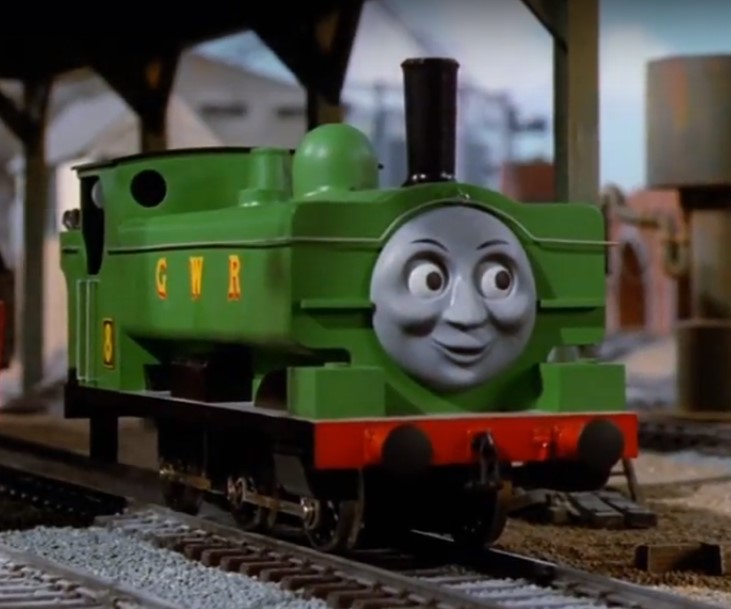
Train Breeds Musical Geniuses

An interesting – if perhaps slightly hyperbolic – video by classical and film music enthusiast Inside the Score, whose works include an appreciative analysis of the score for The Lord of the Rings and a scathing one for Harry Potter.

This short piece posits that the musical complexity of the music from Series 1-7 of Thomas the Tank Engine & Friends – unusual for children’s programming – formed the inspiration for the most talented musicians of the generation watching it.

Co-composer Mike O’Donnell has his own channel, and there are quite a few channels dedicated to the classic series’ music alone, to say nothing of the hundreds pumping out the fanfics:

UPDATE (June 2021)

Mike O’Donnell has given a two-part interview to a fan channel about his work on the series and his new CD releases.

UPDATE (July 2022)

Charles Cornell, another musical YouTuber, has also done an appraisal of the theme.

Farewell to Cottingham Road

Obviously my hair is a lot longer this time, but the suit is the same.

It is a very small proportion of blogs that get serious attention. The same is true of video channels, social network profiles, books, magazines, newspapers and academic journals. For every best seller or household star, there are thousands of obscurities whose volumes fill up discount bins and whose view counts barely break out of single figures. Indeed there are many whose authors just give up or even forget about them, and sit incomplete for eternity. This one was created just shy of five years ago, and this shall be the seventy-fifth published article. A glance of WordPress’s site statistics function shows that there have been 4923 views in total. The mean view count per post is therefore a moderately impressive 66.5, but an inspection of the ranked list shows that the median is a less impressive 6. Factoring in a margin of error for me reading the site myself, I suspect that at least a dozen posts – mostly those talking about student union meetings – actually had no other readers at all. Two articles seriously inflate the mean: The runner up is Interview at Selwyn College, detailing my ill-fated application to matriculate at Cambridge. By far the winner, made just fifty-three weeks ago, is Farewell to Cottingham, discussing my time at The Lawns. Today it is time for the sequel.

All satellite accommodation having closed, the only dwellings available were those in or immediately around the campus. Once again I was slow to investigate options and was primarily concerned with minimizing the expense, so instead of the luxurious newer sites I opted for a Kexgill-owned house with three others on nearby Cottingham Road. In contrast to where I lived before, the history of this house was not well documented, though what sources I can find suggest the road itself dates back to the eighteenth century while the nearby North Hull Estate was constructed between the World Wars, but the construction date of my particular residence and the other student houses adjacent is far from clear. As is to be expected with properties of this nature, a great many fittings and furnishings have been changed over the years to types bought in bulk by the owners, thus obfuscating the property’s true vintage. Buildings like this often have subtle vestigial features which hint at grander days gone by. In our case it was a stained glass window at the top of the staircase. A few dozen metres east of us were houses that had mosaic tile art in their porches. Otherwise they were indistinct from any other undergraduate digs.

The desks, cupboards, wardrobes, drawers and shelves were the same plywood varieties that were seen in the old halls, while the white goods often had panels that were turning yellow. Very little of the flooring in any room was truly flat and very few of the walls were truly straight. In particular my bedroom window had sagged a little on its hinges and did not properly line up with the frame. Full closure required a lot of brute force to lift it up at the same time as pulling it in, the strain of which eventually caused the handle to come off in my hand. The main problem which we experienced in the early months was the cold – even in September it was apparent that there was a sudden drop in temperature upon entering the house. The contract said that Kexgill remotely controlled the central heating for all their properties and so for a while it was assumed that they were leaving it as late as possible before switching it on to save money. As nights got longer and longer we eventually complained and were issued space heaters for our bedrooms. The house was advertised as containing a living room, but on viewing it was clearly a downstairs bedroom with the bed removed. Very little socialising occurred in my time but when it did it was invariably in the kitchen instead. The living room, whose only unique feature was an ironing board (but no iron) was mostly used for storing laundry.

It wasn’t all bad: We had a normal washing machine in the kitchen between four of us, rather than having to use an overstretched institutional launderette with a needlessly complex card payment system. The dryer was less of a boon, as it warped one of my old jumpers until it would have better fitted Mr Tickle. It broke in the spring and a new one was dragged in. The kitchen had further problems: In mid-October the lights broke, forcing me to cook dinner wearing a head torch for a few days. In April the radiator sprang a leak. It was dumped in the bush in the rear garden and a brand new one was fitted in its place. There were also signs of rot or mould having infected one of the storage cupboards. Supposedly this had been treated by spraying the area with bleach, the smell of which lingered for the whole academic year.

The main benefit of the place was that it was barely a two minute walk away from the university’s premises. The result was that I could pop home between lectures, and even access the library at night, without having to carry all the day’s necessary items on an arduous walk or an uncertain bus ride. It was also very close to a large number of food shops, which was especially handy in the last few months.

The outbreak of SARS-CoV-2 caused a great upheaval, of course. At a stroke it negated the benefit of proximity to campus, as the university’s physical presence was closed and teaching became purely virtual. From then on the house might as well have been in the next county. The ensuing national lockdown reinforced how little space there was in the property – we had front and rear gardens, but they were a far cry from the large open space at The Lawns. With no access to the library, the lecture theatres or the student union, our house became our whole world – a billet for which it was obviously not prepared. Thankfully I had earlier taken a few steps to alleviate the drabness of the off-white walls, which eased my sanity during the long period of isolation: in October, when the university’s photocopiers were still available, I had printed off family portraits and hung them in my bedroom. In November I bought several rolls of robin-themed Christmas wrap and made wallpaper out of it. Constantly having to adjust the shifting blu-tack was a pain but if I squinted I could almost convince myself that I inhabited a place of greater splendour.

As mentioned on this blog many times before, there is often a lengthy wrap-up period in May-June when academic courses have concluded and students scuttle off home. This time around it started abnormally early due to lockdown, and two of my three housemates jumped ship straight away, returning only briefly weeks later to collect their belongings. In terms of practical space the departure of one’s co-residents is a benefit, as each remaining person controls a greater share of the communal areas. On a theoretical level, though, the space actually diminishes: their rooms disappearing from the map as the doors are forever closed. They also revert to being identified by number rather than by name.

The depersonalisation culminated today in my own departure. It was with heavy heart that I dismantled the decorations I had spent so long erecting, decanted the contents of my shelves into a pile of plastic bags and scrubbed away at the various empty surfaces they uncovered. By the end, as in all such cases, it was as if I had never existed, just like all of those before me.

The future of these houses, as with so much else in 2020, cannot be predicted with confidence. During my stay our rooms were measured for refits, so it is likely that, even if a new cohort eventually move in, they will not inhabit quite the same home that I did. On some level, therefore, the pattern continues.

UPDATE (April 2022)

Having been in the area for other purposes, I had a look around the house to see if anything had changed. Obviously I didn’t have the key anymore, and the place was deserted again due to the Easter holiday. The tattoo parlour next door is now a dog grooming salon. The curtains were drawn on the front of the house and through the frosted front door the hallway looked barren. The back garden is still accessible. The blinds are drawn on what had been the kitchen window. Those on the lounge window were open, and inside it looked to have been converted into a second kitchen. Cereal boxes on the counter implied someone was living there recently, but there was no other sign of life.

A Shield For Wilbert

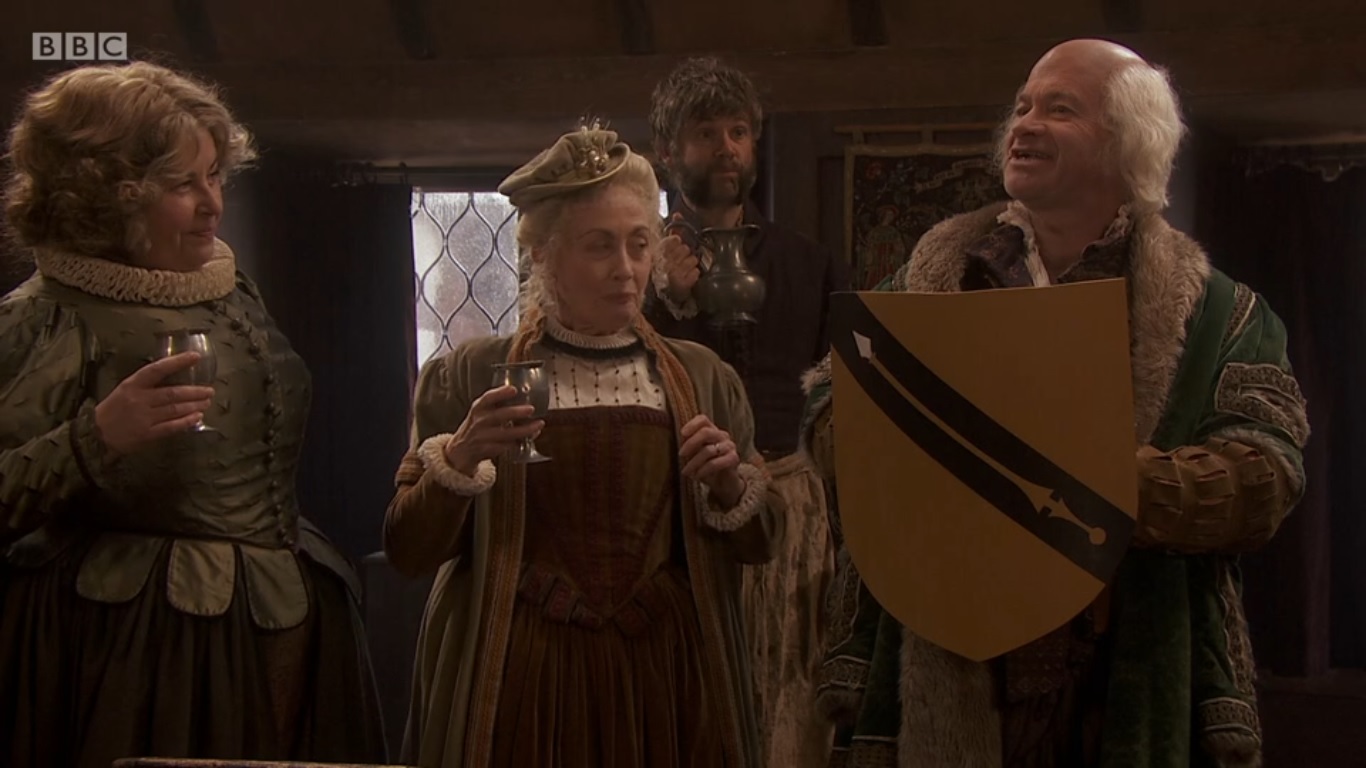
Wilbert Awdry, so far is I know, was not armigerous. As a belated part of The Railway Series‘s anniversary celebrations, I have toyed with the medieval practice of heraldic attribution.

Escutcheon: Azure two sections of railroad track between four steam whistles Or.

Crest: Issuant from a funnel Sable a cloud of smoke Argent.

Motto: I Can And I Will.

Badge: A wheel Azure surmounted by a bar Gules thereon a goat statant Argent horned Or hooved Sable holding in its mouth a top hat of the last.

A crest is included for the sake of completeness, though Awdry as a priest might have used a galero-type hat instead. Also in place is the medal of an Officer of the Order of the British Empire, to which he was appointed in 1995. The motto is based on James’s refrain when hauling a troublesome goods train up Gordon’s hill. The more familiar “Really Useful” did not quite feel appropriate for a personal motto. The badge is, of course, a parody of the “cycling lion” once used by British Rail.

I had originally hoped to include more references to Awdry’s ecclesiastical career, perhaps by taking charges from the arms of parishes he served, but what little heraldic material I could find didn’t really seem to fit. By happy coincidence I discovered afterwards that the real-life municipal crest of Barrow-in-Furness includes a ram’s head with golden horns, though of course its mouth is empty. For those wondering how to tell the difference between the two caprines, a goat’s horns tend to be short and straight while a ram’s tend to curl back.

Since the previous post compared Awdry’s world to that of J. R. R. Tolkien, it is worth taking a brief look at him here, too. While Tolkien designed a lot of heraldic devices for the cultures of Middle Earth, his own armigerous status is uncertain. This article is the only one I can find going into detail.

FURTHER READING

http://www.northernvicar.co.uk/2018/10/26/upwell-norfolk-st-peter/

UPDATES

July 2020

The franchise itself, both in print and on television, features a smattering of characters who would grace the pages of Burke and Debrett. Among them is Robert Norramby, Earl of Sodor, manager of Ulfstead Castle. The man himself is an invention of the television series – introduced in the 2013 special King of the Railway – but his family and their seat were established in The Island of Sodor: Its People, History and Railways in 1987.

sodor_achievementThe Earl’s coat of arms is seen a few times on parts of his home, as well as on the cab of his private engine Millie.

My best guess for the blazon of the shield would be Azure a pale Argent over all issuant from the base a representation of the guard house of Ulfstead Castle Proper atop each of the two turrets a flagstaff erect flying therefrom to the sinister a pennant Or. The supporters are much easier – on either side a lion rampant Or. The absence of a crest or motto is intriguing, as is the use of what resembles a colourfully-jewelled Eastern crown instead of the standard coronet of an Earl.

The Duke of Boxford often sports a vaugely-heraldic image on the left breast of his suit jacket, though the detail is too poor for me to blazon it properly. Curiously the Hatt baronets themselves are never indicated to be armigerous.


February 2021
In wandering around the wider WordPress community I have found two blog posts discussing Awdry’s clerical career. St Edmund’s Church in Emneth, Norfolk has a stained glass window dedicated to him. Instead of a coat of arms (and on a feminine lozenge instead of a shield) is an image of Thomas in steam. Elsworth church in Cambridgeshire (the inspiration for the fictional Wellsworth) has Thomas embroidered into the stole, where heraldic emblems have occasionally appeared.

August 2021
Rev Wilbert Awdry (Elsworth Stole)
Series 13 episode 1 of Great Canal Journeys has Gyles Brandreth and Sheila Hancock visiting Emneth and meeting Veronica Awdry. It’s a nice piece, although some of the images shown on screen don’t quite match the dialogue.

September 2021

This Unlucky Tug video on Skarloey sang the praises of Luke Ryan of the Talyllyn Railway, saying “he pretty often posts interesting facts and tidbits from Awdry’s notes none of us knew before”, and shown on screen at that point is a quartet of heraldic sketches for places on the Island of Sodor, accompanied by written blazons. I have not yet found the particular video in which those were featured, but hopefully you can.

October 2021

Another plaque has been placed on the wall of St Nicholas’s Church in Kings Norton.

June 2023

Max Davies (aka Terrier55Stepney), has made a video about another stained-glass window in the parish church of Rodborough, Gloucestershire.

Rails Go Ever Ever On

Illustration of “Edward’s Day Out” by William Middleton

The Reverend Wilbert Vere Awdry’s The Three Railway Engines, first instalment in what would become the world famous Railway Series, was originally published seventy-five years before today. After his death, the franchise he created was carried on by his son Christopher. That can, of course, be said of another great English writer, though sadly his Christopher’s own demise came earlier this year. Present circumstances impede me from coming up with a more comprehensive tribute, but perhaps this could be the basis for a joint effort between Clamavi de Profundis and The Tuggster Intensifies one day:

Rails go ever ever on,
Over rock and under tree.
By tunnels where no sun has shone,
Canals that never find the sea;
Ploughed through snow by winter sown,
And past the merry flowers of June,
Over sleepers lain on stone,
And viaducts o’er valleys hewn.

Rails go ever ever on,
Under cloud and under star.
Yet wheels that thundering have gone
Roll at last to home afar.
Eyes that fire and smoke have seen,
And horror in the smelter’s place
Look at last on buffer clean,
In cosy sheds they longed to face.

The track goes ever on and on
Down from the door where it began.
Now far ahead the line has gone,
And I must follow, if I can,
Pursuing it with weary wheels,
Until it joins some larger way,
Where many points and switches meet.
And whither then? I cannot say.

The track goes ever on and on
Out from the yard where it began.
Now far ahead the line has gone.
Let others follow, if they can!
Let them a journey new begin.
But I at last with pistons worn
To silent sidings will crawl in,
To down for night and sleep ’till dawn.

Still ’round the next bend there may wait
A new branch or secret gate;
And though I long have roamed this isle,
I never could lose cause to smile
Upon the realm my line does span
West of Barrow, East of Mann.

Adapted from The Road Goes Ever On by J. R. R. Tolkien, circa 1937.

UPDATE (22nd October)

Search engine results show that at least one other has thought of this connection before I did – EndlessWire94 on DeviantArt.

My New Gallery

It has been a few years since I started making heraldic illustrations for Wikimedia Commons. My earliest, according to what the file page says, was that of William Pitt the Younger, uploaded on 11th September 2016. By 8th August 2017 I had made twenty-two, and decided it would be useful to collate them on a subpage. I originally formatted them as a fairly simple two-column table showing each image with a short description next to it. New images collected slowly and intermittently for a year after that, but a sudden growth spurt occured in the latter half of August 2018 when more than eighty new files were added following my discovery of Cracroft’s Peerage. As 2019 dawned I had counted two hundred and forty images in total.

Having found copies of Burke’s and Debrett’s in the university library and the internet archive I was able to expand the collection at a steady pace. In the last few months I noticed that the list had grown very long and was difficult to navigate effectively. This week, therefore, I decided to move them into a gallery format, with files sorted by type rather than by date.

It took several hours to move each individual image from the old page to the new and add the appropriate captions. The principal advantage of the new gallery format, at least for me, is that with the images sorted into neat rows instead of one long column it is now easier to count how many there are. The total presently stands at an ominous six hundred and sixty-six, though this does not include two which the community – one for the Baroness Hale of Richmond for which I couldn’t confirm a source, and a speculative placeholder for the Duchess of Sussex which was subsequently jossed.

My armorial collection is still some way off the size of Sodacan’s, of course, but it’s a start.

Need No Introductions

Are we missing something?

After an unusually long recess today was the day that Parliament finally resumed, but everything was far from back to normal.

Social distancing measures require MPs and peers to be spaced 2 metres apart, which significantly diminished the capacity of the main chambers. Plenaries can no longer be physically attended by more than a few dozen members at a time. Every other bench has been ruled out of bounds. In the Lords this is indicated by a red cloth placed over the length, while in the Commons there are slabs of cardboard bordered by hazard tape blocking access. The small white cards on the frames of the green benches, normally used by honourable members to reserve a place in advance, were replaced by either red cards with a no entry sign or green cards with a tick to indicate which spots could or could not be used. The red benches have no corresponding external frames, so instead the tick signs were attached to small pillars propped up behind. Two of the three cross benches had disappeared, as had two of the three seats for the upper house’s clerks, and both chambers had lines of tape on the floor marking standing distances.

Last month, without much fanfare, two new junior ministers were appointed to the government with a promise that they would be made life peers. One was Sir Gerry Grimstone, former chairman of Barclays Bank; the other was Stephen Greenhalgh, former Deputy Mayor of London. Today they finally had their introduction ceremonies, which fell short of what they had probably been led to expect. Black Rod still wore semi-state dress, but Garter did not wear his tabard, nor did the newcomers themselves wear the familiar robe. The supporters – existing members of the house who accompany the new one – were omitted entirely. The reading clerk began with the letters patent already in his hand rather than the inductee delivering it to him, then stepped back to give their lordships space to swear the oath and sign in – though Greenhalgh almost forgot the latter step and had to quickly double back. After bowing to the throne from behind the clerk’s table as usual, the procession exited through the content lobby, with the peer only nodding to the acting speaker on the woolsack instead of shaking hands. One cannot tell from the footage, but it can reasonably be reckoned that friends and family of the new members were not given the usual invitation to watch from the gallery, nor to attend any kind of reception afterwards.

Of course, this is still the early stage of transition. Both houses are moving to conduct much of their business virtually, so shortly it may be the case that the empty benches are filled with monitor screens, or even that the chambers are not used at all.

Arms to Yourselves

A consequence of the COVID-19 lockdown is that the great majority of schools, colleges and universities have closed as far as physical premises are concerned. This has naturally forced a major surge in online learning as institutions scramble to keep their curricula going on a remote basis.

Heraldry has doubtfully ever been considered a core subject, and indeed neither the College of Arms nor the Lyon Court are considered essential businesses. Both have closed their offices to the public. The latter has attempted to compensate, and perhaps keep children busy, by releasing a rudimentary online course in Scottish heraldry.

The content is rather basic and most hobbyists will not learn anything new from it, but it is pleasing to see that an effort has been made. As I and others have noted, the proliferation of knowledge in this subject online has been rather slow and haphazard, relying mainly on a small smattering of hobbyists who use whatever reference materials they can obtain – typically those which are out of copyright and thus septuagenarian or older. The present circumstances may finally see some progress on this front, though of course it is still much too early to tell.

Turn Right and Change the World!

Cameron 2015 Dissolution

We are turning our country around… we must see this through together.

Five years ago, the fifty-fifth Parliament of the United Kingdom dissolved, commencing the general election campaign. As usual, proclamations were read out from the steps of the Royal Exchange in London, and from the Mercat Cross in Edinburgh, but on this occasion the text was quite a bit shorter than had been the norm before. The substance of the revised version concerns only the convocation date for the newborn legislature and the issue of writs of summons to the Lords Spiritual and Temporal. The act of dissolution itself was omitted, as was any reference to writs of election.

The reason for this was, of course, the Fixed-Term Parliaments Act 2011, which curtailed the monarch’s prerogative to make and break parliaments whenever her prime minister said so. From then on, a general election would happen on the first Thursday in May of the fifth year since the previous election took place, with dissolution occurring twenty-five working days in advance. There were of course some exceptions, but they will be detailed later.

For the first time, the date of the next general election was known years in advance. Even better, the death date of the 56th Parliament was known before it was even born: the five years after 2015 included two leap days to bring the days of the week right around, so this year the general election timetable is exactly the same as last time. Some commentators lamented that the element of surprise had been lost from British politics.

That at least was the dream, now to the reality: The second Cameron ministry did not gracefully live out a full term. Nor, for that matter, did the next three governments. The fifty-sixth Parliament dissolved on 3rd May 2017, after Cameron’s successor Theresa May successfully sought a two-thirds majority in the Commons for an early election motion under Section 2 of the Act. The fifty-seventh parliament was dissolved on 6th November 2019 by a special act of its own creation, May’s own successor Boris Johnson having tried a Section 2 motion several times and failed miserably. We are now in the time of the 58th Parliament, which is currently expected to expire on 25th March 2024, though that expectation has little solidity given that the present government intends to repeal the FTPA altogether at some point.

Jeremy Corbyn, who emerged from three decades of backbench obscurity to become Leader of the Labour Party in the aftermath of the 2015 general election, is due imminently to retire again. The result of the leadership election is due to be announced on Saturday, though the large conference originally planned has had to be scaled back dramatically due to the world events which have transpired in the meantime. It strikes me that, of the six Labour MPs who originally set out to be Corbyn’s replacement, four only joined the House of Commons in 2015. Had politics gone normally they would only now be at the end of their first term, instead of well into their third.

Obviously, it may have been awkward now if those snap elections hadn’t taken place, since all elections scheduled to take place on 7th May this year have been pushed back to 6th May 2021. Presumably the general election would have had to be delayed too*, the first instance of such an action since 1944.

As noted in my posts about Paul Danahar and Terence Casey, it has become common to remark that we currently inhabit the dark timeline, or words to that effect. Neither man could decide precisely on the point of divergence. Until someone else can suggest a better point, I will choose 2015. Obviously the COVID-19 pandemic is an entirely separate issue, but the issues that most prompted the calamitous musings prior to the outbreak were the presidency of Donald Trump in the United States and the exit of the United Kingdom from the European Union. These phenomena both had their gestation five years ago. It was in May that the Conservative & Unionist Party won the general election outright with a manifesto that included an In-Out referendum, which would likely have been dropped in coalition negotiations had that parliament been hung as expected. It was in June that Donald Trump came down that escalator and announced his desire for the GOP nomination.

Life would never be the same again. Still, at least I got to rack up my edit count in the past few years.

*Section 1 of the FTPA allows the prime minister to delay polling by statutory instrument, but only for two months as opposed to the twelve now in place.

UPDATE (9th November)

Turn Left is apparently trending on Twitter. It’s not entirely clear, but I think it’s something to do with the US presidential election.

UPDATE (March 2022)

The Dissolution and Calling of Parliaments Act has received Royal Assent, restoring the prerogative to call elections upon ministerial request.

The New Regime

YouTube comment three days ago: “For once, I know exactly how this ended up in the suggested list.”

Hello, good evening and remain indoors. Today I expected to be closing out the second trilogy of Parliamentary Studies lectures with Simon Burton. That lecture has been cancelled, as has everything else.

Four days into the university’s shutdown, the situation is getting bleak. On Tuesday and Wednesday there was still a smattering of traffic on campus but today nearly all the buildings are locked and barely a soul can be seen. Today the vast majority of British children are going home sine die and now many other types of establishments – pubs, clubs, restaurants and so on – are being advised to close too.

Providing the image for this article, COVID-19 announcements have replaced Brexit votes as the nation’s top daily political fix. I mentioned on Tuesday that the pandemic has destroyed what looked like a return to political stability, but the irony extends far beyond.

For much of 2019 the foremost fear was of Britain leaving the European Union without a deal. Many on the remain side made catastrophic forecasts of borders being locked down, supply lines failing, the pound collapsing, businesses closing down and the imposition of martial law. Many leavers, by contrast, seemed to take a perverse pleasure in the prospect, talking excitedly of a reenactment of the Second World War… or at least the version they had seen in films. This year those anxieties and delights have been transposed to the coronavirus, though the political demographics of the two camps are not necessarily the same. Three months ago the emergence of a large Conservative majority caused many to predict that Boris Johnson would become an authoritarian dictator. In the last few weeks he has been criticised for not being authoritarian enough.

Rishi Sunak became an MP less than five years ago and was still unknown to most of the public until mid-February. Chris Whitty did not have a Wikipedia page until 7th July last year. So far it has been edited 154 times, of which 120 were since 1st March. Even I would not have remembered his name unprompted, though I now realise I’ve watched him several times presenting Gresham lectures. Sir Patrick Vallance does a little better, having a page since 2017, though the edit spike is similar.

Parliament has been looking emaciated this week, with both chambers showing a lot of empty space. Prime Minister’s Questions, normally a heated and passionate cacophony of noise in a room overflowing with attendees, became a subdued and timid affair as many honourable members decided to stay away. Later that afternoon the upper house adjourned during pleasure for ten minutes so that noble Lords who had come for oral questions could clear the chamber before the arrival of those who came to debate the budget, thus keeping the benches well below capacity and allowing peers to maintain social distance. Yesterday the Lord Speaker himself announced that he would be going into isolation. He intends to continue the majority of his duties remotely, though the task of presiding on the woolsack must of course be left to his deputies.


Academic Prorogation

Darn, just as the weather was getting nice!

Last night an announcement was made by our Vice-Chancellor, Professor Susan Lea, that all lectures, seminars and tutorials would be suspended with immediate effect. There will be a managed transition to having all teaching and assessment online. Faculty are also being phased into working from home. People who are over seventy years old and/or have underlying health conditions have been advised to avoid the campus. Cleaners are being sent around all student accommodation to disinfect surfaces and door-handles.

This follows a statement by the Prime Minister advising the public to minimise non-essential travel and social contact. We are still allowed to go outside for exercise, albeit with the proviso that we should keep a safe distance from other people.

Already for some weeks we have been buffeted by regular official updates about travel restrictions and general cleanliness. Several lecturers have also been preemptively redesigning their courses in case they had to do everything by correspondence. While typing out this post I was notified by two lectures and the vice-chancellor herself that end-of-semester examination timetable has been abandoned and that the final module assessments are being rewritten completely to adjust to the new circumstances.

For some, myself included, this new regime does not represent a major upheaval. Those who are accustomed more active and intimate social lives may find it difficult to adjust so suddenly to a life of solitude. I also have the benefit of being in early adulthood and without any obvious pre-existing pulmonary or respiratory weaknesses. All things considered I appear for the moment to be fairly optimally positioned in terms of surviving this pandemic without serious harm and my experience in the coming months could be quite luxurious compared to what many others will have to suffer.

Thus far the suspension of teaching activity has not been accompanied by a quarantine of the physical premises. Obviously there is no outer wall around the entire campus, but at some point it is not inconceivable that the individual buildings could be locked down. I went on a lone stroll some hours ago and could see that while overall activity was diminished the place was not entirely deserted, with some groups of students still milling about as normal. The Brynmor Jones Library is still operational, but only on a nine-to-five basis rather than all day and all night as was much advertised before. Notably the shops and restaurants are still open. I have not spent enough time in the student union bar over the years to know if it is normal for the televisions to be showing the Health & Social Care Select Committee in the House of Commons or if this is a new development.

Who could have expected Jeremy Hunt to become so popular among the youth?

Speaking of Parliament, the speakers of both houses have made their own announcements restricting access to the Palace of Westminster, after at least two MPs tested positive for SARS-CoV-2 and several others have gone into self isolation. For some weeks I had been contemplating posting an article entitled The 58th Parliament – A Return To Normalcy? concerning how, following the general election, some stability had returned to British politics after years of ever-escalating chaos. Obviously that has been jossed now. Yesterday on the way to a lecture (my last for some time, it transpires) I found myself beside Professor Norton, and reminded him of a similarly premature sentiment he had expressed on his own blog in January. I asked him if there were any plans to evacuate the House of Lords – given its high concentration of the over-70s**, and expressed surprise that the younger Commons had suffered first. His lordship explained that peers do not have MPs’ constituency duties, nor so many personal staff, which means they are not exposed in the same way and can isolate themselves more easily. He acknowledged that members of the upper house still have the problem of sharing cramped parliamentary office spaces, but said this is not necessarily a problem so long as the rooms are kept reasonably clean. He said it was likely that parliamentary committees would, like universities, be doing most of their work remotely while plenaries in the main chambers would be cut down and minimally attended. This could mean that new legislation, perhaps excluding emergency laws relating to the pandemic itself, is postponed for some time. I asked if this made a nice change from talking about Brexit all the time. He remarked that if anything he had become nostalgic for 2019.

For this blog, the most immediate consequence of the new policy is that Friday’s scheduled conclusion to the second trilogy of parliamentary outreach lectures – featuring Simon Burton, Clerk Assistant to the House of Lords – has been cancelled. I have not yet checked but it seems a safe bet that any future Inspired in Hull events will be on hold until further notice too.

* I have long suffered various skin conditions, but the main consequence is that I have always been carefully washing my hands several times a day.

**We joked that Norton himself, at 69, is still in the younger half.