Royals and Remembrance

Once Halloween and Guy Fawkes Night have passed, poppy season is all that remains to block Christmas from achieving total domination for the rest of the year. There are, of course, two separate dates for this occasion — Armistice Day (always 11th November, the exact anniversary of the end of the First World War) and Remembrance Sunday (second Sunday in November, a broader commemoration of war dead). Both of these events involve two-minute national silences… assuming, of course, that a silence actually falls. Due to the logistics and practicalities of the working week, some organisations have to hold subsidiary events outside the universal dates. Silences here can be hard to regulate if everyone around isn’t coordinated with it. I remember quite a few occasions from childhood when a reverent, contemplative peace was anything but. Even the highest are not immune to this: The Queen attended a service at Westminster Abbey last Thursday, but it was immediately outside rather than inside the main building. As you would expect from an open-air event in central London on a weekday, the “silence” was actually filled with a lot of traffic noise as well as two different emergency sirens. The only blessing was that at least there were no dogs barking. I’m actually a little surprised that this phenomenon hasn’t been the subject of a Family Guy cutaway by now, given that it would be an easy way to get two minutes of padding with minimal animation.

Another big event in November is the United Nations Climate Change Conference, now taking place in Belém, Brazil. The Prince of Wales flew down some days in advance to present his Earthshot Prize, which Sir Keir Starmer also attended, though neither stayed for COP30 itself. This is the latest in a long line of solo overseas engagements undertaken by the heir apparent since his wife’s cancer diagnosis last year*. William was back in time for the Sunday cenotaph service but he missed the Festival of Remembrance at the Royal Albert Hall on Saturday night. Prince George attended for the first time, in his father’s place. The festival includes the religious and patriotic music expected for a solemn occasion, but also a handful of modern entries. One of these was a cover of Avicii’s The Nights. I can’t work out whether it adds to or detracts from the spirit of the event to know that Avicii himself, err, left this world behind some years ago, his life clearly remembered but tragically brief, and predeceased his father. He was from Sweden, a country formally neutral in both world wars. The festival featured multiple performances from Sir Rod Stewart, who sported the unusual sartorial combination of a knight bachelor’s badge hung from an open shirt.

The cenotaph ceremony in Whitehall traditionally involves the laying of wreaths by senior royals, senior servicemen, cabinet ministers, diplomats, various officials representing the British Overseas Territories and Crown Dependencies, and leaders of the significant political parties in the House of Commons. This has always been a bugbear for Nigel Farage, because his parties have so far never met the threshold of six MPs needed to qualify. UKIP in 2015 got 12.6% of the popular vote but only one seat. Douglas Carswell, as the party’s sole representative in the Commons, was regarded for procedural purposes as an independent rather than a leader. Reform in 2024 got 14.3% of the vote and five seats. The cruel twist here is that since the election the Reform caucus has gained two members (one from defection, one from by-election) but also lost two of the originals, so that when November came they were back as they started. It should be noted that the six-member rule, introduced in 1984, has exceptions for the Northern Ireland parties to avoid the appearance of sectarian bias. It is also possible for two or more parties to coalesce for this purpose, as Plaid Cymru and the Scottish National Party have done since 2001**.

The Princess Royal was also absent from the London commemorations, having gone on a royal tour of Australia. She instead paid her respects at the ANZAC memorial in Sydney. It is a little extraordinary for two royal overseas visits to take place at the same time, especially when both of those away from the United Kingdom are counsellors of state. Recently I have been constructing a Wikipedia page listing all of Anne’s official overseas travel (similar to those which already exist for other senior royals) but it has quickly become a little overwhelming to see just how busy she is, with twenty such journeys listed in the Court Circular just for the last two years.

One ought probably to discuss heraldic matters now. In some of the photographs of Anne’s visit I can see her two crosses and a heart flying in various places. I didn’t see William or Camilla flying theirs in the outings aforementioned. Close-up shots of the wreaths laid and crosses planted also show royal symbols. The Queen’s monogram appeared on hers, complete with the Tudor crown. William’s, even now, still uses the pre-Carolean design (note the oak leaves and lack of arch on the coronet). The King’s wreath did not use his monogram, but instead the full royal achievement with BUCKINGHAM PALACE underneath. Once again it was the old-style illustration with St Edward’s crown.

Sir Lindsay Hoyle is something of a vexillophile and has taken to Tweeting whenever a new flag is flown from New Palace Yard. In 2021 he began making a point of raising the flags of the Overseas Territories. His most recent example was the flag of the British Indian Ocean Territory, allegedly celebrating its national day. I can’t find photographic evidence (including on Parliament.UK) of the flag actually flying in the yard, so I can only go on the image shown in the Tweet itself. The BIOT flag includes the Imperial crown, sometimes with a cap of maintenance and sometimes without, but always in the St Edward form. Hoyle’s picture had a Tudor crown. I cannot find this version on the territory’s website or any other source. Is it a custom make? The BIOT is currently the subject of a slow-moving but high-stakes political controversy as Starmer’s government intends to cede sovereignty of the landmasses to Mauritius. This would mean that the territory as a political entity ceases to exist, hence no point updating the flag. I notice that there was not a representative of the BIOT among all the other BOT representatives laying wreaths at the cenotaph. The flag of the BIOT has been widely used in the campaign against the handover, including by the displaced islanders themselves. The bill to ratify the handover passed the House of Commons and recently had its second reading in the Lords, but then there were reports that the government has paused its progress due to public resistance. In this context it is tempting to read Mr Speaker’s Tweet as a not-so-subtle dig at the Prime Minister.

Finally, a point about Flickr: The cenotaph ceremony and the Earthshot prize both produced plenty of government photographs which can be moved onto Wikimedia Commons. The former had two photographers: Simon Dawson for the Prime Minister’s Office and Gunter Hofer for the DCMS. After migrating both albums across I quickly realised that the time stamps given in the metadata were wrong. Dawson’s were one hour too late (probably not adjusted for daylight savings) while the DCMS ones were in some cases out by a whole year! This feels like an elementary mistake for a professional photographer. Sadly there are not likely to be many photographs of Anne’s excursion to Sydney for the reasons I explained last year.

FOOTNOTES

*The Princess of Wales appears not to have gone abroad on official business since 15 October 2023.
**The SNP alone has won at least six seats in every subsequent general election, so in practice the utility of this alliance is one-sided.

Documentary Déjà Vu

Last month was the 200th anniversary of the opening of the Stockton & Darlington railway, the world’s first public railway to use steam locomotives. There have been quite a few commemorative events for this. The BBC has taken the opportunity to rerun a collection of some of their railway-related documentaries (not that they don’t have at least a handful of these at normal times anyway), which I have been watching on iPlayer over the last week or so.

When you watch a lot of documentaries about the same topic (e.g. railways, World War 2, the royal family, past general elections), especially if created by the same company, you will quickly notice a lot of repetition in what you’re being shown: You’ll notice the same stock film clips, the same talking points in the narration, the same talking heads being interviewed, the same background music being used. To some extent this is inevitable as, of course, they are all talking about the same event. Sometimes, however, the the resemblance is so specific as to be jarring.

Among the aforementioned documentaries were Ian Hislop Goes off the Rails, a standalone production, and The Last Days of Steam, an episode from series 8 of Timeshift. Both were originally aired in October 2008, the former on 2nd and the latter on 16th. When discussing the decline of the railways and the widespread adoption of the private motorcar, both show the same clip of a youngish couple in a red Austin-Healey roadster (registration 699 DON) driving on a motorway.

In Hislop’s documentary the clip starts at 39:19, accompanied by Terry Gourish, historian at LSE, saying

Well from the mid fifties things began to change. There was no fuel rationing affecting private motoring, road transport began to get a great impetus from new road-building, culminating in the first motorway, the M1, in 1959…

whereas in Timeshift‘s, it occurs at 41;30 as Jonathan Glancey, author of John Betjeman on Trains, says

The car from the mid-1950s was, apart from anything else, and beyond a means of transport, a consumer dream. It was something you could own. You can’t own a railway. A railway takes you where the railway goes. A care takes you, theoretically, where you want to go.

That the same clip should occur at almost exactly the same time in two documentaries produced by the same broadcaster a mere fortnight apart feels like a slight failure of quality control.

Some years ago I discovered the Railway Mania podcast series. Unfortunately that series has wound down a little recently, with just one new episode in almost a year. In its place I’ve recently turned to the Green Signals show, co-presented by Richard Bowker (former Chairman of the Strategic Rail Authority) and Nigel Harris, former editor of RAIL magazine. It’s a bit like the ex-politicians’ podcasts that have proliferated over recent years (e.g. Political Currency with Osborne & Balls) but more focused on industrial news.

Moving away from real railways, commemorations of the 80th anniversary year of The Railway Series continue. Today Historic England unveiled a blue plaque at 30 Rodborough Avenue in Stroud to mark that Wilbert Awdry had long ago lived there. The ceremony was attended by a group of his descendants. I was a little disappointed that so much of the news coverage identified him as the creator of Thomas the Tank Engine rather than of The Railway Series, including some incorrectly implying that the character debuted in 1945 rather than 1946. I also see that the display included a cardboard cut-out of the All Engines Go! version of Thomas himself, even though that series has been cancelled now and was generally disliked by most of the Awdry fandom. In some of the news videos a band outside can also be heard playing the Allcroft-era theme by O’Donnell & Campbell.

I also recently discovered that Thomas & Friends itself has an official 80th anniversary podcast. This is also includes many sound clips from the TV series. Curiously, the copyright notice credits the podcast to Gullane (Thomas) Ltd, showing that this company at least nominally still exists within the Mattel empire.

The Deputy & The Duchess

The Duchess’s Heraldic Achievement

Documentaries about the stormy second premiership of Harold Wilson (1974-6) often mention his determination to take the nation by surprise after months of all his government’s secrets being leaked to a vicious press. In the end he pulled off the particularly-impressive trick of resigning on the same day that the Princess Margaret finalised her divorce from the Earl of Snowdon, and therefore knocked the latter story off the front pages. No doubt this spared the royal family a lot of grief.

Today a similar coincidence has been achieved in reverse – Angela Rayner resigned as Deputy Prime Minister, and Buckingham Palace announced the death of the Duchess of Kent. There is something a little uncanny in these events happening so close to the anniversary of Liz Truss’s accession to the premiership and Charles III’s accession to the throne. The public mourning over the deceased Queen Elizabeth obviously didn’t save the Truss government, but did at least postpone its inevitable disintegration. Neither of today’s events are quite on the scale of those but, even so, the cabinet will likely be glad of the news – and Parliament – having a different story to occupy their time.

I will deal with Rayner first. Obviously her property tax scandal is a further reputational blow for a government whose public approval ratings were already abysmal. Her departure could cause some practical issues, too. Rayner simultaneously resigned from three offices: Deputy Prime Minister of the United Kingdom, Deputy Leader of the Labour Party and Secretary of State for Housing, Communities & Local Government. The latter is the one of greatest constitutional substance, for each Secretary of State is a corporation sole defined in statute with responsibility for a government department, in this case the Ministry of Housing, Communities & Local Government. The MHCLG cannot operate effectively without its secretary of state so a successor to Rayner will need to be appointed within days and confirmed at a meeting of the Privy Council shortly afterward. The middle is of course not a government office but a party one. Deputy Leaders are elected by a postal ballot of the rank-and-file partisans in an operation that typically takes months. This will be the first time in decades that the Deputy has been replaced without the actual Leader also changing (unless Sir Keir Starmer somehow also ends up resigning imminently) and, given the unpopularity of the current government among the party’s base, it could be a major opportunity for dissident factions to attempt a strike against front bench. The internecine fighting is bound to highlight controversies and resentments on which the opposition parties can pounce. The former will be the more interesting to watch: As I have mentioned before, the Deputy Prime Minister is constitutionally little more than a courtesy title rather than a substantive office and many premiers can do without appointing one. There is no obligation for the Deputy Leader of the Labour Party to be deputy leader (whether en titre or de facto) of a Labour government – notably Harriet Harman wasn’t. Even so, the Deputy probably need to have some kind of senior government post, for as a backbencher they would be too free to criticise and challenge the incumbent. If the eventual winner of the election is not already a cabinet minister then it may necessitate another minor reshuffle. In the meantime, though the Prime Minister will need a designated survivor, he would probably be better off not appointing a new DPM, nor a First Secretary of State, as whoever landed that job would then have then have to endure the indignity of relinquishing it a few months later and, since everyone would predict this in advance, would probably struggle to accomplish much of worth during that time.

Moving on to the Duchess: Born in 1933, she was the oldest among the royal family, a status which now passes to her 89-year-old widower Edward. Her death does not create a vacancy in the Firm, as she very quietly retired from public duties a few years ago and was absent for nearly all of the big ceremonial gatherings since then.1 At the time of writing the exact date of the Duchess’s funeral has not been announced, but based on usual time lapses it should be concluded before the halfway point of this month and thus narrowly avoid clashing with either Donald Trump’s state visit to the United Kingdom or the Duke of Edinburgh’s attendance at Papua New Guinea’s semicentennial independence celebrations. Katharine was the first British royal since the Glorious Revolution to convert to Roman Catholicism, and it has been stated that her funeral will follow Catholic liturgy. That will be an innovation for the House of Windsor too, as the only thing approaching a recent precedent is the reinterment of Richard III in 2013, and even that was technically an ecumenical affair. The Duke of Kent has been steadily winding down his commitments in recent years but is still considered a senior working royal. It is yet to be seen if the death of his wife will lead to any changes in his arrangements. The Ferens Building at the University of Hull (not to be confused with Ferens Hall) has her name on its keystone and the Prime Minister’s statement this afternoon mentioned that she was “giving her time and working anonymously as a music teacher at a school in Hull”. It will be interesting to see if any of her pupils are involved in the funeral, or indeed if there will be any local ceremonies to celebrate her association.

1The latest reference I can find in the Court Circular to her attending in person, rather than being represented by someone else, is 8th June 2019. I note that the “Where is Kate?” crisis of eighteen months ago failed to notice or care that the other Katharine had been “missing” for a much longer time.

UPDATE (8pm)

In the time between drafting this article and uploading it, Sir Keir has ignored my advice and carried out a full reshuffle, appointing David Lammy as DPM and Lord Chancellor (interestingly making the same career move as Dominic Raab four years ago) and replacing Rayner at MHCLG with Steve Reed, among many other changes. No timetable or candidates have yet been confirmed for the Deputy Leadership.

On Admirals and Arundells

The Queen turned seventy-eight today. That’s not traditionally considered one of the big birthdays and so commemorations have been fairly muted. The most significant announcement was her appointment as Vice-Admiral of the United Kingdom.

The Vice-Admiral is the deputy to the Lord High Admiral, and it may be prudent to recap the outline of that office first: The Lord High Admiral is the ultimate head (originally operational, but later just ceremonial) of the Royal Navy. Appointments have been made since the late fourteenth century in the Kingdoms of England and Scotland, then later Great Britain. Occasionally in Stuart times, and almost permanently from Anne’s reign onwards, the singular office was not filled and instead the post was instead put “In Commission” – i.e. delegated to the Board of Admiralty with the First Lord of the Admiralty (a cabinet minister) as its chair. The creation of the modern Ministry of Defence in 1964 saw the Board with its First Lord dissolved and the title of Lord High Admiral resumed in the person of Queen Elizabeth II. In 2011, on his ninetieth birthday, she conferred the office upon her husband Philip. The status of the office following his death in 2021 is a little ambiguous but the general assumption is that it defaulted back to the sovereign and now resides in King Charles III. I had wondered if Vice-Admiral Sir Timothy Laurence would be appointed on his seventieth birthday this March, but this did not occur. The King perhaps intends to retain the top office for himself and have his wife as runner-up.

The Queen is both the first female and the first royal holder of the office of Vice-Admiral, whose previous recipients have all been career navy men (and indeed tended to hold the actual rank Full Admiral). Her Majesty’s most recent predecessor was the Lord Boyce, who was appointed in 2021 and died in 2022.

Below the Vice-Admiral is another deputy, the Rear-Admiral. This office is currently held by Sir Gordon General, a General in the Royal Marines who was formerly Vice-Chief of the Defence Staff and also served as Lord High Constable at the 2023 coronation.

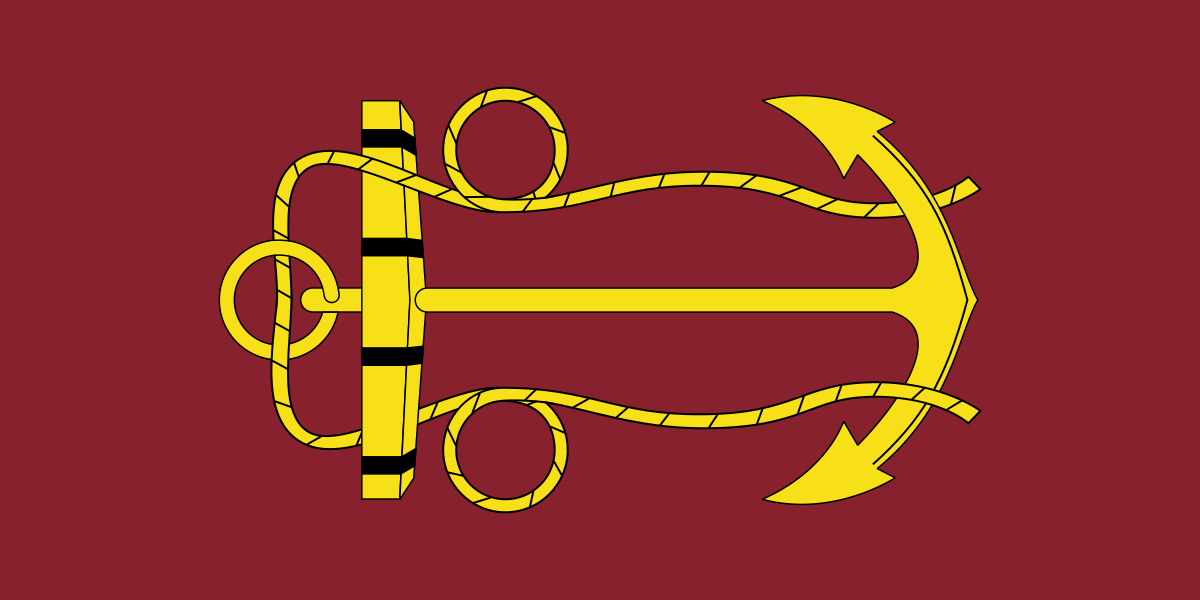
The Lord High Admiral has a flag of office – a fouled golden anchor on a crimson field. The Queen was presented with a “burgee” (pennant) with a red anchor on a white background when she visited HMNB Devonport. I just about saw Camilla’s impaled banner of arms as well.

On another note, today is also the twentieth anniversary of the death of Sir Edward Heath, Prime Minister 1970-1974. His military career was on land, though he was a noted yachtsman in later life. He stayed in the House of Commons for twenty-seven years after his premiership had ended, which is considerably longer than all his successors combined. He is the most recent Father of the House to have served more than one term, as well as the most recent to have formerly been Prime Minister.* He is also the most recent example of the Order of the Garter being conferred upon an incumbent member of the House of Commons**.

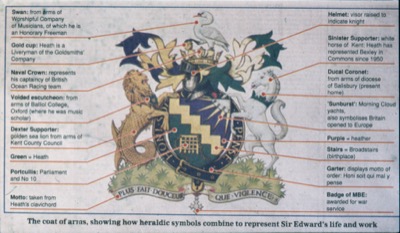
Wikimedia Commons has long had a vector graphic (by Sodacan, of course) of Sir Edward’s shield of arms, but it was only recently that I discovered, through the website of the Heraldry Society, a photograph of the heralds’ illustration of the full achievement. Heath had no offspring, so the arms as a hereditament became extinct.

This anniversary means that Arundells, his house in Salisbury, will now have been his museum for longer than he actually lived there. He bequeathed the building to his namesake charitable foundation who then opened it to the public. There was a fear in 2010 that the house would need to be sold due to high running costs, which then developed into a legal battle, but as of 2025 the estate seems to be running as normal again.

It should be noted that the spelling is Arundells with two Ls, not Arundels with one. Incidentally, it was an Earl of Arundel who is listed as England’s earliest Lord High Admiral, so everything links up I suppose!

*I’m phrasing it that way because Heath is not the most recent Prime Minister to be Father of the House – that was Callaghan.

**I hesitate to say “sitting member” because St George’s Day in 1992 fell in the interlude after the general election (9th April) but before the new Parliament actually assembled (27th April).

Another Condolence Note

Yesterday the Prime Minister and the Mayor of London attended the memorial at Hyde Park commemorating the London bombings of 7th July 2005.

As with the Auschwitz memorial earlier this year, Sir Keir left a wreath of flowers with a card attached. The card uses the old version of the government arms. I’m guessing the pile of these cards printed during the previous reign has still not been exhausted.

A mere four days earlier, the Prime Minister, Secretary of State for Health & Social Care and Chancellor of the Exchequer had visited the Sir Ludwig Guttmann Health Centre, where they spoke from a lectern clearly adorned with the new, Tudor crown, illustration.

I’m afraid I don’t have anything profound to say about the bombing attacks themselves. I had yet to ever visit London in person at the time and my main memory of that month is that of a school assembly in which our headmistress asked pupils what they’d seen on the news and a few had followed the story enough to relay it. I also remember a CBBC drama being made about the event a year later, but that’s about it.

The Railway Series at 80

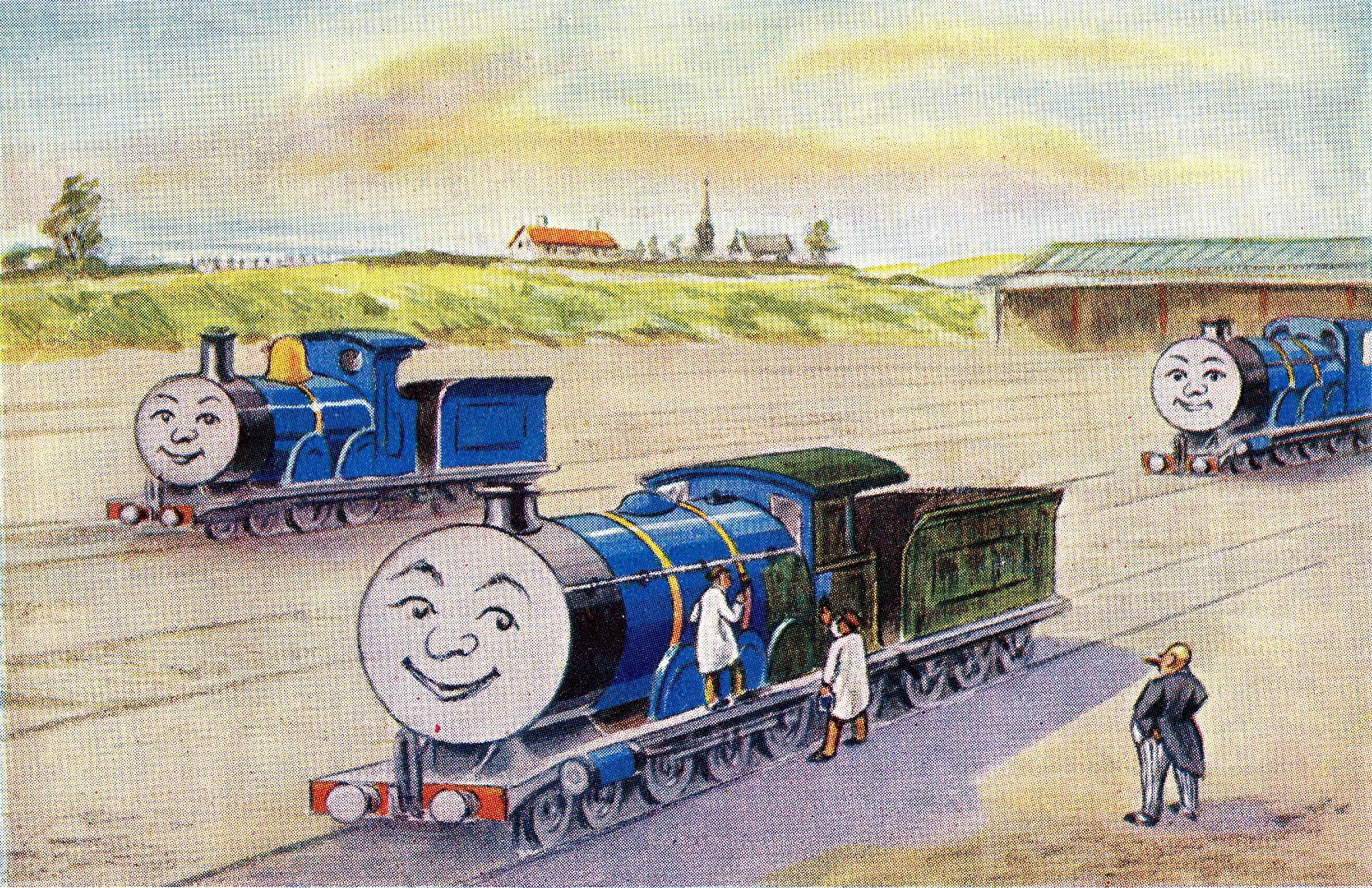
Illustration of “Edward, Gordon and Henry” by William Middleton

Five years ago, for the seventy-fifth anniversary of The Three Railway Engines I came up with a poem based on Tolkien’s work adapted to be about the engines on Sodor.

Today is the eightieth anniversary of said book. I have pondered calling it 3-E Day, but doubt that would catch on. I would like to turn to verse again. This time, instead of adapting another poem, I have thought about what an anthem for the island might be. Truth be told, I don’t think The Island Song really works diagetically – it is too obviously written to be about a children’s television series. Instead here is something simpler: A variation on the royal hymn.

While the first verse of God Save The King! is almost universal across the realms and territories of the Commonwealth, there have often been custom extra verses with lyrics specific to the locality, albeit with many of the same core concepts (and indeed rhymes) cropping up in more than one place. This is my submission for the Sudrian stanza:

Our island is to me,
Homestead and sanctuary,
By Britain’s shore.
Bless this enchanted isle,
That years may ne’er defile.
Grant all Thy children smile,
For evermore!


A Very Late Announcement

Today is St George’s Day. It was delayed in the church calendar from its usual date of 23rd April so as not to clash with Easter, though this was not well publicised in advance and in practice not widely observed. The movement also means that St George’s Day clashes with Ed Balls Day!

I was disappointed to see no new appointments to the Order of the Garter either today or last Wednesday. Currently there are four vacancies among the ordinary Knights and Ladies Companion.

I was a little surprised to see that the News page on GOV.UK included “Prime Minister Liz Truss’s statement on the death of Her Majesty Queen Elizabeth II“, given that said prime minister resigned thirty months ago. Upon inspection of the Updates section, it seems the page was originally published with only the video link, and the transcription has now very belatedly been added. Amusingly, the note doesn’t even say “transcription”, but rather “translation”. Surely, Truss’s thoughts weren’t that incomprehensible, were they?

Observations on ANZAC Commemorations

As the eightieth anniversary of VE Day in World War II approaches, it would be easy to miss that there were also commemorations for World War I still going on.

The ceremonies carried out today in honour of the Gallipoli campaign were of a notably lower key, but still quite interesting.

The Australian & New Zealand Army Corps fought at the time as part of the British Empire under George V. Today Charles III is monarch of all three realms in separate capacities.

His Majesty put out messages relating to the anniversary, which the Royal Twitter feed illustrated with photographs and flags. The letterhead uses the new illustration of the British royal arms with the New Zealand and Australian flags (both containing the Union Flag in the canton) are displayed diagonally in the top corners.

The Palace also Tweeted links to separate messages for Australian and New Zealand veterans, but there is clearly a mistake in the Tweet as the New Zealand link is given twice. Luckily the Australian message is easily findable from that page on the website.

The Princess Royal, President of the Commonwealth War Graves Commission, attended services in Turkey (where the Gallipoli campaign actually took place). While there it appears she left a note from her brother attached to a wreath. The card still uses the old illustration of the arms. I didn’t see the princess’s own banner flying anywhere. The Master of Ceremonies introduced her as “senior member of the British royal family” alongside Sam Mostyn as Governor General of Australia, Christopher Luxon as Prime Minister of New Zealand and Ömer Toroman as Governor of Çanakkale Province. He then moved onto introducing the senior representatives of each country’s armed forces, including First Sea Lord Sir Ben Key. That Britain had a specific national representative among the latter group but not the former implies by default that Anne must be representing the United Kingdom in particular**. When it came to the laying of the wreaths, Toroman went first representing the host nation, then Anne lay hers “on behalf of the British royal family” while Mostyn and Luxon lay theirs “on behalf of the government and people” of their respective countries. Wreaths for Austria, Canada, France, Germany, Hungary, India, Ireland, South Africa and the United Kingdom were laid by their various diplomatic and military representatives, Britain’s being Ambassador Jill Morris. The order of precedence is interesting – most of the countries listed are simply in English alphabetical order***, but it is interesting that “the British royal family” as an institution got to be in the special group higher up the chain while the United Kingdom itself did not. The Australian Broadcasting Corporation has been livestreaming the Gallipoli Dawn Service (and many others) for the past several years and the YouTube videos are still up, allowing one to compare the small variations in the ceremony over time. It doesn’t appear that Britain normally has any representative, royal or otherwise, among the first section of attendees, and indeed the Australian and New Zealand representatives are usually a bit lower-ranking than the ones who attended this time.

The Duchess of Edinburgh was the principal royal representative for services in London – both at Hyde Park and at Westminster Abbey. Getty has a photograph of the order of service for the Hyde Park event. It is a less-than-impressive affair, the title being typed in bold, block capitals Calibri font (the default now on Microsoft Office) and the illustrations of the royal arms of Australia and New Zealand, the latter (still using St Edward’s Crown) clearly being taken from Wikimedia Commons. The order of service for the Abbey event uses the same illustrations.

ITN’s Royal Family Channel on YouTube has, as usual, provided a great deal of raw feed. I particularly enjoyed the wobbly footage of the camera operator navigating behind the Abbey’s arches.

In the stream for the Hyde Park service we can see at 5:42 that one of the wreaths has two cards on it bearing the conjugal arms of the Duke & Duchess – two separate shields slightly angled beneath a single princely coronet.

These events also bring up an interesting conundrum about the use of national anthems in the Commonwealth Realms – at the 12:08 mark in the same video, it is announced that “…an Australian soprano*, a music educator based here in London. This morning she will sing the national anthems of the United Kingdom and Australia. I’m also delighted to welcome Lance Corporal Bryony Williams of the New Zealand Army to sing the national anthem of New Zealand.”

The British anthem used here is God Save The King!, the Australian Advance Australia Fair! and the New Zealand God Defend New Zealand! sung in both Maori and English. Trouble is, New Zealand officially has two national anthems, the other being… God Save The King! That same song is also officially the royal anthem of Australia. For the hymn to be used to represent one realm against another feels a little diplomatically questionable. Perhaps it would be better in these kinds of circumstances to use the royal anthem to represent all realms together and/or use an alternative patriotic song to represent Britain in particular – probably the best choice would be Rule, Britannia! The abbey service has the British anthem at the beginning then the other two at the end. The service also includes a prayer “for His Majesty The King; for the Governors
General of Australia and New Zealand, and for all who govern the nations of the world”.

A minor point to note here is that New Zealand’s High Commissioner to the United Kingdom, Phil Goff, was dismissed last month after making critical comments about Donald Trump. A permanent successor has yet to be appointed so Chris Seed, a retired diplomat, is currently filling in.

The ceremony at the Whitehall cenotaph was attended by David Lammy and therefore produced a dozen photographs on the FCDO Flickr feed which are able to be uploaded to Wikimedia Commons. Sir Lindsay Hoyle also features prominently in these.

*Unfortunately the editing of the video cuts off the soprano’s name.

**Whether the multinational nature of the monarchy extends beyond the sovereign himself to the rest of the royal family is a long-running philosophical conundrum among Wikipedians and others.

***Ironically this tends to mean that the birthplace of said language comes at or near the end. I won’t rehash the tired joke about searching for Britain, Great Britain or United Kingdom on drop-down menus, but I will note this article by Michael Reiners for The Critic which was published coincidentally on the same day.

Canada, Carney and Commonwealth

Sixty-two days after Trudeau announced his intention to step down, the leadership contest for the Liberal Party of Canada concluded last night. The winner, to the surprise of almost nobody, was former bank governor Mark Carney. He garnered 85.9% of the vote, albeit on only a 37% turnout, which really shows how uninspiring the other candidates must have been.

Carney’s Wikipedia page is already describing him as “Prime Minister Designate”, though the exact date at which the Governor General will formally appoint him to that office has not yet been decided. Canada tends to do governmental transitions at a rather slower pace than Britain does, with the time between leadership elections (or indeed general elections) and ministerial appointments often being measured in weeks rather than hours, but most indications are that this one will take place unusually quickly.

That the leadership election should eschew two experienced cabinet veterans in favour of someone who isn’t even an MP is a little surprising. In the Canadian constitution, as in the British, it is not illegal for a non-Parliamentarian to be appointed to a ministerial office, but it is considered improper and, above all, politically impractical. The nearest British precedent for Carney’s situation, and even then it is a very poor one, would be the much-discussed case of Sir Alec Douglas-Home disclaiming his peerages to jump back to the Commons in 1963. A more thorough comparison of these two situations may be worth a separate article.

Accession to the premiership will, of course, give Carney the right to constitutionally advise the King of Canada, including advising him to speak on Canadian matters.

For the moment, Charles continues in a state of political limbo. Following a long-established royal tradition, he must express himself in a cryptic, plausibly-deniable way, often through subtle sartorial cues.

Today is Commonwealth Day, which includes a service at Westminster Abbey and the publication of a message by His Majesty. As the position of Head of the Commonwealth has no formal powers at all, it is not subject to “advice” from the secretariat in the way that ministers advise their monarchs, and thus this is a rare opportunity for Charles to speak his own mind. Of course, the message is meant to broadly encompass all fifty-six-and-counting members of the organisation, so is still a poor venue for a determined diatribe about any particular one of them, so any comment about the defence of Canadian sovereignty must again be inferred rather than stated outright.

Sir Keir Starmer has been similarly cautious, Tweeting about “further deepening the UK-Canada relationship together” but not saying anything specific about what that would entail. It was also announced two days ago that the Department of National Defence had commissioned a fleet of new destroyers based on a British design, but this is likely unrelated to the state of relations with the White House.

Returning to more familiar territory, I notice that where the Commonwealth Day message has been quoted in photographic form, the coat of arms in the letterhead is now the new Timothy Noad illustration with the Tudor crown. Said illustration has also now replaced the earlier versions on the royal website as well. As I noted to Sodacan, the change was done at some point in the morning of Wednesday 5th March.

During the abbey service itself, I distinctly noticed Their Majesties sitting behind ornate wooden faldstools with what looked like the old-style royal arms of Canada on them. This is not in itself the cryptic clue that it might seem – they were donated by the Canada Club in 1949.

The most surprising recent development in the past few days has been the launch of another royal podcast. Whereas Camilla has been patronising The Queen’s Reading Room (of which a podcast is but one part) for some years, Charles has only just announced The King’s Music Room (probably named that way for congruence with his wife’s project), but it has already generated a lot more headlines. The format is very different from the Reading Room, being very explicitly the product of a partnership with Apple and only available to their subscribers, among which I am not.