Ahead of Yourself

https://upload.wikimedia.org/wikipedia/commons/thumb/0/03/George_Hayter_-_The_Marriage_of_Queen_Victoria%2C_10_February_1840_-_WGA11229.jpg/640px-George_Hayter_-_The_Marriage_of_Queen_Victoria%2C_10_February_1840_-_WGA11229.jpg

To the extent that most people have heard of heraldry at all, they conceive it as the study and management of coats of arms. Certainly that is what the majority of my posts on the topic have discussed. That is not a herald’s only concern, however, for armory tends to intersect with other interests. Genealogy, vexillology and phaleristics are the obvious ones, but also within orbit are matters of ceremony and protocol, which often centre heavily on precedence.

Orders of precedence determine the seating plans of formal dinners and the sequencing of parades or processions. Certain institutions whether public or private may have their own specific orders of precedence, and even unaffiliated civilians may be required to adopt them for their extended families at weddings and funerals. What tends to concern heralds and heraldists, though, is the general order of precedence for an entire country.

The order of precedence for England & Wales (though that distinction is a recent one) can be documented descriptively as early as 1399, but the earliest extant prescriptions are the House of Lords Precedence Act 1539 and an ordinance issued by commissioners of the office of Earl Marshal in 1595 (itself based largely on the Lord Chamberlain’s order from 1520). It arranges the royal family and the grades of the aristocracy (peers, knights, esquires, gentlemen and their offspring) as well as the holders of important government, judicial and ecclesiastical offices. The sequence reflects the relative importance of certain jobs in Tudor times and earlier, which is often rather different to the level of power they exercise today. The Lord President of the Council and the Lord Keeper of the Privy Seal – now sinecures given to the leaders of the houses of Parliament – rank just below the royal family while the secretaries of state who make up the bulk of the cabinet rank just below barons and the Chancellor of the Exchequer has a redundant setting below the privy council.

The bulk of the scale has remained intact to the present day – and been repeated at the start of each edition of Burke’s and Debrett’s, though royal warrants have been issued on occasion to make small updates, such as the insertion of new orders of chivalry or of offices not formerly recognised.

The Lord High Treasurer was once a great officer of state*, but when it was put into commission the commissioners had no precedence, even after it became convention for the First Lord of the Treasury to be the de facto head of government. Victoria’s prime ministers would frequently walk into formal gatherings behind barons of their own nomination. The job of Prime Minister was at last given formal recognition by a warrant in December 1905 placing him in the position his grandfather office would have conferred. The Speaker of the House of Commons ranked rather low until a warrant in 1919 put him just after the Lord President. Other offices have fallen away over time, such as the Vice-Regent in Spirituals, the Lord High Steward and the Lord High Constable.

As with so many such matters, the situation in Scotland is less well documented. The earliest extant prescription is Edward VII’s royal warrant from February 1905. Indeed, that may be the earliest ever such instrument, for the preamble admits “a Scale of Precedence in Scotland has not been defined with due authority” and “doubts and a diversity of practice have arisen in consequence”. The order within the royal family is much the same as for England, with the exception that the Lord High Commissioner to the General Assembly of the Church of Scotland during the sitting of the General Assembly outranks everyone except the sovereign – including the Duke of Rothesay. The office is currently held by Prince William, who thus temporarily precedes his own father. Following the nephews of the sovereign – cousins are mysteriously omitted – there is a complicated insertion explaining that the Lord Lieutenants, Lord Provosts and Sheriffs Principal rank above the Lord Chancellor within their own jurisdictions. Following the Lord Chancellor the other Scottish high officers are listed, then the ranks of the peerage and orders of chivalry in a manner near-identical to the English version. The Church of Scotland is rather different in status and structure to the Church of England so there are no bishops listed for the Scottish scale. Senators of the College of Justice are ranked similarly to High Court judges and Lords Justices of Appeal, though other senior Scottish judicial figures are ranked above the viscounts whereas their English counterparts are below barons. I note that the position for Secretaries of State is not defined in the Scottish scale either.

Small amendments have been made to the scale in subsequent years – most prominently in 1999 to clarify the positions of office-holders in the devolved administration. Even so, there are some glaring omissions:

A series of constitutional reforms in the latter noughties saw the duties of the Lord Chancellor carved up: His administrative role in the English & Welsh judiciary was devolved to the Lord Chief Justice, his executive powers to the Secretary of State and his presidency of the upper house of Parliament to the elected Lord Speaker. Plans to abolish the chancery altogether were dropped and the incumbent’s ceremonial precedence was not pushed down, but it was deemed necessary for the others to be raised up. The Lord Speaker was given precedence immediately after the Speaker of the House of Commons. It is curious that the upper house was not given ceremonial priority here, though that could be in recognition of the superior vintage of the latter office as well as the greater degree of power he has within his institution. The Lord Chief Justice had previously been placed below the Chancellor of the Duchy of Lancaster, similarly redundant as all holders in nearly three centuries had been privy councillors and/or peers. A warrant in 2007 promoted him to just below the Lord Speaker, as well as moving the Master of the Rolls (still usually commoners) to just below the barons.

The Lords of Appeal in Ordinary previously ranked solely by their necessary peerages. Upon their reconstitution as a separate Supreme Court, the justices (who from then on would not be ennobled) were placed immediately below the Master of the Rolls, while the President was placed immediately below the Lord Speaker – and thus above the Lord Chief Justice. A difficulty arises here because the Supreme Court is a UK-wide institution while the Master of the Rolls only exists in England & Wales. The precedence of non-baronial Supreme Court justices in Scotland is thus undefined – though all at least are members of the Privy Council. The President also has this problem, although it may be masked by the complexity of the incremental insertions – Scotland had its own privy council prior to the Acts of Union, with its own Lord President whose responsibilities and status were comparable to those of his English counterpart. Logically the Lord President for Great Britain (and later the United Kingdom) would continue to have the same precedence as his provincial predecessors, but the Scottish scale from 1905 makes no reference to the post. This in turn means that the Speaker of the House of Commons, the Lord Speaker and the President of the Supreme Court are all without a defined rank in Scotland. Even the Prime Minister is left without a place, since the Archbishop of York is England-only**. It is no wonder that the Scottish scale was described by one contributor in 2011 as “a bit of a mess” and by another as “complete horlicks”.

Northern Ireland is an even worse story – there is no scale properly defined, and the Wikipedia article uses an unofficial, descriptive list from Burke’s 106th edition in 1999, which tellingly says “as in England” rather frequently.

A common feature of all three is that men and women are listed separately***. The bishoprics and various public offices are exclusively listed in the male scale. There were insertions into the women’s for dames of various orders of chivalry (outranking wives of knights of the same), but subsequent warrants regarding ministers and judges do not bother to specify which list they are altering. A convention has developed among Wikipedians (and probably everyone else who has to mind these matters) that any office held by a woman is temporarily transposed to the female scale, but without authoritative guidance we cannot be certain.

Another curiosity is that the general scale is formally headed by “The Sovereign” while the ladies’ scale is headed by “The Queen”, such that a queen regnant is technically first man as well as first woman, and while a king’s wife is a queen consort a queen’s husband is nothing at all until a special warrant is issued for his benefit. While we’re on the subject of the royal family, our attention should turn to the four – soon five – grandchildren of the Prince of Wales.

It is unusual for an heir apparent to be a grandfather before his accession to the throne. George IV (as regent) almost managed it in 1817 when his daughter Princess Charlotte of Wales was pregnant but she and the baby predeceased him. Edward VII had quite a few – Lady Alexandra Duff (later Duchess of Fife) in 1891, Lady Maud Duff (later Countess of Southesk) in 1893, Prince Edward of York (later Edward VIII) in 1894, Prince Albert of York (later George VI) in 1985, Princess Mary of York (later Princess Royal), Prince Henry of York (later Duke of Gloucester) in 1900. The first two were through a daughter so don’t really count for these purposes and the latter four were still small children when Victoria died, which means it was never necessary to define their place at state functions, though their titles and styles were subject to some dispute. Prince George of Cambridge is now older than Edward VIII was at his great-grandmother’s death and could be into adulthood – or at least adolescence – by the time of the next demise of the crown. Without any specific place for them within the royal family section, Wikipedians have determined that George and his cousin Archie rank as eldest sons of dukes of the blood royal. This status is below the non-royal dukes, who in turn are below the great officers already described****. Charlotte, as the daughter of a royal duke, similarly ranks below the duchesses. This makes sense if you consider royal dukes to be an unofficial sixth extra rank of the peerage above the normal dukes. By extension one would expect Prince Louis, as younger son of a royal duke, to rank immediately below the eldest sons of normal dukes who in turn are just below the marquesses. Instead his place is just below the earls but above the eldest sons of marquesses. This placement is rather confusing as it breaks the otherwise-consistent pattern by which children of peers are stationed. I don’t think there were any royal dukes in England with children of their own in 1520 and there certainly weren’t any in 1595, so the logic behind the original decision eludes me.

EXTERNAL LINKS

*The great officers of state (Lord High whatever) in ancient times are not to be confused with the great offices of state (Prime Minister, Chancellor of the Exchequer, Home Secretary, Foreign Secretary).

**Whether any of the Church of England’s officials should have precedence in Wales is questionable after 1920.

***Bizarrely, in the Scottish warrant from 1905 these were called “The Scale of General Precedence” and “The Scale of Precedence for Ladies”. The ladies are therefore special, one logically presumes.

****One must wonder if the current Lord President of the Council has ever sought a bow from the prince – only to follow protocol, of course.

Something Flagged Up

Regular readers know by now that I am a keen heraldist and am always on the lookout for new – hopefully free – material on the subject. Indeed, I am rapidly closing in on my nine hundredth armorial illustration for Wikimedia Commons. I have not written so much about vexillology, although of course the topics frequently intersect. Earlier this week I was trawling through EventBrite to see if there were any more events coming up soon by the Heraldry Society and instead found an advertisement for the fiftieth birthday of the Flag Institute.

After the standard Zoom introduction by Chairman John Hall, President Malcolm Farrow lectured on the development of the institute itself and of British flag culture more generally over the past fifty years. “The flag institute is instrumental in slowly changing the culture of Britain from a nation which rarely flew flags, to one in which flying flags is becoming the law.” An overview was given of how local and regional flags have proliferated over the past two decades, having rarely if ever seen use before.

Andrew Rosindell MP gave a speech about his efforts to change public attitudes surrounding flags, in particular his campaign – including a personal conversation with The Queen – to have the Union Flag flown over the Victoria Tower throughout the year instead of only when Parliament was sitting. He also mentioned the recent erection of three new flagpoles in New Palace Yard.

There was also a lengthy preview of the documentary Look Away, Look Away by Patrick O’Connor about last year’s change of state flag by Mississippi. Unfortunately the video feed cut out midway through and had to be restarted after some awkward fumbling.

Later a guest asked if the “All-party” Parliamentary Group on Flags & Heraldry could really be called that when six of the ten officers were Conservatives with Labour, SNP, DUP and Crossbench contributing just one each. Rosindell reassured as that there were plenty more within the rank-and-file, but sadly it was hard to make out his words as his audio feed was suddenly plagued by feedback noise. I think he said that anything so traditionalist in nature was bound to disproportionately attract those of a conservative outlook but that there were still plenty of others who recognised the importance of flags and/or held a deep patriotism.

Here it would be prudent to make a distinction between heraldry and vexillology: A coat of arms, even when displayed on a flag, must represent a person. That could be a natural person (Betty Boothroyd, Johnny Hon, Desmond Wilcox) or a legal one (The Association of British Neurologists, Guy’s Hospital, Totnes Town Council). Flags cover a much broader remit, and can represent such abstracts as religions, ethnicities, and political ideals. Another important difference is that arms are only properly borne by their owners (though heralds can wear their masters’ arms and badges can be worn by servants or soldiers) whereas flags unless specifically restricted can be flown by anyone. It is only natural that use of flags is much more prevalent than that of arms, and also that any particular flag is a lot more likely to cause a stir than any particular escutcheon.

There is a prevalent line of thought which deems too overt an invocation of British patriotism to be distasteful and thus, in itself, anti-British. Another related line says that nations more generally are not a meaningful affiliation and that flags – along with their natural companion, anthems – are a distraction for feeble minds. Attitudes toward our national insignia are quite sharply polarised by partisan affiliation and by demographic divides. HM Government has been conspicuously campaigning over recent months for greater use of the Union Flag in both public and private, resulting in praise from some quarters and mockery from others.

It doesn’t look as if there will be any more from the Flag Institute for some time, but the Heraldry Society will be back on 14th May with Crosses and Crossings – Huguenot Heraldry. That the banner heading shows a star looking to be by Sodacan and a coat of arms by Rs-nourse is intriguing by itself.

EXTERNAL LINKS

The Badge of The Magpie

HMS Magpie, circa 1944.

I am always on the lookout for heraldry-related literature, especially if it can be read online for free. Yesterday I discovered that the county of Somerset and the former county of Middlesex have – or at least had – their own heraldry societies, and each publishes on its website a large back-catalogue of society journals – the Somerset Dragon and the Seaxe respectively.

The Seaxe‘s 34th edition (from September 2000), contains an article about the heraldic badges used by HMS Magpie, which the late Duke of Edinburgh once captained.

HMS Magpie and her Badges by Roland Symons

It has become the fashion recently for Royal Naval badges to be redrawn or even completely changed. Some have been altered for aesthetic reasons, some to reflect in status and some because the original design is now considered ‘politically incorrect’! The badge of HMS Forward for example originally consisted of a hunting cap and horn but, being the Royal Naval Reserve Establishment in Birmingham, it now carries the crest of the City of Birmingham. This may be current fashion but one change of badge design came as a result of a schoolboy’s initiative in 1952. There have been seven Magpies in the Royal Navy. The first was a re-named prize – a four-gun schooner captured at Perros in 1807. The last was a sloop of the Black Swan Class, launched in 1943. She saw active service in the Atlantic, the Arctic and off Normandy whilst in 1944 she formed part of Captain F J Walker’s Second Support Group and, along with HMS Starling, HMS Kite and HMS Wild Goose, helped in the sinking of U238 and U592 in that year. In January 1943 had been granted a badge consisting of a magpie volant proper. In September 1952 a pupil from Monkton Combe Junior School, in Bath, saw HMS Magpie at Gibraltar. The badge of the School happened to be a magpie and this appeared on the cover of the School’s magazine. And so, armed with a copy of the magazine, young Michael Swift boarded the Magpie! This contact led to links being forged between the School and the ship. The captain of the Magpie, Commander Graham Lumsden DSC, was rather taken by the design of the magpie used by the School and which had been designed by the art mistress, Miss Bulmer. He enlisted the support of a previous captain of HMS Magpie, HRH Prince Philip, in an effort to get the ship’s badge changed and in January 1953 a letter arrived at Monkton Combe Junior School stating that His Royal Highness feels that your magpie is nicer than the present ship’s badge and he has asked me to write to the Admiralty to suggest that it might be substituted for the one in existence. In May 1953 this was achieved and a new badge and a new badge was granted; this could be blazoned as white within an annulet black a magpie statant rousant proper.

Apart from the bird being turned around to face the right way, the badge was that of Monkton Combe Junior School. Sir Arthur Cochrane, however, surrounded the badge with a black annulet. An annulet is symbolic of unity and friendship, here officially linking school and ship, but it may also be derived from the ‘magpie’ found on a shooting target. Sadly, in 1956, HMS Magpie went into reserve and then to the breakers’ yard in 1959. One of Magpie’s final appearances was to ‘act’ the part of HMS Amethyst in the film The Yangste Incident – and when Amethyst moves in that film, it is in reality Magpie! As a token of her friendship with Monkton Combe Junior, the School was presented with with the ship’s bell and Division Trophies -the former is still used for the christening of children of staff members! In 1970 another chapter in the story was written when the Magpie’s badge made an appearance in the South Atlantic, this time on a postage stamp – the ascension 2s.6d. issue, being one of a series featuring Royal Naval badges. In 1988 Monkton Combe applied for a Grant of Arms and to accompany it, the Junior School asked for its badge to be registered on the same Grant. There was a moment of worry – could the School retrieve its magpie from the Royal Navy? Thanks to the efforts of Hubert Chesshyre a design was produced which satisfied all concerned. It is blazoned within an annulet embellished in chief with a fleur-de-lys Azure a magpie proper. Somewhere amid the cast-off clothing of the Prince of Wales and the Princess Royal there are two rather small sweaters featuring the new badge of their father’s old command. They were given by the School as presents in 1953! and, of course, there was the Warship Class diesel locomotive named Magpie but that is a story for the Editor to tell !

***

The Editors Tale is unfortunately all too quickly told. When the Railway Modernisation Plan of 1955 got under way the Western Region of British Railways (the old Great Western Railway) surprisingly obtained authority to pursue the development of diesel traction, based on a German technology, which was completely different from that authorised for the rest the country. As part of this development several hundred highly individual locomotives were built between between 1958 and 1963, including a batch of 71 intended for hauling express trains between London Bristol and the West of England. The WR in a characteristic gesture of defiance to the dictates then coming down from the British Railways Board gave these engines names commemorating well-known warships primarily of the World War II period. No.829 which was built at Swindon and entered service in 1960 was Magpie, the name being carried on impressive aluminium plates on either side of the locomotive. Many of these engines were also adorned with beautiful cast plaques bearing the appropriate ship’s badge but in the case of Magpie this was regrettably not to be. The arrival of the new 2,200 hp diesel-hydraulic locomotive was reported in the Monkton Combe School Magazine at the time and the School’s Railway Correspondent commented: These diesels will go on running for forty or even fifty years yet, so let’s hope that the then headmaster will acquire the name-plate or any other part of value to go with the bell of its fellow Warship! His prophecy was unfortunately to prove highly inaccurate, the bitter internal politics of British Rail eventually leading to the damning of the “Warships” on the grounds of high maintenance costs and they rapidly disappeared from the scene. Magpie fell victim to the cutter’s torch in 1972, being then just under twelve years old. The nameplates almost certainly still exist, such items nowadays commanding very high prices – but regrettably one did not find its way to Monkton Combe.

It is fascinating to have uncovered this story so soon after publishing my grandmother’s memoir relating to the ship. Unfortunately I have not found any articles about the Pelican‘s badges just yet.

FURTHER READING


The Late Duke

His Royal Highness Prince Philip of Greece & Denmark was born on 10th June 1921. He was the only son of His Royal Highness Prince Andrew of Greece & Denmark, who in turn was a younger son of His Majesty King George I of the Hellenes. Through his agnatic line he was a member of the House of Schleswig-Holstein-Sonderburg-Glücksburg, while his mother Princess Alice was from the House of Battenberg. Queen Victoria was his enatic great-great grandmother.

Philip’s titles have an interesting history, in that he was born a prince of Greece and of Denmark but later renounced these titles to obtain British citizenship. This move later turned out to be unnecessary as the Sophia Naturalization Act 1705 meant he had British citizenship already. He adopted the surname Mountbatten, which was used by his maternal uncle Louis (later Earl Mountbatten of Burma) and represented an Anglicised version of Battenberg. The subsequent controversy over whether his descendants should be the House of Windsor or Mountbatten-Windsor is a little ironic given that Philip himself was already effectively going by his mother’s maiden name rather than his father’s.

The marriage certificate says Philip Mountbatten.

New titles were bestowed rapidly in advance of his wedding: On 19th November George VI appointed him a Royal Knight of the Garter (one day after The Princess Elizabeth, to maintain her seniority) and granted him the style of Royal Highness (on British authority this time), then on 20th raised him to the peerage of the United Kingdom as Duke of Edinburgh, Earl of Merioneth and Baron Greenwich – all of which now belong to his eldest son. The lack of simultaneity between these events means that for a single day he was styled “Lieutenant His Royal Highness Sir Philip Mountbatten”. On the 21st his title was inserted into the Book of Common Prayer. He was ceremonially introduced to the House of Lords on 21st July 1948. For a while there was some controversy over whether or not he was a prince. This was resolved on 22nd February 1957 when his wife, now sovereign, made him a Prince of the United Kingdom of Great Britain & Northern Ireland, which put him level with her sons and uncles. There were some suggestions of making him “Prince Consort” like Albert or “Prince of the Commonwealth” to reflect the monarchy’s larger purview but these were ultimately turned down.

His precedence at this time is unclear, though obviously the lowest he could have ranked was as the newest ordinary duke. A royal warrant on 26th September 1952 declared his should “upon all occasions and in all Meetings except where otherwise provided by Act of Parliament have, hold and enjoy Place, Pre-eminence and Precedence next to Her Majesty”, which again followed the example set by Victoria with Albert. This technically made him second man in the land, for the monarch is always first man even when female, and is the reason he was often seen walking two paces behind his wife on formal occasions.

Heraldic banner at St Giles’s Cathedral in Edinburgh, 2010

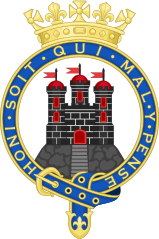
Philip’s heraldic status in his youth is not clear to me, but as a British adult he was – rather unconventionally – given two grants of arms. In 1947 his armorial achievement showed the arms of Greece surmounted by those of Denmark, which in turn were surmounted by those of his great-grandmother Alice (albeit omitting the Saxe-Coburg inescutcheon she used, which the British royals had abandoned in 1917). For reasons difficult to uncover these were deemed “unsatisfactory” so in 1949 the shield was replaced by a new quarterly version. The first quarter showed the lesser arms of the Kingdom of Denmark, the second quarter the white cross of Greece, the third the black and white stripes of Battenberg and the fourth a castle on a rock for Edinburgh. That last part is especially unusual as peers’ shields do not normally incorporate the municipal insignia of their nominal territories. These arms were of course rendered as a rectangular flag (confusingly called a royal standard, even though “standard” refers to a very different style of flag) and a square banner above his Garter stall at Windsor. In composing this article I also discovered that he had a badge, showing the castle surmounted by a princely coronet and encircled by the Garter, though I do not recall ever seeing it in use. Livery colours are not so prominent in modern times, and those of the royal family no longer change with the dynasty. Philip had his own personal livery of “Edinburgh Green”, used for his personal cars and the uniforms of his staff.

New badge illustration, published mere minutes ago.

Sodacan has of course illustrated all of these for Wikimedia Commons, and already I have spotted several instances of his illustrations being used in television coverage of his death as well as in reports online.

EXTERNAL LINKS

On What Authority

A sign welcoming drivers to Humberside, defaced by black and white splatters.

By Adpopulum, 1992 (CC-BY-SA-3.0)

The people of Yorkshire have an unusually strong local identity compared to those of other English regions, and Kingston-upon-Hull a greater notability (or perhaps notoriety?) compared to other cities.

Around 208 CE York was established by Emperor Septimius Severus as the provincial capital of Lower Britain. A reorganisation in 296 made it the probable capital of Second Britain. From around 450 to 654 it was the capital of the Anglian Kingdom of Deira, which then became the southern half of the Anglo-Saxon Kingdom of Northumbria. From 867 to 954 it was known as Jórvík and was under Danish rule. It was during this period that the North, West and East Ridings* were established to subdivide the area. The territory was absorbed into the unified Kingdom of England in 954, then from 966 to 1055 an Earl of York was appointed to govern on the monarch’s behalf.

Prior to the Norman conquest the earls of England had each ruled multiple shires and considered themselves of equal stature to continental dukes, but William of Normandy did not want to be outranked and so diminished them to one shire each, putting the earls level with European counts and so leading to their administrations being called counties. The county system emerging from this time remained fairly stable until Victoria’s reign.

Parts of Cumberland, Lancashire of Westmorland were split off from Yorkshire in the twelfth century, but by the time of the 1831 census it was still by far the largest of England’s forty then-counties, having more than more than twice the acreage of Lincolnshire or Devon and nearly thrice of Norfolk. The Local Government Act 1888 removed many administrative duties from the courts of quarter sessions and invented county councils to take them on instead. The three ridings, already given separate sessions, also had their own separate councils. The next big reform was the Local Government Act 1972, which sought to radically alter the county map of England and Wales so that the borders corresponded to the modern – rather than medieval – population distribution. Yorkshire’s three ridings were abandoned. A few smaller parts around the edges were given to other neigbouring counties, and the rest reconstituted as four entities – North Yorkshire, South Yorkshire, West Yorkshire, and Humberside.

The non-metropolitan county of Humberside mainly replaced the East Riding, but also incorporated parts of the West Riding and northern Lincolnshire. It was subdivided into nine districts, all of which obtained borough status: North Wolds, Holderness, Kingston-upon-Hull, Beverley, Boothferry, Scunthorpe, Glanford, Grimsby and Cleethorpes. Although the government had used the term Humberside in planning since 1964 and the BBC had launched Radio Humberside in 1971, the creation of a county by that name was strongly disliked by a significant proportion of its residents. In 1981 North Wolds renamed itself East Yorkshire and Beverley became the East Yorkshire Borough of Beverley. Already by the 1990s it was clear that the county could not last. With effect from 1996 the area was reformed yet again. Those parts which had been in Lincolnshire were returned, while the Yorkshire part was made into the new ceremonial county (also called a lieutenancy area) called East Riding of Yorkshire. The governance of the new county was split between two unitary authorities – Kingston-upon-Hull became one, while Beverley, Boothferry, Holderness and North Wolds were merged into the other, which confusingly was also called East Riding of Yorkshire.

Even though Humberside has now been dead longer than it was ever alive (as well as longer than I have been) the name continues to haunt us in the aforementioned radio station, the fire service, the airport, the scouts and the police force. There was even a Humberside Police & Crime Commissioner created in 2012. A lot of junk mail continues to put Humberside in our address, and many official notices put up by the former borough councils are still in place.

Hull itself has a place in the national consciousness – particularly in comedy – long before its designation as City of Culture. By the end of the thirteenth century the King’s town upon the River Hull had an active market, a travelling funfair, a seat in the House of Commons and a royal charter. From 1331 the burgesses had the power to elect a mayor. Another charter in 1440 created the municipal corporation and made Hull a county of itself (an early version of the same idea that a unitary authority today expresses). Seven years later the county’s boundaries were widened to include some nearby villages, which were sometimes called Hullshire. These were removed in 1835. The 1888 act made Hull a county borough. Victoria bestowed city status on the town to commemorate her diamond jubilee. George V upgraded the mayor to lord mayor after opening King George Dock. The city council replaced the corporation in 1972.

Readers may be wondering why I have bothered to tell them all of this. Well, in Eye 1540 I came across this passage in the Rotten Boroughs section:

HOW DEMOCRACY WORKS (1): Labour Hull city council is keen to get into bed with Tory East Riding of Yorkshire Council to set up a combined authority. Jumping on the devolution bandwagon with an elected mayor and all could bring in a hoped-for £1.6bn in Whitehall funding.
Under the planned timetable for the creation of the combined authority, a deal will be signed off by 31 March. But public “consultation” on any agreement will not start until late June at the earliest. How might the (meaningless) public consultation go?
Back in 2014, Hull wanted to extend its boundary to take over part of East Riding, so a referendum was held. Fewer than 2,000 voters were in favour, with more than 51,000 against, so the plan was ditched. But this time the public may not have any effective say in the matter.

Looking back I found a story about the plan in the Hull Daily Mail from October, with other hints still earlier but public interest only really seems to have picked up a few days ago. The gist of the plan seems to be that the existing councils will remain, but they will pool their resources to form a combined authority similar to that used by metropolitan counties, and on top will be a directly-elected “metro mayor”. It is not clear if the mayor will absorb the role of the existing Police & Crime Commissioner, as has been the case in other regions. It will also be interesting to see what name the combined authority will take – most have been named after the counties in which their constituent districts are situated, and indeed the county councils which used to be there before 1986, but in this case one of the districts has the same name as the overall county, so most likely the combination will be called something like “Hull & East Riding”, a redundancy akin to saying “Parliament and the Lords” or “Europeans and the French”.

The existence of directly-elected executives is a new development in Britain, and one at odds with the traditions of our constitution. This has long been a nation of parliamentary government, not presidential. The scramble for local and regional devolution has not been without controversy, especially the PCCs. The cost of and confusing of so many reorganisations in local administration also tends to provoke public anger. Many mock the patchwork of differing political structures across the United Kingdom, but attempts to standardise them never really seem to work. In particular it is noted that local personal identity tends to align more with the pre-Heath counties than with the modern ones, which were designed around administrative efficiency rather than emotional allegiance.

In this instance any controversy over the merits of the plans themselves is accompanied by anger at the secretive manner in which negotiations were carried out, and in the apparent intention of both central and local government to impose the new system without public consent. Two items arrived in my postbox today: Issue 39 of Your East Riding, and a campaign leaflet. The first is keen to announce that East Riding won Council of the Year 2020, but makes no mention of the new combined authority, merely having a brief segment about the Humber Local Enterprise Partnership on page 5. The second is credited to Matthew Grove, who was Conservative PCC from 2012 to 2016 but has since defected to the Liberal Democrats. Half of the front page is dedicated to a large-lettered condemnation of the deal and its negotiation process.

There is also a partisan component to consider here, which the Eye briefly mentioned. Generally it is observed that urban voters lean to the left and rural voters to the right. This is clear in recent election results for the two districts.

Hull City Council, 2018: Labour 31, Liberal Democrats 24, Conservatives 2.
East Riding Council, 2019: Conservative 49**, Liberal Democrat 8, Yorkshire Party 2.

The latter result is particularly impressive given that the UK-wide results were disastrous for the Conservative party. While there have been times when the Liberal Democrats gained significant footholds, the norm has been for Labour to have a majority within City of Hull and the Conservatives an ascendancy without. By contrast, the metro mayoral elections across the combined county would be very tight races. I wonder if, without the promise of such a large payment, the existing council leaders would have been more reluctant to relinquish such secure areas of control.

As this blog is so often about heraldry, I will end with some of the arms of the authorities I have been discussing.

Kingston-upon-Hull: Azure three ducal coronets in pale Or. Certified in 1879 but seen in use as early as the fifteenth century.

York: Argent on a Cross Gules five Lions passant guardant Or. Recorded in the 1584 visitation but in use as early as Edward III’s reign.

On 11th February 2004 Hull was also granted a badge of Three coronets in pale Or without the blue background.

The creation of county councils in the nineteenth century led to a proliferation of county heraldry, which previously had been inapplicable. In medieval times it was considered that helmets and crests were appropriate only for human men not impersonal corporations, so older grants of arms are of just a shield, though York obtained semi-official permission to ornament its arms with sword, mace and cap of maintenance in 1396. By Victoria’s reign this principle had been abandoned and so later civic grants of arms frequently include crests, supporters and mottoes. In contrast to the city arms which have been carried through multiple reconstitutions, the county arms have been designed anew as often as the counties themselves.

East Riding County Council (1889-1974): Escutcheon Per chevron Argent and Or in chief two garbs Proper and in base an eagle displayed Azure on a chief Sable three Roses of the first barbed and seeded Proper; crest On a wreath of the colours on a garb fessewise Or an eagle displayed Azure; motto Solis Ortum Conspicere. Granted 28th February 1945.

Humberside County Council (1974-1996): Escutcheon Per fess Sable and Gules on a fess wavy Argent between in chief a coronet Or between two roses Argent barbed and seeded Proper and in base two fleurs de lis Or a bar wavy Azure; crest On a wreath Or and Gules rising from flames Proper a demi-eagle Azure goutté d’Or armed also Gold holding in the beak a sword point downwards Proper hilt and pommel Or; supporters On the dexter a dolphin Argent finned Or charged on the shoulder with a terrestrial globe Azure the land masses Or supporting an anchor Proper and on the sinister a female figure habited representing Ceres with cornucopia all Proper upon a compartment per pale water barry wavy Azure and Argent and a grassy field Proper; motto United We Flourish. Granted 28th July 1976.

Holderness Borough Council (1974-1996): Escutcheon Per saltire the chief Azure charged with a sun in splendour Or the base barry wavy Argent and Azure the dexter flaunch per fess Vert and Sable the sinister flaunch per fess Sable and Vert each charged with a rose Argent barbed and seeded Proper; crest On a wreath Or Vert and Sable within a mural crown Argent charged with a saltire Gules an ancient ship with one mast and two sails set standing on the poop a man with cocked hat and telescope beneath his sinister arm Sable mantled parted Vert and Sable doubled Or.; supporters On the dexter side a mermaid on her head a Roman helm proper and holding in her exterior hand a trident Or and on the sinister side a Triton on his head a horned Danish helm Proper and brandishing with his exterior hand a sword Argent pommel and hilt Or; motto Think Right Do Right; badge A Viking ship with sail and pennon flying within an annulet compony Or and Argent. Granted 30th March 1978.

East Riding of Yorkshire District Council (1996-present): Escutcheon Barry Vert and Or on a chevron engrailed plain cotised Gules three roses Argent barbed and seeded Proper; crest Issuing from a mural crown Argent an eagle displayed Gules armed and langued Azure supporting with the dexter talons a sword hilt upwards and with the sinister talons a crozier in saltire Or mantled Gules doubled Argent.; supporters On the dexter a lion Azure guardant armed and langued Gules gorged with a wreath of barley supporting between the forelegs a trident Or on the sinister a demi-horse Argent langued Gules maned Or the feet webbed Vert conjoined to the lower half of a hippocampus Vert supporting between the forelegs set upon a staff a cross fleury Gules.; motto Tradition and Progress. Granted August 1996.
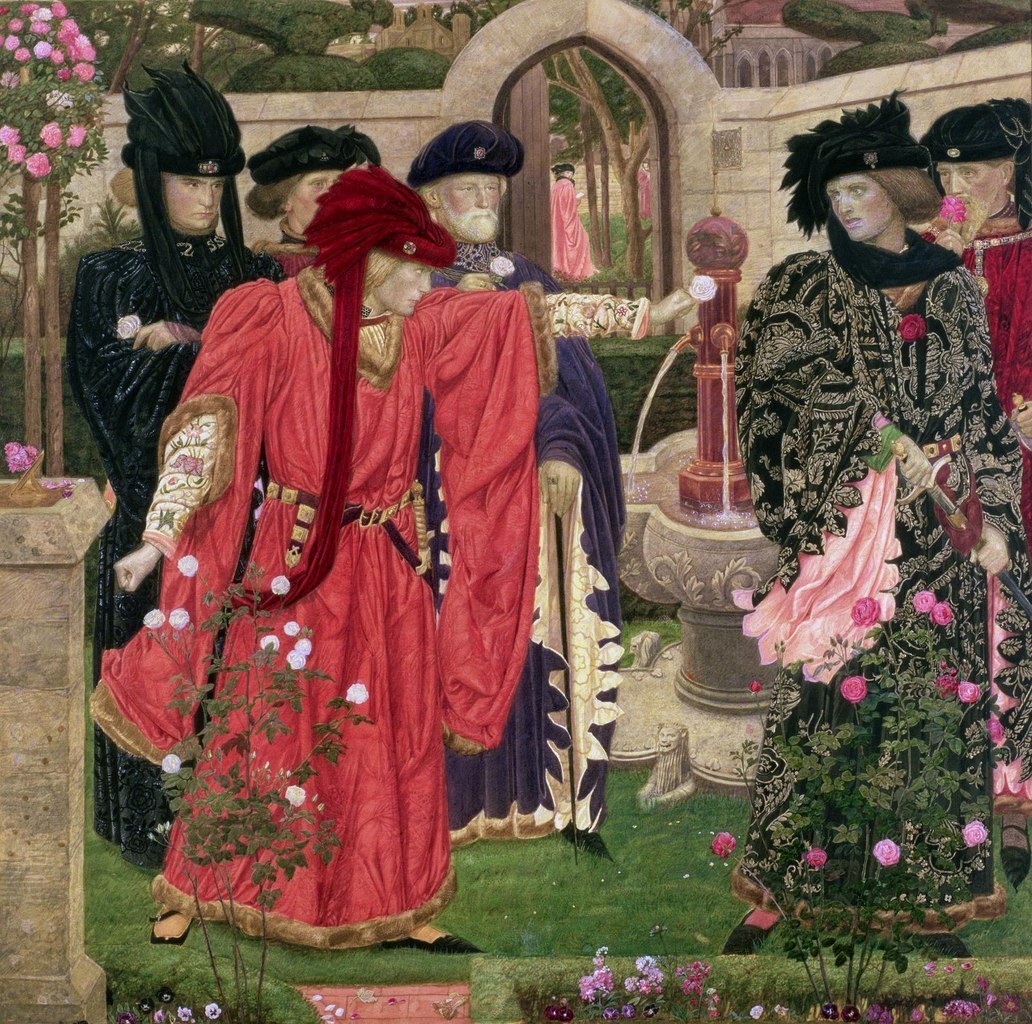
https://upload.wikimedia.org/wikipedia/commons/7/7e/Choosing_the_Red_and_White_Roses.jpgFinally a note about the roses: while the white rose was indeed a badge used by many heads of the House of York, and the red rose a badge used by many heads of the House of Lancaster, the status of each as the badge of its respective faction was imposed retroactively by Henry VII’s creation of the Tudor rose upon his marriage to Elizabeth of York, then bolstered by William Shakespeare’s writing of the Temple Gardens scene in Henry VI, Part 1. The name “Wars of the Roses” came into common use after 1829 in reference to said scene. Their use of symbols for the counties of Yorkshire and Lancashire emerged still later. Notably the roses appear frequently in municipal grants of arms since the 1888 reforms but not in earlier ones. In spite of what some may claim today, the conflict was not a petty rivalry between two northern counties.

EXTERNAL LINKS

UPDATE (13th September)

The latest episode of Jay Foreman’s Map Men covers many of the same topics I have done in this article. Indeed, the resemblance is almost suspicious…

UPDATE (1st November)

For those interested in the region’s past more broadly, I have just found the channel Hull History Nerd. Most of the videos are focused on transport and infrastructure rather than governance.

*The term riding literally means one third (in contrast to the farthings used prominently by a different famous shire) so one of the compass directions had to be left out. Much like the Diocese of Sodor and Man, the name was eventually adopted for a fictional location in Winifred Holtby’s novel. The BBC adapted the novel in 2011 for a miniseries, some parts of which were filmed close to my house.
**Two of them, Leo Hammond and Benjamin Weeks, were at university with me at the time of the election.

21st Century Scots Heraldry with Gordon Casely

Left: Casely finishes his speech. Right: Lyon models his hoodie.

Today I attended another Zoom lecture, this time arranged by the Heraldry Society of Scotland. This one went rather more smoothly than the one six months ago, though I still think that putting it on YouTube or similar would be more practical in the long run.

Our main speaker today was Gordon Casely, described as “a freelance journalist, heraldist and piper” by the host Edward Mallinson (the Society’s Social Secretary). His presentation was on what he perceived as a rise in grants of arms and interest in heraldry more generally. His anecdotal evidence for this was that he had attached a new hard drive to his overloaded computer for all of his hi-resolution heraldic images – a problem I too have encountered since last summer. More objective information was provided in the form of grant and matriculation records from the Lyon court in certain years: fourteen for the year 1720, four each for 1820 and 1821, then thirty in 1920. He described these as appalling output figures, which would shock any work study manager or time & motion engineer. Later in the session Dr Joseph Morrow – on the seventh anniversary of his appointment as Lord Lyon King of Arms – confirmed that in modern times the norm is between fifty and sixty-five new grants per year as well as matriculations, and that about 10% of the court’s business is from the commercial sector. He also said that in the last year, due to people having more time on their hands for such things, the court had seen a 50% increase in new petitions, though all of them had to be managed by electronic correspondence rather than meeting in person.

Casely told us of the records for time taken to complete an application, the longest being Banchory Community Council (thirty-seven years) and the shortest the Aberdeen Association of Civil Engineers (twelve minutes). He complimented the latter’s multilayered symbolism – simultaneously it represented a bridge over water, a stream, a cross section of a pipe half-filled with water, the sweep of a bend in a road, a ditch and a mound, as well as the letters ACE.  He was less happy with the arms of Gordon District Council, describing them as “how not to design a coat of arms, unless you’re in the Clydesdale Bank school of heraldry”.

He sang the praises of the late Anthony Maxwell, his longtime colleague. He drew attention to a commission Maxwell had done of the arms of Dr Tom Tait on the side of a carriage at a railway heritage centre in Derbyshire. He confirmed to “those anoraks who are watching” that it was the only British Rail Class 119 Diesel Multiple Unit in preservation. I did a little searching and can now say more specifically that it is DMCB 51073 on the Ecclesbourne Valley Railway.

After the main talk had ended there was an opportunity to ask questions, though on this occasion I couldn’t think of one – and indeed I wasn’t sure that my microphone was working. When the structured questions and answers concluded the session moved to informal chatter among the veteran members with occasional interjections by outsiders. This included showing some rather garish heraldic tattoos that they had seen, and then Lyon putting on a heraldic hoodie that he had received as a novelty gift.

A few more heraldic zoom lectures are scheduled for later this year, including a Canadian one that, for Brits, begins at midnight. That could prove an interesting experience!

Christ Is My Shield

The tomb of Alfred Ollivant in Llandaff Cathedral, his arms impaled with those of the see.

Having composed armorial pages for speakers, Lord Chancellors, universities and schools, this month I turned my attention to the church. The Anglican Communion has sixty-seven bishops in the British Isles. Forty-two of these belong to the still-established Church of England*, twelve to the Church of Ireland, seven to the Scottish Episcopal Church and six to the Church in Wales.

Each bishopric is considered a corporation sole, and for each an official coat of arms is recorded. The incumbent bishop may impale his personal arms with those of the see – symbolically marrying him to the job.

In contrast to the tiresome searching that has often been required to track down the blazons for the aforementioned politicians and educational institutions, ecclesiastical heraldry has proven exceedingly easy. The arms of most of the sees in Britain have been extensively recorded by Burke, Debrett, Fox-Davies, Hartemink and Woodward. Furthermore the vast majority of those arms had already been illustrated for Wikimedia Commons, so I had merely to compile them and type up their respective blazons.

Looked upon as a whole, the quality of Anglican heraldry is rather disappointing. Very little imagination is shown with the choice of charges and many sees have coats so similar as to be barely distinguishable: ten separate sees have the symbol of two keys in saltire and five use a trio of episcopal mitres. Within the province of Canterbury alone the sees of Coventry, Derby and Lichfield all centre on a cross potent quadrate while Guildford, Portsmouth, Truro and Winchester all have keys in saltire with swords. Fox-Davies complained in his writings of grants of personal arms in which the shield merely repeated as charges what should have been reserved for use as external ornaments – helmets, coronets and occasionally staves of various offices. It seems that the use of the mitre on so many diocesean shields is the ecclesiastical counterpart.

Another problem with the arms here covered is that a great many of them specify pictorial representations of humanoid figures. These include a handful of named saints, especially the Virgin Mary holding her baby and in Chichester’s case even the adult Jesus enthroned. Anyone with a working knowledge of heraldry (as well as vexillology and indeed most forms of graphic design) will know that such things are generally best avoided.

Thus far I have talked about the corporate arms of the bishoprics, but earlier this month I attempted to find the personal arms of the bishops themselves, hoping to make personal armorials for the Archbishops of Canterbury and York. Alas these arms were a lot harder to come by, for Burke and Debrett tend not to list personal arms of bishops and only in recent decades has it become the norm for the primates to transition to the Lords Temporal after retirement**. The only ones which I could find were those of the Bishops of Chester, already researched by the now-defunct Cheshire Heraldry Society. Those escutcheons were much more varied as well as much easier to construct in comparison to many of those which I have done before, so illustrating and uploading the whole lot took only three days.

EXTERNAL LINKS

*This includes the Diocese of Sodor and Man, after which Wilbert Awdry named his island, as well as the Gibraltar-based Diocese in Europe.

**At present John Sentamu is awaiting the life peerage that was announced in December, having left office in July.

More Podcasts

For the whole of January I wondered when the third episode of the House of Lords podcast was going to arrive. On 10th February it finally did so. The Lord Patel, Chair of the Science & Technology Committee, was interviewed about healthy ageing. The Lord Cashman, former MEP and actor, recalled his role in founding Stonewall. I hope that new episodes will be produced more frequently in future so that momentum is not lost among potential listeners.

The Heraldry Society recently started a podcast of its own, the first episode being an interview of Quentin Peacock about Digital Heraldry. Peacock spoke about the time and difficulty of creating high-quality vector graphics. Notice was also taken of the growth of online heraldist communities in recent years.

Back on Wikipedia, I have spent the last week constructing another armorial page – that for Anglican Bishops of the Diocese of Chester. The bulk of the necessary information was found on the website of the now-defunct Cheshire Heraldry Society. The vast majority of the escutcheons (no crests or mottoes listed) were simple enough to recreate in a short time, so that it only took a few days to illustrate and upload the whole lot. Creating the list page itself was also quite easy, given that I am well used to the template by now. It is too early to say if the page will survive. At present no other editor appears to have noticed it at all. If it is accepted then I may go on to produce armorials for the more senior bishoprics of Canterbury and York, though so far I have not found the relevant information so conveniently assembled.

UPDATE (15th February)

Searching around I uncovered this presentation by Dr Adrian Ailes for the National Archives, recorded a decade ago.

It’s Just Not Cricket

Armorial achievements of the Lord Cowdrey of Tonbridge (left) and Sir John Major (right)

Having exhausted what I could glean from the available editions of Burke’s and Debrett’s, I am ever on the lookout for new material on heraldry. Last week the College of Arms published its latest newsletter (which now regrettably appears only to print in October and January), but as usual the actual exemplifications of new armorial bearings were few.

I was delighted yesterday to discover this lecture on the development of English heraldry, given by the Somerset Herald David White in 2014. It is far from the only heraldry-related lecture video I have encountered online. Unfortunately I commonly find that the piece rarely goes beyond the basics of armorial composition and a brief overview of medieval chivalry, thus not telling me much beyond what I knew already – indeed it’s probable that the people making them are reliant on the same online and/or public domain resources that I am. This was not one of those, for it went beyond the Middle Ages to cover modern heraldry and much in between.

White’s lecture studied the artistic phases of heraldry, from the very simple designs of the medieval period to the more crowded ones of the early Tudors – when the nouveau riche were acquiring arms to display where they could be studied up close instead of glimpsed in motion – followed by a deliberate return to simplicity in the later Tudor and Stuart eras. There was a section on the infamous “landscape” and “seascape” heraldry of the Georgian years, with particular emphasis on Horatio Nelson, whose absurdly augmented escutcheon is often considered the nadir of the art. The Victorian era is not discussed in as much detail, save for a vague assertion that they went back to earlier styles as a result of the blossoming Gothic revival. Along the way he gave examples of families assuming arms and then later trying to get similar ones granted, or appropriating those of namesakes who were not actually related. The relative popularity of certain charges was also shown, with an ordinary or arms from the mid-1500s showing that already by then there were dozens of pages of lions (indeed a double-page spread shows thirty-two separate shields just with white lions on a red backdrop). White said that in modern times “one’s heart sinks” if a new applicant for arms requests a lion be included due to the difficulty of inventing an original design. He also speculated that the utility of heraldry as a system of identification might have been undermined by the preponderance of so many near-identical blazons.

Near the end of the lecture he showed some examples of reasonably recent grants of arms. Of particular interest was that of the cricket-player Colin Cowdrey, who was ennobled by John Major in 1997. His shield has a paly of four defaced by a bend dexter, representing the tallying of points. His crest had a set of wickets nosed by the white horse of Kent. Just to quash any remaining uncertainty, he also had crickets as supporters. Major himself became entitled to supporters upon his appointment as a Knight of the Garter in 2005. He too wished to have crickets, but was required to distinguish them from Cowdrey’s and so had them stand upon despatch boxes. Heraldry, of course, has no sense of scale. White called it a “slightly depressing thing” that the portcullis symbol was increasingly used on the shields of retired politicians to represent their profession.

The lecture I found was part of a collection of public lectures archived online by Newcastle University. The range of topics is as wide as you would find at Gresham, so well worth checking out.

The Long Arms of the Law

The Lord Kerr of Tonaghmore died on the first of this month, having retired on the last of September. He was both the last Lord of Appeal in Ordinary appointed to the Appellate Committee of the House of Lords under the Appellate Jurisdiction Act 1876 (just ninety-four days before their respective dissolution and appeal took effect) and the last of that group’s veterans to retire from the successor Supreme Court.

Undeterred by the recent obliteration of so many such pages, I wondered if the law lords were worth an armorial list on Wikipedia, and so have begun to draft one. As with my article last year on Speakers of the House of Commons, I found that there were quite a few names on the list who died so soon after being ennobled that they miss out being recorded in the genealogy books (and the law lords are of course life peers, so no heirs or successors can hold the place). What’s more, those books themselves are in shorter supply than they were last year – whereas Wikipedians used to have access to online scans of Burke’s Peerage from 1949 (on The Internet Archive) and 1959 (on Hathitrust), those files have been removed in the latter half of this year. Our earliest edition now is a copy of Debrett’s Peerage from 1936, and that is a poor-quality scan with many sections of prose missing.

Of course, nowadays the country’s highest judges would not be mentioned in such volumes at all: The Constitutional Reform Act 2005 which brought about the change barred those justices already holding peerages from resuming their seats in the House of Lords until their time on the court had ended. Further, a political decision was made that subsequent appointments to the new court would not be ennobled at all, but merely granted courtesy titles akin to those of hereditary peers’ heirs apparent. An exception was made at the start of this year when the new President of the Supreme Court Robert Reed, who had already used the courtesy title Lord Reed since his appointment to the College of Justice in 1998, was substantively created Baron Reed of Allermuir, of Sundridge Park in the London Borough of Bromley, under the Life Peerages Act 1958. It remains to be seen whether this favour will be repeated for his successors in that office.

How then, do I find the missing entries? My experience hunting down the speakers’ arms taught me the importance of looking for unofficial records, especially fan labour. I discovered some time ago the Flickr account of Baz Manning, an older heraldist who has carefully photographed a lot of armorial art and architecture over the years. In particular he has uploaded a scrupulous catalogue of the coats of arms displayed on the walls and windows of Lincoln’s Inn, where so many of Britain’s senior lawyers and judges are trained. The collection of shields of the institution’s alumni stretches back centuries, and proved very helpful to me in resuming my contributions to the Commons, which had petered out in the previous month due to running out of source material. The main real drawback to using this method is that I have no access to the text of the original blazon, and so can only copy what the previous artist has done, and if any charge or ordinary is unclear in the image I see then it is not possible to identify it. I would not attempt to reverse engineer the blazon from the depiction and risk getting any parts wrong.

Obviously not all of the UK’s judiciary went to Lincoln’s Inn – or even necessarily to the other Inns of Court – but the proportion who did is significant enough to keep my hobby going for the present, and hopefully the presence of such a large armorial display in such a prestigious location dedicated specifically to legal professionals should bolster my case (ahem) for the notability of an armorial list for the law lords, so that it would not be so casually junked as were the others.

EXTERNAL LINKS