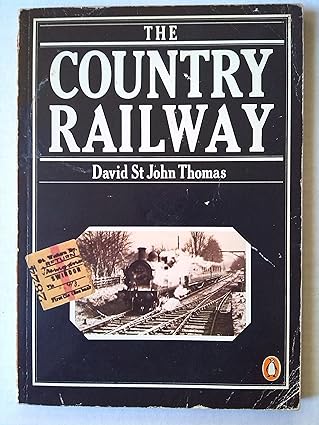
Review: The Country Railway by David St John Thomas

After a tumultuous voyage through Dead Europe I needed a rest on more familiar literary ground. The most obvious choice was another railway book. This one was printed in 1979 with an original price of £1.50. I picked it up from Dovehouse Hospice earlier this year for £1.00. The book is a few years older than The Penguin Guide to the Railways of Britain and rather different in scope: It is only really looking at the past rather than the present and it focuses, as the name implies, specifically on the rural lines rather than the urban ones. This book also doesn’t trouble itself to recap the evolution of locomotives and rolling stock from the beginning, assuming the reader already knows the broad strokes and only bringing up the details where directly necessary. Instead this book is mainly about the experience of daily life for the workers and passengers, as well as the financial aspects of operating the organisation.

The phrase “Country Railway” feels inherently nostalgic precisely because, following the Beeching Axe, there are not many of them around anymore (save heritage lines). A recurring theme of books like this is that the railways were vital to the survival of rural communities yet paradoxically those rural communities tended to be a dead loss to the railways. Closures of country lines would be bitterly mourned despite few people actually riding on them. There is an element of the rotten boroughs about some of the remote services where trains were run back and forth daily with full signalling operations and well-built stations even though the carriages would were at low capacity at the best of times and frequently had no passengers at all. The opening paragraphs of Chapter 8 (starting page 120) lay this out in most striking terms, and it is difficult to avoid simply quoting the entire page verbatim: Rural railways companies insisted on building and staffing their lines, stations and signal boxes to the same standards of quality — as well as safety — that would be expected on urban routes despite the far lower ticket revenue, in contrast to Continental Europe where country railways were far more cheaply constructed. As Thomas sums up:

“An army could have been carried in safety where only scores of people ever travelled. Because stations were so costly, they were often not provided at all where there might still have been useful traffic; and one could argue that in the motor age more lives would have been saved had the railways reduced safety standards — more people would have gone by train, which would still have been safer than buses and cars.”

It may feel a little odd to read someone explicitly argue for the moral virtue of cutting corners in public safety, but a robust case is made that the builders’ noble aspirations actually doomed their projects in the long run. Thomas notes another major obstacle in the need for the company to get a special Act of Parliament passed and/or secure the consent of all the landowners along the route, which an attempted streamlining of the process in 1864 failed to fix. The result was that construction costs per mile of track ended up being many times the original estimates and the railway companies frequently found themselves financially sunk before operations even started. These problems are entirely familiar in the present day. Indeed, I was struck when reading this section by how much the prose of a book on such a genteel topic, written nearly fifty years ago and describing events almost a hundred years before that, bore so much resemblance to that by Ezra Klein & Derek Thompson in Abundance, released earlier this year and addressing the same problems on a larger scale in the present — even including the building of railway lines!

On the flipside, the book also emphasises the death and destruction that results when strict safety protocols are not followed, the appendix retelling the tale of the Abermule Disaster of 1921, in which a quartet of negligent station staff got a pair of signalling tablets swapped around so that two trains collided head-on. The final sentence draws parallels with RMS Titanic:

“Time and again one or other of these mistakes had been made with impunity, but at Abermule on that disastrous day, like the scattered pieces of a jigsaw puzzle, these trifling faults fitted one into another until the sombre picture was complete.”

The book looks over the lifestyle of the rural stationmaster, isolated from the station’s local community, assailed from above as well as below and occupying a liminal, uncertain position within the British class system of the time. The ticket prices were no less convoluted then than now with a dizzying array of tariffs, rates, discounts, equivalences and exceptions. Thomas further looks at the advancement of new technologies and working practices in railway operations, particularly as regards the directions of trains — from turntables to passing loops to runarounds to push-pull to double-ended railcars. A recurrent problem for this sector was that, although the stationery infrastructure was kept to the same standard as the urban lines, the moving parts were not. Whereas the intercity main lines were upgraded to diesel and electric multiple units, the country branches were stuck with antiquated steam engines and their threadbare coaches. Even getting electric lighting on the platforms instead of gas was a struggle. Continuing with old-fashioned systems kept these lines more labour-intensive than they could otherwise have been, which only widened the gap in profitability compared to the main lines. Speed was also an issue for a lot of country lines, particularly in pre-war times, due to the low power of the locomotives and the mixing of passengers with goods on stopping trains.

In contrast to a lot of books of this type, which only look at Great Britain, this one also includes sections set in Ireland. Mostly these serve to tell us how the Irish rural railways were even more spendthrift, disorganised and ramshackle than the English, Scottish and Welsh ones. Attention is drawn to the larger gauges on this island (standard 5’6” and “narrow” typically 3′) which further increased expenditure. Timekeeping too was even worse and page 141 has an amusing anecdote relayed from Punch wherein a local dignitary was surprise to see his train actually leaving on time, only to be informed that it was the train from the previous day.

Despite the myriad problems in running the railways, Thomas is keen to point out that the local communities held great affection for them, staging elaborate celebrations when they were opened and even grander funerals at their closure. That books such as this (and indeed films, magazines and television series) about old railways and the engines that ran on them are so numerous and constitute such a well-established genre is testament to the high regard in which the British hold at least the idea of the railways, even if in practice relatively few get to make regular use of them.

Ten Years of Blogging

It’s difficult, in retrospect, to work out precisely when this website actually started: According to some emails from WordPress I’ve recently dug up, it seems my account with them may have been created as early as July 2015, but I didn’t actually publish my first proper post until March 2016. I have settled on 5th October as the anniversary date as it is the publication date listed for the About page, as well as the earliest date for which any site views are recorded.*

This was far from my first attempt at building a website for myself: That summer I had launched Homework Direct, itself the successor to a different website started in July 2012, and I have a dim memory of working with a school friend in 2009-10 to set up an online magazine, though that never got anywhere. Thinking even further back to the mid-noughties, I have still fainter recollections of two different instances where I experimented with simple blogs, but those definitely didn’t get published either.

I can’t quite remember my original motivation for creating the blog. It may be that I had just started at Wilberforce College, leaving behind my prior social group and taking a while to establish a new one, so it wouldn’t always be possible to discuss my observations on various phenomena in person. That would have been a little redundant by March, though. More likely it was prompted by a vague sense of building one’s “brand”. I’d never fancied (and still don’t) joining Facebook or Twitter, deciding instead that having an actual website of my own would better suit my needs. The next question was which site-builder to use. I had, that summer and last, experimented with coding pages directly in HTML but it proved too much of a faff. Blogspot and Livejournal already looked a bit primitive, antiquated and amateur. Tumblr was too unstable and had too many undesirable political connotations. I couldn’t get to grips with Weebly or Squarespace no matter how much they were advertised. I didn’t learn about Medium until years later. If I was starting ten years later (and perhaps if I was ten years younger) I could well have ended up on Substack. WordPress was recommended to me by every friend and family member with webmaster experience. I suppose I could have used Wix, on which Homework Direct was already done, but it’s lucky I didn’t as I quickly came to find that service inferior. Another item to consider was the name and domain. I long had my mind set on HomeworkDirect.Com only to see it taken at the last minute by the Uncle Ben’s rice company. I ended up going for HomeworkDirect.UK instead. When it came to my personal blog I was a little annoyed to find that all the Robin Taylor domains were taken. At first I was tempted to dismiss this as the inevitable fate of all names by that point. I then tried searching for the names of my acquaintances at Wilberforce, then those I remembered from secondary and even primary school, to discover that the vast majority of them did not suffer the same problem. I had to include my middle name to find a unique domain, at the expense of the URL being a bit long. The Robin Stanley Taylor domains were all available. I settled on the one I wanted** and even designed stationery with it included, but held off actually registering it until two years later as I wanted to avoid the additional expense of a second subscription until I was sure the blog would be a long-term commitment.

Late in 2015 I became a low-level public officeholder when a senior faculty member at the college nominated me*** to be on the student council. I found myself in the position of secretary and had the role of presenting triannual reports on the reports on the council’s activities to the college corporation. That gave me some material that seemed vaguely blog-worthy. There were also visits by famous faces to the college and days out (such as university open days, or that tour of medieval Beverley) to provide extra fodder. The blog was vague enough that could write on any number of miscellaneous interests, so I discussed politics and public events a fair amount (my principal hobby at the time), such as Harold Wilson’s centenary or the recall of the National Assembly for Wales over the Tata Steel crisis. These two topic areas could overlap when Wilberforce had a political visitor, such as the Lord Norton of Louth in late 2016. At the University of Hull I became a school and then subject representative in the student union. I was a much smaller fish in this much larger pond and, although I still went to a lot of meetings, I never had anything interesting to say at them and posts about them got almost no views. More engaging were the posts I wrote about guest lecturers — such as Paul Danahar and Terence Casey. One of my most-read articles is about my time at The Lawns in Cottingham.

The COVID lockdowns put an end to campus activity anyway, so I turned almost entirely to other matters. By this point I was blogging regularly about heraldry in its various aspects, which accounts for a sizeable proportion of my posts. One upside to the lockdowns was proliferation of organisations doing free virtual conferences and lectures, often with very little scrutiny of whom they let in. I attended far more of these than I ever got around to writing up. In the years after COVID the supply of these has slowly dried up with many organisations going back to in-person events and/or restricting them to paying members. Even so, I still get to attend a handful of these each year.

As time has gone on I have drifted into standard political analyses a lot, covering both the dignified and the efficient aspect of the constitution. I got onto a particular roll with this in the closing years of the former reign and across the slow beginning of the current one. This occasionally gets recognition from high up, as when David Torrance quoted my critique of Parliamentary guidance around dissolution in 2024.

While all this is going on, I’m not really sure what to do with Homework Direct. Initially it was my main focus (which partly explains the sloth of activity on the blog) but by September 2016 I had uploaded everything I could find which fit the format and there was little more to do. There have been very few updates since then and visitor activity is low compared to the main blog. The most significant development was in August 2022 when Wix announce a hiking of the domain registration price. I was tempted to close the project completely at this point, but I ultimately decided to migrate**** it to WordPress along with everything else. A month earlier I had created a new website for Paull Holme Tower, but that is stuck in a frozen state too.

I have mentioned before the steady growth of readership on this site. From 1st January to 4th October this year I have achieved a total of 3716 views, a mean of 13.4 per day. If this trend continues for the remaining 88 days of this year I will end up just shy of 4900 views, which will exceed last year’s record but still fall a little short of my target. I don’t want to give the wrong impression here: As it says on the about page, this blog is run as a hobby not as a business, and even with an audience much larger than this it wouldn’t occur to me to put up paywalls or sell merchandise. It’s just nice to know that my contributions are appreciated.

I don’t really know what the future holds. I suppose I shall just keep on blogging about events in the news, political and royal trivia, book and television reviews, trains, buildings and virtual lectures until I physically or mentally can’t anymore, or until the hosting gets too expensive, or until WordPress shuts down or becomes unworkable, or too expensive, or until I say something controversial that gets me censured, or until the free internet is ended. Instead of planning for the future, this little exercise got me more interested in the past: There have been multiple occasions over the past ten years in which I had meant to put out an article but never got around to writing it, or wrote much of it but never got it finished, or even finished it but never published. I’m considering whether it would be worth now going back around to fill in some of the gaps, particularly for the early years where it currently looks a bit threadbare. I’m sure my student council report for the Michaelmas term in 2015 will prove super fascinating to all!

FOOTNOTES

*Most of the views are from Britain, and these are almost certainly from me checking my own site to make sure it worked, but there was also one from the United States. I wonder how they found me so soon?

**RobinStanleyTaylor.Com was also available but ‘.Net felt somehow more apposite.

***I didn’t actually meet her until some time afterwards and I never found out what was the procedure for choosing candidates.

****When I say “migrate”, I really mean a day of frantic copying and pasting.

The Longest Month

September commences the waning third of the year. October is where we start the waning quarter. All pretence of clinging to summer now becomes untenable, as does any attempt to ignore that most dreadful phenomenon of the later months — the long countdown to Christmas. Yesterday I was in a branch of Home Bargains and found an aisle which encapsulated this perfectly; solidly packed with Halloween decorations on one side and Christmas on the other. A fortnight earlier I went into a B&M across the road and found among the confusing maze of aisles a few which were entirely Christmas-dominated, a couple which were all Halloween and a small, pathetic half-section offering huge discounts on the remaining stock of beach buckets. We’re also past the autumnal equinox, of course, and it is rare now to maintain daylight past dinnertime. I had spent most of the preceding season reading The Book of Lost Tales in my garden, but getting through the rest of the series in that manner will be difficult now that most of the time it’s either dark or raining. Artificial light is needed more and more to make up for the loss of the natural and, indeed, daylight savings will take effect on 26th, which is what makes October longer than the other 31-day months. I think back to John Finnemore’s song about 5th February being the Most Miserable Time of the Year “with Christmas a distant memory and summer still far away”. A song about the converse situation would probably put the key date around 12th October. Of course, as I discussed some years ago, lots of TV shows have already recorded their Christmas specials by now, which must only further feed a sense of dissatisfaction from linear time.

The Met Office reported that the summer of 2025 was Britain’s hottest on record, and the record has been set several times already this century. This kind of commentary seemed to peak just after the Glastonbury festival, with lamentations that the tradition of the “washout” now seems to have quietly died. The British still stereotype themselves as living in a cold, wet country but the reality is that we are fast becoming a war, dry one, hence a growing public outrage about the low availability of air conditioning. These complaints are likely to resurface in the next few summers, but for now they have abated… because we’re moving into the colder months now and thus looking forward to panics about the cost of heating. I remember that in 2022, as an inflammatory heatwave was only just receding, there were already warnings of “warm hubs” being needed in the winter so that the poor didn’t freeze. I can’t help but feel that if we were collectively capable of thinking more than three months ahead or behind then we likely wouldn’t be in either of these messes.

Discovering the Small Web Movement

What happens when the mines run out?
The Captain announces a new golden age of prosperity. They just fill up again.
What, just like that?
Yeah. Well, you don’t think that’s wrong, do you?
Wrong? It’s an economic miracle. Of course it’s wrong.
Oh. Oh then, of course, the lights change.
What lights?
You know, the lights. The ones on the sky at night. Little points of light.
Do you mean the stars?

Conversation between the Doctor (Tom Baker) and Kimus (David Warwick) in The Pirate Planet (part 2) by Douglas Adams, broadcast 7th October 1978.

Anyone perusing my blog’s back-catalogue recently may recall my post about The Queen’s Reading Room, a post which I named “Reading the Room” in a very weak pun on the topic name. That post now has an update at the bottom clarifying that since I wrote it another podcast has started up which actually is called “Reading the Room”. Of course, it’s such an obvious title that, in this age of mass podcast proliferation, it was bound to be used eventually (and indeed the Substack blog carrying it needs to have “pod” at the end of its subdomain because plain “readingtheroom” was already taken), but this one seems to be rising to prominence among intellectual circles. It almost certainly gets a leg-up due to the fact that both the hosts – Felice Basbøll and Ella Dorn – are columnists for a handful of newspapers and magazines, as likely are a lot of their listeners, so its popularity is not entirely grassroots. Apart from the very broad stroke that they both talk about books, this podcast is entirely unlike the Clarence House production: There are no interviews with the authors, tours of vintage libraries or commissions of research into national literacy statistics. This podcast consists of the two hosts talking among themselves for over an hour at a time about one or more books they’ve read, their choices and the outflowing discussions focusing heavily on philosophy and contemporary socio-political matters. This is not an approach that it would be practical (or constitutionally wise) for Her Majesty to take.

Alright, that’s enough unpaid advertising. The podcast is not the real reason I’m writing this article now. In addition to their newspaper editorials, Basbøll and Dorn both also have individual Substack blogs. Most of what they write there isn’t relevant to this article either, but there was one that particularly struck me as important – Dorn’s post from 27th February this year entitled “How to Take Down Big Tech”. The main thrust was that, for the preservation of online freedom and, more broadly, of enlightened society, it would be better if we avoided large social networks as a general principle in favour of smaller forums and individual websites. She referred to this as “The Small Web Movement”. I have supported the same goals for practically the whole of my online life and have often encountered posts, articles, comments and videos from other people concurring, but only here did I discover that it was an established ideology with a tangible identity.

My history with the World Wide Web is a fought one. For most of the noughties, my family – and most households in the area – had about the connection quality you would expect from rural broadband at that time. Then again, the web itself was still quite primitive. In 2009 out ISP jacked up the price prohibitively high. For the next few years we had no home broadband at all, and internet access was only achievable through a prepaid WiFi plug-in device, which had limited utility. I think it was in 2012 that, having established HubbNet, we finally got a decent connection again. No sooner had I rejoined the online world then I became aware that it was under threat. In the good old days it appeared that, subject only to the physical limitations of their hardware, anyone could have their own website, use any number of online services and upload any number of photographs or videos. It seemed to be, quite literally, a free-for-all. The story of the past decade or so has been the realisation that this utopia was unsustainable. For a long time all of these big sites were running at a loss, heavily subsidised by very wealthy investors who supported the development of these technologies in the hope that they would somehow become massively profitable in the near future. A lot of them still haven’t. As the money dried up and investors started insisting on a tangible return, and even moreso post-pandemic as the long era of ultra-low interest rates finally ended, companies had to make drastic changes to their products to increase revenue and slash costs. Restrictions were placed on space, ads became more aggressive and harder to skip. Pages disappeared behind paywalls and old pictures/videos/files were deleted. The crusade against free riders often became in practice a war on usability. The polite term, though not the common one, for this phenomenon is “Platform Decay”. If the freedom of the web wasn’t under threat from the companies themselves, it was threatened by politicians. Leaders and legislators across many countries, parties and decades have repeatedly sought to take control of the medium that most of them don’t understand in the slightest. This is alternately done in the name of copyright, security and safety. In the New Tens we were threatened with the spectres of SOPA, PIPA, CISPA, ACTA and Article 13. thankfully the most dangerous aspects of these were killed before they could reach the statute book. In the present decade we haven’t been so lucky: I am writing this in the wake of the coming-into-force of the Online Safety Act, a multipartisan disaster passed in 2023 against the objections of everyone with half a brain. Similar laws exist in some parts of the United States and are expected to proliferate across the European Union. However virtuous may have seemed the intentions these laws claimed, they all had the potential to destroy the internet as it has been known for the past thirty years. The deliberations over these laws tend to play out as battles between sovereign states and the major tech businesses, with the common end user having plenty of reason to distrust both. With states concentrating on the most prominent large platforms, and the platform owners themselves often pre-emptively shutting messages which could offend either the government or their advertisers, the need for a decentralised network of small independent backup sites becomes pressing.

The main benefit of having an entire website of your own is that it gives you a greater degree of personal control, especially with regard to visual customisation. Twitter and similar sites give you a profile picture, a couple of sentences’ written biography and maybe a header image if you’re lucky. Long ago YouTube channels allowed you to change the button colours and set a background image, but those abilities were removed around the time they were bought out by Google. Variables, on social media profiles, tend to be restricted within a fairly narrow range. Website builders, by contrast, often allow dozens, maybe hundreds of templates, after which the client has further options for menus, logos, assorted other widgets, fonts and colour schemes. If you’re coding your own website from scratch you can have it look and work basically any way you want. For a physical analogy, imagine a street where each resident can have his own house with its own unique design and decoration, versus a barrack hall where each inmate can, at best, have a different selection of photographs on the backboard behind his pillow. The flipside of this, of course, is that increased proximity allows conversations to happen faster. Short, snappy replies can be given almost in real time, whereas with separate websites they would naturally tend to be longer and more spaced out. Most in and indeed out of the Small Web Movement would consider that a positive, perhaps even the positive, but there are others for whom this spontaneity and intimacy are extremely valuable. There are ways to approximate this, if need be – most website builders include the options for comment sections on posts and pages, as well as a “re-blog” feature. If inter-platform compatibility is an issue, you could always just include a hyperlink to the other person’s post in your own. If that’s too cumbersome… maybe email each other? In my personal experience, I’ve more often witnessed this problem occur the other way around, as Tweeters desperately crush a substantial paragraph of text into a long string of single-sentence posts, or even screenshot the block of text on another medium then upload that as an image. The latter solution has the advantage of speed but it must be monstrously inefficient in terms of accessibility, searchability and digital memory space.

The Movement’s favoured solution is the return to the dedicated online forum. Forums have been around since the earliest days of the World Wide Web, but their power and prominence has waned in latter years with the rise of the social media giants. Reddit, in particular, is designed as a sort of universal mega-forum which subsumes all the others. Forums are a halfway point between personal websites and major social networks, giving people with shared interests a common space without having to invite the whole world in, allowing customisation of design at group level but not individual. Examples of forums which still command some cultural weight are The Student Room, Digital Spy and the notorious Mumsnet. One might throw in the Army Rumour Service as well. There are also lots of smaller forums dedicated to specific hobbies, needs or franchises. Often a long-running film, book, or television series will have a quasi-official fan forum, e.g. Star Trek has Trek BBS, Doctor Who has Outpost Gallifrey and I think I’ve already mentioned Sodor Island Forums. In case I’ve not mentioned already, there are, of course, heraldry forums too.

Fairly it could be said that all of this still falls short of the intention of the Small Web Movement because they still involve using someone else’s platform. The real goal is to have each blogger hosting their own website independently. While I accept the principle of decentralisation, I think expecting everyone to keep individual servers running may be a little beyond feasibility given constraints on money, space, electricity supply and technical knowledge. Indeed, since it has been over a decade since I completed my Information Technology GCSE or had much direct involvement in HubbNet, some of the material I’ve come across from the Movement about Gopher and Gemini is stretching the limits of my own understanding a little, though I hope to get there reasonably soon. Perhaps a compromise could come about in the form of small local data centres, with hosting space rented out in a manner akin to garden allotments. More realistically, since the intention is to transition the masses away from social media accounts, builders such as this would be a relatively easy first step, from which those most determined (and whose sites are successful enough to justify it) can later move the whole way.

I remain undecided on the necessity of registering your own domain rather than using a subdomain of the website builder. I have written before about my disappointment in having to go for “HomeworkDirect.UK” because the Uncle Ben’s rice brand snapped up “HomeworkDirect.Com” just before I could claim it. I always intended this blog to be at “RobinStanleyTaylor.Net”, but did not actually get around to registering the domain until 2017, with “RobinStanleyTaylor.Wordpress.Com” sufficing for the first two years. I cannot run a proper counterfactual to see how the blog would have fared without the change, but I know I was getting at least some regular engagement on the small number of posts I’d made up until that point. I suppose the main value of a domain is on an aesthetic level – it confers an air of formality and professionalism, whereas a “.someonelse.com” looks casual and amateur. A personalised domain also tends to be shorter (what with one of the levels being removed) which makes branding easier. On a practical level, and in keeping with the general thrust of this article, having your own domain allows you to totally replace the website you use without having to give up the URL you’ve already posted everywhere. I took advantage of this in 2022 when I moved Homework Direct to WordPress because Wix put its prices up. On the other hand, renting a domain is itself an expense as well as requiring identification whereas subdomain sites can still be free and anonymous. Of the sites I frequent (on which topic more later), I notice that The Norton View is still on a WordPress subdomain after operating more than fifteen years, as did Murrey and Blue under its original ownership. Of the many Substack blogs I’ve recently encountered, the vast majority have kept it at “.substack.com”, whereas it would be difficult to imagine them all doing the same on WordPress. Perhaps one is considered more prestigious than the other in some way.

As a case study into the importance of having a website and not just a channel, I point to the example of Chuck Sonnenburg, professionally known as SF-Debris. Chuck is a film and television critic of more than seventeen years’ standing, making him one of the seniormost figures in what is now a very large “reviewtainment” industry. He got his start talking about Star Trek: Voyager, then gradually branched out to the rest of the Star Trek franchise, then to other science fiction and fantasy franchises (e.g. Doctor Who and Red Dwarf) as well as whatever miscellaneous films and series his fans suggest for him. He claims to have surpassed the ten thousand video mark some years ago. His journey has rarely been easy. His review videos take the form typical of the genre – ten to fifteen minutes of footage from the episode he’s reviewing, occasionally playing the sound but mostly as a silent montage over which he reads his commentary. Purveyors of this type of content maintain that it falls under Fair Use, but that doesn’t stop IP owners – or indeed the automated systems of the video-hosting services) from blocking videos on the grounds of copyright infringement. Chuck has been around long enough to witness several such piracy purges. For his first few years he used YouTube as his primary platform – only natural as it was and is by far the largest – with a backup channel on Blip.TV. The backup channel was mainly used for long-form videos, as YouTube back then had quite restrictive limits on running time. In 2011, having had a few too many threats from YouTube, Chuck decided to take down hundreds of his own videos before the platform inevitable purged them, then set about making Blip his main platform instead. Rather than simply reupload his old videos in their original form, Chuck decided that a lot of them needed rerecording. He did this alongside still making new reviews, so it took years before all his missing episodes were available again. Almost immediately this effort was rendered worthless because BlipTV completely shut down as a platform. Chuck therefore had to reupload everything again with yet another host. He has joked about this himself, claiming not to remember how many platforms have dropped him over the years. At the time of writing he seems to be using DailyMotion for his “full motion” videos while, ironically, going back to YouTube for lesser versions where he essentially talks over a slideshow of still images instead of moving clips. This alternative format is less engaging to watch but safer from a copyright perspective, as well as almost certainly being easier to edit. Here the point of this [my, not Dorn’s] article comes into play – originally Chuck’s videos were displayed on his YouTube channel and that was likely to be the place where people watched and commented on them. Alongside this, however, he also had a standalone website at sfdebris.com which essentially ran like a blog with each post being titled after the episode or film he was reviewing and consisting of an embed of the corresponding video followed by a short (and snarky) written description. Originally this could have struck some as pointless, but the repeated purges vindicated his approach, for links to his website remain usable long after links to his video channels are killed. When the videos are taken down, the sites pages are left with error messages or even just empty spaces where the embeds used to be, but the page titles, the descriptions and the navigation menus are intact so that the site exists as something of an empty shell. As Chuck proceeds with reuploading on a new video host, the shell is gradually filled in again with the new videos being embedded exactly where the old ones had been. When the reupload process is eventually completed, visitors will find the site looking and working much as it did before. If they notice any difference at all, it will only be that the play button on the video is a different colour – just like the citizens of Zanak noticing the new lights in the sky when the mines are refilled. Nowadays Chuck has the DailyMotion videos unlisted to they cannot be viewed from the hosting site itself, only as embedded on his blog, so that none come to think of the former as his home. Chuck also has a dedicated forum set up to take on the role normally played by the comment section. Again, this helps to maintain long-term continuity, because comments left on the videos themselves would be lost to digital history upon blocks or takedowns. It also has the advantage that the conversations themselves are easier to write and read.

If you’re as much a pessimist as I am you’ve probably already anticipated that if a critical mass of content creators adopted this strategy then the platform owners would cotton on and start forbidding embeds, or at least restricting them in some (probably financial) way to force viewers to use the host sites directly. In this scenario I would hope that creators already using said strategy would be able to vote with their feet by switching to hosts more obliging (unless of course they were to all do it at once). In the interim a simple direct link on the blog page would probably suffice for the same purpose, even if it was less elegant in looks.

Dorn’s article expressed a wish to see people exchanging URLs for websites instead of handles for profiles, so at this point I ought to share some of my own recommendations. Per her advice, I have created a link directory on this website, which can be accessed under the “About” heading in the main menu.

FURTHER READING

Mid-Year Reading Round-up

Having already posted some months ago a long list of all the books I’ve recently acquired, I suppose at some point I should say something about the experience of actually reading them. Here, then, are some mini-reviews of the publications I’ve finished during the period of January-June 2025, in no particular order.

The First Four Georges by Sir J. H. Plumb

Already reviewed in a different post.

The Extended Phenotype by Richard Dawkins

Although he is primarily famous for The God Delusion and maybe secondarily for The Selfish Gene, the professor himself generally regards this one as his true magnum opus. I’m not sure how famous Dawkins already was back in 1982, but this book feels as if written in his capacity as a biologist rather than as a public intellectual and activist. It is a much more academic work than his more famous ones and, having not been taught biology for just over a decade, I cannot claim full comprehension of the more terminologically-dense parts, but these aren’t really necessary for understanding the main thesis. Dawkins does not present new facts so much as a new way of interpreting facts we already possess: Normally the conception of evolution and natural selection is that they take place on the level of the individual organism, the family, the society and even the entire species. Dawkins instead looks at it in terms of the alleles of genes competing indirectly against each other with the organisms serving merely as a convenient – and disposable – host. The title of the book refers to Dawkins’s other big point that alleles affect the physical and behavioural characteristics of a species, which in turn affect the environment those species inhabit, as well as the ways in which other species evolve in response, so the phenotype of an allele in one species can be regarded as including the features observed in another species. The author also brings up a great many case studies of evolutionary adaptation and competition, including counter-intuitive examples such as between males and females of the same species, or even between parent and child! Of great interest here are his analyses of why some creatures are capable of adapting to “win” an evolutionary war while others are not. A theme which runs through the book as well is the difficulty of finding the vocabulary to comprehend these complex natural phenomena without slipping into metaphor and personification, which feels in some way prescient given the author’s later writings about religion.

The Final Curtsey by Margaret Rhodes

As with Lady Boothroyd’s autobiography, the early sections of this book felt a lot like reading my own grandmother’s childhood recollections, although from the opposite end of the class spectrum. Rhodes gives her account of her aristocratic early life, her experience of living through the war and her career as a courtier to the royal family. One thing that confused me a little was her choice of names for Britain’s senior mother and daughter after 1952 – the reigning sovereign is “The Queen” whereas George VI’s widow is “Queen Elizabeth”. Often I would get a long way into a paragraph before working out which one Rhodes meant. Despite being published in 2012, just four years before she died, Rhodes mentions a distinctly old-fashioned approach to writing. To modern eyes she appears curiously unfazed by the historical weight of her experiences, taking it in her stride that she dined nightly with the heiress presumptive while the bombs were falling, got roped into organising a faraway dynastic wedding, smuggled prisoners out of a country undergoing a violent coup and even watched a man drop dead in front of her. While the overall tone may seem a little twee at times it’s definitely worth the read and packs a lot into relatively few pages. The final days of the Princess Margaret and the Queen Mother are especially important for the record.

The Gathering Storm by Sir Winston Churchill

This is a very long book, and that’s only the first in a six-volume set amounting to more than three thousand pages in total. Churchill has written a great many well-renowned history books, but here it is a history in which he was a major protagonist so it also doubles as a memoir of sorts. The length here is justified as he writes in great detail about a multiplicity of topics, taking the reader step-by-step from the conclusion of WWI to the outbreak of WWII, with the volume ending at the point when he became Prime Minister. It’s astonishing to realise that he completed this enormous tome while he was serving as Leader of the Opposition, a feat of intellectual multitasking which feels impossible today. Given that Churchill’s reputation speaks for itself it almost feels redundant to comment further except to say that I am on the lookout for Volume 2, though given the backlog of books already accumulated it could take a while to get there.

The Glamour Boys by Sir Chris Bryant

Yet another World War II history, and also written by a sitting MP. Bryant’s behind-the-scenes account of the parliamentary machinations leading up to the war is in many ways complementary to Churchill’s own. The focus here is on the alternative, underground world that the “boys” were forced to inhabit, noting the parallels between their nonconformism, adamant against the mainstream of the time, on both personal and political levels. This book presents a major setback for anyone attempting a historical rehabilitation of Neville Chamberlain – his reputation before was of optimistic (or perhaps delusional) naivety rather than malevolence, but here he comes off as cruel and wicked in his attempts to suppress his glamorous detractors with an underhanded smear campaign. The only downside to this book is its length – at 448 pages it’s a rather weighty tome and it sometimes feels as if Bryant was padding it out to look more imposing on the shelves. Some critics have said he indulges too much in the lurid descriptions of the rebels’ relationships in the early part of the book, but I think the real waffle comes nearer the end, once the war has already gotten going, when the defining goal of the story has been completed and everything thereafter feels a bit more like generic wartime biography divorced from the specialist subject matter.

The King’s Painter by Franny Moyle

Going a bit further back this time takes us to the Tudor era. This is a biography of the portrait artist Hans Holbein the Younger, best remembered for his imposing image of Henry VIII. The biography covers the full length of Holbein’s life and career, with detailed analyses of his major works and the artistic innovations they represented. Not having studied the history of art (or art itself) much before I cannot fairly judge the quality of Moyle’s commentary here, except to note that she brought up verisimilitude so often it almost felt like a tic. Aside from the art itself, a lot of the book was dedicated to the religious and political upheavals in continental Europe which alternately expanded and restricted Holbein’s professional opportunities.

The Roman War Machine by John Peddie

Returning to the war theme but backing up even further to the ancient world, this is a book on the military structure and logistics of the Roman Empire. In some ways this felt like a throwback to my GCSE Latin course, in others like a memory of and educational field trip I might have done in primary school. This book is in English, of course, save for the heavy use of Latin military jargon. Peddie writes in detail, and with diagrams, about the ranks, formations, equipment and resources sustaining Rome’s military operations. Even here we cannot avoid World War II, for Peddie makes repeated comparisons to campaigns in the twentieth century to show the historical resilience of the Roman legacy.

The Penguin Guide to the Railways of Britain by Edgar Jones

This book was published in 1981 so a lot of the guidance here is obviously out of date now. On this note I would particularly highlight some lines from pages 36-38: “The Advanced Passenger Train represents the latest development in electric rail transport.”, “It is possible that a diesel-powered version of the APT will be developed for use on non-electrified lines.” and “At this moment 60 per cent of trains are diesel-powered. With the progressive introduction of the HST – the most advanced diesel-electric in the world – it is fair to say that this form of power has reached its apogee in Britain. Since electricity holds the key to the future, when these expresses become obsolete it is probable that the diesel, like steam, will disappear.”. The first fifty pages tell the history of locomotion in Britain from the early nineteenth century to the late twentieth, including the evolution (with diagrams) of different types of rail vehicles. The next three hundred pages take the reader around the country, region by region, explaining all the routes can be taken and all the stations that can be visited. The writing, though concise and eloquent, can be a little dry and it was difficult to keep up the momentum towards the end. From the way it’s structured, it less resembles a conventional reading book than the railway version of Burke’s and Debrett’s, so perhaps one is better off treating it that way instead of trying to finish it in a linear fashion.

Classical Literary Criticism by T. S. Dorsch

It is a little strange to realise that not only has literature itself been around for thousands of years but that literary criticism has been too. Even though the source texts may be as old as the fourth century BC and the translations into English were done in 1965, a lot of the prose still feels contemporary to one familiar with book and film reviews both amateur and professional. Indeed, a lot of the talking points would not have been out of place in a modern day “reviewtainment” video essay. There are multiple chapters on individual narrative devices, as well a the structures and purposes of different types of plays and comments on stories already performed in the writers’ memories. Most impressively, there are multiple instances when one of the writers goes into detailed analyses of the subtleties of another writer’s word choices and sentence structure. All of this, of course, has to be translated from Greek and Latin into English with the nuances intact. There are even times when one of them criticises another critic’s literary criticism, such as when (p65) Aristotle notes that “Ariphades ridiculed the tragedies for using expressions that no one would use in ordinary speech… these raise the diction above the level of the commonplace, but Ariphades failed to see this”. The introductory note by the editor explains who the sources – Aristotle, Horace and Longinus – actually were. The former belonged in the fourth century BC while the latter two belonged in the first. The gap between them is greater than between Shakespeare and Wilde, yet to us know they seem interchangeable, a good reminder of how long the ancient Greek and Roman eras really were.

Shadow State by Luke Harding

The book was just over three hundred page but I devoured it very rapidly. It tells of how the Russian Federation went from the collapse of the Soviet Union under Gorbachev to the emergence of Putin’s regime in which the military, business, the mafia and the President’s personal interests are all effectively merged into one and how this level of corruption affects not just Russia itself but also the other nations with which Russia interferes. The stories told are the ones you’d expect – Hillary Clinton’s emails, the Salisbury poisoning, and Brexit. There is some poetry in the timing: The book was published in 2020 as Trump was heading to the election he would lose. I bought it from Red Cross on 28th August 2024, as he was heading to the election which would see him restored. This also of course means that Putin’s ongoing war against Ukraine cannot be included, though there is much about the events leading up to it and Zelensky (suited and beardless) makes several appearances. The hero of the tale is Eliot Higgins, a journalist who created the Bellingcat online information exchange that allowed amateurs to monitor and scrutinise world events remotely. Harding resists the temptation to grant Russia an Orwellian omniscience, noting instead that Putin’s schemes often backfired or fell flat, that he only turned to online subterfuge because he lacked the funds for traditional spycraft, that many of his apparent successes – including Trump – were coincidence or blind luck and that the quality of Russian operatives had declined since Soviet times. The story of Salisbury assassins Chepiga and Mishkin, in particular, plays out as something of a farce. Nonetheless the death and destruction they caused is very real and, at time of writing, the threat feels as pressing as ever.

The Ricardian Century by John Saunders

This may be the newest book I’ve ever picked up from a charity shop, as I found it at RSPCA in February and the copyright notice said 2025. The book was in pristine condition and I worked very hard to keep it that way, although despite my best efforts a few bits of the corner flaked off before I’d finished it. This is the official history of the Richard III Society from its foundation in 1924 (as the Fellowship of the White Boar) to its centenary celebrations in 2024. The book is the product of a print-on-demand service rather than an established publisher and at times looks, to paraphrase Mark Corrigan, like a printout rather than a book. The cover design is especially poor: On the rear is a small square photograph of Saunders, in low resolution and squinting a bit, clearly cropped from a larger group shot, while the front has an equally-fuzzy raster of a depiction of the Society’s coat of arms from which not all of the white space has been cut out of the background. Aesthetic issues aside the contents are engaging enough, giving the reader a detailed look at all the twist and turns of both Ricardianism as a movement and the Society as an organisation. What fascinates me is that by all logic the Society ought to be a dissident fringe group. Though clearly there has been a shift in public attitudes to Richard III over the centuries (and certainly in this millennium) towards acquitting him of history’s more outlandish charges, the consensus among historians is still that he was the most likely perpetrator of the regicide of his nephews. Furthermore, as Ricardianism asserts that “the wrong side won” at Bosworth in 1485, and that sad side includes the current royal family, it is tantamount to asserting (much like the Jacobites) that the entire royal line thereafter to the present day must be illegitimate. Despite this the Society has been accepted by the wider academic community as a legitimate scholarly institution (even if they still ultimately disagree with its conclusions) and has even been accepted by the royal establishment with Prince Richard, Duke of Gloucester serving as Patron for more than half of his and its lifetime and the College of Arms hosting the book’s launch. George Awdry, Wilbert’s brother, is also mentioned a few times. One thing that really stuck out at me was the revelation (p93-4) that the Society was not formally incorporated as a legal entity until 2019, which made me wonder how they’d acquired a grant of arms in 1988, among other things.

Here We Go Again

As the minutes tick down until the end of December, I find myself once again resetting and archiving the talk page for my Wikipedia account, which I have already done on ten occasions before.

Some people think of time as a straight line, others as a circle. I have come to compromise by thinking of time as helical. The turn can be conceived of as lasting, hours, days, months, years or even centuries. Sitting at my computer desk now, ready to perform the same routine again, I find that the manoeuvre is ready in my muscle memory. It almost feels as if mere minutes have passed since I did this on 31 December 2023, or 2022, or 2021…

Conversely, events from earlier this year – such as the general election or the D-Day commemorations – feel a lifetime away. Perhaps the cycle of the seasons is to blame; by July it can be easy to forget the feeling of cold and darkness, and by January equally hard to remember the feeling of warmth and sunlight. Habits, timetables, wardrobes all change accordingly so that we almost inhabit two different selves with little knowledge of each other.

Christmas intensifies this effect, given the disappearance and reappearance of the same decorations each year, as well as the propensity of television and radio to endlessly rerun the same seasonal songs and specials. What’s more, Christmas is often a bit between, when work and school temporarily shut down. Once the rush of shopping for Christmas Day itself concludes, we find ourselves in the awkward denouement, the anticlimactic final week of the year when nothing much happens, which gives us time to reflect. It can all be a bit disorienting and existential, really.

What a strange phenomenon it is that memory and perception should vary in this way – over and over there will be weeks, days or even individual hours which feel excruciatingly long, yet somehow the year as a whole can go in no time at all.

Forty Years of Thomas & Friends

At noon on 9th October 1984, ITV premiered Thomas & Gordon and Edward & Gordon, the first two episodes of Thomas the Tank Engine & Friends, Britt Allcroft’s adaptation for television of The Railway Series Wilbert Awdry.

Although fans have aired their private celebrations, official commemorations (e.g. those by the franchise owners) have been muted. I suspect that is to avoid community burnout when anniversaries pile up. This autumn’s quadragenary of the television adaptation is swiftly followed next spring by the octogenary of the books themselves, and likely there has been a collective decision to focus efforts on the latter instead.

I will keep my own remarks on the short and stumpy side to avoid rehashing the colossal article I posted in 2021. Though T&F has had its rocky periods over the decades (including an especially bad one at present), the classic seasons are a timeless artistic masterpiece in their own right, down mostly to the model-work of David Mitton and the music of Mike O’Donnell & Junior Campbell.

Even forty years on, there still is nothing quite like it.

Liberating a musical relic

In discussions of artistic and intellectual property it is often remarked that “There is nothing new under the sun.” in reference to the frequency with which works under copyright turn out themselves to have been copied or derived from older material which may or may not have been public domain already – such as popular film scores taking cues from classical compositions.

One example is Howard Shore’s In Dreams, part of his soundtrack to The Fellowship of the Ring. The melody, especially the first seven notes, came from the 1901 hymn This Is My Father’s World.

The lyrics were written by Presbyterian minister Maltie Babcock and set to music by composer Franklin Sheppard. Despite the musical similarity, thematically they are entirely different: Babcock’s lyrics are mainly about the beauty of natural creation, with a few explicit references to scripture, and obviously multiple references to the Christian deity. Shore’s song, in common with everything else in Jackson’s films, avoids any direct mention of Eru Ilúvatar. Principally the song seems to be about perseverance through adversity and the emotional pain of separation from close friends. Given how the story ends, it could be interpreted as anticipating reunification after death. That the song should allude to spiritual principles without actually naming a real religion is in keeping with Tolkien’s conception of the book (albeit he was Catholic not Presbyterian).

This was the favourite childhood church song of prominent atheist Penn Jillette, who even parodied it for the opening them of his podcast. Personally I only discovered the hymn when searching backwards from the FOTR score, and on further investigation it does not seem to have made much of a cultural penetration outside North America. Searching for it on YouTube mainly brings up American religious schools.

Given the song’s publication and Babcock’s death both occurred in 1901, with Sheppard dying in 1930, the music and lyrics have both been in the public domain for some time, so I was a little surprised to see that Wikimedia Commons did not have an audio file. I set about creating one, based on a photograph they did have of a printout of the sheet music. It had been a long time since last I used MuseScore, but in about an hour I had relearned enough to copy out the page, render it as a sound file and upload it. Obviously mine is instrumental only as MuseScore does not have a singing function and I did not wish to record my own voice for this.

EXTERNAL LINKS

  • This Is My Father’s World, performed by pupils of Fountainview Academy, British Columbia. They really seem to be leaning into the LOTR comparisons with the rowboats and the fallen leaves.
  • Extract from LOTR making-of documentary, showing the recording of In Dreams.
  • Rendition by Sean Holshouser. Twelve years and forty videos later (many of them being actual Christian songs), this remains by far his most popular.

With Heart and Voice to Sing

The coronation, in addition to its visual majesty, is an opportunity for musical expression. In addition to the long list of traditional pieces, there were twelve brand new compositions commissioned for the day. The whole has been turned into an album, which was uploaded to YouTube and various streaming services on the same day. It is also due to go on sale in CD format on 15th May.

Naturally I took it upon myself to arrange it all into a convenient table for the coronation’s Wikipedia page, which another editor shortly afterwards redesigned almost entirely.

THE OLD

  • Johann Sebastian Bach: Magnificat in D Major; Sunday After New Year; Singet dem Herrn ein neues Lied; Alla breve in D Major.
  • William Boyce: The King Shall Rejoice: Opening Chorus
  • Anton Bruckner: Ecce sacerdos magnus.
  • William Byrd: Prevent Us, O Lord; Gloria; Earl of Oxford’s March.
  • Walford Davies: Confortare.
  • Edward Elgar: Nimrod; March No. 4.
  • Orlando Gibbons: Threefold Amen
  • John Goss:
  • George Friderich Handel: The Arrival of the Queen of Sheba; Oh, had I Jubal’s lyre; Care selve; Zadok the Priest.
  • William Henry Harris: Flourish for an Occasion.
  • Gustav Holst: Jupiter, the Bringer of Jollity.
  • Hubert Parry: I was glad; March from the Birds; Chorale Fantasia on “The Old Hundredth”.
  • Henry Purcell: Trumpet Tune; Christ Is Made The Sure Foundation.
  • Richard Georg Strauss: Wiener Philharmoniker Fanfare;
  • William Walton: Crown Imperial; Coronation Te Deum.
  • Thomas Weelkes: O Lord, Grant the King a Long Life.
  • Ralph Vaughan Williams: Fantasia on Greensleeves; Prelude on Rhosymedre.

THE NEW

  • Karl Jenkins: Crossing the Stone.
  • Sarah Class: Sacred Fire.
  • Patrick Doyle: King Charles III Coronation March.
  • Iain Farrington: Voices of the World.
  • Nigel Hess, Roderick Williams & Shirley Thompson: Be Thou My Vision.
  • Paul Mealor: Kyrie Eleison.
  • Roxanna Panufnik: Coronation Sanctus.
  • Tarik O’Regan: Coronation Agnus Dei.
  • Christopher Robinson: The Recognition; Homage Fanfare.
  • Andrew Lloyd-Webber: Make A Joyful Noise.
  • Judith Weir: Brighter Visions Shine Afar.
  • Debbie Wiseman: Alleluia.

Personally, I’m a little disappointed at the lack of Howard Shore.