
Is this the end of the line?
EDWARD scolded the twins severely, but Gordon told him it served him right. Gordon was furious.
Err, what?
Almost twenty years ago my mother read Edward’s Exploit by my bedside. She stopped in confusion after the first sentence, for the story appeared to start in media res, with little way to find out the cause of Gordon’s fury nor the twins being scolded.
Other than Gordon the Big Engine (1953) my family doesn’t own any of The Railway Series individually. My main source was a 2001 print of Thomas The Tank Engine Collection. The A4 book contained fifty-six of Wilbert Awdry’s one hundred and five stories. Instead of order of original publication the individual stories were grouped according to protagonist. Very early on I read the long list of “first published” notes on the copyright page, but I do not recall at what point I ultimately pieced together that Edward’s Exploit (page 139) came immediately after Wrong Road (page 167) and that the twins are being scolded for having threatened to dump Gordon in the sea.
Thomas’s section had ten stories, Percy’s eleven, Toby’s, Edward’s and Gordon’s seven each, Henry’s nine and James’s five. No section could have had fewer than four since each of those engines had at least one dedicated book. The time jumps in the collection are interesting as an indication of each character’s importance. Thomas is the star (and gets his name in the title) for eight of the first sixteen stories (1946-49) but then not again until The Fat Controller’s Engines (1957) and Thomas Comes to Breakfast (1961). Percy’s lumps are more spread out. He is introduced with Trouble in the Sheds and Percy Runs Away (1950), then the bizarre minisode Percy & the Trousers (1951), but doesn’t his dedicated volume until 1956, which is followed up by Percy Takes the Plunge (1957), then there is small lull before Percy’s Predicament (1961) and a much larger lull until Ghost Train and Woolly Bear (1972). Toby’s introduction is with his namesake book in 1952, but his next prominent appearance is not until Double Header (1957), then his stuck in secondary status until Mavis and Toby’s Tightrope (1972), right at the end of Wilbert’s tenure. Gordon and Edward were the introduced at the very start of the series but didn’t get their dedicated volumes until 1953 and 1954 respectively, with only four chapters between them thereafter. They don’t exactly disappear, though, as they are prominent supporting characters in a lot of other stories throughout the series. Henry’s character arc (overcoming his poor health and hypochondria) is the most obvious and most complicated in the first five books – he gets a two part story in the 1945 premier, then a revisit in Henry & the Elephant (1950), then finally his own book in 1951, but after that he fades from view and doesn’t get the spotlight again until Tenders for Henry and Super Rescue (1968). James is seemingly the least interesting of the lot, for though he gets his volume in early (1948) his only subsequent story is Buzz Buzz in 1966.
The chronology matters little to those who just want to pick stories at random and read them individually, but with so many stories missing and the rest so jumbled up it is hard to appreciate the serialised aspects of the books and the longer-term themes that Awdry wanted to portray. Of course, this was hardly the only instance of that problem.
Thomas the Tank Engine & Friends premiered on 9th October 1984, produced by Britt Allcroft and by David Mitton with music composed by Mike O’Donnell and Junior Campbell. These people would remain associated with the series until the end of the seventh season in 2003. That period is thus considered the Classic era, in contrast to what followed. The first season sticks closely to the first eight of Awdry’s books, adapting most of the stories word-for-word and in mostly the right order: Thomas & Gordon gets moved to the beginning. Henry & the Elephant, Percy & the Trousers, Leaves and Paint Pots & Queens all get delayed until the third and fourth seasons. Edward’s Day Out gets merged with Edward & Gordon, as does James & the Top Hat with James & the Bootlace and Gordon’s Whistle with Henry’s Sneeze. Mrs Kyndley’s Christmas is replaced with Thomas’s Christmas Party, written by Allcroft & Mitton.
Already in the second season there are some major deviations: If it had stuck as closely as the first then it would have adapted the next eight books – Cows! (1954) through to Percy’s Predicament (1961). This, however, would prove to be too expensive a course, for books 10 and 14 were about the narrow-gauge engines of the Skarloey Railway – adapting those would require a big investment in a separate lot of sets and props at a much smaller scale. Those adaptations were all postponed until the necessary money was available. Cost concerns led to many other episodes being dropped – Gordon Goes Foreign would have required new sets for St. Pancras and Barrow-in-Furness as well as Henry’s model to be modified for the big city engine. Domeless Engines would have required a new model for City of Truro. The Missing Coach became the Shada of this series, abandoned mid-production when Allcroft decided the plot was too complicated. A few other stories were also delayed, as will be detailed in later paragraphs. To fill the gaps later stories were brought forward – three from 1966 and two from 1972. Sometimes existing characters were given additional roles to avoid introducing new ones – Bill & Ben instead of Jinty & Pug, for instance. Brand new material was then devised, with Christopher Awdry was encouraged to write and publish More About Thomas the Tank Engine at short notice purely to have more stories featuring the title character as well as Bertie and Harold. Christopher also wrote the one-off stories Thomas & Trevor and the season finale Thomas & the Missing Christmas Tree. Even with all these changes the second season still represents a major expansion of the scope of the programme as there are multiple new sets built (including the very large wet set for Brendam Docks) and more new characters than old ones (Duck, Donald, Douglas, Diesel, Daisy, Bill, Ben, BoCo).
The third season did not arrive until 1992 and featured a noticeable visual adjustment as well as new narration (the late Michael Angelis replacing Ringo Starr) and updated scores. No whole books are adapted this time, but three chapters each are done from Enterprising Engines (1968) and Oliver the Western Engine (1969). The rest of the adaptations were from books that the previous seasons had begun but not completed – Percy & the Trousers, Leaves, Percy’s Promise, Double Header, Domeless Engines, Buzz Buzz, Mavis and Toby’s Tightrope all being filled in. More controversially this season incorporated a lot of episodes that were adapted from Andrew Brenner’s magazine stories rather than the Awdrys’ own material, including the clerically-detested Henry’s Forest. This was again motivated by a desire to have more stories focused on Thomas and other familiar characters instead of having to build new ones.
The fourth season came in 1995, and saw something of a return to form with only one Allcroft-written story and even that still an augmentation of one of Awdry’s. The narrow-gauge stories finally got their moment, with the first half of the season given over to adapting Duke the Lost Engine (1970), Four Little Engines (1955), The Little Old Engine (1958) and Gallant Old Engine (1962) en bloc with their chronology mostly intact. Stepney the Bluebell Engine (1963) is adapted with some modification. The last eight episodes are a bit of a hodgepodge, with five catching up what the earlier seasons missed out – Henry & the Elephant, Toad Stands By (1969), Bulls Eyes (1961), The Fat Controller’s Engines, Paint Pots & Queens and Fish. The final three push forward into Christopher’s stories again, adapting from Really Useful Engines (1983) and Toby, Trucks & Trouble (1988). The reasoning for choosing these stories is not exactly clear – they may well have been picked at random.
Readers who have made it through the last few paragraphs may wonder if the order of the stories is that important. I think it helps in understanding the characters’ motivations in any particular story if you know what they’ve experienced up to that point. Many of Awdry’s engines, and the relationships between them, grow and evolve over the course of his books and many simpler earlier stories are necessary foundations for later more complex ones. Chopping and shuffling breaks the connections and perverts the arcs so that characters who seemed to mature in one episode then regress in another. The jettisoning of peripheral characters or locations also results in much of Awdry’s wider mythology being lost in translation – Tenders for Henry has Gordon lamenting that his brothers have been scrapped in the dieselisation of the British mainland, and the Fat Controller bringing Scotsman over to cheer him up. The adaptation couldn’t afford to build Scotsman (strange, really, given that the engine is so famous you’d think they could buy one off the shelf and slap on one of Gordon’s spare faces) so instead there are just two tenders jutting out from behind a station, said to belong to “a visitor”. Bluebells of England has some graphic accounts and illustrations of engine scrapping which Rusty to the Rescue, though suitably spooky, cannot really match. The nature of “the other railway” is also left unclear, becoming “a faraway part of the island” of Sodor instead of Great Britain.
Furthermore there are certain episodes that just don’t make sense out of context: Henry has no particular motivation to strike after Tenders & Turntables, not yet being whooshed by an elephant. The Trouble with Mud doesn’t really explain how Gordon got to be so filthy. Percy boasts about his trek through a flooded valley years before it happens. The same engine is delighted to be reassigned to the Ffarquhar branch line in Duck Takes Charge, but was already working there in Thomas, Percy & the Coal.
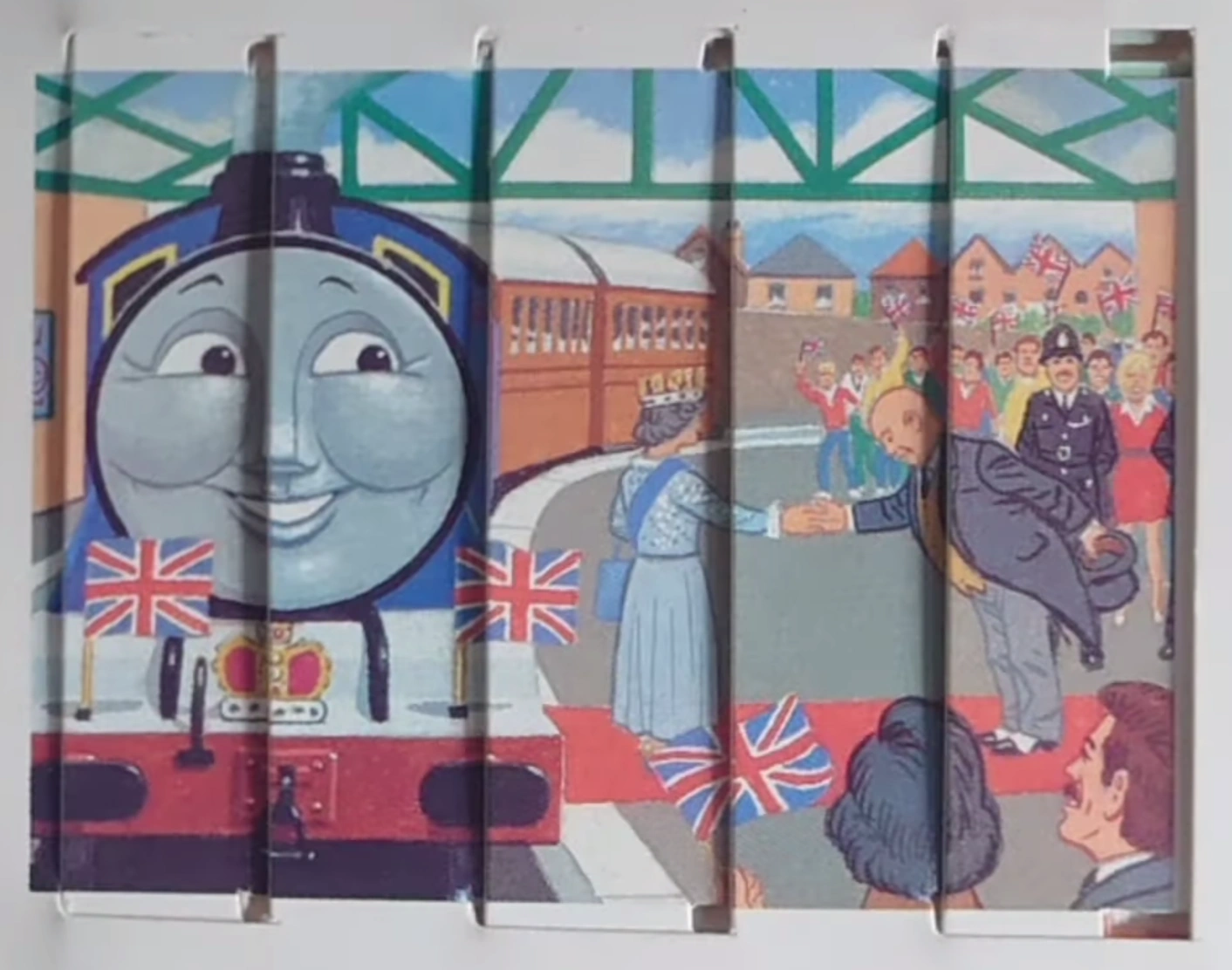
When I originally watched most of these episodes it was on VHS tape rather than television broadcast. The episodes chosen for each tape were sometimes sequential blocks, other times chosen by a particular theme. There would be certain episodes of which I had more than one copy, with subtly different packaging. I do not recall them being labelled according to season or year, but it was usually possible to make an educated guess at which came earlier and which later on account of the technical details (narrator, lighting, colour balance, title sequence typeface) and also the narrative ones (how many characters were present and references to prior events). The one that left me confused was always Paint Pots & Queens, which still pretended to follow directly on from Down the Mine despite being three seasons later – with all the stylistic changes that entailed. Gordon and Thomas commence the episode rolling buffer-to-buffer, the former still wearing the winch on his footplate. Dialogue continues to suggest that their misbehaviour still awaits forgiveness with the Fat Controller, despite both of them interacting normally with him many times in the intervening years. One might advise to simply assume that this episode is set in its original position whatever the order of production, but Duck’s presence at the big station renders that impossible. Plus, placing this episode after with Thomas & the Special Letter feels like overkill – two celebration episodes back-to-back, the engines making a grand visit to London and the next day receiving one. Since each is the final chapter of its respective book it would have worked better to have either of them as the season finale rather than the low-key Mind That Bike!
The fifth season came in 1998, by which time Wilbert Awdry himself had died. Allcroft, harbouring ambitions of a theatrical film, decided to break away from the books entirely and write new stories herself, although she maintained the tradition of using real railway anecdotes for inspiration. The new episodes focused more heavily on action, especially crashes. Furthermore, where early seasons had limited the numbers of new characters to save model costs, subsequent ones added new engines for the purpose of being able to sell more toys.
Those theatrical ambitions eventually manifested in 2000 as Thomas & the Magic Railroad, a crossover between the normal series and its American framing device Shining Time Station. The film featured a mix of model animation and live action, with separate voice actors for each of the engines and a star-studded cast for the humans. Thomas the Tank Engine had been a huge international success up to this point, but this was the first real sign of failure: The film is largely regarded as an embarrassing flop, with an over-complicated story, poor visual effects, mismatched acting and an ill-conceived premise. Allcroft herself complained in 2007 about how many major changes were made between her original script and the finished film, including the editing out of the main antagonist P. T. Boomer because test audiences found him too scary. Mara Wilson, who had played Lily, retired from acting for twelve years afterwards. She later commented that she enjoyed working on the film but was disappointed at how much of her part was cut out. Furthermore many of the models were damaged in transit across the North Atlantic. The film’s failure was a blow to Allcroft’s career and she stepped down as company director, remaining only as executive producer. The Britt Allcroft Company was then renamed Gullane Entertainment.
Season 6 aired in 2002. The series was filmed in 16:9 rather than 4:3 for the first time and a new title sequence montage was created. In addition to the twenty-six episode of the season, Allcroft planned a spin-off series called Jack & the Pack. Its first season was also supposed to have twenty-six episodes but only thirteen were ever filmed, partly due to money issues and partly due to Gullane being bought that year by HiT Entertainment, who also produced Bob the Builder and deemed the two programmes too similar.
Season 7 aired in 2003. A change of name took effect at this point, with “Thomas the Tank Engine & Friends” shortened to “Thomas & Friends”. The original title sequence was restored (albeit cropped, and with the new logo superimposed over the old one). Allcroft was by then further relegated to non-executive director. This series is notable for the introductions of Emily, a Stirling Single and Spencer, based on Mallard. After production Allcroft, Mitton and a host of other important figures decided to leave the series, thus ending what would later be dubbed the Classic era.
Even though they had already purchased the series before 2003, Season 8 (2004) is seen as the beginning of the HiT era, for it was a this stage that their signature changes were implemented. A major artistic and technical retool of the series saw BetaCam videotape replace 35mm film, an entirely new musical score and credits sequence, episodes lengthened from 270 to 420 seconds each and animated “Learning Segments” inserted between the episodes themselves. The large locomotive ensemble cast that had built up over the previous twenty years was compressed to an octet of the most important characters while the rest were demoted to minor supporting roles or excluded altogether. The composition of the “Steam Team” was itself controversial as HiT’s desire for a female character in the main cast saw Emily promoted at the expense of Duck. A change to broadcast schedule also occurred at this point, with two episodes airing per week instead of one per day.
2005 was the franchise’s 60th anniversary year, and HiT commemorated it with Calling All Engines! The hour-long home video special was released alongside the airing of season 9 and depicted an escalating conflict between the steam and diesel engines, as well as the rebuilding of Tidmouth Sheds to include a seventh berth. HiT insisted that Lady and Diesel 10 be included in the plot, for their merchandise had sold well despite the 2000 film’s failure. The characters were this time depicted without any magical qualities and the writers did not consider the special to be a sequel.
In 2008, between the eleventh and twelfth seasons, another special was released: The Great Discovery. This was the last to rely solely on physical models with resin faces. By this point new brass models had been built for the main characters to replace the ageing perspex ones. Season 12 used CG animated faces for the vehicles and fully CG models for the humans, meaning that characters’ lips could move for the first time. This was also the time that Sharon Miller, already script editor since season 9, became the head writer for the series, hence the next few seasons sometimes being called the Miller era. Episodes from this period are characterised by lots of rhyming and alliterative narration and plots built on the “rule of three” formula. Tonally they were aimed at very young children and visually they portray the vehicle characters moving and stopping with unrealistic agility.
2009 was an off-year for the franchise with no new episodes released, but it did see the debut of the third special Hero of the Rails in which the Japanese engine Hiro is found and restored. This special also introduced the Sodor Steamworks, with narrow-gauge tank engine Victor and mobile crane Kevin. This was initially conceived as another hybrid production, but budget cuts meant it would be unfeasible to keep maintaining the existing physical sets and models as well as building the new ones the story required. HiT therefore decided to abandon the physical models entirely and switch the series permanently to full CG animation. Also from here on all characters would have individual voice actors instead of the narrator reading their lines. The standard length of an episode was further increased to ten minutes.
Series 13, produced at the same time as the special, aired in early 2010. From this point on, much like Top Gear, there would be a special to accompany each season. Here the chronology problem rears its head again: Frequently the special would introduce a new character to be either the protagonist or antagonist for that story, and then said character would appear in supporting roles for multiple episodes of the accompanying season, often then fading into obscurity as the next new character was then brought in, though rarely explicitly leaving the cast. It was sometimes the case, though, that the DVD of the special wouldn’t be released until after the corresponding season had already aired, which then made the character’s introduction redundant. A more general problem is common to a lot of programming, especially animated – the time taken to produce a block of episodes may well be greater than the time between blocks airing, with the result that multiple seasons are overlapping from a creative standpoint. Individual stories may be delayed or accelerated to broadcast for whatever reason and TV networks in different countries will make different decisions as to the broadcast schedule, with the end result that the orders in which stories are made, set, and shown may be drastically misaligned. This is especially the case with Christmas and other holiday specials, which obviously have to go out at the right time of year even if the rest of the season can be delayed indefinitely.
Another retool occurred in 2012 with Brenner replacing Miller as head writer and Arc Productions replacing Nitrogen Studios as the animators. Mark Moraghan replaced Michael Angelis as narrator, though the difference between their voices is much less noticeable than with Starr’s. The narrator’s role was significantly reduced to allow the characters’ speech and movements to carry the story more naturally. Plots in seasons 17-20 (sometimes called the “Brennaissance”) tended to be more sophisticated than those before and the new format allowed for finer subtleties in the interactions between characters, for purposes both comedic or dramatic. A lot of neglected classic characters were also returned to the main cast during this period and other parts of Awdry’s lore were incorporated – namely Ulfstead Castle and the Norramby family. The franchise also went another change of ownership this year, with HiT Entertainment bought up by the American toy company Mattel.
2015 was the seventieth anniversary of the franchise, which was celebrated with The Adventure Begins, a special that remade the first seven episodes of the series and re-adapted the first two books. Notable is that many details are presented differently to how they were in season 1, correcting some adaptation errors (James has his black livery this time) but creating others (Henry is in his new shape from the beginning). This overwriting led many to conclude that seasons 1-7 effectively exist in a separate continuity from season 13 onward, though nobody is quite sure which side of the boundary seasons 8-12 should fall. Another special, Sodor’s Legend of the Lost Treasure, was released that summer. Produced at some point in 2014, it starred John Hurt as the antagonist Sailor John, and introduced the miniature Arlesdale Railway and the Thin Clergyman (an avatar for Wilbert Awdry himself) to the TV series for the first time. This special was noted for its rather darker tone as John (essentially a second attempt at the PT Boomer character) engages in physical combat and even attempts to kill Thomas with dynamite.
Mattel took over as producer in 2016, and then some further changes were seen in 2017, with the twenty-first season and the special Journey Beyond Sodor: Edward moved out of Tidmouth sheds with the others ominously wondering who might take his place. More elaborate animation was used for jokes and for fantasy sequences, and the engines gained the ability to bounce their bodies around on their chassis to emphasise emotions – probably inspired by Chuggington. This season was only eighteen episodes long, with a further eight having been cancelled to make way for the next project. Five of them were eventually included in the next three seasons. Two Christmas episodes were released on DVD after season 21 that were produced as part of season 20.
Behind the scenes the franchise was running into difficulty, with all-important toy sales in decline and Thomas losing viewers to newer shows like Paw Patrol. Market research brought back an anecdote about a child they interviewed, who told them “Trains can go places but Thomas never goes anywhere.” In 2018 the company implemented yet another retool, under the brand of Big World! Big Adventures. This was to be the banner of both the 2018 special and seasons 22-24. The special features Thomas going on a trip all around the world so that through him the viewers can learn about other cultures. The ensuing series are split between standard episodes set on Sodor and episodes set internationally, with Thomas in-character narrating stories about what happened on his travels. By and large the latter stories follow the same formula (characters get lost, things go wrong, stuff breaks, shout at each other) but with multiple exotic locations as backdrops rather than just a small part of Britain. Again, it’s a lot like Top Gear. Yet another new theme song and title sequence was deployed, and the physics moved further away from realism with a lot more energetic and cartoonish movement by the locomotive cast, as well as at least one fantasy sequence in almost every episode. On the other hand, there was greater realism in the character designs, with the inclusion of rivets and other details that had long been omitted. Running alongside this is a trend towards having the specials and even some of the normal episodes written and advertised around more general ideas of what would excite children – castles, dinosaurs, pirates – with the railways themselves being a sideshow, which Mattel did not start but did compound with many scenes where locomotives dream of being anything else.
The “Steam Team” was reshuffled again in these years with Kenyan ED1 engine replacing Edward and Light Pacific Rebecca replacing Henry in a push for closer gender-balance. Toby was also demoted from the main cast though without much ceremony nor any replacement.
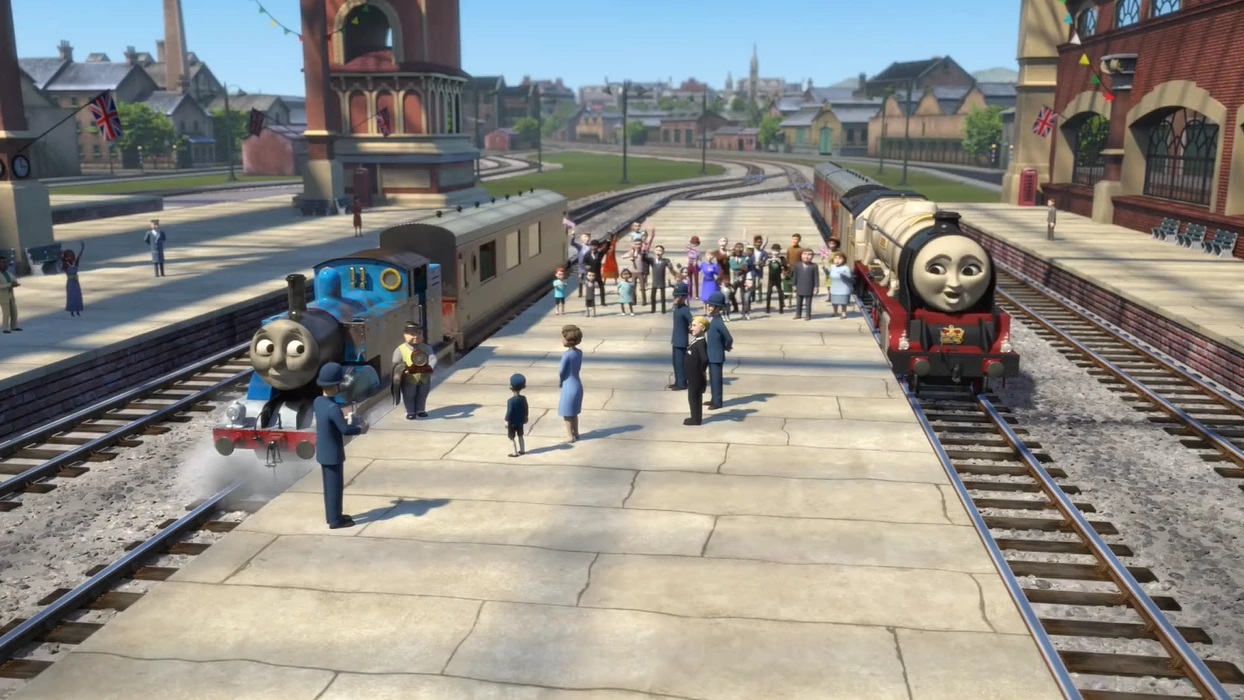
Following the production of season 24, a double-length (though not feature-length) special was commissioned for the franchise’s 75th anniversary. Entitled Thomas & the Royal Engine, it featured Thomas meeting Her Majesty again, this time with her son Prince Charles in tow. His son Prince Harry recorded a live-action introduction in January, shortly before he stepped aside from royal duties. The special aired on 2nd May 2020 (ten days before the actual anniversary), and was shortly followed by the last nine episodes of season 23. Season 24 then aired in three chunks from September 2020 to January 2021.
On 12th October 2020 Mattel announced some changes for the next season, which would arrive in autumn 2021. This in itself was not much of a surprise given that the series had been retooled several times already (indeed, I can’t think of any other series besides Doctor Who that gets changed so much so often). This one, however, was rather more drastic: the series was changing to 2D animation. This on its own was a more radical change than any that had been imposed before, but more was to come. On 27th January 2021, just six days after season 24 finished airing, another announcement was made: there would be no season 25, the supposed retool was actually a reboot. Thomas & Friends as made from 1984 to 2020 had ended, and in its place was a completely new series called All Engines Go! with a drastically reduced cast (including no engine crews at all) and a complete break of continuity. Also on this day a trailer for the new series was leaked online, which was much derided by all who saw it prior to its swift takedown. Whereas Big World! Big Adventures! had included so much extra detailing on the models, All Engines Go! swings the other way with extremely crude drawings that omit cab doors and coupling rods. To make matters worse it doubles down on the wacky animation, with engines now hopping about the screen like caffeinated squirrels. There have also been hints that Sodor will be made to feel like “every island” so as to be accessible to children of all nationalities. The new production will therefore lack any distinctive British identity. On top of all this the new animation style means another change of animation team, with Nelvana (again Canadian) taking over from Arc. There are a few personnel who had roles in Shining Time Station and ‘Magic Railroad, but from what I can find it appears that the vast majority of the former creative team has been made redundant.
The reaction to the new imagery was overwhelmingly negative, with parents reporting their children’s disgust at the sight and even Britt Allcroft herself commiserating with fans on Facebook.
Now, having spent four thousand words building up to this point, it is time to answer to initial question – why is The Royal Engine so significant? Well, although there still dozens of other episodes to be released, this was the last in production order and thus, with the reboot pending, effectively becomes the finale not just for season 24 but for the entirety of Thomas & Friends on television for the last thirty-six years. In hindsight, the birthday is made a funeral.
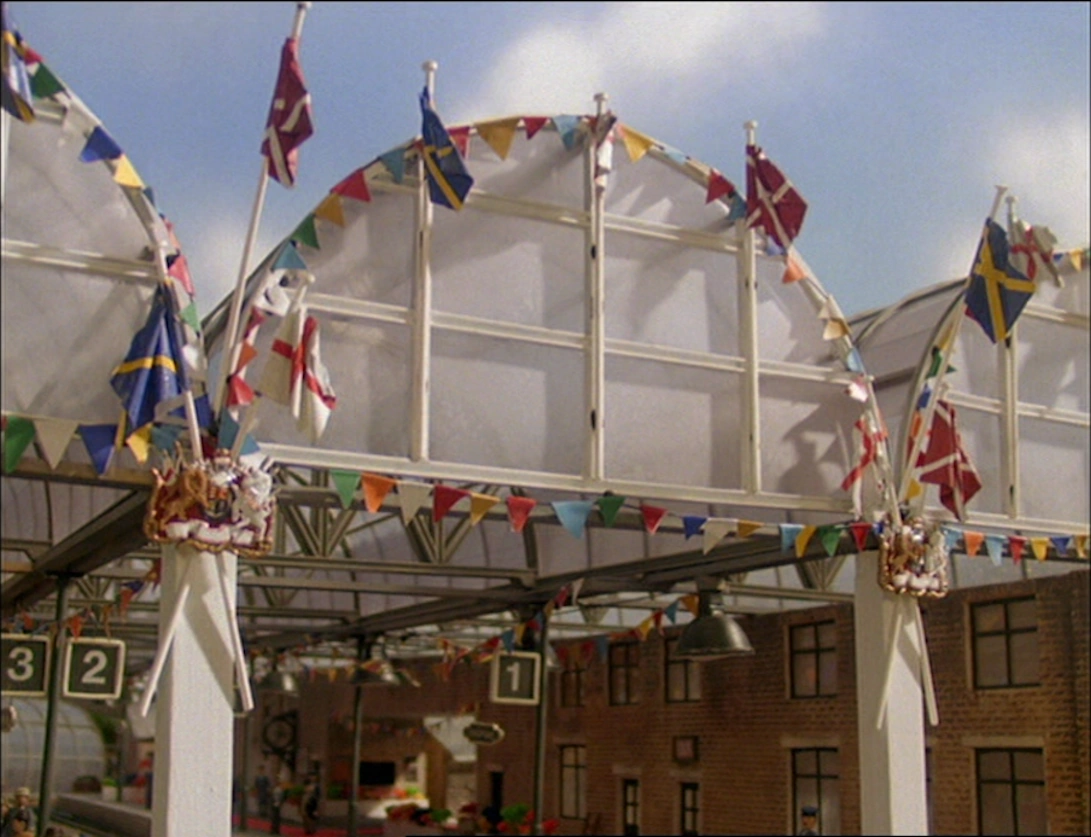
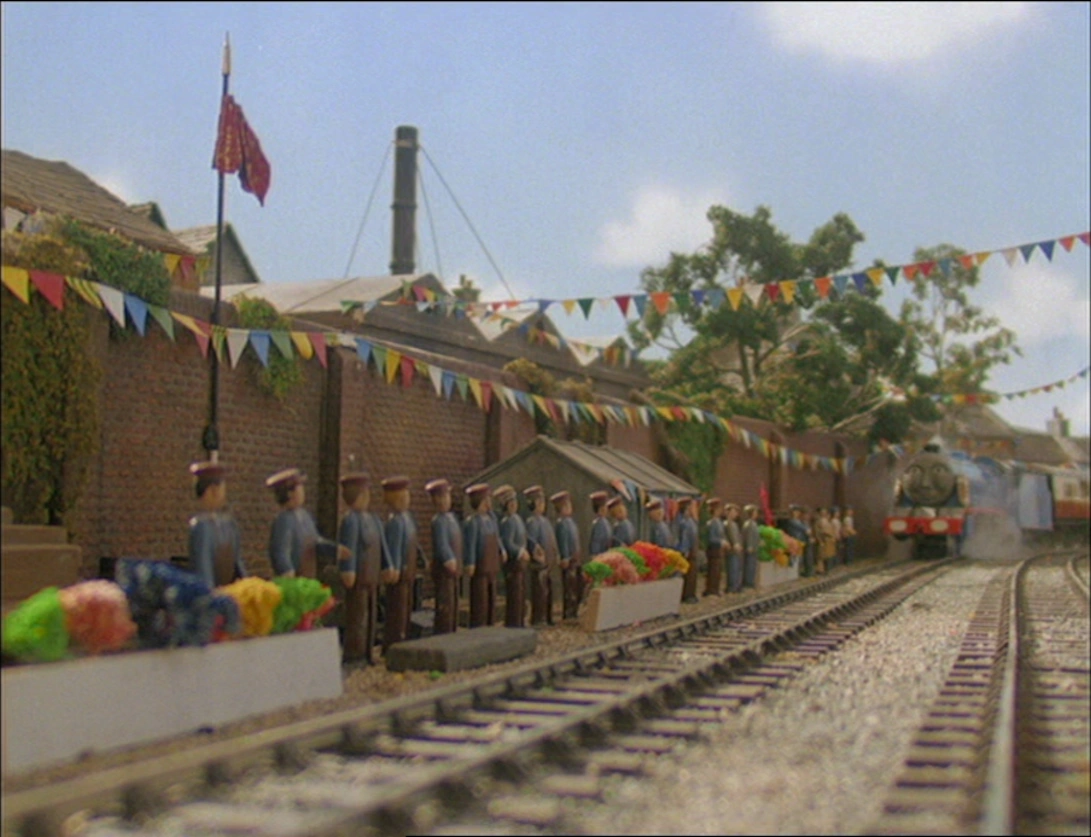
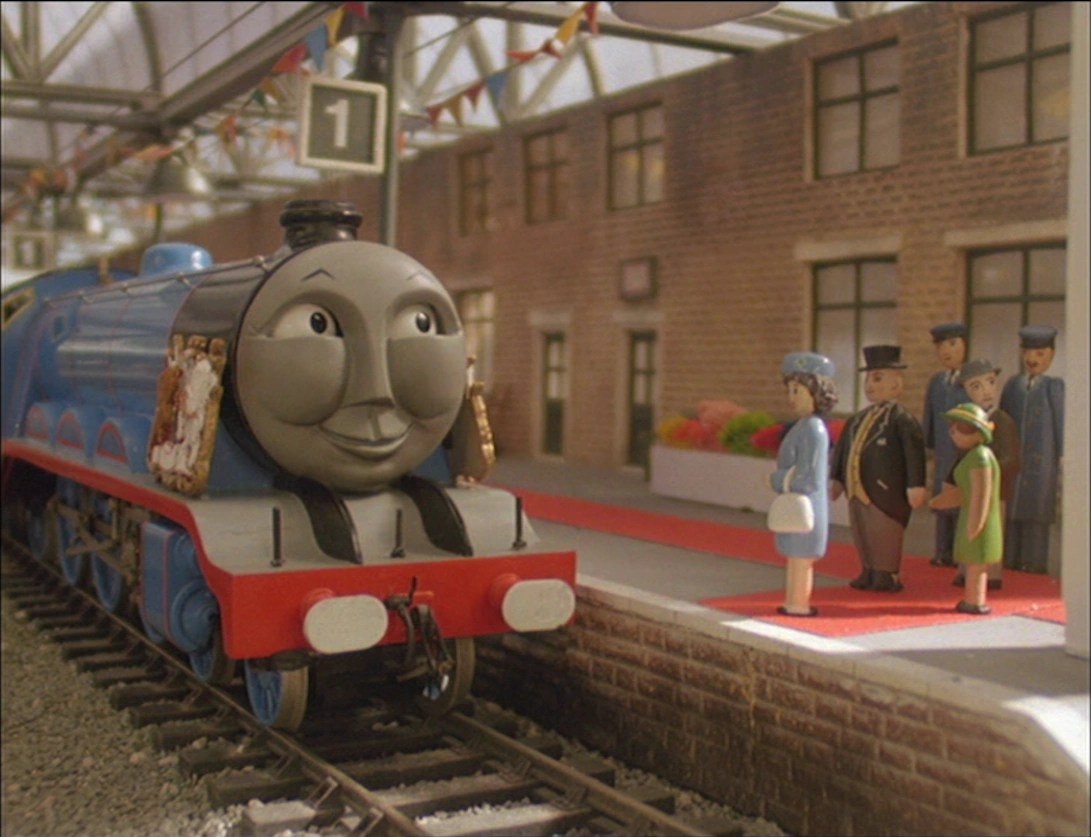
By comparison to the rest of late stage T&F, this special is surprisingly low-key. Too low, perhaps? There are no dream sequences and, though the bouncing is still present, no blatant physics-breaking either. The bombastic BWBA intro starts up but then fades away in a manner that almost feels like a subversive rebuke to the style of the last three seasons. Instead we have the Duke of Sussex sitting calmly in an armchair reading holding open the book (whose covers are very carefully styled to resemble those from The Railway Series, though the internal illustrations are just screenshots from the episode) and talking us briefly through the premise. This then fades back into the episode proper, with Percy hurriedly delivering a delayed letter to Knapford. It turns out to be a letter from Queen Elizabeth. She invites Sir Topham to Buckingham Palace the next day to receive a special award for services to the railway and says that Prince Charles has specifically requested Thomas be the engine to bring him. There is a morning montage of Hatt putting on his finest suit and Thomas being specially decorated. Of course, nothing goes to plan, with the bulk of the runtime being dedicated to them getting lost, scratched, and splattered with mud. The title character is Duchess of Loughborough, based on the Coronation-class Duchess of Sutherland. She breaks down and Thomas has to push her to the station, then it turns out she was pulling the royal train. The ceremony is then performed on the platform, Elizabeth (voiced by Miller) gifts Hatt an ornate clock and Charles lays a medal on Thomas’s left wheel arch. The Queen dubs him a “royally useful engine”, the crowd cheers, the camera pans out until a large Union Flag flops in front of it and then the credits roll.
Of all the other TV finales I’ve seen, I’d say that that The Royal Engine is structurally most similar to Meanwhile, the 2013 ending of Futurama. Rather than being a grand epic that ties up everything in one go, the episode focuses on just two of the main characters and is paced rather sedately. Other character arcs are given smaller individual closures in the episodes leading up to it (Zoidberg finding love, Emily getting an official number) so that the finale is not overloaded. Indeed, the other main characters only have brief cameos in the first five minutes. Of course, there is still time to chuck in a great many references to earlier episodes. There is even a last-minute canonisation of Gordon Goes Foreign, with Henry teasing him for getting London stations mixed up.
There are parts of it that feel a little rushed – the route to London is surprisingly quiet, with Victoria station and the space around it being almost deserted but for a few dozen cheerers. There is some irony that this episode, finished shortly before the pandemic hit and set vaguely in the 1960s, predicts the eerie emptiness of public space under lockdown and the barely-quorate versions of public ceremonies thereafter. I also think that the royal characters don’t look or sound much like the real ones, and that Charles’s lines about Thomas’s travels around the world and environmental efforts feel a bit shoehorned – appropriate for the real Charles as an adult but really nothing to with the stories Awdry wrote.
Futurama was cancelled and uncancelled many times, with the result that there are several episodes intended to serve as finales in case it didn’t come back. The Thomas franchise never had that problem, but there are several episodes that finales for each section of the series before the next retool hit: The Classic era closes with Three Cheers for Thomas, essentially a remake of the much-beloved Thomas & Bertie. HiT’s model series closed out with Best Friends which, while not really referencing much, evaluates the way two main characters relate to each other. Sharon Miller as writer and Nitrogen as animator finish on either Happy Birthday Sir! (by production) or The Christmas Tree Express (by broadcast). The former has some character stuff for the Fat Controller, the latter is a cavalcade of elements introduced during Miller’s tenure including the final appearance of Misty Island and the logging locos. It’s hard to judge where season 21 properly ends due to all the shuffling, but A Shed for Edward was the last made and it effectively retires the character from the main cast.
Thomas’s Animal Friends, the last to be aired, has no qualities that mark it out as the conclusion of anything larger than itself. The Royal Engine, on the other hand, harks back to Paint Pots & Queens by Her Majesty’s presence as well as The Fat Controller’s Engines by Thomas getting damaged on a trip to the mainland and only just arriving in time. Prince Charles’s inclusion is symbolically very important here, for he delivered the closing line in Centenary, Christopher Awdry’s very last chapter of the books.
All in all, I think that this special does an okay if imperfect job of finishing off this enormously successful and beloved series. It wasn’t as big as The Adventure Begins or any others in that line, but adequate for its intended purpose and many other shows have ended on worse. That being said, I have nothing but pessimistic dread for what is to follow.
First, on the animation: Wilbert Awdry had been keen for all his characters to closely resemble real locomotives, to the point of occasionally writing whole stories (e.g. The Flying Kipper, Thomas Comes to Breakfast) solely to explain changes in their appearances. He had disputes with at least two of his illustrators due to what he perceived to be their negligence of railway realism. Early attempts at adaptations were rejected – a live BBC airing of The Sad Story of Henry was condemned due to Henry derailing and a human hand needing to come into shot to right him. An approach by Andrew Lloyd Webber in 1973 was rejected because he wanted too much control of the franchise in order to secure American investment, to which Awdry said “Once the Americans get hold of it the whole series would be vulgarised and ruined!”.
It wasn’t until 1979 that Britt Allcroft proposed her series to him, and then 1981 that she was able to put it into production. Cell animation and stop motion were both turned down, eventually settling on live action with moving railway models. All of the lines and narration were done by the same voice, evoking a parent reading the story to their children. There was little else like it before or since. Scenes were shot with a specially-designed camera using the same quality film as was used for cinemas. The music was also drastically different to that normally used for children’s programming. The Classic series was especially popular among autistic children, even beyond their fascination with locomotion more generally. The static faces which changed between shots to represent discrete emotional states allowed them to process the scene far more easily than with most other media, while the genteel pace of the action (with movement on predictable patterns) and stillness of the scenery avoided the sensory overload they would suffer from faster, flashier programming. All that being said the early episodes were never flat – characters were capable of witty, often snarky, conversation and could call on broad vocabularies when the situation demanded it.
Of course, HiT’s takeover removed much of the cinematic quality in both the visuals and the music, then the switch to CG inevitably changed the nature of how characters expressed themselves. Still, Nitrogen and Arc clearly put a great effort into ensuring that their digital models resembled the old physical ones as closely as possible. Mattel, by contrast, have spent the last four years engaging in a race to the bottom which has now culminated in obnoxious, low-grade, hyperactive baby crack indistinguishable from any other children’s television. Press releases have said that two seasons have already been commissioned, each consisting of fifty-two 11-minute episodes and a 60-minute special, twice the output rate of the previous series. At that speed, it’s unlikely that artistic quality will see much attention.
Second, on the characters: The Railway Series was always an ensemble piece. Thomas was not even first among equals, having the number 1 on his side only because Awdry found it the easiest numeral to draw. He was not the first character in the franchise, nor the one with the most detailed backstory, and plenty of books do not feature him – or any of the “steam team” – at all. For whatever reason he quickly proved to be the engine that most resonated with audiences, and so publishers pestered the author to put out more stories about him rather than the other engines, even to the extent of slapping his name in the titles of books which were really about other characters. The naming of the TV series shows the extent to which the general public recognised him individually rather than the stories as a whole. As the episodes diverged from the books the “& Friends” part of the title lost accuracy as writing attention increasingly focused on Thomas himself to the exclusion of many others, and in this too the Mattel reboot goes even further with plans to make him the main character of all 104 episodes.
It’s worth drawing attention at this point to the online community: Awdry’s stories and Allcroft’s adaptation have a combination of complex mythology with simple movements which render them abnormally well-suited for fan films. TRAINZ railroad simulator and various other virtual model software (sometimes even real model trains) have been a boon wishing to see and show others their take on the tales, from adaptations of stories Allcroft couldn’t afford or never reached, to originals in the same style, vast expansions of old stories’ details, new takes on the premise, deconstructive parody, and dystopian horror, alternative backstory and things beyond description. The writing quality of these has long been superior to that on the official TV series, and the visuals were steadily catching up as well. It’s nice to know that there is so vast a community dedicated to keeping the fire of the franchise alive even if the current owners are desperate to put it out.
Before I go it’s worth saying that there is a film underway by Quantum of Solace director Marc Forster. It is supposed to be a four-quadrant film with a mix of animation and live action to tell the railway story in a “modern and unexpected way”. I’m cautious about getting excited though, for it sounds suspiciously similar to a different film that was pitched more than a decade ago which was delayed several times and then quietly cancelled. For a very long time all the information we got about it was a few lines of synopsis and a poster that proclaimed “Arriving Soon” – about as accurate for the film as for anything else involving British trains. Also in the pipeline is An Unlikely Fandom by independent filmmaker Brannon Carty, though his own Twitter feed contradicts itself as to whether the release is in summer or fall.
When I began writing this article it was only meant to be a quick aside but it has turned out to be probably the longest blog post I have ever done. The effort to keep typing has taxed me for four days, but Thomas is so prestigious and has been so foundational in my life that I think he deserves it. Don’t you?
EXTERNAL LINKS
UPDATE (February 2022)
Meanwhile is no longer the overall finale of Futurama, as that series has been revived yet again with new episodes expected in 2023.

 Robert Hardman is no stranger to royal biography, having already penned quite a handful about Elizabeth II in the last decade or so of her life, including Queen of Our Times which came out in March 2022 as part of her Platinum Jubilee season and then in December of the same year was released again in a “commemorative edition” to update for the fact that she’d died. Now he moves into the present reign with a biography of her eldest son. I am a little confused about the title of this one as the British publication is called “Charles III: New King. New Court. The Inside Story”1 but on Google Books I can see that the United States version is called “The Making of a King: King Charles III and the Modern Monarchy”. I suspect the titles must be written this way for SEO purposes, or perhaps he just couldn’t decide which description he wanted so used all of them at once. It must be quite a fraught process to come up with a distinctive and meaningful name for a biography when you know that lots of other biographies will be documenting the same person and all competing to emerge in future history as the one definitive authority thereon. Most likely in the long run the general public (maybe academics too) will discard the pretentious subtitle and just remember it as “[AUTHOR] on [SUBJECT]” (e.g. “Jenkins on Churchill”) instead.


 The inevitable moment I and so many others around the world had long dreaded finally arrived tonight – Buckingham Palace announced the death of Elizabeth II. It is a blessing that she survived to see her Platinum Jubilee and the end of the pandemic, but also a disappointment that she missed her centenary.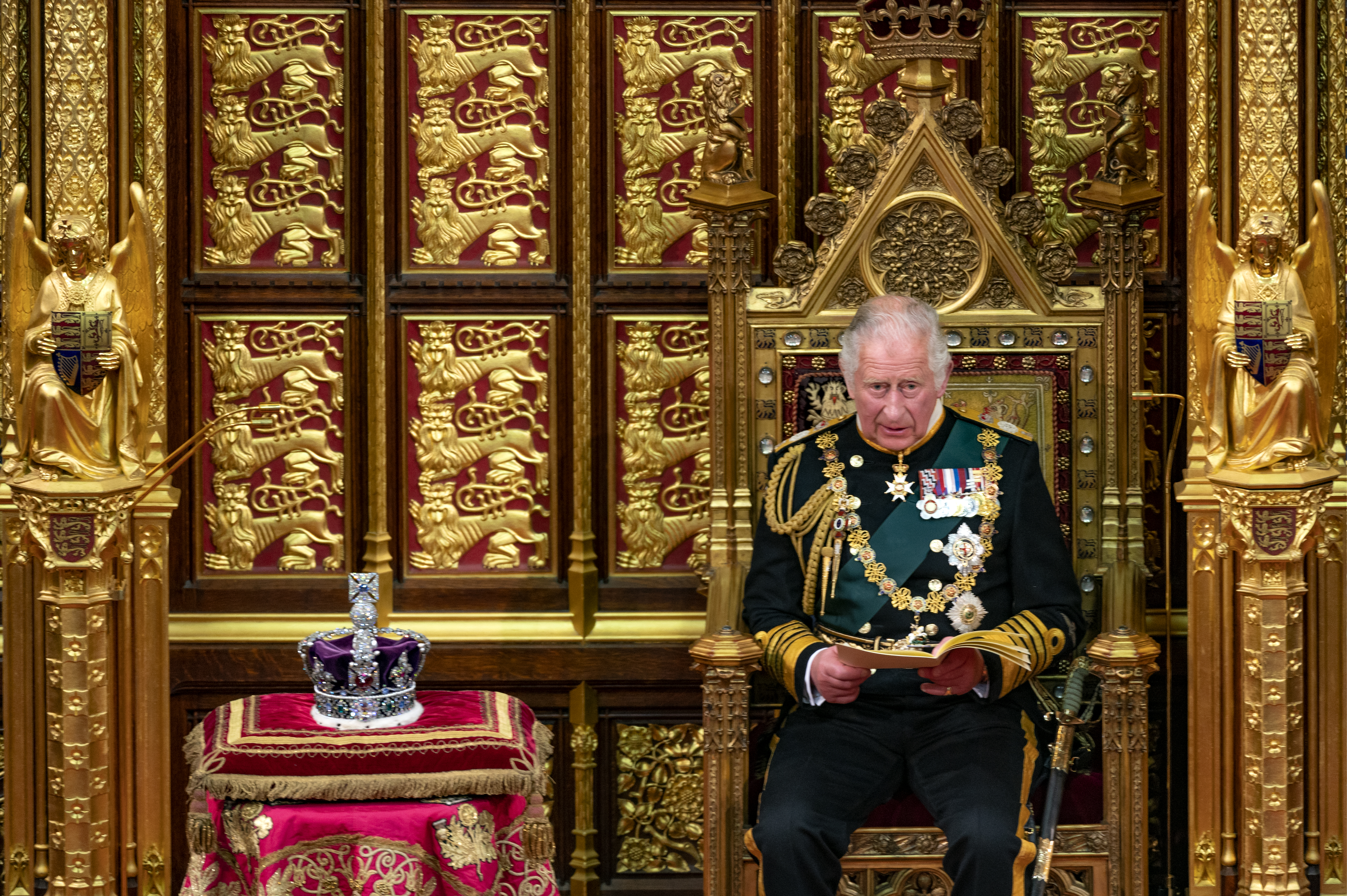



 Robin Stanley Taylor
