Arms and the Woman

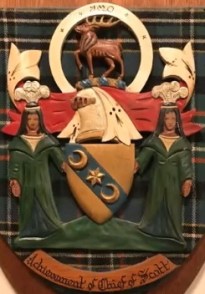
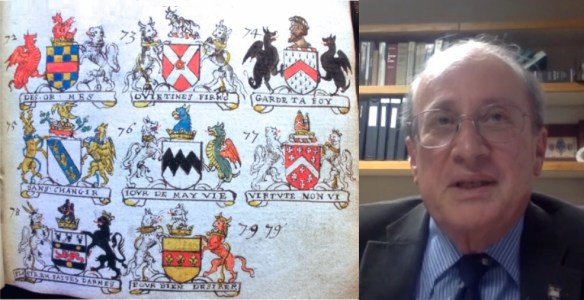
The heraldic achievements of the Baronesses Hornsby-Smith (left) and Miller of Hendon (right)

This evening I returned to the Yorkshire Heraldry Society for a virtual lecture by Duncan Sutherland, detailing the arms which were sought and borne by Britain’s female parliamentarians since 1958. This is far from the first time that he has made this presentation – in 2019 he performed it in person at the Palace of Westminster. Today, however, was my first time to witness it, thanks to the virtual format.

The majority of these cases were baronesses for life, but there were some others, including the posthumous grant of arms that was made to the late Jo Cox for display in the chamber of the Commons.

In other news, yesterday Ruth Davidson finally took her seat in the Lords, with the title Baroness Davidson of Lundin Links, of Lundin Links in the County of Fife. Also yesterday I made a disappointing excursion to Hull Central Library: some months ago I found in their online catalogue a copy of Debrett’s Peerage 2015 – a much more recent edition than the ones in the university’s library – but of course as the libraries were still under semi-lockdown conditions I could not actually go there to access it. Once the restrictions were lifted I went there hoping to scoop up hundreds of new(er) blazons only to discover that, while the ground floor of the library was open again, the reference section on the first floor was closed for a refurbishment and the staff had no idea when it would open again. Blast!

UPDATE (September 2021)

The Heraldry Society has updated the publication section of its website. Sutherland’s presentation can be read as a PDF.

Two Newcomers

The Lord Stevens of Birmingham was introduced to the upper house at noon today, having been ennobled yesterday.

This is the first introduction ceremony since Sentamu’s, and the first to feature David Vines White, who succeeded Sir Thomas Woodcock as Garter Principal King of Arms last Thursday.

Even though she left the Scottish Parliament two months ago, we are still waiting for Ruth Davidson’s peerage to be Gazetted.

On Ladies’ Garters

Dr Andrew Gray

Just a day after York’s presentation, I attended yet another heraldic zoom lecture, this time by Dr Andrew Gray for the Heraldry Society, concerning Ladies of the Order of the Garter. I made a post about this topic two years ago and advertised it in the chat box. Unusually the host actually drew attention to it, and my site traffic is already seeing an uptick.

The lecture began with the special statute enacted by the newly-ascendant Edward VII in 1901 to appoint his wife Alexandra to the order, followed by a similar instrument in 1910 for Queen Mary. Gray noted that this was unusual at the time but not unprecedented. In 1358, just ten years into the order’s creation, Edward III made Philippa of Hainault a lady of it. Gray mentions that the early gentlemen of the Garter had ladies in their company on ceremonial occasions, though their status – and even identity – is vague. In the period of 1358-1495 Gray identified seventy-four Ladies of the Garter in the records, most of whom were wives of the knights and/or members of the royal family. He notes that there were probably a lot more but the necessary records are missing. The ladies received robes, and wore the garter itself on the upper arm (whereas the men wore it on the leg).

There then followed an examination of the ladies appointed in that time, their arms, and their relation to the contemporary monarchs. One of those highlighted was Jacquetta, Countess Rivers, whom Gray noted had been made famous by Philippa Gregory. She was allegedly descended from the water goddess Melusine and gifted psychic powers, which the present monarch has presumably inherited.

The appointments of ladies of the order ended in 1495 with Margaret, Countess of Richmond and mother of Henry VII. Over the next few centuries there were five female sovereigns of the Garter but no female appointees until the sudden spurt in the twentieth century. There was also some discussion of the issues I raised in my aforementioned 2019 post regarding female crests and helms.

While I enjoyed the presentation it still left me a little confused – I don’t recall learning any explanation as to why the installation of ladies was discontinued in the sixteenth century, nor the precise distinction between plain “Lady” and “Lady Companion”. Still, at least I got to flog the blog rather effectively this time.

The society’s lecture series is taking a break now, and will return on 24th September.

The College of Arms in the Eighteenth Century

The early decades of the eighteenth century saw the College of Arms at its lowest point in its history, when its relevance and even its survival seemed to be in doubt. Very few grants of Arms were being made, heraldic regulation was increasingly ineffective, and the practices of its Officers were in decline. Appointments were sometimes made for the wrong reasons, so that Officers might not be there for their heraldic or genealogical skills. Could the century see a revival of the fortunes of this ancient institution? Could it find new venues for its activities, new areas of expertise, and new sources of revenue? Could heraldry adapt to the changing fashions and aesthetics of the Enlightenment and Romanticism? This talk will seek to examine and answer these questions.

So said the online invitation. Today’s virtual heraldic lecture was given by Peter O’Donoghue, York Herald since 2012. As the title implies, the lecture covered the ups and downs of life and work at the college from 1701 to 1800. As this one, unusually, has been uploaded to YouTube, I do not think it necessary in this instance to type out a long account.

Are You Equal To It?

Several times before now I have written of the frustration in locating up-to-date sources of heraldic information. For the last few years the latest edition of Debrett’s Peerage I could access was from the year 2000 and the latest of Burke’s was from 2003.

Earlier this week I found Debrett’s Peerage 2019 advertised on Amazon. Unusually it had the “Look Inside” feature enabled. Ordinarily this preview only allows one to read the first chapter, with some barely even getting through the title and contents pages. This one, however, had hundreds of pages included. That made it all the more annoying that so many of the early pages were spent on essays, anecdotes, company history, biographies of the royal family and explanations of the peerage system itself (the latter two generally not changing much from one edition to the next). For some time I feared that the preview would end before it actually got to the part for which I was looking. Thankfully that did not occur, and I got as far as Chorley before the page went blank. I was able to harvest previously-unknown blazons for more than a dozen recent-ish life peers and a few hereditaries as well. For those whose titles come later in the alphabet I had to think of alternative strategies.

The Baroness Hale of Richmond is one whose blazon I have sought for many years. Her arms, or rather the motto that goes with them, has been elevated to fame in certain media circles, particularly after her prorogation ruling. Despite this, the newspapers almost and press releases never actually showed a picture of her arms nor quoted any part of the blazon. As with Michael Martin, it leads me to wonder if none of the journalists have actually seen it either and they’re all just copying each other. When I spoke to her ladyship over Teams two weeks ago I considered asking her outright to find her letters patent and hold them up to the camera, but ultimately opted for a more lecture-relevant question instead. In fact I had seen her arms before, in August 2018 when someone on a forum somewhere (I cannot find it again) linked to a photograph of her lozenge, showing two scrolls in saltire between four towers in cross. Unfortunately the picture included no contextual clues to its authenticity, so when I recreated that image and it added to her Wikipedia page it was swiftly removed for lack of evidence. On the day of the prorogation ruling the heraldry subreddit discussed her arms using my image as their reference. From that thread one user (account since deleted) posted a link to a different illustration which included the motto and supporters (presumably a photograph of the letters patent), but which still omitted the blazon and any other contextual details so was no more useful for encyclopedic purposes. Still, it gave me an idea:

Google Books is variable in what it shows you – a book out of copyright usually has its full text available, but one still protected may show you only a small sample, the exact extent of which is at the discretion of the owner. A lot of books have a generous preview, others yield nothing at all. Debrett’s Peerage 2015 and 2019 were of the latter sort, but 2008 and 2011 allowed the “snippet view”, where if you search the text for a certain word or phrase it will bring up screenshots of those terms with maybe a couple of lines above and below. In Hale’s case I was fortunate to already know what I wanted to find and, upon typing “two frogs” into the small search bar, found it. I was amused to see that Debrett’s had translated the motto Omnia Feminae Aequeissimae as “Everything to the Most Just Woman” and not “Women are equal to everything” as her fans have widely quoted.

The Lord Tebbit was a similar case. I found a few scattered references to his coat of arms including a polecat – derived from what had originally been an insulting political nickname – but no further detail or illustration. Searching for “polecat” returned the blazon for his crest, supporters and motto, then searching for bits of those eventually got me the blazon for his shield. The Lord Brittan of Spennithorne’s arms were completely unknown to me, but when I searched for him by name the snippet showed the top of his crest. I guessed it was a sheep, then searched for “crest – a sheep” and found the full details.

All in all this is quite a cumbersome process but not entirely fruitless. I hope to find more soon.

It Mitre Be Good

Bowyer (left) and Burgoin (right)

My assault on the Eventbrite buffet continues with Crosiers, and Mitres, and Tiaras, Oh My: A Gamboling Journey Through Ecclesiastical Heraldry by David Bowyer. The session was hosted by Jason Burgoin, president of the Toronto Branch of the Royal Canadian Heraldry Society.

Logging on was difficult: I had expected the meeting to begin at 7pm as listed on the advertisement but then it became apparent that this was Toronto time, so for attendees from the British Isles it would actually be taking place from midnight. The first few minutes were a little tense as the audio quality was very poor and an unknown person let out several primal-sounding screeches that left the rest of us confused. Burgoin, pleading that “We are not IT folks.” advised us that the bandwidth would be conserved and quality improved if everybody not presenting would turn off their cameras and microphones, and indeed there was some improvement. When Bowyer began his presentation he was swiftly interrupted by a notice that the screen share feature was not on.

Bowyer’s presentation eventually got moving. There were 119 PowerPoint slides, each showing an illustration of the titular ecclesiastical objects either in real life or represented in heraldry. He explained the history and symbolism of all the different kinds of hats that could be placed above a clergyman’s arms and the other embellishments that could be placed behind.

After nearly two hours the talk concluded and Burgoin resumed the screen to announce other upcoming events. He was conscious that many overseas viewers had been forced to stay up very late and was keen to answer any questions before they started logging off en masse. There was some time left over for idle chitchat, with one Englishwoman commenting that she had never used Eventbrite before signing up to this two months ago, and that it wasn’t a problem for Brits be up past midnight but she didn’t expect it to go on until 2am. I, in my first verbal interjection to any virtual conference, remarked that one of the advantages of the virtual format was the ability to attend from in bed. Lyon then told us how annoyed he was that the College of Arms in England had granted arms to Bishop Seabury of Connecticut* even though he had been consecrated in Aberdeen. He then announced that he had recently granted arms to the Principal Presbyterian Theological College. They had requested that their supporters be “one man, one woman, one white, one black, one in one academic gown, one in another academic gown” and that “when I described it in the blazon they decided it wasn’t gender-neutral enough so I had to go back and look at new language to be able to express what the students’ aspirations were for the supporters which I managed to do.” I then asked how long the blazon ended up being, expecting that the effort to account for every demographic permutation would have consumed reams of parchment. Instead he replied “Very short, I ended up just blazoning it “two human figures one wearing X one wearing Y representative of inclusion” and they can do what they like with it after that as far as I’m concerned.” and then departed saying he had to preach in the morning. I noted after he had gone that I now had an unusual claim to fame – very few can say that they spoke to Scotland’s chief herald from in bed at 2am. Another member said “We’ll just have to invite Garter to one of these.” and indeed I have often wondered when I will get to see any representatives of the English college on Zoom.

I recognised some of the names, faces and avatars from earlier conferences – such as Liam Devlin. Alexandra Fol, David G. Scott, Richard d’Apice, Brian Abel Ragen and Douglas Anderson were also among the names, though I cannot be certain that they were the ones I have linked.

There are plenty more heraldry conferences to come, as well as plenty on other topics – such as Lady Hale of Richmond discussing her 2019 prorogation judgement. All in good time.

*It wasn’t clear from context if he meant Seabury’s personal arms or the official arms of the diocese.

Documenting Scottish Armory


Last year I noted that the Lyon Court was putting out an online crash course in Scottish heraldry. A major component of this was the list of all the blazons of defunct local councils. Yesterday I decided to take this ready-made armorial and convert it into a Wikipedia page. I intended this to complement the page that already existed on English counties, begun almost sixteen years ago.

The vast majority of the arms concerned had not already been illustrated, and for that matter the municipal corporations themselves did not have biographies to the level of their English counterparts – if at all. Fortunately there is a much greater degree of standardisation among the heraldry of Scottish local government, especially the regional councils of which all but one had the same background and differed only in their central charges, and so to create and upload a large number of emblazonments to fill the gaps was a relatively rapid process. There is a long way still to go, however, especially in finding blazons for present-day institutions.

On a partly-related note, earlier today I discovered a YouTube channel dedicated to Scottish Heraldry – Abarone’s Armorial by Ethan L. MacDonald, Herald of Clan MacKinnon USA. Though I had not seen the channel before I recognised the man’s face and voice from some of the virtual heraldic conferences I have attended over the past few months. MacDonald also managed to arrange a one-on-one interview with Lyon. By and large his content is not original – much like A Royal Heraldry it mainly reiterates the information already known to anyone who has read the relevant Wikipedia pages and the images are the familiar ones from the Commons. In particular I found it a little suspicious that he put out a video on heraldry from Tolkien’s Legendarium just a few months after I initiated the article on it. Still, it is nice to see more coverage of the subject in video form, as until a few years ago there was very little, and what did exist was overwhelmingly focused on the rudiments of heraldry from the middle ages or from the perspective of fantasists and reenactors, with precious little about the modern era. That Scottish heraldry is so much more likely than English to be documented on YouTube is also a bit of a mystery.

Sentamu Returns

It was not the norm for bishops to retire. They could be translated to another – preferably more senior – diocese, but one they reached the upper ranks they would expect to serve until death*.

Change began in 1928 when the octogenarian Randall Davidson, Archbishop of Canterbury since 1903, decided to step down. He had been one of the Lords Spiritual since his appointment as Bishop of Winchester in 1895 and two days after retirement was reintroduced to the upper house among the Lords Temporal (Baron Davidson of Lambeth, of Lambeth in the County of London). His successor, Cosmo Gordon Lang, retired in 1942 and was likewise ennobled. There was a break in the new trend when William Temple died suddenly in 1944**, but after that the next six (Fisher, Ramsay, Coggan, Runcie, Carey and Williams) were granted baronies after stepping down. The Ecclesiastical Offices (Age Limit) Measure 1975 imposed an obligation for each bishop to retire upon his seventieth birthday. Justin Welby must therefore relinquish his post on 6th January 1926.

The first Archbishop of York to resign voluntarily was William Maclagan in 1908. He died two years later as a commoner. Four of the next five Archbishops were translated from that office to Canterbury, three of them being ennobled as already mentioned. The exception was Cyril Garbett (1942-1955) who died forty-seven weeks after retirement, having accepted the offer of a peerage (reportedly Baron Garbett of Tongham) but not seen the patent sealed. Later Archbishops Stuart Blanch (1975-1983), John Habgood (1983-1995) and David Hope (1995-2005) were all ennobled shortly after the ends of their tenures.

John Sentamu‘s timeline was rather more drawn out. His retirement was announced on 1st October 2018 but did not take effect until 7th June 2020. When the dual honours lists were announced on 31st July there was some consternation that he had not been included. The list released on 22nd December did include him, but it was not until 27th this April that his barony was conferred. Today, nearly a year after leaving the house he was finally introduced. I had expected him to have other former bishops as his supporters (e.g. Carey of Clifton and Chartres) but instead he chose Lady Hale of Richmond and Lord Popat.

Two things struck me about the ceremony. First was the presence of Thomas Woodcock as Garter King of Arms, which surprised me as the College of Arms also has a retirement age of seventy and his is thus five days overdue. The second was that Sentamu, along with so many other peers introduced this year and last, got a little too close to the Lord Privy Seal.

Long before the pandemic it was the norm for the front benches on either side of the chamber to be left empty during an introduction ceremony. I presume this is to reduce the risk of the robed newcomer tripping over other peers’ legs. Ministers tend to wait by the doorway at the right of the throne (leading to the Content lobby) and greet the new peer as he leaves the chamber. This I have seen taking place at a great many introduction ceremonies and I find it quite alarming that often the new member gets right up to the leader of the house’s face without either wearing a mask and in many cases they even shake hands. That nobody else apparently notices this glaring breach of COVID-safety protocol is a real headscratcher.

*There have been rare cases of bishops being deposed for political reasons.
**He was the son of Frederick Temple, Davidson’s predecessor and thus the last in the regular line of those dying incumbent.

The Arms Business

https://dailymotion.com/video/k5stMU5mFy8GWpwTZ3z?autoplay=1

Two days ago I was contacted by Charles Matthews, former Wikimedian in Residence for the Betty & Gordon Moore Library at Cambridge, saying that Karl Wilcox, developer of DrawShield, wanted volunteers to assist with the next stage. Matthews contacted me because I was, in his mind, “certainly adept with heraldry software”. It was with a heavy heart that I told him the less glamorous truth: I do all of my heraldic art on PowerPoint and Paint. He said it was still interesting to know my methods, so I put together a video of the process by which I make each piece.

For those unfamiliar, blazon is heraldry’s own language, and DrawShield is an attempt at a translator tool. The software allows you to type a blazon into a small box, for which it then generates an illustration of the shield, comprising charges drawn from a bank from Wikimedia Commons. As anyone who has had to use an online translator will know, the subtleties of even an apparently-simple phrase can be difficult to teach to a machine. Drawshield occasionally has difficulty when sentences are factorised for word economy (e.g. noting the tincture at the end of a list of multiple charges, rather than separately for each one) or when it is asked to illustrate a charge not encountered before. Syntax also tends to be a difficulty as blazons are generally written with as little punctuation as possible and attempts to break up the long run-on sentences can drastically change the meaning.

It seems, based on the snippets given to me, that Matthews and Wilcox are attempting to rectify exactly these problems, with the former showing me a list of new charges sought for inclusion. He also boasts a substantial gallery of those he has already made.

More troubling, though, is the artistic element: To depict an aesthetically-pleasing shield requires careful consideration of the relative sizes of elements within the escutcheon. Sometimes the same charge may be depicted in different ways within the same emblazonment, tapering or stretching to fit the curves of the shield. Furthermore an asymmetric charge may have a centre of gravity which is distinct from its centre of width, requiring careful spacing. These decisions are too fine and too subjective for the computer, which instead drops out coats with a lot of empty background and charges too small to properly see. The end result is often an image that is technically correct but looks subjectively cheap and inauthentic. The main advantage, of course, is speed – even my relatively crude pictures take 20-40 minutes depending on complexity while those of Sodacan or RS-Nourse must take a far longer time, but DrawShield can spit out multiple coats of arms in a minute. It would therefore be a very useful tool in filling any gaps or catching up on backlogs in instances where blazons are known but images have not yet been added. I would not, however, recommend it as a permanent solution for the arms of anyone whose page is viewed with a serious degree of regularity. Matthews says “It would be great to work on a reference collection for heraldry that was uniform.” but compared to the works that already exist I fear such uniformity would represent a levelling-down rather than up.

The Gunpowder Plotters – Gentlemen all

Earlier this evening I attended yet another virtual lecture, this time by Martin Goldstraw for the Yorkshire Heraldry Society. As the title implies, the lecture concerned the attempt by a group of Catholic conspirators on 5th November 1605 to thirty-six barrels of gunpowder beneath the Palace of Westminster while James I was performing the state opening of Parliament, then provoke a revolution which would install his daughter Elizabeth (later Queen consort of Bohemia) as a pro-papist successor to the throne.

Goldstraw spoke at length about each conspirator in turn, giving not just the blazon of each man’s armorial bearings but also background details of the lineages through which he acquired them. He had digitally illustrated a great many of their shields himself and for this was lauded by many in attendance, but confessed that there were many other artists of ability far beyond his. I tried to plug my own uploads for Wikimedia Commons though I’m not sure if anyone noticed.

After the presentation had finished there was the usual question & answer session. This included some joking about whether Bridlington (where Goldstraw’s sister lived) was part of Yorkshire or “North Humberside”, which prompted Malcolm Lobley (Honorary Treasurer) to talk about the East Yorkshire signs being put up by residents sick of the Humberside name. That the transition took place twenty-five years ago appeared to have slipped his mind.

The College of Arms usually publishes quarterly newsletters in January, April, July and October. Last year it was just January and October. When they didn’t publish an April edition this year either I asked if if this represented a permanent change, but the York Herald (Peter O’Donoghue) reassured me that the college intended to revert to normal after the COVID setbacks of passed. Now, perhaphs for the first time ever, a May edition has been released. Usually my primary interest when reading these is to find an exemplification and blazon for at least one person who has a Wikipedia page. The star in this latest edition is Sir Ciarán Devane, chief executive of the British Council since 2015. Also mentioned, though frustratingly not elaborated, were grants of arms to the Baroness Stuart of Edgbaston and Lord Justice Leveson.

The head of the college is the Garter Principal King of Arms, an office held since 1st April 2010 by Thomas Woodcock, who must retire upon his seventieth birthday tomorrow. His successor has not yet been named. The two assistant kings of arms have also retired recently, as noted in the newsletter.

EXTERNAL LINKS