She Spoke to Serve

The late Baroness Boothroyd has fascinated me for as long as I have followed British politics, and hers was among the deaths I most dreaded.

Just last October, with my newly-registered library card, I took out her autobiography. There are eighty pages before she actually becomes an MP (and she goes into detail of her multiple failed attempts), describing her childhood in impoverished Dewsbury, then her time as a Tiller girl, then going into politics as a secretary to two Labour MPs, then going overseas to work for JFK. Even when she gets into parliament, her struggles are as within her own party as against the others – this being the age of entryism by Militant, which she was instrumental in rooting out.

Before the release of the 2018 parliamentary portrait series ,(and note that her image is the one used on the PDS blog) Boothroyd was one of the many prominent politicians for whom I struggled long to find a free photograph to use on Wikipedia. The only one on which I could lay my hands was a poor-quality screenshot from President Obama’s speech in Westminster Hall in 2011, published on the White House channel and thus public domain. The baroness is shown looking the wrong way, sandwiched awkwardly between George Osborne and Douglas Alexander. For the top (indeed, only) illustration in a prominent online biography it just wasn’t good enough.

The other big challenge was her coat of arms – one of my earliest such works. Unlike her successor Michael Martin, Boothroyd’s arms were widely photographed and shown online. Recreating the lozenge visually was easy enough, though it wasn’t until years later that I tracked down the text of the blazon to go with it. My first attempt was not well-received by the residents of r/heraldry, so it was one of the few of my graphics which I completely remade.

I never got to see how the community (or anyone else) viewed my second attempt, for within hours of her death being announced another user, ProfAuthor, had replaced it with his own vector graphic. It is technically superior, of course, but still it is disappointing to know that my own efforts are made redundant. Something similar happened with Sir Ernest Shackleton the last time he was in the news.

Heralds-a-Heralding

Today and yesterday, Charles III was formally proclaimed as King across the world, following the meeting of his accession council. This is only the fourth accession in Britain since the invention of the television, and the first time that the council itself has been broadcast live. Indeed, to my knowledge the only other time that any meeting of the council in Britain has been recorded was for the 1993 documentary Days of Majesty, and even then only a small clip was shown. There was supposed to have been a meeting (probably done virtually) some days ago for the swearing in of Liz Truss’s new cabinet, but the fading of Queen Elizabeth’s health prevented it. When that session will eventually take place is unknown. We are in an odd situation where the new monarch is having his accession confirmed by a set of ministers whose own office-holding has not been fully confirmed either. The ceremony was something of a consolation prize for Penny Mordaunt, who lost the bid to become Prime Minister but was instead appointed Lord President. She took the lead role in the day’s proceedings. Once the proclamation had been approved and various oaths had been taken it was read out by David White, Garter King of Arms, on the palace’s balcony. Not long later it was repeated by Timothy Duke (Clarenceux) on the steps of the royal exchange. The next day it was read by Robert Noel (Norroy & Ulster) at Hillsborough Castle. Joseph Morrow (Lyon) read it at Mercat Cross, as did Morfudd Meredith (Lord Lieutenant of South Glamorgan) and Thomas Lloyd (Wales Herald) in Cardiff. The other proclamations made around the British Isles, and the Commonwealth, are far too numerous to list.

Times such as this are a rare opportunity (others being state openings and, next year, the coronation) to see officers of arms in their full finery. They will be very busy over the coming months.

It can be taken as read that, following his ascent to the throne, the undifferenced arms of the United Kingdom, and those of all his other realms and territories, now belong to His Majesty. The arms of his siblings, niblings and cousins have no reason to change from what they were before. The arms of his wife, sons, and daughters-in-law are all due for upgrades.

Probable arms of Camilla, Queen Consort

Camilla, as Queen Consort, can now be expected to impale the Shand arms with those of the King. Given that William now has all of the statuses and titles that his father held a week ago, it is most probable that he will bear the same heraldic achievement, with which Catherine will impale the Middleton arms. It is yet to be seen (and there are conflicting precedents) of the Duke & Duchess of Sussex will similarly upgrade by swapping their five-point cadency label for one of three points, and removing the strawberry leaves from their coronets. The ever-present yet ever-uncredited Sodacan has already uploaded multiple illustrations of how he expects the revised armorial achievements to look.

Probable arms of Catherine, Princess of Wales

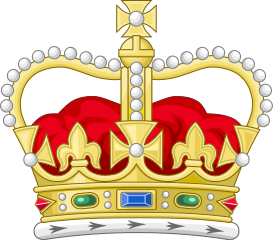
There is some controversy over whether Charles will change the heraldic depiction of the crown from St. Edward’s (depressed arch) to Tudor (no depression). There is a perception that St. Edward’s Crown is for queens and the Tudor crown for kings (due to the latter being preferred from 1901 to 1952) but this is not binding and St. Edward’s was regularly used by kings before Victoria’s reign.

FURTHER VIEWING

UPDATE (April 2024)

I’ve just finished reading Charles III: New King. New Court. The Inside Story by Robert Hardman. Chapter Three: London Bridge explains that the Truss ministry was supposed to be sworn in on 7th September with the politicians meeting in Westminster and Queen Elizabeth attending by audio-only link from Balmoral, but the meeting was cancelled at short notice when her health took a downturn.

UPDATE (September 2025)

Historian Jason Loch has published this article analysing the intricacies of the accession council and the legal status of Truss’s cabinet.

Demise and Disarray

The death of Elizabeth II is a time of serious grief for her family and her many peoples. It is also a time of mild confusion for public bodies, and of course Wikipedians. Here is a run-down of some of the changes that have recently been made.

The Monarch

The man long known as Charles, Prince of Wales is now King. For many years there had been speculation that he would take the regnal name George VII in honour of his maternal grandfather and great-grandfather, but shortly after his accession it was confirmed that he would indeed go by Charles III. There was a brief period when his page was at Charles, King of the United Kingdom before being changed to Charles III. There is an ongoing debate as to whether the article title should include “of the United Kingdom”. The side in favour argues that there have been many other monarchs over the centuries called Charles III from whom the present monarch needs to be differentiated. The side against argues that Charles is king of far more than just Britain, and that if you included one realm in his title you would have to include all of them, lest you imply that one is more important than another.

The Consort

Camilla Shand, at the time of her marriage in 2005, was not popular among much of the public still grieving Diana Spencer. So as to avoid appearing to usurp her legacy, she never styled herself “Princess of Wales”, instead going by “Duchess of Cornwall”. It was also suggested back then that, upon her husband’s accession, she would be styled “Princess Consort” (presumably derived from Prince Albert) rather than Queen. How true this proved to be was always a matter of public relations rather than constitutional law. By the start of this year it was clear that her reputation had recovered sufficiently to abandon that idea, and Elizabeth II in an open letter explicitly endorsed her daughter-in-law to be called Queen Consort. Currently all major media and government sources are very insistent on styling her “The Queen Consort”, rather than simply “The Queen” as other queens consort were before her. It is not yet clear if she will be described this way for the whole of Charles’s reign or if it is simply a temporary measure so as not to confuse the public while the late queen regnant is still being mourned. Again, there is dispute over whether her article title should include “of the United Kingdom”.

The Heir Apparent

In 2011 Prince William of Wales was ennobled by his grandmother as Duke of Cambridge, Earl of Strathearn and Baron Carrickfergus in the peerage of the United Kingdom. He has not ceased to hold these titles, but they are now buried beneath several others. The dukedom of Cornwall, in the peerage of England, is governed by a 1337 Charter instructing that it belongs automatically to the eldest living legitimate son of the incumbent monarch and the heir apparent to the throne, and that if these two statuses are held by different people then the title is left vacant. This means that all dukes (save Richard of Bordeaux) are deemed to have held the original peerage, rather than it being created anew each time. The Duchy of Cornwall, a substantial land-holding corporation in the south of England, is governed by the same. The dukedom of Rothesay in the peerage of Scotland is mandated by an Act of Parliament from 1469 to follow an identical succession, as are the titles Earl of Carrick, Baron of Renfrew, Lord of the Isles, Prince of Scotland and Great Steward of Scotland. The titles of Prince of Wales and Earl of Chester, by contrast, are not automatic. They are conferred by letters patent at the discretion of the monarch. It appears from news reports that Charles III has opted to do so almost immediately after coming to the throne, though I am still waiting to see this formally confirmed in the Gazette or the Court Circular. There was a short interlude in which the royal website and Wikipedia styled him “Duke of Cornwall and Cambridge”. I argued that it was poor form to include Cambridge while leaving out Rothesay, to which an anonymous user replied:

It would, but we don’t have a basis for that usage in Wikipedia practice. The hierarchy is very much What the Papers Say > legal/heraldic/formal/official names > anything that actually makes sense. I’m guessing there will be a followup announcement about his distinct style in Scotland and indeed in Northern Ireland, and maybe they’ll end up with something more logical and less clumsy. After workshopping every other possibility.

The Others

The accession of a new sovereign causes a reshuffle in the orders of precedence among the royal family. In the male order, Charles is naturally now on top. His sons William and Harry also move up, as do his grandsons George, Louis and Archie (their position before, as great-grandsons of the sovereign, was a little unclear). Andrew and Edward are demoted from sons to brothers, James and Peter from grandsons to nephews, and the Earl of Snowdon from nephew to cousin. The Dukes of Gloucester and Kent and Prince Michael are unaffected. On the female side Camilla achieves supremacy, followed by Catherine, then Meghan, then Charlotte, then Lilibet, then Sophie, Anne, Beatrice, Eugenie, Louise, Zara, Birgitte, Katharine, Marie-Christine, Sarah and Alexandra.

The styles and titles of Charles’s descendants are also upgraded (though those of his siblings and niblings are not diminished). William and Harry both gain a definitive article in their princely titles. George, Charlotte and Louis are now “of Wales” rather than “of Cambridge”. There has, of course, already been a famous Princess Charlotte of Wales, so until an alternative solution emerges their Wikipedia pages must be differentiated by the awkward use of years in brackets. Archie and Lilibet, as children of a younger son of the sovereign, now qualify as royals under the terms of the 1917 letters patent. They could now correctly be styled as “His Royal Highness Prince Archie of Sussex” and “Her Royal Highness Princess Lilibet of Sussex”, though no move has been made in that direction so far. The situation regarding the Earl of Wessex’s children remains ambiguous. Charles could, of course, amend or revoke the letters patent however he wishes, but there has not yet been any indication in that regard.

The dukedom of Edinburgh, earldom of Merioneth and barony Greenwich, which were conferred by George VI on his daughter’s fiancé Philip Mountbatten in 1947, and were then inherited by Charles in 2021, have now merged with the crown. Any of them can be bestowed anew on whomever His Majesty chooses. His brother Edward has long been presumed to receive them next, but no decision has been taken at this time.

Under the Regency Act 1937 Camilla (consort) and Beatrice (fourth adult in line) have become Counsellors of State.

The office of Lord Great Chamberlain of England (not the same as Lord Chamberlain of the Household) has automatically transferred from the 7th Marquess of Cholmondeley to the 7th Baron Carrington. The former therefore loses membership of the House of Lords under Section 2 of the 1999 Act while the latter gains it. What happens to the place he already held among the ninety elected hereditary peers is still to be determined.

The Courts

The Queen’s Bench Divisions of the High Courts of England & Wales and of Northern Ireland, as well as the Courts of Queen’s Bench for the Canadian provinces of Alberta, Manitoba, New Brunswick and Saskatchewan, have all been renamed King’s Bench. The status of Queen’s Counsel in Australia, Britain, Canada and New Zealand has likewise changed to King’s Counsel, and all who hold it have had to amend their post-nominals accordingly. Only last month I created a new template for judges of the Queen’s Bench Division and had scrupulously added the specification to each of their infoboxes. Now I have had to change all of them. Still, it helps boost my edit count I suppose.

UPDATE (March 2023)

A few months late but better than never, the Palace now confirms that Archie & Lilibet have princely titles, as well as that Edward has become a duke.

The Late Queen

The inevitable moment I and so many others around the world had long dreaded finally arrived tonight – Buckingham Palace announced the death of Elizabeth II. It is a blessing that she survived to see her Platinum Jubilee and the end of the pandemic, but also a disappointment that she missed her centenary.

Last year, shortly after the death of her consort Philip, I blogged an extract from my grandmother’s writings, concerning the time she spent in Malta with then-Lieutenant Mountbatten. I sent a letter about such recollections to his widow. Some weeks later I received a thank-you note from Mary Anne Morrison, Woman of the Bedchamber.

I would have liked to be able to recall a more direct interaction with Her Late Majesty, but sadly my only in-person encounter was a drive-by glimpse in 2017. My time with the new monarch has been similarly brief – I once got a wave from him at the Valley Gardens in Withernsea in July 2013.

More words will come when I have had time to compose them.

Double David

For a while now the Supreme Court of the United Kingdom has had two vacancies, caused by the retirement of Lord Lloyd-Jones and Lady Arden of Heswall in January. Yesterday it was announced that appointments had been made: Arden’s place is to be taken by Sir David Richards, formerly of the Court of Appeal of England & Wales, while Lloyd-Jones’s successor is… Lord Lloyd-Jones.

The reason for this bizarre phenomenon is found by looking at legislation relating to mandatory retirement ages. The Judicial Pensions Act 1959 set the retirement age for people entering the judiciary thereafter at 75, though it was not binding on those already holding office by then (so Lord Denning and Lord Cameron continued until ages 83 and 85 respectively). The Judicial Pensions and Retirement Act 1993 lowered this to 70, but again was not retroactive so that those who had held judicial office before 31 March 1995 were grandfathered in. Lady Arden was the last such grandfathered member of the UKSC. The last overall was Sir James Holman, appointed a judge of the Family Division (EWHC) on 18 March 1995, who retired on 28 June.

The Public Service Pensions and Judicial Offices Act 2022 (which received Royal Assent on 10 March) raised the retirement age back to 75, and this time it was retroactive, so that those already in office can now serve an extra five years, and some who recently retired at age 70 (such as Lloyd-Jones and Richards) can come back for an encore.

Incidentally, I discovered these appointments through the Twitter feed CrownOffFOIDs. The name is a shorthand for “Crown Office Freedom of Information Disclosures”. This is the Crown Office in Chancery, a small section of the Ministry of Justice responsible for the production and management of certain state and royal documents. Whether the office itself, or a private citizen, is operating the Twitter account is not clear. The output includes photographs of the Great Seal of the Realm as well as many of the different types of document to which it may be attached. There are writs, warrants, patents and proclamations of a great many kinds, including the proclamation of the present monarch’s accession, which the Tweet notes is not as physically impressive as one might have expected.

EXTERNAL LINKS

Lyon Lectures

Video

A downside of the fading of the pandemic and return to normalcy is that a lot of the institutions which had taken to putting on virtual meetings have now reverted to doing them in person only. Since these events are in many different locations around the world, far away from each other and from me, my ability to attend is severely limited.

One particular frustration has been been the Lyon Court, which for the last few months has been commemorating the 350th anniversary of the Lyon Register. Many times I have seen these lectures advertised on EventBrite, but I have not been able to go to them.

Now, belatedly, there is happy news, for the Lyon Court’s formerly-sparse YouTube channel has in the past fortnight seen a flurry of uploads from this lecture series. It is a little disappointing to have to catch up months later instead of taking part live, but getting to see them at all is still a great improvement compared to what would have been expected three years ago.

Developments in England have been less encouraging – there has been no newsletter from the College of Arms for this July. Upon inquiry, Portcullis told me that they hope to publish one later in the year. The heraldic decisions of Amess, Amos, Blair and Hoyle remain elusive.

A Note on the Leadership Race

As Boris Johnson’s premiership draws to an undignified conclusion, a new leader of the Conservative & Unionist Party is to be elected for the third time in just over six years.

When last that happened, Professor Norton blogged about about four different types of Prime Ministers: Innovators who want to implement specific and ambitious goals of their own design (e.g. Thatcher), reformers who want to implement the goals of the party overall (Attlee), egoists who are in it for their own fame (Eden, Wilson, Johnson) and balancers who are concerned with keeping the peace between rival factions (Macmillan, May). He has not claimed these to be definitive or exclusive, but merely the labels he finds most useful. Recently he has revisited the idea.

In my view the roles of innovator and reformer are a little difficult to distinguish, as political ideas are often credited to the prime minister who enacted them even when their invention was owed to another (e.g. much of Thatcherite thinking was actually the product of Sir Keith Joseph). It might be better to merge them into one category of ideologue.That of balancer more obviously stands apart as someone less ambitious about specific goals and more concerned about overall stability. Egoist, of course, is something that few politicians would admit of themselves and which often comes across as a slur (not that it is untrue).

At present the nomination window has yet to formally open let alone close, so the field is still prone to change, but let us take a look at those declaring so far:

  • Kemi Badenoch (Saffron Walden), lately a junior local government minister
  • Suella Braverman (Fareham), current Attorney General
  • Jeremy Hunt (South West Surrey), current health committee chair
  • Sajid Javid (Bromsgrove), lately health secretary
  • Penny Mordaunt (Portsmouth North), a junior trade minister
  • Grant Shapps (Welwyn Hatfield), current transport secretary
  • Rishi Sunak (Richmond Yorks), lately Chancellor of the Exchequer
  • Elizabeth Truss (South West Norfolk), current foreign secretary
  • Tom Tugendhat (Tonbridge & Malling), current foreign affairs committee chair
  • Nadhim Zahawi (Stratford-on-Avon), current Chancellor of the Exchequer

At present Sunak and Truss are perceived as most likely to make the final ballot. Sunak seems to be positioning himself as a balancer. He wants to be perceived as a safe pair of hands and broadly popular among the public. Truss is going more for the ideologue side, particularly those who had favoured a harder departure from the European Union. Both are obviously egoists at heart, given that both appear to have registered their campaign websites some time before there was any hint of Johnson’s resignation. Concerns have long been raised about Truss spending government money on her own publicity, while Sunak seems to have hired a social media specialist to improve his personal brand.

Among the other candidates, Mordaunt and Tugendhat might be considered together. Their support (and that for defence secretary Ben Wallace, who was the front-runner before he ruled himself out) seems to come from the same source – a desire to clean up the party’s image and get politics back to normal. The quest for them is less about any specific policy goals and more about cleaning up the party’s image. They are seen to have demonstrated competence in their roles so far (a rare treat in modern politics) and avoided the scandals plaguing those at the top. Their military backgrounds are likely a large part of their appeal.

Javid and Hunt are somewhere in between. Hunt was the runner up in 2019 and has stayed out of Johnson’s government, so is a champion for the opposing faction (especially Remainers). Javid is more closely associated with Johnson but not seen as a lackey to the extent that Sunak or Truss are. Both are well-established within the parliamentary party so probably seek the same safe-hands image, as well as leaning on their reputations as businessmen.

Badenoch and Braverman both have fairly low national profiles which they are probably hoping to raise. They are unlikely to win but may be securing higher offers in the new cabinet or the next leadership election, whenever that may be. The former is well regarded for her chamber and studio performance, and promoted as a competent officeholder, whereas the latter seems to be favoured more as a stalking horse for an economic sect of the party.

That leaves Shapps and Zahawi, whose analysis must be very carefully phrased. Like Hunt and Javid they both have business backgrounds, but these may prove more a hindrance than a help. Shapps has several times attracted controversey over the conduct of his companies as well as denial of operating them under pseudonyms while serving in the Commons. In late 2015 he had to resign from the government due to alleged negligence in handling bullying claims within the party. He’s even been caught editing his own Wikipedia page to remove inconvenient details. Zahawi is distrusted by some in the party for having accepted a great office of state from Boris Johnson immediately before demanding he step down. There have also been numerous concerns raised about his private business interests, and flags raised by HMRC over his tax affairs.

Without commenting on the veracity of these particular claims, it raises the prospect of another category of leader – the featherer. Like egoists, no candidate would outright admit to being one, but unlike them the goal is less to acquire personal fame and more to protect one’s personal interests – or those of a different person supporting them. This would be hard to use in an academic textbook though, since such nest-feathering typically does not become known until many years after the accession has taken place.

UPDATE (12th July)

Shapps and Javid have withdrawn, Rehman Chisti dipped his toe but shortly withdrew again. Badenoch, Braverman, Hunt, Mordaunt, Sunak, Truss, Tugendhat and Zahawi have qualified for the first round.

York and Swinfen

Late last night Professor Norton blogged about the decease of his noble friend Roger Swinfen Eady, 3rd Baron Swinfen. The photograph he used in his post was a screenshot of him in the upper chamber on 1st February 2018, taken from parliamentlive.tv, and displayed on his Wikipedia page. I know because I put it there.

Swinfen was not photographed for an official parliamentary portrait, nor in any other setting that resulted in an image released with a Wiki-compatible licence, so I had to resort to a Fair Use screenshot, as with so many other deceased parliamentarians, in order to illustrate his page. Thankfully the fact that both houses (and indeed the devolved legislatures) have recently gotten into the habit of publishing high-quality portraits under CC-BY-3.0 or similar means that such a trick will likely be needed less often in the future.

Of course, I also illustrated his coat of arms a year ago, and being the copyright owner for that graphic I released it under the same.

Last month Norton blogged on a different topic – the repeated floating by the government of plans to move the House of Lords to York. Not, to be clear, moving Parliament as a whole along with the royal households, the senior courts and the departmental headquarters of the executive, but just moving the upper house while leaving everything else in London. On Thursday he secured a lengthy debate in the chamber on that topic. The peers who spoke were unanimous in their savaging of their proposal. Many of the issues I commented on Norton’s post regarding the practical absurdities of a separation and the apparent powerlessness of ministers in the upper house to influence their Commons colleagues were repeated by members in their speeches. My favourite contribution was by the Lord Addington: Michael Gove’s comment was the sort that usually comes up halfway through the third round in a pub, that should be forgotten by the end of the fourth, and certainly not remembered the next morning.

The Deep Breath Before The Plunge

File:2022 Russian Invasion of Ukraine animated.gif

Almost two years ago, it was becoming clear in Britain and most other countries that the coronavirus was a global problem and not merely a regional one. There were cases identified in the UK in January 2020, through February its news coverage slowly outgrew that of Brexit, with stories of panic buying and rising case rates, but much of ordinary life went on. By mid-March the crisis had become unavoidable – the government was giving daily press conferences and many public places (including universities) were shutting down. Hand sanitiser dispensers and social distance signs popped up all over. Then, on 23rd, the entire country went into the first lockdown. The Britain at the end of that month felt like a wholly different world from what it had been at the beginning. For other countries the exact dates vary but the overall phenomenon is very much the same. In retrospect, there was something particularly surreal about the week of 17th-23rd, where for many it may have felt like an unplanned holiday, the full weight of the disaster looming but having yet to hit.

Now, after twenty-three months of on-and-off disease control, much of the developed world is transitioning from “pandemic” to “endemic” and returning to something like normality. In Scotland and Wales, all remaining COVID-induced restrictions are set to be lifted by the end of next month. In Northern Ireland they were lifted on 15th of this one. In England they went on Thursday. By superb coincidence, that was the same day the Vladimir Putin launched a full-on invasion of Ukraine.

Compared to the virus, this is neither as surprising nor as sudden – Russia has been in a state of war with its western neighbour for just over eight years, and diplomatic relations with other countries have been tense throughout that time, including many accusations of election meddling, political bribery and even assassination. Over the last few months the pressure could be seen rising. It was generally understood that war would properly break out at some point, but not exactly when. I remember Lucy Worsley’s Empire of the Tsars airing in early 2016, with quite a few online quips that the BBC wanted to get the filming done quickly in case war was imminent. Now, at the time of typing, it looks as if momentum has gathered – countries are, with varying degrees of enthusiasm, freezing (soon it could even be seizing) the financial assets of Russian businessmen and officials, as well as banning such people from their airspace. Sporting organisations look to ban Russia from their games. Britain is even sending troops to Eastern Europe. Other countries are doing likewise, or at least supplying equipment to the Ukranians themselves.

All that being said, we are not yet actually at war. British and Russian embassies to each other remain open, as do those in most other countries. It remains to be seen how long that lasts. The situation of the tens of thousands of Russian people living in Britain is perilous, as is that of Russian businesses trading here, or vice versa. This week’s invasion has been dubbed the largest conventional warfare operation in Europe since World War 2, and cries of World War 3 are widespread – and they are not meant jokingly this time. In the books that my late grandmother bought for me about the first two, it was mentioned that before the United States’s involvement, British and German ambassadors in Washington DC were competing with each other for American military contracts, and that private businesses within the allied and axis territories continued trading with each other (including weapons) right up until the declarations of war took effect. It will be interesting to see how much of that is repeated with Russia Today.

Speaking of Russia Today, RT continues to broadcast in this country. Suffice to say, its coverage of the invasion differs sharply from that of most other networks. The channel has been under review by Ofcom, and the leaders of the Labour and Scottish National parties have called for its termination. This has already been done in Poland and Germany, though the latter’s own public broadcasting service was reciprocally banned in Russia and there are fears that the BBC would suffer the same fate. I discovered RT in late 2012, at the same time as I was covering the Soviet Union for GCSE history. I appreciated the level of attention it gave to topics other channels thought less important, such as SOPA/PIPA/CISPA/ACTA and the Snowden revelations, as well as its documentaries on a variety of topics. If nothing else, it was good for checking the aspect ratio settings on one’s television, being for the time one of very few networks still airing in 4:3. All that being said, as a state-controlled news outlet it was never entirely trustworthy, and one could always sense that it was going out of its way to depict western democracies – and indeed “The West” as a concept – in the worst possible light and to encourage any kind of crankery that would undermine Russia’s strategic rivals.

As many are now pointing out, the true strength of Russian propaganda is online rather than on television, and that will be much trickier to sort out. The powers, rights and obligations of the large social media sites to intervene on political matters has long been controversial, as have measures to restrict the digital activity of Russia in particular. If the situation continues to escalate we may well see YouTube channels and Twitter accounts being suspended en-masse, as well as purges of suspicious users from message boards. As far as the pandemic comparison goes, we must currently be at least at the second or third week of March. I dread to think what the fourth looks like.

OTHER ANALYSES

  • Putin’s Power and Western Impotence by David Starkey. He says that Putin seeks to revive Tsarism not Stalinism, and that he understands that all authority derives from force whereas Western nations have forgotten this. Starkey condemns Angela Merkel for shutting down Germany’s nuclear plants in favour of Russian gas, as well as all European nations for letting their militaries wither. This being Starkey, he also takes potshots at 16-year-old girls.

UPDATE (2nd March)

RT’s television channel is off air and YouTube, along with other platforms, has hidden all of its videos.

Another Day, Another Death

James Brokenshire was not the most high-profile of British politicians. Overall he spent sixteen years in the House of Commons, including seven years as a junior minister in a senior department and three as the senior minister in two junior departments, twice having to resign from the government due to the lung cancer which ultimately ended his life earlier this month. Even so, the fact that he had been a cabinet minister, the relatively low age at which he passed and the level of public fear surrounding cancer, one would reasonably have thought it unlikely that his demise could be outdone in the eleven days before the house was to meet again. Then, to the shock of the nation and world, Sir David Amess was stabbed to death. MPs were already due to return from the conference recess today, but scheduled business in both chambers was abandoned in favour of tributes to Amess, with a service following in St Margaret’s Church. Brokenshire’s tributes have been postponed to Wednesday.

Something similar happened during the Easter recess – the death of Dame Cheryl Gillan on 4th April and of the Baroness Williams of Crosby* on 11th would have been the principal concern of their respective houses, had not the Duke of Edinburgh died on 9th. In that instance it was the social and constitutional rank of the departed that determined priority of mourning rather than the manner of death.

The most obvious comparison, made frequently by those who have spoken publicly in the last few days, is to the murder of Jo Cox a week before the EU referendum. There has even been a move to design a shield of arms for Sir David and place it on the chamber wall next to hers. Of course, the two victims had very different profiles – Cox was a Labour woman who supported remaining in the EU, Amess a Conservative man who favoured leaving. This is reflected in the different profiles of their killers – Thomas Mair was a white supremacist with links to the English Defence League, Ali Hari Ali is said to be of Somalian heritage and a suspected Islamist.**

Also distinguishing the two victims is the time they had spent in politics. As I mentioned before, Jo Cox was not well-known to the general public, having only begun her tenure in the House of Commons thirteen months prior. She could well have joined the shadow cabinet in the mass reshuffle later that month, and by this point she might even have been a contender for the party leadership, but back then she was a much a footnote as most of the other MPs from the 2015 intake. Part of what made her death so tragic was precisely that she died so young and so early in her political career, with so much potential thereby wasted. Amess, by contrast, had been an MP for almost long as the average Brit has been alive. Though never a minister, he was a creature of the house, serving on many important if low-profile committees as well as being involved in numerous campaigns and publications. Most in the political sphere knew his reputation, in contrast to Cox who was something of a cipher.

More broadly, the country must acknowledge the worrying frequency with which politicians and their entourages have been attacked (whether or not the attack succeeded in killing the victim) in recent decades, and consider how this can be rectified, both in terms of personal security to defend from those with evil motivations, and in the public attitude to politics that would encourage such evil in the first place. As the pandemic has shown this year and last, the kind of openness and accessibility required of parliamentarians can also be very dangerous to them in person, yet to abandon it can be very damaging to democracy as a whole.

EXTERNAL LINKS

*The speaker mentioned on 13th April that four other former MPs had died during the recess – Peter Ainsworth, Ian Gibson, Robert Howarth, Paul Marland.

**Almost immediately upon the announcement of the attack and the description of the attacker as a “British national” there were people denouncing immigration policy and calling for border closure.