The Nearest Exit

One of the most iconic components of election night in the United Kingdom is the 10pm exit poll. There will have been a heavy outpouring of regular polls, predictions and projections throughout the campaign, but the beauty of the exit poll is that instead of asking people what they intend to do it asks what they already did – all uncertainty thus being removed. The mood of political parties regarding their relative fortunes, the emotional state of all watching and the entire political narrative can be one way throughout the whole campaign and then change dramatically into something entirely different as soon as the bongs sound. The most prominent examples are 2015 – where it was widely predicted that the Conservatives would sink to around 290 seats and be level pegging with Labour, only to find that they’d actually gone up – and 2017 – where Theresa May had long expected to win by a landslide, but actually lost her majority.

Only a very small section of the people are surveyed – in the 2010 example Dimbleby said one hundred and thirty polling places, or one for every five parliamentary constituencies. The statisticians in charge of the polling companies are razor sharp in finding exactly the right places from which to check the political temperature. This makes it all the more remarkable that the polls’ predictions are so close to reality. Despite the protestations of the talking heads that “it’s too early to call” and Dimbleby’s own quip that “if it was dead accurate there’d be no need for anybody to go and vote”, generally the numbers shown are not far from the real ones.

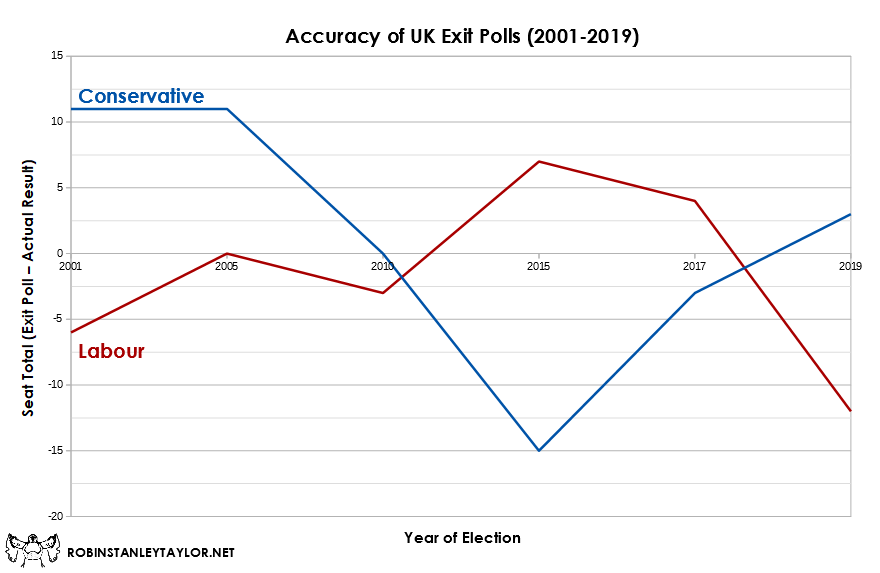
To make the lead graphic, I skimmed through the coverage of the six UK general elections that have taken place in my lifetime, and compiled a spreadsheet of the seat totals projected for the two main parties as well as the actual numbers of seats won by those parties. The graph shows how much either party was under- or overestimated each time. The 2010 poll was nearly spot-on, with the Conservative figure exactly right and the Labour only three too low. The worst inaccuracy was the Conservative figure for 2015, and indeed this was the only occasion in this millennium where the overall result was mispredicted (it was a small Conservative majority rather than a hung parliament).

FURTHER READING

Exit polling explained – University of Warwick

State Occasions

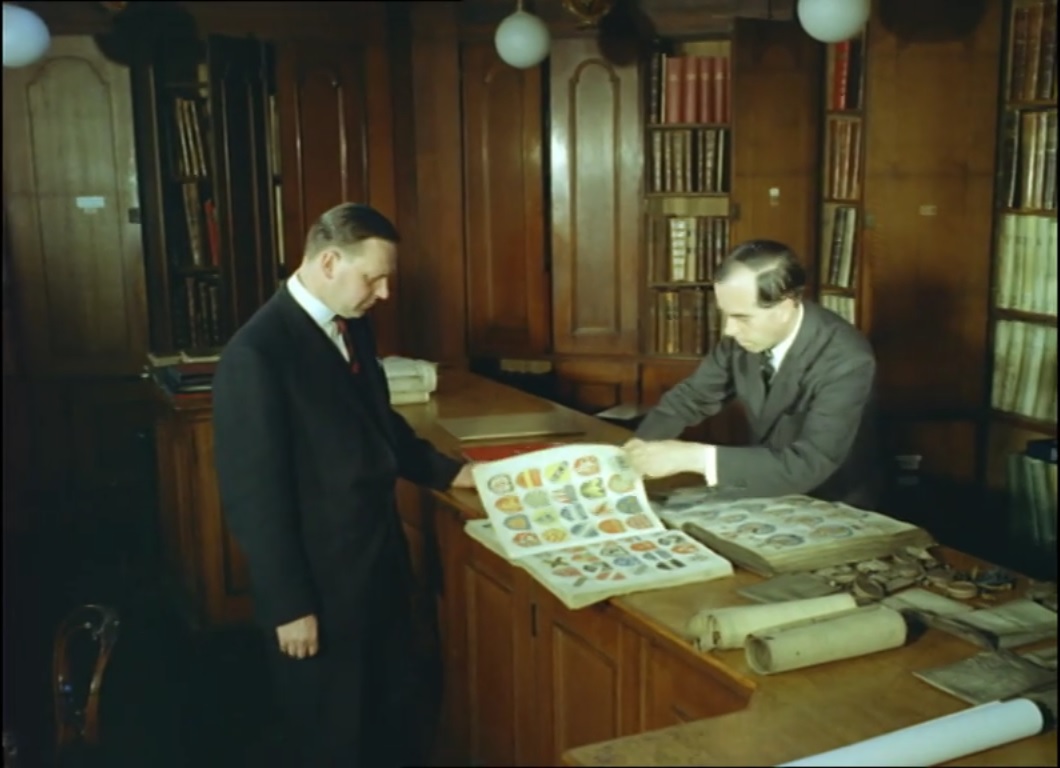
The York Herald’s Twitter feed recently led me to discover the 1960 short documentary series Look at Life, episode 7 of which is State Occasions. It follows the then-Earl Marshal (Bernard, 16th Duke of Norfolk) around the State Opening of Parliament and the Garter Day procession, as well as giving a tour inside the college of arms.

The narrator gives a concise but comprehensive overview of the college’s work and of heraldry as an artform, with ample footage of officers and artists going about their business as well as detailed closeups of the fruits of their labour.

It’s well worth a look.

Re-imagining Towns and Cities

Recently I’ve been binging on some urban design channels – mostly talking about the best way to structure and arrange a populous settlement. Today I attended a Zoom talk on that topic – the heraldry stuff for this year appearing to have run out.

I had expected today’s session to be on similar themes – housing density, cycle paths, zoning etc – but instead it was mainly focused on children’s play areas. It was hosted by Timberplay, with guest speakers Lucy Wallwork and Laura Scott-Simmons.

The consensus was a need to move away from “KFC” playgrounds (Kit, Fencing and Carpet, not Kentucky-Fried Chicken) and towards more varied, naturalistic settings. Much of the aim was to design urban environments in a child-friendly way, so that children could access communal spaces without needing to be driven around in parents’ cars (or, for that matter, being endangered by other cars passing nearby).

Another theme in the talk was the decline of high streets due to the rise of online shopping – exacerbated by the pandemic, of course. It was recommended that city centres cater to more than just retail, with outlets for religion, leisure, culture and even rewilding. It was important to avoid “clone cities” which are indistinguishable from their neighbours, and create a unique feature for each town to attract tourism.

The talk ran on for a little longer than I had expected but there was still time at the end for questions. One asked if the measures for “children” also applied to adolescents, and the speakers acknowledged that teens were often “designed out” of public spaces because of negative perceptions. (The popular industry phrase quoted earlier was “too old for the playground, too broke for the café, too young for the pub”.)

I, living most of my life in remote countryside and noticing how many of these projects had “urban” or “city” in the title, asked if the same principles of design also worked for smaller and more rural settlements. The speakers said that the basic rules still applied, and that there was sometimes a “play deficit” in rural areas because it is often assumed that people there have easy access to nature whereas really much of it is closed-off agricultural land.

FURTHER READING

Most of these were mentioned in the presentations, and it’s easier just to list the links instead of copying them out.

The Decoy Docks

Given that so much of my YouTube intake is about history, civic architecture, and trains, it is perhaps surprising that I did not come across the Hull History Nerd sooner. Though the channel claims to date back to 2012 the videos list that I can see begins in 2019, and a large proportion of it focuses on forgotten Yorkshire railways.

This video, however, lays closer to home. The presenter is standing on the banks of the Humber about 1500m from my house. His topic is the construction upon the riverside mud of facsimiles of Hull’s docks to distract German bombers.

I don’t have much to add beyond what is said in the video itself, though it would have been nice if he had walked a little further down the bank to inspect some of the other World War Two relics nearby.

FURTHER READING

Countessing Your Blessings

Recently I was browsing the Straight Dope Message Board and found a thread entitled Wait… ______ is still alive? As you’d expect, it’s about people one could reasonably assume to have died a long time ago who are actually still living. The one that caught my eye was post #40, mentioning that Clarissa Eden “died only last week”.

Having maintained the Wikipedia pages of British political figures past and present for the last few years, I was intensely aware of the curiosity of Clarissa’s continued existence. One of my earliest posts was on the centenary of Harold Wilson, but his wife had already passed that marker two months earlier. Whereas he died in 1995 at age seventy-nine, Mary finally passed in 2018, aged one hundred and two. Clarissa falls a little short of her record at one hundred and one. By comparison, Lady Dorothy Macmillan died in 1966 (aged sixty-five), the Lady Home of the Hirsel in 1990 (aged eighty), Sir Denis Thatcher in 2003 (aged eighty-eight) and the Lady Callaghan of Cardiff in 2005 (aged eighty-nine).

Still, it is interesting that so little media coverage was given to her death. In most newspapers that mentioned her at all it was as a minor footnote. Perhaps that is the ultimate tragedy – to outlive your fame by so long that nobody even remembers you. Indeed, her title itself would not be recognised – her three stepsons all predeceased her with no offspring of their own so the peerages are long extinct. Clarissa is so far the last premier’s spouse to be a countess*. There may never be another.

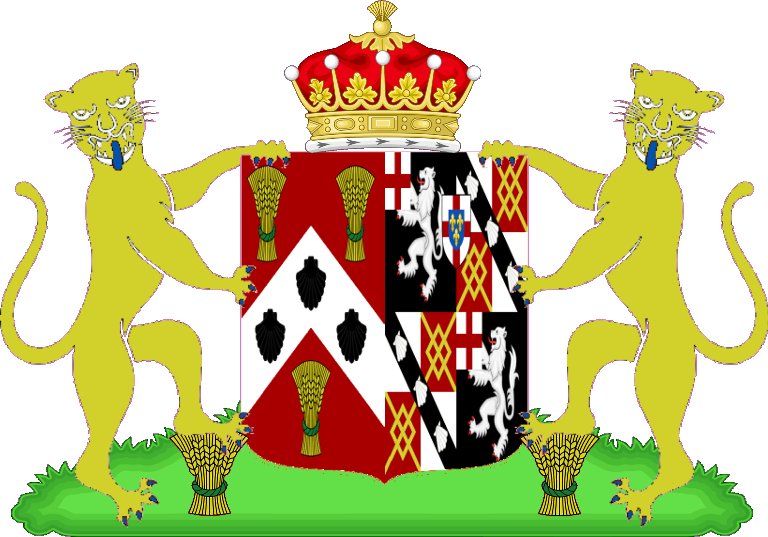
Clarissa’s heraldic achievement – the arms of Eden impaling Spencer-Churchill

EXTERNAL LINKS

*Eden’s immediate successor Macmillan was the last prime minister to receive an earldom, but that was long after his wife had died. Douglas-Home was of course a countess before her husband’s tenure but died a mere baroness. The title refers to the River Avon in Warwickshire. A county called Avon (referring to a different Avon river in Bristol) was created by Heath’s reforms in 1974 then abolished by Major’s reforms in 1996.

A Stark Vision

Amateur or professional, few students of Britain’s royal, political and constitutional history will be unaware of Dr David Starkey. With an extensive collection of literary and televisual credits, plus a famously oversized personality, he was for many years a giant among celebrity historians. His most prominent was his 2004 series Monarchy, followed by Magna Carta in 2015, but he can be traced back much earlier, appearing in The Trial of King Richard the Third in 1984. He has even been featured on the royal family’s own YouTube channel.

His career, though illustrious, has not been smooth sailing, for his character is notoriously abrasive and his reputation has been rocked by a string of ill-worded outbursts – in most notably in 2011 and 2015. His performance in directly teaching the youth was also rocky.

I was quite surprised, early in 2020, to see him interviewed on Akkad Daily. It taxed my mind to decide whether this pairing more represented Benjamin going up in the world or Starkey going down. Certainly the latter plummeted with great velocity that summer following a catastrophic episode with Darren Grimes, which resulted in many of his professional contracts being terminated and accolades withdrawn.

Given the severity of that latest offence, and given that he was seventy-five years old, one could have expected Starkey to vanish from public life altogether and slip quietly into retirement. For a few months that looked to be the case but then he began popping up again on various virtual conferences and current affairs broadcasts, suggesting there is still a place for him on the talking head circuit (well, the right-wing parts of it anyway).

A week ago he launched his own YouTube channel on which, seemingly alone, he gives lengthy speeches to his camera about his specialist subjects. Much of it recycles what he has already said in his earlier lectures and documentaries, some of which are of course no longer available. His motivation is not clear: it could simply be a charitable effort for the sake of public education (sort of a more sedate Crash Course) but then his website asks for monetary donations and boasts about the number of supporters he has in his “fight back”.

In between these was Charlie Brooker’s end of year mockumentary Death to 2020, in which Hugh Grant plays the historian Tennyson Foss. Judging by the hair, clothes, spectacles and voice I am fairly sure this is meant to be a pastiche of Starkey’s own interviews, although hints at the character’s backstory are clearly different.

Railway Heraldry with Gordon Casely

Casely with the Scotsman, 10th April 1966

Today I virtually attended the Alan Watson Memorial Lecture by the Heraldry Society of Scotland, focusing on the coats of arms of Britain’s railway companies since Victorian times.

Before the presentation proper, Edward Mallinson gave a speech commemorating Alan Watson himself – a heraldist, philatelist and trainspotter who died last year.

Gordon Casely added to the tributes, then began his lecture. He noted that the society had never covered railway heraldry in its lectures before, and insisted that “to sample the pleasures of such heraldry, one doesn’t need to be a railway enthusiast, far less a loco-spotter, number-bagger, rivet-counter, or even an anorak. Casely himself had been a railway journalist in the 1960s, and in later decades a campaigner for higher quality rail services in Scotland.

He prefaced his historical tour was a health warning – railway heraldry is an absolute mess, almost all being borrowed, bogus or thieved. He also said that much of it amounts to heraldry we don’t really deserve – badges, totems, insignia, emblems, motifs or devices, rather than coats of arms. As to why this had occurred, he suggested that Victorian-era Lyons and Garters had both “missed their trains” when it came to “the heraldic iron horse”. He said that he had examined over two hundred sets of heraldic devices used by railways in Britain, and could count on his fingers the real coats of arms. Still, railway heraldry was always interesting and entertaining.

His first example was a plaque at Edinburgh Waverley station commemorating Sir Nigel Gresley. The coat of arms above the text is that of the London & North Eastern Railway (real and legal, unusually), rather than Gresley’s own.

In the next slide, I am sad to say that our speaker made an error. He showed my illustration of the arms of the Gooch baronets of Benacre Hall, although he attributed them to Sir Daniel Gooch, 1st Baronet of Clewer Park and Chairman of the Great Western Railway. He compared these to the arms to those displayed on the stall plate of Major John Gooch in the chapter room of the Order of St John, and thought it curious that the latter’s arms contained railway references (a wheel in centre chief and on the crest) while the former’s did not. Having checked in Burke’s, I can say that the arms of Sir Daniel and his successors do contain those elements, and that Casely was simply using the wrong image.

The vast majority of railway arms showed a shield within a strap and buckle. Within the Scottish clan system, such an arrangement marks that one is a junior member of the group rather than the chief, and thus the captains of industry were making themselves look like mere corporals. Of the five major railways in Scotland circa 1920, four used a buckle around their main emblem while the Caledonian Railway simply copied the pre-1603 royal arms of Scotland. Scottish railways in modern times are no better. Casely recalled writing to the chief executive of the Great North Eastern Railway in 1996 suggesting arms be adopted. What resulted was, in Casely’s words, “a real fruit salad”, featuring two oval shields within a strap and generic Scottish floral emblems crammed between. Particularly bad was the logo of the English, Welsh & Scottish Railway, which instead of the unicorn represented Scotland with a stag more appropriate to Northern Ireland. A case study was made of the Deltics (“a proper locomotive”, Mallinson interjected). An earlier plan was for this class to be called Heralds, with individual vehicles named after specific heralds (i.e. Albany, Rothesay, Ross, Orkney, Marchmont and Stirling, plus Glasgow).

Moving down to England, the Great Western Railway used the “entirely bogus” emblem simply placing the arms and crests of London and Bristol side by side, even though the line ended at Paddington and never penetrated the square mile. The Lancashire & Yorkshire Railway borrowed the shields of the two county towns, while an early emblem for the Hull & Barnsley Railway used an ermine pavillion based on those employed (incorrectly even then) by peers of the realm. Casely was particularly contemptuous of the Cornwall railway, whose seal used the shield of the Duchy, ensigned it with the heir apparent’s feathers, and shoved some industrial tools behind it. A smorgasboard of other railway emblems was shown, most following the trend of simply stealing the civic arms of their connected towns or badges of the royal family.

At last some “real” heraldry was featured – the Great Central Railway matriculated from the College in 1898, making it likely the first railway in Britain with legal heraldry, and used them on just about everything.

Arms were adopted for British Rail following nationalistation in 1948, technically those of the British Transport Commission. The crest alone was used on a roundel on the sides of many trains. Two versions of this were used – with the lion facing either dexter or sinister depending on which side of the train you stood. Allegedly Garter Bellew went apoplectic upon realising this. The famous cycling lion was similarly reversible.

Casely also mentioned that a handful of lines never used any kind of emblem – such as the North Sunderland Railway which he personally visited in 1951. His conclusion was that though railways have long used a large selection of emblems, badges and other quasi-heraldic insignia, the majority of it would not be heraldry as we know it. He wondered if heraldists had “some work to do” in convincing modern rail companies to seek legal grants of arms.

This was, by the speaker’s assertion, the society’s first in-person lecture for eighteen months. A hybrid system was in place, with an uncertain number of people sitting in the lecture hall and two dozen (including myself) attending virtually. What annoyed me about this setup was that all of the virtual attendees had been forcibly muted and the chatbox was disabled. Members physically present were invited to ask questions at the end of the presentation, but we had no ability to interact. This was a deep disappointment as I was keen to advertise the island armory post that I published a week ago. The only function I found still working was the “raise hand” button, which I and one other attendee used, but I never got to see if this was acknowledged by the hosts as while Mallinson was advertising an upcoming lecture my internet connection failed. By the time I got it working again the meeting had concluded and the session had closed.

FURTHER READING

Islanders’ Arms

Ever since the seventy-fifth anniversary of The Railway Series last May, I have been looking to bridge my interest in that franchise with my hobby as a heraldist. I had long known that the thin clergyman had invented coats of arms for many characters and institutions within his fictional world, but it was difficult to actually find them.

Of especial importance was a video by Max Davies, better known as Terrier55Stepney, documenting one of many visits that he and other tankies have made to the Talyllyn Railway. This particular video is valuable because at fifteen minutes and ten seconds in it shows a front-on close-up shot of an old sheet of paper on which Awdry had sketched and blazoned four different fictional coats of arms. I had glimpsed this before but never in quite enough clarity to make out the details. Even in this version the handwriting is not always legible. Luckily I found a handful of old posts on the Sodor Island Forums where other fans had also attempted to decipher the text. I have now illustrated all four shields there depicted and uploaded the results to Wikimedia Commons, though whether I shall be able to use them on any Wikipedia articles following last year’s purge is debatable.

CROVAN’S GATE

Escutcheon: Vert a gateway kernelled Or with portcullis closed of the same. In base a glove dexter Argent.

Motto: Ave Amicos Cave Hostes (Welcome Friends, Beware Enemies)

The symbolism here is fairly obvious – the gate is a literal interpretation of the proverbial “gate” (the narrow pass in the hills between eastern and central Sodor) at which King Godred Crovan held the Normans at bay in 1089, while the glove is one of his famous white leather gauntlets.

SUDDERY


Escutcheon: Argent in base three closets wavy Azure charged at the nombril point with a coracle therein a monk erect dexter hand raised in blessing in sinister hand a crozier all Proper.

Motto: Luoc Sodoris Lux (Luoc, the Light of Sodor)

This was the hardest to do and the least visually-satisfying at the end. The arms are pictorial heraldry, showing the legendary arrival of Saint Luoc on the island in the fifth century. There is a discrepancy between sources here – the above blazon refers to simply “a monk” but The Island of Sodor: Its People, History and Railways twice asserts that the arms have him “arrayed as a bishop”, the latter reference specifying “in cope and mitre”. I have said before that human figures usually don’t work well in heraldry, and this is no exception. Awdry does not describe Luoc’s appearance nor his liturgical vestements, so I took a drawing of St Vallier and changed the colours to give a more Anglo-Irish aesthetic, with the mitre using the blue and green shown on the other coats of arms here.

TIDMOUTH

Escutcheon: Quarterly Azure and Vert 1st a lymphad 2nd a Smith’s hammer & tongs saltirewise 3rd a wheel 4th three herrings naiant all Argent.

Motto: Industry and Progress

There is some obvious faux-quartering here, though at least the colour scheme works. The first and fourth quarters refer to the towns history of fishing and later ship-building while the second and third refer to the other industries based there – possibly including the big train station.

THE NORTH WESTERN RAILWAY

Escutcheon: Per saltire Azure and Vert two gloves Argent saltirewise in fess a rose of Lancaster Proper in chief Azure a wheel or winged of same dexter Vert a fleece Argent sinister Vert a mattock Argent hafted Or in base Azure three herrings naiant Argent.

Motto: Nil Unquam Simile (There’s Nothing Quite Like It)

The gloves are here again, though I have elongated and narrowed them to fit the saltire. The herrings also make a reappearance. The winged wheel has a long history in heraldry and has appeared in the arms of a few real-life transport companies. The fleece and mattock presumably represent agriculture and industry, both of which are serviced by the railway but do not have any more specific importance. The rose refers to Sodor’s attachment to the Duchy of Lancaster, though of course its symbolism as such is very much a modern affectation.

While we are here, let us recap the other heraldic images I have mentioned here before:

THE SODOR REGIMENT

Escutcheon: Sable two gloves Argent saltirewise, charged in fess with the Rose of Lancaster Proper.

The blazon is given in the book (described as the regiment’s “colours”), though I wasn’t sure which shape to use for the field. The significance of the red rose and the white gloves has already been explained. The military is not covered much in the franchise so there is little detail to give here.

THE EARL OF SODOR

The Norramby line is mentioned in the book but nothing is said of them armorially. When the earl appears in the 2013 special “King of the Railway” his shield is Azure a pale Argent bearing a representation of Ulfstead Castle, with a jewelled Eastern crown on top and two lions rampant Or as supporters.

Taken as a whole, the Sudrian arms are a mixed bag – just as in real life. The time of matriculation for any of these devices is not specified, though we can guess from both content and context – the North Western Railway was formed in 1915 so its arms cannot be older unless inherited from one of the predecessor companies (earliest 1853). It looks a little too busy, as do those of many real railway companies from the time. The regimental badge, featuring the red rose, is probably from no earlier than Victoria’s reign. The faux-quartering on Tidmouth’s shield suggests a much more modern adoption, most likely by assumption in the mid-twentieth century. The shield of Crovan’s Gate is simple enough that it could be medieval. I am not sure about Suddery as I do not know how far back precedent can be found for the depiction of humanoid religious icons in heraldry.

I notice that blue and white seem to be the most persistent (though of course not universal) colours in the island’s civic and corporate heraldry as well as in the flag. This could be the diagetic reason for the majority of the main characters on the North Western Railway being painted blue. It would also fit the historical connections made in the source material, as blue and white were the livery colours of both the House of Lancaster and the Lordship of Ireland.

UPDATE (1st November)

I have just discovered the website Railway Mania, dedicated to building and running model trains. A subsidiary project is Sodor Histories, an attempt at re-imagining Awdry’s island in as much detail and as realistic a manner as possible. It’s well worth a look for the truly dedicated railfan.

UPDATE (June 2022)

Looking again at Burke’s General Armory, I have found two entries (on page 467) for the surname Hatt:

  • Hatt (co. Berks, Orsett, co. Essex, and London) escutcheon Quarterly Argent and Gules on a bend Sable three chaplets Or crest A falcon’s head quarterly Argent and Gules between two wings expanded Sable.
  • Hatt, or Hatte escutcheon Argent a chevron Sable between three annulets Azure.

Of course neither of these is necessarily linked to the Fat Controller. The only thing ‘People, History & Railways says about his origins is that he was apprenticed in Swindon – which is in Wiltshire, one county to the west from Berkshire, two from London and three from Essex.

UPDATE (October 2025)

This post has been referenced by Tumblr user Whumpster Fire, who has used my illustration of the regimental colours to make some alternative designs for a Sudrian flag.

Matters of the Harp

Heraldists and historians will know that there have long been two versions of the British royal arms. Prior to the death of Elizabeth I the arms of England had been three yellow lions passant guardant on a red background, while those of Scotland had been one red lion rampant on a yellow background. When James VI of Scotland ascended to the English he quartered the arms of both countries to indicate their personal union, albeit varying the precedence so that each kingdom had its own arms in both the first and fourth quarters with the other’s confined to the second. This duality continued even after the 1707 union into Great Britain, although the “English” version is the standard one used internationally, with the Scottish version being purely for internal purposes. Though the first, second and fourth quarters of the shield have chopped and changed much over the centuries, the third quarter of both shields has consistently been Azure a harp Or stringed Argent. This represented the Kingdom of Ireland since its creation in 1542, though its usage in other capacities can be traced back much further. Prior to 1603 Ireland was not referenced in the English royal arms. What is a little perplexing to those interested in this subject is that neither James nor his successors ever created a distinct Irish arrangement of the shield as he had English and Scottish ones. Instead it seems that Ireland (both before and after the 1801 union) used either the same arrangement as in England or the harp alone.

One might have expected some other curious heraldist to have come up with such illustrations by now – for the interpolation is fairly simple – but I could not find any, so set about performing the thought experiment myself. After a few hours of cutting and splicing Sodacan’s familiar pictures I had produced Irish arrangements not just of the royal arms in their present state, but for every other variation that has occurred since the union of the crowns.

There were some aesthetic challenges here, the most prominent of which is that the harp in the fourth quarter has to be significantly smaller than that in the first to fit the curve of the shield, though that would be alleviated if the instrument would face right rather than left (as in the Guiness logo). It also produces some interesting colour combinations – especially in the 1714 version where the impalement of England & Scotland lines up perfectly with that of Brunswick & Lüneburg.

Readers will note that I have only made shields here, not full achievements. That is largely because I was unsure what the other elements would be. While the crowns, supporters, mottos and crests for England and Scotland solidified long before their personal union and have been consistent ever since despite numerous changes to the shield, those of Ireland are much less clear. A crest was designed for James I (A tower triple towered Or from the portal a hart springing Argent attired and unguled also Or) but it was not much used, and neither supporters nor motto were granted at all. Occasionally depictions can be found which copy those pieces from the English achievement, but this is the result of artistic fancy rather than official sanction. I would hesitate to put the Order of St Patrick around the shield, since it was only instituted in 1783 and became dormant in 1974, never achieving the same prominence as the Garter or Thistle nor appearing much in heraldic art. Certainly the present Republic of Ireland uses the shield alone and the achievement of the government of Northern Ireland from 1924-1972 is of sufficiently different appearance and origin to be ruled out as any indication of what to use here.

On a different note, the YouTube channel Terrier55Stepney recently put out a video documenting another visit to the Talyllyn Railway. Fifteen minutes in the camera points at a framed page of drawings and blazons for Sudrian heraldic devices. I mentioned this before but this time I could see the whole page (though the legibility of the handwriting remains a difficulty). I hope to have illustrated at least some of them fairly soon.

Another Day, Another Death

James Brokenshire was not the most high-profile of British politicians. Overall he spent sixteen years in the House of Commons, including seven years as a junior minister in a senior department and three as the senior minister in two junior departments, twice having to resign from the government due to the lung cancer which ultimately ended his life earlier this month. Even so, the fact that he had been a cabinet minister, the relatively low age at which he passed and the level of public fear surrounding cancer, one would reasonably have thought it unlikely that his demise could be outdone in the eleven days before the house was to meet again. Then, to the shock of the nation and world, Sir David Amess was stabbed to death. MPs were already due to return from the conference recess today, but scheduled business in both chambers was abandoned in favour of tributes to Amess, with a service following in St Margaret’s Church. Brokenshire’s tributes have been postponed to Wednesday.

Something similar happened during the Easter recess – the death of Dame Cheryl Gillan on 4th April and of the Baroness Williams of Crosby* on 11th would have been the principal concern of their respective houses, had not the Duke of Edinburgh died on 9th. In that instance it was the social and constitutional rank of the departed that determined priority of mourning rather than the manner of death.

The most obvious comparison, made frequently by those who have spoken publicly in the last few days, is to the murder of Jo Cox a week before the EU referendum. There has even been a move to design a shield of arms for Sir David and place it on the chamber wall next to hers. Of course, the two victims had very different profiles – Cox was a Labour woman who supported remaining in the EU, Amess a Conservative man who favoured leaving. This is reflected in the different profiles of their killers – Thomas Mair was a white supremacist with links to the English Defence League, Ali Hari Ali is said to be of Somalian heritage and a suspected Islamist.**

Also distinguishing the two victims is the time they had spent in politics. As I mentioned before, Jo Cox was not well-known to the general public, having only begun her tenure in the House of Commons thirteen months prior. She could well have joined the shadow cabinet in the mass reshuffle later that month, and by this point she might even have been a contender for the party leadership, but back then she was a much a footnote as most of the other MPs from the 2015 intake. Part of what made her death so tragic was precisely that she died so young and so early in her political career, with so much potential thereby wasted. Amess, by contrast, had been an MP for almost long as the average Brit has been alive. Though never a minister, he was a creature of the house, serving on many important if low-profile committees as well as being involved in numerous campaigns and publications. Most in the political sphere knew his reputation, in contrast to Cox who was something of a cipher.

More broadly, the country must acknowledge the worrying frequency with which politicians and their entourages have been attacked (whether or not the attack succeeded in killing the victim) in recent decades, and consider how this can be rectified, both in terms of personal security to defend from those with evil motivations, and in the public attitude to politics that would encourage such evil in the first place. As the pandemic has shown this year and last, the kind of openness and accessibility required of parliamentarians can also be very dangerous to them in person, yet to abandon it can be very damaging to democracy as a whole.

EXTERNAL LINKS

*The speaker mentioned on 13th April that four other former MPs had died during the recess – Peter Ainsworth, Ian Gibson, Robert Howarth, Paul Marland.

**Almost immediately upon the announcement of the attack and the description of the attacker as a “British national” there were people denouncing immigration policy and calling for border closure.