The Trouble with Tombs

This was a presentation by the University of Liverpool, concerning the history, primarily between the seventh and nineteenth centuries, of how England has dealt with human corpses.

The main speaker was Ruth Nugent. She wanted to examine how the dead were handled literally, emotionally, ethically, spiritually and ideologically. She found that there was rarely much commentary on the relationship between bodies and tombs, students of other subjects would focus on associated details of architecture, geneaology, heraldry and religion but the principles of burial itself were often overlooked.

Until the eleventh century burial within a church building (as opposed to the yard outside) was reserved for royals, saints and clergy. Until the thirteenth it was monasteries that were most sought after as resting places. Due to the long-term problem of overcrowding it was common for bodies to be moved after a hundred years so that the plot could be used for someone else, or because the church was undergoing renovation work. There were cases of corpses stolen by one church from another, and legal disputes between families of the deceased over where the remains could be placed. Sometimes churchmen would claim to “discover” the bodies of legendary figures such as King Arthur. Epidemics, such as the Great Plague, put increased pressure on churchyards due to sudden mass burials. In the nineteenth century secular public cemeteries were opened to give alternatives to church burials, and cremation became more accepted. Laws were passed against intramural burials and exhumation to recycle spaces.

Physical upkeep was always a problem. Tombstones would be chipped away to make ingredients for magical medicines, and sometimes families would carry out clandestine removals of their own ancestors to escape from vandalism. Elizabeth I ordered churches to restore their tombs but often the churches lacked the money to comply. The Civil War left cathedrals in particularly poor condition and soldiers often looted graves. Large numbers of graves underneath churches could cause subsidence. Antiquarians (she named John Leland, John Stow, William Camden, John Waver and William Dering) determined to make written records of tombs and their contents in the hopes that the information could survive even if the physical structures didn’t – partly through interest in history, partly to safeguard their own futures.

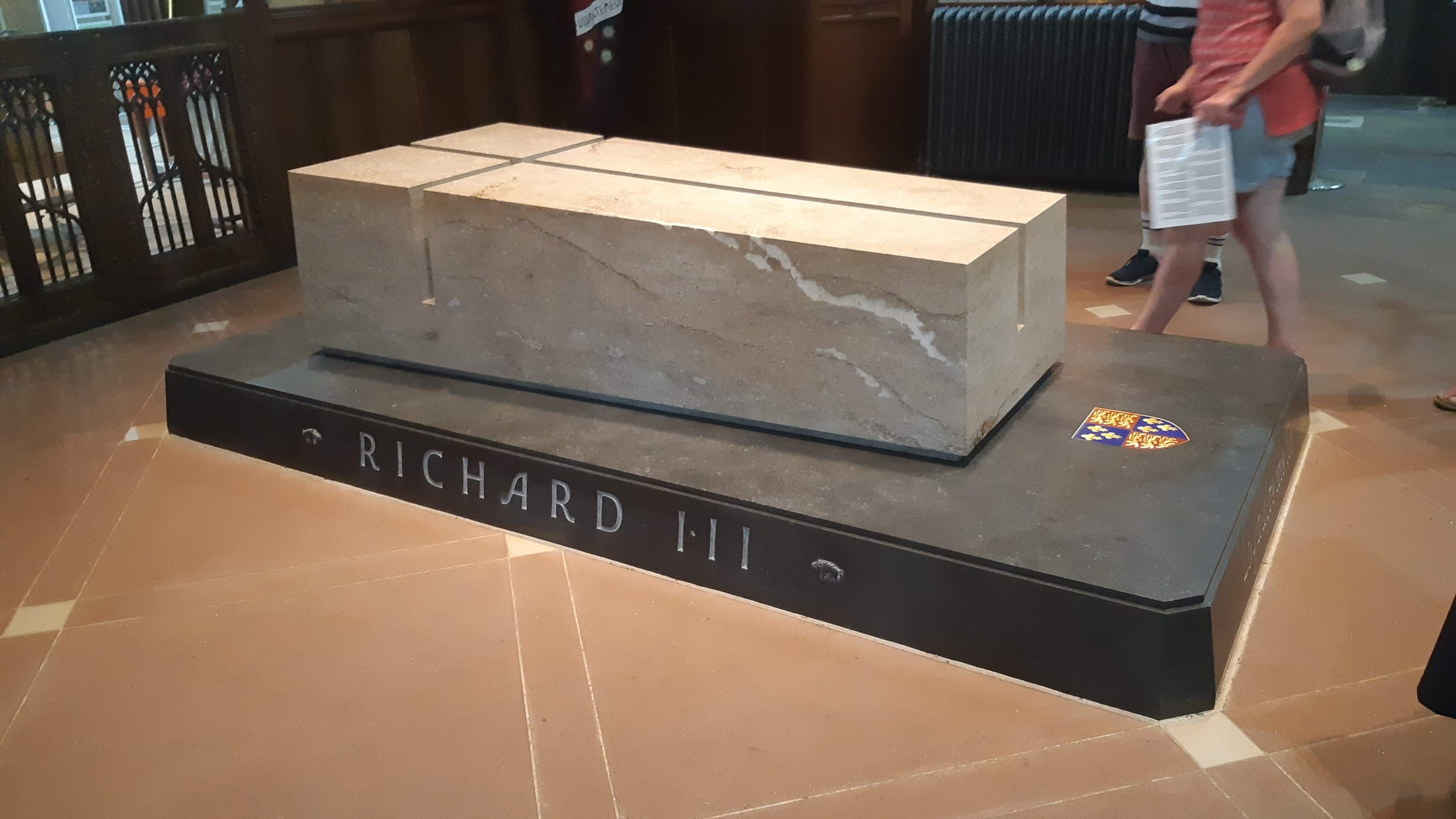
The next speaker was David Monteith, who recalled his experience with the reburial of Richard III in 2015. Public consultation revealed a very wide spectrum of preferences for the appropriate manner in which to deal with the late king – some wanting a full tomb, others a simpler box. He noted that many people’s feelings about Richard were hard to separate from his Shakespearean portrayal, and that if the rediscovery had occurred a few years later he would have needed to contend with much more polarised attitudes to memorials. He said that even in Richard’s day it was normal for the dead to be moved or their surroundings altered – Edward IV rebuilt many tombs of his relatives, as later would Elizabeth I. Burial styles changed over the centuries and so there were many valid ways of disposing of Richard. He did, though, have to discourage visitors at Leicester Cathedral from taking photographs with the casket.

Harold Mytum followed. The Church of England has policies for bodies found on consecrated land that parallel those of secular authorities. In medieval times English burials were much the same as continental ones, including frequent recycling of plots. Most above-ground interments in Europe lasted only twenty-five years before the cadaver was moved elsewhere. The Church has a duty to protect and respect human remains, but exhumation can be allowed if it serves the public interest, e.g. the advancement of science.

Andrea Bradley spoke of the challenges involved in securing land for HS2 – with its own bespoke system for the removal and reburial of human remains. They have a specific legal agreement with the Archbisop’s Council that corpses uprooted from consecrated ground must be put down in other consecrated ground.

Ian Dungavell said that burial spaces in cities are getting full again, and few now expect a large grave for themselves in perpetuity, instead accepting that after some time they will be relocated. Re-use of graves in this way has been allowed again (although only in London) since 2007 because there is no alternative possible.

Lin Foxhall, the host, took questions from the audience.

  • On the rise of digital commemoration, Nugent said to be wary of rapid-onset obsolescence. QR codes and URLs might not be functional a century from now and those without compatible technology – even today – would be locked out of interaction.
  • Asked why bodies were so obsessed over, even by cultures who insisted the soul was more important, Monteith suggested that without a standardised metaphysical understanding of death we fill the gap with fear.  He also wondered if we over-medicalise death nowadays.
  • Asked how common it was for bodies to be upgraded to higher-status graves, Mytum said that the emergence of non-religious cemeteries allowed greater commercialism in burial plans. Dungavell said that not everyone has detailed plans for their disposal, and that survivors sometimes need to “park” the body in a cheap grave for a few years while a more elaborate commemoration is organised.
  • Asked if future wills could contain clauses regulating future exhumations, Nugent said that such clauses are already in use. Foxhall said that ecological implications of burial and/or cremation are more closely observed now.
  • Asked if we should go back to communal burials, and why bones are seen as more important than ashes, Dungavell thought bones were treated brutally enough and Mytum said there are already commercial long-burrows.
  • I asked if something like the Necropolis Railway could reappear to allow urban residents to visit relatives’ graves far away. Dungavell said that the original company was unsuccessful as people wanted burials nearby. Ruth mentioned how railway companies had allowed corpses to go in sidings and embankments.
  • Asked about the changing nature of images on graves, Nugent said that some pictures could be very upsetting, especially if photographs peel off. Mytum noted that there had been changes in taste for memorials in the middle of the twentieth century, Foxhall noted very dark imagery in the eighteenth – such as cherubs becoming skeletons.
  • Asked about the need for different funeral and disposal styles for different cultures, Monteith noted he had already seen multi-faith crematoria for that purpose.

EXTERNAL LINKS

Guts for Garters

For the last few Decembers I have eagerly awaited the release of the new year honours list. Normally they arrive a few days before the actual new year, but this time around they came with barely an hour to spare.

There were, as to be expected, a great many awards given on ministerial advice for those involved in fighting COVID, but at the very top were three new appointments made at Her Majesty’s personal discretion to the Order of the Garter: Camilla, Duchess of Cornwall, her daughter-in-law; Valerie, Baroness Amos, former Lord President of Her Privy Council; and Tony Blair, her former Prime Minister.

While sons (and in modern times also daughters) of the reigning monarch are appointed to the order routinely it is rare for royals by marriage. The only examples in the past two hundred years are of those married to the sovereigns themselves – Albert two months in advance of his wedding, Alexandra, Mary and Elizabeth shortly after their husbands’ accessions. Camilla and the late Prince Philip are the only consorts to receive the garter while their spouses were not yet on the throne. I wonder if she shall use the same stall that he did?

Amos is a former leader of the House of Lords (like Lord Salisbury, and indeed others of that title before him). She also served a brief term as High Commissioner to Australia and an even briefer one as International Development Secretary.

Tony Blair appointed Amos to most of those offices. It used to be the norm for former Prime Ministers to join the order, up to and including John Major in 2005 it became rare to see party politicians appointed. It was long assumed that Blair had declined any honours if indeed he was ever offered them, whether that was due to his personal distaste for them (he portrayed himself as a moderniser rather than a traditionalist, and was often observed to behave more like a US President than a British minister), or potential public backlash over controversies stemming from his premiership. What has persuaded him to accept the award now, fifteen years on, is not yet known.

These are the first appointments to the order since 2019. There were no Garter Day ceremonies in 2020 or 2021 due to the pandemic. This year is set to be Elizabeth II’s Platinum Jubilee, so one presumes that the Firm will be keen to make up for lost time.

Today’s news will have interesting ramifications heraldry-wise: Camilla has of course been openly armigerous since 2005, and Sodacan has already updated his graphic of her arms to include the Garter circlet. Amos has been a peeress all my life, and typically appears early on in the pages of Burke’s and Debrett’s, but has never been shown with any armorial design. She may therefore receive a brand new grant in the coming months. Blair is especially confusing, though he is joining an English order of chivalry, he may be Scottish for heraldic purposes and so it would be Lyon not Garter arranging his grant.

SEE ALSO

Matters of the Harp

Heraldists and historians will know that there have long been two versions of the British royal arms. Prior to the death of Elizabeth I the arms of England had been three yellow lions passant guardant on a red background, while those of Scotland had been one red lion rampant on a yellow background. When James VI of Scotland ascended to the English he quartered the arms of both countries to indicate their personal union, albeit varying the precedence so that each kingdom had its own arms in both the first and fourth quarters with the other’s confined to the second. This duality continued even after the 1707 union into Great Britain, although the “English” version is the standard one used internationally, with the Scottish version being purely for internal purposes. Though the first, second and fourth quarters of the shield have chopped and changed much over the centuries, the third quarter of both shields has consistently been Azure a harp Or stringed Argent. This represented the Kingdom of Ireland since its creation in 1542, though its usage in other capacities can be traced back much further. Prior to 1603 Ireland was not referenced in the English royal arms. What is a little perplexing to those interested in this subject is that neither James nor his successors ever created a distinct Irish arrangement of the shield as he had English and Scottish ones. Instead it seems that Ireland (both before and after the 1801 union) used either the same arrangement as in England or the harp alone.

One might have expected some other curious heraldist to have come up with such illustrations by now – for the interpolation is fairly simple – but I could not find any, so set about performing the thought experiment myself. After a few hours of cutting and splicing Sodacan’s familiar pictures I had produced Irish arrangements not just of the royal arms in their present state, but for every other variation that has occurred since the union of the crowns.

There were some aesthetic challenges here, the most prominent of which is that the harp in the fourth quarter has to be significantly smaller than that in the first to fit the curve of the shield, though that would be alleviated if the instrument would face right rather than left (as in the Guiness logo). It also produces some interesting colour combinations – especially in the 1714 version where the impalement of England & Scotland lines up perfectly with that of Brunswick & Lüneburg.

Readers will note that I have only made shields here, not full achievements. That is largely because I was unsure what the other elements would be. While the crowns, supporters, mottos and crests for England and Scotland solidified long before their personal union and have been consistent ever since despite numerous changes to the shield, those of Ireland are much less clear. A crest was designed for James I (A tower triple towered Or from the portal a hart springing Argent attired and unguled also Or) but it was not much used, and neither supporters nor motto were granted at all. Occasionally depictions can be found which copy those pieces from the English achievement, but this is the result of artistic fancy rather than official sanction. I would hesitate to put the Order of St Patrick around the shield, since it was only instituted in 1783 and became dormant in 1974, never achieving the same prominence as the Garter or Thistle nor appearing much in heraldic art. Certainly the present Republic of Ireland uses the shield alone and the achievement of the government of Northern Ireland from 1924-1972 is of sufficiently different appearance and origin to be ruled out as any indication of what to use here.

On a different note, the YouTube channel Terrier55Stepney recently put out a video documenting another visit to the Talyllyn Railway. Fifteen minutes in the camera points at a framed page of drawings and blazons for Sudrian heraldic devices. I mentioned this before but this time I could see the whole page (though the legibility of the handwriting remains a difficulty). I hope to have illustrated at least some of them fairly soon.

Who am I to Judge?

This has been a busy week for state ceremony, yet you wouldn’t know it from the news.

Friday 1st October was the beginning of the legal year 2021-22 in England & Wales, marked by the procession of hundreds of judges in their full dress uniform to a special service at Westminster Abbey. This included readings by the Lord Chancellor and the Lord Chief Justice, as well as a sermon by the preacher of Lincoln’s Inn.

The legal year in Scotland began on Monday 27th September. It featured similar events at the Court of Session and St Giles’s Cathedral. The Lyon Court was one of the bodies involved and a number of new officers of arms had their inaugurations.

On Saturday 2nd October the sixth devolved Scottish Parliament had its ceremonial opening, though of course it has been sitting and legislating since May.  The Queen visited the chamber, accompanied by the Duke & Duchess of Rothesay and Edinburgh. Many heralds were in attendance carrying with them the crown of James V.

It is a little disappointing that these events were so ill-publicised, even accounting for the distraction of party conferences and fuel queues. Rather than major newspapers I have mostly had to piece together details of all three ceremonies from the websites and social media accounts of the people involved.

Curiously this is not consistent across time – footage of judges’ processions from a few years ago can be found on YouTube, and some from many decades back are archived by British Pathé.

EXTERNAL LINKS

Judges at Westminster Abbey

Heralds at the Court of Session

The Scottish Parliament

Discerning Dukes

This afternoon I missed a turnoff on the way to my second COVID vaccination. While navigating back to where I should have been I discovered Church Street where there was a pub called the Duke of York. This struck me because the pub’s sign showed an illustration of the duke’s coat of arms which I instantly recognised as Sodacan’s illustration from Wikimedia Commons. Unfortunately I wasn’t in a position to stop and take a photograph and what I can find in the pub’s own galleries or on Google Street View isn’t very clear, so I cannot work out which particular duke is being honoured here.

The Prince Andrew, Duke of York since 1986, uses the royal arms of the United Kingdom differenced by a label of three points Argent, the centre bearing an anchor Azure. This same cadency label was also used by his grandfather George VI from 1920 to 1936, and by his father George V from 1892 to 1901. It plainly cannot be George V represented here since his arms as Duke of York included the inescutcheon of Saxony. The main identifier, therefore, is the harp of Ireland – versions made during the present reign use a plain harp, while those issued in earlier reigns show a woman’s head and chest carved into the side. I think that this pub sign shows the modern version but the image resolution is too low to be sure.

Ever to Succeed

News has broken that two days ago Her Royal Highness Princess Beatrice, Mrs Edoardo Mapelli Mozzi, gave birth for the first time. Her yet-unnamed daughter is eleventh in line to the throne. I wished to edit the relevant Wikipedia article accordingly, but that proved difficult as the list had multiple levels of indentation to reflect the generations and all the numbers had to be changed manually.

There is a challenge in deciding just how many names to include on the page. The legitimate non-Papist descendants of George I’s mother number well into the thousands nowadays and the vast majority of them are non-notable. The editors have here decided to limit the display to the descendants of the sons of George V. In practice this just means Bertie, Harry and Georgie, since David and John both died without issue. Even that restricted selection comprises sixty-three living people, of whom thirty-two have no pages of their own.

The clumsiness of editing this list brought up an idea I had some years ago for giving each member of the diaspora a numerical code to indicate their position within the succession. The electress herself, being the origin of the succession, would be 0. Her eldest son Georg Ludwig would be 1, her next son Frederick Augustus 2, Maximilian William 3 and so on. For each generation a digit is added, so Georg’s offspring George Augustus and Sophia Dorothea would be 1.1 and 1.2, while George Augustus’s children would be 1.11, 1.12, 1.13 and so forth. Under this system Princess Alexandrina Victoria of Kent & Strathearn would be 1.11141 while Princess Elizabeth Alexandra Mary of York would be 1.111411221. Prince Philip of Greece & Denmark would, I think, be 1.111416331. The beauty of this system is that the crown always goes to the living person with the lowest number, rather than each new birth or death close to the throne forcing everyone downstream to be renumbered.

There are downsides, of course. First, there is always the danger of one day discovering a missing sibling who died young and was forgotten to history. Second, until the commencement of the Perth Agreement the crown followed male-preference primogeniture, so any girl’s code was liable to change upon the arrival of a brother. Third, if any person in the line has more than nine legitimate children then the numerals would be inadequate (as in George III’s case, though perhaps there one could only number his nine sons and omit his six daughters, none of whom had surviving children of her own), and an alphabetical system might be needed instead – Elizabeth II would be AAAADAABBA and the late Prince Philip AAAADAFCCA.

On a related note, I have been keeping tabs on Judiciary UK for some months looking at new judgements as they come out. My main interest was Bell v Tavistock, but the day before that was resolved my eye was caught by the decision of Sir Andrew McFarlane (President of the Family Division) not to publish the Duke of Edinburgh’s will. Sir Andrew spoke at length about official etiquette regarding the royal family, and shed some light on that term’s definition. For Wikipedians, academics, press and others, there has always been a little confusion as to when membership of the family ends**. Is it the top X in line to the throne? Everyone descended from the current monarch? All descendants in the male line from George V? From Victoria? Everyone styled Royal Highness? Everyone on the balcony at Trooping the Colour? Then there are the gradations – often the headlines talk of “minor royals”, usually meaning the Dukes of Gloucester and Kent but sometimes including the Prince of Wales’s siblings and niblings, while mentions of “senior royals” are even more nebulous. One reason for this difficulty is that there are really three separate types of rank within group – precedence is determined by one’s relationship to the incumbent monarch, style and title by generations’ removal from any monarch and succession by primogeniture of descent from Sophia. McFarlane, in his judgement, may have given some more substance on which to build at least the latter’s definition.

From paragraph 15: This Court has been informed that in recent times the definition of the members of the Royal Family whose executors might,as a matter of course,apply to have the will sealed up has been limited to the children of the Sovereign or a former Sovereign, the Consort of the Sovereign or former Sovereign, and a member of the Royal Family who at the time of death was first or second in line of succession to the throne or the child of such a person. In addition, the wills of other, less senior, members of the Royal Family may have been sealed for specific reasons, or, as the list of names suggests, a wider definition of “Royal Family” may have been applied in this context in earlier times.

From paragraph 23: The confidential note that was disclosed and is attached to Charles J’s judgment contains an interesting account of the development of the practice of sealing Royal wills during the last century. That note provided that, in particular,the practice of applying to the Family Division applied, as a matter of course,to ‘senior members of the Royal Family’ who were defined as:

•The Consort of a Sovereign or former Sovereign;

•The child of a Sovereign or former Sovereign;and

•A member of the Royal Family who, at the time of His/or Her death, is first or second in line of succession to the throne or the child of such a person.

This means that, for judges’ purposes “senior royal” essentially means monarchs themselves, their consorts and their children (not necessarily children-in-law), as well as the first two in line to the throne and their children. Monarchs’ children are easy enough to spot from the rest, with the definitive article in their princely styles and their coronets of crosses interspersed with fleur-de-lys, but the latter category could be unstable – Princesses Elizabeth and Margaret of York would have been senior by this definition during their grandfather’s reign but would have lost that status had Edward VIII sired children of his own.

Applying it to the current situation, then, we can see that the seniors of the present royal family are:

  • HM The Queen
  • HRH The Prince Charles, Prince of Wales
  • HRH The Prince Andrew, Duke of York
  • HRH The Prince Edward, Earl of Wessex
  • HRH The Princess Anne, Princess Royal
  • HRH Prince William, Duke of Cambridge
  • HRH Prince Henry, Duke of Sussex
  • HRH Prince George of Cambridge
  • HRH Princess Charlotte of Cambridge
  • HRH Prince Louis of Cambridge

There is one part of the judgement with which I take issue – paragraph 13 says It is understood that the first member of the Royal Family whose will was sealed on the direction of the President of the Probate, Admiralty and Divorce Division was His Serene Highness Prince Francis of Teck. Prince Francis was the younger brother of Princess Mary of Teck who, upon her marriage to King George V, became Queen Mary in 1910. Later that same year, at the age of 40 years, Prince Francis died. An application was made for the will to be sealed and not published. The application was granted. This is a little misleading, as Mary married Prince George, Duke of York in 1893 and became Queen on his accession in 1910. The judge’s text implies that she didn’t marry him until he was already King.

*Some in the press have claimed that as her father is an Italian count, the baby will be a countess, but the title is not recognised by the Italian republic or by the United Kingdom. Most likely she will be Miss [[Firstname]] Mapelli Mozzi.
**Of course, any family can present this difficulty as few are consciously defined by any formal rules.

UPDATE (1st October)

Princess Beatrice’s baby is named Sienna Elizabeth Mapelli Mozzi.

Cecily Neville by Annie Garthwaite

Host Cynthia Spencer, Chairman Keith Stenner and Writer Annie Garthwaite

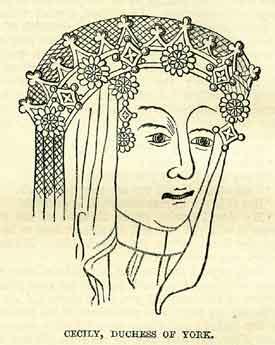
The latest installment in my EventBrite saga is today’s presentation to the Gloucester Branch of the Richard III Society by Annie Garthwaite, who has written a historical fiction piece about Cecily Neville (1415-1495), Duchess of York and mother of two kings.

The meeting properly began at 14:00 but the Zoom session was opened at 13:30. Cynthia Spencer, the host, said this was both to reduce the risk of interruption due to technical errors (or people arriving late) and to replicate in some way the socialisation between attendees that would occur at physical meetings. The first few minutes were thus filled with little more than awkward “Hello, hello?”s as early arrivals tested their sound systems. Garthwaite herself had to borrow an office with a fast broadband connection, her own being unreliable. There ensued a more general discussion as to the benefits and drawbacks of conducting all such meetings virtually. The ease of attendance from across a wider geographical area without a long commute was weighed against the subscription fee for the software. I opined that a virtual event’s main weakness was the impossibility of a buffet. Garthwaite recalled having virtual dinner parties – dinner for twelve people but only washing up for two! Inevitably there was talk about not being dressed below the waist.

After many more minutes of functional chatter, Keith Stenner (Chairman of the Gloucester Branch) announced that this was their first presentation of a fiction book. Garthwaite said that she had inherited her mother’s obsession with historical fiction and that her history teacher would pass books along to her. She was particularly enthralled by We Speak No Treason and developed an infatuation with Richard III – one obviously unrequited if for no other reason than the monarch having died five centuries prior.

Likeness by unknown artist circa 1540.

Cecily, the speaker noted, was born in the year of Agincourt and died in the reign of Henry VII. She was the only main protagonist of the Wars of the Roses to personally live through the whole of the conflict period, and spent much of that time as the most powerful woman in England save the queens themselves.

Garthwaite read out an extract from her book, set in Rouen in 1531 with Cecily observing Joan of Arc’s execution.

Returning to her background, she mentioned that she had long been familiar with other important women from the period – Margaret of Anjou, Margaret Beaufort, Elizabeth Woodville – and blamed Shakespeare for Cecily’s comparative obscurity. In his plays the duchess appears old, pious and dull, with few lines and little agency. Our guest went into an explanation of her subject’s childhood and courtship, then (with some fumbling around the screen-share function) showed us a simplified* diagram of Richard of York’s ancestry to demonstrate how he came about his multiple peerages as well as his two claims to the throne. She noted that, despite Richard clearly receiving royal favour at various points, he was always under suspicion from the Lancastrians.

Cecily’s arms – Richard Duke of York impaling Ralph Earl of Westmorland.

Garthwaite said she believed Richard & Cecily to be a marriage of equals, both being highly intelligent and ambitious – Cecily was allowed to operate autonomously in her husband’s business, household and political negotiations. It was a worryingly long time before the marriage produced any children but eventually she sired eight sons and four daughters (most of whom she outlived).

Garthwaite views Cecily’s marriage as the apprenticeship to her true flourishing as a widow, noting that when her son Edward IV acceded to the throne he immediately rushed off to the Battle of Towton, leaving the duchess in charge of the royal household “effectively as regent”, with ecclesiastical and diplomatic correspondence describing her as the true leader of England.

Describing the production process, Garthwaite said she – a novelist not a historian by training – was determined to stick as closely to known facts as possible. Medieval noblewomen did not solely concern themselves with embroidery and maternity, but would be in charge of managing large and complicated household organisations. Cecily’s family conflict was examined – her marriage into the House of York pitted her against her own Beaufort cousins.

After an anecdote about Destiny’s Stone on the Hill of Tara, another extract was read – concerning the Duke & Duchess’s last day in Ireland. This ended the formal presentation. Stenner noted that the book ended in 1461 but Cecily lived to 1495, and asked if a sequel was coming. Garthwaite confirmed that there would.

Spencer then began reading out questions that had been submitted by other attendees. One was about the allegation that Edward IV was the son of Blaybourne the archer and not Richard of York. Garthwaite laughed “I knew this would come up!” and said that the possibility of an affair was gold dust for historical novelists, but she decided that the theory was too tenuous.

Another was how a writer decides which historical events to include and which to omit, given Cecily’s very long life. Garthwaite said she learned to find the junctures which enable you to tell the overall story most clearly. She also said that “Your editor always has different opinions on it than you do.”

Spencer herself then asked about the legal status of decisions made by a woman in that era, and how her household was managed during confinement. Garthwaite replied that a lady of Cecily’s rank effectively had her own household distinct from her husband’s. After her husband’s death and her son’s accession she procured for herself very substantial tracts of land. This demonstrated, in the writer’s view, that female emancipation was not strictly linear – women of Cecily’s time wielded significantly more power than their Victorian or even later counterparts.

I asked Garthwaite what she thought of Cecily’s portrayal by Caroline Goodall in The White Queen and The White Princess** – the only instance I knew of her being played on television besides adaptations of Shakespeare plays. She replied that she had not seen either series and never passed judgement on other writers, but credited Philippa Gregory with renewing public interest in that era of history. Spencer chimed in that Cecily came across as a powerful person and that “It was a weird series but there were a few outstanding performances and I thought she was very good.”. Garthwaite said that while writing her own book she could not read anyone else’s historical fiction for fear of getting their thoughts mixed up with her own. This reminded me of Daisy Goodwin, writer of ITV’s Victoria, saying she would not watch The Crown to keep her own work independent and avoid plagiarism allegations.

The congregation then began to disperse but the session was kept open for a few more minutes so that members could scribble down contact details. I plugged my blog verbally for the first time, though I wish I had got in a moment earlier as by then there were only six out of thirty-one other people still logged in.

I have read and heard about the Richard III Society before but this was my first time directly interacting with its members. I hope there may be more.

*Inevitably, for a fully-detailed family tree for the Plantagenets, Beauforts, Nevilles and Mortimers would require multiple dimensions and still look tangled.

**Notably she was the only character not to be recast, perhaps because she was already an old woman when the first series started and so did not need to be aged up.

Henry and the Trackside Trees

Euan Roger (left) John Varley (right)

This week I got a little carried away with Eventbrite, and consequently this afternoon I attended two virtual talks in rapid succession – both on Teams rather than Zoom.

The first was All aboard a railway for people and wildlife by Women in Sustainable Rail. The session began less than formally with John Varley (Estate Director of Clinton Devon Estates) and Dr Neil Strong (Biodiversity Strategy Manager for Network Rail) getting carried away in a conversation about beavers. Varley spoke about the review he had done in 2018 for the Department of Transport, commissioned by then-minister Jo Johnson.  Varley concluded that the review was about nature and not just trees. He stated that in the 1950s there were fewer trees immediately bordering Britain’s railways than today, yet there was greater overall biodiversity. He noted that people tend to have a spiritual relationship with trees that is not extended to other plants. He delightedly recalled one day being given his own train in the North of England to go around inspecting the ground and interviewing the locals. He urged Network Rail to treat nature as an asset equal with its man-made infrastructure. The next speaker was Jane Dodds, Portfolio Head of Project at the Rail Safety & Standards Board. She told of the negative public perception surrounding Network Rail’s approach to managing vegetation around the lines. Strong then recounted the story of the implementation of the review. He showed photographs of a pilot scheme in Kent where a large row of trees was cut down from the side of the line, with the intention to plant a meadow there instead. He presented a long list of organisations with which he liaised over the course of the scheme. There was a question & answer session at the end which concluded in a similarly awkward fashion with the host offering to send slides and asking anyone still listening to email further questions. I couldn’t think of anything to ask (and wasn’t sure if my microphone worked) to ask so logged off sheepishly.

The second was event Readeption and Revenge: The final years of Henry VI by the National Archives. This detailed the later life of the last monarch from the House of Lancaster, though the lecturer Euan Roger included a brief overview of his early life, when he inherited the throne at aged nine months and was ruled by regents until coming of age. He founded Eton College and King’s College Cambridge, and was said to be overly generous with petitions, even granting the same estate to two people on the same day, to the point where his ministers began screening documents before the King was allowed to see them. The people perceived that senior officials were enriching themselves at the crown’s expense and that profligate royal pardons were undermining the rule of law. Henry’s reign took a serious turn for the worse in 1453 when his mental illness first appeared. He was barely lucid for much of the time, so unable to carry out duties of state. When he recovered he dedicated his life to religious pursuits instead of administrative or military ones. Roger noted, though, that reports of infirmity could have been exaggerated by those seeking political advantage. Without wishing to tell the whole story of the Wars of the Roses again, Henry was deposed by Edward IV in 1461. The new king eventually captured the old, but his imprisonment was relatively comfortable by the standards of the time. Contemporary documents referred to him as “Henry of Windsor” or “late by fact but not by right King of England”. One calls him “Henry Beaufort”, which Rogers suggested could be an attempt by the Yorkists to reframe his ancestry. A fall-out within Edward IV’s court saw the Duke of Clarence and Earl of Warwick depose him, restoring Henry to the throne as a puppet under their joint protection. The readeption only lasted six months before Edward IV had taken the throne again, and weeks later Henry died, officially of natural illness but more probably through blunt head injuries. Henry was buried at Chertsey Abbey, but in 1484 was relocated to St George’s Chapel, Windsor. For this lecture questions were asked in the chat box, but I waited too long to ask mine and so the session ran out of time to answer it.

EXTERNAL LINKS

I had wished to know why the Yorkists had killed Henry in such an obviously violent manner rather than poisoning him or denying him food, so that it would have been more plausible to claim that his death had been peaceful. Even Philippa Gregory’s version of events had him suffocated with pillows instead of beaten.

Ahead of Yourself

https://upload.wikimedia.org/wikipedia/commons/thumb/0/03/George_Hayter_-_The_Marriage_of_Queen_Victoria%2C_10_February_1840_-_WGA11229.jpg/640px-George_Hayter_-_The_Marriage_of_Queen_Victoria%2C_10_February_1840_-_WGA11229.jpg

To the extent that most people have heard of heraldry at all, they conceive it as the study and management of coats of arms. Certainly that is what the majority of my posts on the topic have discussed. That is not a herald’s only concern, however, for armory tends to intersect with other interests. Genealogy, vexillology and phaleristics are the obvious ones, but also within orbit are matters of ceremony and protocol, which often centre heavily on precedence.

Orders of precedence determine the seating plans of formal dinners and the sequencing of parades or processions. Certain institutions whether public or private may have their own specific orders of precedence, and even unaffiliated civilians may be required to adopt them for their extended families at weddings and funerals. What tends to concern heralds and heraldists, though, is the general order of precedence for an entire country.

The order of precedence for England & Wales (though that distinction is a recent one) can be documented descriptively as early as 1399, but the earliest extant prescriptions are the House of Lords Precedence Act 1539 and an ordinance issued by commissioners of the office of Earl Marshal in 1595 (itself based largely on the Lord Chamberlain’s order from 1520). It arranges the royal family and the grades of the aristocracy (peers, knights, esquires, gentlemen and their offspring) as well as the holders of important government, judicial and ecclesiastical offices. The sequence reflects the relative importance of certain jobs in Tudor times and earlier, which is often rather different to the level of power they exercise today. The Lord President of the Council and the Lord Keeper of the Privy Seal – now sinecures given to the leaders of the houses of Parliament – rank just below the royal family while the secretaries of state who make up the bulk of the cabinet rank just below barons and the Chancellor of the Exchequer has a redundant setting below the privy council.

The bulk of the scale has remained intact to the present day – and been repeated at the start of each edition of Burke’s and Debrett’s, though royal warrants have been issued on occasion to make small updates, such as the insertion of new orders of chivalry or of offices not formerly recognised.

The Lord High Treasurer was once a great officer of state*, but when it was put into commission the commissioners had no precedence, even after it became convention for the First Lord of the Treasury to be the de facto head of government. Victoria’s prime ministers would frequently walk into formal gatherings behind barons of their own nomination. The job of Prime Minister was at last given formal recognition by a warrant in December 1905 placing him in the position his grandfather office would have conferred. The Speaker of the House of Commons ranked rather low until a warrant in 1919 put him just after the Lord President. Other offices have fallen away over time, such as the Vice-Regent in Spirituals, the Lord High Steward and the Lord High Constable.

As with so many such matters, the situation in Scotland is less well documented. The earliest extant prescription is Edward VII’s royal warrant from February 1905. Indeed, that may be the earliest ever such instrument, for the preamble admits “a Scale of Precedence in Scotland has not been defined with due authority” and “doubts and a diversity of practice have arisen in consequence”. The order within the royal family is much the same as for England, with the exception that the Lord High Commissioner to the General Assembly of the Church of Scotland during the sitting of the General Assembly outranks everyone except the sovereign – including the Duke of Rothesay. The office is currently held by Prince William, who thus temporarily precedes his own father. Following the nephews of the sovereign – cousins are mysteriously omitted – there is a complicated insertion explaining that the Lord Lieutenants, Lord Provosts and Sheriffs Principal rank above the Lord Chancellor within their own jurisdictions. Following the Lord Chancellor the other Scottish high officers are listed, then the ranks of the peerage and orders of chivalry in a manner near-identical to the English version. The Church of Scotland is rather different in status and structure to the Church of England so there are no bishops listed for the Scottish scale. Senators of the College of Justice are ranked similarly to High Court judges and Lords Justices of Appeal, though other senior Scottish judicial figures are ranked above the viscounts whereas their English counterparts are below barons. I note that the position for Secretaries of State is not defined in the Scottish scale either.

Small amendments have been made to the scale in subsequent years – most prominently in 1999 to clarify the positions of office-holders in the devolved administration. Even so, there are some glaring omissions:

A series of constitutional reforms in the latter noughties saw the duties of the Lord Chancellor carved up: His administrative role in the English & Welsh judiciary was devolved to the Lord Chief Justice, his executive powers to the Secretary of State and his presidency of the upper house of Parliament to the elected Lord Speaker. Plans to abolish the chancery altogether were dropped and the incumbent’s ceremonial precedence was not pushed down, but it was deemed necessary for the others to be raised up. The Lord Speaker was given precedence immediately after the Speaker of the House of Commons. It is curious that the upper house was not given ceremonial priority here, though that could be in recognition of the superior vintage of the latter office as well as the greater degree of power he has within his institution. The Lord Chief Justice had previously been placed below the Chancellor of the Duchy of Lancaster, similarly redundant as all holders in nearly three centuries had been privy councillors and/or peers. A warrant in 2007 promoted him to just below the Lord Speaker, as well as moving the Master of the Rolls (still usually commoners) to just below the barons.

The Lords of Appeal in Ordinary previously ranked solely by their necessary peerages. Upon their reconstitution as a separate Supreme Court, the justices (who from then on would not be ennobled) were placed immediately below the Master of the Rolls, while the President was placed immediately below the Lord Speaker – and thus above the Lord Chief Justice. A difficulty arises here because the Supreme Court is a UK-wide institution while the Master of the Rolls only exists in England & Wales. The precedence of non-baronial Supreme Court justices in Scotland is thus undefined – though all at least are members of the Privy Council. The President also has this problem, although it may be masked by the complexity of the incremental insertions – Scotland had its own privy council prior to the Acts of Union, with its own Lord President whose responsibilities and status were comparable to those of his English counterpart. Logically the Lord President for Great Britain (and later the United Kingdom) would continue to have the same precedence as his provincial predecessors, but the Scottish scale from 1905 makes no reference to the post. This in turn means that the Speaker of the House of Commons, the Lord Speaker and the President of the Supreme Court are all without a defined rank in Scotland. Even the Prime Minister is left without a place, since the Archbishop of York is England-only**. It is no wonder that the Scottish scale was described by one contributor in 2011 as “a bit of a mess” and by another as “complete horlicks”.

Northern Ireland is an even worse story – there is no scale properly defined, and the Wikipedia article uses an unofficial, descriptive list from Burke’s 106th edition in 1999, which tellingly says “as in England” rather frequently.

A common feature of all three is that men and women are listed separately***. The bishoprics and various public offices are exclusively listed in the male scale. There were insertions into the women’s for dames of various orders of chivalry (outranking wives of knights of the same), but subsequent warrants regarding ministers and judges do not bother to specify which list they are altering. A convention has developed among Wikipedians (and probably everyone else who has to mind these matters) that any office held by a woman is temporarily transposed to the female scale, but without authoritative guidance we cannot be certain.

Another curiosity is that the general scale is formally headed by “The Sovereign” while the ladies’ scale is headed by “The Queen”, such that a queen regnant is technically first man as well as first woman, and while a king’s wife is a queen consort a queen’s husband is nothing at all until a special warrant is issued for his benefit. While we’re on the subject of the royal family, our attention should turn to the four – soon five – grandchildren of the Prince of Wales.

It is unusual for an heir apparent to be a grandfather before his accession to the throne. George IV (as regent) almost managed it in 1817 when his daughter Princess Charlotte of Wales was pregnant but she and the baby predeceased him. Edward VII had quite a few – Lady Alexandra Duff (later Duchess of Fife) in 1891, Lady Maud Duff (later Countess of Southesk) in 1893, Prince Edward of York (later Edward VIII) in 1894, Prince Albert of York (later George VI) in 1985, Princess Mary of York (later Princess Royal), Prince Henry of York (later Duke of Gloucester) in 1900. The first two were through a daughter so don’t really count for these purposes and the latter four were still small children when Victoria died, which means it was never necessary to define their place at state functions, though their titles and styles were subject to some dispute. Prince George of Cambridge is now older than Edward VIII was at his great-grandmother’s death and could be into adulthood – or at least adolescence – by the time of the next demise of the crown. Without any specific place for them within the royal family section, Wikipedians have determined that George and his cousin Archie rank as eldest sons of dukes of the blood royal. This status is below the non-royal dukes, who in turn are below the great officers already described****. Charlotte, as the daughter of a royal duke, similarly ranks below the duchesses. This makes sense if you consider royal dukes to be an unofficial sixth extra rank of the peerage above the normal dukes. By extension one would expect Prince Louis, as younger son of a royal duke, to rank immediately below the eldest sons of normal dukes who in turn are just below the marquesses. Instead his place is just below the earls but above the eldest sons of marquesses. This placement is rather confusing as it breaks the otherwise-consistent pattern by which children of peers are stationed. I don’t think there were any royal dukes in England with children of their own in 1520 and there certainly weren’t any in 1595, so the logic behind the original decision eludes me.

EXTERNAL LINKS

*The great officers of state (Lord High whatever) in ancient times are not to be confused with the great offices of state (Prime Minister, Chancellor of the Exchequer, Home Secretary, Foreign Secretary).

**Whether any of the Church of England’s officials should have precedence in Wales is questionable after 1920.

***Bizarrely, in the Scottish warrant from 1905 these were called “The Scale of General Precedence” and “The Scale of Precedence for Ladies”. The ladies are therefore special, one logically presumes.

****One must wonder if the current Lord President of the Council has ever sought a bow from the prince – only to follow protocol, of course.

And Ever Shall Be

It was always difficult to work out the exact year in which a given episode of Victoria was taking place, given the series’ sloppiness with chronology. Series 2 ended with “Luxury & Conscience” in which Sir Robert Peel resigns as prime minister following the murder of his personal secretary Edward Drummond – events which actually took place three years apart. Series 3 picks up with “Uneasy Lies the Head that Wears the Crown”, which covers the revolutions of 1848 and features Lord John Russell in charge. Dialogue indicates that the return of the Whigs to government is a recent development. In between these installments is the 2017 Christmas special “Comfort & Joy”, set in 1846 and showing, among other things, the adoption of Sarah Forbes Bonetta (which happened in 1850). The curious thing about the Christmas special is the absence of the political side of things. In real life Russell’s ministry had already been in place for six months but, in the series’ uncertain timeline, the political situation is simply ignored. This is almost certainly deliberate, as the intention is for the holiday special to be a purely family affair. Plus, with more than a year’s gap between the series it’s entirely possible that the later story arcs hadn’t yet been planned out, nor the relevant characters cast.

Flash forward to 2021: The Duke of Edinburgh had wished for a low-key funeral (well, by royal standards at any rate), and the pandemic meant that something on the scale of the Queen Mother’s funeral in 2002 or even Lady Thatcher’s in 2013 would not be possible. Instead Philip’s coffin was driven a short distance within the bounds of Windsor Castle and then lowered into the vault. Hundreds of soldiers were still present outside, but COVID regulations forbade more than thirty attendees. Ordinarily it would be expected that prime ministers and other senior officials would attend, but Boris Johnson (and, presumably, any others concerned) relinquished his place to make room for more of the deceased’s family. The resulting guest list included eighteen descendants of King George V, eight spouses thereof, three other descendants of Queen Victoria and one spouse thereof. I had wondered if the family or the press would have sought to orchestrate a photograph of Prince George of Cambridge saluting the coffin à la John Kennedy, but it was decided that the great-grandchildren were too young to be involved.

While the masks and social distancing ought to be obvious giveaways, I actually found that the reduced attendance gave the ceremony a strangely timeless quality – it was effectively a bottle show. Other than Mssrs Mozzia and Brooksbank all the people there were the same people one would have expected to see there at had this happened at any point in the last ten years – admittedly Viscount Severn and Lady Louise would have been smaller. Justin Welby might be considered a semi-political figure and he took office in 2013, but as St George’s Chapel is a royal peculiar he played a minor role compared to David Conner, who has been Dean since 1998. Thomas Woodcock as Garter King of Arms could also be considered vaguely political given his role introducing new members of the House of Lords, with that office the public tend to remember the uniform rather than the face. The sounds of the past week, too, were those you’d expect to hear: steady footsteps, military orders, cannon blasts, church bells, and, from the studio, the interminable wittering of Gyles Brandreth. Now the burbling of a Land Rover TD5 has been added to the mix. Even that adds to the timeless effect, since the Defender was in production for a third of a century and without a number plate even I – a subscriber to Land Rover Enthusiast for a few years – could not guess at a glance the decade in which this one was constructed.

Those who have studied British political history know that long ago the House of Commons met in St Stephen’s Chapel, with the Speaker’s chair on the altar steps and the members facing each other in the choir stalls – an arrangement which has been maintained in subsequent legislative chambers in Britain and around the world. As a consequence today’s proceedings – with only a few dozen people carefully spaced apart – resembled a session of the hybrid house, or perhaps even the failed 1am prorogation in 2019. Hopefully on this occasion the ceremony won’t have to be repeated a month later.

Having already done a piece about television scheduling in light of COVID, it would be pertinent to review it in relation to the royal death. Of course major newspapers and broadcasters have documentaries and obituaries prepared years in advance of the event – not just for the Duke of Edinburgh but for a wide range of prominent public figures. Eye 1545 page 18 notes how, in the build up to his centenary on 10th June, contributors often had to do each interview twice – the first speaking in present tense wearing light suits, the second in past tense wearing black ones. It was also noted that, in addition to different networks’ documentaries often – and unavoidably – using the same stock footage and delivering the same story as each other, there were some instances of companies recycling interview footage from their own documentaries in 2011 or even 2007, with talking heads who nowadays are visibly much older or even who themselves have died in the intervening years.

On other occasions this temporal tangle would be cause for disdain, but to commemorate a man who has been “a constant” for longer than most of the world can remember, somehow it feels oddly appropriate.

UPDATE (20th April)

The video I originally embedded (from the firm’s own YouTube channel) has now been set to private. The BBC’s has also disappeared. I have replaced it with the Teletrece version.

UPDATE (1st May)

That one has gone as well. I’m now using the one from 6abc Philadelphia.