Thanks for the Memoiries

Politician’s autobiographies are a strange beast. Everyone who’s anyone (and some who maybe aren’t) eventually publishes a weighty tome detailing their time in (or out of) power with a view to putting a favourable account of themselves in the public’s minds, as well as perhaps generating income and attention lost since holding office. A few of these, such as Alastair Campbell or Alan Clark, become famous in their own right but I suspect the majority sink into obscurity as fast as their authors do.

When I discovered it four days ago, the Wikipedia article on British political memoirs was a left much to be desired. The list was long and disorganised. After many hours of code crunching, I had rearranged it into three big tables, searchable by name and publication date. I also added details of the authors’ notability as well as the publisher. The list is, of course, incomplete, given that there are new memoirs coming out every year as well as older ones overlooked (indeed I discovered a few along the way), but with as much as is already there I can spot a few trends. Harper and Collins (together or apart) got the top picks of the right wing while Penguin and Random House (ditto) got the left’s. I don’t know if that says anything about those companies’ corporate politics or if it’s just a herd mentality among their clients. Biteback, a company dedicated to political publications, is happy to print for any party.

I am sometimes struck by how early some of these books were published: Jess Phillips, who became MP for Birmingham Yardley in 2015, released her first book Everywoman in 2017 and already seems to be on at least her third. Gerald Kaufman published How to be a Minister in 1980, when his own ministerial experience amounted to just five years as a junior minister. Maureen Colquhoun wrote A Woman In The House having been voted out of the Commons after just five years. Even those who have served a long time still stand to miss out on what happens after – Ken Clarke’s Kind of Blue, debuting in 2016, mentioned how he was glad that Kaufman cut ahead of him when taking the oath in 1970, for he had no desire to be Father of the House. I presume he didn’t expect Sir Gerald to die so soon, to say nothing of the chaos of 2019.

The titles of such books are also interesting. Both Parmjit Dhanda (Gloucester 2001-10) and Matthew Parris (West Derbyshire 1979-86) described themselves as “outsider”. Almost forty of the books listed actually had “memoir” as part of the name. Some attempted puns on their own names, such as Coming Up Trumps or Teddy Boy Blue. Of particular significance is the number of books actually named after people other than the subject: Three Conservative autobiographers defined themselves in relation to Thatcher, while only one Labour book similarly refers to Blair.

Although a large proportion of the writers end up being members of the House of Lords at some point, relatively few devote more to it than a brief note in the epilogue. Those who were MPs tend to regard their time on the green benches as their real career, with ennoblement marking its end. Often the book is already out by the time the scarlet robes are put on. Clement Attlee stands out here – he apparently wrote and released As It Happened in 1954 while he was still leading his party!

FURTHER READING

Counting Stars

Aside

After eight years as a Wikipedia editor, I have made over eighteen thousand edits, which puts me at the service rank of Veteran III, or Most Perfect Tutnum. These ranks are gained automatically by reaching the necessary tenure and edit count, with users themselves left to keep track of them. They are not any kind of deliberately-selected prize from those in charge. The Wikipedian honours system is large, varied and probably not well understood by the majority of users, including me. The one thing I had managed to comprehend was the barnstar, essentially a token of appreciation which any ordinary user can award to any other. I woke up today for some reason thinking of these, pondering why I had never gotten one. Of course, I could never draw attention to this, for nothing could be more pitiful. I thought of designing a userbox saying “This user has never received a barnstar, but he pretends not to be disappointed”. It’s the sort of ironic cloak to one’s frustrations that could well have caught on. Then, late this afternoon, I found a message on my Commons talk page from senior editor Cardofk, giving me the graphic designer’s barnstar for all the the coats of arms I’ve uploaded. So much for that plan!

State of Change

May I see the wine list?

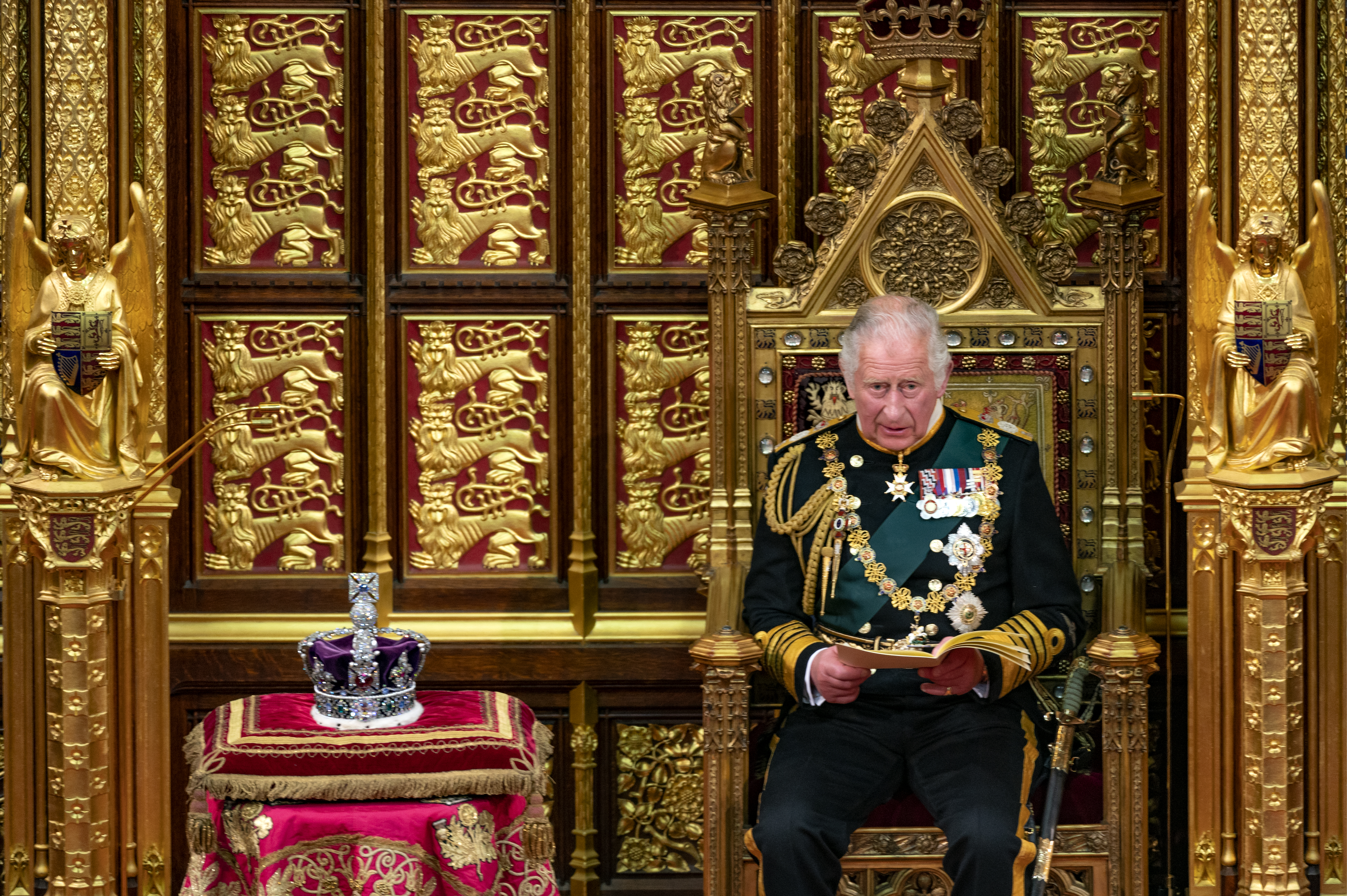
Late last night it was announced that, due to episodic mobility issues, Queen Elizabeth would not be personally present for the state opening of Parliament today. While the shortness of notice is unusual, it is far from unprecedented for a parliamentary session to begin without the monarch. The present queen missed the openings of 1959 and 1963 due to pregnancy. Victoria loathed to visit Parliament at all during her forty years of mourning. On those occasions the standard procedure was to open the session by commission, with the Lord Chancellor reading the speech. This time, perhaps in consequence of the shortness of notice, the full state ceremony went ahead but with the Prince of Wales reading the speech instead of his mother.

The last time an heir apparent opened Parliament in this way was 23rd November 1819, when the Prince Regent opened the second session of the sixth Parliament on behalf of George III, a mere nine weeks before actually ascending to the throne. Charles, of course, is not full regent, and performed today’s ceremony in his capacity as counsellor of state. Such counsellors are required to act in pairs, hence the first appearance of the Duke of Cambridge at the event.

It was reported in the BBC coverage that Charles was sitting on the consort’s throne, with the monarch’s throne being removed from the chamber completely. The Imperial State Crown was displayed on a small table to his right where the monarch’s throne would normally be, while his wife and son sat on the smaller chairs in the alcoves either side.

Convention has long been for the peer reading the speech to do so in first person, as the sovereign herself would have done, but Charles opted to switch to third person, repeatedly describing the government and its ministers as “Her Majesty’s” instead of “my”*. I do not know if he was making the substitution mentally or if the speech was actually printed again with altered wording – which would require a downgrade in materials.

Also last night it was announced that Professor Anne Curry had been appointed Arundel Herald Extraordinary. This did not make her a member of the College of Arms, but did allow her to take part in the procession with the other heralds.

This afternoon the House of Lords Flickr account published twenty photographs of the ceremony, taken by Annabel Moeller and licensed as CC BY 2.0, enabling me to quickly absorb them into Wikimedia Commons. It is unusual for us to have such number and quality of images for events like these. The trend towards releasing photographs in this way is encouraging, even if it is intermittent.

Given that this if the first time counsellors of state have been used to open a legislative session, and that the decision was not known until thirteen hours prior, one has to wonder how much improvisation was employed in today’s ceremony, for example:

  • Their Royal Highnesses travelled entirely by motorcar. Had there previously been plans to use the horse-drawn carriages?
  • The Prince of Wales was in full military uniform as for most state openings, but his wife and son were in morning suits as for the “dress down” occasions in June 2017 and December 2019. The inconsistency is inexplicable.
  • There was no mention of the Union Flag over the Victoria Tower being swapped for the royal standard. Was a banner of the heir apparent’s arms available?
  • The limousine carrying Charles had his own shield of arms mounted on the roof, but that carrying William used the generic red shield with a crown. Has a shield of William’s arms been made for this purpose?
  • The carpet on the lowest step to the throne was plain red, whereas previously the pattern of lions and roses continued all the way.
  • Sir Lindsay Hoyle is wigless for the third consecutive state opening, despite promising to wear it before his election. It can’t still be missing, can it?

When the ceremony is over, both houses debate a response to the address. Tradition dictates that the motion be introduced by a long-serving older member and seconded by a younger, recently-elected one. The role of the “old duffer” was this time fulfilled by my own MP, the “shy and retiring” Graham Stuart. He said of his constituency:

Beverley and Holderness comprises four towns—Beverley, Hornsea, Withernsea and Hedon—and many other hamlets and villages that are dotted across east Yorkshire. It is a beautiful part of the world and has history as well as charm. Beverley has contributed more than most places to the improvement of our democratic system over the years—admittedly chiefly by running elections in such a corrupt manner that the law had to be changed afterwards. After the unseating of the victorious candidate in 1727 by a petition, his agents were imprisoned and Parliament passed a whole new bribery Act. But Beverley’s notorious freemen were not to be put off so easily. Beverley continued to be a byword for electoral malpractice. The novelist Anthony Trollope stood in the Liberal interest, unsuccessfully, in 1868, and such was the level of wrongdoing that a royal commission was established especially and a new law passed disenfranchising the town and barring it from ever returning a Member of Parliament again. Obviously the law did change. Free beer and cash inducements were the electoral controversies then, rather than, say, beer and curry today. Never in the history of human conflict has so much karma come from a korma.

FURTHER READING

*The version used on the Hansard website for both the Commons and the Lords is in third person as Charles delivered it, while that on the government’s site is in first person, as well as annotated with the names of the bills being described.

Fighting Corruption in the Judiciary

Many times before I have virtually attended the kinds of events that I could not attend in person. Sometimes it is because the location is too far away, other times because I am not a member of the organisation hosting. On this occasion it was both.

When I first found the flyer for today’s presentation on Eventbrite I assumed it would be an academic or professional presentation similar to all the others. Only upon entry did I realise it was actually the preparatory talk to a competition (which I obviously will not be entering).

The challenge was for high-schoolers and undergraduates to imagine that they were junior staffers at the justice ministry in a fictional Eastern European country which, having emerged from the Warsaw Pact, signed and ratified the United Nations Anti-Corruption Convention but then, after a change of government, withdrew from it, and wanted to make changes to the method of appointment and dismissal of judges. The student’s task was to make a video presentation about the meaning and consequence of corruption. They should outline the basics of a legal strategy to bring their fictional homeland in line with the convention again, and produce three key ideas on enhancing judicial independence.

The speaker, Alice Thomas, then went on to make some general points about political corruption: It exists everywhere in some shape or form. What we know is only what other people have found out, and in countries without an independent media it can be difficult to find out anything. Most countries have anti-corruption strategies, at least on paper. The United Nations often follows the work of smaller regional groups, because having fewer members means it takes less time to reach decisions. North Korea, unsurprisingly, did not sign the aforementioned treaty at all. Some countries signed but did not ratify. International cooperation is important for asset recovery and information exchange, since corruption is often a cross-border phenomenon. The judiciary, legislature and executive are there to monitor each other. In a country without a functioning judiciary everybody can basically do as they please. Corruption may take the form of individual judges being bribed or coerced rather than the whole system being controlled. For a government to ensure judicial independence without inadvertently encroaching on it is a complicated task, since attempts to scrutinise the courts would themselves resemble the executive applying  political pressure.

Rather amusingly, Thomas ended by telling participants to be careful about their sources and not to rely on Wikipedia because “it’s not always very accurate. It’s a very subjective thing. It relies on who writes what in it.” – me, for example.

EXTERNAL LINKS

More Speakers, More Arms

Almost three years ago I constructed, for Wikipedia, a list of all the coats of arms borne by Speakers of the House of Commons. That list covered the lower houses of Great Britain (1707-1800) and the United Kingdom (1801-present). Finding sources for the later incumbents was difficult – quite a few were missing from Burke’s and Debrett’s, so I had to get creative in looking for visual evidence, often relying on photographs from corporate events at Speaker’s House.

A few weeks ago the heraldic artist Baz Manning, whose photographs from Lincoln’s Inn I had already used for a similar page about Lords of Appeal, contacted me to say that he had taken extensive photographs inside the Palace of Westminster of the speakers’ arms, and would be uploading those on Flickr too. Not content with merely documenting those speakers who served since the Acts of Union, he had photographed the shields commemorating just about every speaker since the age of Henry III. It was therefore only natural that I should make a Wikipedia list for them as well.

In addition to these photographs I had written the written source of the 1850 book The Lives of the Speakers of the House of Commons by James Alexander Manning (Related? I’ll have to ask.), which I had already used for the earlier entries in the British list. The relative ease of accessing these compared to what I had before meant the prequel was much more easily accomplished than the original.

That is not to say that there were no difficulties, however – whereas speakers from the Georgian age onward generally served a good number of years in the green chair before ascending to the red bench*, in medieval to Stuart times their tenures were often very brief – indeed, the legislatures themselves were often only in existence for a few weeks. It was also much more common for members to serve non-consecutive terms, which means confusion about how to arrange their entries.

A particularly knotty problem is that many of these men lived and died in an age long before English spelling was nailed down, which means tricky decisions on what to actually call them (e.g. Guildesborough or Goldsborough, Broke or Brooke). Another is that different sources often contradict each other as to what exactly their armorial bearings were, Baz even pointing out quite a few instances where the painted shield on the wall does not conform to the blazon in the grant, or when there are two separate illustrations that are not in agreement.

Still, the page is up, and unlike last time it does not appear that I will be stuck waiting months for review and clearance, so I’m counting this as a success. It remains to be seen if one more armorial page can be squeezed out of this topic. Obviously the old Parliament of Scotland had no elected speaker (being unicameral and chaired by the Lord Chancellor much like the House of Lords), but the House of Commons of Ireland before 1801 had one much like its English counterpart. I will have to see if a similar gallery of painted shields is maintained at College Green, and if any other budding heraldists have been able to photograph it.

*Only five speakers of the English House of Commons ever ascended to the peerage, whereas only ten speakers of the British house have not, and several of them died in office. Quite a lot of English speakers were at least knights or baronets, though that introduces the further difficulty of finding out if each one was knighted before or after their time in office.

A Thistly Issue

I have written before about the intricacies of the Order of the Garter. Although it technically has only one grade (in contrast to the Bath which has three, or the British Empire which has five), there are many finely differentiated categories of membership. It is traditionally said that the order is limited to twenty-four knights companion at a time, but of course the reigning monarch himself is always the sovereign of the order (and all others), so really it was twenty-five. Then the Princes of Wales had automatic membership, so it was twenty-six. On top of that, George III in 1786 created the separate status of “royal knight”, so that his unusually large brood of sons could be installed without crowding out everybody else. In 1813 a further category of “stranger knight” was instituted so as to allow the appointment of supernumerary foreign members.

The position of female members is even more complicated. From the time of Richard II it was common to appoint ladies of the order, though even after many years I am still unsure as to their exact status and function. The last such lady appointed was Margaret Beaufort, Henry VII’s mother, in 1488. After that the installation of women to the order was discontinued completely, and for the next four hundred years the only women to wear the Garter robes were the queens regnant. After Victoria’s passing her son Edward VII, her grandson George V and her great-grandson George VI each installed their consorts as royal ladies by special statute. The Princess Elizabeth was also made a royal lady in 1947 and the stranger category came to include foreign female monarchs. From 1987 the statues were altered to allow non-royal women to be Ladies Companion of the order on the same basis as the non-royal men, the first example being the Duchess of Norfolk in 1990.

Wikipedia’s list of members for the order took pains to colour-code and differentiate between the different categories of membership. Curiously, while the modern ladies from Queen Alexandra onwards were all included, the medieval ladies were omitted. Long ago there had been a separate smaller page listing them, but it had been deleted on the recommendation to merge with the larger list. For unknown reasons that merger was never actually carried out, so that the medieval ladies were simply forgotten.

Yesterday, with the aid of one other editor, I worked to correct that problem. The sixty-four Garter ladies of the fourteenth and fifteenth centuries are now included in the table with their own colour code and numbering. For completeness, I have also added entries for those monarchs who were not already members of the order prior to accession.

Having finished that task, I then wondered if the page for the Order of the Thistle – Scotland’s Garter equivalent – would need a similar refurbishment. The list page I found was of a very different table design to that used for the Garter, or indeed the other chivalric orders, bearing sharp black borders around cells and being organised by century instead of by monarch. It took just over a day to completely convert the content to the more usual format. On the one hand, the Thistle has fewer categories than the Garter – sixteen knights brethren and supernumerary extra knights. On the other, the list did not differentiate one type of member from the other in the way that the Garter’s did, so in many cases guesswork was required and it is likely that the whole numbering system will need to be redone at some point to account for any I’ve missed.

While going through this, I received a notice that I had been granted access to the Wikipedia Library. This was intriguing, for it was an innocuous, easy-to-miss announcement of what turned out to be quite an important perk of being an editor. According to a video I found from last summer, the library has actually been around for about a decade, but until recently there was no systematic effort to advertise it, and so the vast majority of eligible members (including me) had no clue it existed. Having only discovered the resource today I cannot yet report on how useful it will be, but it looks promising so far.

It’s not all good news – for a long time I have been vexed by the positioning of “Sir” and “Dame” in the infoboxes of such subjects as are entitled to them. I prefer them to be in the name field, rather than among the honorific prefixes. Previously this appeared to be the consensus among the editors who frequented the articles of knighted politicians and civil servants, though not necessarily those of actors and musicians, with only a small number of persistent miscreants persisting otherwise. A fortnight ago this was discussed and my contribution was sought. It appeared that my stance was going to win out, but when the matter went to vote my supporters were rarely to be seen. We’re doomed to ugly box-headers for the forseable future, one supposes.

Guts for Garters

For the last few Decembers I have eagerly awaited the release of the new year honours list. Normally they arrive a few days before the actual new year, but this time around they came with barely an hour to spare.

There were, as to be expected, a great many awards given on ministerial advice for those involved in fighting COVID, but at the very top were three new appointments made at Her Majesty’s personal discretion to the Order of the Garter: Camilla, Duchess of Cornwall, her daughter-in-law; Valerie, Baroness Amos, former Lord President of Her Privy Council; and Tony Blair, her former Prime Minister.

While sons (and in modern times also daughters) of the reigning monarch are appointed to the order routinely it is rare for royals by marriage. The only examples in the past two hundred years are of those married to the sovereigns themselves – Albert two months in advance of his wedding, Alexandra, Mary and Elizabeth shortly after their husbands’ accessions. Camilla and the late Prince Philip are the only consorts to receive the garter while their spouses were not yet on the throne. I wonder if she shall use the same stall that he did?

Amos is a former leader of the House of Lords (like Lord Salisbury, and indeed others of that title before him). She also served a brief term as High Commissioner to Australia and an even briefer one as International Development Secretary.

Tony Blair appointed Amos to most of those offices. It used to be the norm for former Prime Ministers to join the order, up to and including John Major in 2005 it became rare to see party politicians appointed. It was long assumed that Blair had declined any honours if indeed he was ever offered them, whether that was due to his personal distaste for them (he portrayed himself as a moderniser rather than a traditionalist, and was often observed to behave more like a US President than a British minister), or potential public backlash over controversies stemming from his premiership. What has persuaded him to accept the award now, fifteen years on, is not yet known.

These are the first appointments to the order since 2019. There were no Garter Day ceremonies in 2020 or 2021 due to the pandemic. This year is set to be Elizabeth II’s Platinum Jubilee, so one presumes that the Firm will be keen to make up for lost time.

Today’s news will have interesting ramifications heraldry-wise: Camilla has of course been openly armigerous since 2005, and Sodacan has already updated his graphic of her arms to include the Garter circlet. Amos has been a peeress all my life, and typically appears early on in the pages of Burke’s and Debrett’s, but has never been shown with any armorial design. She may therefore receive a brand new grant in the coming months. Blair is especially confusing, though he is joining an English order of chivalry, he may be Scottish for heraldic purposes and so it would be Lyon not Garter arranging his grant.

SEE ALSO

Hard to Track Down

Following Gordon Casely’s talk on the subject two months ago, I have pursued the topic further with the creation of another Wikipedia armorial.

As with the Middle-earth one, I notified both the relevant WikiProject groups beforehand. Nobody in the heraldry group responded, as per usual. The UK railways group took a lot more interest, though so far none have directly contributed to the article. One controversy was how to name the article – at present it is called ”Armorial of railways in Great Britain” as I have decided the island of Ireland should be a separate article to reflect its railways having always been a separate administration, though this does leave some ambiguity over how to classify the railway heraldry of the smaller islands. It may expand to ”Armorial of railways in the British Isles” at a later date.

The other controversy, of course, was over what to count as heraldry. As Casely’s lecture pointed out – and as many in the latter talk page reminded me – most railway armory in the UK is entirely bogus in terms of legal authority and trite in terms of artistic merit. This leads to some difficulties in how to cite the various insignia being catalogued, since few will appear in the works of Burke, Debrett or Fox-Davies, though the latter’s Book of Public Arms still proved very useful in blazoning the civic arms which railway emblems so frequently appropriated. Most of the illustrations are not by me, nor by other heraldic artists, but photographs of emblems as they appear on the sides of old locomotives, stock and stations or scans from very old books (William Weaver Tomlinson’s The North Eastern Railway; its rise and development being especially handy). A good handful of the company seals found are easy enough to recognise in terms of blazonry (such as the York, Berwick & Newcastle Railway, which just had the shields of those towns in a triangle formation) but others (such as Hull & Selby) have no armorial pretensions at all and look more suited to the Soviet Union.

The list is still far from complete at present, and it will be difficult by nature to judge when completeness has been achieved, but I hope this has at least got the fire started – and allowed at least one of the Sudrian shields to get a viewing.

In further heraldry news, the Lyon Court recently opened a YouTube channel, and the second uploaded video is of the installation of new heralds at the Court of Session that I covered some time ago.

Islanders’ Arms

Ever since the seventy-fifth anniversary of The Railway Series last May, I have been looking to bridge my interest in that franchise with my hobby as a heraldist. I had long known that the thin clergyman had invented coats of arms for many characters and institutions within his fictional world, but it was difficult to actually find them.

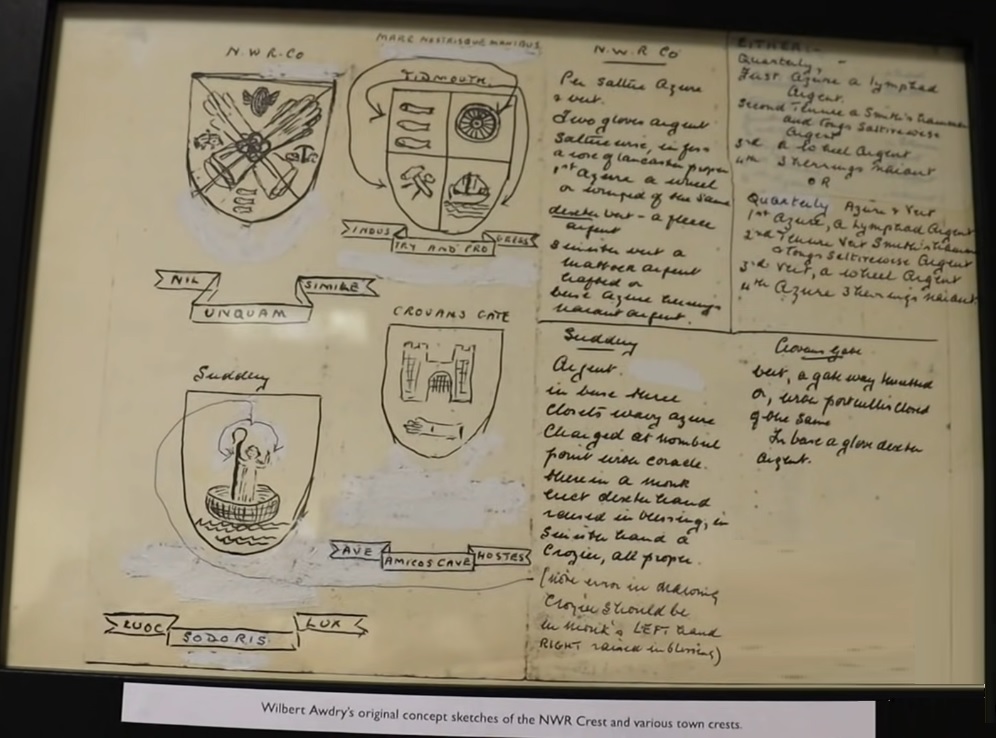
Of especial importance was a video by Max Davies, better known as Terrier55Stepney, documenting one of many visits that he and other tankies have made to the Talyllyn Railway. This particular video is valuable because at fifteen minutes and ten seconds in it shows a front-on close-up shot of an old sheet of paper on which Awdry had sketched and blazoned four different fictional coats of arms. I had glimpsed this before but never in quite enough clarity to make out the details. Even in this version the handwriting is not always legible. Luckily I found a handful of old posts on the Sodor Island Forums where other fans had also attempted to decipher the text. I have now illustrated all four shields there depicted and uploaded the results to Wikimedia Commons, though whether I shall be able to use them on any Wikipedia articles following last year’s purge is debatable.

CROVAN’S GATE

Escutcheon: Vert a gateway kernelled Or with portcullis closed of the same. In base a glove dexter Argent.

Motto: Ave Amicos Cave Hostes (Welcome Friends, Beware Enemies)

The symbolism here is fairly obvious – the gate is a literal interpretation of the proverbial “gate” (the narrow pass in the hills between eastern and central Sodor) at which King Godred Crovan held the Normans at bay in 1089, while the glove is one of his famous white leather gauntlets.

SUDDERY


Escutcheon: Argent in base three closets wavy Azure charged at the nombril point with a coracle therein a monk erect dexter hand raised in blessing in sinister hand a crozier all Proper.

Motto: Luoc Sodoris Lux (Luoc, the Light of Sodor)

This was the hardest to do and the least visually-satisfying at the end. The arms are pictorial heraldry, showing the legendary arrival of Saint Luoc on the island in the fifth century. There is a discrepancy between sources here – the above blazon refers to simply “a monk” but The Island of Sodor: Its People, History and Railways twice asserts that the arms have him “arrayed as a bishop”, the latter reference specifying “in cope and mitre”. I have said before that human figures usually don’t work well in heraldry, and this is no exception. Awdry does not describe Luoc’s appearance nor his liturgical vestements, so I took a drawing of St Vallier and changed the colours to give a more Anglo-Irish aesthetic, with the mitre using the blue and green shown on the other coats of arms here.

TIDMOUTH
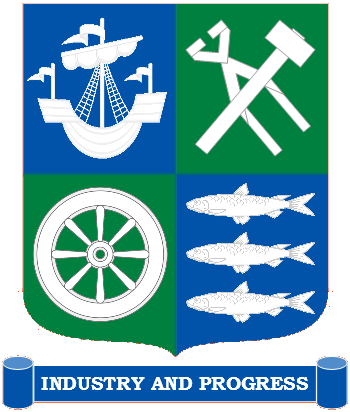
Escutcheon: Quarterly Azure and Vert 1st a lymphad 2nd a Smith’s hammer & tongs saltirewise 3rd a wheel 4th three herrings naiant all Argent.

Motto: Industry and Progress

There is some obvious faux-quartering here, though at least the colour scheme works. The first and fourth quarters refer to the towns history of fishing and later ship-building while the second and third refer to the other industries based there – possibly including the big train station.

THE NORTH WESTERN RAILWAY

Escutcheon: Per saltire Azure and Vert two gloves Argent saltirewise in fess a rose of Lancaster Proper in chief Azure a wheel or winged of same dexter Vert a fleece Argent sinister Vert a mattock Argent hafted Or in base Azure three herrings naiant Argent.

Motto: Nil Unquam Simile (There’s Nothing Quite Like It)

The gloves are here again, though I have elongated and narrowed them to fit the saltire. The herrings also make a reappearance. The winged wheel has a long history in heraldry and has appeared in the arms of a few real-life transport companies. The fleece and mattock presumably represent agriculture and industry, both of which are serviced by the railway but do not have any more specific importance. The rose refers to Sodor’s attachment to the Duchy of Lancaster, though of course its symbolism as such is very much a modern affectation.

While we are here, let us recap the other heraldic images I have mentioned here before:

THE SODOR REGIMENT

Escutcheon: Sable two gloves Argent saltirewise, charged in fess with the Rose of Lancaster Proper.

The blazon is given in the book (described as the regiment’s “colours”), though I wasn’t sure which shape to use for the field. The significance of the red rose and the white gloves has already been explained. The military is not covered much in the franchise so there is little detail to give here.

THE EARL OF SODOR
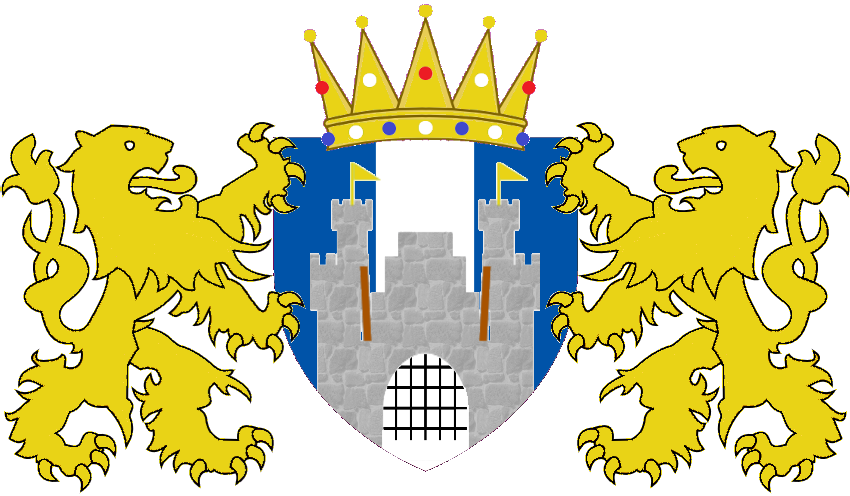
The Norramby line is mentioned in the book but nothing is said of them armorially. When the earl appears in the 2013 special “King of the Railway” his shield is Azure a pale Argent bearing a representation of Ulfstead Castle, with a jewelled Eastern crown on top and two lions rampant Or as supporters.

Taken as a whole, the Sudrian arms are a mixed bag – just as in real life. The time of matriculation for any of these devices is not specified, though we can guess from both content and context – the North Western Railway was formed in 1915 so its arms cannot be older unless inherited from one of the predecessor companies (earliest 1853). It looks a little too busy, as do those of many real railway companies from the time. The regimental badge, featuring the red rose, is probably from no earlier than Victoria’s reign. The faux-quartering on Tidmouth’s shield suggests a much more modern adoption, most likely by assumption in the mid-twentieth century. The shield of Crovan’s Gate is simple enough that it could be medieval. I am not sure about Suddery as I do not know how far back precedent can be found for the depiction of humanoid religious icons in heraldry.

I notice that blue and white seem to be the most persistent (though of course not universal) colours in the island’s civic and corporate heraldry as well as in the flag. This could be the diagetic reason for the majority of the main characters on the North Western Railway being painted blue. It would also fit the historical connections made in the source material, as blue and white were the livery colours of both the House of Lancaster and the Lordship of Ireland.

UPDATE (1st November)

I have just discovered the website Railway Mania, dedicated to building and running model trains. A subsidiary project is Sodor Histories, an attempt at re-imagining Awdry’s island in as much detail and as realistic a manner as possible. It’s well worth a look for the truly dedicated railfan.

UPDATE (June 2022)

Looking again at Burke’s General Armory, I have found two entries (on page 467) for the surname Hatt:

  • Hatt (co. Berks, Orsett, co. Essex, and London) escutcheon Quarterly Argent and Gules on a bend Sable three chaplets Or crest A falcon’s head quarterly Argent and Gules between two wings expanded Sable.
  • Hatt, or Hatte escutcheon Argent a chevron Sable between three annulets Azure.

Of course neither of these is necessarily linked to the Fat Controller. The only thing ‘People, History & Railways says about his origins is that he was apprenticed in Swindon – which is in Wiltshire, one county to the west from Berkshire, two from London and three from Essex.

UPDATE (October 2025)

This post has been referenced by Tumblr user Whumpster Fire, who has used my illustration of the regimental colours to make some alternative designs for a Sudrian flag.