Guts for Garters

For the last few Decembers I have eagerly awaited the release of the new year honours list. Normally they arrive a few days before the actual new year, but this time around they came with barely an hour to spare.

There were, as to be expected, a great many awards given on ministerial advice for those involved in fighting COVID, but at the very top were three new appointments made at Her Majesty’s personal discretion to the Order of the Garter: Camilla, Duchess of Cornwall, her daughter-in-law; Valerie, Baroness Amos, former Lord President of Her Privy Council; and Tony Blair, her former Prime Minister.

While sons (and in modern times also daughters) of the reigning monarch are appointed to the order routinely it is rare for royals by marriage. The only examples in the past two hundred years are of those married to the sovereigns themselves – Albert two months in advance of his wedding, Alexandra, Mary and Elizabeth shortly after their husbands’ accessions. Camilla and the late Prince Philip are the only consorts to receive the garter while their spouses were not yet on the throne. I wonder if she shall use the same stall that he did?

Amos is a former leader of the House of Lords (like Lord Salisbury, and indeed others of that title before him). She also served a brief term as High Commissioner to Australia and an even briefer one as International Development Secretary.

Tony Blair appointed Amos to most of those offices. It used to be the norm for former Prime Ministers to join the order, up to and including John Major in 2005 it became rare to see party politicians appointed. It was long assumed that Blair had declined any honours if indeed he was ever offered them, whether that was due to his personal distaste for them (he portrayed himself as a moderniser rather than a traditionalist, and was often observed to behave more like a US President than a British minister), or potential public backlash over controversies stemming from his premiership. What has persuaded him to accept the award now, fifteen years on, is not yet known.

These are the first appointments to the order since 2019. There were no Garter Day ceremonies in 2020 or 2021 due to the pandemic. This year is set to be Elizabeth II’s Platinum Jubilee, so one presumes that the Firm will be keen to make up for lost time.

Today’s news will have interesting ramifications heraldry-wise: Camilla has of course been openly armigerous since 2005, and Sodacan has already updated his graphic of her arms to include the Garter circlet. Amos has been a peeress all my life, and typically appears early on in the pages of Burke’s and Debrett’s, but has never been shown with any armorial design. She may therefore receive a brand new grant in the coming months. Blair is especially confusing, though he is joining an English order of chivalry, he may be Scottish for heraldic purposes and so it would be Lyon not Garter arranging his grant.

SEE ALSO

The Nearest Exit

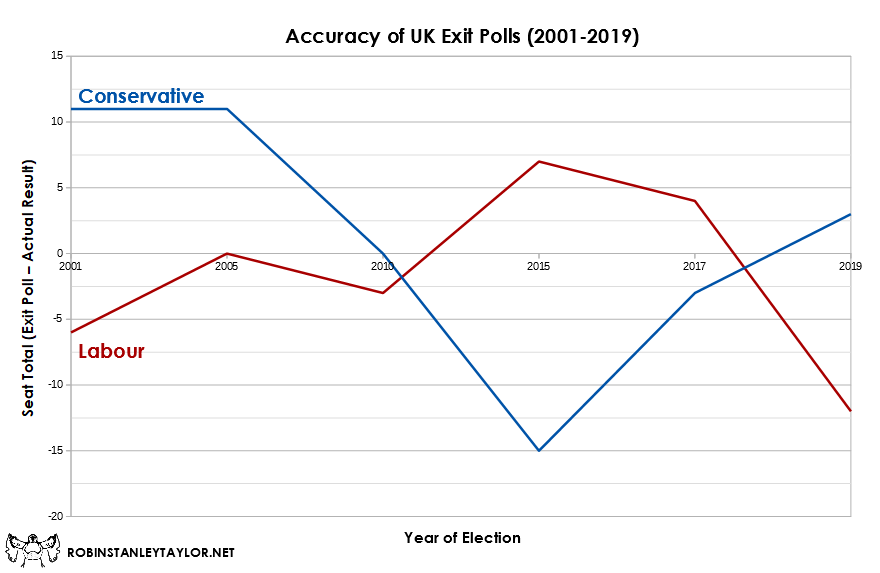
One of the most iconic components of election night in the United Kingdom is the 10pm exit poll. There will have been a heavy outpouring of regular polls, predictions and projections throughout the campaign, but the beauty of the exit poll is that instead of asking people what they intend to do it asks what they already did – all uncertainty thus being removed. The mood of political parties regarding their relative fortunes, the emotional state of all watching and the entire political narrative can be one way throughout the whole campaign and then change dramatically into something entirely different as soon as the bongs sound. The most prominent examples are 2015 – where it was widely predicted that the Conservatives would sink to around 290 seats and be level pegging with Labour, only to find that they’d actually gone up – and 2017 – where Theresa May had long expected to win by a landslide, but actually lost her majority.

Only a very small section of the people are surveyed – in the 2010 example Dimbleby said one hundred and thirty polling places, or one for every five parliamentary constituencies. The statisticians in charge of the polling companies are razor sharp in finding exactly the right places from which to check the political temperature. This makes it all the more remarkable that the polls’ predictions are so close to reality. Despite the protestations of the talking heads that “it’s too early to call” and Dimbleby’s own quip that “if it was dead accurate there’d be no need for anybody to go and vote”, generally the numbers shown are not far from the real ones.

To make the lead graphic, I skimmed through the coverage of the six UK general elections that have taken place in my lifetime, and compiled a spreadsheet of the seat totals projected for the two main parties as well as the actual numbers of seats won by those parties. The graph shows how much either party was under- or overestimated each time. The 2010 poll was nearly spot-on, with the Conservative figure exactly right and the Labour only three too low. The worst inaccuracy was the Conservative figure for 2015, and indeed this was the only occasion in this millennium where the overall result was mispredicted (it was a small Conservative majority rather than a hung parliament).

FURTHER READING

Exit polling explained – University of Warwick

Countessing Your Blessings

Recently I was browsing the Straight Dope Message Board and found a thread entitled Wait… ______ is still alive? As you’d expect, it’s about people one could reasonably assume to have died a long time ago who are actually still living. The one that caught my eye was post #40, mentioning that Clarissa Eden “died only last week”.

Having maintained the Wikipedia pages of British political figures past and present for the last few years, I was intensely aware of the curiosity of Clarissa’s continued existence. One of my earliest posts was on the centenary of Harold Wilson, but his wife had already passed that marker two months earlier. Whereas he died in 1995 at age seventy-nine, Mary finally passed in 2018, aged one hundred and two. Clarissa falls a little short of her record at one hundred and one. By comparison, Lady Dorothy Macmillan died in 1966 (aged sixty-five), the Lady Home of the Hirsel in 1990 (aged eighty), Sir Denis Thatcher in 2003 (aged eighty-eight) and the Lady Callaghan of Cardiff in 2005 (aged eighty-nine).

Still, it is interesting that so little media coverage was given to her death. In most newspapers that mentioned her at all it was as a minor footnote. Perhaps that is the ultimate tragedy – to outlive your fame by so long that nobody even remembers you. Indeed, her title itself would not be recognised – her three stepsons all predeceased her with no offspring of their own so the peerages are long extinct. Clarissa is so far the last premier’s spouse to be a countess*. There may never be another.

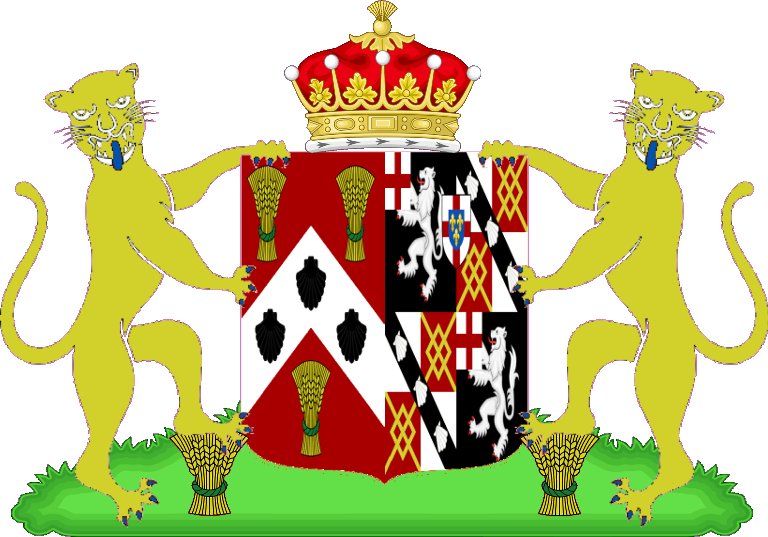
Clarissa’s heraldic achievement – the arms of Eden impaling Spencer-Churchill

EXTERNAL LINKS

*Eden’s immediate successor Macmillan was the last prime minister to receive an earldom, but that was long after his wife had died. Douglas-Home was of course a countess before her husband’s tenure but died a mere baroness. The title refers to the River Avon in Warwickshire. A county called Avon (referring to a different Avon river in Bristol) was created by Heath’s reforms in 1974 then abolished by Major’s reforms in 1996.

A Stark Vision

Amateur or professional, few students of Britain’s royal, political and constitutional history will be unaware of Dr David Starkey. With an extensive collection of literary and televisual credits, plus a famously oversized personality, he was for many years a giant among celebrity historians. His most prominent was his 2004 series Monarchy, followed by Magna Carta in 2015, but he can be traced back much earlier, appearing in The Trial of King Richard the Third in 1984. He has even been featured on the royal family’s own YouTube channel.

His career, though illustrious, has not been smooth sailing, for his character is notoriously abrasive and his reputation has been rocked by a string of ill-worded outbursts – in most notably in 2011 and 2015. His performance in directly teaching the youth was also rocky.

I was quite surprised, early in 2020, to see him interviewed on Akkad Daily. It taxed my mind to decide whether this pairing more represented Benjamin going up in the world or Starkey going down. Certainly the latter plummeted with great velocity that summer following a catastrophic episode with Darren Grimes, which resulted in many of his professional contracts being terminated and accolades withdrawn.

Given the severity of that latest offence, and given that he was seventy-five years old, one could have expected Starkey to vanish from public life altogether and slip quietly into retirement. For a few months that looked to be the case but then he began popping up again on various virtual conferences and current affairs broadcasts, suggesting there is still a place for him on the talking head circuit (well, the right-wing parts of it anyway).

A week ago he launched his own YouTube channel on which, seemingly alone, he gives lengthy speeches to his camera about his specialist subjects. Much of it recycles what he has already said in his earlier lectures and documentaries, some of which are of course no longer available. His motivation is not clear: it could simply be a charitable effort for the sake of public education (sort of a more sedate Crash Course) but then his website asks for monetary donations and boasts about the number of supporters he has in his “fight back”.

In between these was Charlie Brooker’s end of year mockumentary Death to 2020, in which Hugh Grant plays the historian Tennyson Foss. Judging by the hair, clothes, spectacles and voice I am fairly sure this is meant to be a pastiche of Starkey’s own interviews, although hints at the character’s backstory are clearly different.

Another Day, Another Death

James Brokenshire was not the most high-profile of British politicians. Overall he spent sixteen years in the House of Commons, including seven years as a junior minister in a senior department and three as the senior minister in two junior departments, twice having to resign from the government due to the lung cancer which ultimately ended his life earlier this month. Even so, the fact that he had been a cabinet minister, the relatively low age at which he passed and the level of public fear surrounding cancer, one would reasonably have thought it unlikely that his demise could be outdone in the eleven days before the house was to meet again. Then, to the shock of the nation and world, Sir David Amess was stabbed to death. MPs were already due to return from the conference recess today, but scheduled business in both chambers was abandoned in favour of tributes to Amess, with a service following in St Margaret’s Church. Brokenshire’s tributes have been postponed to Wednesday.

Something similar happened during the Easter recess – the death of Dame Cheryl Gillan on 4th April and of the Baroness Williams of Crosby* on 11th would have been the principal concern of their respective houses, had not the Duke of Edinburgh died on 9th. In that instance it was the social and constitutional rank of the departed that determined priority of mourning rather than the manner of death.

The most obvious comparison, made frequently by those who have spoken publicly in the last few days, is to the murder of Jo Cox a week before the EU referendum. There has even been a move to design a shield of arms for Sir David and place it on the chamber wall next to hers. Of course, the two victims had very different profiles – Cox was a Labour woman who supported remaining in the EU, Amess a Conservative man who favoured leaving. This is reflected in the different profiles of their killers – Thomas Mair was a white supremacist with links to the English Defence League, Ali Hari Ali is said to be of Somalian heritage and a suspected Islamist.**

Also distinguishing the two victims is the time they had spent in politics. As I mentioned before, Jo Cox was not well-known to the general public, having only begun her tenure in the House of Commons thirteen months prior. She could well have joined the shadow cabinet in the mass reshuffle later that month, and by this point she might even have been a contender for the party leadership, but back then she was a much a footnote as most of the other MPs from the 2015 intake. Part of what made her death so tragic was precisely that she died so young and so early in her political career, with so much potential thereby wasted. Amess, by contrast, had been an MP for almost long as the average Brit has been alive. Though never a minister, he was a creature of the house, serving on many important if low-profile committees as well as being involved in numerous campaigns and publications. Most in the political sphere knew his reputation, in contrast to Cox who was something of a cipher.

More broadly, the country must acknowledge the worrying frequency with which politicians and their entourages have been attacked (whether or not the attack succeeded in killing the victim) in recent decades, and consider how this can be rectified, both in terms of personal security to defend from those with evil motivations, and in the public attitude to politics that would encourage such evil in the first place. As the pandemic has shown this year and last, the kind of openness and accessibility required of parliamentarians can also be very dangerous to them in person, yet to abandon it can be very damaging to democracy as a whole.

EXTERNAL LINKS

*The speaker mentioned on 13th April that four other former MPs had died during the recess – Peter Ainsworth, Ian Gibson, Robert Howarth, Paul Marland.

**Almost immediately upon the announcement of the attack and the description of the attacker as a “British national” there were people denouncing immigration policy and calling for border closure.

Restoration & Renewal with James Henderson

Today’s Zoom meeting was with the charity Transforming Communities Together, concerning the Restoration & Renewal programme for the Palace of Westminster.

James, our host, asked his small group about our reasons for joining him. I replied that I was not professionally affiliated with the project but followed politics (and occasionally architecture) as a hobby. I also referred to my father’s ownership and ongoing restoration of Paull Holme Tower.

The presentation began with a brief virtual tour of the premises and an explanation of the role of MPs. James asked us if we had ever met our member of Parliament. I responded that I had never met with my own, but had met several others – Diana Johnson, Alan Johnson, Victoria Atkins and Lia Nici.

Much of the conversation focused on ways to make Parliament more accessible to the public – with participants requesting a hearing loop and better wheelchair routes. I recalled my parents’ experience opening the tower to the public, finding that tours had to be stopped due to the unsafe medieval staircase which could not be brought up to code without substantially altering the original fabric of the building and thus rather defeating the objective. Another participant responded that it was all about money.

On a related note, it was announced on Wednesday that Parliament had launched a new website for its heritage collections. The new site provides detailed galleries and records of all the palace’s artworks, furniture and fittings. I appreciate the idea but so far I have been a little disappointed by how many items have their illustrations missing and the range of records not quite being as wide as expected, but hopefully in time that will be resolved.

Who am I to Judge?

This has been a busy week for state ceremony, yet you wouldn’t know it from the news.

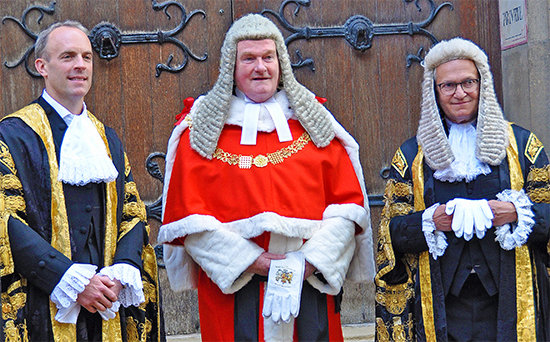
Friday 1st October was the beginning of the legal year 2021-22 in England & Wales, marked by the procession of hundreds of judges in their full dress uniform to a special service at Westminster Abbey. This included readings by the Lord Chancellor and the Lord Chief Justice, as well as a sermon by the preacher of Lincoln’s Inn.

The legal year in Scotland began on Monday 27th September. It featured similar events at the Court of Session and St Giles’s Cathedral. The Lyon Court was one of the bodies involved and a number of new officers of arms had their inaugurations.

On Saturday 2nd October the sixth devolved Scottish Parliament had its ceremonial opening, though of course it has been sitting and legislating since May.  The Queen visited the chamber, accompanied by the Duke & Duchess of Rothesay and Edinburgh. Many heralds were in attendance carrying with them the crown of James V.

It is a little disappointing that these events were so ill-publicised, even accounting for the distraction of party conferences and fuel queues. Rather than major newspapers I have mostly had to piece together details of all three ceremonies from the websites and social media accounts of the people involved.

Curiously this is not consistent across time – footage of judges’ processions from a few years ago can be found on YouTube, and some from many decades back are archived by British Pathé.

EXTERNAL LINKS

Judges at Westminster Abbey

Heralds at the Court of Session

The Scottish Parliament

The Deputies That Weren’t

In the long-awaited cabinet reshuffle it was announced that Dominic Raab, First Secretary of State since 2019, had been appointed Deputy Prime Minister. This would appear to be the latest in a long though intermittent line of appointments to that title. On closer inspection, however, the line may not be as long as once thought. A year ago the Wikipedia page listed eight people as having held the post, with a footnote about a possible ninth. By last month, that had been revised to just three official title-holders, supplemented by alternate lists of many more unofficial ones.

The main sources for these were Vernon Bogdanor’s 1995 book The Monarchy and the Constitution, Jonathan Kirkup & Stephen Thornton’s 2015 article ‘Everyone needs a Willie’: The elusive position of deputy to the British prime minister, Rodney Brazier’s 2020 book Choosing a Prime Minister: The Transfer of Power in Britain, and the Lord Norton of Louth’s 2020 book Governing Britain: Parliament, Ministers and Our Ambiguous Constitution. The latter has been much advertised on his lordship’s blog in recent months. The differences in the lists that they give shows that there is much scholarly dispute over who can be canonically considered a deputy prime minister in this country. In addition to those who were thought to have the title but actually didn’t, there are several listed as not having the title but still performing essentially the same function.

Different authorities have different criteria for who should be counted – Bogdanor lists those who chaired the cabinet in the prime minister’s absence and chaired numerous cabinet committees, Kirkup & Thornton use a five point checklist:

  • Styled as Deputy Prime Minister in Hansard or the Gazette
  • Designated as such by the Prime Minister
  • Recognised as such by their cabinet colleagues
  • Listed second in the cabinet hierarchy
  • Answered Prime Minister’s Questions

Clement Attlee, generally considered the trope maker and codifier, was Leader of the Labour Party from 1935 to 1955, a period which included the 1940-1945 wartime coalition government. Churchill had him appointed Lord Keeper of the Privy Seal in 1940, then Secretary of State for Dominion Affairs in 1942, then Lord President of the Council in 1943. He deputised for Churchill in parliamentary questions and cabinet meetings, with many sources saying he essentially ran all domestic business of the government while Churchill focused on the war. Curiously the time period usually given for his tenure as DPM begins only in February 1942. The Lord Hennessy of Nympsfield asserts that George VI’s minute for that reshuffle just said “Secretary of State for Dominion Affairs” and that it was Churchill who wrote “Deputy Prime Minister” on a separate paper. Bogdanor also asserts that Attlee was never formally given the latter title by the King.

Herbert Morrison was Lord President of the Council and Leader of the House of Commons through most Attlee’s premiership from 1945 to 1951, switching to Secretary of State for Foreign Affairs in the last few months. He is counted by Bogdanor, Kirkup & Thornton and Norton but not by Brazier.

Sir Anthony Eden was Secretary of State for Foreign Affairs during Churchill’s peactime ministry of 1951 to 1955. He is considered by all the lists to have functioned as DPM, though the King did not formally appoint him as such.

R. A. Butler is counted by all, though there is dispute as to when he took office. Under Eden and Macmillan he held several overlapping posts: Lord Privy Seal (1955-59), Leader of the House of Commons (1955-61), Chairman of the Conservative Party (1959-61), Secretary of State for the Home Department (1957-62) and First Secretary of State (1962-63). Brazier considers him to have been DPM beginning in 1955 but Norton believes he only started in 1962. Both agree he ceased when Douglas-Home replaced Macmillan in 1963.

George Brown became Deputy Leader of the Labour Party in 1960 and remained so throughout Wilson’s first two governments, resigning after the general election of 1970. From 1964 to 1966 he was First Secretary of State and Secretary of State for Economic Affairs, then he was Secretary of State for Foreign Affairs until 1968. It could be a typo, but Brazier apparently still considered him to have been DPM after that despite him no longer being in government.

Michael Stewart was First Secretary of State from 1966 to 1968 then Secretary of State for Foreign & Commonwealth Affairs from 1968 to 1970, succeeding Brown in both offices. He is counted by Bogdanor as well as Kirkup & Thornton to have been DPM in the last two years.

Curiously none of the authors consider Barbara Castle (First Secretary of State 1968-70) to be worthy of inclusion.

Reginald Maudling had been appointed by Heath as Deputy Leader of the Conservative Party in 1965. He was appointed Secretary of State for the Home Department following the party’s election victory in 1970. He resigned both posts in 1972. Bogdanor and Brazier consider him to have been DPM for two years.

William Whitelaw was Deputy Leader of the Conservative Party from 1975 to 1991, being created Viscount Whitelaw roughly halfway through this period. He was appointed Secretary of State for the Home Department in 1979, then Lord President of the Council and Leader of the House of Lords from 1983 to 1988. All the lists include him as DPM while he was in government, but are clear that he did not actually hold the formal title.

Sir Geoffrey Howe is widely considered to have been DPM from a reshuffle in 1989 until his famous resignation in 1990. He held the posts of Lord President of the Council and Leader of the House of Commons. When I commented on Norton’s blog suggesting his inclusion the noble lord replied:

Sir Geoffrey Howe was offered the title, but as he explained in his autobiography*:
Charles Powell then contacted him to tell him that Buckingham Palace ‘had had a little difficulty in accepting the official description “Deputy Prime Minister” . They were proposing to follow the precedent of Eden with Churchill and use the form of words: “Sir Geoffrey will act as Deputy Prime Minister”.

Michael Heseltine, it seems, is the first to be definitively appointed Deputy Prime Minister. He held the title from 1995 to 1997 as well as being First Secretary of State.

John Prescott was the second canonical incumbent. He had been elected Deputy Leader of the Labour Party in 1994 and was appointed Deputy Prime Minister after the general election of 1997, resigning both posts in 2007. For his first four years in government he was Secretary of State for Environment, Transport & the Regions. Thereafter he was First Secretary of State.

It is another curiosity that none of the lists include anyone for Gordon Brown’s premiership, even though the Lord Mandelson (First Secretary of State and Lord President of the Council 2009-2010) was widely considered to be DPM for the last eleven months of New Labour.

Nick Clegg, Leader of the Liberal Democrats throughout their coalition with the Conservatives from 2010 to 2015, was the third canonical DPM. He was also appointed Lord President of the Council and Minister for Political & Constitutional Reform. He regularly stood in for David Cameron at Prime Minister’s Questions.

William Hague was First Secretary of State through the same period. He was the second Conservative in the cabinet hierarchy and answered Prime Minister’s Questions when both of his superiors were absent. He was the senior member of Cameron’s shadow cabinet and so probably would have been DPM had the party won outright in 2010.

George Osborne was First Secretary of State and second in the cabinet ranking during Cameron’s second government of 2015 to 2016. He answered Prime Minister’s Questions in Cameron’s absence.

Theresa May did not appoint a DPM or FSoS during her first ministry. Most seem to have assumed that Philip Hammond (Chancellor of the Exchequer) was deputy by default. When she missed PMQs on 7 December it was David Lidington, Leader of the House of Commons, who stood in for her.

Damian Green was appointed First Secretary of State and Minister for the Cabinet Office in June 2017 but had to resign in scandal in December. He was second in the cabinet ranking and deputised at PMQs.

David Lidington was Chancellor of the Duchy of Lancaster from January 2018 to July 2019. He was second in the cabinet ranking throughout despite not holding either of the usual titles. He again deputised at PMQs during this period.

Dominic Raab was appointed First Secretary of State and Secretary of State for Foreign & Commonwealth Affairs in July 2019. He resigned both posts this month in favour of Deputy Prime Minister, Lord High Chancellor of Great Britain and Secretary of State for Justice. Bizarrely many press sources called this a demotion. He took charge of the government last year when Boris Johnson was in intensive care, and has deputised at PMQs many times, including last week. He would appear to be the fourth canonical DPM, having the title in Hansard as well as in government publications (no Gazette mention yet). Oddly the cabinet rankings until recently had him below the Chancellors of the Exchequer (Sajid Javid, then Rishi Sunak) and the most recent list of cabinet committees showed he wasn’t chairing any of them.

One might reasonably be wondering at this point as to the constitutional distinction between Deputy Prime Minister and First Secretary of State. Put simply, the latter actually exists in law. Every time a new first secretary is appointed there will be an order in council recording it, in the same way as for all the other secretaries of state. The office commands a salary in its own right and so an incumbent does not need to hold a sinecure in conjunction. This is in contrast to Deputy Prime Minister, which has no legal existence and is, in effect, simply a courtesy title given by the actual Prime Minister. Every holder of the title has simultaneously held at least one other ministerial office.

There is, though, one way in which First Secretary of State is like the Deputy Prime Minister and unlike the other secretaries of state. As I commented to Norton last year:

The main difference between the First Secretary of State and all the others is that he is a minister without a ministry. While there is an Order in Council to appoint a new First Secretary of State each time, there has never been a statutory instrument to establish a corresponding First Department. For this reason there is a little similarity with the title of Deputy Prime Minister in that leaving the position vacant has the same practical effect as abolishing it (indeed the press often don’t know which term to use), because the role cannot be proven to exist if it is not occupied.

*This is “Conflict of Loyalty”, published in 1994. The machinations of Howe’s appointment as DPM are described in pages 586-594.

UPDATE (July 2024)

Despite Norton agreeing with my above comment, this article by Robert Swetlic for the UK Constitutional Law Association highlights that there actually was a statutory instrument to give formal powers to the First Secretary of State in 2002, only for another instrument to take them away in 2008, with the latter acknowledging the corporation sole as being vacant at that time. Neither references a “First Department”, with the appropriate references being made instead to the “Office of the Deputy Prime Minister”, despite the title Deputy Prime Minister itself not being given a statutory footing in the way that First Secretary of State was, which just confuses the situation even more.

Arms and the Woman

The heraldic achievements of the Baronesses Hornsby-Smith (left) and Miller of Hendon (right)

This evening I returned to the Yorkshire Heraldry Society for a virtual lecture by Duncan Sutherland, detailing the arms which were sought and borne by Britain’s female parliamentarians since 1958. This is far from the first time that he has made this presentation – in 2019 he performed it in person at the Palace of Westminster. Today, however, was my first time to witness it, thanks to the virtual format.

The majority of these cases were baronesses for life, but there were some others, including the posthumous grant of arms that was made to the late Jo Cox for display in the chamber of the Commons.

In other news, yesterday Ruth Davidson finally took her seat in the Lords, with the title Baroness Davidson of Lundin Links, of Lundin Links in the County of Fife. Also yesterday I made a disappointing excursion to Hull Central Library: some months ago I found in their online catalogue a copy of Debrett’s Peerage 2015 – a much more recent edition than the ones in the university’s library – but of course as the libraries were still under semi-lockdown conditions I could not actually go there to access it. Once the restrictions were lifted I went there hoping to scoop up hundreds of new(er) blazons only to discover that, while the ground floor of the library was open again, the reference section on the first floor was closed for a refurbishment and the staff had no idea when it would open again. Blast!

UPDATE (September 2021)

The Heraldry Society has updated the publication section of its website. Sutherland’s presentation can be read as a PDF.

Two Newcomers

The Lord Stevens of Birmingham was introduced to the upper house at noon today, having been ennobled yesterday.

This is the first introduction ceremony since Sentamu’s, and the first to feature David Vines White, who succeeded Sir Thomas Woodcock as Garter Principal King of Arms last Thursday.

Even though she left the Scottish Parliament two months ago, we are still waiting for Ruth Davidson’s peerage to be Gazetted.