The annual Wade lecture at the University of Southampton.

The annual Wade lecture at the University of Southampton.
 I have written before about the intricacies of the Order of the Garter. Although it technically has only one grade (in contrast to the Bath which has three, or the British Empire which has five), there are many finely differentiated categories of membership. It is traditionally said that the order is limited to twenty-four knights companion at a time, but of course the reigning monarch himself is always the sovereign of the order (and all others), so really it was twenty-five. Then the Princes of Wales had automatic membership, so it was twenty-six. On top of that, George III in 1786 created the separate status of “royal knight”, so that his unusually large brood of sons could be installed without crowding out everybody else. In 1813 a further category of “stranger knight” was instituted so as to allow the appointment of supernumerary foreign members.
The position of female members is even more complicated. From the time of Richard II it was common to appoint ladies of the order, though even after many years I am still unsure as to their exact status and function. The last such lady appointed was Margaret Beaufort, Henry VII’s mother, in 1488. After that the installation of women to the order was discontinued completely, and for the next four hundred years the only women to wear the Garter robes were the queens regnant. After Victoria’s passing her son Edward VII, her grandson George V and her great-grandson George VI each installed their consorts as royal ladies by special statute. The Princess Elizabeth was also made a royal lady in 1947 and the stranger category came to include foreign female monarchs. From 1987 the statues were altered to allow non-royal women to be Ladies Companion of the order on the same basis as the non-royal men, the first example being the Duchess of Norfolk in 1990.
Wikipedia’s list of members for the order took pains to colour-code and differentiate between the different categories of membership. Curiously, while the modern ladies from Queen Alexandra onwards were all included, the medieval ladies were omitted. Long ago there had been a separate smaller page listing them, but it had been deleted on the recommendation to merge with the larger list. For unknown reasons that merger was never actually carried out, so that the medieval ladies were simply forgotten.
Yesterday, with the aid of one other editor, I worked to correct that problem. The sixty-four Garter ladies of the fourteenth and fifteenth centuries are now included in the table with their own colour code and numbering. For completeness, I have also added entries for those monarchs who were not already members of the order prior to accession.
Having finished that task, I then wondered if the page for the Order of the Thistle – Scotland’s Garter equivalent – would need a similar refurbishment. The list page I found was of a very different table design to that used for the Garter, or indeed the other chivalric orders, bearing sharp black borders around cells and being organised by century instead of by monarch. It took just over a day to completely convert the content to the more usual format. On the one hand, the Thistle has fewer categories than the Garter – sixteen knights brethren and supernumerary extra knights. On the other, the list did not differentiate one type of member from the other in the way that the Garter’s did, so in many cases guesswork was required and it is likely that the whole numbering system will need to be redone at some point to account for any I’ve missed.
While going through this, I received a notice that I had been granted access to the Wikipedia Library. This was intriguing, for it was an innocuous, easy-to-miss announcement of what turned out to be quite an important perk of being an editor. According to a video I found from last summer, the library has actually been around for about a decade, but until recently there was no systematic effort to advertise it, and so the vast majority of eligible members (including me) had no clue it existed. Having only discovered the resource today I cannot yet report on how useful it will be, but it looks promising so far.
It’s not all good news – for a long time I have been vexed by the positioning of “Sir” and “Dame” in the infoboxes of such subjects as are entitled to them. I prefer them to be in the name field, rather than among the honorific prefixes. Previously this appeared to be the consensus among the editors who frequented the articles of knighted politicians and civil servants, though not necessarily those of actors and musicians, with only a small number of persistent miscreants persisting otherwise. A fortnight ago this was discussed and my contribution was sought. It appeared that my stance was going to win out, but when the matter went to vote my supporters were rarely to be seen. We’re doomed to ugly box-headers for the forseable future, one supposes.
Throughout the past two years I have been a regular viewer of Jimmy Carr’s YouTube channel. He has uploaded many full-length videos of his old standup specials, as well as dozens of shorter compilation videos. He even did a quiz to entertain those trapped in lockdown, although this content has subsequently faded from prominence, condensed into a few large weekly compilations.
Late last year, he announced that after getting by for so long by endlessly rehashing old material, he was finally releasing a new show, albeit not on YouTube. His Dark Material premiered on Christmas Day.
There are two segments which focus on the events of the past two years, but these are relatively brief and the majority of the material is interchangeable with what one comes to expect from all his other concerts – I even caught a few classic lines being reused.
His earlier shows primarily used a static multi-camera format, with occasional panning to keep up with him as he walks about the stage or to focus on a heckling audience member. His later output features much greater use of swooping shots from behind while he’s standing still, as well as over the audience. This can be a little surreal at times, giving the impression that one is watching a film (perhaps a biopic) rather than a live event. It also, unfortunately, highlights the increasing sagginess of Carr’s face.
A consequence of watching so many compilations of much older material is that one develops a mental cache of a celebrity’s face, hair, voice and mannerisms that averages out as being a few years into the past, which then makes it a shock to see how they’ve changed when new material finally arrives. The problem is exacerbated if the “new” material is actually delayed for a long time. I have discussed this before in relation to ‘Cats Does Countdown: Throughout 2020 and into 2021 the programming still consisted wholly of holdovers from 2019, and it was quite jarring when post-COVID footage (only four episodes so far) finally arrived showing Sean Lock‘s deathly pallor, Katherine Ryan’s increased girth and, of course, Carr’s hair transplant (which he got after the Lockdown quiz and laughs at in this special).
Later in the special Carr pondered the passing of the ages in a different way – by lecturing to the younger members of the audience about how social interaction, telephony and taxi rides used to work in the 1990s. Here I must digress into a rant about a common trend I have witnessed among comedians and other social commentators – premature declarations of obsolescence. As someone born in the cusp of generations Y and Z (sometimes called a “Zillennial”), I will say for the record that well into the noughties I was playing and recording cassettes and VHS tapes (many of which I still have). I also operated fax machines a few times and stored some school projects on diskettes. Even restricting to the past five years I have regularly sent and received paper letters (both typed and handwritten), paid for things in cash, driven a car with hand-wound rear windows and made calls on public payphones. On at least two occasions I have ridden on trains pulled by steam locomotives. The notion pushed by so many talking heads that all of these things are entirely alien to anyone born after about 1995 has never quite rung true to me.

For the last few Decembers I have eagerly awaited the release of the new year honours list. Normally they arrive a few days before the actual new year, but this time around they came with barely an hour to spare.
There were, as to be expected, a great many awards given on ministerial advice for those involved in fighting COVID, but at the very top were three new appointments made at Her Majesty’s personal discretion to the Order of the Garter: Camilla, Duchess of Cornwall, her daughter-in-law; Valerie, Baroness Amos, former Lord President of Her Privy Council; and Tony Blair, her former Prime Minister.
While sons (and in modern times also daughters) of the reigning monarch are appointed to the order routinely it is rare for royals by marriage. The only examples in the past two hundred years are of those married to the sovereigns themselves – Albert two months in advance of his wedding, Alexandra, Mary and Elizabeth shortly after their husbands’ accessions. Camilla and the late Prince Philip are the only consorts to receive the garter while their spouses were not yet on the throne. I wonder if she shall use the same stall that he did?
Amos is a former leader of the House of Lords (like Lord Salisbury, and indeed others of that title before him). She also served a brief term as High Commissioner to Australia and an even briefer one as International Development Secretary.
Tony Blair appointed Amos to most of those offices. It used to be the norm for former Prime Ministers to join the order, up to and including John Major in 2005 it became rare to see party politicians appointed. It was long assumed that Blair had declined any honours if indeed he was ever offered them, whether that was due to his personal distaste for them (he portrayed himself as a moderniser rather than a traditionalist, and was often observed to behave more like a US President than a British minister), or potential public backlash over controversies stemming from his premiership. What has persuaded him to accept the award now, fifteen years on, is not yet known.
These are the first appointments to the order since 2019. There were no Garter Day ceremonies in 2020 or 2021 due to the pandemic. This year is set to be Elizabeth II’s Platinum Jubilee, so one presumes that the Firm will be keen to make up for lost time.
Today’s news will have interesting ramifications heraldry-wise: Camilla has of course been openly armigerous since 2005, and Sodacan has already updated his graphic of her arms to include the Garter circlet. Amos has been a peeress all my life, and typically appears early on in the pages of Burke’s and Debrett’s, but has never been shown with any armorial design. She may therefore receive a brand new grant in the coming months. Blair is especially confusing, though he is joining an English order of chivalry, he may be Scottish for heraldic purposes and so it would be Lyon not Garter arranging his grant.
SEE ALSO
I have mentioned before my delight at finding old documentaries uploaded for free on YouTube. One which has stuck with me for a long time is episode 10 of Monster Moves, in which a South African Class 15F tender engine is rescued from a breaker’s yard in Bloemfontein and returned to its birthplace in Glasgow.
As expected from this sort of program, every setback is milked for the drama. First, the lorry meant to move the engine to Durban turns out to be too small, so it has to be towed on rails by a diesel engine. Then the wheels all have to be re-lubricated so they don’t catch fire, then ten empty flatbeds have to be hauled behind for breaking capability, then the line is blocked by a stalled lorry, then the diesel breaks down just shy of the dock, then the ferry is diverted, then a giant floating crane is needed to lift the 100 tonnes aboard, then after arriving in Immingham another giant crane is needed to lift it off again, then the lorry trailer has to be redesigned for the narrower track gauge, then the load might be too high to get under British motorway bridges, then the long trailer struggles to navigate Glasgow’s tight corners. All of this is accompanied by a gloriously over-the-top orchestral Western song.
No. 3007 now resides at the Riverside Museum. It is a little disheartening to think that she can never actually run again – her track gauge being too narrow and her loading gauge too wide – and that the other old locomotives at the same depot probably won’t be saved. Many in the comments section also allege that South Africa’s rail infrastructure has deteriorated severely since 2006 and been hit by widespread looting during lockdown. All this makes the film’s ending a little bittersweet.
This was not the only rail-centric episode of the series – they also covered the relocation of two Gresley A4s from North America to York and the retrieval of two Stanier 8Fs from Turkey.

Following Gordon Casely’s talk on the subject two months ago, I have pursued the topic further with the creation of another Wikipedia armorial.
As with the Middle-earth one, I notified both the relevant WikiProject groups beforehand. Nobody in the heraldry group responded, as per usual. The UK railways group took a lot more interest, though so far none have directly contributed to the article. One controversy was how to name the article – at present it is called ”Armorial of railways in Great Britain” as I have decided the island of Ireland should be a separate article to reflect its railways having always been a separate administration, though this does leave some ambiguity over how to classify the railway heraldry of the smaller islands. It may expand to ”Armorial of railways in the British Isles” at a later date.
The other controversy, of course, was over what to count as heraldry. As Casely’s lecture pointed out – and as many in the latter talk page reminded me – most railway armory in the UK is entirely bogus in terms of legal authority and trite in terms of artistic merit. This leads to some difficulties in how to cite the various insignia being catalogued, since few will appear in the works of Burke, Debrett or Fox-Davies, though the latter’s Book of Public Arms still proved very useful in blazoning the civic arms which railway emblems so frequently appropriated. Most of the illustrations are not by me, nor by other heraldic artists, but photographs of emblems as they appear on the sides of old locomotives, stock and stations or scans from very old books (William Weaver Tomlinson’s The North Eastern Railway; its rise and development being especially handy). A good handful of the company seals found are easy enough to recognise in terms of blazonry (such as the York, Berwick & Newcastle Railway, which just had the shields of those towns in a triangle formation) but others (such as Hull & Selby) have no armorial pretensions at all and look more suited to the Soviet Union.
The list is still far from complete at present, and it will be difficult by nature to judge when completeness has been achieved, but I hope this has at least got the fire started – and allowed at least one of the Sudrian shields to get a viewing.
In further heraldry news, the Lyon Court recently opened a YouTube channel, and the second uploaded video is of the installation of new heralds at the Court of Session that I covered some time ago.
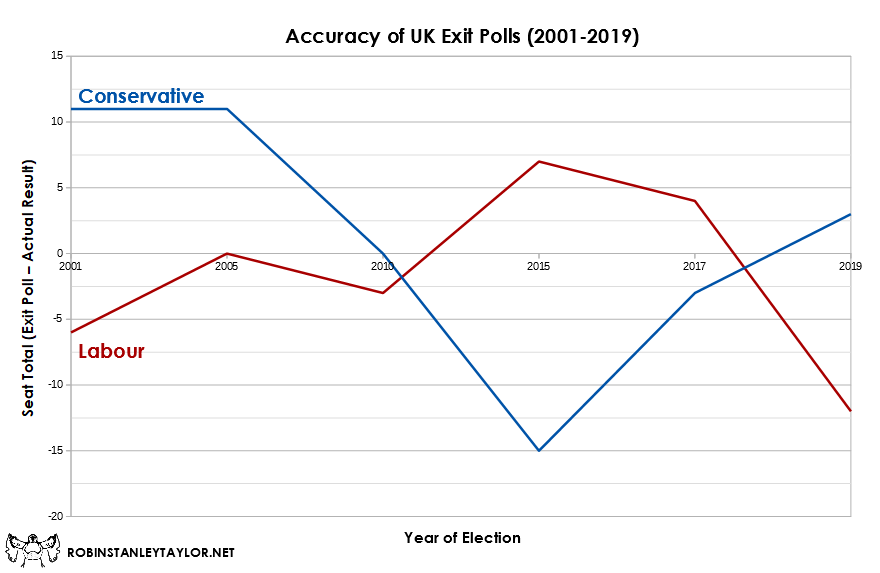 One of the most iconic components of election night in the United Kingdom is the 10pm exit poll. There will have been a heavy outpouring of regular polls, predictions and projections throughout the campaign, but the beauty of the exit poll is that instead of asking people what they intend to do it asks what they already did – all uncertainty thus being removed. The mood of political parties regarding their relative fortunes, the emotional state of all watching and the entire political narrative can be one way throughout the whole campaign and then change dramatically into something entirely different as soon as the bongs sound. The most prominent examples are 2015 – where it was widely predicted that the Conservatives would sink to around 290 seats and be level pegging with Labour, only to find that they’d actually gone up – and 2017 – where Theresa May had long expected to win by a landslide, but actually lost her majority.
Only a very small section of the people are surveyed – in the 2010 example Dimbleby said one hundred and thirty polling places, or one for every five parliamentary constituencies. The statisticians in charge of the polling companies are razor sharp in finding exactly the right places from which to check the political temperature. This makes it all the more remarkable that the polls’ predictions are so close to reality. Despite the protestations of the talking heads that “it’s too early to call” and Dimbleby’s own quip that “if it was dead accurate there’d be no need for anybody to go and vote”, generally the numbers shown are not far from the real ones.
To make the lead graphic, I skimmed through the coverage of the six UK general elections that have taken place in my lifetime, and compiled a spreadsheet of the seat totals projected for the two main parties as well as the actual numbers of seats won by those parties. The graph shows how much either party was under- or overestimated each time. The 2010 poll was nearly spot-on, with the Conservative figure exactly right and the Labour only three too low. The worst inaccuracy was the Conservative figure for 2015, and indeed this was the only occasion in this millennium where the overall result was mispredicted (it was a small Conservative majority rather than a hung parliament).
FURTHER READING
Exit polling explained – University of Warwick
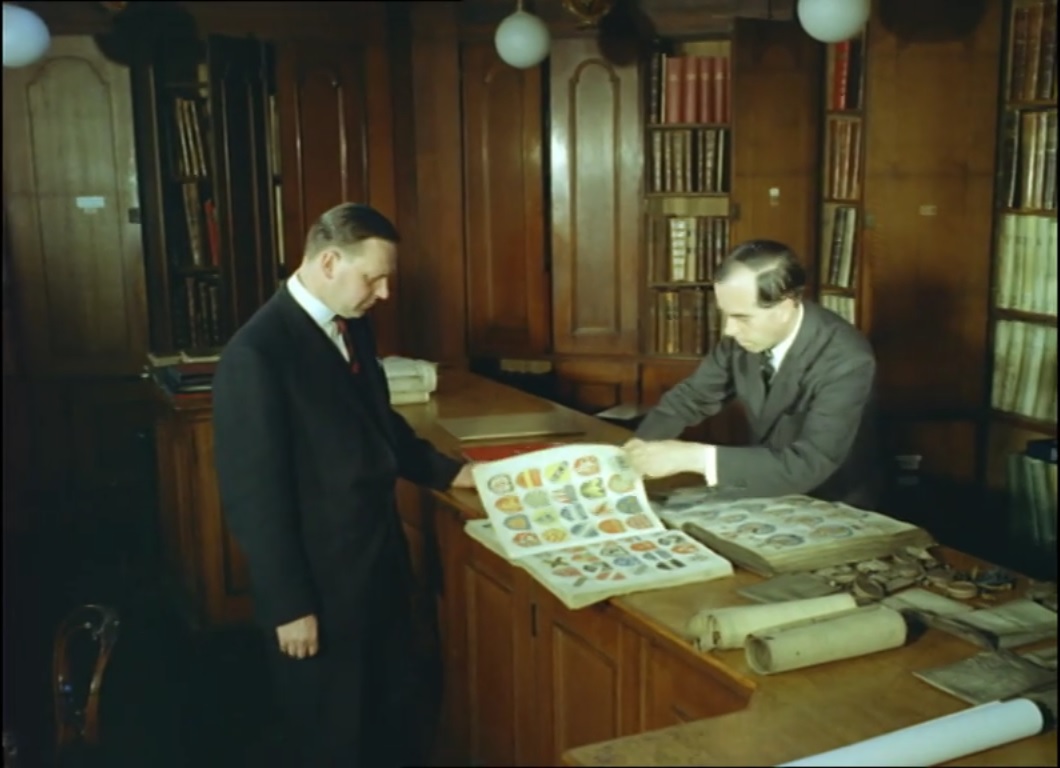 The York Herald’s Twitter feed recently led me to discover the 1960 short documentary series Look at Life, episode 7 of which is State Occasions. It follows the then-Earl Marshal (Bernard, 16th Duke of Norfolk) around the State Opening of Parliament and the Garter Day procession, as well as giving a tour inside the college of arms.
The narrator gives a concise but comprehensive overview of the college’s work and of heraldry as an artform, with ample footage of officers and artists going about their business as well as detailed closeups of the fruits of their labour.
It’s well worth a look.
 Recently I’ve been binging on some urban design channels – mostly talking about the best way to structure and arrange a populous settlement. Today I attended a Zoom talk on that topic – the heraldry stuff for this year appearing to have run out.
I had expected today’s session to be on similar themes – housing density, cycle paths, zoning etc – but instead it was mainly focused on children’s play areas. It was hosted by Timberplay, with guest speakers Lucy Wallwork and Laura Scott-Simmons.
The consensus was a need to move away from “KFC” playgrounds (Kit, Fencing and Carpet, not Kentucky-Fried Chicken) and towards more varied, naturalistic settings. Much of the aim was to design urban environments in a child-friendly way, so that children could access communal spaces without needing to be driven around in parents’ cars (or, for that matter, being endangered by other cars passing nearby).
Another theme in the talk was the decline of high streets due to the rise of online shopping – exacerbated by the pandemic, of course. It was recommended that city centres cater to more than just retail, with outlets for religion, leisure, culture and even rewilding. It was important to avoid “clone cities” which are indistinguishable from their neighbours, and create a unique feature for each town to attract tourism.
The talk ran on for a little longer than I had expected but there was still time at the end for questions. One asked if the measures for “children” also applied to adolescents, and the speakers acknowledged that teens were often “designed out” of public spaces because of negative perceptions. (The popular industry phrase quoted earlier was “too old for the playground, too broke for the café, too young for the pub”.)
I, living most of my life in remote countryside and noticing how many of these projects had “urban” or “city” in the title, asked if the same principles of design also worked for smaller and more rural settlements. The speakers said that the basic rules still applied, and that there was sometimes a “play deficit” in rural areas because it is often assumed that people there have easy access to nature whereas really much of it is closed-off agricultural land.
FURTHER READING
Most of these were mentioned in the presentations, and it’s easier just to list the links instead of copying them out.
Given that so much of my YouTube intake is about history, civic architecture, and trains, it is perhaps surprising that I did not come across the Hull History Nerd sooner. Though the channel claims to date back to 2012 the videos list that I can see begins in 2019, and a large proportion of it focuses on forgotten Yorkshire railways.
This video, however, lays closer to home. The presenter is standing on the banks of the Humber about 1500m from my house. His topic is the construction upon the riverside mud of facsimiles of Hull’s docks to distract German bombers.
I don’t have much to add beyond what is said in the video itself, though it would have been nice if he had walked a little further down the bank to inspect some of the other World War Two relics nearby.
FURTHER READING
 Robin Stanley Taylor
