State of Change

May I see the wine list?

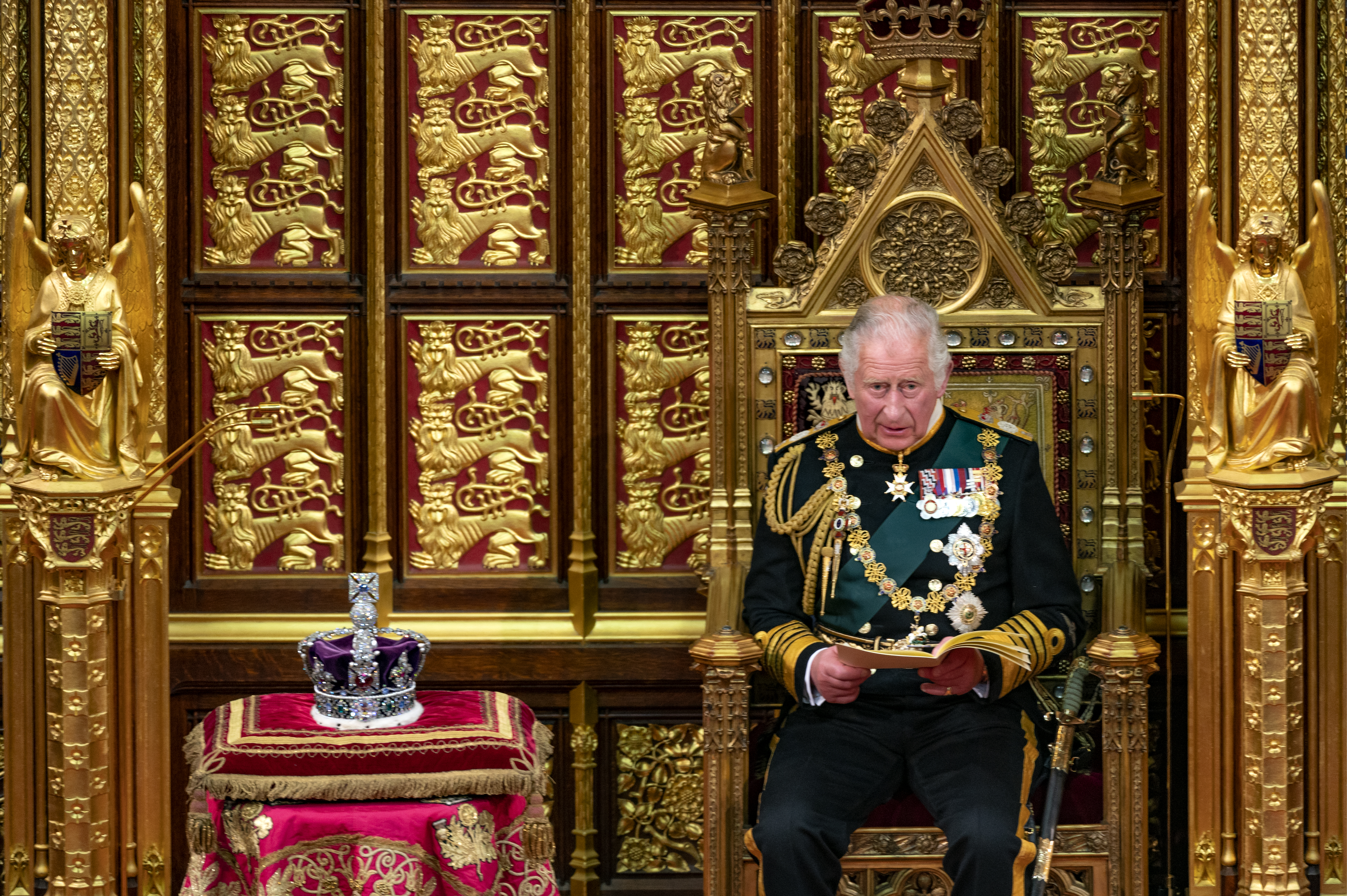
Late last night it was announced that, due to episodic mobility issues, Queen Elizabeth would not be personally present for the state opening of Parliament today. While the shortness of notice is unusual, it is far from unprecedented for a parliamentary session to begin without the monarch. The present queen missed the openings of 1959 and 1963 due to pregnancy. Victoria loathed to visit Parliament at all during her forty years of mourning. On those occasions the standard procedure was to open the session by commission, with the Lord Chancellor reading the speech. This time, perhaps in consequence of the shortness of notice, the full state ceremony went ahead but with the Prince of Wales reading the speech instead of his mother.

The last time an heir apparent opened Parliament in this way was 23rd November 1819, when the Prince Regent opened the second session of the sixth Parliament on behalf of George III, a mere nine weeks before actually ascending to the throne. Charles, of course, is not full regent, and performed today’s ceremony in his capacity as counsellor of state. Such counsellors are required to act in pairs, hence the first appearance of the Duke of Cambridge at the event.

It was reported in the BBC coverage that Charles was sitting on the consort’s throne, with the monarch’s throne being removed from the chamber completely. The Imperial State Crown was displayed on a small table to his right where the monarch’s throne would normally be, while his wife and son sat on the smaller chairs in the alcoves either side.

Convention has long been for the peer reading the speech to do so in first person, as the sovereign herself would have done, but Charles opted to switch to third person, repeatedly describing the government and its ministers as “Her Majesty’s” instead of “my”*. I do not know if he was making the substitution mentally or if the speech was actually printed again with altered wording – which would require a downgrade in materials.

Also last night it was announced that Professor Anne Curry had been appointed Arundel Herald Extraordinary. This did not make her a member of the College of Arms, but did allow her to take part in the procession with the other heralds.

This afternoon the House of Lords Flickr account published twenty photographs of the ceremony, taken by Annabel Moeller and licensed as CC BY 2.0, enabling me to quickly absorb them into Wikimedia Commons. It is unusual for us to have such number and quality of images for events like these. The trend towards releasing photographs in this way is encouraging, even if it is intermittent.

Given that this if the first time counsellors of state have been used to open a legislative session, and that the decision was not known until thirteen hours prior, one has to wonder how much improvisation was employed in today’s ceremony, for example:

  • Their Royal Highnesses travelled entirely by motorcar. Had there previously been plans to use the horse-drawn carriages?
  • The Prince of Wales was in full military uniform as for most state openings, but his wife and son were in morning suits as for the “dress down” occasions in June 2017 and December 2019. The inconsistency is inexplicable.
  • There was no mention of the Union Flag over the Victoria Tower being swapped for the royal standard. Was a banner of the heir apparent’s arms available?
  • The limousine carrying Charles had his own shield of arms mounted on the roof, but that carrying William used the generic red shield with a crown. Has a shield of William’s arms been made for this purpose?
  • The carpet on the lowest step to the throne was plain red, whereas previously the pattern of lions and roses continued all the way.
  • Sir Lindsay Hoyle is wigless for the third consecutive state opening, despite promising to wear it before his election. It can’t still be missing, can it?

When the ceremony is over, both houses debate a response to the address. Tradition dictates that the motion be introduced by a long-serving older member and seconded by a younger, recently-elected one. The role of the “old duffer” was this time fulfilled by my own MP, the “shy and retiring” Graham Stuart. He said of his constituency:

Beverley and Holderness comprises four towns—Beverley, Hornsea, Withernsea and Hedon—and many other hamlets and villages that are dotted across east Yorkshire. It is a beautiful part of the world and has history as well as charm. Beverley has contributed more than most places to the improvement of our democratic system over the years—admittedly chiefly by running elections in such a corrupt manner that the law had to be changed afterwards. After the unseating of the victorious candidate in 1727 by a petition, his agents were imprisoned and Parliament passed a whole new bribery Act. But Beverley’s notorious freemen were not to be put off so easily. Beverley continued to be a byword for electoral malpractice. The novelist Anthony Trollope stood in the Liberal interest, unsuccessfully, in 1868, and such was the level of wrongdoing that a royal commission was established especially and a new law passed disenfranchising the town and barring it from ever returning a Member of Parliament again. Obviously the law did change. Free beer and cash inducements were the electoral controversies then, rather than, say, beer and curry today. Never in the history of human conflict has so much karma come from a korma.

FURTHER READING

*The version used on the Hansard website for both the Commons and the Lords is in third person as Charles delivered it, while that on the government’s site is in first person, as well as annotated with the names of the bills being described.

Heraldic Artist Chat

Another session with the Royal Heraldry Society of Canada, Toronto Branch. This time Jason Burgoin was interviewing six heraldic artists from different countries.

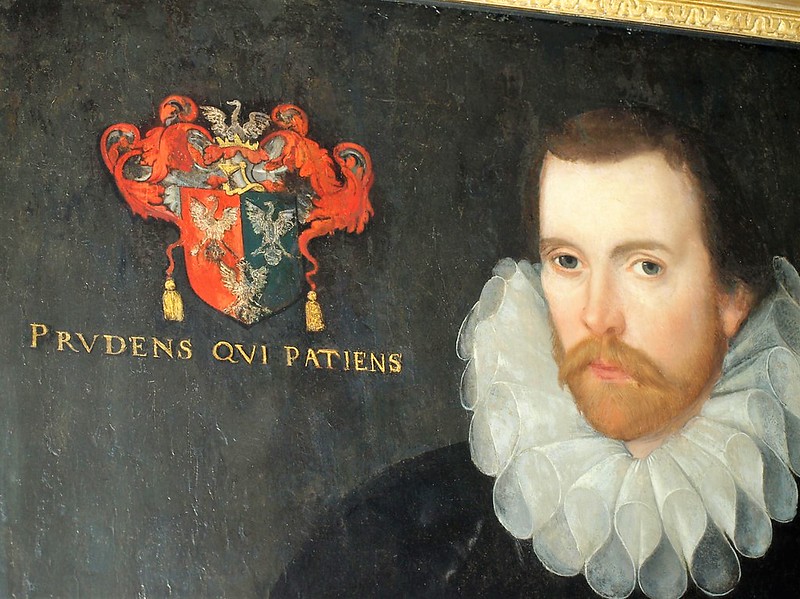
Edgar Sims

He has been drawing all his life, becoming a graphic designer after high school. He worked in different areas of art, not always as exciting. He studied law at some point, then transitioned to studying history in the last ten years. All of a sudden they all clicked together. Coats of arms are all around but most people don’t really think about them. Sims always worked with traditional media, but Latvian heraldry is very digital – no scrolls, letters patent or large beautiful manuscripts. He often has to explain the rules of heraldry to audiences who are not knowledgeable. He only works with Latvian clients, creating new achievements from scratch. He has made many civic arms, including the national hospital, as well as a President of Latvia.

Latvian heraldry is both very old and very new, rooted in the thirteenth century but interrupted by Soviet occupation. The Heraldic Authority is quite pedantic in stylistic choices to make a unified aesthetic, but the four artists working their can each recognise their own work. A wide variety of traditions are blended together – generally following the Nordic tradition but using British torses and crests. Branches of plants often surround personal shields, whereas other countries reserve these for civic arms. The main inspiration for the authority was the “boom” of heraldry in the interwar years, when civic arms were widespread but personal arms were discouraged – tainted by association with Germany.

Aaron Murray Travers

He is still relatively new to heraldry, but has been sculpting, painting and drawing his whole life. He met some of his lifelong friends through artwork. Australian heraldry was rare in the second millennium aside from politicians and military officers, but interest is growing now. Blazon has always been a challenge due to his dyslexia. He originally got into the subject after finding “the Travers arms” at a bucketshop. Fired up by his ancestry he eventually created his own style. He enjoys being able to recognised particular individuals by their arms across the centuries. He repeats traditional artistic techniques, but also incorporates elements from graffiti and comic book work. He particularly loves bookplates.

Allan Ailo

He was a graphic artist for many years. He had a lifelong interest in heraldry since finding Heather Childs’s book on it in high school. The rise of digital art has given heraldists much more flexibility and allowed it to become more widespread. Individuals can have representations of their own heraldry with much less fuss – no need to rent a private artist. Whereas before heraldic dinnerware required skilled craftsmanship, nowadays heraldic mugs can be printed by machine. Heraldry is more visible now that it is no longer bound to a physical object.

He advises new artists to study symbolism, and other types of art. His most rewarding experiences are seeing other people suddenly understand heraldry. His most challenging are interpreting blazon. He designed the scroll which the society sent to Elizabeth II for her Platinum Jubilee, as well as the members’ medallion.

Tania Crossingham

She is also Australian, but has lived in Finland for the past four years. She studied to teach art history in high school, but then fell in love with medieval illumination and taught herself calligraphy. She is also branching out to fabric design. One day Leon Mintle approached her at an exhibition and said she should try heraldry.

She loves the more traditional styles and these are what her customers typically want. She reworks old designs, including letters patent. She advises finding a more experienced artist to mentor you.

Xon de la Campa

Before he got into proper education he saw heraldry everywhere, but it was not popular as a hobby. It was weird, like comic books. Spain is unique in using the bordure to denote maternal arms, as well as quartering them with the paternal as a matter of course. There is also a tradition of adding text to the shield. This makes for some interesting designs, not all of them nice. He is more relaxed with digital art than traditional tools as it is easier to correct mistakes that way. Daniel de Bruen is his main influence, with his unique ability to show new and old, producing something very different.

Brian Abshier

He took art as an optional class at university. He was never taught formally. He never did any kind of digital art. He had a parallel passion for history. Wikipedia made his research easier. Heraldry is not very prevalent in the United States. His preferred style is that of manuscripts and armorials from the thirteenth and fourteenth centuries, for which he often receives online requests. His most interesting project was a history of an English manor, illustrating the house, its owners and their arms. Bitmaps and rasters don’t scale well, so he has to ask clients about the size of their intended display. He uses a mouse rather than a tablet, the resulting imperfections avoiding a wholly digital look.

EXTERNAL LINKS

Burgoin’s Hall of Heraldic Artists

A Canadian Heraldry Double-Dip

At 4pm today (or 11am for them) I attended yet another virtual lecture put on by the Toronto Branch of the Royal Heraldry Society of Canada. The speaker was Bernard Juby and the topic was heraldic bookplates – meaning a decorative label pasted into the early pages of a book, illustrating the arms of the copy’s owner. Juby told us, and showed many examples, of heraldic artists in Canada and around the world who had been commissioned to make such pieces. He said that the convention began in late fifteenth-century Germany, and that until relatively recently books of all kinds were primarily owned by the elite social classes, most of whom would be armigers.

His presentation focused on breadth rather than depth, moving at considerable speed through the portfolios of over a hundred artists. The rushing by of so many luxuriously detailed and coloured artworks was quite dazzling. It was indicated that a recording of the presentation will shortly be available on the society’s YouTube channel, so I need not attempt to describe them all again.

Towards the end of this presentation, Jason Burgoin casually mentioned that later in the same day the British Columbia & Yukon branch of the society would be holding its annual general meeting. This began at 1pm BC time, which was 4pm in Toronto or 9pm in Yorkshire.*

The meeting was chaired by Steve Cowan. He welcomed the presence of Angélique Bernard, one of the branch’s patrons, and then announced that this would probably be the last Zoom meeting for a little while. He moved swiftly and efficiently through the agenda, including a handful of financial statements and appointments of various society officers (He noted that everybody else turned their cameras off at that point. “Very wise”.). The main concern was the content of The Blazon, the branch’s newsletter, and anticipation of upcoming commemorations (Commonwealth Day, Platinum Jubilee and the branch’s own fortieth anniversary). I was pleased to be able to witness this, as practice for the NERA’s AGM in May.

After an ten-minute adjournment, another presentation followed. This was by Charles Maier, former Athabaska Herald, and concerned the armorial history of Sir Winston Churchill. Maier said that while we often talk of him as one of the great men of history, his heraldry is great in itself. Winston was born a nephew of the Duke of Marlborough. He was proud of his lineage but also wanted to secure his own accomplishments. It is a lingering curiosity that he consistently refused to differentiate his own arms from those of his uncle.

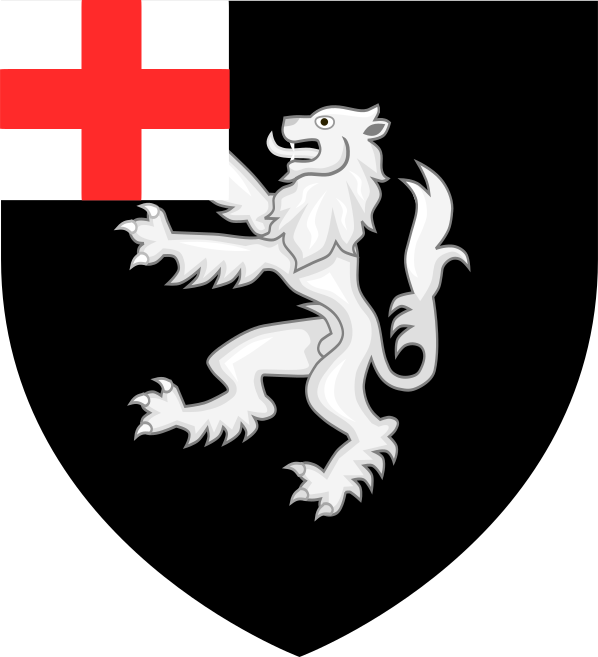
The first Sir Winston Churchill was a cavalier soldier who was stripped of his lands and wealth under the republic. It was most likely during this time that the motto “Faithful Though Disinherited” was adopted. His branch of the family had borne arms Sable a lion rampant Argent over all a bend Gules, but in Charles II’s reign the bend was removed and replaced with a canton Argent thereon a cross Gules, presumably as an augmentation in reward for his services. The crest, a lion holding a red flag, also seems to date from this time. John Churchill, 1st Duke of Marlborough, was also made a Prince of the Holy Roman Empire in 1704 and Prince of Mindelheim in 1705. This allowed him to use the Imperial Eagle as a supporter behind the shield in addition to the wyverns on either side. A further augmentation (an inescutcheon Argent a cross Gules, surmounted by another inescutcheon Azure three fleur-de-lys Or) was granted in time for his funeral in 1722, and carried on flags in his procession. A special act of Parliament allowed Churchill’s English peerages to pass to his daughters, and through them into the Spencer family. The Spencer dukes gave their own quarterings priority over his until 1817 when they swapped them around and changed their name to Spencer-Churchill. They used a griffin and a wyvern as supporters. The modern day dukes continue to use the heraldic accoutrements of their principality, despite titles of the Holy Roman Empire never being allowed to pass through the female line, and also in spite of all German monarchies having been abolished in 1918. I found it a little strange that the Churchills continue to cling to a token given by the Germans for defeating the French, given that their name is now associated with saving the French from the Germans.
The later Winston was appointed Lord Warden of the Cinque Ports in 1941, allowing him to use the arms of that office. He became a Knight of the Garter in 1953, requiring a banner and stallplate of his arms to be placed in St George’s Chapel. Churchill disliked his first banner and had another one made in “a more striking, modern style”. He also had two stall plates – the first was made by Harold Soper in 1954, but never affixed because the herald responsible was not satisfied with its artistic quality. The second was made in 1958 by George Friend. He received a state funeral in 1965. This was conducted by the Earl Marshal, who had Nelson and Wellington as his only precedents. Banners of Churchill’s own arms, and those of the Cinque Ports, were held by heralds in his procession. The funeral banner had a small blue crescent for difference, which Churchill had refused to use when alive. The coffin went from Victoria to Bladen by train, the namesake locomotive bearing a plaque of his arms on its boiler.

Maier pointed to some other examples of his heraldic legacy – HMS Churchill, HMCS Churchill, Churchill College Cambridge and the 1965 Churchill postal stamp, whose launch coincided with the introduction of the modern flag of Canada, ironically symbolic of the passing of the very age with which he was most associated. His arms were also borne, impaled, by his daughter Mary Soames, who became a Lady of the Garter in 2005. Of course, he also brought up Churchill’s time in Canada: The famous “roaring lion” portrait was taken by Yousuf Karsh in 1941, and Churchill’s expression is of anger at having his cigar taken away. William McKenzie-King, Prime Minister of Canada at the time, was desperate to be photographed with Churchill, though that picture is less well known. When Churchill was Secretary of State for the Colonies he argued with the Garter King of Arms about whether a warrant or a proclamation was needed for Canada’s new blazon.

Patrick Crocco asked if there was any particular system for assigning Garter stalls. Maier said it was simply whichever stall had been recently vacated. He also mentioned that HM Treasury covers all expenses relating to the order’s insignia.

There followed even more post-presentation chat, including a lengthy discussion between Cowan and Burgoin about women’s naval bowler hats. Sean from New Zealand was again present with his baby (whose burblings could be heard). I said that I had spent much of the past two years baby-sitting, thus becoming familiar with the heraldic banners featured in Ben & Holly among other programs. I also mentioned that I had been reading The History of the English-Speaking Peoples aloud to my mother, and trying to master Churchill’s voice.

All in all, today’s three events took up a lot of virtual time, but was well worth it. More are coming soon.

FURTHER READING

*A considerable amount of the post-presentation chat concerned the confusion that arises due to holding virtual meetings across multiple time zones. To make matters worse, different countries do daylight savings at different times – in Canada it begins tomorrow, but in Britain not for another fortnight.

More Speakers, More Arms

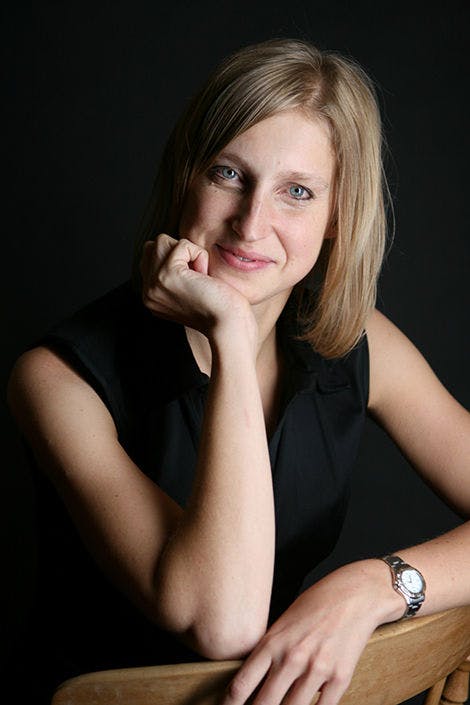
Almost three years ago I constructed, for Wikipedia, a list of all the coats of arms borne by Speakers of the House of Commons. That list covered the lower houses of Great Britain (1707-1800) and the United Kingdom (1801-present). Finding sources for the later incumbents was difficult – quite a few were missing from Burke’s and Debrett’s, so I had to get creative in looking for visual evidence, often relying on photographs from corporate events at Speaker’s House.

A few weeks ago the heraldic artist Baz Manning, whose photographs from Lincoln’s Inn I had already used for a similar page about Lords of Appeal, contacted me to say that he had taken extensive photographs inside the Palace of Westminster of the speakers’ arms, and would be uploading those on Flickr too. Not content with merely documenting those speakers who served since the Acts of Union, he had photographed the shields commemorating just about every speaker since the age of Henry III. It was therefore only natural that I should make a Wikipedia list for them as well.

In addition to these photographs I had written the written source of the 1850 book The Lives of the Speakers of the House of Commons by James Alexander Manning (Related? I’ll have to ask.), which I had already used for the earlier entries in the British list. The relative ease of accessing these compared to what I had before meant the prequel was much more easily accomplished than the original.

That is not to say that there were no difficulties, however – whereas speakers from the Georgian age onward generally served a good number of years in the green chair before ascending to the red bench*, in medieval to Stuart times their tenures were often very brief – indeed, the legislatures themselves were often only in existence for a few weeks. It was also much more common for members to serve non-consecutive terms, which means confusion about how to arrange their entries.

A particularly knotty problem is that many of these men lived and died in an age long before English spelling was nailed down, which means tricky decisions on what to actually call them (e.g. Guildesborough or Goldsborough, Broke or Brooke). Another is that different sources often contradict each other as to what exactly their armorial bearings were, Baz even pointing out quite a few instances where the painted shield on the wall does not conform to the blazon in the grant, or when there are two separate illustrations that are not in agreement.

Still, the page is up, and unlike last time it does not appear that I will be stuck waiting months for review and clearance, so I’m counting this as a success. It remains to be seen if one more armorial page can be squeezed out of this topic. Obviously the old Parliament of Scotland had no elected speaker (being unicameral and chaired by the Lord Chancellor much like the House of Lords), but the House of Commons of Ireland before 1801 had one much like its English counterpart. I will have to see if a similar gallery of painted shields is maintained at College Green, and if any other budding heraldists have been able to photograph it.

*Only five speakers of the English House of Commons ever ascended to the peerage, whereas only ten speakers of the British house have not, and several of them died in office. Quite a lot of English speakers were at least knights or baronets, though that introduces the further difficulty of finding out if each one was knighted before or after their time in office.

Warwick the Kingmaker by John Reid

Today I attended another virtual meeting of the Richard III Society Gloucester Branch. The presentation was by John Reid, discussing the historical reputation of Richard’s father-in-law Richard Neville, 16th Earl of Warwick, popularly nicknamed “The Kingmaker”.

Warwick has been hugely divisive to contemporaries as well as historians, Ricardians, Lancastrians and Yorkists. He was England’s greatest celebrity of the fifteenth century and his fame (or infamy) carried on into the twentieth). He even had a board game named after him.

He became the premier earl in England in 1449 due to lucky deaths. His family were great winners in the lottery of aristocratic marriages – picking up the estates of the Beauchamps and Despensers. His patchwork of armorial quartering reflects the complexity of his family connections. He had initially supported Henry VI, but changed sides in 1452 largely due to his inheritance disputes with the Duke of Somerset.

Henry VI, due in part to inherited mental health troubles, proved spectacularly incompetent, and many considered Richard, Duke of York to be king by right – though Reid showed us York’s signature on the letters patent of 1454 appointing Henry’s son Edward of Lancaster as Prince of Wales, clearly showing that even at this late stage he was not disputing the latter’s right. When eventually he rebelled against the Lancastrian crown he had Warwick’s invaluable support. York’s son Edward, Earl of March rescued Warwick from Margaret of Anjou and Warwick in turn arranged his coronation as Edward IV. For the first three years of Edward’s reign Warwick was thought “third king”, being virtual governor of the realm, acquiring even more land (after he confiscated the estates of the Percy and Clifford families, he wound up with lordships in twenty-eight English counties and a handful in Wales) and an annual income of at least £10,000 (nearly £11m in 2021 money).

Matters of matrimony spoiled his status: Warwick had spent months lobbying for a French princess to marry his king, and was humiliated by the revelation that Edward had already married – in secret – to Elizabeth Woodville, a dowager dame whose family had fought for the Lancastrian side. He described the parvenu Woodvilles as “grasping and charmless”, resenting how many titles, offices and marriages were given to them at the expense of his own dynasty, and how their influence over the crown came to displace his. Reid drew parallels with the modern-day rivalry between Carrie Symonds and Dominic Cummings.

Warwick’s first coup against Edward occurred in the summer of 1469. He launched his second in 1471, making a deal with Margaret of Anjou on 22 July and reinstating Henry VI on 3 October. He was killed at the Battle of Barnet on 14 April 1471. Reid noted that this was the only time he had fought on foot rather than horseback, leaving him with no easy way to escape when the tide turned against him and he was isolated from his allies on the field. This was very similar to the way Richard III would die fourteen years later.

The earl was adept at his own spin so contemporary sources are often too kind to him. Later writers were often too harsh. In particular Burgundian writers made him a bogeyman, believing that his policies would lead to their absorption by France. He had something of a rehabilitation under the Tudors – Henry VII wanted Henry VI to be declared a saint.

In summing up, Reid discussed Warwick’s virtues and vices. He was confident, charismatic, charming, courageous and energetic. He was treated shabbily by Edward IV after 1464. He may have been the model for Sir Lancelot as envisioned by Sir Thomas Mallory. On the other hand he can be seen as seeking power only for himself and being motivated by personal feuds rather than the national interest. His military skill is doubted, as is his necessity in the Yorkist accession. Could Edward IV have made himself king without Warwick’s help? Were the Woodvilles any worse than the Nevilles?

After the presentation itself had concluded and most attendees had logged out, there was a lengthy discussion between one attendee (Sean O’Neill) and the host (Cynthia) over the intricacies of Zoom functions – because various buttons were appearing and disappearing depending on the settings of individual hosts and updates by the company. This led to an explanation of the difficulties of an organisation managing virtual meetings, then one into internet difficulties generally as well as experiences of coronavirus. I mentioned having tested positive in November, and my experience with Hubbnet. I remarked that I would have been truly screwed had the pandemic hit in the period of 2009-13 when my house relied on plugabble WiFi dongles for very limited internet access. The two were surprised to realise that I lived near Hull, the former having once lived in North Ferriby and the latter in Hessle. They started asking me if Kingston Telecoms or Kingston Communications still existed (they do).

A Thistly Issue

I have written before about the intricacies of the Order of the Garter. Although it technically has only one grade (in contrast to the Bath which has three, or the British Empire which has five), there are many finely differentiated categories of membership. It is traditionally said that the order is limited to twenty-four knights companion at a time, but of course the reigning monarch himself is always the sovereign of the order (and all others), so really it was twenty-five. Then the Princes of Wales had automatic membership, so it was twenty-six. On top of that, George III in 1786 created the separate status of “royal knight”, so that his unusually large brood of sons could be installed without crowding out everybody else. In 1813 a further category of “stranger knight” was instituted so as to allow the appointment of supernumerary foreign members.

The position of female members is even more complicated. From the time of Richard II it was common to appoint ladies of the order, though even after many years I am still unsure as to their exact status and function. The last such lady appointed was Margaret Beaufort, Henry VII’s mother, in 1488. After that the installation of women to the order was discontinued completely, and for the next four hundred years the only women to wear the Garter robes were the queens regnant. After Victoria’s passing her son Edward VII, her grandson George V and her great-grandson George VI each installed their consorts as royal ladies by special statute. The Princess Elizabeth was also made a royal lady in 1947 and the stranger category came to include foreign female monarchs. From 1987 the statues were altered to allow non-royal women to be Ladies Companion of the order on the same basis as the non-royal men, the first example being the Duchess of Norfolk in 1990.

Wikipedia’s list of members for the order took pains to colour-code and differentiate between the different categories of membership. Curiously, while the modern ladies from Queen Alexandra onwards were all included, the medieval ladies were omitted. Long ago there had been a separate smaller page listing them, but it had been deleted on the recommendation to merge with the larger list. For unknown reasons that merger was never actually carried out, so that the medieval ladies were simply forgotten.

Yesterday, with the aid of one other editor, I worked to correct that problem. The sixty-four Garter ladies of the fourteenth and fifteenth centuries are now included in the table with their own colour code and numbering. For completeness, I have also added entries for those monarchs who were not already members of the order prior to accession.

Having finished that task, I then wondered if the page for the Order of the Thistle – Scotland’s Garter equivalent – would need a similar refurbishment. The list page I found was of a very different table design to that used for the Garter, or indeed the other chivalric orders, bearing sharp black borders around cells and being organised by century instead of by monarch. It took just over a day to completely convert the content to the more usual format. On the one hand, the Thistle has fewer categories than the Garter – sixteen knights brethren and supernumerary extra knights. On the other, the list did not differentiate one type of member from the other in the way that the Garter’s did, so in many cases guesswork was required and it is likely that the whole numbering system will need to be redone at some point to account for any I’ve missed.

While going through this, I received a notice that I had been granted access to the Wikipedia Library. This was intriguing, for it was an innocuous, easy-to-miss announcement of what turned out to be quite an important perk of being an editor. According to a video I found from last summer, the library has actually been around for about a decade, but until recently there was no systematic effort to advertise it, and so the vast majority of eligible members (including me) had no clue it existed. Having only discovered the resource today I cannot yet report on how useful it will be, but it looks promising so far.

It’s not all good news – for a long time I have been vexed by the positioning of “Sir” and “Dame” in the infoboxes of such subjects as are entitled to them. I prefer them to be in the name field, rather than among the honorific prefixes. Previously this appeared to be the consensus among the editors who frequented the articles of knighted politicians and civil servants, though not necessarily those of actors and musicians, with only a small number of persistent miscreants persisting otherwise. A fortnight ago this was discussed and my contribution was sought. It appeared that my stance was going to win out, but when the matter went to vote my supporters were rarely to be seen. We’re doomed to ugly box-headers for the forseable future, one supposes.

Guts for Garters

For the last few Decembers I have eagerly awaited the release of the new year honours list. Normally they arrive a few days before the actual new year, but this time around they came with barely an hour to spare.

There were, as to be expected, a great many awards given on ministerial advice for those involved in fighting COVID, but at the very top were three new appointments made at Her Majesty’s personal discretion to the Order of the Garter: Camilla, Duchess of Cornwall, her daughter-in-law; Valerie, Baroness Amos, former Lord President of Her Privy Council; and Tony Blair, her former Prime Minister.

While sons (and in modern times also daughters) of the reigning monarch are appointed to the order routinely it is rare for royals by marriage. The only examples in the past two hundred years are of those married to the sovereigns themselves – Albert two months in advance of his wedding, Alexandra, Mary and Elizabeth shortly after their husbands’ accessions. Camilla and the late Prince Philip are the only consorts to receive the garter while their spouses were not yet on the throne. I wonder if she shall use the same stall that he did?

Amos is a former leader of the House of Lords (like Lord Salisbury, and indeed others of that title before him). She also served a brief term as High Commissioner to Australia and an even briefer one as International Development Secretary.

Tony Blair appointed Amos to most of those offices. It used to be the norm for former Prime Ministers to join the order, up to and including John Major in 2005 it became rare to see party politicians appointed. It was long assumed that Blair had declined any honours if indeed he was ever offered them, whether that was due to his personal distaste for them (he portrayed himself as a moderniser rather than a traditionalist, and was often observed to behave more like a US President than a British minister), or potential public backlash over controversies stemming from his premiership. What has persuaded him to accept the award now, fifteen years on, is not yet known.

These are the first appointments to the order since 2019. There were no Garter Day ceremonies in 2020 or 2021 due to the pandemic. This year is set to be Elizabeth II’s Platinum Jubilee, so one presumes that the Firm will be keen to make up for lost time.

Today’s news will have interesting ramifications heraldry-wise: Camilla has of course been openly armigerous since 2005, and Sodacan has already updated his graphic of her arms to include the Garter circlet. Amos has been a peeress all my life, and typically appears early on in the pages of Burke’s and Debrett’s, but has never been shown with any armorial design. She may therefore receive a brand new grant in the coming months. Blair is especially confusing, though he is joining an English order of chivalry, he may be Scottish for heraldic purposes and so it would be Lyon not Garter arranging his grant.

SEE ALSO

Hard to Track Down

Following Gordon Casely’s talk on the subject two months ago, I have pursued the topic further with the creation of another Wikipedia armorial.

As with the Middle-earth one, I notified both the relevant WikiProject groups beforehand. Nobody in the heraldry group responded, as per usual. The UK railways group took a lot more interest, though so far none have directly contributed to the article. One controversy was how to name the article – at present it is called ”Armorial of railways in Great Britain” as I have decided the island of Ireland should be a separate article to reflect its railways having always been a separate administration, though this does leave some ambiguity over how to classify the railway heraldry of the smaller islands. It may expand to ”Armorial of railways in the British Isles” at a later date.

The other controversy, of course, was over what to count as heraldry. As Casely’s lecture pointed out – and as many in the latter talk page reminded me – most railway armory in the UK is entirely bogus in terms of legal authority and trite in terms of artistic merit. This leads to some difficulties in how to cite the various insignia being catalogued, since few will appear in the works of Burke, Debrett or Fox-Davies, though the latter’s Book of Public Arms still proved very useful in blazoning the civic arms which railway emblems so frequently appropriated. Most of the illustrations are not by me, nor by other heraldic artists, but photographs of emblems as they appear on the sides of old locomotives, stock and stations or scans from very old books (William Weaver Tomlinson’s The North Eastern Railway; its rise and development being especially handy). A good handful of the company seals found are easy enough to recognise in terms of blazonry (such as the York, Berwick & Newcastle Railway, which just had the shields of those towns in a triangle formation) but others (such as Hull & Selby) have no armorial pretensions at all and look more suited to the Soviet Union.

The list is still far from complete at present, and it will be difficult by nature to judge when completeness has been achieved, but I hope this has at least got the fire started – and allowed at least one of the Sudrian shields to get a viewing.

In further heraldry news, the Lyon Court recently opened a YouTube channel, and the second uploaded video is of the installation of new heralds at the Court of Session that I covered some time ago.

State Occasions

The York Herald’s Twitter feed recently led me to discover the 1960 short documentary series Look at Life, episode 7 of which is State Occasions. It follows the then-Earl Marshal (Bernard, 16th Duke of Norfolk) around the State Opening of Parliament and the Garter Day procession, as well as giving a tour inside the college of arms.

The narrator gives a concise but comprehensive overview of the college’s work and of heraldry as an artform, with ample footage of officers and artists going about their business as well as detailed closeups of the fruits of their labour.

It’s well worth a look.